
ShieldBreak has reopened a security boundary Microsoft appeared to have closed only weeks earlier.
On August 12, 2026, security researcher Nightmare Eclipse, also known publicly as Chaotic Eclipse and MSNightmare, released a proof of concept called ShieldBreak targeting Microsoft Defender. The researcher describes it as a complete bypass of Microsoft’s fix for CVE-2026-50656, the Defender elevation-of-privilege vulnerability commonly known as RoguePlanet. Independent researchers have since reported successful reproduction on current Windows 11 systems. Microsoft told The Hacker News that it is aware of the report and is investigating its validity and applicability. (GitHub)
That makes ShieldBreak important, but the wording needs precision.
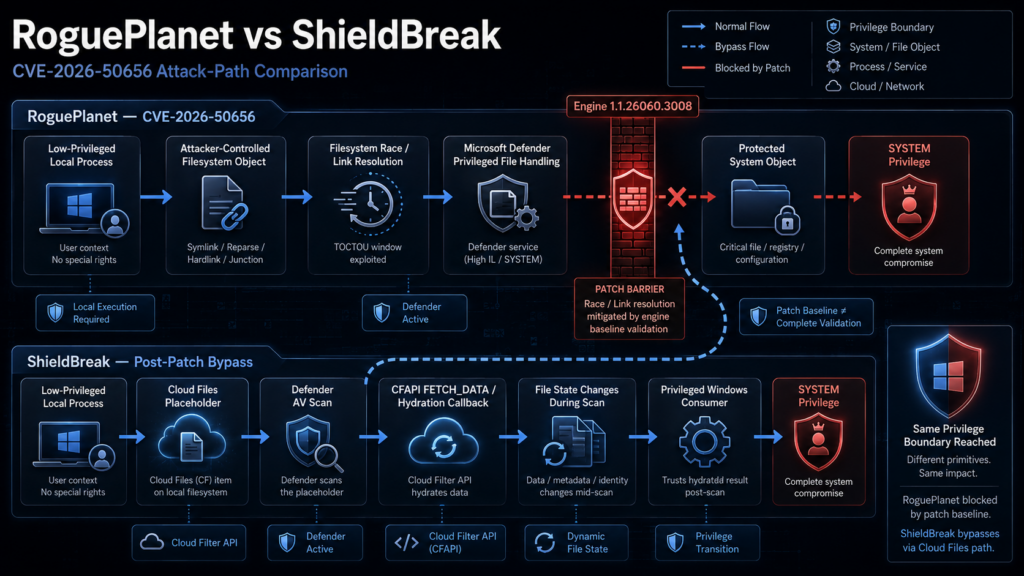
It is tempting to summarize the story as: Microsoft patched RoguePlanet, the exact same vulnerability still works, therefore the patch failed. The public technical evidence points to something more interesting. RoguePlanet and ShieldBreak both turn interactions with Microsoft Defender into a route from a low-privileged Windows user toward SYSTEM, but researchers who examined both exploits say their mechanisms differ substantially. RoguePlanet centers on a filesystem race involving Defender’s privileged file handling. ShieldBreak instead introduces Windows Cloud Files behavior, file hydration, callbacks, and a different privileged consumption path. (해커 뉴스)
For defenders, the distinction does not reduce the urgency. It changes what should be measured.
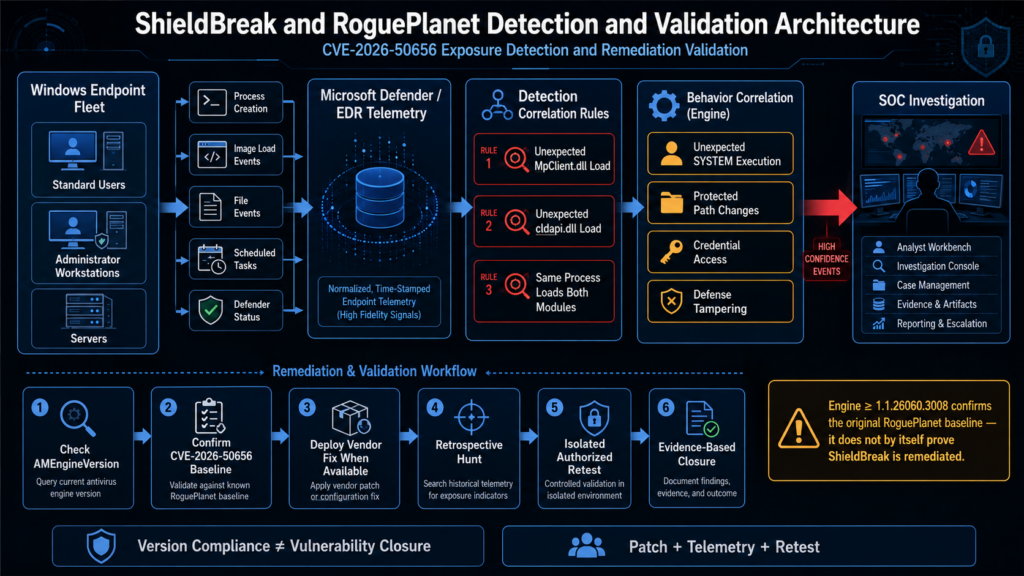
A machine reporting a Defender engine version newer than the original RoguePlanet fix can satisfy the CVE-2026-50656 patch baseline and still require investigation for ShieldBreak. Version compliance is therefore no longer sufficient evidence that the broader attack path has been eliminated.
ShieldBreak at a glance
The most useful starting point is to separate established facts from claims that remain under investigation.
| 질문 | Current public evidence |
|---|---|
| What is ShieldBreak? | A publicly released Microsoft Defender local privilege-escalation proof of concept disclosed on August 12, 2026 |
| What does the researcher claim? | A full bypass of Microsoft’s RoguePlanet CVE-2026-50656 remediation |
| What privilege is required initially? | A low-privileged local execution context is involved; this is not presented as an unauthenticated internet attack |
| What is the intended impact? | Elevation to NT AUTHORITY\SYSTEM |
| Has it been independently reproduced? | Yes. Kevin Beaumont and Will Dormann publicly reported successful validation on Windows 11 |
| Does Defender need to be enabled? | Dormann’s testing indicates active Defender is required for the ShieldBreak path he reproduced |
| Is it technically identical to RoguePlanet? | No. Public analysis indicates materially different exploitation mechanics |
| Is there a dedicated Microsoft ShieldBreak fix? | No dedicated fix had been announced in Microsoft’s public response as of August 13; Microsoft said it was investigating |
| Is CVE-2026-50656 already fixed? | Microsoft’s CVE data identifies Malware Protection Engine versions before 1.1.26060.3008 as affected by the original issue |
| Does 1.1.26060.3008 prove ShieldBreak is fixed? | No. ShieldBreak was disclosed specifically against post-RoguePlanet systems |
| Is widespread active exploitation confirmed? | The public official data examined here does not establish widespread in-the-wild exploitation of ShieldBreak |
Microsoft’s current CVE record, as reflected through NVD, says the original CVE-2026-50656 affected Microsoft Malware Protection Engine versions from 1.1.0.0 up to but excluding 1.1.26060.3008. NVD currently displays a Microsoft CNA CVSS 3.1 score of 7.8 High and an NVD assessment of 7.0 High. The main difference is attack complexity: Microsoft rates it Low, while NVD’s assessment uses High. Both agree on the operationally significant parts of the vector: local attack, low privileges, no user interaction, and high confidentiality, integrity, and availability consequences. (NIST National Vulnerability Database)
The same NVD record is particularly notable because its August 12 change history added the public ShieldBreak repository as a CISA-ADP reference and removed the earlier RoguePlanet repository reference. That administrative change should not be overinterpreted as proof that every ShieldBreak detail has been formally validated by Microsoft, but it shows that the new research has already entered the public CVE ecosystem around CVE-2026-50656. (NIST National Vulnerability Database)
The timeline from RoguePlanet to ShieldBreak
The timing explains why this case matters for vulnerability management.
RoguePlanet emerged publicly in June 2026. Microsoft acknowledged CVE-2026-50656 as an elevation-of-privilege problem in the Microsoft Malware Protection Engine. NVD mapped the weakness to CWE-59, Improper Link Resolution Before File Access, a class of vulnerability in which software can be made to operate on a different filesystem object than the one it intended to use. (NIST National Vulnerability Database)
In early July, the CVE metadata changed. Microsoft’s affected-version information began identifying Malware Protection Engine versions earlier than 1.1.26060.3008 as vulnerable. That gave defenders something they did not have at initial disclosure: a concrete version boundary that could be inventoried across endpoints. (NIST National Vulnerability Database)
Microsoft’s own Defender for Endpoint release documentation now lists later Windows Antivirus builds as well. The July 2026 release line, published August 5, lists Platform 4.18.26070.9 and Engine 1.1.26070.7. In other words, organizations that keep Defender updated may already be well past the version associated with the original RoguePlanet remediation. (Microsoft Learn)
Then ShieldBreak appeared on August 12.
The repository description explicitly calls the new proof of concept a complete CVE-2026-50656 patch bypass. The researcher says it was tested on Windows 11 25H2, including the Canary channel, and Windows Server 2025. The researcher’s stated success rate should be treated as a result from that testing environment, not a guaranteed reliability figure across every enterprise Windows configuration. (GitHub)
Independent reproduction is more meaningful than the author’s own reliability claim. Kevin Beaumont reported that the exploit works on current Windows 11 and published Defender for Endpoint hunting logic. Will Dormann separately validated ShieldBreak and noted an especially important difference from RoguePlanet: in his testing, Defender has to be active for ShieldBreak to achieve the intended escalation. (해커 뉴스)
Microsoft’s response, reported in the August 13 update to The Hacker News, was that the company is aware of the vulnerability report and is investigating the validity and potential applicability of the claims. That is materially different from saying Microsoft has confirmed a new CVE, published a final affected-product matrix, or shipped a new fix. Those conclusions should wait for Microsoft’s technical disposition. (해커 뉴스)
The resulting timeline looks like this:
| Date | Event | Defensive meaning |
|---|---|---|
| June 2026 | RoguePlanet becomes public and CVE-2026-50656 is assigned | Treat Defender as a potential local privilege-escalation boundary |
| June 17 | NVD analyzes the CVE as High severity | Public PoC and technical-impact signals justify hunting |
| July 8 | Microsoft updates the affected range | Engine 1.1.26060.3008 becomes the original remediation baseline |
| August 5 | Microsoft lists Engine 1.1.26070.7 in the current Windows Antivirus release line | Many current systems can be newer than the RoguePlanet fixed baseline |
| August 12 | ShieldBreak is published | Passing the RoguePlanet version check no longer proves the broader path is closed |
| August 12–13 | Independent researchers validate the new exploit behavior | Treat ShieldBreak as a credible defensive concern |
| August 13 | Microsoft says it is investigating | Await a vendor-specific ShieldBreak disposition while hunting immediately |
The central patch-management lesson is simple: the version that closes one CVE can become only the first validation checkpoint when a variant or bypass emerges.
What RoguePlanet actually changed in the risk model
RoguePlanet was dangerous because the vulnerable component was not an ordinary desktop application. It was an antimalware engine operating close to one of the most sensitive Windows trust boundaries.
Microsoft Defender must inspect content that originates from untrusted users, browsers, email clients, archives, synchronization systems, developer tools, network locations, and removable storage. It also needs sufficient authority to quarantine or remediate malicious material. Those requirements create an unavoidable asymmetry: low-trust content is processed by a high-trust security component.
That architecture is necessary. It is also security-sensitive.
A simplified model looks like this:
Untrusted file or low-privileged user
                |
                v
       Defender inspection
                |
                v
Privileged scanning and remediation
                |
                v
     Protected OS resources
The intended boundary says that the low-privileged side may supply data, but it must never gain control over which protected object the privileged side modifies.
File-identity bugs weaken that guarantee.
With CWE-59-style problems, the pathname a privileged service believes it is handling can become disconnected from the underlying object ultimately reached by the filesystem. Symlinks, junctions, reparse mechanisms, mount transitions, races, and other forms of indirection can turn a seemingly ordinary file operation into a security boundary. NVD explicitly associates CVE-2026-50656 with CWE-59. (NIST National Vulnerability Database)
Public analysis of RoguePlanet describes a filesystem race involving virtual disks, NT-native file operations, and Defender’s quarantine or remediation behavior. Beaumont summarized the technique as a way of causing the privileged quarantine process to overwrite an unintended system file. (해커 뉴스)
That matters because a local privilege escalation does not need to be the initial breach to be valuable.
A real intrusion chain often looks more like:
Phishing / malicious download / stolen session
                    |
                    v
        Standard-user code execution
                    |
                    v
        Local privilege escalation
                    |
                    v
           NT AUTHORITY\SYSTEM
                    |
        +-----------+-----------+
        |           |           |
        v           v           v
 Credential     Defense     Persistence
  access        tampering
                    |
                    v
            Lateral movement
ShieldBreak belongs in that middle stage. It does not need to magically compromise a machine from the public internet to be serious. Its role is to turn an existing low-privileged foothold into control over the endpoint.
ShieldBreak is not simply RoguePlanet again
This is where many short vulnerability summaries become misleading.
Calling ShieldBreak a CVE-2026-50656 patch bypass is reasonable because the researcher deliberately developed it as a post-fix path back across the same practical privilege boundary. But available analysis indicates that the new exploit does not merely repeat RoguePlanet’s original filesystem race unchanged.
Kevin Beaumont distinguished the two techniques publicly. His summary characterizes RoguePlanet as a filesystem race involving virtual disks and NT-native file manipulation, while ShieldBreak uses a user-mode callback to alter file content while Defender is performing a cloud-file hydration scan through the Windows Cloud Filter API. (해커 뉴스)
Will Dormann reached a similar conclusion after testing ShieldBreak. He noted that the new chain involved Cloud Files behavior and other components that were not recognizable from the original RoguePlanet technique. He also observed that ShieldBreak depends on Defender being active in his reproduction. (해커 뉴스)
That distinction gives defenders a more useful mental model.
A security patch can fail in several different ways.
The first is an exact bypass. The vulnerable primitive remains fundamentally available and the attacker makes only superficial changes to get around a newly introduced check.
The second is a variant. The original defect is mitigated, but another way to reach the same vulnerable operation remains.
The third is a broader trust-boundary failure. The patch correctly fixes the original implementation error, but the surrounding architecture contains another primitive that lets low-trust state influence a privileged consumer.
Until Microsoft publishes a root-cause analysis for ShieldBreak, it is premature to state definitively which category applies. The public evidence strongly supports one narrower conclusion: fixing the known RoguePlanet technique did not eliminate every practical route demonstrated by the same researcher from low-privileged interaction with Defender to SYSTEM-level execution. (해커 뉴스)
That is enough to justify a new validation cycle.
Why Cloud Filter API changes the technical picture
ShieldBreak brings a Windows subsystem into the discussion that many endpoint-security teams do not normally associate with privilege escalation: the Cloud Files platform.
Windows Cloud Files APIs exist so synchronization providers can represent remotely stored data as local placeholder files and retrieve the actual content when something needs it. Microsoft’s documentation describes callbacks associated with fetching and validating placeholder content, along with operations that transfer data into a placeholder during hydration. (Microsoft Learn)
Conceptually:
Local placeholder
      |
      | application requests data
      v
Cloud Files platform
      |
      | FETCH_DATA
      v
Sync provider callback
      |
      | returns file data
      v
Hydrated local file
This architecture allows a file to have a local filesystem identity before all of its content is physically present.
That distinction becomes important when an antivirus engine enters the flow.
Microsoft’s CFAPI documentation includes a hydration-policy option specifically discussing antivirus filters. The documented policy allows the platform to fully hydrate a placeholder synchronously when an AV filter attempts to scan it. Microsoft also documents safeguards around hydration restart behavior because antivirus scanning and provider-side changes can interact in complex ways. (Microsoft Learn)
None of that means CFAPI is inherently vulnerable. Cloud Files is a legitimate Windows platform used for synchronization workflows.
The security question is narrower:
What assumptions does a privileged scanner make about file identity and file content while that content can be supplied or changed through a callback-driven hydration process?
Suppose a security component makes two assumptions:
- The object it validated is still the object it will later act on.
- The bytes presented during validation remain equivalent to the bytes consumed during the privileged operation.
Any mechanism that allows attacker-controlled state to change between those moments deserves careful treatment.
ShieldBreak appears to exploit precisely this broader class of trust problem, although Microsoft’s own final root-cause description is still pending. Public analysis says a user-mode callback changes file contents during a Defender-triggered cloud hydration scan. (해커 뉴스)
From a defensive engineering standpoint, this is more important than memorizing the exploit’s implementation details.
The ShieldBreak attack path at a safe level of abstraction
The public proof of concept contains enough implementation detail to be weaponized against real Windows hosts. Reproducing that exploit chain is unnecessary for understanding the security boundary, so the useful model for defenders is intentionally higher level.
The sequence is approximately:
Low-privileged local execution
            |
            v
Attacker-controlled file state
            |
            v
Cloud Files placeholder / hydration behavior
            |
            v
Defender accesses and scans the object
            |
            v
Callback-controlled state changes
            |
            v
Privileged Windows workflow consumes
attacker-influenced material
            |
            v
SYSTEM-level execution
Independent analysis has publicly described additional Windows internals used by the proof of concept, but those are implementation details rather than prerequisites for defensive understanding. The key observation is that Defender’s legitimate high-privilege work becomes one stage in the escalation chain. (해커 뉴스)
This also explains why turning Defender off is not a sensible enterprise mitigation.
For RoguePlanet, some public reporting said the original proof of concept could operate regardless of real-time protection state. ShieldBreak behaves differently: Dormann’s reproduction indicates that Defender needs to be enabled because Defender’s scan interaction is part of the trigger. (컴퓨터)
Disabling the antivirus engine to prevent an antivirus-engine exploit would simultaneously remove a major defensive control. That trade is difficult to justify without explicit Microsoft guidance.
The right response is to reduce opportunities for untrusted local execution, monitor the suspicious behaviors surrounding the chain, maintain current Defender updates, and deploy Microsoft’s eventual ShieldBreak remediation when available.
Why local privilege escalation still deserves urgent treatment
“Local” is one of the most commonly misinterpreted words in vulnerability management.
It does not mean harmless.
It means the attacker generally needs some form of execution or access on the endpoint before exploiting the privilege boundary. In modern intrusions, that condition is common enough that security teams should model local privilege escalation as a post-compromise accelerator.
Consider a standard corporate workstation.
A compromised browser process, malicious downloaded application, code executed through a developer dependency, stolen interactive account, abused remote-management tool, or malware running as the logged-in user may all begin with permissions far below SYSTEM.
Those restrictions matter. A standard user cannot automatically manipulate every service, access every credential store, modify every protected system file, or control every endpoint-security setting.
SYSTEM changes the equation.
After successful elevation, the attacker can potentially interact with resources that were unreachable from the initial account. What happens next depends on Windows hardening, Credential Guard, protected-process settings, EDR tamper protection, application control, identity architecture, and other controls. SYSTEM should therefore not be treated as a magic guarantee of domain compromise, but it is an extremely consequential privilege boundary.
CVE-2026-50656’s scoring captures this asymmetry. Both Microsoft and NVD model low privileges as required, but they also assign High impact to confidentiality, integrity, and availability if exploitation succeeds. (NIST National Vulnerability Database)
The correct risk question is therefore not:
Can ShieldBreak attack an arbitrary Windows laptop directly from the internet?
The better question is:
What happens to an intrusion that has already reached a standard Windows user if that foothold can be converted into SYSTEM on a fully updated endpoint?
That is the scenario defenders should prioritize.
The CVSS disagreement is useful rather than confusing
NVD currently displays two CVSS 3.1 assessments for CVE-2026-50656.
Microsoft’s CNA assessment is 7.8 High, using a vector that treats attack complexity as Low. NVD’s assessment is 7.0 High, with attack complexity rated High. Both identify the attack vector as Local, required privileges as Low, user interaction as None, scope as Unchanged, and successful impact to confidentiality, integrity, and availability as High. (NIST National Vulnerability Database)
The disagreement illustrates why a CVSS number should not be the endpoint of prioritization.
RoguePlanet involved race-dependent behavior, and race conditions can vary with system timing, hardware, load, operating-system state, and implementation details. A researcher may demonstrate reliable exploitation in one environment while another environment behaves differently.
But exploit reliability is not binary.
A local attacker with an established foothold can sometimes retry operations. A vulnerability does not become operationally irrelevant merely because exploitation is timing-sensitive.
ShieldBreak further complicates simple scoring because the current public discussion is about a newly demonstrated path after the original CVE remediation. Microsoft’s final classification of that path had not yet been published as of the August 13 response. (해커 뉴스)
Risk teams should therefore track four separate facts:
| 신호 | What it answers |
|---|---|
| CVSS | How severe is the modeled vulnerability under standardized assumptions? |
| Public PoC | Can outside researchers study a concrete exploitation path? |
| Independent reproduction | Has someone other than the original author shown that the path works? |
| Active exploitation | Is there evidence attackers are using the vulnerability against real targets? |
ShieldBreak has strong public evidence for the middle two categories. That is already enough to justify hunting. It is not a reason to invent evidence for the fourth.
Do not confuse proof of concept with confirmed exploitation in the wild
The distinction matters because several fast-moving security stories use “exploited” loosely.
NVD’s CVE-2026-50656 history contains CISA-ADP SSVC enrichment identifying PoC exploitation and a total technical impact. That is different from an “active” exploitation designation. (NIST National Vulnerability Database)
As of the information available for this article, defenders should not state as fact that ShieldBreak is already being deployed broadly by criminal or state-sponsored groups.
There is still a reason to act before such evidence appears.
The proof of concept is public. The researcher repository is accessible. Independent analysts say the technique works. The vulnerable boundary is relevant after initial endpoint compromise. That combination reduces the value of waiting for an incident report before building telemetry.
Security engineering works best when the detection exists before the first known campaign.
Why the original RoguePlanet version check is no longer enough
For CVE-2026-50656 itself, Microsoft’s affected-version metadata is clear: Malware Protection Engine versions below 1.1.26060.3008 are identified as affected. (NIST National Vulnerability Database)
That remains useful information.
Organizations should still find endpoints running older Defender engines and update them. An emerging ShieldBreak issue does not make the original RoguePlanet remediation irrelevant.
The mistake would be converting this rule:
Engine >= 1.1.26060.3008
→ original RoguePlanet remediation baseline satisfied
into this rule:
Engine >= 1.1.26060.3008
→ all RoguePlanet-related privilege escalation paths are impossible
The second statement is no longer defensible.
Microsoft’s own release notes list an even newer Windows Antivirus engine, 1.1.26070.7, released with Platform 4.18.26070.9 on August 5. ShieldBreak was disclosed after that release, and independent researchers reported success on current Windows 11. (Microsoft Learn)
That means patch validation needs another state:
Original CVE baseline satisfied
            +
Current ShieldBreak exposure unresolved
Vulnerability-management systems that support only “vulnerable” and “patched” often struggle with exactly this kind of event.
The better model distinguishes:
- affected version,
- vendor-fixed version,
- bypass reported,
- bypass independently validated,
- vendor investigation,
- new fix available,
- fix deployed,
- fix behaviorally retested.
That model is much closer to how real security engineering works.
Checking Microsoft Defender versions safely
Security teams can inventory Defender status without reproducing ShieldBreak.
On a Windows endpoint, PowerShell’s Defender cmdlets provide a straightforward starting point:
Get-MpComputerStatus |
    Select-Object `
        AMEngineVersion,
        AMProductVersion,
        AntivirusSignatureVersion,
        AntivirusEnabled,
        RealTimeProtectionEnabled
For fleet analysis, collect the same fields through your normal endpoint-management or Defender for Endpoint tooling rather than manually logging in to every machine.
The important distinction is what each value proves.
| 필드 | Why collect it | What it does not prove |
|---|---|---|
AMEngineVersion | Shows Malware Protection Engine build | Does not prove ShieldBreak is remediated |
AMProductVersion | Helps establish platform posture | Does not establish exploit resistance by itself |
AntivirusSignatureVersion | Shows security-intelligence freshness | Signatures are not equivalent to an engine vulnerability fix |
AntivirusEnabled | Establishes Defender state | Being enabled does not imply immunity |
RealTimeProtectionEnabled | Adds runtime context | Should not be treated as a ShieldBreak mitigation switch |
Microsoft documents platform and engine updates separately from security-intelligence updates and recommends keeping the platform and engine current. (Microsoft Learn)
That distinction is particularly important here. A machine can download fresh malware signatures and still run a vulnerable engine or platform build.
A safe PoC for understanding the trust failure
The following demonstration is not a ShieldBreak exploit.
It does not interact with Microsoft Defender, Windows CFAPI, Object Manager links, Cloud Files placeholders, scheduled tasks, privileged DLL loading, or any protected Windows resource. It cannot elevate privileges.
Its only purpose is to demonstrate the abstract security mistake that makes dynamic-content workflows dangerous: a trusted component verifies one state and later consumes a different state.
Consider this isolated Python toy:
class DynamicObject:
    def __init__(self, value):
        self.value = value

    def read(self):
        return self.value

    def hydrate(self, new_value):
        self.value = new_value


def insecure_privileged_workflow(obj):
    checked = obj.read()

    if checked != "BENIGN":
        raise ValueError("Rejected during validation")

    # Simulate an external callback changing the object
    # between validation and privileged consumption.
    obj.hydrate("CHANGED_AFTER_VALIDATION")

    consumed = obj.read()
    return consumed


demo = DynamicObject("BENIGN")

result = insecure_privileged_workflow(demo)

print("Value accepted during validation: BENIGN")
print("Value consumed later:", result)
The output is conceptually:
Value accepted during validation: BENIGN
Value consumed later: CHANGED_AFTER_VALIDATION
The bug is not that the validator failed to inspect the original content.
It did.
The bug is that validation and privileged consumption were not bound to the same immutable state.
A safer model snapshots the data:
def safer_privileged_workflow(obj):
    snapshot = obj.read()

    if snapshot != "BENIGN":
        raise ValueError("Rejected during validation")

    # External state can change, but the privileged action
    # remains bound to the exact validated snapshot.
    obj.hydrate("CHANGED_AFTER_VALIDATION")

    consumed = snapshot
    return consumed
This tiny program captures an important security principle:
Validate object X
        |
        v
Bind privileged action to X
is safer than:
Validate whatever X points to now
        |
   state changes
        |
        v
Use whatever X points to later
Real ShieldBreak mechanics are much more complex, and Microsoft’s final root-cause analysis remains pending. The toy example intentionally omits all Windows exploitation primitives. Its purpose is to explain why deferred hydration, filesystem identity, callbacks, scanning, and privileged operations deserve to be treated as a single trust boundary.
Detecting ShieldBreak without running the exploit
Public defensive work gives security teams a much better option than executing the proof of concept on production systems.
Kevin Beaumont published Microsoft Defender for Endpoint hunting logic specifically for ShieldBreak. The queries focus on unusual combinations involving two Windows components that are central to the public technical analysis: MpClient.dll, associated with Defender client functionality, and cldapi.dll, used by the Windows Cloud Files API. (GitHub)
One hunting principle is to identify unexpected processes loading Defender client code.
A simplified defensive query is:
DeviceImageLoadEvents
| where ActionType == "ImageLoaded"
| where FileName =~ "MpClient.dll"
| where not(
    InitiatingProcessFolderPath startswith @"C:\Program Files\Windows Defender\"
    or InitiatingProcessFolderPath startswith @"C:\ProgramData\Microsoft\Windows Defender\"
    or InitiatingProcessFolderPath startswith @"C:\Windows\System32\"
)
| project
    Timestamp,
    DeviceName,
    InitiatingProcessFileName,
    InitiatingProcessFolderPath,
    InitiatingProcessCommandLine
This is a hunting query, not a signature.
A non-Microsoft process loading MpClient.dll is not automatically malicious. Security-management products, troubleshooting tools, compatibility software, and legitimate enterprise applications can create exceptions.
A second hunting direction is unusual Cloud Files API use:
DeviceImageLoadEvents
| where ActionType == "ImageLoaded"
| where FileName =~ "cldapi.dll"
| where not(
    InitiatingProcessFolderPath startswith @"C:\Windows\System32\"
    or InitiatingProcessFolderPath startswith @"C:\Program Files\"
    or InitiatingProcessFolderPath startswith @"C:\Program Files (x86)\"
)
| project
    Timestamp,
    DeviceName,
    InitiatingProcessFileName,
    InitiatingProcessFolderPath,
    InitiatingProcessCommandLine
Again, cldapi.dll is legitimate. OneDrive-style synchronization systems and other cloud providers rely on Windows cloud-file functionality.
The more interesting signal is co-occurrence.
Beaumont’s published hunting logic includes a correlation looking for one process loading both the Defender client module and Cloud API module within a short interval. (GitHub)
A simplified version is:
let DefenderLoads =
    DeviceImageLoadEvents
    | where FileName =~ "MpClient.dll"
    | project
        DefenderTime = Timestamp,
        DeviceName,
        InitiatingProcessId,
        InitiatingProcessFileName,
        InitiatingProcessFolderPath;

let CloudLoads =
    DeviceImageLoadEvents
    | where FileName =~ "cldapi.dll"
    | project
        CloudTime = Timestamp,
        DeviceName,
        InitiatingProcessId;

DefenderLoads
| join kind=inner CloudLoads
    on DeviceName, InitiatingProcessId
| where abs(datetime_diff("minute", DefenderTime, CloudTime)) < 5
| project
    DeviceName,
    InitiatingProcessFileName,
    InitiatingProcessFolderPath,
    DefenderTime,
    CloudTime,
    InitiatingProcessId
The correlation is stronger than either library load by itself.
It still is not a verdict.
A detection engineer should enrich a hit with:
- signer information,
- process hash,
- file path,
- parent process,
- user identity,
- device role,
- software inventory,
- recent file events,
- cloud-sync configuration,
- Defender alerts,
- scheduled-task activity,
- subsequent elevated process execution.
That gives analysts an evidence chain rather than a fragile indicator.
Why old RoguePlanet detections are not enough
When RoguePlanet first appeared, one of the strongest behavioral ideas was watching for unexpected SYSTEM processes associated with Defender’s high-privilege execution context.
That remains useful.
It is also exactly the kind of rule that can fail when a bypass changes the final execution chain.
Security detections tied too closely to one exploit demonstration often look like this:
Exploit sample
   |
   v
Specific child process
   |
   v
Detection
When the attacker changes the intermediate Windows component, the rule loses coverage even though the security outcome is the same.
Better detections model the invariant:
Low-trust process
      |
      +--> unusual Defender client interaction
      |
      +--> unusual Cloud Files interaction
      |
      +--> dynamic file state
      |
      +--> privileged Windows execution
      |
      v
Unexpected SYSTEM activity
ShieldBreak is a reminder that behavioral invariants usually age better than exploit-specific filenames.
That does not mean IOC matching is useless. Hashes, paths, filenames, and known proof-of-concept artifacts are excellent for finding unsophisticated reproduction attempts.
They should sit underneath broader behavioral hunting, not replace it.
Building a practical ShieldBreak investigation query
A SOC investigation can begin with the DLL-load correlation and then pivot into process telemetry.
예를 들어
let SuspiciousModules =
    DeviceImageLoadEvents
    | where FileName in~ ("MpClient.dll", "cldapi.dll")
    | summarize
        Modules = make_set(FileName),
        FirstSeen = min(Timestamp),
        LastSeen = max(Timestamp)
      by
        DeviceId,
        DeviceName,
        InitiatingProcessId,
        InitiatingProcessFileName,
        InitiatingProcessFolderPath
    | where array_length(Modules) == 2;

SuspiciousModules
| join kind=leftouter (
    DeviceProcessEvents
    | project
        DeviceId,
        ProcessId,
        ProcessCreationTime = Timestamp,
        FileName,
        ProcessCommandLine,
        AccountName,
        ProcessIntegrityLevel
) on DeviceId
| where ProcessCreationTime between
    (FirstSeen - 5m .. LastSeen + 15m)
| order by DeviceName asc, ProcessCreationTime asc
This does not prove ShieldBreak exploitation.
It answers a useful hunting question:
What processes executed around the time an unusual process interacted with both Defender client functionality and the Windows Cloud Files API?
Analysts can then determine whether the process belongs to a known synchronization client, management application, security product, developer tool, or something unexplained.
The public hunting repository itself warns implicitly against one-line thinking by providing multiple behavioral detections rather than one exploit hash. (GitHub)
False positives matter
Cloud Files functionality is widely useful.
A synchronizer loading cldapi.dll is expected. A Microsoft component interacting with Defender client libraries can be expected. Enterprise endpoint-management products may also have behavior that looks unusual compared with a clean consumer Windows installation.
That means a ShieldBreak detection should not immediately isolate every endpoint that loads one of these DLLs.
A useful prioritization model is:
| Observation | 우선순위 |
|---|---|
Known signed cloud-sync application loads cldapi.dll | Low by itself |
Normal Defender component loads MpClient.dll | 낮음 |
Unknown user-writable executable loads cldapi.dll | Medium |
Unknown user-writable executable loads MpClient.dll | Medium to high |
| Same unexpected process loads both modules | High-interest hunt |
| Same activity followed by unexplained privileged execution | 높음 |
| Same activity plus suspicious protected-path file modification | 매우 높음 |
| Same activity plus credential theft or defense tampering | Treat as probable compromise |
Detection engineering should preserve that context.
High-sensitivity rules are useful during an emerging zero-day window, but a SOC that floods itself with every normal cloud synchronization process will stop seeing the interesting hosts.
What defenders should do before Microsoft ships a ShieldBreak-specific fix
The absence of a dedicated fix does not mean the only available action is waiting.
The objective is to interrupt the attack chain around the unresolved vulnerability.
Keep Microsoft Defender fully updated
Do not roll back the RoguePlanet fix because ShieldBreak exists.
The original affected-version boundary still matters. Microsoft’s Defender documentation lists newer engine and platform releases and recommends maintaining supported platform and engine versions. (Microsoft Learn)
Inventory systems below 1.1.26060.3008 and remediate them.
Then separately flag current systems as requiring ShieldBreak monitoring until Microsoft publishes a conclusive update.
Reduce arbitrary local code execution
ShieldBreak is valuable after an attacker can execute code locally.
Application control therefore changes exploitability even when it does not repair the underlying Defender bug.
Organizations using Windows Defender Application Control, AppLocker, EDR application controls, software allowlisting, managed software distribution, or equivalent execution policy should review whether ordinary users can run arbitrary binaries from downloads, temporary directories, archives, cloud-synchronized directories, developer workspaces, and other user-writable locations.
Perfect prevention is unrealistic. The goal is to shrink the number of ways an attacker can reach the privilege-escalation stage.
Prioritize privileged workstations
Not every workstation has the same consequence if SYSTEM is obtained.
Endpoints used by:
- domain administrators,
- identity engineers,
- cloud administrators,
- security administrators,
- build engineers,
- source-code maintainers,
- certificate administrators,
- endpoint-management operators
deserve more aggressive restrictions.
A SYSTEM compromise on a generic kiosk is serious. A SYSTEM compromise on a machine where high-value administrative credentials appear can become an identity-security event.
Hunt now rather than waiting for signatures
Deploy or test ShieldBreak-specific hunting logic.
At minimum, establish visibility into:
- unusual
MpClient.dllloads, - unusual
cldapi.dllloads, - processes interacting with both modules,
- unexpected user-writable binaries participating in those events,
- unusual elevated process creation following those events.
Beaumont’s public hunting work provides a defensible starting point. (GitHub)
Preserve telemetry
Emerging local privilege-escalation investigations often fail because the relevant telemetry has already rolled off.
Retain enough endpoint process, image-load, file, scheduled-task, identity, and Defender telemetry to reconstruct the period between initial low-privileged execution and suspected SYSTEM activity.
If a Microsoft fix arrives tomorrow, that will protect tomorrow’s exploitation path. It will not tell you whether a host was compromised yesterday.
Do not disable Defender as a blanket workaround
ShieldBreak’s dependence on active Defender in independent testing creates an obvious temptation.
It is still a dangerous trade.
Microsoft has not published a general recommendation telling organizations to disable Defender to mitigate ShieldBreak. Turning off antivirus and endpoint protection can remove detection and prevention against a much larger population of threats.
Unless Microsoft provides explicit mitigation guidance changing that calculation, keep protection active and layer monitoring around the suspected path.
Patch status should be treated as four different states
Many organizations still treat vulnerability remediation as:
unpatched -> patched
ShieldBreak demonstrates why that is inadequate.
A better model is:
1. Version remediated
2. Exploit path behaviorally mitigated
3. No evidence of prior compromise
4. Fix independently revalidated
Those states answer different questions.
Version remediated asks whether the endpoint has Microsoft’s stated fixed build.
Behaviorally mitigated asks whether surrounding controls make exploitation harder or detectable.
No evidence of prior compromise asks whether the machine remained trustworthy during the exposure window.
Independently revalidated asks whether the security boundary actually behaves as expected after remediation.
RoguePlanet initially appeared to move endpoints from state one into a satisfactory patched position. ShieldBreak now challenges the assumption that state one alone proves the broader privilege boundary is safe.
This principle applies well beyond Defender.
VPN appliances, browsers, identity providers, endpoint agents, file parsers, cloud gateways, and security products regularly receive partial mitigations, variant fixes, or follow-on disclosures.
A patch number is evidence.
It is not always the final proof.
Related Defender CVEs show why the attack surface deserves attention
ShieldBreak did not emerge in a vacuum.
Other 2026 Microsoft Defender vulnerabilities demonstrate different ways that a privileged security engine can become part of an attack surface.
CVE-2026-41091
CVE-2026-41091 is especially relevant because NVD describes it as another Microsoft Defender local privilege-escalation vulnerability caused by improper link resolution before file access. Microsoft fixed the issue in Malware Protection Engine 1.1.26040.8. (NIST National Vulnerability Database)
More importantly, CISA added CVE-2026-41091 to its Known Exploited Vulnerabilities catalog in May 2026. (CISA)
That does not prove ShieldBreak is being exploited.
It does establish something useful for prioritization: Defender link-following vulnerabilities are not purely theoretical as a class. A closely related Defender weakness has already met CISA’s evidence threshold for known exploitation.
CVE-2026-45498
CVE-2026-45498 is a Microsoft Defender denial-of-service vulnerability affecting the antimalware platform. It is also in CISA’s KEV catalog. NVD records the affected platform range as versions before 4.18.26040.7 and identifies uncontrolled resource consumption as the associated weakness. (NIST National Vulnerability Database)
The exploitation outcome is different from ShieldBreak, but the architectural lesson is similar. Security software is not outside the attack surface merely because its job is to defend the machine.
CVE-2026-45584
CVE-2026-45584 goes further. NVD describes it as a heap-based buffer overflow in Microsoft Defender that can allow an unauthorized attacker to execute code over a network. Microsoft’s Defender release documentation lists Engine 1.1.26040.8 as addressing the issue. (NIST National Vulnerability Database)
Together, these vulnerabilities show several distinct risk families:
| 취약성 | 클래스 | 실습 레슨 |
|---|---|---|
| CVE-2026-41091 | Link following, local EoP | Privileged file identity must remain trustworthy |
| CVE-2026-45498 | 리소스 고갈, DoS | Security engines can be attacked for availability |
| CVE-2026-45584 | Heap overflow, RCE | Scanning untrusted data can expose parser-level code execution |
| CVE-2026-50656 | RoguePlanet local EoP | Defender remediation behavior can become a privilege primitive |
| ShieldBreak | Reported post-fix Defender EoP path | Patch validation must include variants and behavior |
The lesson is not that Defender is uniquely unsafe.
The same structural problem exists in many endpoint-security products: they consume hostile input automatically and operate with privileges intentionally unavailable to normal applications.
That architecture requires exceptionally careful treatment of parsing, paths, callbacks, file identity, race conditions, remediation operations, and privileged consumers.
CVE-2026-41091 is an important warning against complacency
The KEV status of CVE-2026-41091 deserves one more distinction.
Organizations sometimes respond to a new proof of concept with:
There is no confirmed exploitation yet, so we will wait.
That can be a rational response to a low-impact vulnerability with high prerequisites and no public exploit.
It is much weaker here.
CISA’s May 20 alert added both CVE-2026-41091 and CVE-2026-45498 to KEV based on evidence of active exploitation. (CISA)
Again, those are different vulnerabilities. ShieldBreak should not inherit their exploitation status.
But they tell defenders that adversaries already have demonstrated interest in Defender itself as an attack surface.
When another publicly working Defender privilege-escalation path appears two months later, waiting for a campaign report before enabling telemetry is difficult to justify.
What a real ShieldBreak incident investigation should look like
If a hunting rule produces a credible hit, avoid narrowing immediately to “Was this the public PoC?”
Start with the security outcome.
Establish the initial execution context
Determine:
- Which user was logged in?
- What process first introduced the suspicious behavior?
- Was the binary downloaded?
- Was it launched from a temporary or user-writable directory?
- Was it signed?
- Was the signer trusted?
- Did the process originate from a browser, archive, email client, package manager, developer tool, remote-management system, or cloud-sync directory?
The purpose is to understand whether a low-privileged foothold already existed.
Establish Defender state
Record:
Get-MpComputerStatus |
    Select-Object *
Preserve the relevant fields rather than relying on a screenshot.
At minimum, record engine, platform, signatures, Defender enablement, and real-time protection state.
Build the module timeline
Identify whether the suspicious process loaded:
MpClient.dll
cldapi.dll
Then determine whether the process was a legitimate cloud provider, Windows component, security tool, enterprise management agent, or unexplained executable.
Review privileged execution
Look for unexplained high-integrity or SYSTEM-level activity after the suspicious module interaction.
Do not limit the search to cmd.exe.
A modern privilege-escalation chain may execute through legitimate Windows components rather than immediately opening a visible command shell.
검토:
- process creation,
- integrity level changes,
- service activity,
- scheduled tasks,
- unexpected child processes,
- protected-directory file modifications,
- security-product state changes.
Check for post-exploitation behavior
SYSTEM is usually a means, not the final objective.
Hunt for:
- credential access,
- LSASS interaction,
- token manipulation,
- service creation,
- persistence,
- new scheduled tasks,
- local account modification,
- registry persistence,
- EDR or antivirus tampering,
- unusual outbound authentication,
- remote service access,
- lateral movement.
Preserve evidence before remediation
If compromise is plausible, collect the evidence necessary to reconstruct the timeline before cleaning the host.
A vulnerability fix can remove the exploitable condition while leaving the attacker’s persistence untouched.
That distinction is fundamental:
Patch status answers:
"Can this happen again through the same flaw?"

Incident response answers:
"Did it already happen, and what changed afterward?"
You need both.
A practical triage matrix
| Finding | Interpretation | Recommended response |
|---|---|---|
| Old Defender engine below RoguePlanet baseline | Confirmed patch gap | Update immediately and hunt exposure window |
| Current engine, no suspicious behavior | RoguePlanet baseline satisfied, ShieldBreak still under investigation | Keep updated and deploy hunting |
Current engine plus unusual cldapi.dll 사용 | Interesting but ambiguous | Validate application identity |
Unexpected process loads MpClient.dll | Suspicious Defender interaction | Investigate process provenance |
| Unexpected process loads both modules | Stronger ShieldBreak-like behavioral signal | Escalate endpoint review |
| Correlated SYSTEM activity follows | Potential privilege escalation | Treat as incident until explained |
| Credential theft or defense tampering follows | Post-exploitation evidence | Isolate and execute incident-response plan |
The table intentionally avoids treating any single DLL as an IOC.
Context is the difference between useful threat hunting and noisy alerting.
Why security products need hostile-input design assumptions
ShieldBreak also carries an engineering lesson for security software developers.
An antivirus engine lives in an unusually adversarial environment.
Normal applications often receive input because a user deliberately opens something.
Security engines may receive input precisely because that input is suspicious.
That means the scanner should assume adversaries will deliberately manipulate:
- parser state,
- filesystem metadata,
- links,
- mount points,
- placeholders,
- sparse ranges,
- archive structures,
- cloud synchronization behavior,
- alternate streams,
- access timing,
- callbacks,
- remediation paths.
A useful architectural principle is:
The object inspected must remain cryptographically, structurally, or handle-wise bound to the object acted upon.
Pathnames alone are often weaker security identities than they appear.
If privileged software checks a path, releases state, and later reopens the path, the filesystem namespace may have changed in between.
If a file’s content is dynamic because a synchronization provider can hydrate it later, validation must account for that dynamic behavior.
If a scanner requests data and later takes a privileged action based on the earlier observation, the system must know whether the bytes and identity are still the same.
That is why race conditions, link-following bugs, callback ordering, and hydration logic repeatedly become security boundaries.
A toy design pattern for safer privileged file processing
Consider a generic privileged service processing untrusted files.
An unsafe conceptual pattern is:
Receive pathname
     |
Validate pathname
     |
Close / release state
     |
Open pathname again
     |
Perform privileged operation
The attacker can attempt to modify what the pathname resolves to between validation and use.
A stronger pattern is closer to:
Open object securely
       |
Resolve and validate final identity
       |
Keep trusted handle / immutable representation
       |
Validate content associated with that identity
       |
Perform privileged operation on same identity
For dynamic or cloud-backed content:
Hydrate
   |
Establish stable object state
   |
Validate exact state
   |
Bind authorization decision
to exact validated state
   |
Privileged action
The details differ across Windows APIs, but the security principle is portable.
Do not let a low-trust actor change the meaning of an already-authorized privileged operation.
ShieldBreak also exposes a weakness in vulnerability dashboards
Imagine an enterprise dashboard on August 11:
CVE-2026-50656
Fixed version: 1.1.26060.3008
Fleet compliant: 99.8%
Status: Remediated
Then ShieldBreak appears.
The dashboard still says green.
Operationally, the question has changed.
A more mature system should be able to attach new intelligence to an already-closed issue:
CVE-2026-50656
Original fix: deployed
New bypass report: credible
Independent reproduction: yes
Vendor disposition: investigating
Detection coverage: partial
Retest status: required
Overall status: reopened
That is a much better representation of security reality.
Automated security validation is useful in exactly this stage when it is used to gather evidence rather than blindly execute public exploit code. A workflow can inventory Defender versions, confirm control states, run defensive hunts, collect suspicious endpoint evidence, and schedule isolated post-fix retesting. The existing Penligent RoguePlanet analysis documents the original CVE-2026-50656 boundary and defensive validation model; a platform such as 펜리전트 can be used in authorized workflows to organize repeatable validation and evidence collection, but a live production endpoint is not an appropriate place to blindly replay a newly released SYSTEM-level exploit.
The important artifact is not “the scanner says fixed.”
It is evidence:
version
+
configuration
+
telemetry
+
detection coverage
+
isolated retest
=
defensible remediation conclusion
What security teams should do in the first 24 hours
The initial response does not need to be complicated.
First, identify where Microsoft Defender is active and collect engine/platform versions.
Second, confirm that no endpoint remains below the original CVE-2026-50656 fixed engine baseline.
Third, deploy or test hunting logic around unexpected MpClient.dll 그리고 cldapi.dll use.
Fourth, prioritize privileged workstations and security-sensitive servers for manual review.
Fifth, brief incident-response teams that a current Defender version does not, by itself, rule out a ShieldBreak-like path.
Sixth, preserve endpoint telemetry.
The objective is visibility.
You do not need to run the exploit to know whether your fleet can detect the behaviors researchers have already identified.
What to do over the next 72 hours
Once the initial inventory is complete, improve the quality of the controls.
Build an allowlist of legitimate Cloud Files users in your environment.
That might include known enterprise synchronization applications and managed software.
Do the same for expected MpClient.dll interactions.
Then make the suspicious condition narrower:
untrusted executable
+
Defender client interaction
+
Cloud Files API interaction
+
unexpected privileged activity
Review application-control coverage, particularly on endpoints where administrative identities are used.
Look for common execution paths where users can easily introduce unsigned or unapproved binaries.
Confirm that endpoint telemetry retention is long enough for retrospective hunting.
Finally, define the evidence required to close the incident when Microsoft ships its next update.
Do not improvise closure criteria after deployment.
What to do when Microsoft releases a fix
When a dedicated remediation becomes available, do not stop after patch deployment reaches 100%.
Use a four-step closure sequence.
Verify the vendor baseline
Record the exact engine, platform, or Windows version Microsoft identifies as addressing ShieldBreak.
Do not assume the next signature update is the fix.
Verify deployment
Confirm the fixed build is actually running.
Machines that are offline, partially managed, stuck in update rings, reboot-pending, or misconfigured routinely create gaps between “update approved” and “update active.”
Retrospectively hunt
Search the exposure window for ShieldBreak-like behavior.
The fix cannot retroactively remove an attacker who already escalated privileges.
Revalidate behavior
In an isolated lab that your organization owns and is authorized to test, confirm the security boundary no longer behaves in the vulnerable manner.
A safe validation process does not require publishing exploit automation or running it indiscriminately across production.
The desired evidence is simple:
Before fix:
known vulnerable behavior demonstrable in isolated test

After fix:
same authorized validation path no longer reaches privilege boundary
That is stronger than a screenshot showing a patch installed.
ShieldBreak versus RoguePlanet
The differences are important enough to summarize directly.
| Property | RoguePlanet | ShieldBreak |
|---|---|---|
| Public timing | June 2026 | August 12, 2026 |
| Relationship | CVE-2026-50656 original disclosure | Researcher-described bypass of RoguePlanet fix |
| Primary public technical characterization | Filesystem race and privileged Defender remediation behavior | Cloud Files hydration and user-mode callback interaction with Defender |
| Cloud Filter API central to public analysis | 아니요 | 예 |
| Defender active requirement | Public reporting on RoguePlanet differed from ShieldBreak | Independent ShieldBreak testing says Defender must be enabled |
| Original fixed baseline | Engine 1.1.26060.3008 or later | No dedicated Microsoft baseline announced in the August 13 public response |
| Privilege outcome | SYSTEM-level execution under successful conditions | SYSTEM-level execution in public demonstrations |
| Remote unauthenticated attack | 아니요 | No evidence supporting that characterization |
| Current public status | Microsoft CVE with fixed affected-version range | Microsoft investigating new claims |
문구 Microsoft Defender patch bypass is therefore useful as an operational description.
It should not erase the technical differences.
Why “fully patched” needs qualification
Security articles frequently use “fully patched” as though it were a permanent state.
It is not.
A machine is fully patched only relative to:
- a particular point in time,
- a particular vendor release channel,
- a particular set of known vulnerabilities,
- the patches available at that time.
A Windows 11 machine could have been fully patched for CVE-2026-50656 on August 11 and become exposed to a newly disclosed ShieldBreak path on August 12 without losing a single update.
Nothing about the machine changed.
Knowledge changed.
That is one reason continuous vulnerability intelligence matters.
Patch compliance measures whether you deployed the vendor’s current remediation.
Security assurance asks whether the security property you care about still holds.
Those are related, but not identical.
What the Defender release numbers actually tell you
Microsoft Defender consists of multiple updateable elements.
Microsoft’s documentation separates the antimalware platform, engine및 security intelligence. The Windows Antivirus July 2026 release listed Platform 4.18.26070.9, Engine 1.1.26070.7, and Security Intelligence 1.457.11.0. (Microsoft Learn)
This matters during vulnerability response because teams sometimes record only signature currency.
A useful fleet record looks like:
Host
Windows build
Defender platform
Defender engine
Security intelligence
Antivirus state
Real-time protection
EDR onboarding state
Application-control state
If the vulnerability is in the engine, a fresh signature number alone does not answer the patch question.
Likewise, if a future ShieldBreak remediation lands in the platform rather than the engine, checking only AMEngineVersion could miss the relevant control.
Wait for Microsoft’s final fix documentation and validate the component Microsoft actually changes.
Avoid unsupported claims about affected Windows versions
The public ShieldBreak repository says the proof of concept was tested on Windows 11 25H2, Canary builds, and Windows Server 2025. The researcher also states that Windows 10 and corresponding server editions are vulnerable even though the published PoC does not currently support all of them. (GitHub)
Those statements should not be converted into a Microsoft-confirmed affected-product table.
The stronger independent evidence is narrower: researchers have publicly reported successful reproduction on current Windows 11, and Microsoft is investigating broader applicability. (해커 뉴스)
Until Microsoft publishes an authoritative matrix, enterprise communications should distinguish:
confirmed by Microsoft
verified by independent researchers
claimed by original researcher
not yet determined
That avoids two equally bad errors.
The first is dismissing the issue because Microsoft has not completed its investigation.
The second is declaring every supported Windows edition definitively exploitable without vendor or independent confirmation.
Should organizations remove Cloud Files providers?
Not based on the public evidence alone.
ShieldBreak’s use of CFAPI does not mean OneDrive, enterprise synchronization, or Cloud Files itself is generally unsafe.
CFAPI is a legitimate Windows platform. Microsoft’s official documentation explicitly supports placeholder hydration and callbacks as part of cloud-file synchronization. (Microsoft Learn)
The security concern is how the exploit composes that functionality with Defender and another privileged Windows workflow.
Removing legitimate synchronization infrastructure across an enterprise could create operational damage without guaranteeing that the underlying vulnerable trust relationship has been eliminated.
A better temporary response is:
- inventory cloud-sync providers,
- know which executables legitimately use CFAPI,
- flag unusual users of
cldapi.dll, - correlate Cloud Files behavior with Defender client interaction,
- prioritize unexplained combinations.
This preserves business functionality while improving detection.
Should organizations disable Defender?
Again, not as a general response.
Independent ShieldBreak testing indicates active Defender is part of the exploitation path, which makes “turn Defender off” superficially attractive. (컴퓨터)
But the endpoint then loses or degrades a primary security control against malware, malicious scripts, unwanted software, and other threats.
Microsoft has not, in the public ShieldBreak response cited here, instructed customers to disable Defender. Instead, the company says it is investigating the vulnerability report. (해커 뉴스)
Organizations should therefore avoid inventing a mitigation that may create a larger exposure than the vulnerability it is intended to address.
Keep Defender and its engine/platform current, improve application control, increase hunting, and follow Microsoft guidance when a dedicated remediation becomes available.
The most important detection question is not “Do I have this filename?”
Proof-of-concept filenames are easy to change.
A public attacker can rename an executable in seconds.
Hashes change after recompilation.
Paths change.
Even specific child processes can change if the final privilege-execution route changes.
The more durable question is:
Is an unexpected low-trust process orchestrating security-sensitive APIs and then causing an unexpected high-privilege outcome?
For ShieldBreak, current public detection work suggests focusing heavily on the intersection of Defender client and Cloud Files functionality. (GitHub)
That creates a useful abstraction:
Low-trust process
      |
      +--> Defender API
      |
      +--> Cloud Files API
      |
      +--> unusual file-state manipulation
      |
      +--> privileged Windows behavior
      |
      v
Investigation
That pattern can survive minor implementation changes better than a hash list.
An incident should not be closed just because the exploit file is gone
Suppose an analyst identifies a suspicious ShieldBreak-like executable and deletes it.
That removes one artifact.
It does not answer:
- Did privilege escalation succeed?
- What executed as SYSTEM?
- Were credentials accessed?
- Was persistence installed?
- Were security controls changed?
- Were other devices accessed?
- Was the binary copied elsewhere?
- Was a remote operator involved?
- Is the original initial-access mechanism still present?
A mature incident response moves in the opposite direction:
Preserve
   |
Timeline
   |
Determine privilege transition
   |
Determine post-exploitation
   |
Contain
   |
Eradicate
   |
Patch
   |
Retest
The vulnerability is only one piece of the incident.
A stronger long-term Defender hardening model
Even after ShieldBreak is fixed, several controls remain useful because they reduce the consequences of future local privilege escalations.
Application control
Preventing arbitrary unsigned or unapproved binaries from executing as normal users removes a large class of post-phishing and post-download attack opportunities.
Credential isolation
Credential Guard, protected authentication workflows, strong admin tiering, and reduced reuse of privileged credentials limit what an attacker can obtain even after local escalation.
Privileged access workstations
Administrative identities should not share the same endpoint risk model as ordinary productivity users.
Endpoint telemetry
Module loads, process creation, filesystem changes, service activity, scheduled tasks, and identity events provide the context required to distinguish a vulnerability test from a real compromise.
최소 권한
Removing unnecessary local administrator access does not itself stop a low-user-to-SYSTEM vulnerability, but it shrinks the number of ways an attacker can reach adjacent privileged operations and limits other escalation routes.
Continuous patch validation
Endpoint security components should be included in the same remediation-verification discipline applied to browsers, VPNs, hypervisors, identity systems, and internet-facing appliances.
Security software is software.
It deserves the same assumptions about bugs, regression, variants, and bypasses.
The broader lesson from CVE-2026-50656 and ShieldBreak
RoguePlanet and ShieldBreak illustrate an uncomfortable property of defensive software.
The stronger a security product’s privileges, the more carefully its interaction with untrusted state must be designed.
Defender has to inspect objects ordinary applications may not trust.
It has to inspect them automatically.
It has to interact with Windows filesystem and remediation machinery.
It has to operate with enough privilege to enforce security decisions.
Those are exactly the capabilities an attacker wants to redirect.
The desired design boundary is:
Attacker controls data
Attacker does NOT control privileged meaning
Bugs appear when that becomes:
Attacker controls data
+
Attacker influences object identity,
timing, callback state, or destination
=
Privileged action becomes attacker-directed
RoguePlanet demonstrated one expression of that failure.
ShieldBreak appears to demonstrate another.
자주 묻는 질문
What is ShieldBreak?
- ShieldBreak is a publicly released Microsoft Defender local privilege-escalation proof of concept disclosed on August 12, 2026. The researcher describes it as a bypass of Microsoft’s remediation for CVE-2026-50656 RoguePlanet. (GitHub)
- Independent researchers including Kevin Beaumont and Will Dormann have publicly reported successful reproduction on current Windows 11 systems. (해커 뉴스)
- The intended security outcome is elevation from a low-privileged execution context toward NT AUTHORITY\SYSTEM.
- Microsoft said on August 13 that it is investigating the validity and applicability of the report. (해커 뉴스)
Is ShieldBreak the same vulnerability as CVE-2026-50656 RoguePlanet?
- Operationally, ShieldBreak is presented as a CVE-2026-50656 patch bypass, but the public technical mechanisms differ.
- RoguePlanet has been characterized as a filesystem race involving virtual disks, native file handling, and Defender’s privileged remediation behavior.
- ShieldBreak instead involves Cloud Files hydration and callback-driven content changes during Defender interaction. (해커 뉴스)
- Microsoft’s final determination of whether ShieldBreak is the same root vulnerability, a variant, or a separate flaw was not yet public in the August 13 response.
Does Defender Engine 1.1.26060.3008 fix ShieldBreak?
- It is the fixed baseline Microsoft records for the original CVE-2026-50656 affected range, not proof that ShieldBreak is fixed. (NIST National Vulnerability Database)
- Microsoft identifies Malware Protection Engine versions below 1.1.26060.3008 as affected by CVE-2026-50656.
- Microsoft has subsequently released newer engines, including 1.1.26070.7. (Microsoft Learn)
- ShieldBreak was disclosed against post-RoguePlanet systems, so passing the original engine-version check should not be treated as complete ShieldBreak remediation evidence.
Can ShieldBreak be exploited remotely over the internet?
- The currently documented ShieldBreak scenario is a local privilege escalation, not a general unauthenticated remote exploit.
- An attacker needs an existing execution context on the endpoint before the privilege-escalation stage becomes relevant.
- That initial foothold could come from another vulnerability, malware, a malicious download, stolen credentials, remote-management abuse, or another intrusion mechanism.
- The practical danger is converting that foothold into SYSTEM.
Does disabling Microsoft Defender stop ShieldBreak?
- Independent testing indicates ShieldBreak relies on Defender being active, unlike some reporting around the original RoguePlanet path. (컴퓨터)
- That does not make disabling Defender a recommended enterprise mitigation.
- Turning off endpoint protection removes defensive capability against many other threats.
- Microsoft had not publicly advised disabling Defender in its August 13 response; the company said it was investigating. (해커 뉴스)
- Keep Defender current and use behavioral hunting and application control while awaiting vendor guidance.
Is ShieldBreak being exploited in the wild?
- Public proof of concept and independent reproduction are confirmed; widespread active exploitation is not established by the official evidence cited here.
- NVD’s CVE-2026-50656 record contains CISA-ADP SSVC information describing PoC exploitation rather than an active-exploitation designation. (NIST National Vulnerability Database)
- Do not convert PoC availability into an unsupported claim that ransomware or state-sponsored actors are already using ShieldBreak.
- Public working code is still enough reason to deploy detection before such activity is observed.
How can security teams detect ShieldBreak?
- Hunt for unexpected processes loading
MpClient.dll. Kevin Beaumont’s public Defender for Endpoint hunting rules use this as one signal. (GitHub) - Hunt for unusual programs loading
cldapi.dll, particularly from user-writable or otherwise unexpected locations. - Give higher priority to processes that interact with both Defender client functionality and the Cloud Files API in a short time window.
- Correlate those events with unexpected SYSTEM processes, protected-directory modifications, scheduled-task activity, credential access, and defense tampering.
- Treat individual DLL loads as hunting signals rather than definitive indicators of compromise.
What should organizations do while Microsoft investigates ShieldBreak?
- Keep Defender platform, engine, and security intelligence current. Microsoft currently documents newer Defender releases beyond the original RoguePlanet fixed baseline. (Microsoft Learn)
- Confirm no endpoint remains below the original CVE-2026-50656 engine baseline.
- Deploy ShieldBreak-oriented Defender for Endpoint hunting.
- Review application-control coverage and restrict unnecessary execution from user-writable locations.
- Prioritize administrative workstations and other high-value endpoints.
- Preserve EDR telemetry for retrospective investigation.
- Do not run the public SYSTEM-level proof of concept against production machines merely to determine exposure.
- When Microsoft releases a dedicated fix, verify the exact affected component, deploy it, retrospectively hunt the exposure window, and retest the security boundary in an isolated authorized lab.
최종 평가
ShieldBreak matters because it breaks a comfortable assumption.
Microsoft could correctly identify CVE-2026-50656, ship an engine version that closes the known RoguePlanet path, and give security teams a clean version number to deploy. Yet a later exploit can still demonstrate that the broader privilege boundary remains reachable through different Windows mechanisms.
That does not automatically prove Microsoft’s original fix was technically incorrect. Public analysis suggests ShieldBreak and RoguePlanet operate differently enough that the final root-cause relationship deserves Microsoft’s investigation rather than speculation. (해커 뉴스)
It does prove that patch deployment and security validation are different activities.
For RoguePlanet, verify the Microsoft Malware Protection Engine baseline.
For ShieldBreak, add behavioral hunting around Defender and Cloud Files interactions, restrict low-trust code execution where possible, preserve endpoint evidence, and watch Microsoft’s investigation for a new remediation boundary.
Most importantly, do not mark the issue closed simply because a dashboard says CVE-2026-50656 is patched.
The meaningful question is whether the attacker-controlled state that Defender inspects can still be transformed into a privileged action the attacker controls.
ShieldBreak shows why that question needs to be asked again after every significant bypass.
 Korean
  English
  German
  French
  Spanish
  Portuguese
  Japanese
  Hindi
Hindi  Arabic
  Turkish
  Hebrew