
CVE-2026-19490 is a critical authentication bypass vulnerability affecting certain configurations of NetScaler ADC and NetScaler Gateway.
The vulnerability has been classified as CWE-288: Authentication Bypass Using an Alternate Path and carries a CVSS v4.0 score of 9.3, placing it firmly in the critical severity range.
The combination of an authentication bypass and an enterprise edge gateway deserves immediate attention.
NetScaler ADC and Gateway appliances are frequently deployed directly between the public internet and sensitive corporate resources. They can provide SSL VPN access, Citrix application delivery, ICA Proxy, RDP Proxy, centralized AAA authentication, and identity federation through systems such as SAML.
A failure in this security boundary is therefore fundamentally different from an authentication bug in a low-value internal web application.
More importantly, the vulnerability can be reached remotely and does not require an attacker to already possess legitimate credentials.
However, CVE-2026-19490 should not be interpreted as meaning that every NetScaler appliance on the internet can automatically be compromised.
Its applicability depends heavily on software version and configuration.
Understanding those conditions is essential for determining which systems deserve the highest remediation priority.
CVE-2026-19490 at a Glance
| 속성 | 세부 정보 |
|---|---|
| CVE | CVE-2026-19490 |
| 제품 | NetScaler ADC and NetScaler Gateway |
| 취약점 유형 | 인증 우회 |
| CWE | CWE-288: Authentication Bypass Using an Alternate Path |
| CVSS version | CVSS v4.0 |
| CVSS score | 9.3 Critical |
| 공격 벡터 | 네트워크 |
| Attack complexity | 낮음 |
| Privileges required | 없음 |
| 사용자 상호 작용 | 없음 |
| Important exposure | Gateway and AAA configurations |
| Important configuration dependency | SAML action on certain newer branches |
| Authentication required | 아니요 |
| Confirmed direct RCE | Not established by the published vulnerability description |
| Primary remediation | Upgrade affected NetScaler installations |
The published CVSS vector associated with CVE-2026-19490 is:
CVSS:4.0/AV:N/AC:L/AT:N/PR:N/UI:N/VC:H/VI:H/VA:H/SC:L/SI:L/SA:L
For defenders, several parts immediately stand out:
AV:N
PR:N
UI:N
AC:L
In practical terms, the vulnerability is considered network reachable, does not require existing privileges, does not require victim interaction, and has low attack complexity.
For an enterprise edge device, this is an extremely concerning combination.
What Is CVE-2026-19490?
CVE-2026-19490 is described as an authentication bypass using an alternate path.
This maps to CWE-288.
The central idea behind CWE-288 is relatively simple.
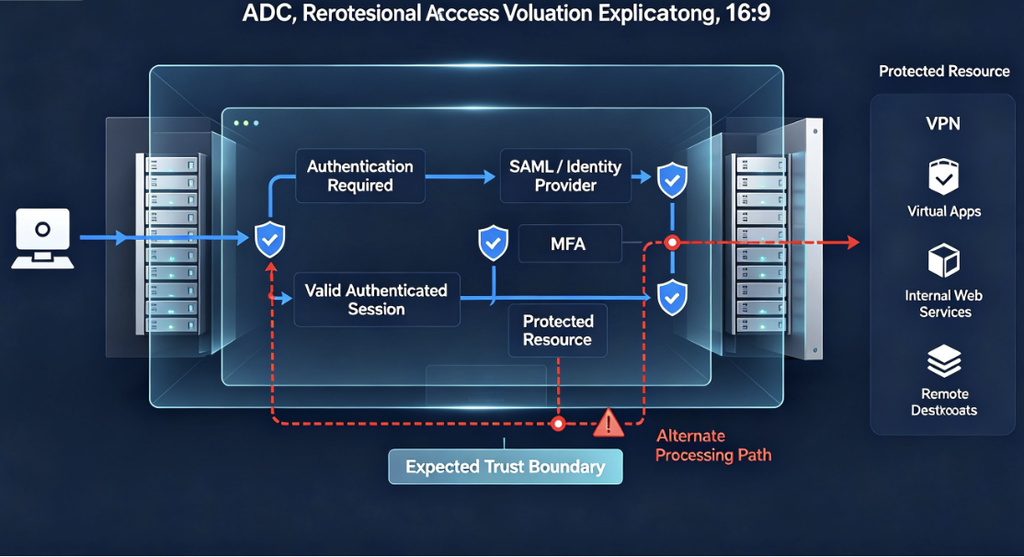
A system may provide several different routes through which a user can access the same protected functionality. Authentication is correctly enforced on the primary route, but another route does not perform equivalent security checks.
A simplified secure architecture might look like this:
Internet
   |
   v
NetScaler Gateway
   |
   v
Authentication
   |
   +----------------+
   |                |
   v                v
 SAML             LDAP
   |                |
   +-------+--------+
           |
           v
Authenticated Session
           |
           v
Protected Resources
Every path reaching protected resources should satisfy the same security invariant:
Protected resource
        =
Valid authenticated session required
An alternate-path authentication vulnerability violates that assumption.
Conceptually, the vulnerable condition could resemble:
External Request
       |
       v
Request Processing
   /           \
  /             \
 v               v
Normal Path    Alternate Path
   |               |
Authentication     |
   |               |
   v               |
Valid Session      |
   |               |
   +-------+-------+
           |
           v
Protected Context
The important point is that “alternate path” does not necessarily mean there is a second visible login page.
The alternate path could theoretically involve another endpoint, protocol handler, callback mechanism, state transition, routing rule, or authentication workflow.
Unless NetScaler publishes deeper implementation information, it would be irresponsible to claim that CVE-2026-19490 depends on one specific HTTP request or SAML manipulation technique.
The confirmed security issue is the broader one:
an affected configuration can allow the expected authentication boundary to be bypassed.
Why Authentication Bypass on NetScaler Is Particularly Dangerous
Authentication bypass vulnerabilities are serious in almost any application.
They are especially dangerous in products whose primary purpose is enforcing a security boundary.
NetScaler Gateway often sits directly between the internet and enterprise resources.
A typical architecture looks like this:
                    Internet
                       |
                       v
             +-------------------+
             | NetScaler Gateway |
             |                   |
             | TLS               |
             | Authentication    |
             | SAML              |
             | Session Control   |
             | Access Policies   |
             +-------------------+
                       |
         +-------------+-------------+
         |             |             |
         v             v             v
   Citrix Apps    Internal Apps    VPN Access
                                      |
                                      v
                               Internal Network
The organization deliberately trusts the Gateway to answer an extremely important question:
Has this remote user actually authenticated?
Downstream systems may then operate under the assumption that the Gateway has already performed that validation.
An authentication bypass can undermine that trust relationship.
This is why CVE-2026-19490 should be thought of as a trust-boundary vulnerability, not merely a broken login page.
Which NetScaler Configurations Matter?
One of the most important characteristics of CVE-2026-19490 is that exploitation depends on how NetScaler is configured.
A simplistic vulnerability scanner may effectively use logic like:
NetScaler detected
+
Affected-looking firmware
=
CVE-2026-19490
That is not sufficient.
Relevant configurations include NetScaler Gateway functionality such as:
- SSL VPN
- ICA Proxy
- CVPN
- RDP Proxy
and deployments using:
- AAA virtual servers
For portions of the newer NetScaler 14.1 and 13.1 release branches, the presence of a SAML authentication action becomes particularly important.
This distinction matters because two NetScaler appliances running a similar software branch may expose completely different security surfaces.
Consider the following deployment:
NetScaler ADC
Version: 14.1
Gateway enabled
SAML authentication configured
Public VIP
Now compare it with:
NetScaler ADC
Version: 14.1
Load balancing only
No Gateway
No AAA vServer
No SAML authentication
A version-only scanner may classify both devices similarly.
Their exposure to CVE-2026-19490 is not necessarily equivalent.
Understanding the SAML Connection
SAML is commonly used to integrate NetScaler with enterprise identity providers.
A normal authentication process might work like this:
User
 |
 | Requests protected resource
 v
NetScaler Gateway
 |
 | Authentication required
 v
Identity Provider
 |
 | Password / MFA / policy
 v
SAML Assertion
 |
 v
NetScaler
 |
 | Validate authentication state
 v
Authenticated Session
 |
 v
Protected Application
There are several important security decisions in this process.
NetScaler needs to correctly determine:
- whether authentication is required;
- which authentication mechanism should be invoked;
- whether the authentication transaction completed;
- whether the returned authentication information is valid;
- which identity should be associated with the session;
- whether the user is authorized for the requested resource.
A failure in any of those state transitions can create an authentication vulnerability.
However, CVE-2026-19490 should not automatically be described as a flaw in SAML cryptography.
There is currently no justification for casually claiming that the vulnerability means attackers can:
forge arbitrary SAML signatures
or:
compromise the enterprise IdP
or:
decrypt SAML assertions
Those would be entirely different vulnerabilities.
The presence of SAML can be a configuration prerequisite without SAML itself being cryptographically broken.
That distinction matters when analyzing CVE-2026-19490.
Authentication Bypass Does Not Necessarily Mean Password Bypass
The phrase “authentication bypass” is frequently oversimplified.
Security reporting often describes it as:
attackers can log in without a password.
That may be technically misleading.
A more accurate model is:
Expected security flow:

Request
   |
   v
Authentication
   |
   v
Identity Established
   |
   v
Protected Resource
An authentication bypass changes the transition:
Request
   |
   v
Unexpected Processing Path
   |
   X
Authentication
   |
   v
Protected Security Context
The key issue is not necessarily that the attacker supplied the wrong password and NetScaler accepted it.
The system may instead fail to require the expected authentication process at all.
Does MFA Protect Against CVE-2026-19490?
Organizations should not assume that MFA neutralizes this vulnerability.
MFA improves the strength of the normal authentication process.
예를 들어
Username
   +
Password
   +
Security Key
   |
   v
Authenticated Session
But an authentication bypass can target the mechanism that determines whether authentication must happen in the first place.
Conceptually:
Attacker
   |
   v
Alternate Path
   |
   X
Username
Password
MFA
   |
   v
Protected Context
If authentication itself is skipped, stronger authentication factors cannot repair the vulnerable processing path.
This creates an important security principle:
Authentication strength and authentication enforcement are different problems.
An organization might use phishing-resistant hardware tokens and still remain vulnerable to an authentication bypass in the gateway responsible for invoking those tokens.
Patching the affected NetScaler software therefore remains necessary.
Is CVE-2026-19490 a Remote Code Execution Vulnerability?
No direct RCE capability should be attributed to CVE-2026-19490 based solely on its current public classification.
The vulnerability is an authentication bypass.
That matters.
Authentication bypass means an attacker can potentially cross a boundary that should require authentication.
Remote Code Execution means an attacker can execute arbitrary instructions in the security context of the vulnerable process or operating system.
The two vulnerability classes are fundamentally different.
It is possible for vulnerabilities to be chained:
Authentication Bypass
        |
        v
Access Privileged Functionality
        |
        v
Second Vulnerability
        |
        v
Remote Code Execution
But such a chain does not turn the first vulnerability itself into an RCE.
Unless an exploit chain is demonstrated and supported by evidence, CVE-2026-19490 should remain described as:
NetScaler ADC and Gateway authentication bypass.
This is both more technically accurate and more useful for defenders.
Authentication Bypass vs. Account Takeover
Authentication bypass should also not automatically be equated with account takeover.
Traditional account takeover often works like this:
Credential Theft
       |
       v
Valid Account
       |
       v
Attacker Logs In
       |
       v
Victim Account Taken Over
Password-reset abuse may create a similar outcome:
Reset Flow Abuse
       |
       v
Password Changed
       |
       v
Attacker Controls Account
Authentication bypass can be structurally different:
No Valid Credentials
        |
        v
Authentication Enforcement Failure
        |
        v
Unauthorized Security Context
Depending on implementation, the attacker might obtain access without truly taking over an existing user’s credentials.
The exact post-bypass security context depends on the vulnerability mechanics.
Until those mechanics are publicly established, claiming conventional account takeover would go beyond the available evidence.
Why CVSS 9.3 Matters
CVE-2026-19490 carries a critical CVSS v4.0 rating.
Its vector contains several particularly important properties.
Network Attack Vector
AV:N
The attack can occur over a network.
For internet-facing NetScaler Gateways, this means the vulnerable surface may potentially be reachable from anywhere on the internet.
Low Attack Complexity
AC:L
CVSS does not treat exploitation as inherently dependent on unusually complex conditions.
This does not guarantee that exploitation is trivial.
It does mean the vulnerability is not scored as requiring a difficult race condition or similarly exceptional technical circumstance.
No Privileges Required
PR:N
The attacker does not need an existing NetScaler account before attempting exploitation.
For an authentication bypass, this is particularly important.
No User Interaction
UI:N
The exploitation path does not require a victim to open a document, click a malicious link, or approve an authentication request.
Put together:
Remote reachable
+
No account
+
No user interaction
+
Low attack complexity
+
Authentication bypass
For edge infrastructure, this combination justifies urgent investigation.
How to Determine Whether a NetScaler Is Exposed
Security teams should begin with configuration verification rather than blindly testing production systems.
Three major configuration areas matter.
Check for VPN Virtual Servers
NetScaler configurations may contain declarations such as:
add vpn vserver
A local configuration review could identify relevant definitions:
grep "add vpn vserver" ns.conf
This helps identify whether the appliance is operating as a Gateway.
Check for AAA Virtual Servers
AAA virtual servers can be identified through configuration entries such as:
add authentication vserver
예를 들어
grep "add authentication vserver" ns.conf
Check for SAML Authentication Actions
SAML actions may appear as:
add authentication samlAction
A defensive audit could use:
grep "add authentication samlAction" ns.conf
Finding these strings alone does not prove vulnerability.
The administrator must correlate them with:
Exact NetScaler build
+
Gateway or AAA configuration
+
SAML bindings
+
Network exposure
+
Current vendor advisory
That correlation is what turns configuration inventory into vulnerability assessment.
Exact Build Numbers Matter
Security inventories frequently store product versions too broadly.
예를 들어
NetScaler 14
is not useful enough.
Even:
NetScaler 14.1
may be insufficient.
Security teams should record the complete build:
14.1-xx.xx
The same applies to 13.1.
Version-specific configuration prerequisites can change inside the same major branch.
That means vulnerability prioritization should not stop at the major release number.
Be Careful With Version Boundary Data
Newly disclosed vulnerabilities frequently expose a problem in modern vulnerability management: different databases may temporarily represent fixed-version boundaries differently.
One source might describe an affected range as:
before version X
while another machine-readable feed may temporarily interpret the boundary as:
less than or equal to X
For a critical vulnerability affecting an internet-facing authentication gateway, administrators should not gamble on an ambiguous equality comparison.
The safer approach is:
verify the current NetScaler security advisory and deploy the latest supported security update available for the affected release branch.
This is more reliable than assuming that a vulnerability scanner’s string comparison always perfectly represents vendor intent.
It is also a useful reminder that CPE matching and real vulnerability state are not the same thing.
FIPS and NDcPP Builds Need Separate Attention
Organizations running NetScaler FIPS or NDcPP variants should confirm that they are using remediation guidance specific to those branches.
These editions can follow separate firmware tracks and build numbering.
Administrators should not assume that:
Standard NetScaler fixed version
=
FIPS fixed version
The appliance edition needs to be identified before selecting an upgrade package.
This matters particularly in regulated environments, where FIPS appliances are often used precisely because they protect sensitive access paths.
Internet Exposure Changes the Risk
Suppose an enterprise has two affected NetScaler appliances.
The first is publicly reachable:
Internet
   |
   v
NetScaler Gateway
   |
   v
Enterprise Resources
The second is isolated inside a restricted network.
The CVE is the same.
The real-world risk is not.
The internet-facing Gateway represents a much more immediate attack opportunity.
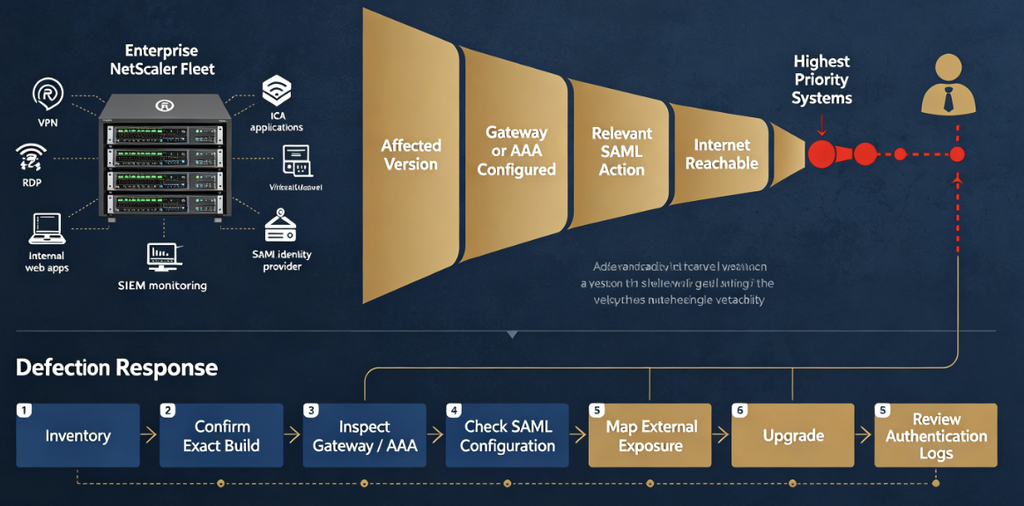
A useful prioritization formula for CVE-2026-19490 is therefore:
Vulnerable Version
+
Relevant Configuration
+
Authentication Method
+
Internet Exposure
=
Practical Exploitability
Security teams should prioritize appliances where all four conditions converge.
Why Attackers Target VPN and Gateway Appliances
Enterprise edge products are attractive targets because they occupy a strategically valuable position.
They often have:
- direct internet exposure;
- access to internal networks;
- trusted relationships with identity providers;
- privileged connections to enterprise applications;
- high availability requirements;
- access to authentication/session data.
The architecture may look like:
                 Internet
                    |
                    v
          +------------------+
          | NetScaler        |
          | VPN / Gateway    |
          +------------------+
                    |
       +------------+------------+
       |            |            |
       v            v            v
    Users        Citrix        Internal
                 Apps          Services
Compromising the perimeter can be much more valuable than exploiting one isolated application.
This is why VPNs, firewalls, ADCs, secure gateways, and identity appliances repeatedly become high-priority targets after vulnerability disclosure.
A Practical Defensive Investigation Workflow
Defenders should evaluate CVE-2026-19490 systematically.
Build an Accurate Asset Inventory
Locate every NetScaler appliance, including:
- production Gateway appliances;
- HA secondary nodes;
- disaster recovery deployments;
- regional gateways;
- test infrastructure;
- legacy systems;
- forgotten public VIPs;
- FIPS appliances.
Do not assume the CMDB is complete.
Public attack-surface discovery and internal inventory should be reconciled.
Identify Exact Versions
Record:
Product
Edition
Major branch
Exact build
FIPS / non-FIPS
Avoid generic entries such as “Citrix ADC” or “NetScaler 14”.
Inspect Authentication Configuration
Determine whether the system uses:
- SAML;
- LDAP;
- RADIUS;
- certificate authentication;
- nFactor;
- external identity providers;
- AAA virtual servers.
For CVE-2026-19490, SAML configuration is particularly relevant on certain release ranges.
Identify Gateway Services
Look for:
SSL VPN
ICA Proxy
CVPN
RDP Proxy
AAA
Determine which ones are actually enabled.
Map Network Exposure
Determine whether each relevant VIP is:
Internet-facing
Partner-facing
Internal-only
Administrative-only
A vulnerable feature that cannot be reached by an attacker represents a different risk profile from a publicly accessible Gateway.
Patch the Appliance
Once an appliance matches the affected conditions, upgrade it according to the latest NetScaler security guidance.
Configuration analysis should help prioritize remediation.
It should not become an excuse to avoid patching vulnerable software indefinitely.
Detection and Threat Hunting
For newly disclosed authentication vulnerabilities, defenders should be careful about prematurely treating speculative HTTP patterns as confirmed indicators of exploitation.
A stronger initial approach is behavioral correlation.
Security teams should investigate:
- unusual authentication sequences;
- sessions created without normal authentication events;
- unexpected access immediately following failed authentication;
- abnormal SAML workflows;
- unusual VPN sessions;
- authentication from unexpected source networks;
- anomalous session creation;
- unexplained access to protected applications;
- suspicious configuration changes;
- abnormal post-authentication behavior.
The expected workflow is:
Connection
   |
   v
Authentication Request
   |
   v
Identity Validation
   |
   v
Authentication Success
   |
   v
Session Creation
   |
   v
Protected Access
A bypass may create inconsistency:
Connection
   |
   v
Unexpected Request
   |
   v
No Corresponding Authentication Event
   |
   v
Session or Protected Access
That inconsistency is valuable hunting data.
Why Missing Authentication Events Matter
Many detection programs focus exclusively on malicious events.
Authentication bypasses introduce another useful detection strategy:
look for events that should exist but do not.
If access to a protected application normally requires a successful authentication event, then this combination should be suspicious:
Protected Resource Access = TRUE
Authentication Success = FALSE
A simplified SIEM correlation model might therefore look like:
IF protected_resource_access
AND NOT preceding_valid_authentication
THEN investigate
Real implementation will depend on available NetScaler, IdP, VPN, application, and SIEM telemetry.
The principle is broadly applicable.
IOC-Only Detection Is Not Enough
Static indicators can be useful once reliable exploit data becomes available.
They should not be the only defensive strategy.
An attacker can easily change:
Source IP
User-Agent
Infrastructure
Headers
Timing
Session values
But the underlying security invariant remains the same:
protected access should correspond to successful authentication.
Detection based on this invariant is more resilient than detection based only on a single IP address or exploit string.
Does a WAF Solve CVE-2026-19490?
A specific vendor-provided mitigation rule may sometimes reduce exposure to a known exploitation technique.
That is different from claiming that placing a generic WAF in front of NetScaler solves the vulnerability.
Authentication bypasses can involve subtle state and routing behavior.
A WAF that does not understand the exact vulnerable processing path may not reliably block exploitation.
Therefore:
WAF
≠
Patch
Any virtual patching or application-firewall mitigation should be considered a compensating control unless the vendor explicitly states otherwise.
The durable remediation is to upgrade the affected NetScaler software.
Should Organizations Disable SAML?
If a specific SAML configuration is confirmed as a prerequisite for the affected release, temporarily removing that configuration may reduce exposure.
However, there are several problems with treating this as a permanent solution.
Disabling SAML can:
- break employee authentication;
- disrupt remote access;
- interfere with Citrix workloads;
- force users onto weaker authentication mechanisms;
- create complex temporary configurations;
- leave vulnerable code installed.
The preferred remediation is still the vendor-provided security update.
Temporary configuration changes should be considered emergency risk-reduction measures rather than substitutes for patching.
Does Strong Password Policy Help?
Not against the root cause of an authentication bypass.
Password policies address credential security.
예를 들어
Password
   |
Complexity
   |
MFA
   |
Authentication
But CVE-2026-19490 concerns whether the system correctly enforces authentication.
If an alternate path bypasses that security decision, changing password length from 12 characters to 20 characters does not remove the vulnerable path.
This is another reason the vulnerability deserves immediate technical remediation rather than an identity-policy workaround.
Is CVE-2026-19490 Actively Exploited?
Critical severity alone does not prove exploitation in the wild.
Security reporting should distinguish carefully between:
Technically exploitable
and:
Confirmed exploitation in real attacks
These are not equivalent statements.
Unless NetScaler, CISA, a trusted incident-response organization, or another authoritative source confirms active exploitation, articles should avoid presenting exploitation as established fact.
However, defenders should also avoid the opposite mistake.
The absence of public exploitation evidence does not mean it is safe to postpone remediation.
The relevant risk equation is:
Critical
+
Unauthenticated
+
Network reachable
+
Edge infrastructure
=
High patch priority
Waiting for weaponized exploit code before upgrading an exposed Gateway is an unnecessarily risky strategy.
What About Public Proof-of-Concept Exploits?
The availability of a public PoC can dramatically increase exploitation pressure because it reduces the amount of reverse engineering required by attackers.
But the absence of a PoC should not determine whether organizations patch.
Attackers capable of analyzing security updates can often compare vulnerable and fixed builds independently.
A common vulnerability lifecycle looks like this:
Vendor Patch
   |
   v
Binary Diffing
   |
   v
Root Cause Analysis
   |
   v
Exploit Development
   |
   v
Automation
Once a vendor releases a security patch, the patch itself can provide information to sophisticated researchers.
For exposed edge infrastructure, the patch window matters.
Safe Verification of CVE-2026-19490
Authorized security teams do not necessarily need to reproduce the authentication bypass on production infrastructure to establish meaningful exposure.
A safe verification workflow can begin with configuration and version analysis.
Phase 1: Identify the Product
Confirm that the target is genuinely:
NetScaler ADC
or
NetScaler Gateway
Do not rely solely on one HTTP header.
Phase 2: Determine the Exact Build
Collect the precise firmware version.
Phase 3: Inspect Gateway Configuration
Identify whether:
VPN vServer
AAA vServer
Gateway functions
are configured.
Phase 4: Inspect SAML Configuration
Search for relevant SAML authentication actions and bindings.
Phase 5: Determine Reachability
Identify whether the vulnerable authentication surface can be reached from an untrusted network.
Phase 6: Validate Patch Status
Compare the appliance against the latest official NetScaler security guidance.
Only after these steps should an organization decide whether active exploitation verification is necessary and appropriate within its authorization scope.
Why Version-Only Vulnerability Scanning Fails
CVE-2026-19490 highlights one of the largest weaknesses in conventional vulnerability management.
A traditional scanner often reasons like this:
Product
   |
Version
   |
CVE Database
   |
Finding
But real exploitation depends on substantially more information:
Product
   |
Exact Version
   |
Configuration
   |
Authentication Flow
   |
Exposure
   |
Security Controls
   |
Exploitability
Imagine an enterprise has 80 NetScaler systems.
A vulnerability scanner identifies 45 devices whose versions appear relevant.
Configuration analysis finds:
45 version matches
      |
      v
22 Gateway / AAA systems
      |
      v
10 meet relevant SAML conditions
      |
      v
5 are internet-facing
Those five systems represent the most immediate external attack surface.
This does not mean the other systems should never be upgraded.
It means defenders now have much better prioritization information.
CVE Scanning vs. Attack-Path Analysis
Traditional CVE management asks:
Does this server contain vulnerable software?
Attack-path analysis asks:
Can an attacker actually reach the vulnerable feature, cross the security boundary, and reach something valuable?
For CVE-2026-19490:
CVE Detection
=
NetScaler + Version
is weaker than:
Real Risk Analysis
=
Version
+
Gateway Configuration
+
AAA
+
SAML
+
External Exposure
+
Downstream Access
This is increasingly important as security infrastructure becomes more configurable.
Two appliances running identical binaries can represent dramatically different levels of risk.
NetScaler as an Identity Boundary
It is useful to think about NetScaler Gateway as part of the organization’s identity plane.
A simplified enterprise architecture might contain:
Internet
   |
   v
NetScaler
   |
   v
Identity Provider
   |
   v
Enterprise Applications
But in practice NetScaler itself can participate in:
- authentication orchestration;
- session establishment;
- authorization policy;
- application routing;
- VPN establishment;
- identity federation.
Therefore an authentication bypass can influence more than a single login screen.
The vulnerability potentially affects the point where the organization converts:
Untrusted Remote User
into:
Trusted Authenticated Session
That transition is one of the most valuable security decisions in the entire remote-access architecture.
Alternate Authentication Paths Are an Architectural Problem
Modern authentication systems are not simple.
A traditional model looks like:
Username
   |
Password
   |
Authenticated
Modern enterprise authentication may instead involve:
              +---- SAML ----+
              |              |
Request ---> Gateway ---> Session
              |              |
              +---- LDAP ----+
              |
              +---- RADIUS --+
              |
              +---- MFA -----+
              |
              +---- Cert ----+
There may also be:
- authentication callbacks;
- fallback paths;
- session recovery;
- nFactor policies;
- multiple virtual servers;
- API endpoints;
- protocol compatibility handlers;
- legacy authentication mechanisms.
Each additional transition creates another opportunity for inconsistent security checks.
The difficult problem is therefore not merely:
Is SAML implemented securely?
It is:
Does every path through the authentication state machine enforce the same security invariants?
That is the deeper lesson behind CWE-288.
Authentication State Machines Matter
Authentication is often easier to understand as a state machine.
예를 들어
STATE 0
Unauthenticated

     |
     | Start authentication
     v

STATE 1
Authentication pending

     |
     | Identity validated
     v

STATE 2
Authenticated

     |
     | Authorization granted
     v

STATE 3
Resource access allowed
A secure system should prevent transitions such as:
STATE 0
   |
   +-------------------->
                        STATE 3
unless a legitimate mechanism explicitly allows it.
Alternate-path authentication vulnerabilities often emerge when unusual request sequences cause such invalid state transitions.
This is why security testing should examine workflows, not just individual endpoints.
The Role of Continuous Security Validation
CVE-2026-19490 also demonstrates why externally exposed security infrastructure deserves continuous validation.
An organization may patch correctly today.
Tomorrow it may:
- expose a new Gateway;
- restore an old HA appliance;
- enable SAML;
- create a new AAA vServer;
- deploy an older image;
- introduce another vulnerable configuration.
A vulnerability management process based on a quarterly spreadsheet may miss these changes.
A stronger process repeatedly validates:
Asset
+
Version
+
Configuration
+
Exposure
+
Authentication Path
This is particularly important for VPN and identity infrastructure because small configuration changes can significantly change attackability.
Post-Patch Verification
Installing the security update should not be the final step.
Organizations should verify that:
- every HA node is upgraded;
- the appliance actually booted into the intended build;
- old nodes have not rejoined the cluster;
- disaster recovery appliances are also patched;
- authentication still functions correctly;
- Gateway policies have not accidentally changed;
- SAML authentication continues to operate normally;
- public attack-surface inventory reflects the new version.
A useful post-patch workflow is:
Upgrade
   |
   v
Confirm Running Build
   |
   v
Confirm HA State
   |
   v
Test Authentication
   |
   v
Check External Exposure
   |
   v
Review Logs
Historical Log Review Is Still Important
Patching removes the vulnerable condition going forward.
It does not prove that the system was never targeted beforehand.
For systems that were externally accessible while vulnerable, organizations should consider reviewing historical telemetry.
Useful data sources may include:
- NetScaler authentication logs;
- VPN session logs;
- SAML IdP logs;
- reverse proxy logs;
- application access logs;
- SIEM events;
- endpoint telemetry from downstream systems.
A particularly useful technique is cross-system correlation.
예를 들어
NetScaler says session exists
             |
             v
Does IdP show successful authentication?
If not, the discrepancy deserves investigation.
Similarly:
Internal application access
             |
             v
Was there a corresponding Gateway login?
Authentication bypasses create value for defenders precisely because they may disrupt the normal relationship between these events.
Incident Response Considerations
If an organization discovers a vulnerable internet-facing NetScaler and finds suspicious authentication anomalies, remediation should expand beyond patching.
Potential incident-response actions can include:
Patch appliance
        |
        v
Preserve logs
        |
        v
Review suspicious sessions
        |
        v
Invalidate active sessions
        |
        v
Review downstream access
        |
        v
Rotate relevant secrets if needed
Whether credentials or tokens need rotation depends on what evidence is discovered.
Defenders should avoid automatically assuming every exposed appliance has been compromised.
They should also avoid treating successful patching as proof that no previous compromise occurred.
Frequently Asked Questions
What is CVE-2026-19490?
CVE-2026-19490 is a critical authentication bypass vulnerability affecting certain NetScaler ADC and NetScaler Gateway configurations.
다음과 같이 분류됩니다. CWE-288: Authentication Bypass Using an Alternate Path.
What is the CVSS score of CVE-2026-19490?
CVE-2026-19490 has a CVSS v4.0 score of 9.3, placing it in the critical severity category.
Can CVE-2026-19490 be exploited remotely?
The published CVSS vector uses:
AV:N
which indicates a network-based attack vector.
For internet-facing NetScaler Gateway services, this is especially important.
Does CVE-2026-19490 require authentication?
No.
The CVSS vector specifies:
PR:N
meaning existing privileges are not required.
Does it require user interaction?
No.
The CVSS vector contains:
UI:N
meaning a victim does not need to click a link or perform another action during the scored exploitation path.
Is every NetScaler ADC vulnerable?
No.
Version alone is not enough to establish exploitability.
Gateway, AAA, SAML, firmware branch, and network exposure all matter.
Which services are important?
Relevant NetScaler Gateway deployments can include:
- SSL VPN;
- ICA Proxy;
- CVPN;
- RDP Proxy;
- AAA virtual servers.
Is SAML relevant to CVE-2026-19490?
Yes, particularly for certain newer affected NetScaler 14.1 and 13.1 builds.
However, the vulnerability should not be interpreted as proof that SAML cryptography itself is broken.
Can an attacker forge SAML assertions with CVE-2026-19490?
That is not established by the public classification.
The vulnerability is an alternate-path authentication bypass.
There is no basis for automatically equating it with arbitrary SAML signature forgery.
Is CVE-2026-19490 RCE?
CVE-2026-19490 should currently be treated as an authentication bypass rather than a direct Remote Code Execution vulnerability.
A separate vulnerability could theoretically be chained after authentication bypass, but that would be a different capability.
Does MFA mitigate CVE-2026-19490?
MFA should not be considered a substitute for patching.
If authentication enforcement itself can be bypassed, stronger factors inside the normal authentication workflow do not necessarily protect the alternate path.
Should internet-facing systems be patched first?
Yes.
A system satisfying the vulnerable configuration prerequisites and exposing Gateway or AAA functionality to untrusted networks represents the highest operational priority.
Is a WAF enough?
A WAF or vendor-provided mitigation may reduce exposure in some circumstances, but it should not generally be considered equivalent to installing the security update.
Should administrators check logs after upgrading?
Yes.
For externally exposed systems that may have been vulnerable before patching, authentication, Gateway, SAML, application, and downstream access logs should be reviewed for anomalous behavior.
Final Assessment
CVE-2026-19490 deserves serious attention because it affects one of the most important security boundaries in many enterprise networks: NetScaler’s decision about whether a remote request has successfully authenticated.
Its risk characteristics are concerning:
Network reachable
+
No privileges required
+
No user interaction
+
Low attack complexity
+
Authentication bypass
+
Enterprise edge infrastructure
But the correct security response requires more nuance than simply searching for every NetScaler appliance.
CVE-2026-19490 is configuration-sensitive.
Security teams should determine:
Is this NetScaler version affected?
        |
        v
Is Gateway functionality configured?
        |
        v
Is an AAA virtual server present?
        |
        v
Is SAML relevant to this release?
        |
        v
Is the vulnerable service reachable externally?
        |
        v
Has the vendor security update been installed?
That sequence provides a much more accurate risk assessment than a simple version banner check.
The broader lesson extends beyond NetScaler.
Modern enterprise authentication systems increasingly contain multiple identity providers, protocols, redirects, callbacks, authentication factors, session mechanisms, policy engines, and legacy compatibility paths.
Security therefore depends not only on whether individual authentication mechanisms are cryptographically strong.
It also depends on whether every possible route through the system consistently enforces authentication.
CVE-2026-19490 is a useful example of why that distinction matters.
Strong passwords cannot fix an authentication path that does not require a password.
Phishing-resistant MFA cannot protect a workflow that never invokes MFA.
A secure SAML identity provider cannot repair an alternate route around the authentication boundary.
For organizations operating NetScaler ADC or Gateway infrastructure, especially internet-facing Gateway or AAA deployments, the appropriate response is therefore clear:
identify the exact software build, inspect the relevant authentication configuration, determine exposure, apply the latest NetScaler security update, verify the resulting state, and review historical authentication activity where appropriate.
For critical enterprise edge vulnerabilities, waiting for widespread exploit code or confirmed mass exploitation is rarely a good risk strategy.
The authentication gateway is the door.
CVE-2026-19490 is important because the vulnerability concerns whether every path through that door actually passes through the lock.
 Korean
  English
  German
  French
  Spanish
  Portuguese
  Japanese
  Hindi
Hindi  Arabic
  Turkish
  Hebrew