
A vulnerability identifier beginning with CVE-2009 looks ancient by modern cybersecurity standards. For many security teams, seeing a vulnerability more than 17 years old creates an almost automatic assumption: the software must have disappeared, the patch must have been deployed years ago, and whatever exploitation once existed belongs to security history rather than today’s attack surface.
CVE-2009-0238 is a useful reminder that this assumption can be dangerously wrong.
CVE-2009-0238 is a Microsoft Excel remote code execution vulnerability involving memory corruption during the parsing of specially crafted spreadsheet files. Microsoft disclosed and patched the vulnerability in 2009 through security bulletin MS09-009. The company also confirmed at the time that exploitation had already been observed in the wild. (Microsoft Learn)
Then, seventeen years later, the vulnerability became relevant to vulnerability-management teams again for an unusually concrete reason.
As of 2026, the NIST National Vulnerability Database identifies CVE-2009-0238 as being included in the CISA 알려진 익스플로잇 취약점 카탈로그, with an addition date of April 14, 2026. CISA’s ADP data associated with the CVE also describes exploitation as active and assigns it a CVSS 3.1 score of 8.8. (NVD)
That does not necessarily mean attackers suddenly rediscovered Excel 2003 in 2026 or that a completely new campaign using CVE-2009-0238 has been publicly documented. KEV inclusion should not be stretched beyond what the available evidence establishes.
It does mean something more operationally important: security teams should not consider vulnerability age a valid reason to ignore a known-exploited flaw when vulnerable systems can still exist.
For CVE-2009-0238, the real story is therefore bigger than one malformed spreadsheet.
It is about why document parsers remain attractive attack surfaces, why legacy software survives far longer than vulnerability-management inventories suggest, and why a CVE published during the Windows XP era can still become a remediation priority in 2026.
What Is CVE-2009-0238?
CVE-2009-0238 is a memory corruption vulnerability in Microsoft Office Excel that can result in remote code execution when a victim opens a specially crafted Excel spreadsheet.
Microsoft described the vulnerability as existing in the way Excel parses its spreadsheet file format. An attacker could construct a spreadsheet containing a malformed object which, when processed by a vulnerable version of Excel, could cause unsafe memory behavior and ultimately permit arbitrary code execution.
Microsoft’s original advisory states that successful exploitation could allow the attacker to run code with the privileges of the currently logged-in user. If that user had administrative privileges, the attacker could potentially take complete control of the system, install software, modify or delete information, or create additional accounts. (Microsoft Learn)
The fundamental characteristics are therefore straightforward:
| 속성 | CVE-2009-0238 |
|---|---|
| 취약성 | CVE-2009-0238 |
| 제품 | Microsoft Office Excel |
| 취약성 등급 | Memory corruption / remote code execution |
| Primary attack vector | Malicious Excel document |
| Authentication required | 아니요 |
| 사용자 상호 작용 | Yes — victim must open the crafted document |
| 영향 | Arbitrary code execution as the logged-in user |
| Microsoft bulletin | MS09-009 |
| Original Microsoft advisory | Security Advisory 968272 |
| Patch release | April 14, 2009 |
| 익스플로잇 | Confirmed in the wild |
| CISA KEV status | Listed |
| KEV addition date | April 14, 2026 |
| CISA-ADP CVSS 3.1 | 8.8 High |
The NVD description adds another useful technical detail: exploitation can involve an Excel document that causes an attempted access to an invalid object. NVD also records historical exploitation associated with Trojan.Mdropper.AC in February 2009. (NVD)
This combination makes CVE-2009-0238 a classic client-side document exploitation vulnerability.
The attacker does not necessarily need a listening network service on the victim machine. Instead, the malicious input is transported to the application itself.
The attack surface is the parser.
Affected Microsoft Excel Versions
CVE-2009-0238 affected a surprisingly broad collection of Microsoft Office products available at the time.
Microsoft listed affected products including Excel 2000 SP3, Excel 2002 SP3, Excel 2003 SP3 and Excel 2007 SP1. The vulnerability also affected Microsoft Office 2004 and 2008 for Mac, Excel Viewer products and the Microsoft Office Compatibility Pack for Word, Excel and PowerPoint 2007 file formats SP1. (Microsoft Learn)
NVD continues to identify essentially the same legacy product families in its affected CPE configurations. (NVD)
| 제품 | 영향을 받는 |
|---|---|
| Microsoft Office Excel 2000 SP3 | 예 |
| Microsoft Office Excel 2002 SP3 | 예 |
| Microsoft Office Excel 2003 SP3 | 예 |
| Microsoft Office Excel 2007 SP1 | 예 |
| Microsoft Office 2004 for Mac | 예 |
| Microsoft Office 2008 for Mac | 예 |
| Excel Viewer 2003 | 예 |
| Microsoft Office Excel Viewer | 예 |
| Office Compatibility Pack 2007 SP1 | 예 |
The fact that these products are obsolete today is important, but it should not be confused with evidence that they have disappeared.
Enterprise environments frequently contain software well past its vendor support lifecycle.
Manufacturing systems, laboratory equipment, embedded engineering workstations, financial reporting environments, legacy ERP clients and machines connected to specialized industrial hardware can remain frozen for years because changing the operating environment risks breaking the underlying business process.
This is precisely where vulnerabilities such as CVE-2009-0238 become relevant again.
Why Was CVE-2009-0238 Considered Remote Code Execution?
The word “remote” in 원격 코드 실행 sometimes causes confusion with document vulnerabilities.
CVE-2009-0238 is not equivalent to an unauthenticated attacker sending a network packet directly to an Internet-facing service and immediately receiving a remote shell.
User interaction is required.
Microsoft explicitly stated that an attacker would need to persuade the user to open a specially crafted Excel document. In an email attack, the malicious spreadsheet could be delivered as an attachment. In a web-based scenario, the attacker could host the document and persuade a victim to download and open it. Microsoft noted that simply receiving an email was not sufficient: the attachment had to be opened. (Microsoft Learn)
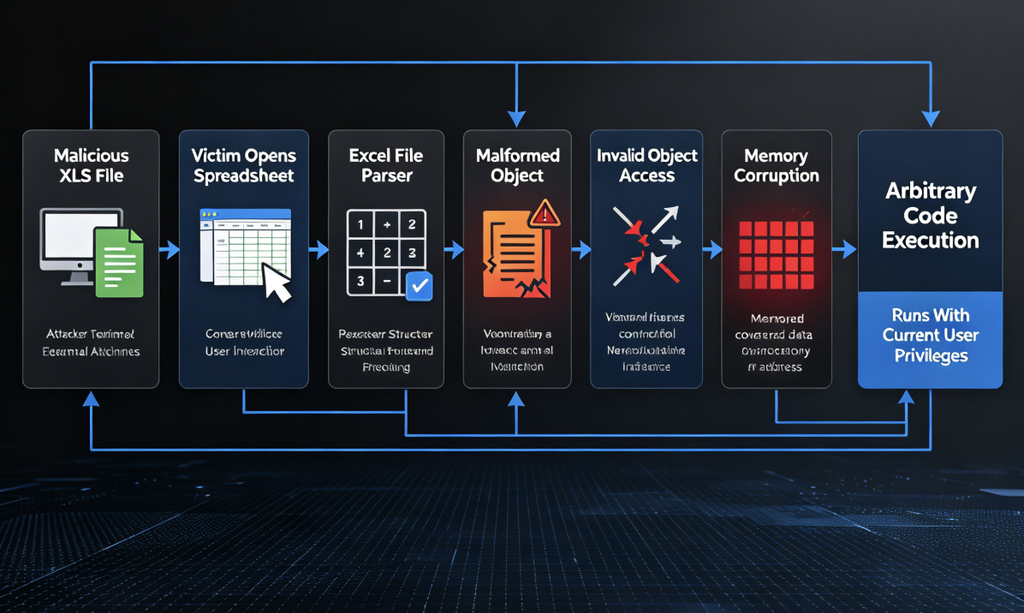
Conceptually, the attack chain looks like this:
Attacker
   |
   v
Crafted Excel document
   |
   v
Email / website / file share / removable media
   |
   v
Victim opens workbook
   |
   v
Vulnerable Excel parser
   |
   v
Malformed object is processed
   |
   v
Invalid object access / memory corruption
   |
   v
Attacker-controlled execution path
   |
   v
Arbitrary code execution
   |
   v
Code runs with victim's privileges
This model was extremely common in client-side exploitation during the 2000s and 2010s.
Office documents, PDFs, image files, fonts and multimedia formats all represented attractive attack surfaces because the victim effectively delivered attacker-controlled structured input directly into complex native-code parsers.
What Actually Causes CVE-2009-0238?
Microsoft’s description is deliberately broad.
취약점은 다음에 존재합니다. the way Microsoft Office Excel parses the Excel spreadsheet file format, and exploitation involves a specially crafted document containing a malformed object. (Microsoft Learn)
NVD characterizes the result as an access attempt involving an invalid object. (NVD)
From a security-engineering perspective, the important sequence is therefore:
Untrusted spreadsheet structure
        ↓
Excel file parser
        ↓
Malformed internal object
        ↓
Invalid memory/object state
        ↓
Memory corruption
        ↓
Potential control-flow influence
        ↓
Arbitrary code execution
There is an important accuracy issue here.
A large number of Excel vulnerabilities were disclosed during 2009, many involving malformed records, indexes, offsets, pointers, string tables and other components of Excel’s binary file-processing logic.
Those details should not automatically be attributed to CVE-2009-0238.
For example, CVE-2009-0100 was another vulnerability fixed by MS09-009 and was described with different malformed-object characteristics. Other 2009 Excel vulnerabilities involved record pointer corruption, array indexing errors, stack-based overruns and malformed record objects. (CVE)
Consequently, saying that CVE-2009-0238 definitely depends on one particular BIFF record type or a specific integer field without evidence from the vulnerability research would overstate the public technical documentation.
The defensible description is simpler: a crafted Excel file can drive the vulnerable parser into unsafe handling of a malformed object, producing memory corruption that can lead to code execution.
That is already enough to understand its defensive significance.
CVE-2009-0238 Was Exploited Before the Patch Arrived
One reason CVE-2009-0238 deserves more attention than a random historical CVE is that exploitation was never theoretical.
Microsoft published Security Advisory 968272 on February 24, 2009 in response to the Excel vulnerability and later replaced the advisory with MS09-009 after completing its investigation and releasing a security update. (Microsoft Learn)
When Microsoft published MS09-009 on April 14, 2009, it explicitly stated that the company had received information that CVE-2009-0238 was being exploited.
Microsoft’s April 2009 bulletin summary was even more direct, recording CVE-2009-0238 as currently exploited in the Internet ecosystem and assigning it the highest exploitability category: “1 – Consistent exploit code likely.” (Microsoft Learn)
Microsoft’s Security Research & Defense team similarly described CVE-2009-0238 as already known to be exploited and identified XLS files delivered through email or websites as the primary attack vector. (Microsoft)
NVD’s historical description associates exploitation with Trojan.Mdropper.AC in February 2009. (NVD)
So CVE-2009-0238 should not be modeled as:
Old theoretical vulnerability
A better classification is:
Old vulnerability
+
known exploitation history
+
document-delivery attack vector
+
potentially persistent legacy attack surface
+
modern KEV prioritization
That distinction matters enormously for vulnerability prioritization.
Why Microsoft Rated Excel 2000 Critical but Later Versions Important
Another interesting aspect of CVE-2009-0238 is Microsoft’s original severity classification.
MS09-009 was rated Critical for Excel 2000, while Excel 2002, Excel 2003, Excel 2007, the affected Mac editions, Excel Viewer and Compatibility Pack configurations were generally rated Important. (Microsoft Learn)
That does not mean the underlying memory-corruption bug was harmless on the later versions.
Microsoft explained that Excel 2002 and subsequent versions contained a feature prompting users to Open, Save, or Cancel before opening a document. That additional interaction provided a mitigating factor that reduced the assigned severity. (Microsoft Learn)
This is an excellent historical example of why vulnerability severity should not be treated as a single immutable property of a bug.
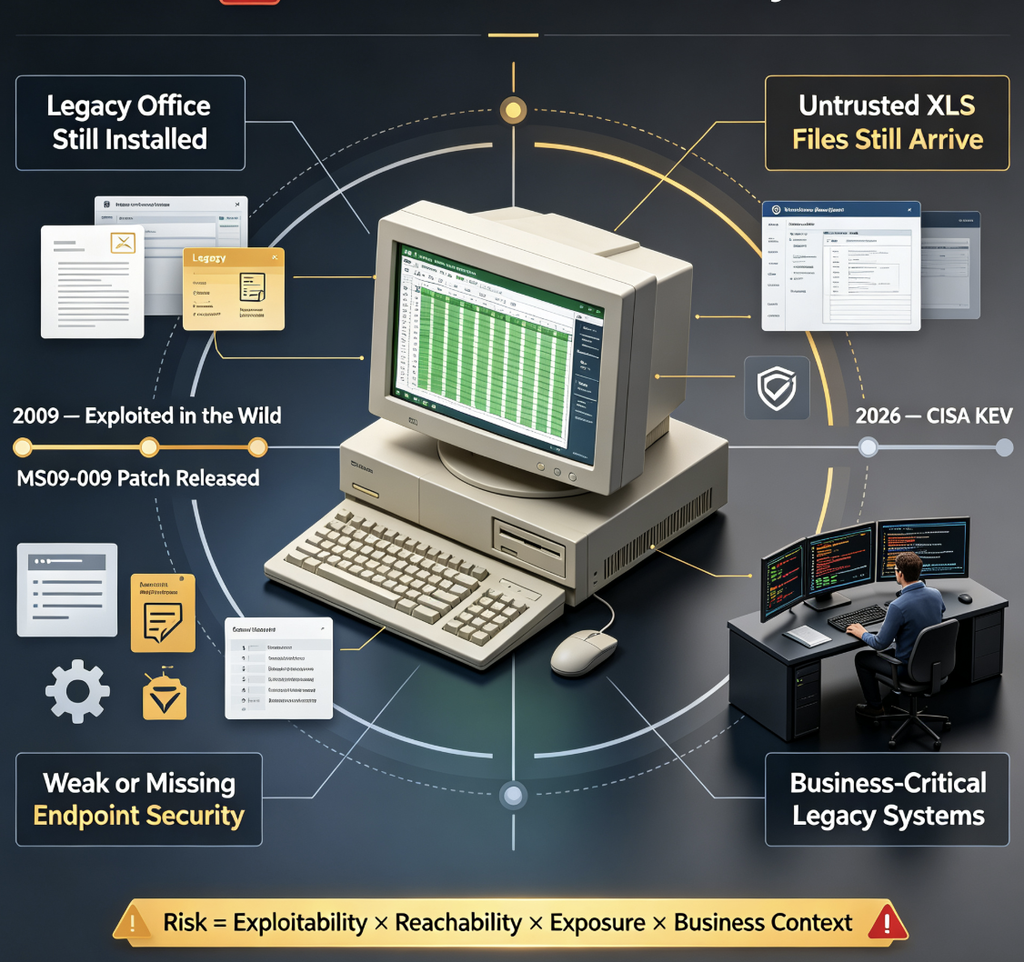
Risk is a function of vulnerability and environment.
The same underlying corruption primitive can represent different practical risks depending on how many barriers exist before execution.
Conceptually:
Risk =
Exploitability
× Exposure
× User interaction
× Privilege
× Security controls
× Business context
A vulnerability capable of arbitrary execution does not cease being code execution simply because the victim must click something.
Conversely, the existence of an RCE primitive does not mean every affected environment has identical exploitation probability.
This distinction remains relevant to modern phishing and document-based exploitation.
What Happens After Successful Exploitation?
Microsoft described code execution as occurring in the security context of the current user.
That detail is critical.
Suppose the victim is running Excel as a standard user.
An attacker exploiting CVE-2009-0238 initially obtains whatever privileges that user possesses. The attacker does not automatically receive SYSTEM privileges merely because the vulnerability is described as remote code execution.
The resulting compromise could conceptually look like:
Malicious spreadsheet
        ↓
Excel RCE
        ↓
Execution as current user
        ↓
Payload execution
        ↓
Credential access / discovery / persistence
        ↓
Privilege escalation if another primitive exists
        ↓
Lateral movement
If the victim operates with administrative permissions, the consequences can be substantially greater.
Microsoft specifically highlighted least privilege as a mitigating factor, noting that users with fewer permissions would generally suffer less impact than users operating with administrative rights. (Microsoft Learn)
This remains one of the most durable lessons from old Office RCE vulnerabilities.
Application exploitation and privilege escalation are different security boundaries.
An attacker may not need both in the same vulnerability if the victim already has excessive privileges.
Why CVE-2009-0238 Still Matters in 2026
Here is where the vulnerability becomes unusually interesting.
CVE-2009-0238 was patched in April 2009.
Yet NVD now reports that the vulnerability was added to the CISA Known Exploited Vulnerabilities Catalog on April 14, 2026, with a remediation due date of April 28, 2026 for organizations subject to the associated federal requirements. (NVD)
CISA-ADP’s information attached to the NVD entry labels exploitation as 활성, identifies its technical impact as total and gives the vulnerability a CVSS 3.1 vector of:
CVSS:3.1/AV:N/AC:L/PR:N/UI:R/S:U/C:H/I:H/A:H
That corresponds to a base score of 8.8 High. (NVD)
There is an important caveat.
The fact that a vulnerability was added to KEV in 2026 does not, by itself, establish the existence of a newly documented 2026 malware operation specifically targeting CVE-2009-0238.
It would be inaccurate to turn KEV inclusion into evidence for an attack campaign that the public sources do not document.
What the designation does establish is the point security teams actually care about: this is not a vulnerability that should be dismissed merely because its CVE identifier begins with 2009.
Old CVEs Do Not Necessarily Mean Dead Attack Surfaces
Vulnerability management tends to have a recency bias.
Security dashboards naturally prioritize vulnerabilities such as:
CVE-2026-xxxxx
CVE-2025-xxxxx
CVE-2024-xxxxx
while something such as:
CVE-2009-0238
feels like archaeology.
Attackers have no reason to share this bias.
An attacker does not receive extra points for exploiting a vulnerability discovered this year.
If an old exploit works against an exposed or reachable machine, it may actually be preferable to a modern vulnerability.
The vulnerability may be thoroughly understood.
Existing exploit techniques may be mature.
Legacy targets may lack EDR.
The operating system may have weaker exploit mitigations.
Monitoring may be poor.
The device may sit outside normal endpoint-management infrastructure.
And administrators may assume nobody would bother attacking it.
From the attacker’s perspective, those characteristics can be attractive.
Legacy Microsoft Office Still Exists
Modern enterprises rarely consist entirely of modern endpoints.
A security inventory may show that the organization has standardized on Microsoft 365 while simultaneously missing machines that never went through the normal migration process.
A manufacturing workstation might require Excel 2003 because a specialized plugin was never updated.
An engineering computer might remain on an old operating system because the hardware controller connected to it has no supported modern driver.
A laboratory workstation might depend on macros created twenty years ago.
A reporting pipeline may still use an unsupported Office component.
A virtual machine snapshot containing Excel 2007 may be restored during an incident investigation.
A terminal server may survive unnoticed because only one business unit uses it every quarter.
An Excel Viewer installation may exist precisely because administrators assumed that viewing a document was safer than editing it.
These systems create what could be described as vulnerability fossils.
They are old enough to disappear from daily security conversations but alive enough to remain exploitable.
Unsupported Software Changes the Remediation Equation
For software still receiving vendor updates, vulnerability management typically follows a familiar process:
Identify
→ test patch
→ deploy patch
→ verify
Unsupported software produces a different problem.
The vendor may no longer produce updates.
The vulnerable version may not integrate with modern endpoint-management tooling.
The operating system running it may itself have dozens or hundreds of known vulnerabilities.
Replacing the application may require changing a business workflow rather than simply installing one security patch.
At that point, treating CVE-2009-0238 as an isolated patch-management problem misses the bigger picture.
The real issue becomes legacy system risk containment.
If an organization discovers Excel 2003 on an endpoint in 2026, the correct question is probably not merely:
Is KB959995 installed?
The better questions are:
Why does this machine still exist?
What business function depends on it?
Can it receive email?
Can users download files?
Can it access shared drives?
Can it reach production networks?
Does it have EDR?
Does it contain privileged credentials?
Can the workflow be migrated?
These questions reveal actual attack paths.
Why Malicious Documents Remain a Valuable Delivery Mechanism
CVE-2009-0238 also illustrates a broader security principle: complex document formats create parser attack surfaces.
Applications such as Excel do far more than display cells.
Spreadsheet processing can involve formulas, charts, embedded objects, metadata, formatting structures, external references, macros and multiple generations of file-format compatibility.
Every parser must transform attacker-controllable bytes into internal application objects.
Conceptually:
File bytes
   ↓
Format recognition
   ↓
Record/object parsing
   ↓
Allocation
   ↓
Validation
   ↓
Object construction
   ↓
Rendering / calculation
A failure at any of these stages can potentially produce unsafe states.
CVE-2009-0238 existed in an era when native desktop applications routinely processed complex attacker-controlled binary files with far fewer exploit mitigations than modern software.
That historical context helps explain why document exploitation became such a powerful initial-access technique.
But the underlying security lesson remains current.
Any complex parser exposed to untrusted input should be treated as an attack surface.
Modern Defenses Change Exploitation, but They Do Not Erase Vulnerabilities
A natural question is whether modern Windows exploit mitigations would make CVE-2009-0238 irrelevant even if the vulnerable Excel binary remained installed.
They can certainly change exploitation reliability.
Modern Windows platforms have accumulated a large collection of mitigation technologies covering address randomization, executable memory protections, control-flow protection and other exploitation barriers.
Endpoint detection has also changed dramatically since 2009.
But there is a major catch.
Organizations running vulnerable Excel versions from this period are frequently also running legacy operating environments.
That means we cannot safely assume a hypothetical Excel 2003 endpoint has the protections of a contemporary Windows 11 workstation.
The actual risk assessment must consider the complete execution environment.
An obsolete Office version running inside an obsolete Windows deployment can represent a fundamentally different exploitability profile from the same application component placed inside a heavily hardened contemporary environment.
This is why software inventory alone is insufficient.
Asset context matters.
Detection: How Should Defenders Look for CVE-2009-0238?
Because CVE-2009-0238 is a client-side memory-corruption vulnerability, detection should not depend exclusively on looking for one magic network signature.
Security teams should combine asset discovery, document telemetry and endpoint behavior.
First, determine whether vulnerable Office components still exist.
This is the highest-value step because an organization with no affected software has a fundamentally different risk profile from an organization containing forgotten Office 2003 installations.
Inventory should include Excel itself, Excel Viewer and Compatibility Pack components.
Second, investigate execution chains involving legacy Excel processes.
The historical exploitation model can be reduced to:
Untrusted document
        ↓
EXCEL.EXE
        ↓
Unexpected process behavior
Depending on the environment and security tooling, suspicious behaviors surrounding document exploitation can include unusual child processes, executable content dropped into temporary locations, unexpected outbound connections shortly after a spreadsheet opens, scripting-engine invocation or persistence creation immediately following document access.
These signals are not specific enough to prove CVE-2009-0238 exploitation.
They are behavioral indicators that can help identify suspicious document-processing chains.
That distinction is important.
Detecting:
EXCEL.EXE → suspicious child process
does not mean:
CVE-2009-0238 confirmed
Attribution to a specific memory-corruption CVE generally requires much stronger evidence, such as the document itself, crash behavior, vulnerable application version and exploit-focused technical analysis.
Example Defensive Hunting Logic
A modern EDR investigation might start from behavior rather than the CVE number itself.
For example, defenders could look for legacy Excel processes spawning unexpected executables or scripting tools:
Parent process:
    EXCEL.EXE

Potentially suspicious children:
    cmd.exe
    powershell.exe
    wscript.exe
    cscript.exe
    rundll32.exe
    regsvr32.exe
The presence of one of these relationships is not automatically malicious.
Excel legitimately integrates with many enterprise workflows.
The objective is to identify unexpected execution patterns within the local baseline, especially when they correlate with newly opened documents from email, downloads or external file shares.
A stronger investigation combines several dimensions:
Legacy vulnerable Excel
        +
Externally sourced spreadsheet
        +
Application crash or anomalous memory behavior
        +
Unexpected process creation
        +
Network activity
        =
High-priority investigation
This produces substantially better signal than searching for a CVE string in logs.
File-Based Detection Is Useful but Fragile
Security gateways can also inspect incoming Excel documents.
However, defenders should be careful about assuming that static signatures alone solve parser exploitation.
Attackers can change document structure while preserving the underlying exploitation concept.
Different delivery containers can also alter the file’s observable signature.
For example, malicious content might arrive through email attachments, archived files, shared cloud storage or internal file shares following another system compromise.
The defensive objective should therefore be broader:
prevent untrusted legacy Office binaries from processing attacker-controlled documents whenever possible.
That is much more durable than depending on a single hash or byte pattern.
Microsoft Originally Recommended File-Handling Workarounds
Before organizations could deploy the 2009 update, Microsoft documented several temporary mitigations.
One involved the Microsoft Office Isolated Conversion Environment, or MOICE, for Office 2003 environments. Microsoft also documented file-blocking approaches designed to prevent vulnerable Excel versions from opening particular binary formats. (Microsoft Learn)
These mitigations are historically interesting, but organizations should not interpret them as a reason to preserve unsupported Office installations indefinitely.
In 2026, if a vulnerable Office version is discovered, migration or isolation is generally a more meaningful strategy than reconstructing a 2009 workstation configuration around temporary compensating controls.
The original security update fixed the underlying vulnerability by modifying the way Excel opened specially crafted Excel files. (Microsoft Learn)
Where applicable, verified patch status is obviously important.
Where software has reached end of life, the long-term answer should be removal or containment.
Remediation Priorities for CVE-2009-0238
For a modern organization encountering CVE-2009-0238, remediation should be based on the role of the affected asset rather than simply the age of the CVE.
A useful prioritization model is:
| 상황 | Recommended priority |
|---|---|
| Vulnerable Excel endpoint receiving Internet email | Critical operational priority |
| Vulnerable endpoint with web access | 매우 높음 |
| Vulnerable terminal server used by multiple users | 매우 높음 |
| Legacy workstation connected to production network | 매우 높음 |
| Isolated legacy machine with controlled file transfer | High, but compensating controls may reduce immediate exposure |
| Powered-off archival VM | Lower immediate exploitability, but remediate before reuse |
| Patched supported environment | Verify patch and controls |
| No affected software | No direct exposure |
A particularly dangerous pattern is a legacy system that is supposedly isolated but still receives files through USB drives, shared folders or operator workstations.
“Air-gapped” does not necessarily mean “input-free.”
If users regularly transfer spreadsheets onto the environment, the file parser remains exposed to potentially hostile input.
Why Vulnerability Scanners Can Miss the Real Problem
CVE-2009-0238 also illustrates a weakness in conventional vulnerability-management programs.
A network scanner may never find an old Excel installation if the application exposes no remotely detectable service.
The vulnerable software may sit on an endpoint behind NAT, an internal workstation or a virtual machine that is powered on only occasionally.
The attack surface enters through documents rather than an open TCP port.
This makes accurate endpoint software inventory essential.
An organization’s security posture can therefore look deceptively clean:
External vulnerability scan:
No CVE-2009-0238 detected
while the actual environment contains:
Accounting workstation
Windows legacy environment
Excel 2003
Email access
Shared network drive
Privileged domain user
The vulnerability exists even though the perimeter scanner cannot see it.
For client-side software, endpoint visibility is often more important than network enumeration.
Why CVE Age Is a Bad Prioritization Metric
Security organizations frequently accumulate more vulnerabilities than they can remediate immediately.
Prioritization becomes unavoidable.
But vulnerability age alone is one of the weakest prioritization signals.
Consider two hypothetical vulnerabilities.
The first is a CVE published yesterday, affecting a management interface that your organization does not use.
The second is CVE-2009-0238 on an active workstation receiving external spreadsheets.
Which represents greater risk?
Almost certainly the second.
A more realistic risk model is:
Priority =
Known exploitation
× Reachability
× Exposure
× Exploitability
× Asset importance
× Privilege context
× Detection weakness
CVE publication year is contextual metadata.
It is not an attack-prevention mechanism.
CISA KEV Changes the Conversation
The rise of the CISA Known Exploited Vulnerabilities Catalog has helped move vulnerability prioritization away from pure CVSS scoring.
Instead of treating every theoretical flaw equally, KEV emphasizes vulnerabilities for which exploitation evidence exists.
CVE-2009-0238 is particularly illustrative because its timeline stretches across nearly two decades:
February 2009
↓
Active exploitation observed

February 24, 2009
↓
Microsoft Security Advisory 968272

April 14, 2009
↓
MS09-009 security update

April 14, 2026
↓
CISA KEV catalog addition
Microsoft’s advisory confirms that the vulnerability was already under investigation in February 2009, while the April bulletin confirms both the patch and known exploitation. NVD currently records the later KEV designation. (Microsoft Learn)
Few vulnerability timelines better demonstrate the difference between vulnerability disclosure lifecycle 그리고 vulnerability risk lifecycle.
The disclosure lifecycle may have ended in 2009.
The risk lifecycle depends on whether vulnerable assets still exist.
CVSS 8.8 Does Not Tell the Entire Story
Current NVD information displays a CISA-ADP CVSS 3.1 base score of 8.8 High, with network attack vector, low attack complexity, no required privileges and required user interaction. NVD itself does not currently provide its own CVSS 3.x or CVSS 4.0 base assessment for the entry. (NVD)
The vector is informative:
AV:N
AC:L
PR:N
UI:R
S:U
C:H
I:H
A:H
In plain English, the model represents an attack that can originate remotely, does not require attacker privileges beforehand, requires victim interaction and can result in severe confidentiality, integrity and availability impact.
Yet even that score misses deployment context.
A vulnerable Excel instance on a disconnected forensic image is not equivalent to one running on a privileged finance workstation processing supplier spreadsheets every day.
CVSS describes vulnerability characteristics.
It does not replace threat modeling.
Why the User-Interaction Requirement Should Not Be Dismissed
One of the most common mistakes in vulnerability triage is treating UI:R as synonymous with low risk.
History says otherwise.
Phishing works precisely because attackers have repeatedly demonstrated that obtaining user interaction is possible at scale.
An Excel attachment can be made contextually convincing.
A finance department expects spreadsheets.
A sales team expects pricing sheets.
HR expects candidate data.
Operations teams exchange inventory files.
Executives receive financial models.
The document format itself can help make the attack believable.
The correct question is therefore not:
Does exploitation require someone to open the spreadsheet?
It is:
How plausible is it that someone in this environment will open an attacker-controlled spreadsheet?
For many organizations, the answer is “very plausible.”
Terminal Servers Deserve Special Attention
Microsoft explicitly identified workstations and terminal servers using Excel as systems primarily at risk from CVE-2009-0238. (Microsoft Learn)
Terminal servers can be particularly problematic because multiple users may interact with one legacy application environment.
A vulnerable application on such infrastructure can expose a broader population of users than a single forgotten desktop.
Terminal environments may also host historically accumulated software that administrators are reluctant to modify because numerous workflows depend on it.
If vulnerability scanning discovers an old Office environment on a terminal server, CVE-2009-0238 should therefore be treated as evidence of a potentially larger legacy-software problem rather than an isolated package-version finding.
Validate Exposure, Not Exploitation Against Production
Security teams sometimes respond to old CVEs by immediately attempting exploitation.
For client-side memory-corruption vulnerabilities, that is often unnecessary and creates avoidable risk.
You generally do not need to weaponize CVE-2009-0238 against a production workstation to establish that remediation is required.
Safer validation can establish:
Is the affected Office component installed?

What exact version is present?

Is the relevant security update installed?

Can the system receive untrusted Excel files?

Does the user have elevated privileges?

What security controls surround EXCEL.EXE?

Can the asset be isolated or upgraded?
Only where deeper exploit verification is legitimately necessary should testing move into a dedicated controlled laboratory environment.
A representative lab architecture might look like:
[Controlled Test Host]
        |
        | isolated network
        v
[Legacy Windows VM]
        |
        +-- vulnerable Excel version
        |
        +-- process monitoring
        |
        +-- debugger
        |
        +-- no production credentials
        |
        +-- snapshot/rollback
This preserves the value of vulnerability research without unnecessarily exposing production systems to memory-corruption testing.
Lessons for Security Teams in 2026
CVE-2009-0238 is interesting partly because it breaks several common assumptions about vulnerability management.
The first is that old vulnerabilities automatically become irrelevant.
They do not.
The second is that unsupported software is only a compliance problem.
It is often an exploitation problem.
The third is that network scanning reveals the entire vulnerability surface.
Client-side applications prove otherwise.
The fourth is that user interaction makes RCE unimportant.
Years of phishing-driven initial access prove otherwise.
And the fifth is that patch age tells you whether attackers still care.
Attackers care about whether exploitation works.
CVE-2009-0238 vs. Modern Office Vulnerabilities
Modern Office exploitation frequently involves much more than classic memory corruption.
Attackers may abuse document features, protocol handlers, embedded content, macros, templates, external relationships or vulnerabilities in auxiliary Windows components.
But CVE-2009-0238 represents an older and extremely important model:
Attacker controls complex file
          ↓
Native application parses file
          ↓
Parser reaches unsafe memory state
          ↓
Memory corruption
          ↓
Code execution
Understanding this model remains useful to vulnerability researchers because similar security problems continue to appear across parsers for images, videos, fonts, archives, documents and other structured formats.
The file format changes.
The secure-engineering principle does not:
Never assume structured input is trustworthy simply because it is a document rather than a network packet.
The Bigger Lesson: Patch Windows Can Be Measured in Decades
Most vulnerability discussions focus on a narrow time interval between disclosure and remediation.
Security teams ask:
How quickly can attackers weaponize this CVE?

How soon will exploit code appear?

Can we patch within 24 hours?

Can we patch within seven days?
CVE-2009-0238 illustrates the opposite edge of the lifecycle.
What happens when an organization never truly eliminates the vulnerable asset?
Then the exploitation window does not last seven days.
It can theoretically last seventeen years.
The vulnerability remains relevant for as long as all three conditions continue to exist:
Vulnerable software exists
        +
attacker-controlled input can reach it
        +
a useful exploitation path remains
Remove any one of those conditions and risk falls dramatically.
Leave all three intact and the calendar offers little protection.
Frequently Asked Questions About CVE-2009-0238
Is CVE-2009-0238 a remote code execution vulnerability?
Yes. Microsoft classifies CVE-2009-0238 as a remote code execution vulnerability caused by memory corruption during Excel spreadsheet parsing. Successful exploitation can run arbitrary code with the privileges of the current user. (Microsoft Learn)
Does CVE-2009-0238 require authentication?
The attacker does not need an authenticated account on the victim system as a prerequisite to delivering the malicious document.
However, exploitation requires user interaction because the victim must open the crafted Excel spreadsheet.
Can CVE-2009-0238 exploit a computer automatically through email?
Not according to Microsoft’s original description.
Microsoft specifically stated that the vulnerability could not be exploited automatically merely by sending email. The victim needed to open the malicious attachment. (Microsoft Learn)
Was CVE-2009-0238 exploited in the wild?
Yes.
Microsoft confirmed exploitation when MS09-009 was released, and its April 2009 bulletin summary described CVE-2009-0238 as being exploited in the Internet ecosystem. NVD also records historical exploitation associated with Trojan.Mdropper.AC. (Microsoft Learn)
Is CVE-2009-0238 in CISA KEV?
Yes.
The current NVD record states that CVE-2009-0238 is included in CISA’s Known Exploited Vulnerabilities Catalog and records an addition date of April 14, 2026. (NVD)
Does the 2026 KEV addition prove a new 2026 attack campaign?
Not by itself.
It proves that the vulnerability meets the criteria represented by its KEV inclusion and deserves exploitation-informed prioritization. Publicly available evidence cited here is not sufficient to claim a specific newly discovered 2026 malware campaign without additional campaign-level evidence.
This distinction is important when reporting threat intelligence.
What versions of Excel were affected?
Microsoft identified Excel 2000 SP3, Excel 2002 SP3, Excel 2003 SP3 and Excel 2007 SP1, together with certain Excel Viewer, Office Compatibility Pack and Office for Mac products. (Microsoft Learn)
Is Microsoft 365 vulnerable to CVE-2009-0238?
CVE-2009-0238 applies to the historical Office products identified in Microsoft’s 2009 bulletin. It should not be generalized to current Microsoft 365 versions simply because they contain Excel.
Organizations should still keep current Office deployments fully updated because modern Excel versions have their own vulnerability histories.
What should organizations do if they discover an affected Excel version?
Determine whether the relevant 2009 security update is present, but also investigate why such an old Office product remains operational.
If the software is unsupported, replacing or isolating the legacy environment is generally more defensible than treating one historical patch as sufficient remediation.
The machine’s network connectivity, ability to receive external files, privilege level and business purpose should all affect priority.
최종 생각
CVE-2009-0238 is not important because it is an exotic new Excel exploit. It is important because it demonstrates how long an exploitable software dependency can survive.
The vulnerability dates to 2009.
Microsoft investigated active attacks in February of that year and released MS09-009 on April 14, 2009. The vulnerability allowed a malicious spreadsheet to exploit unsafe Excel file-format parsing and potentially execute arbitrary code with the victim’s privileges. Microsoft confirmed that exploitation existed when the patch was released. (Microsoft Learn)
Seventeen years later, the CVE appears in CISA’s Known Exploited Vulnerabilities Catalog, with NVD recording its KEV addition on April 14, 2026. (NVD)
That timeline should change how defenders think about “old” vulnerabilities.
A CVE does not expire because its identifier looks outdated.
Its practical risk ends when the vulnerable software disappears, attacker-controlled input can no longer reach it, exploitation is reliably blocked, or the affected asset ceases to matter.
Until then, vulnerability age is merely a date.
For security teams reviewing CVE-2009-0238 today, the highest-value action is therefore not searching the Internet for increasingly aggressive proof-of-concept code. It is determining whether legacy Excel installations are still alive inside the environment, whether those systems process untrusted documents, and whether anyone actually verified that the 2009 remediation reached them.
That is why CVE-2009-0238 Microsoft Excel RCE still matters in 2026.

 Korean
  English
  German
  French
  Spanish
  Portuguese
  Japanese
  Hindi
Hindi  Arabic
  Turkish
  Hebrew