
A user uploads an image.
The application validates the file extension, checks the MIME type, resizes the picture, generates a thumbnail and stores the result.
From the perspective of most web developers, nothing particularly dangerous appears to have happened.
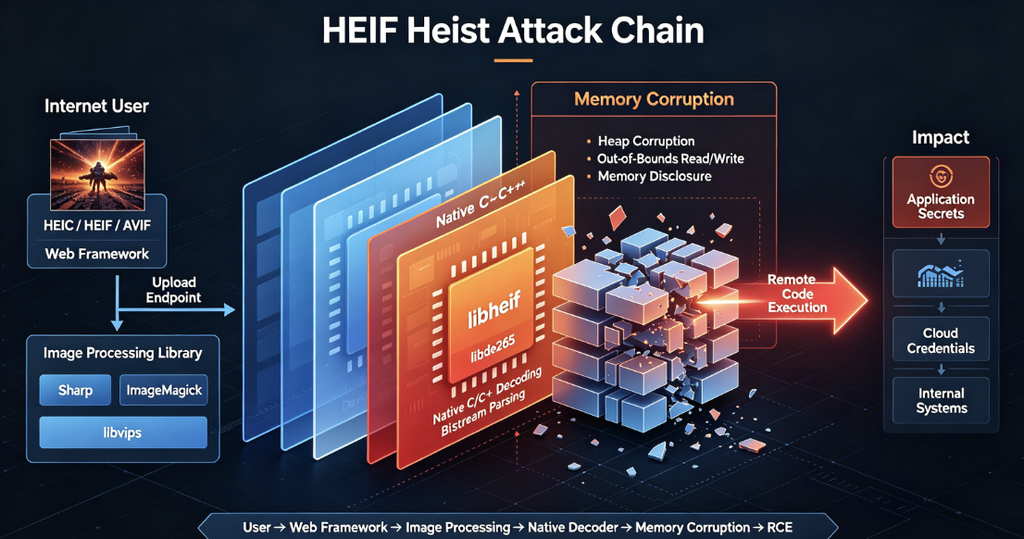
But underneath that seemingly ordinary workflow, the file may have crossed several security boundaries: a web framework hands it to an image-processing package, the package invokes a native wrapper such as Sharp, libvips or ImageMagick, the wrapper loads a C or C++ image parser, and that parser begins interpreting attacker-controlled offsets, dimensions, reference graphs, pixel planes and compressed bitstreams.
HEIF Heist is a striking demonstration of what happens when vulnerabilities exist at the bottom of that stack.
Publicly disclosed by Hacktron in September 2026, HEIF Heist is not one vulnerability and should not be treated as a single CVE. Hacktron uses the name for a broader class of remote attack paths targeting services that decode attacker-controlled HEIF, HEIC or AVIF images through native libraries such as libheif 그리고 libde265. Depending on the vulnerability and surrounding application, the result can range from a process crash to heap disclosure, sensitive-data exposure or remote code execution. (Hacktron)
The research became especially visible because Hacktron demonstrated attack paths involving systems used by OpenAI, Discourse, Meta, Slack, Next.js and GitHub Enterprise. But the more important security lesson is not the list of recognizable brands.
It is the architecture.
A vulnerability in an image decoder can sit several dependency layers below the code that security teams normally audit, while still processing completely untrusted internet input.
That makes HEIF Heist an important case study in modern application security, supply-chain risk, native memory safety and AI-assisted exploit development.
What Is HEIF Heist?
Hacktron defines HEIF Heist as a family of attack paths involving applications that process attacker-controlled HEIF, HEIC or AVIF content. The vulnerable surface sits primarily in native C/C++ components such as libheif 그리고 libde265, which may be pulled into production indirectly through ImageMagick, libvips, Sharp, operating-system packages or prebuilt container images. (Hacktron)
That distinction matters.
There is no universal vulnerability called simply “the HEIF Heist CVE.”
Instead, the research intersects with numerous vulnerabilities and advisories affecting different versions, code paths and products.
For example, libheif CVE-2026-84383 describes a critical heap-buffer overflow involving duplicate alpha planes created through nested iden 그리고 auxl references. The upstream advisory says a crafted HEIC, HEIF or AVIF file can cause 16-bit samples to be written into an 8-bit allocation, producing an attacker-influenced out-of-bounds write. The advisory gives the issue a CVSS 3.1 score of 9.8 and states that libheif versions from 1.22.0 through 1.23.1 are affected, with 1.23.2 containing the fix. (GitHub)
Another critical upstream advisory, GHSA-2jg2-4ch7-h545, describes out-of-bounds reads and writes arising from incorrect assumptions about the relationship between an image’s logical geometry and its underlying channel planes. It affected libheif through version 1.23.1 and was also fixed in 1.23.2. According to the advisory, Meta’s Product Security team confirmed a functional RCE proof of concept involving a malformed HEIC file and identified multiple related vulnerabilities during its investigation. (GitHub)
The picture becomes clearer when those vulnerabilities are considered together.
HEIF Heist is less like a single broken lock and more like the discovery that a large number of buildings quietly installed locks from the same vulnerable family.
Why HEIF, HEIC and AVIF Matter
HEIF stands for High Efficiency Image File Format. HEIC is commonly used for HEIF images encoded using HEVC/H.265, while AVIF uses AV1 image compression within a related ISO Base Media File Format structure.
These formats offer capabilities well beyond a simple flat bitmap.
A file can describe image items, metadata, grids, transformations, derived images, alpha channels, auxiliary images, references between objects and encoded media streams.
That flexibility is useful for legitimate image processing.
It also means that a decoder must process complex attacker-controlled relationships.
A simplified processing chain may look like this:
Internet user
     |
     v
Upload endpoint
     |
     v
Web framework / CMS
     |
     v
Sharp / ImageMagick / libvips
     |
     v
libheif
     |
     +---- HEIF container parsing
     +---- derived image handling
     +---- grid / overlay operations
     +---- alpha planes
     +---- AV1 / HEVC decoding
                       |
                       v
                 libde265 / codec
The security boundary is therefore not just the upload controller.
Even if the application itself is written in memory-safe JavaScript, Ruby, Python or another high-level language, an image-processing operation can eventually pass attacker-controlled bytes into native C or C++.
Once that happens, memory-safety assumptions inside the decoder become part of the security model of the web application.
This is why the HEIF Heist researchers describe the issue as effectively language and framework agnostic. (Hacktron)
The Hidden Native Dependency Problem
Consider a modern Node.js application.
Developers may reasonably believe that their application consists of TypeScript, Next.js and a small set of npm packages.
But image processing might use Sharp.
Sharp in turn uses native image-processing components.
Those components may support HEIF and AVIF through libheif.
And libheif may itself rely on additional codec implementations.
At that point, a request such as:
POST /upload
Content-Type: multipart/form-data

avatar.avif
may cause attacker-controlled content to travel from JavaScript into native memory-management code.
The npm application does not need to explicitly import libheif 에 대한 libheif to become part of its external attack surface.
This exact dependency relationship became visible in Sharp’s August 2026 security advisory. Sharp versions before 0.35.4 were considered affected when processing untrusted inputs because vulnerable libheif components could potentially result in remote code execution under certain Linux configurations. Sharp 0.35.4 updated its bundled libheif to 1.23.2. (GitHub)
This is one of the central lessons of HEIF Heist:
your attack surface includes code that your developers may never have knowingly installed.
The Memory-Corruption Primitive Behind HEIF Heist
A particularly useful example is CVE-2026-84383.
The vulnerability involved interactions between derived images, auxiliary image references, alpha planes and image resizing.
At a high level, a malicious file could construct internal image objects whose channel layouts violated assumptions later made by the resizing code.
The affected code could encounter multiple alpha planes with different bit depths. The destination allocation could be sized using information from one plane while a later code path wrote data using the assumptions of another.
The result was a heap-buffer overflow.
The upstream advisory explains that both the amount of overflow and the values written could be influenced through attacker-controlled image structures and encoded pixel data. (GitHub)
That is a significantly different security condition from a simple malformed-image crash.
A crash gives an attacker a denial-of-service primitive.
A controlled heap write may provide a foundation for code execution.
Similarly, an out-of-bounds read can potentially disclose heap contents that were never supposed to leave the process.
Hacktron specifically highlights this second scenario in its explanation of the name “HEIF Heist”: even when RCE is unavailable, heap disclosure may expose other users’ data, environment variables and other secrets present in the image-processing process. (Hacktron)
That means an image parser vulnerability can become a secrets-management vulnerability.
From Image Upload to Server Compromise
The generic HEIF Heist attack chain is therefore more interesting than simply saying “upload a malicious image.”
Conceptually, the chain looks like this:
Attacker-controlled HEIC / AVIF
            |
            v
Public image upload endpoint
            |
            v
Application accepts the format
            |
            v
Image conversion / optimization triggered
            |
            v
Native HEIF parser processes malicious structure
            |
            v
Memory corruption
       /            \
      v              v
Heap disclosure     Controlled memory write
      |              |
      v              v
Secrets leak       Process compromise
                       |
                       v
                 Remote Code Execution
Whether the attack reaches the final stage depends heavily on the exact vulnerability, target architecture, allocator, process sandbox and operating-system protections.
Hacktron explicitly cautions that the vulnerabilities are not universal one-click exploits. Exploitation may require identifying the target’s decoder version and adapting the payload to the relevant memory layout. The researchers reported that some attempts required large numbers of image submissions before producing a successful RCE. (Hacktron)
That nuance is important.
HEIF Heist demonstrates a serious attack class, but it does not mean every server accepting .avif files can automatically be compromised with one universal file.
The OpenAI HEIF Heist Attack Chain
The most widely discussed HEIF Heist case began with OpenAI’s community forum.
According to Hacktron’s detailed disclosure, OpenAI used Discourse for community.openai.com. HEIC and HEIF uploads passed through a path involving ImageMagick, which exposed the underlying libheif decoder to attacker-controlled images. (Hacktron AI)
The researchers found that the Discourse Docker environment included an older vulnerable libheif package. Their investigation identified a heap-buffer-overflow condition capable of producing out-of-bounds read/write primitives during HEIC processing.
The first security boundary therefore looked roughly like this:
HEIC upload
   ↓
Discourse
   ↓
ImageMagick
   ↓
libheif
   ↓
heap corruption
   ↓
RCE in forum environment
But that was only the beginning.
Hacktron reported that the researchers then combined the forum compromise with a separate OpenAI authentication problem.
According to their disclosure, an issue in the OpenAI SSO flow allowed the impact of the forum compromise to extend into OpenAI accounts using the identity integration.
The full chain they documented was:
libheif image decoder
        ↓
Discourse image processing
        ↓
community.openai.com compromise
        ↓
OpenAI SSO identity flaw
        ↓
ChatGPT / Codex employee account access
        ↓
connected GitHub integration
        ↓
OpenAI internal repository access
To demonstrate impact while avoiding access to sensitive source code, the researchers say they instructed the compromised employee’s Codex session to create a harmless pull request in OpenAI’s internal monorepo. (Hacktron AI)
Hacktron says the period from initial discovery to demonstrating internal repository access was under 72 hours.
They reported the issues through the relevant bug-bounty channels. According to their disclosure, OpenAI confirmed its side of the issue had been fixed roughly 14 hours after the submission, and later awarded a $6,500 bounty for the OpenAI-side authentication finding. Hacktron also notes that testing against the Discourse-hosted forum itself was outside OpenAI’s bounty scope. (Hacktron AI)
That distinction is worth preserving because some early coverage simplified the story into “Claude hacked OpenAI.”
The actual technical story was more complicated:
a native image-decoder weakness enabled compromise of a third-party-hosted forum environment, and a separate identity design issue allowed that foothold to cross a much more important trust boundary.
Discourse and the Malformed HEIF RCE
Discourse published its own advisory, GHSA-vhm9-85gw-x335, on July 28, 2026.
The advisory states that an upstream libheif vulnerability allowed remote code execution through Discourse image uploads. The advisory carries a CVSS 3.1 score of 8.8 and identifies patched Discourse releases including 2026.7.0, 2026.6.1, 2026.5.2 and 2026.1.6. (GitHub)
For self-hosted Discourse installations, simply updating application-layer Ruby code may therefore not have been sufficient.
Hacktron specifically warned administrators to rebuild the Discourse container so that the underlying image and its native packages are replaced. (Hacktron AI)
This is another recurring supply-chain lesson.
Security teams often ask:
“Did we upgrade the vulnerable application?”
For this class of issue, a better question is:
“Did we actually replace the vulnerable native library inside the running production artifact?”
Those are not always the same thing.
Next.js and Unauthenticated AVIF RCE
Next.js provides an especially clear demonstration of how an underlying image-decoder vulnerability can propagate into an application framework.
GitHub’s reviewed advisory GHSA-2xp9-vwfh-vxw4 describes an unauthenticated RCE condition in the Next.js Image Optimization API when crafted AVIF images reach the vulnerable libheif dependency used through Sharp.
Affected releases include Next.js versions from 10.0.0 through versions below 15.5.24, as well as 16.x releases below 16.3.3. GitHub scores the advisory 9.5 under CVSS v4. (GitHub)
Vercel independently documented the issue in its August 25 security release.
It stated that GHSA-2xp9-vwfh-vxw4 originated in the upstream libheif dependency and could cause unauthenticated remote code execution when Next.js Image Optimization processed a crafted AVIF image. (Vercel)
Vercel temporarily disabled AVIF optimization in its managed image service, while self-hosted users were instructed to update.
At the time of that advisory, the relevant commands were:
# Next.js 15.x and earlier
npm install next@15.5.24

# Next.js 16.x
npm install next@16.3.3
Vercel stated that patched versions temporarily served AVIF images without resizing or optimization rather than passing them through the vulnerable path. (Vercel)
This case demonstrates why file-processing functionality should be treated as an externally reachable interpreter.
From an attacker’s perspective, the endpoint does not need to say /execute-code.
It only needs to say /optimize-image.
Sharp and Astro Were Exposed Through the Same Dependency Layer
Sharp’s advisory makes the transitive nature of the risk even more explicit.
Applications using Sharp versions below 0.35.4 to process untrusted input could be affected by upstream libheif vulnerabilities. Sharp 0.35.4 moved to libheif 1.23.2. (GitHub)
Astro inherited similar risk through its default Sharp image service.
GitHub’s advisory for Astro, GHSA-26w7-cxv4-gfx2, states that a malicious AVIF processed by a vulnerable project could lead to remote code execution. Versions before Astro 7.2.8 were affected, while 7.2.8 moved to the corrected Sharp dependency. The advisory is rated critical with CVSS 9.8. (GitHub)
The dependency chain is therefore important enough to write explicitly:
Astro / Next.js application
        ↓
      Sharp
        ↓
     libvips
        ↓
     libheif
        ↓
native memory corruption
A JavaScript dependency scanner that stops at JavaScript package boundaries can miss the actual vulnerable code responsible for exploitation.
Meta Confirmed a Working libheif RCE Proof of Concept
One of the strongest pieces of evidence supporting the seriousness of the underlying bug class comes from the upstream libheif advisory itself.
GHSA-2jg2-4ch7-h545 includes a report associated with Meta’s Product Security team.
The advisory states that Meta received an external report describing a working exploit against libheif 1.23.1 in which parsing a malformed HEIC file could execute malicious code.
Meta’s investigation reportedly uncovered 11 related vulnerabilities involving assumptions about HeifPixelImage geometry and channel-plane layout. (GitHub)
That is significant because it demonstrates that this was not simply a theoretical crash found by fuzzing.
A functional RCE proof of concept existed against a then-current version of the library.
GitHub Enterprise Needs a More Careful Explanation
HEIF Heist’s project page also references CVE-2026-19118 as an authenticated GitHub Enterprise Server RCE.
However, this case should not simply be described as another libheif CVE.
GitHub’s official release notes describe CVE-2026-19118 as a high-severity race condition in which an authenticated attacker with repository write access could replace previously validated uploaded content with attacker-controlled content before the processing stage, ultimately obtaining arbitrary code execution. (GitHub Docs)
GitHub’s public description does not identify libheif as the root cause.
So the technically accurate formulation is that the HEIF Heist researchers include the GitHub Enterprise finding within their broader image-processing research, while GitHub’s official advisory documents the immediate vulnerability as a validation/processing race condition.
That distinction matters for vulnerability management.
Security teams should remediate based on the vendor’s actual advisory rather than assuming that updating libheif alone fixes every attack path discussed under the HEIF Heist name.
libde265 Expands the Native Attack Surface
libheif is not the only native component involved.
HEIC images can include HEVC/H.265 encoded content, which means decoder libraries such as libde265 can form another security boundary.
During 2026, libde265 received multiple memory-safety fixes.
For example, CVE-2026-49346 involved an integer overflow in image dimension handling that could lead to a severely undersized allocation followed by a much larger write. (GitHub)
Other advisories addressed out-of-bounds writes during reference-picture processing and additional decoder-state problems. (GitHub)
The project later released libde265 1.1.2 on September 2, 2026 as a security and bug-fix release. Among its fixes were heap use-after-free and double-free conditions in multithreaded decoding, as well as another use-after-free related to decoder reset state. (GitHub)
So patch management should not end at libheif.
The codec underneath it matters too.
Why HEIF Heist Is More Than Another Image Parser Bug
Image parser vulnerabilities are not new.
What makes HEIF Heist particularly relevant in 2026 is the combination of three factors:
complex native parsing, widespread transitive deployment and rapidly improving AI-assisted exploit engineering.
Modern web stacks have spent years moving business logic into safer languages and managed runtimes.
Yet media processing remains full of high-performance C and C++.
At the same time, image optimization has become infrastructure.
Frameworks automatically resize images.
CDNs transcode them.
CMS platforms generate thumbnails.
Messaging applications generate previews.
AI products accept multimodal uploads.
Developer platforms render avatars, attachments and repository content.
The attacker therefore has enormous numbers of opportunities to make a server decode an image.
HEIF Heist turns that mundane functionality into an attack surface worthy of the same attention normally given to authentication endpoints, template engines or deserialization frameworks.
AI-Assisted Exploit Development Changed the Economics
The second major reason HEIF Heist attracted attention is how Hacktron says it used frontier models during exploit development.
According to Hacktron’s OpenAI write-up, Claude Opus 4.8 was initially used to inspect the Discourse environment and vulnerable libheif package.
The researchers say Opus 4.8 helped construct an exploit with ASLR disabled but struggled to make it reliable under more realistic mitigations.
After Claude Opus 5 became available, the team assigned the same class of problem to the newer model. They report that Opus 5 produced a working ARM64 local exploit within roughly three hours and was subsequently used to adapt the exploit to the x86-64 and jemalloc configuration involved in the Discourse environment. (Hacktron AI)
Hacktron further says that later stages of the broader HEIF Heist campaign used GPT-5.6 Sol, particularly when adapting exploitation without detailed prior knowledge of the remote target environment. (Hacktron AI)
The researchers estimate that the larger two-month investigation cost less than $3,000 in model tokens and involved three researchers. They say adapting the exploit to a new company generally required one or two days. (Hacktron AI)
Those numbers come from the researchers themselves rather than an independent benchmark, so they should not be generalized into a universal measurement of AI exploit capability.
But the qualitative conclusion is still important.
One of the traditional protections around memory-corruption bugs was economic rather than cryptographic.
Turning a crash into reliable RCE required specialized expertise.
ASLR, allocator behavior, compiler differences and target-specific layouts raised the cost further.
AI does not eliminate these barriers.
But HEIF Heist provides evidence that it can help skilled operators traverse them more quickly.
AI Did Not Make the Attack Fully Autonomous
It would also be misleading to describe the work as completely autonomous hacking.
Hacktron explicitly says skilled human guidance remained important. (Hacktron AI)
That distinction matters.
The interesting security transition is not necessarily:
human hacker → autonomous AI hackerIt may instead be:
one highly skilled researcher
        +
multiple parallel AI agents
        +
cheap repeated experimentation
        =
research output that previously required a larger team
This is arguably more relevant for defenders.
Attackers do not need a perfect autonomous cyber agent.
They only need AI to make vulnerability research, crash triage, code auditing, environment adaptation and exploit debugging cheaper.
Which libheif Versions Should Be Considered Safe?
Administrators should avoid interpreting HEIF Heist as “upgrade past one CVE and you are finished.”
The project has experienced several rapid security releases.
libheif 1.23.2, released in August 2026, fixed multiple critical and high-severity vulnerabilities including CVE-2026-84383 and GHSA-2jg2-4ch7-h545. (GitHub)
However, that was not the final security release.
Version 1.23.3 subsequently addressed another critical heap-buffer-overflow condition.
Version 1.23.4, released September 6, is a further security-maintenance release, and the project’s release notes state that three of its corrected issues were rated high severity. (GitHub)
Therefore, as of September 20, 2026, teams building directly against upstream libheif should be evaluating 1.23.4, not stopping at the earlier 1.23.2 recommendation.
Distribution packaging complicates the situation.
A Linux distribution may backport security patches without adopting the same upstream version number.
Debian, for example, published DSA-6417-1 in August to correct a set of libheif vulnerabilities and marked its Debian 13 package 1.19.8-1+deb13u1 as fixed for that advisory. (security-tracker.debian.org)
Consequently, blindly comparing semantic versions can produce false positives or false negatives.
The correct question is whether the package contains the relevant security backports.
How to Check Whether a Server Uses libheif
On Linux systems, defenders can begin by checking installed packages.
Debian or Ubuntu:
dpkg -l | grep -E 'libheif|libde265|imagemagick'
apt-cache policy libheif1 libde265-0
RPM-based distributions:
rpm -qa | grep -E 'libheif|libde265|ImageMagick'For ImageMagick:
magick -version
magick identify -list format | grep -Ei 'HEIC|HEIF|AVIF'
The second command is particularly useful because merely installing libheif does not necessarily mean the application exposes it to attacker-controlled content.
What matters is whether an externally reachable processing path can invoke it.
Node.js applications should inspect Sharp:
npm list sharpand, where available:
const sharp = require("sharp");

console.log(sharp.versions);
This can reveal the native library versions bundled into the runtime.
Containerized systems also require checking the actual production image rather than only the developer workstation.
예를 들어
docker run --rm YOUR_IMAGE \
  sh -c 'dpkg -l 2>/dev/null | grep -E "libheif|libde265" || true'
The goal is inventory, not exploitation.
Security teams need to determine whether untrusted input can reach the decoder.
Don’t Trust File Extensions as a Security Boundary
One tempting mitigation is to reject .heic 또는 .avif.
That can reduce exposure, but extension checks alone are weak.
Files can be renamed.
Content-type headers are controlled by clients.
Libraries may perform format detection based on magic bytes rather than extensions.
Image-processing pipelines may also transcode or re-read previously stored files.
Therefore:
filename.jpgdoes not necessarily imply that only a JPEG decoder will ever process the content.
A safer architecture validates the actual format, explicitly restricts the set of decoders that can run and isolates the media-processing service from sensitive infrastructure.
Disable HEIF and AVIF Decoding When You Do Not Need It
One of the simplest lessons from HEIF Heist is that unnecessary parsers should not be reachable.
Every enabled image format adds parsing code.
Every additional decoder increases the amount of native code an attacker can exercise.
ImageMagick explicitly recommends adapting its security policy to the threat model. Its documentation notes that the default model is permissive and provides mechanisms for restricting coders, modules, memory, disk usage and processing time. It also recommends sandboxing for untrusted environments. (이미지 매직)
For a service that only needs PNG, JPEG and WebP, a restricted policy could conceptually resemble:
<policy domain="module" rights="none" pattern="*" />
<policy domain="module"
        rights="read|write"
        pattern="{PNG,JPEG,WEBP}" />
The exact policy should be tested against application requirements before deployment.
The principle is more important than the snippet:
do not expose a complex parser to internet input merely because your imaging library happens to support the format.
Run Image Processing as an Untrusted Workload
Patching is necessary.
It is not enough.
The HEIF ecosystem has received multiple security fixes in a relatively short period, suggesting that defenders should expect additional parser vulnerabilities rather than assuming all relevant bugs have now been found.
Image processing should therefore run under the assumption that another decoder vulnerability will eventually exist.
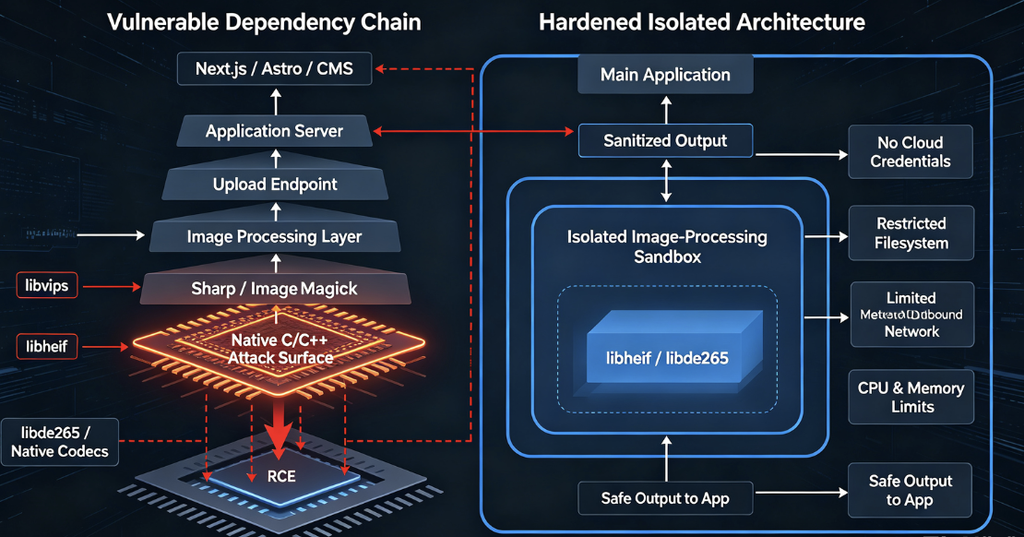
A hardened architecture can look like this:
Internet
   |
   v
Upload gateway
   |
   | no cloud credentials
   | no database credentials
   | no internal API tokens
   v
Ephemeral image-processing sandbox
   |
   | restricted filesystem
   | blocked metadata services
   | limited outbound network
   | CPU / RAM / time limits
   v
Sanitized output
   |
   v
Main application
This architecture changes the consequence of decoder compromise.
Instead of turning:
image parser RCEinto:
production infrastructure compromisethe result becomes closer to:
image parser RCE
        ↓
short-lived isolated worker
        ↓
minimal credentials
        ↓
limited lateral movement
That is a much better security property.
Remove Secrets From Image-Processing Workers
HEIF Heist also highlights a subtle secret-management issue.
If the image worker contains AWS credentials, database passwords, signing keys, service tokens or internal API credentials in its environment, then an arbitrary read may be nearly as damaging as RCE.
The worker does not need those secrets merely because the main application does.
Use narrowly scoped identities.
Prefer short-lived credentials.
Avoid inheriting the parent service’s entire environment.
Block access to cloud metadata APIs unless required.
Do not mount application-wide secret directories into conversion containers.
Memory disclosure becomes less valuable when there is little valuable memory to disclose.
Detection Opportunities for HEIF Heist-Like Attacks
Memory-corruption exploitation frequently leaves operational signals even when the payload itself is difficult to detect.
Hacktron reported cases in which successful exploitation required large numbers of image submissions and repeated parser crashes. (Hacktron)
That suggests useful detection opportunities around behavior rather than signatures.
For example, defenders can correlate:
unusual HEIC / AVIF upload volume
        +
repeated image-worker crashes
        +
segmentation faults
        +
rapidly changing malformed files
        +
same account / source IP
        +
container restarts
A single malformed image is probably noise.
Hundreds or thousands of distinct HEIC files followed by repeated worker crashes deserve investigation.
Useful telemetry includes application upload logs, worker exit codes, kernel crash reports, container restart counts, ImageMagick errors, libheif parsing errors and outbound connections originating from image-processing workers.
Why WAF Rules Alone Will Not Solve HEIF Heist
A web application firewall operates primarily at the HTTP and application-protocol layers.
The HEIF vulnerability exists much deeper.
A perfectly legitimate request can look like:
POST /api/avatar HTTP/1.1
Content-Type: multipart/form-data
The dangerous behavior occurs only after the uploaded bytes reach the native decoder.
The WAF would effectively need to reproduce substantial portions of HEIF parsing to reliably distinguish safe structures from malicious ones.
Doing so simply creates another parser that itself needs to be secure.
WAF controls can still reduce abuse by limiting upload rates, request sizes and suspicious automation.
But they are supplementary controls.
The primary defenses are patched parsers, reduced attack surface and isolation.
SBOMs Need to Reach Native Dependencies
HEIF Heist also exposes a weakness in shallow software bills of materials.
Imagine an SBOM containing:
next
sharp
react
typescript
That may look complete from the npm perspective.
From the security perspective, it is incomplete if Sharp’s executable artifacts also contain:
libvips
libheif
libde265
libaom
Security teams should therefore inventory not only language-level packages but also shared libraries and native binaries inside their deployed artifacts.
This is particularly important with prebuilt binaries.
The vulnerable component may never appear explicitly in package.json.
What HEIF Heist Means for Penetration Testing
HEIF Heist provides a useful lesson for modern black-box security testing.
File-upload testing traditionally focuses heavily on application-layer issues:
extension bypass
MIME spoofing
path traversal
stored XSS
SVG scripting
malware upload
web-shell upload
Those remain useful.
But the upload endpoint can also expose an entire native media-processing attack surface.
A better security assessment asks what happens after the upload succeeds.
Does the application create thumbnails?
Does it extract metadata?
Does it generate previews?
Does it optimize AVIF?
Does it call ImageMagick?
Does the framework automatically transform remote images?
Which native parsers are loaded?
What privileges does that worker have?
What secrets exist in its environment?
Can it access the private network?
The upload feature is therefore not merely a storage feature.
It may be a remote interface to a complex C++ parser.
The Most Important Lesson From the OpenAI Case
The OpenAI portion of HEIF Heist demonstrates another security principle that extends far beyond image processing.
The original RCE occurred in a community forum.
A community forum should ordinarily be far less valuable than an internal development environment.
Yet the identity relationship between the forum and OpenAI services allowed the initial compromise to cross trust boundaries.
That transformed:
forum RCEinto a path toward:
employee identity
    ↓
ChatGPT / Codex
    ↓
connected GitHub resources
    ↓
internal source repositories
This is why third-party services using first-party SSO must be part of an organization’s threat model.
SSO simplifies authentication.
It can also connect the blast radius of systems that would otherwise be isolated.
An externally hosted forum should never automatically become equivalent to the security boundary protecting highly privileged internal developer identities.
HEIF Heist Is a Dependency Security Story
One way to understand HEIF Heist is through the familiar dependency-chain diagram:
Web application
      ↓
Framework
      ↓
Image library
      ↓
Native wrapper
      ↓
HEIF parser
      ↓
Codec
The higher layers inherit security assumptions from everything below them.
The developer may have audited the application.
The framework maintainer may have audited the framework.
Sharp may correctly validate its API arguments.
ImageMagick may correctly invoke its decoder.
And the resulting system can still be exploitable because the lowest native parser mishandles an attacker-controlled object graph.
The weakest dependency wins.
Current Patch Guidance as of September 20, 2026
The precise remediation depends on how the image-processing stack is deployed.
| 구성 요소 | Relevant status |
|---|---|
libheif | Upstream security maintenance release is 1.23.4 as of September 2026; administrators should also check distro backports. (GitHub) |
libde265 | 1.1.2 was released September 2 as a security and bug-fix update. (GitHub) |
| Sharp | Versions < 0.35.4 were affected by the relevant upstream libheif issues; update to a current release. (GitHub) |
| Next.js | GHSA-2xp9-vwfh-vxw4 affected <15.5.24 그리고 16.x <16.3.3 in the documented ranges; use current supported Next.js releases rather than treating those historical minimums as long-term targets. (GitHub) |
| Astro | HEIF-related image optimization RCE fixed in 7.2.8; current supported releases should be preferred. (GitHub) |
| Discourse | Rebuild/update installations according to the vendor advisory so the underlying native packages are replaced. (GitHub) |
| 이미지 매직 | Restrict unused coders and apply an appropriate security policy in addition to keeping dependencies updated. (이미지 매직) |
Do not treat this table as a substitute for checking current vendor advisories.
A distribution can backport fixes while keeping an older-looking package version, and upstream projects may release additional security updates after publication.
HEIF Heist and the Future of Image Parser Security
There is a broader reason HEIF Heist deserves attention.
Image formats are becoming more capable while applications are becoming more eager to process images automatically.
A file uploaded today may be:
resized by a framework, transcoded by a CDN, scanned by an antivirus engine, analyzed by an AI model, converted into a thumbnail, inspected for metadata and stored in multiple derivative formats.
Every transformation introduces code.
Every parser introduces assumptions.
Every native library introduces memory-management risk.
Meanwhile, AI-assisted vulnerability research lowers the cost of understanding and adapting those bugs.
Hacktron claims that some HEIF Heist targets required substantial experimentation and thousands of image-processing attempts, but that frontier AI models reduced exploit-development timelines to roughly days rather than the much longer cycles traditionally associated with advanced memory-corruption work. (Hacktron)
Whether every future vulnerability sees the same acceleration is unknown.
The defensive implication does not require that assumption to be true.
Organizations should stop treating difficult exploitation as a permanent security control.
최종 생각
HEIF Heist is not simply a story about HEIC images.
It is a story about hidden attack surfaces.
An innocent-looking upload feature can expose complex native parsers. A JavaScript framework can inherit a C++ memory-safety bug several layers below its own code. A vulnerable decoder can transform image optimization into remote code execution. An RCE in a relatively low-value service can become critical when identity and credentials connect it to more sensitive systems.
And AI can make the process of turning those underlying bugs into target-specific exploits substantially cheaper for skilled security researchers.
The most useful response is therefore broader than patching one CVE.
Update libheif 그리고 libde265. Update Sharp, Next.js, Astro, Discourse and any other affected wrappers or frameworks. Check the binaries that are actually running in containers. Disable image formats you do not need. Treat media-processing workers as hostile workloads. Keep secrets out of those processes. Monitor repeated decoder crashes. And include native transitive dependencies in both your SBOM and your penetration-testing scope.
HEIF Heist reinforces a security principle that is easy to forget:
the code processing an untrusted file is part of your external perimeter, even when that code lives five dependencies beneath your application.

 Korean
  English
  German
  French
  Spanish
  Portuguese
  Japanese
  Hindi
Hindi  Arabic
  Turkish
  Hebrew