
There are vulnerabilities that earn a CVSS 10.0 because a scoring formula says the worst-case conditions line up. Then there are vulnerabilities where the score almost feels secondary.
CVE-2026-76460 belongs to the second category.
Cisco disclosed CVE-2026-76460 on September 16, 2026 as a critical authentication bypass affecting Cisco Identity Services Engine, or ISE, and Cisco ISE Passive Identity Connector, commonly called ISE-PIC. The vulnerability sits in an API endpoint where authentication controls were insufficient. According to Cisco, an unauthenticated remote attacker can send a specially crafted request to that API and bypass the normal web management authentication boundary. (Cisco)
That alone would justify urgent remediation.
But Cisco disclosed something more important: the vulnerability is already being actively exploited.
More seriously, Cisco warns that successful exploitation may result in command execution with root privileges. At that point, CVE-2026-76460 stops looking like an ordinary web authentication bug and starts looking like a potential compromise of one of the systems responsible for deciding who and what gets access to an enterprise network. (Team Development)
CISA added CVE-2026-76460 to its Known Exploited Vulnerabilities catalog on September 16, 2026, with a remediation due date of September 19 for affected U.S. federal civilian agencies. The KEV entry also requires forensic triage under BOD 26-04, reflecting the fact that remediation is not simply a matter of installing a patch when exploitation may already have occurred. (Deja Vu)
For defenders running Cisco ISE, that distinction matters.
The correct question is no longer simply:
“Are we vulnerable?”
It is also:
“Were we vulnerable while attackers were already exploiting this flaw?”
Those are two very different incident-response problems.
What Is CVE-2026-76460?
CVE-2026-76460 is an authentication bypass vulnerability in an API exposed by Cisco Identity Services Engine.
Cisco describes the root cause as insufficient authentication control on an API endpoint. An attacker able to reach the affected interface can submit a crafted request and potentially access the device without successfully passing through the authentication process normally enforced by the web-based management interface. (Cisco)
Cisco assigned the issue:
CVE: CVE-2026-76460
Cisco Bug ID: CSCww39530
CWE: CWE-648 — Incorrect Use of Privileged APIs
CVSS v3.1: 10.0 Critical
공격 벡터: 네트워크
Attack Complexity: 낮음
Privileges Required: 없음
User Interaction: 없음
Cisco exploitation status: Actively exploited
The complete CVSS vector published by Cisco is:
CVSS:3.1/AV:N/AC:L/PR:N/UI:N/S:C/C:H/I:H/A:HThat vector captures why defenders should treat the issue aggressively. The attack is remotely reachable, requires no existing account, does not depend on a victim clicking anything, and can result in severe confidentiality, integrity and availability impact. (Cisco)
Cisco’s authoritative advisory is available here: Cisco Security Advisory for CVE-2026-76460
Why Cisco ISE Makes This Vulnerability Particularly Dangerous
Understanding CVE-2026-76460 requires understanding what Cisco ISE actually does.
Cisco Identity Services Engine is not simply another administrative web application sitting somewhere in an enterprise network.
ISE is a policy and identity platform used to make network access decisions. Organizations can use it with technologies such as 802.1X, RADIUS, TACACS+, VPN infrastructure, wired networks and wireless networks to determine whether a user or device should be allowed onto the network and what level of access it should receive.
That puts ISE close to what might be called the trust control plane of an enterprise.
A normal application server may hold data belonging to one application. An identity and network-access system can influence trust decisions across thousands of endpoints and infrastructure devices.
That changes the consequences of compromise.
If an attacker compromises a conventional web server, the immediate blast radius may initially be bounded by the data and credentials accessible to that server.
If an attacker gains privileged control over an ISE node, defenders have to consider something broader: whether the system making network identity and authorization decisions can still be trusted.
This is one reason the combination of authentication bypass and root-level command execution deserves substantially more attention than the phrase “API authentication vulnerability” might initially suggest.
The Technical Problem Behind CVE-2026-76460
Cisco has not publicly documented enough implementation detail to justify pretending that the complete vulnerable code path is known.
What is known is significant enough.
The vendor says that an API endpoint does not apply authentication controls correctly. A specially crafted request can therefore reach functionality that should have been protected behind the application’s authentication boundary. (Cisco)
Conceptually, the vulnerable architecture looks something like this:
Normal administrative request

Client
   |
   v
Management/API Interface
   |
   v
Authentication Check
   |
   v
Authorized API Function
   |
   v
ISE Backend


CVE-2026-76460 exploitation path

Unauthenticated Client
   |
   v
Affected API Endpoint
   |
   +---- Authentication enforcement fails
   |
   v
Privileged Functionality
   |
   v
ISE Backend
   |
   v
Potential root-level command execution
This is importantly different from stealing an administrator password.
With credential theft, authentication technically still works; the attacker has simply obtained something the system accepts as proof of identity.
With an authentication bypass, the attacker may be able to cross the boundary without possessing valid administrator credentials at all.
That has operational consequences.
Password rotation does not fix the underlying exposure. MFA does not necessarily protect an API path that never properly invokes the authentication decision. Locking or deleting suspicious administrator accounts does not repair a privileged endpoint that incorrectly accepts unauthenticated requests.
The vulnerability exists underneath those controls.
CWE-648 and Privileged APIs
Cisco maps CVE-2026-76460 to CWE-648: Incorrect Use of Privileged APIs. (Cisco)
The important architectural lesson is that authentication and authorization cannot be treated as properties of the frontend.
A management interface might visually require a user to log in before displaying administrative functionality, but that does not automatically mean every backend route implements the same boundary.
Secure systems require authorization decisions on the server side, at the point where privileged actions are actually executed.
A simplified secure API pattern would resemble:
request
   |
   v
authenticate caller
   |
   +-- failure --> reject request
   |
   v
resolve identity
   |
   v
check privilege
   |
   +-- insufficient privilege --> reject request
   |
   v
perform administrative action
A security failure occurs when a privileged route becomes reachable through an alternative path that misses one of those gates.
That distinction is particularly relevant in modern products composed of API gateways, internal services, web management layers and service-to-service APIs.
The browser UI is not the security boundary.
The backend API is.
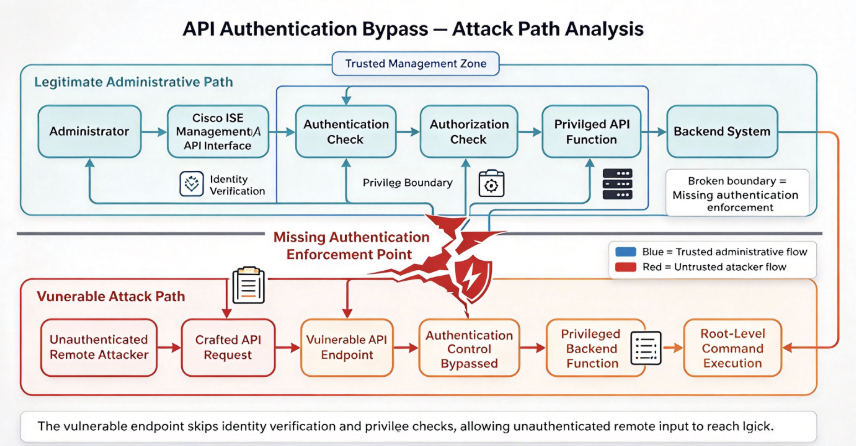
CVE-2026-76460 Is Not Just an Authentication Bypass
One of the most important additions in Cisco’s advisory appears in its compromise-investigation guidance.
Cisco states that after successful exploitation, threat actors may obtain command execution with root privileges. (Team Development)
That dramatically changes the impact model.
An authentication bypass might theoretically provide unauthorized access to an administrative application while still constraining the attacker to application-level actions.
Root command execution means defenders should instead consider the operating system itself compromised.
Once an attacker reaches that privilege level, the relevant questions expand significantly:
Can the attacker modify configuration?

Can the attacker read locally stored secrets?

Can the attacker alter authentication or authorization behavior?

Can the attacker install persistence?

Can the attacker use the appliance to communicate with other systems?

Can the attacker delete logs?

Can the attacker conceal indicators of compromise?
Cisco specifically warns about the last two possibilities.
Because the attacker may obtain root-level execution, Cisco says exploitation evidence and indicators of compromise may be removed or hidden. That is why its guidance tells administrators not to depend exclusively on evidence stored on the affected appliance. (Team Development)
This is arguably one of the most important details in the entire advisory.
An ISE Compromise Is Potentially a Trust Compromise
Security teams often prioritize vulnerabilities according to the asset running the vulnerable software.
That is appropriate here.
ISE frequently participates in network authentication, authorization and identity-aware access policies. It may interact with network infrastructure and enterprise identity systems that assume ISE itself is trusted.
An attacker compromising that trusted component may therefore gain opportunities that extend beyond simply controlling one Linux-based appliance.
The realistic post-compromise investigation should consider whether the attacker could have:
altered network access policies, accessed sensitive configurations, harvested authentication-related material, modified administrative settings, established persistence, interacted with connected infrastructure, or used the ISE node as a staging point for further activity.
Not every successful exploitation necessarily results in all of those actions. Cisco has not said that every exploitation incident produced each of those outcomes.
But root-level control means defenders cannot safely assume they did not happen without investigating.
This is the difference between vulnerability severity 그리고 incident scope.
The CVSS score tells you the potential technical severity.
Incident response has to determine what actually occurred.
Active Exploitation Changes the Response
Cisco PSIRT explicitly states that it is aware of active exploitation of CVE-2026-76460. (Cisco)
That statement changes how vulnerability management teams should approach the issue.
When a vulnerability has not been observed in the wild, an organization may prioritize remediation based on exposure, exploitability, business criticality and patching constraints.
Once exploitation is confirmed, the problem moves closer to incident-response territory.
That is particularly true when three conditions appear together:
Unauthenticated remote exploitation
        +
Root-level command execution
        +
Confirmed exploitation in the wild
CVE-2026-76460 has all three.
The Canadian Centre for Cyber Security likewise highlighted active exploitation when issuing its alert on the vulnerability and recommended immediate upgrade to fixed software. (Canadian Centre for Cyber Security)
Singapore’s Cyber Security Agency issued comparable guidance, including the vendor’s log-investigation instructions and recommendation to update immediately. (Cyber Security Agency of Singapore)
This convergence between vendor disclosure and national cyber authorities is useful because it removes much of the usual uncertainty around whether exploitation is merely theoretically possible.
It is happening.
CISA Added CVE-2026-76460 to the KEV Catalog
CISA added CVE-2026-76460 to its Known Exploited Vulnerabilities catalog on September 16, 2026, the same date as Cisco’s public advisory.
The required remediation date listed for U.S. Federal Civilian Executive Branch agencies was September 19, 2026. CISA’s entry also indicates that forensic triage is required under BOD 26-04. (Deja Vu)
The ransomware-use field was listed as unknown, which is worth distinguishing from active exploitation.
“Known exploited” means evidence exists that attackers have used the vulnerability.
It does not by itself tell us who those attackers were, the exact number of victims, their motivations, or whether ransomware operators were responsible.
Claims going beyond that should therefore be treated cautiously unless supported by additional incident intelligence.
Which Cisco Products Are Vulnerable?
Cisco says CVE-2026-76460 affects:
Cisco Identity Services Engine
그리고
Cisco ISE Passive Identity Connector
Importantly, Cisco says affected products are vulnerable regardless of device configuration. (Cisco)
That sentence deserves attention because administrators sometimes assume an optional feature must be enabled before a vulnerability becomes exploitable.
Cisco’s advisory does not offer that comfort here.
The fixed versions are:
| Cisco ISE / ISE-PIC branch | First fixed release |
|---|---|
| 3.1 | 3.1 Patch 12 |
| 3.2 | 3.2 Patch 11 |
| 3.3 | 3.3 Patch 12 |
| 3.4 | 3.4 Patch 7 |
| 3.5 | 3.5 Patch 4 |
Cisco ISE 3.0 has reached End of Software Maintenance. Cisco recommends moving from 3.0 to a supported release containing the fix rather than expecting another 3.0 security patch. (Cisco)
This means administrators should verify the complete patch level rather than simply checking whether a deployment reports “3.4” or “3.5.”
예를 들어
ISE 3.4 ≠ necessarily safe

ISE 3.4 Patch 7 or later = fixed for CVE-2026-76460
That is an easy but important distinction during rapid asset inventory.
There Is No Workaround, but There Is a Mitigation
Cisco states that there is no workaround that addresses the vulnerability itself.
There is, however, a network-level mitigation.
Administrators who cannot immediately patch can use infrastructure access control lists, or iACLs, to restrict traffic destined for affected appliances to only the management and control-plane traffic that is actually required. (Team Development)
This is useful, but terminology matters.
An iACL does not remove CVE-2026-76460 from the appliance.
It reduces who can reach the attack surface.
Conceptually:
Before iACL restriction

Internet / User Networks / Compromised Hosts
                  |
                  v
             ISE API


After restrictive iACL

Approved Management Sources
                  |
                  v
               iACL
                  |
                  v
             ISE API

Other Sources
      |
      X
That can materially reduce risk, especially for unnecessarily exposed management interfaces.
But it is not equivalent to installing the fixed software.
If an attacker already controls a permitted management host or resides inside an allowed network segment, network filtering may not prevent exploitation.
Cisco therefore continues to recommend upgrading to a fixed release. (Cisco)
How to Check for CVE-2026-76460 Exploitation
Cisco included unusually important forensic guidance with this vulnerability.
Administrators should examine the API gateway access logs and look for suspicious usernames.
Cisco provides the following example command:
show logging application ise-kong/access.log | include dummyuserCisco describes that example as non-exhaustive. In other words, dummyuser should not be interpreted as the only possible malicious value that defenders need to search for.
The investigation needs to look for anomalous or unauthorized identities and activity more broadly. (Cisco)
For additional historical logs, Cisco says administrators can collect a support bundle with debugging logs included and inspect files corresponding to:
./ise/logs/apigateway/access.log.<date>.gzIf the deployment contains multiple ISE nodes, every relevant node needs to be checked rather than assuming evidence on one node represents the entire deployment. (Cisco)
That distributed-node detail is easy to overlook during emergency remediation.
Why the Local Logs May Not Tell the Whole Story
This is where the investigation becomes more interesting.
Ordinarily, defenders might inspect the compromised server’s access logs and decide whether exploitation occurred.
Cisco explicitly warns against relying on that approach alone for CVE-2026-76460.
Because exploitation may provide root-level command execution, an attacker may be capable of removing or modifying evidence stored on the ISE system itself. (Team Development)
Therefore:
"No suspicious entry exists in access.log"is not logically equivalent to:
"The system was never exploited."That difference is fundamental to post-exploitation forensics.
The absence of evidence becomes less reassuring when the suspected attacker could control the storage location containing that evidence.
Cisco consequently recommends cross-checking logs that reside outside the compromised device.
These include network logs and firewall logs. Cisco specifically calls out suspicious activity such as unexpected uploads from an affected ISE device to external IP addresses or downloads from malicious IP addresses. (Team Development)
This makes external telemetry extremely valuable.
A mature investigation might correlate events across:
ISE API gateway logs

Firewall logs

Network flow telemetry

DNS logs

Proxy logs

Authentication infrastructure logs

SIEM events

EDR or monitoring data from reachable systems

Administrative access records
The objective is to reconstruct activity using evidence the potentially compromised appliance could not easily modify.
Patch First, but Do Not Stop at Patching
The most dangerous operational mistake around CVE-2026-76460 may be treating patch installation as proof that the incident is finished.
Patching answers this question:
Can the vulnerable code path still be exploited?
It does not answer:
Was this machine compromised before the patch was installed?
Consider this timeline:
September 14
Attacker compromises vulnerable ISE

September 16
Cisco publishes advisory

September 17
Organization learns about CVE

September 18
Organization installs patch

September 18
Vulnerability scanner reports "not vulnerable"
From the vulnerability scanner’s perspective, the problem is solved.
From an incident-response perspective, the attacker may have had four days with root access.
Those are completely different measurements.
When exploitation is suspected, Cisco goes substantially further than recommending a patch: it recommends re-imaging affected nodes and restoring configuration from backup if necessary. (Team Development)
That recommendation reflects the trust problem created by root compromise.
Once the underlying operating environment may have been modified by an attacker, proving that every unauthorized change has been discovered can be harder than rebuilding the system from a known-good state.
What Defenders Should Investigate After Suspected Exploitation
A strong CVE-2026-76460 response should therefore treat the vulnerability as a potential initial-access event rather than merely a missing patch.
First, establish which ISE and ISE-PIC nodes were running vulnerable versions and during what dates.
Then determine which networks could reach their relevant management surfaces during that exposure window.
That second question matters enormously.
An ISE interface exposed only to a highly restricted management segment has a different external attack surface from one accessible from broad internal address ranges or the public Internet.
But internal exposure should not automatically be considered safe either.
An attacker who already compromised a workstation, VPN account, jump server or another management asset may have reached the same interface from inside the network.
Next, correlate appliance logs with independent telemetry.
Particular attention should be paid to communication that is inconsistent with the normal behavior of the ISE node—especially unexpected outbound connections, unusual file transfer activity and contacts with external infrastructure.
Finally, organizations should review credentials and secrets associated with the appliance according to what their specific deployment stores or can access.
This is not because Cisco has stated that every attacker using CVE-2026-76460 steals every connected credential. It has not.
It is because defenders should not assume secrets remain confidential after root compromise without examining their architecture and evidence.
CVE-2026-76460 and the Problem With Identity Infrastructure
There is a broader security lesson here.
Identity systems are becoming increasingly valuable attack targets because they occupy an unusual position in enterprise architecture: other systems are designed to trust them.
A security device does not become less attractive to attackers simply because its purpose is security.
In fact, sometimes the opposite is true.
If compromising one application gives you one application, that is useful.
If compromising one identity control point changes what many other systems believe about users and devices, it may provide far greater leverage.
This is why identity infrastructure should be treated similarly to other privileged control-plane systems such as domain controllers, certificate authorities, hypervisor management systems and cloud identity platforms.
Their security posture should reflect not only the data stored on them but also the trust they can issue.
CVE-2026-76460 is a particularly clear example of that principle.
Why Network Segmentation Still Matters Even When Patching Is Required
Because Cisco says no workaround fixes CVE-2026-76460, it might be tempting to conclude that network architecture does not matter.
It still does.
The vulnerability’s CVSS attack vector is network-based.
Therefore the set of systems allowed to communicate with the vulnerable service directly influences who can attempt exploitation.
Management interfaces for systems such as ISE should generally not be reachable from arbitrary user networks.
A more defensive architecture looks like:
Internet
   |
   X

User VLANs
   |
   X

Server Workloads
   |
   X

Authorized Admin Network
   |
   v
Firewall / ACL
   |
   v
ISE Management Plane
That architecture does not make vulnerable software acceptable.
It does provide another barrier between an attacker and the vulnerability.
This is the purpose of defense in depth: not assuming that any single control will remain perfect forever.
CVE-2026-76460 demonstrates precisely why the principle matters.
When an authentication control fails inside the application, an independent network-level authorization boundary can still limit who reaches it.
What Security Testing Teams Can Learn From CVE-2026-76460
There is also a useful lesson for penetration testers and application-security teams.
Testing only the visible login workflow is not enough to establish that an application is correctly enforcing authentication.
The more important question is whether every privileged backend operation independently requires an authenticated and authorized caller.
For systems with significant API surfaces, security testing should examine differences between:
browser routes versus API routes

legacy APIs versus current APIs

external APIs versus internal service APIs

administrative APIs versus user APIs

authenticated requests versus malformed authentication states

direct backend requests versus requests initiated through the UI
The purpose is not merely to ask whether the login page can be bypassed.
It is to determine whether the server possesses any alternate execution path where the authentication assumption disappears.
This is a recurring architectural risk in API-heavy applications.
A frontend may correctly hide privileged functions from unauthenticated users while the backend route remains insufficiently protected.
Security controls implemented only through presentation logic do not constitute meaningful access control.
The server must enforce the boundary.
Authentication and Authorization Are Different Problems
CVE-2026-76460 also provides a useful opportunity to separate two concepts that are frequently blurred together.
인증 answers:
Who are you?
권한 부여 answers:
Are you permitted to perform this operation?
Secure privileged APIs require both.
A request should first establish a verified identity and then demonstrate that the authenticated identity possesses the required permission.
That means a privileged API needs a chain resembling:
Request
  ↓
Authentication
  ↓
Identity established
  ↓
Authorization
  ↓
Permission confirmed
  ↓
Privileged action
Skipping either stage can create serious vulnerabilities.
Cisco classified CVE-2026-76460 under incorrect use of privileged APIs, while other ISE vulnerabilities disclosed around the same September release involved different access-control weaknesses. That is another reason defenders should avoid treating every “auth bypass” advisory as the same bug.
The implementation details and resulting privileges matter.
CVE-2026-76460 Versus CVE-2026-76423
Another potential source of confusion is that Cisco disclosed multiple significant ISE vulnerabilities around the same time.
For example, CVE-2026-76423 is another critical ISE issue. The Canadian Cyber Centre describes it as an authentication-bypass-by-spoofing vulnerability capable of allowing administrative access and modification of ISE configuration and identity information. CVE-2026-76460, by contrast, is the CWE-648 privileged-API issue discussed here and is the one Cisco explicitly says is being actively exploited. (Canadian Centre for Cyber Security)
Those CVE identifiers should not be treated interchangeably.
This matters operationally because large Cisco security releases can contain many vulnerabilities simultaneously. Security teams need to determine whether their patch level addresses the entire relevant set rather than closing one CVE and assuming the product is fully remediated.
Cisco itself published the CVE-2026-76460 advisory as part of a broader September 2026 ISE security release. (Cisco)
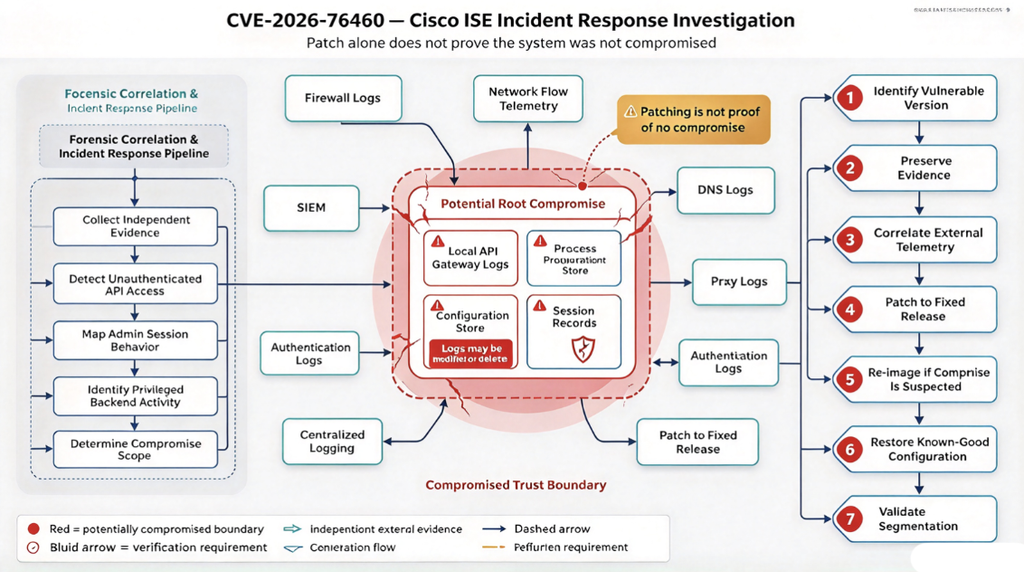
Should You Search the Internet for Public CVE-2026-76460 Exploits?
For defensive validation, chasing arbitrary exploit scripts is not the first thing an enterprise should do here.
Cisco has already established the facts necessary for remediation:
the vulnerability is remotely exploitable, requires no authentication, is being exploited in the wild, has root-level consequences, and has vendor patches available.
That means organizations do not need a public proof of concept before prioritizing the issue.
Testing whether a production system can actually be compromised can also introduce unnecessary operational risk on an identity infrastructure appliance.
A safer verification workflow is:
Asset identification
        ↓
Version / patch verification
        ↓
Exposure mapping
        ↓
Vendor IoC checks
        ↓
External-log correlation
        ↓
Authorized controlled validation if necessary
        ↓
Patch / rebuild
        ↓
Post-remediation verification
The distinction is important.
Vulnerability verification should generate confidence without creating a second incident.
Why External Telemetry Is the Real Detection Boundary
One of the most valuable defensive observations from CVE-2026-76460 extends far beyond Cisco ISE.
Whenever a vulnerability produces root, SYSTEM, hypervisor-level or equivalent control over the affected machine, defenders should assume local telemetry has become potentially untrustworthy.
This suggests a simple architectural principle:
the system being monitored should not control the only copy of its security evidence.
Centralized logging exists partly for exactly this reason.
If API requests, firewall sessions, authentication events and network flows are copied to independent infrastructure in near real time, compromising the source host does not automatically erase the historical record.
For CVE-2026-76460, this becomes directly relevant because Cisco itself tells administrators to cross-check network and firewall logs outside the impacted device. (Team Development)
That is more than an IoC tip.
It is a reminder about how security telemetry should be designed.
A Practical CVE-2026-76460 Response Strategy
For organizations operating Cisco ISE today, the response should combine vulnerability management and incident response.
Determine whether Cisco ISE or ISE-PIC exists in the environment and identify every node, including distributed deployment nodes.
Record exact software and patch versions.
Compare them against Cisco’s first-fixed releases.
Map the networks and hosts that could reach the affected management/API plane before remediation.
Preserve relevant logs where appropriate.
Inspect Cisco’s API gateway access logs for suspicious identities or activity.
Correlate those findings with firewall, network and other externally stored telemetry.
Apply the fixed Cisco release.
Restrict management access with iACLs and network segmentation even after patching where architecture allows it.
And where evidence suggests successful exploitation, treat the appliance as potentially root-compromised rather than merely “previously vulnerable.”
Cisco’s own recommendation to re-image suspected compromised nodes should carry substantial weight in that decision. (Team Development)
CVE-2026-76460 FAQ
Is CVE-2026-76460 actively exploited?
Yes.
Cisco PSIRT says it is aware of active exploitation of CVE-2026-76460. CISA also placed the vulnerability in its Known Exploited Vulnerabilities catalog on September 16, 2026. (Cisco)
What is the CVSS score for CVE-2026-76460?
Cisco assigns CVE-2026-76460 a CVSS v3.1 base score of 10.0, Critical. (Cisco)
Does CVE-2026-76460 require authentication?
No.
Cisco describes the attacker as unauthenticated and remote.
Does exploitation require user interaction?
No.
The published CVSS vector contains UI:N, meaning no user interaction is required. (Cisco)
Can CVE-2026-76460 lead to root access?
Cisco warns that successful exploitation may allow attackers to obtain command execution with root privileges. (Team Development)
Which products are affected?
Cisco Identity Services Engine and Cisco ISE Passive Identity Connector are affected. Cisco says the issue applies regardless of device configuration. (Cisco)
Is there a workaround?
Cisco says there is no workaround that fixes the vulnerability.
An iACL can be used as a mitigation to restrict management and control-plane traffic while organizations prepare to upgrade. (Team Development)
What versions fix CVE-2026-76460?
The first fixed versions are Cisco ISE/ISE-PIC 3.1 Patch 12, 3.2 Patch 11, 3.3 Patch 12, 3.4 Patch 7 and 3.5 Patch 4. Cisco ISE 3.0 is beyond software maintenance and should be migrated to a supported fixed release. (Cisco)
How can organizations detect exploitation?
Cisco recommends reviewing ise-kong/access.log for suspicious usernames on every node and examining archived API gateway logs. Because attackers may obtain root access and erase local evidence, administrators should also correlate network and firewall logs stored outside the affected appliance. (Cisco)
Should a compromised ISE server simply be patched?
Not necessarily.
A patch removes the vulnerable code path, but it cannot retroactively remove attacker persistence or restore trust in a system that was already compromised. Cisco recommends re-imaging affected nodes and restoring from configuration backup when malicious activity is suspected. (Team Development)
최종 생각
The most important fact about CVE-2026-76460 is not its perfect CVSS score.
It is the combination of where the vulnerability exists and what Cisco says attackers can achieve.
The flaw exists in Cisco Identity Services Engine, a platform deeply involved in enterprise identity and network-access decisions. The vulnerable API can be reached without authentication. Cisco says attackers may obtain root-level command execution. Exploitation has already been observed in the wild. And because root access can allow attackers to conceal their activity, the affected appliance cannot necessarily provide a trustworthy record of its own compromise. (Cisco)
That changes the correct remediation mindset.
Patch the vulnerability, but investigate the exposure window.
Organizations running vulnerable Cisco ISE or ISE-PIC releases should upgrade to Cisco’s fixed software immediately. If immediate patching is impossible, tightly restrict access using infrastructure ACLs as a temporary risk-reduction measure. And if evidence suggests exploitation may have occurred, the response should move beyond vulnerability management into incident response, including external-log analysis and potentially rebuilding affected nodes.
CVE-2026-76460 is also a useful reminder of a broader engineering principle.
Authentication is only as strong as the least-protected path into privileged functionality.
A product can have passwords, MFA, sophisticated administrator roles and a carefully designed management interface, yet one privileged API route with missing authentication enforcement can undermine the entire boundary.
In ordinary applications, that is dangerous.
In the infrastructure responsible for deciding who gets onto the network, it can be catastrophic. (Cisco)
Authoritative references: Cisco CVE-2026-76460 Security Advisory - CISA 알려진 익스플로잇 취약점 카탈로그 - Canadian Centre for Cyber Security Alert

 Korean
  English
  German
  French
  Spanish
  Portuguese
  Japanese
  Hindi
Hindi  Arabic
  Turkish
  Hebrew