
A critical vulnerability affecting Atlassian Jira, Confluence, Bitbucket, and five other enterprise products began attracting exploitation attempts within hours of detailed technical research becoming public. Tracked as CVE-2026-21589, the flaw allows unauthenticated attackers to retrieve specific files from affected web application directories. Depending on how an installation is configured, those files may expose sensitive application settings or credentials used to communicate with other enterprise systems.
Atlassian disclosed the issue on October 5, 2026, assigning it a critical CVSS 4.0 score of 9.3. The company released fixes for eight affected product families and urged administrators of self-managed installations to take immediate action. On October 6, watchTowr Labs published a technical investigation demonstrating the underlying path traversal behavior. The following day, security researchers reported exploitation attempts against honeypot infrastructure.
The speed of that progression changed the practical significance of the vulnerability. As
bleepingcomputer.com
, cybersecurity company Previdian began observing exploitation attempts within two hours of watchTowr publishing its findings and public proof of concept. The availability of automated scanning templates added to concerns that attackers could rapidly identify exposed installations.
CVE-2026-21589 is not a conventional remote code execution vulnerability. It does not automatically grant an attacker a system shell, permission to read every file on the server, or the ability to enumerate arbitrary directories. Its confirmed behavior involves accessing known files within a vulnerable application’s web root. That boundary matters, but it does not make the issue benign. Enterprise applications frequently store important configuration material in predictable locations, and an exposed integration credential can be more consequential than an isolated document disclosure.
The immediate priorities are to identify affected installations, apply vendor fixes, review historical access logs, and determine whether protected configuration files could have been exposed before remediation.
What Is CVE-2026-21589?
CVE-2026-21589 is an unauthenticated arbitrary file access vulnerability affecting eight Atlassian product families. The issue involves resource-handling functionality that can allow a remote attacker to retrieve files normally protected from direct web access.
에 따르면
confluence.atlassian.com
, exploitation requires the attacker to know the exact name and path of the target file in advance. The vulnerability does not provide directory enumeration, meaning the attacker cannot simply browse the filesystem to discover whatever happens to be present.
That limitation is important for accurately assessing exploitability. A deployment whose accessible application directories contain only standard, nonsensitive files may present fewer opportunities for consequential disclosure than one storing customized integration settings or secrets in predictable locations. However, attackers familiar with Atlassian software can use knowledge of standard application layouts to identify possible targets without relying on directory listings.
Atlassian assigned the issue the following CVSS 4.0 vector:
CVSS:4.0/AV:N/AC:L/AT:N/PR:N/UI:N/VC:H/VI:N/VA:N/SC:H/SI:H/SA:H
The network attack vector, low attack complexity, absence of special attack prerequisites, and lack of required privileges or user interaction explain much of the concern. An externally reachable application can expose the vulnerable functionality without requiring an attacker to compromise an account first.
The confidentiality impact is the main issue. Although the CVSS 4.0 vector includes downstream impact metrics, the public technical evidence does not mean that every successful file read automatically results in subsequent privilege escalation or a complete enterprise compromise. Those outcomes depend on what files are present, whether their contents are sensitive, and what additional systems trust the information they contain.
그리고
cve.org
identifies Atlassian as the assigning authority and documents the affected product families and fixed releases. It also provides more specific introduced-version information than the shorthand description of all earlier versions used in Atlassian’s emergency advisory.
That distinction is relevant when investigating very old software. While Atlassian’s public response treats affected product lines as broadly vulnerable and recommends upgrading to fixed releases, an exact assessment of a historical version should consider the more detailed ranges in the CVE record. Unsupported installations may also have other unresolved security vulnerabilities even if a particular historical build predates this defect.
Public PoC Release and the First Exploitation Reports
The disclosure timeline explains why CVE-2026-21589 became an emergency patching issue so quickly.
Atlassian published an out-of-band advisory on October 5. Unlike a routine collection of lower-severity fixes, the notice identified a critical problem spanning products used for issue tracking, source code collaboration, documentation, continuous integration, identity management, and related development workflows.
On October 6, researchers Sonny, Piotr Bazydlo, and Yordan Ganchev at watchTowr Labs published an investigation titled
labs.watchtowr.com
. Their research moved beyond the vendor’s high-level file access description and showed how the flaw could be reproduced in vulnerable installations.
The researchers compared patched and vulnerable versions of multiple Atlassian products, investigated their shared web resource library, and identified how unusual path processing created access to normally protected resources. They also explored the consequences of exposing configuration material related to Atlassian Crowd.
On October 7, BleepingComputer published observations from Previdian researcher Ryan Dewhurst, who reported that the company’s honeypot infrastructure had detected exploitation attempts shortly after the public PoC appeared. The report also noted the release of a Nuclei template, making it easier to automate checks for vulnerable systems.
Previdian reported activity associated with three IP addresses: 38.60.157[.]86, 146.70.187[.]234및 159.26.119[.]225. These addresses are historical indicators linked to the company’s observed activity, not a comprehensive list of hostile infrastructure. Their presence in an organization’s logs could support an investigation, but their absence cannot establish that a system was not targeted.
Additional corroboration came from
tracker.crowdsec.net
, which records its first observed exploitation activity on October 7 and the release of an associated detection rule.
The Canadian Centre for Cyber Security also updated its
cyber.gc.ca
on October 7, acknowledging open-source reports that the vulnerability was being exploited in the wild.
There is an important evidentiary distinction between these developments. A public PoC shows that researchers have demonstrated exploitation under particular conditions. An automated scanning template makes identification or testing easier. Honeypot observations show that suspicious requests are being sent. None of those observations, in isolation, proves that a particular enterprise experienced a successful compromise.
The public evidence is nevertheless sufficient to justify urgent remediation. Once attackers are visibly testing an unauthenticated vulnerability in widely deployed infrastructure, an organization should not wait for a confirmed victim disclosure before acting.
The sequence also demonstrates that the period between public technical analysis and opportunistic exploitation can be extremely short. Patch-management procedures built around fixed monthly maintenance windows are poorly suited to a situation where active probing is observed a day after the vulnerability’s technical mechanism becomes widely available.
The Root Cause Lies in Atlassian’s Shared Web Resource Handling
The unusual aspect of CVE-2026-21589 is the way it crosses product boundaries. Jira, Confluence, and Bitbucket perform different functions, yet the underlying problem involves common application infrastructure.
The watchTowr team suspected a shared component because the vendor’s advisory affected so many products simultaneously. To test that hypothesis, they deployed vulnerable and patched installations and compared files distributed with the applications. Their investigation identified a JAR file associated with the atlassian-plugins-webresource 라이브러리.
The researchers highlighted version 6.0.7 of the library in vulnerable installations and version 6.0.8 in their patch comparison. This provided a starting point for examining changes in resource routing and path handling. The version comparison should not be taken to mean that checking a single JAR filename is a universally sufficient way to establish whether every Atlassian product is patched; supported product releases remain the authoritative remediation targets.
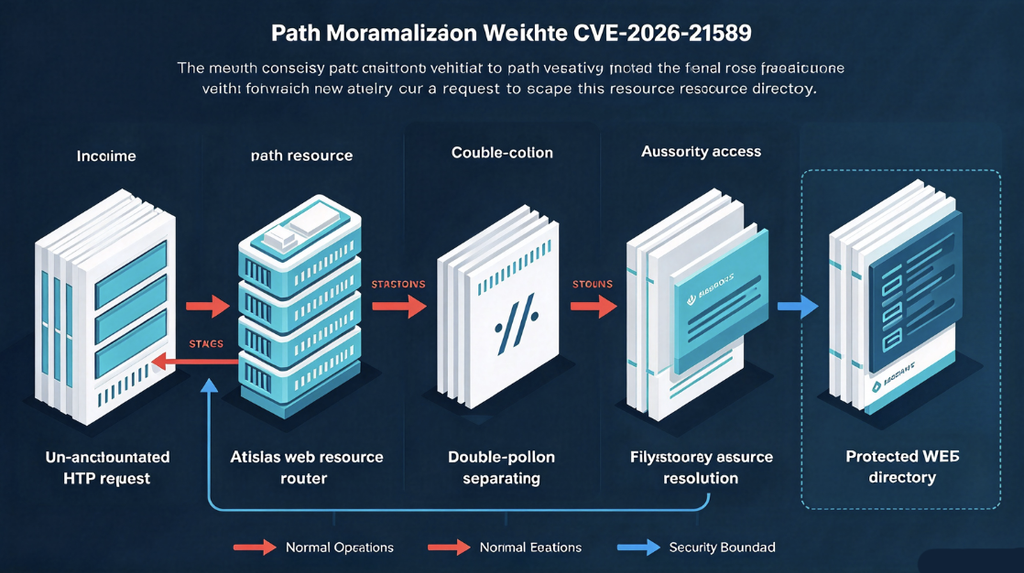
The key behavior appeared in a router class responsible for transforming resource paths. As documented in the
labs.watchtowr.com
, the component included functions for substituting double colons for forward slashes and reversing that transformation.
The essential idea can be illustrated without reproducing the vulnerable application’s entire implementation:
String encoded = originalPath.replace("/", "::");
String decoded = encoded.replace("::", "/");
Encoding a slash as two colons is not inherently a security vulnerability. Applications use many forms of encoding to represent special characters in URLs, identifiers, and internal routing schemes. The problem arises when validation is performed against one representation while a later component interprets the transformed representation differently.
Suppose a request includes a resource name that does not visibly contain an ordinary forward slash. An early validation stage may treat the resource name as an acceptable identifier. If a later stage converts special character sequences into slashes, the resulting string may contain directory navigation elements that were absent from the representation originally validated.
The security question is whether the system revalidates the resulting path against the intended resource boundary before accessing the filesystem.
This class of weakness is generally described as inconsistent path canonicalization. Canonicalization is the process of reducing alternative representations to a consistent form so that equivalent paths are treated the same way.
A secure implementation should not allow untrusted input to acquire new directory-navigation meaning after the application has already decided that the input is safe.
The watchTowr researchers traced the relevant behavior through the application’s routing and resource-serving logic. The publicly documented analysis identifies functions in Router.java, the handling of resource identifiers, and subsequent interactions with the resource factory responsible for resolving resources.
Their investigation included a resource lookup path that could eventually pass a relative path to a filesystem-backed resource provider. Under the vulnerable conditions, the path-processing logic allowed a resource request to reach files outside the intended resource location.
This is not the same as saying that every string containing :: is malicious or that every path-normalization operation is unsafe. The vulnerability depends on the specific interaction between routing, decoding, resource selection, and directory boundaries.
The distinction matters for defenders building detection logic. Overly broad filtering of double colons can produce false positives, while filters that look only for conventional ../ traversal may fail to identify the application’s unusual representation.
From Resource Requests to Protected Application Files
Atlassian’s affected web resource component is intended to serve resources needed by the application, such as JavaScript, stylesheets, and other static assets.
These resources are normally referenced through structured application routes. A request identifies a plugin or resource group, and the resource-serving framework resolves the corresponding file. Under correct conditions, the application should return only resources that the requesting user is permitted to access.
The vulnerable processing path could cause the resolved resource location to escape its intended directory while remaining within the broader web application context.
In the watchTowr research, the team demonstrated access to the Java web application deployment descriptor WEB-INF/web.xml in Jira and Confluence test installations. This file is normally protected from direct public HTTP retrieval.
The significance is not that web.xml must contain credentials. Its successful retrieval established that a resource-serving endpoint could cross a boundary normally enforced by the web application container.
Java application servers such as Apache Tomcat use the WEB-INF directory to store application resources that should not be directly served as ordinary public content. The directory can contain deployment descriptors, classes, libraries, and configuration resources.
A successful request to a protected file demonstrates that a security assumption made elsewhere in the application has failed. Code that trusts the web container to prevent direct access to an internal resource may be undermined if a separate resource handler exposes the same file through an unintended route.
The watchTowr researchers also tested the boundaries of the issue. Their published findings indicate that the demonstrated traversal did not allow access outside the Tomcat application context. The technique therefore has a narrower reach than a generic arbitrary filesystem read affecting the entire host.
That boundary should be preserved in vulnerability descriptions. Calling CVE-2026-21589 a remote code execution flaw would imply capabilities that the initial file-read primitive does not provide. Likewise, claiming that every file on a host can be retrieved would misrepresent the published research.
The correct risk assessment depends on the security value of the files accessible within the affected application.
How Configuration Exposure Can Affect Atlassian Crowd
One of the most consequential areas examined by watchTowr involved integrations with Atlassian Crowd.
Crowd provides centralized identity and user management capabilities for environments containing multiple applications. Other Atlassian products may authenticate to Crowd using application credentials so that the systems can coordinate identity and authorization functions.
Some deployments store connection details and application credentials in configuration files. The precise location and contents depend on the product and installation.
In its
labs.watchtowr.com
, watchTowr examined how a file such as WEB-INF/classes/crowd.properties could become significant if it was accessible through the vulnerable resource handler.
A Crowd configuration file may contain an application name, server connection details, and credentials used to authenticate the connected application. Such information is intended to support legitimate communication between systems, not to be publicly accessible.
If an attacker obtains a valid integration credential, the next question is what the credential authorizes. It may not represent a human administrator account, and it may not grant unrestricted permissions. Its value depends on the connected system’s access model, network availability, and the configuration of application trust relationships.
Nevertheless, exposing an integration secret can allow an attacker to interact with services that were previously inaccessible. The watchTowr investigation demonstrated why these secondary consequences deserve serious consideration.
This illustrates a common distinction between initial access and ultimate impact. The initial vulnerability permits a file read. A separate misconfiguration or overly privileged integration credential may turn the disclosed information into an opportunity for further compromise.
Defenders should therefore identify not just which files could be reached, but what those files were authorized to do within the broader environment.
For a heavily integrated Jira deployment, that may mean reviewing authentication connections, service accounts, internal endpoints, and configuration-management practices. For a simpler installation without sensitive files in reachable locations, the immediate confidentiality consequences may be narrower.
The same vulnerability can therefore produce different organizational risks depending on deployment architecture.
Affected Atlassian Products and Fixed Versions
The breadth of the affected product list is one reason organizations should assess their entire Atlassian estate rather than checking only Jira or Confluence.
그리고
confluence.atlassian.com
identifies eight product families and provides patched releases for their supported branches.
| 제품 | 고정 버전 | Operational significance |
|---|---|---|
| Jira Software Data Center | 9.12.40, 10.3.26, 11.3.12 | Issue tracking, development workflows, and integrations |
| Jira Service Management Data Center | 5.12.40, 10.3.26, 11.3.12 | Service management, incident processes, and connected business systems |
| Confluence Data Center | 9.2.26, 10.2.19 | Internal knowledge bases, technical documentation, and collaboration |
| Bitbucket Data Center | 9.4.26, 10.2.8, 10.5.1 | Source code management and development integrations |
| Bamboo Data Center | 10.2.24, 12.1.12 | Build automation and continuous integration infrastructure |
| Crowd Data Center | 6.3.7, 7.0.3, 7.1.7, 7.2.4 | Centralized application identity and user management |
| Crucible | 4.9.15 | Collaborative code reviews |
| Fisheye | 4.9.15 | Source code repository analysis and browsing |
These are fixed versions within particular release branches. Administrators should not assume that a version from one branch is automatically an appropriate replacement for an installation on another branch. The relevant upgrade path depends on the organization’s product version, support status, compatibility requirements, and vendor release guidance.
The vendor’s advisory describes all versions preceding the applicable fixes as affected. The
cve.org
provides additional details about the versions in which the flaw was introduced, which can matter for precise historical assessments.
For ordinary remediation planning, the safest approach is to follow Atlassian’s fixed-release guidance rather than using a historical introduced-version boundary as justification for continuing to operate unsupported software.
Atlassian Cloud and Data Center are not interchangeable
Atlassian’s October 5 advisory distinguishes between affected self-managed installations and Cloud services.
The company stated that affected Cloud products had already been patched and that its investigation found no evidence of exploitation involving those Cloud services. No customer action was required for the Cloud deployments covered by that statement.
This does not mean every application associated with an organization’s Atlassian environment is automatically protected. An organization may use Cloud services for some workflows while retaining self-managed Data Center installations for others. Each installation needs to be identified and classified correctly.
The hostname alone may not be enough to understand the organization’s complete exposure, especially where custom domains, proxies, or hybrid arrangements are involved. Asset inventories, deployment records, licensing information, and application administration consoles provide better evidence.
Unsupported Server installations create an additional problem
Some organizations continue to operate legacy Atlassian Server products after standard support has ended. Those installations may no longer have straightforward access to maintained security update branches.
Atlassian’s Data Center fixes should not be interpreted as a guarantee that an equivalent patch is available for every unsupported Server installation.
This distinction matters because a legacy service may remain operational for business reasons even though its security maintenance path has disappeared. In that situation, network isolation and migration planning become important risk-reduction measures.
그리고
cyber.gc.ca
also identifies legacy Server products in its broader affected-software assessment, reinforcing the need to include older deployments during inventory work.
For systems that cannot be updated to a supported release, administrators should not treat an interim WAF rule as a permanent substitute for supported software.
A Safe Local PoC Explaining the Path Normalization Failure
A useful proof of concept should explain why the vulnerability exists without requiring readers to attack a real Atlassian installation.
The following demonstration is deliberately isolated. It does not use Atlassian endpoints, product-specific routes, real credentials, or a network service. It creates a temporary directory structure and shows how validating a path before decoding its representation can produce an unsafe filesystem lookup.
The example reproduces the general security failure demonstrated in CVE-2026-21589, not the complete vulnerable Atlassian implementation.
Build the isolated example
from pathlib import Pathfrom tempfile import TemporaryDirectorydef decode_resource_name(value): return value.replace("::", "/")def vulnerable_lookup(resource_root, supplied_name): # Incorrect: validate the encoded representation. if "/" in supplied_name or "\\" in supplied_name: raise ValueError("Path separator rejected") # Decode after validation. decoded_name = decode_resource_name(supplied_name) # The decoded value is now interpreted as a filesystem path. return (resource_root / decoded_name).resolve()def safe_lookup(resource_root, supplied_name): root = resource_root.resolve() # Normalize before enforcing the filesystem boundary. decoded_name = decode_resource_name(supplied_name) candidate = (root / decoded_name).resolve() # The final resolved path must remain inside resource_root. if not candidate.is_relative_to(root): raise ValueError("Resource escapes the allowed directory") return candidatewith TemporaryDirectory() as directory: app_root = Path(directory) / "demo-app" resources = app_root / "public" private = app_root / "private" resources.mkdir(parents=True) private.mkdir(parents=True) (private / "sample.txt").write_text( "Synthetic training data only" ) supplied = "..::private::sample.txt" unsafe_path = vulnerable_lookup(resources, supplied) print("Unsafe resolved path:", unsafe_path) print("Escapes public directory:", not unsafe_path.is_relative_to(resources.resolve())) try: safe_lookup(resources, supplied) except ValueError as error: print("Safe resolver:", error)This example requires Python 3.9 or later because it uses Path.is_relative_to(). It runs entirely on the local machine and relies on a temporary directory that is deleted after execution.
The deliberately vulnerable function checks for obvious path separators before decoding the encoded resource name. The supplied string contains no literal forward slash at the validation stage, so it passes the initial check. When the function subsequently converts double colons into slashes and resolves the resulting path, the target moves outside the allowed public 디렉터리로 이동합니다.
The safe implementation changes the order of operations. It decodes the resource name first, resolves the resulting path, and then checks whether the final canonical location remains within the permitted directory.
The important lesson is that validation must apply to the same effective path the application will ultimately access.
There are additional concerns in production software. Filesystem symbolic links, race conditions, case sensitivity, platform-specific path behavior, archive extraction, and repeated decoding can all affect the final meaning of a resource path.
A robust resource server may need to avoid accepting arbitrary filenames altogether. Where possible, resources should be selected through fixed identifiers or an explicit allowlist rather than constructed from user-controlled path fragments.
For applications that must handle filesystem paths, boundary checks should be performed at the point of use, and the implementation should account for how the operating system resolves paths.
What this demonstration does not prove
Running the local example does not establish whether an Atlassian deployment is vulnerable. It demonstrates a class of path-normalization error, not the existence of a specific vulnerable endpoint.
It also does not test the patch supplied by Atlassian. The actual vulnerability depends on routing, resource selection, and component behavior specific to the affected products.
For a production vulnerability assessment, version verification should remain the primary initial step. Any additional behavioral validation should be conducted only in an authorized and appropriately isolated environment.
The purpose of this PoC is to help developers and defenders recognize the security boundary failure, understand why certain WAF signatures consider unusual encoded separators, and design safer resource-handling code.
Detecting CVE-2026-21589 Exploitation in HTTP Logs
Once a vulnerable Atlassian installation has been identified, the next question is whether attackers attempted to exploit it before the security update was applied.
The most useful initial evidence generally comes from HTTP access logs. These may exist on the application server, a reverse proxy, a load balancer, a web application firewall, or several of those components.
Atlassian’s
confluence.atlassian.com
recommends examining requests for traversal patterns involving parent-directory sequences and multiple representations of path separators. It also notes that URL decoding may be necessary to recognize suspicious requests.
The double-colon encoding used by the vulnerable component is particularly relevant because conventional traversal signatures frequently focus on ../ and its ordinary URL-encoded variants.
Why raw request matching may be insufficient
A reverse proxy may log the original request target, while an application framework may evaluate a decoded or normalized version. Security appliances may perform one or more decoding passes before applying their own detection rules.
As a result, the request string shown in an edge log may not be identical to the path eventually interpreted by the vulnerable application.
A request may also contain ordinary query parameters, encoded punctuation, or application-specific resource identifiers. Some of these values are entirely legitimate.
Detection should therefore consider the combination of suspicious traversal elements, relevant resource-serving paths, and the context of the response.
For example, a request containing a double colon is not automatically malicious. A request attempting to combine parent-directory components with resource access to a protected application file is more concerning.
Even then, a log entry usually establishes that a request was made. Determining whether the request succeeded requires further evidence.
Offline Python log triage
The following script operates on an existing log file. It does not scan websites, send HTTP requests, or attempt to retrieve protected files. It is intended to identify candidate request lines for analyst review.
import argparseimport refrom pathlib import Pathfrom urllib.parse import unquote, urlsplitTRAVERSAL_PATTERN = re.compile( r"(?:^|/)\.\.(?:/|$)|\.\.::|\.\.\\", re.IGNORECASE)PROTECTED_PATH_PATTERN = re.compile( r"WEB-INF|crowd\.properties|web\.xml", re.IGNORECASE)REQUEST_PATTERN = re.compile( r'"(?:GET|POST|HEAD|PUT|OPTIONS|PATCH|DELETE) ' r'([^\s"]+) HTTP/[\d.]+"')def decode_candidates(value): """ Produce bounded decoding views for offline analysis. """ candidates = [value] current = value for _ in range(2): current = unquote(current) candidates.append(current) return candidatesA defender can run this script against a locally collected Nginx access log:
python3 atlassian_log_triage.py \
  /var/log/nginx/access.log
The results are candidates for investigation, not confirmed exploit attempts. The parser assumes a conventional quoted HTTP request field, so environments using JSON logging or customized formats will require changes.
The script also uses bounded decoding for triage. That does not establish the exact transformations performed by a particular proxy or Atlassian application. Analysts should compare the decoded request with the original log entry and understand the request-processing behavior of their own environment.
The search for protected resource names is intentionally broad. It may flag legitimate requests, diagnostics, or unrelated security testing. A matching line should not automatically trigger a declaration of compromise.
Indicators and their investigative meaning
| 증거 | Possible interpretation | Important limitation |
|---|---|---|
| Parent-directory sequences in resource paths | Possible path traversal probing | Can appear in benign testing or unrelated attacks |
| Double-colon separator patterns near traversal components | Potentially relevant to CVE-2026-21589 | Not sufficient alone to prove exploitation |
Requests referencing WEB-INF | Attempted access to protected application resources | May be blocked or unrelated to the specific flaw |
| Requests referencing Crowd configuration files | Possible interest in integration credentials | Does not prove a credential was disclosed |
| HTTP 200 responses to suspicious requests | The server returned a successful HTTP status | Does not prove the intended sensitive file was returned |
| Unusual response sizes | May indicate different response behavior | Depends on application, caching, proxying, and error handling |
| Subsequent unexpected authentication activity | May suggest attempted use of exposed credentials | Requires separate investigation and attribution |
| Repeated requests from one address | May indicate automation or scanning | NAT, proxies, and shared networks can complicate attribution |
The table illustrates why multiple indicators should be correlated. No single pattern is sufficient to establish that an attacker successfully exploited CVE-2026-21589.
Distinguishing Scanning from Successful File Disclosure
One of the most common incident response mistakes is treating any suspicious HTTP request as proof that sensitive data was stolen.
A scanner may attempt to reach a vulnerable resource endpoint but receive a 403 response because a WAF blocked the request. Another request may receive a 404 because the targeted file does not exist. A third may return HTTP 200 while serving an ordinary error page or login response.
Conversely, a successful retrieval may not be obvious from the HTTP status alone, especially when application caching or intermediary components change the recorded response.
The investigation therefore needs to determine both intent and outcome.
Request paths reveal what the client attempted to access. Status codes and response lengths help characterize the server’s behavior. Application logs may indicate how the request was processed. Where response bodies were retained by an authorized security-monitoring system, those records may provide stronger evidence about what content was returned.
Most production environments do not retain full response bodies for every HTTP request, partly for performance and privacy reasons. Investigators should not assume that missing response content can be reconstructed after the fact.
If a request targets a known configuration file and the server’s response characteristics suggest success, the organization may need to treat the file as potentially exposed even when direct proof of its contents being returned is unavailable.
The decision depends on the sensitivity of the file, the credibility of the request, and what additional evidence exists.
A request for a standard deployment descriptor may justify a different response from a request targeting a file known to contain live integration credentials. Both deserve analysis, but the possible consequences are not identical.
Follow-on authentication evidence
Where an organization uses Atlassian Crowd or another connected identity provider, suspicious activity should be evaluated across the affected trust relationship.
Potentially relevant evidence includes unexpected authentication attempts using application accounts, unexplained changes in integration behavior, administrative activity inconsistent with normal operations, or unusual requests to systems accessible through the integration.
Such events should be interpreted carefully. Credential use after a suspicious file-read request does not automatically establish causation. Legitimate automation, maintenance activity, and unrelated incidents can produce superficially similar patterns.
A stronger assessment correlates timestamps, affected accounts, source systems, permissions, and the information that might have been disclosed.
This is why incident response to an arbitrary file read should not stop at web logs. The exposure may concern a credential that is only meaningful when used against another application.
Temporary Mitigations for Atlassian Data Center
Atlassian recommends immediately upgrading affected applications. Where an upgrade cannot be completed at once, the vendor documents temporary protections intended to reduce the likelihood of successful exploitation.
그리고
confluence.atlassian.com
cover network restrictions, web application firewall rules, Tomcat RewriteValve configurations, and Bitbucket-specific rewriting controls.
The first measure is to remove publicly accessible instances from the internet where operationally possible. This recommendation applies even if the application normally displays an authentication page, because the vulnerable resource-handling functionality does not require an authenticated user.
Restricting an application to a trusted network reduces exposure from arbitrary external clients. It does not eliminate risk from compromised internal systems, malicious insiders, or other attackers who already have network access.
Web application firewall filtering
Atlassian provides a regular expression designed to identify suspicious traversal behavior, including unusual separator representations and encoded characters.
Using the vendor-supplied expression is preferable to improvising a simple rule that blocks only ../. The disclosed vulnerability involves path representations that may not be recognized by a conventional traversal filter.
However, correct filtering depends on the WAF’s implementation. Different products interpret regular expressions, normalization, decoding, and request variables differently. A rule copied into the wrong inspection context may behave differently from the vendor’s intended configuration.
Administrators should verify how their WAF processes encoded URLs and whether the rule is applied to the relevant request path before the request reaches the application.
A rule must also be evaluated for unintended effects on legitimate application traffic. Resource requests form an important part of normal Jira and Confluence operation, so aggressive blocking can create functional problems.
Tomcat RewriteValve mitigations
For Jira, Jira Service Management, Confluence, Bamboo, and Crowd, Atlassian documents temporary protections involving Tomcat RewriteValve configuration.
These controls operate within the Java web application environment and provide another opportunity to reject suspicious resource paths before vulnerable application functionality handles them.
The vendor’s instructions include changes to application configuration files. Administrators should follow the documented procedure for their product rather than assuming that file locations and deployment structures are identical across all Atlassian applications.
Configuration changes should be backed up, tested, and deployed consistently across cluster nodes. Restart requirements and operational dependencies should be considered as part of the change plan.
Bitbucket requires separate consideration
Bitbucket has distinct URL rewriting instructions. Organizations operating Bitbucket Data Center should not simply reuse a Jira or Confluence configuration without checking product-specific guidance.
Bitbucket mirror installations and mirror farms also need to be included in the exposure assessment.
An environment can appear remediated at its primary application endpoint while another accessible component remains unprotected.
Mitigation comparison
| 제어 | Primary benefit | 제한 사항 |
|---|---|---|
| Vendor security update | Fixes the vulnerability in the affected product | Requires deployment and verification |
| Remove public network access | Reduces exposure to external attackers | Does not eliminate internal network risk |
| WAF or proxy rule | Blocks recognized malicious request patterns | Depends on correct decoding and rule behavior |
| Tomcat RewriteValve | Adds application-server-level filtering | Requires product-specific configuration |
| Bitbucket URL rewrite rule | Provides a temporary Bitbucket-specific restriction | Must be applied to relevant infrastructure |
| Credential rotation | Reduces risk from a potentially disclosed secret | Does not repair the underlying file access flaw |
| Log investigation | Identifies evidence of attempted or possible past exploitation | Cannot prevent new exploitation on its own |
The practical distinction is between reducing exposure and fixing the vulnerability. Network restrictions and request filtering reduce attack opportunities, but applying a supported fixed release remains the definitive remediation.
Validating the Patch Across Jira and Confluence Environments
A successful software update should be verified rather than assumed.
This is especially important in Atlassian Data Center environments where several application nodes may participate in a cluster. A load balancer may distribute requests across instances, and changes applied to one node do not necessarily establish that every node is running the expected fixed release.
The first verification step is to inventory the installed product and version on each relevant node. Administrators should compare the reported versions against the fixed releases in
confluence.atlassian.com
.
Application version information should be corroborated with deployment records or package inventories where available. A web interface may report the version of the node serving a particular request, but that does not always provide a complete picture of the entire cluster.
For containerized or automated deployments, administrators should also inspect the image or artifact version referenced by their deployment configuration. An updated running instance can become vulnerable again if a subsequent deployment restores an older image.
The next step is verifying that traffic reaches only patched application nodes. Load balancer inventories, infrastructure configuration, and node-level health checks can help establish this.
Where temporary WAF or application-server mitigation rules were applied, administrators should decide when they can safely be retired. Removing interim controls immediately after a single successful patch operation may be premature if other nodes or supporting components remain vulnerable.
Finally, teams should preserve evidence of the remediation process. Relevant records include the original vulnerable version, the installed replacement, deployment timestamps, affected nodes, and the results of verification.
These details become important if the organization subsequently discovers suspicious requests in historical logs.
Why a successful patch does not rule out an earlier incident
A patch changes how the application behaves going forward. It does not automatically invalidate credentials that may have been exposed before the update.
Suppose an attacker accessed a configuration file containing an application credential before remediation. Even after the file-read vulnerability is fixed, that credential might remain valid until it is rotated or revoked.
The same principle applies to any sensitive information whose security depends on confidentiality.
Incident responders should therefore consider the time interval during which the application was vulnerable and reachable, the evidence of attempted access, and the consequences if particular files had been retrieved.
The appropriate response may range from documenting unsuccessful probing to conducting a broader credential exposure investigation.
CVE-2026-21589 Compared with Earlier Atlassian Vulnerabilities
Atlassian products have previously experienced critical vulnerabilities with very different exploitation mechanisms. Comparing those cases helps clarify the particular risks associated with CVE-2026-21589.
Two relevant examples are CVE-2023-22515 and CVE-2023-22527, both of which affected Confluence installations.
CVE-2023-22515 and unauthorized administrator creation
CVE-2023-22515 was a critical broken access control vulnerability affecting particular Confluence Data Center and Server versions.
In its
confluence.atlassian.com
, Atlassian described circumstances in which attackers could exploit publicly accessible installations to create unauthorized Confluence administrator accounts.
This was a different technical problem from CVE-2026-21589. Rather than exposing files through inconsistent path processing, CVE-2023-22515 allowed attackers to cross an application access-control boundary.
The outcome could be direct unauthorized administrative access to a vulnerable Confluence instance.
Atlassian subsequently reported evidence suggesting exploitation by a known nation-state actor. The company’s incident guidance focused on immediate patching, investigation of unexpected accounts, and signs of unauthorized administrative activity.
The relationship between the vulnerabilities is operational rather than mechanical. Both demonstrate that externally accessible enterprise collaboration systems can expose high-value functionality without the attacker first compromising a legitimate user account.
However, the detection priorities differ. CVE-2023-22515 investigations emphasize unauthorized account creation and relevant setup activity, whereas CVE-2026-21589 investigations focus primarily on suspicious resource requests and possible configuration disclosure.
CVE-2023-22527 and remote code execution
CVE-2023-22527 was a template injection vulnerability affecting outdated Confluence Data Center and Server releases.
에 따르면
confluence.atlassian.com
, an unauthenticated attacker could achieve remote code execution on an affected version.
Remote code execution and arbitrary file access are not equivalent. Code execution may allow an attacker to interact with the operating system under the privileges of the affected process. File access is constrained by the resources the vulnerable functionality can retrieve.
Nevertheless, the practical consequences of a file-read vulnerability can expand when sensitive credentials are present. An exposed secret may create a second path to additional access, even though the initial vulnerability does not execute arbitrary commands.
The distinction is important for technical reporting, incident severity assessment, and containment decisions.
Comparing the three vulnerabilities
| CVE | Primary weakness | Initial attacker capability | Main defensive concern |
|---|---|---|---|
| CVE-2026-21589 | Arbitrary file access through path-processing behavior | Retrieve certain known application files without authentication | Sensitive configuration and credential disclosure |
| CVE-2023-22515 | Broken access control | Potential unauthorized Confluence administrator creation | Unauthorized accounts and administrative activity |
| CVE-2023-22527 | Template injection | Potential remote code execution | Host compromise and post-exploitation activity |
The differences matter because organizations should avoid applying generic incident-response assumptions to every critical Atlassian vulnerability.
A vulnerability classified as remote code execution warrants investigation for possible command execution and host compromise. A vulnerability that creates administrator accounts requires scrutiny of application identities and permissions. A file-read vulnerability requires understanding the confidentiality and downstream significance of the accessible files.
The common defensive principle is to reduce unnecessary network exposure, maintain supported software, and prepare incident-response procedures appropriate to the actual vulnerability mechanism.
The Broader Security Problem with Shared Application Libraries
CVE-2026-21589 also exposes a software architecture problem that is relevant well beyond Atlassian.
Modern enterprise applications rely heavily on reusable libraries. Those libraries simplify development and help products maintain consistent functionality, but they also concentrate security assumptions.
A shared resource-handling component may be integrated into products with different routing arrangements, authentication controls, deployment structures, and operational requirements.
If the component contains an unsafe assumption about how paths are validated or normalized, the weakness may appear across several applications at once.
The scale of the affected product list makes this issue especially visible. Jira and Confluence are not the same application, but the relevant path-processing behavior comes from shared infrastructure.
For security engineers, this changes how vulnerability analysis should be conducted.
When several products from the same vendor receive a similar security fix at the same time, common dependencies deserve investigation. Comparing patched and vulnerable components can reveal whether the weakness lies in a shared framework, a third-party dependency, or duplicated application logic.
The watchTowr analysis demonstrates this approach. Rather than beginning with an assumption that every affected product contained an independent flaw, the researchers looked for common components and traced the relevant behavior from resource routing to file access.
The defensive implications extend into software composition analysis and secure development practices.
Maintaining a reliable inventory of components makes it easier to identify which applications may depend on a vulnerable library. However, component inventory alone is not sufficient. Whether a library vulnerability is exploitable can depend on which features are enabled and how the host application exposes them.
Effective analysis must therefore consider both the dependency and the application-level route through which untrusted input reaches vulnerable functionality.
Canonicalization as a security boundary
Path canonicalization is frequently treated as an implementation detail, but it has direct security consequences.
A path can have several textual representations that resolve to the same filesystem location. URL encoding, alternative separators, Unicode transformations, symbolic links, and application-specific routing rules may all affect interpretation.
When an application validates a path before all meaningful transformations are complete, it risks authorizing a representation that later changes into something unsafe.
The safer design is to perform normalization consistently and verify the final resource against an explicit allowed boundary.
A strong implementation should also avoid assuming that a single regular expression provides complete path safety. Textual filtering is useful as an additional control, but authorization should be enforced against the resource ultimately selected.
In many applications, an even safer approach is to avoid exposing arbitrary path construction at all. Fixed resource identifiers and explicit mapping tables can reduce the number of untrusted filesystem decisions.
These engineering principles would not, by themselves, eliminate every class of path traversal vulnerability. They do, however, address the kind of representation mismatch central to the CVE-2026-21589 research.
Building a Defensible Response to Public Exploit Research
The appearance of a working public PoC changes the urgency of vulnerability response, but it should not eliminate technical discipline.
A rushed patch deployment that leaves cluster nodes inconsistent may create false confidence. An overly broad WAF rule may disrupt business functionality while failing to inspect the normalized path actually reaching the application. A scanner report may identify a potentially vulnerable version without establishing whether a particular deployment exposes the relevant functionality.
A sound response balances urgency with verifiable outcomes.
For CVE-2026-21589, the vendor’s fixed versions provide the clearest initial remediation target. Security teams can use asset inventories and version data to identify affected applications without first sending potentially intrusive exploit requests to production services.
Network access restrictions can reduce immediate exposure while upgrades are prepared. Existing access logs can provide evidence about prior suspicious activity without requiring active exploitation.
Where organizations perform authorized validation, they should collect reproducible evidence and clearly distinguish vulnerable versions, potentially exploitable configurations, observed attack attempts, and confirmed compromise.
Automated security testing can help maintain consistency across large inventories, but a successful detection workflow must retain those distinctions. AI-assisted validation platforms, including
penligent.ai
, are relevant to this broader class of security operations when teams need to coordinate authorized testing and evidence collection. Automated findings should still be checked against vendor advisories and independently verified before being treated as proof of exploitation.
The most useful outcome is not simply a vulnerability finding marked critical. It is an evidence-backed answer to the questions that determine operational risk: which installations are affected, which are reachable, which have been patched, and whether available evidence indicates previous exposure of sensitive information.
This is also where detection engineering and vulnerability management intersect. A detection rule identifies suspicious behavior, while vulnerability management establishes whether the relevant weakness exists. Neither process can independently answer every incident-response question.
Common Mistakes When Responding to CVE-2026-21589
One common mistake is assuming that an application is protected simply because it requires users to authenticate. The flaw is unauthenticated, so ordinary login requirements do not necessarily prevent an attacker from reaching the vulnerable resource handler.
Another mistake is assuming that every vulnerable installation has already been compromised. Public exploit information and observed hostile probing justify urgent investigation, but they do not establish a successful breach at a particular organization.
A third problem is describing the vulnerability as unrestricted file read or direct remote code execution. The confirmed behavior has a meaningful application-directory boundary, and any secondary compromise depends on additional conditions.
Overconfidence in WAF filtering is another risk. Atlassian’s documented mitigations are useful, but a request-filtering control should not replace a fixed product release. Encoding differences, application routing, and inconsistent deployment across cluster nodes can all affect protection.
Organizations can also underestimate the importance of integration credentials. An apparently minor configuration file may contain information used to authenticate to another system. Determining whether such files were accessible is an important part of assessing potential impact.
Finally, patching without historical investigation may leave an incident unresolved. A system can be fully patched today while an exposed credential obtained yesterday remains valid.
Avoiding these mistakes requires accurate vulnerability classification, consistent remediation, and evidence-based incident assessment.
Frequently Asked Questions
Is CVE-2026-21589 being actively exploited?
- Yes. bleepingcomputer.com, citing observations from Previdian’s honeypot network.
- CrowdSec also recorded exploitation activity beginning on October 7.
- These reports establish real-world attempts but do not prove that every targeted system was compromised.
- Internet-facing vulnerable installations should be prioritized for remediation and log review.
Does CVE-2026-21589 affect Jira Cloud or Confluence Cloud?
- Atlassian stated that affected Cloud services had been patched.
- The vendor reported no evidence of exploitation affecting those Cloud services in its October 5 advisory.
- No additional customer action was required for the covered Cloud products.
- Organizations using both Cloud and self-managed Data Center products must assess their Data Center installations independently.
Can CVE-2026-21589 lead to remote code execution?
- The confirmed initial vulnerability provides access to certain known files within the application web root, not direct arbitrary code execution.
- Sensitive files may expose credentials or configuration information that could support additional attacks.
- Any resulting privilege escalation or broader compromise depends on specific deployment conditions and separate security boundaries.
- The issue should not be classified as direct RCE merely because some configurations permit serious downstream consequences.
How can administrators determine whether Jira or Confluence is vulnerable?
- Identify the product, deployment model, installed version, and all relevant application nodes.
- Compare each installation with the fixed versions in Atlassian’s official advisory.
- Verify that publicly accessible application endpoints are not served by an overlooked vulnerable node.
- Review historical request logs for suspicious traversal activity.
- Use authorized, isolated validation where additional behavioral confirmation is necessary.
Should organizations rotate Atlassian Crowd credentials?
- Credential rotation should be considered when evidence indicates that files containing Crowd integration secrets may have been accessed.
- The need for rotation depends on the existence of the integration, the location of its secrets, and the available investigation evidence.
- Credentials should be evaluated according to their permissions and the systems that accept them.
- Rotation should be coordinated with containment and remediation to avoid unnecessary service disruption or continued credential exposure.
Can a WAF rule completely mitigate CVE-2026-21589?
- Atlassian provides temporary WAF filtering guidance for affected products.
- The effectiveness of filtering depends on correct request decoding, rule implementation, and coverage of all relevant application endpoints.
- A WAF does not change the vulnerable application code.
- Installing a fixed release remains the preferred permanent remediation.
What logs are most useful for investigating possible exploitation?
- Reverse proxy and web server access logs can reveal suspicious resource requests.
- WAF logs may show blocked or permitted traversal-like patterns.
- Application logs can help establish how unusual requests were processed.
- Authentication logs from connected systems may reveal possible follow-on activity involving exposed integration credentials.
- Investigators should correlate multiple sources rather than treating one suspicious request as conclusive evidence of compromise.
What should organizations do if they cannot patch immediately?
- Restrict access to vulnerable installations, particularly from the public internet.
- Apply the appropriate temporary mitigations documented by Atlassian.
- Confirm that the controls cover every relevant application node and supporting component.
- Increase monitoring for suspicious resource requests and potential credential exposure.
- Establish a supported upgrade path rather than treating temporary filtering as a permanent solution.
Final Assessment
CVE-2026-21589 is a critical vulnerability not because it automatically compromises an entire server, but because it allows unauthenticated access to resources that enterprise applications normally protect.
Its impact crosses eight Atlassian product families, and the public research demonstrates how inconsistent path handling in shared infrastructure can undermine application security boundaries. The rapid appearance of exploitation attempts after the release of technical details made remediation urgent.
The highest priorities are clear: identify vulnerable Data Center installations, apply the vendor’s fixed releases, restrict unnecessary exposure, and investigate whether sensitive application files may have been retrieved before patching.
The longer-term lesson concerns the security of shared components and connected enterprise systems. A relatively narrow file access flaw can become much more serious when it exposes credentials that other services trust. Effective defense therefore requires more than recognizing the initial vulnerability. It requires understanding the application architecture, enforcing consistent path validation, and treating potentially exposed integration secrets as part of the incident response.
For organizations running Jira, Confluence, Bitbucket, or other affected Atlassian products, the central question is not simply whether a patch exists. It is whether every vulnerable instance has been remediated and whether the period before that remediation left any sensitive information exposed.

 Korean
  English
  German
  French
  Spanish
  Portuguese
  Japanese
  Hindi
Hindi  Arabic
  Turkish
  Hebrew