
Start with the product inventory, not a single “Cisco patch.” Cisco’s October 21, 2026 advisory bundle identifies 14 advisories covering 34 CVE IDs, with a maximum CVSS score of 9.8. The release time is October 22 at midnight Beijing time. Expressway, Unified Communications, Snort 3 and several other products have different fixes; the maximum score does not apply to every device or every CVE.
The priority question is which affected component and release actually run in your network. The highest-rated Expressway and Unified Communications advisories merit rapid exposure review, but an inventory match must precede a patch recommendation. Cisco’s product pages distinguish fixed releases, cloud-managed updates and migration paths. No live exploitation claim follows merely from a critical rating.
Map the advisory to your estate
The following inventory follows Cisco’s final advisory list. Abbreviated identifiers retain the CVE-2026 prefix; grouped scores are maxima, not the score of every underlying defect.
| Product and advisory topic | CVE 식별자 | Highest CVSS |
|---|---|---|
| Snort 3 hardening | CVE-2026-20043, -20236, -20291, -20356 | 9.0 |
| Snort 3 control socket | CVE-2026-76524 | 7.8 |
| Snort 3 multiple DoS | CVE-2026-76489, -20019, -20179, -20197 | 5.8 |
| Snort 3 GRE | CVE-2026-20221 | 5.8 |
| Snort 3 SMTP MIME | CVE-2026-20011 | 5.8 |
| Snort 3 VBA | CVE-2026-20218 | 5.8 |
| Snort 3 GTP | CVE-2026-76445 | 5.3 |
| Expressway root RCE | CVE-2026-76466 | 9.8 |
| Expressway hardening | CVE-2026-76490 through CVE-2026-76497 | 8.6 |
| Expressway information disclosure | CVE-2026-76435 | 5.3 |
| Unified Communications hardening | CVE-2026-76473 through -76479, and -76481 | 9.8 |
| Unified CM access control | CVE-2026-76487 | 5.3 |
| IOS XR ASR 9000 IPv4 DoS | CVE-2026-76505 | 7.5 |
| Secure Client posture privilege escalation | CVE-2026-76462 | 5.5 |
Expressway: examine the cookie and client-certificate path
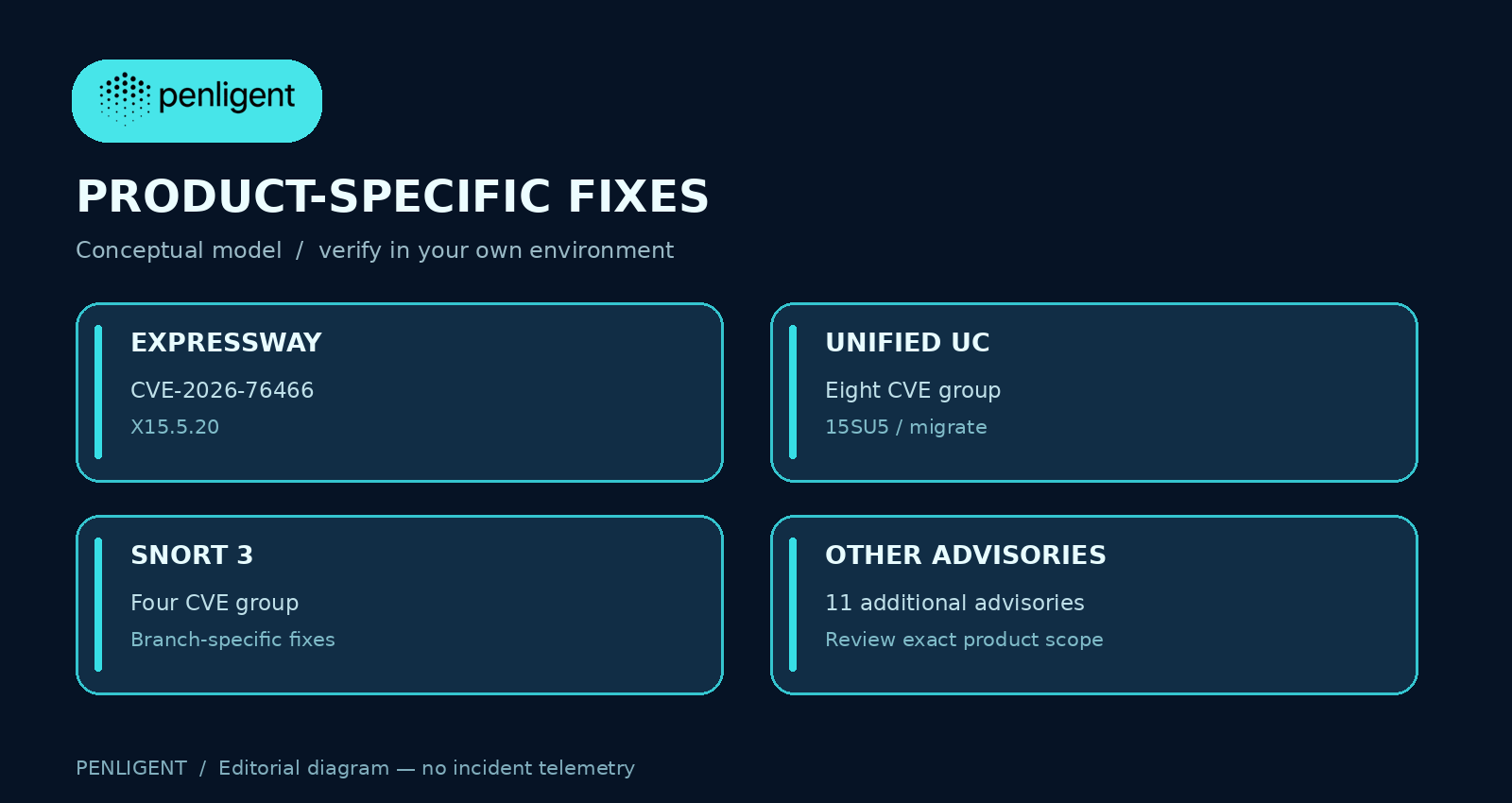
그리고 CVE-2026-76466 Expressway advisory describes network database credentials associated with persistent cookies and an RPC path in which client-certificate validation is not performed as expected, even when TLS Verify Mode is enabled. Cisco states an attacker in possession of the required material may execute commands with root privileges. Possession and reachability matter; the CVE is not a claim that every Internet-facing Expressway permits an anonymous single-request exploit.
The affected-product condition is a vulnerable Expressway-C or -E release configured in a cluster, for both virtual and appliance deployments. Inventory the cluster members and their running versions. Prioritize reachable management and inter-component surfaces under the vendor guidance. Cisco lists X15.5.20 as fixed and says X14 and earlier require migration. It gives no workaround for this issue. Its PSIRT statement reported no known malicious use at publication; that is an observation bound to that statement, not a guarantee for later dates.
Unified Communications and Snort need their own release mapping
그리고 Unified Communications hardening advisory covers Emergency Responder, Prime Collaboration Deployment, Unified CM, IM and Presence Service, Session Management Edition and Unity Connection regardless of configuration. Its grouped eight CVEs have a maximum rating of 9.8, rather than a single documented eight-step chain. Cisco maps version 15 to 15SU5 and directs version 14 customers to migrate. Check the product matrix for each installed release.
The separate Snort 3 hardening advisory fixes four CVEs. Open-source Snort 3 reaches a fixed release at 3.12.4.0. Firepower Threat Defense releases require their own branch mapping: 7.0→7.0.10, 7.2→7.2.12, 7.4→7.4.8, 7.6→7.6.6, 7.7→7.7.13, 10.0→10.0.2 and 10.1→10.1.0. These are not generic upgrades for the other advisories in the bundle.
Cyber Vision earlier than 5.6 requires migration; 5.6 reaches 5.6.0. UTD in IOS XE has another release table in the advisory. Cisco says its cloud-delivered firewall instances were updated, and the Snort package for applicable online, Dashboard-connected Meraki models updates automatically. Validate the model, connection and actual package state before closing a ticket; an offline appliance does not inherit a successful cloud rollout. Snort 2 is not affected by this particular Snort 3 advisory, which is not an endorsement of unsupported software.
A safe verification record
For each applicable system record product family, exact branch and build, relevant advisory, upgrade target, exposure and operational owner. After an authorized maintenance window, read the running version, verify core service health and test an ordinary permitted workflow. Avoid scanning production voice infrastructure with an unreviewed exploit script. A vulnerable version finding is enough to prioritize a vendor patch without a weaponized demonstration.
Read-only patch ledger example
Asset: uc-east-01
Product/branch: Unified CM 15
Advisory: cisco-sa-voice-hardening-twgbH9e3
Running build before: record from inventory
Fixed target: 15SU5 per vendor matrix
Running build after: pending observation
Call-flow smoke check: pending approved test
Exception owner: on-call team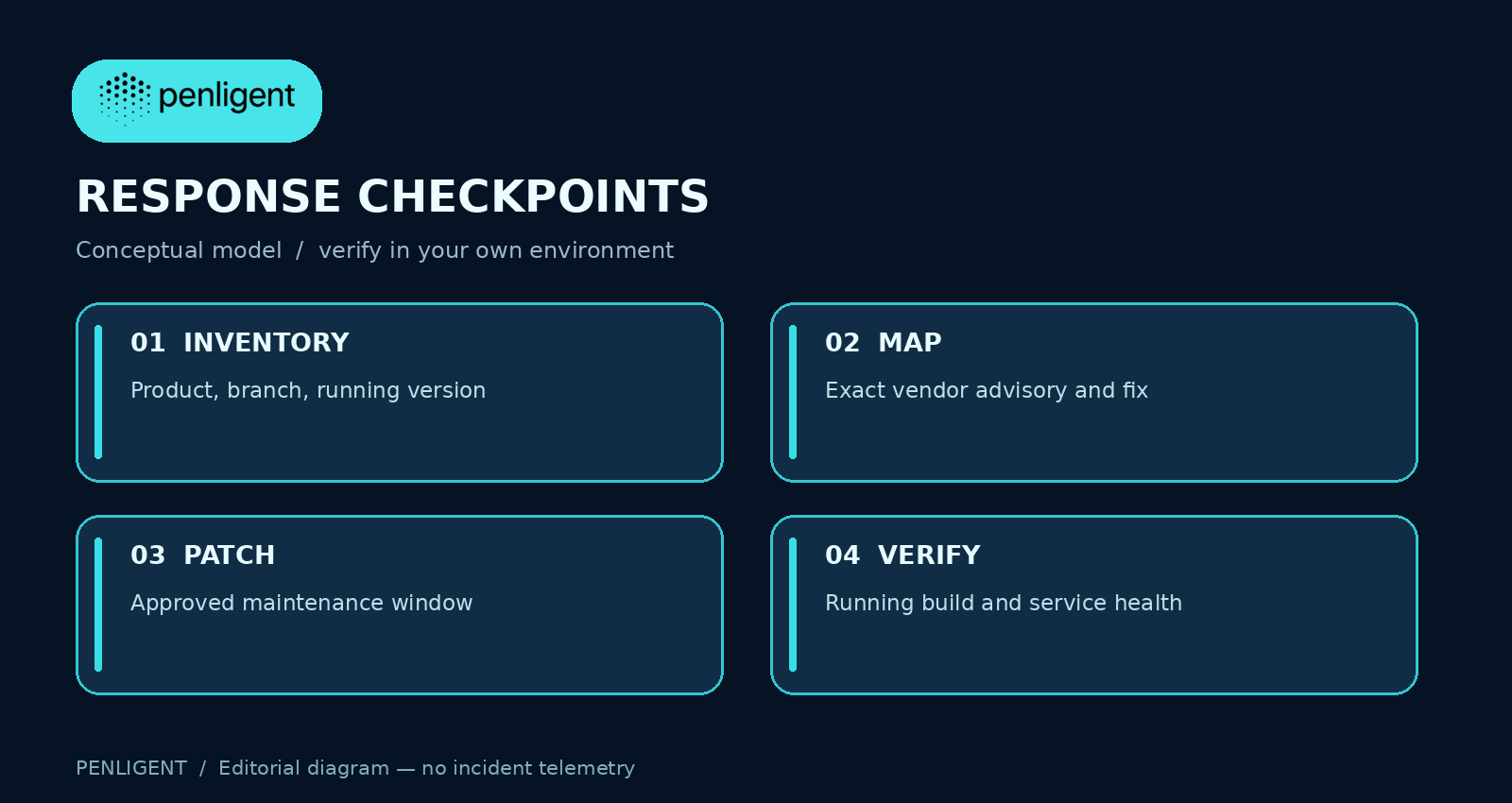
Treat those example fields as a template, not observations from a Cisco deployment. If a component cannot be patched immediately, document reachability and compensating controls under its particular advisory; do not invent a universal workaround. Review the vendor page for changes and keep evidence of the running build rather than a downloaded image alone.
After the Cisco maintenance work, an authorized application assessment may address web portals and APIs in your own scope. Penligent can be evaluated for that separate evidence-driven workflow. This article does not claim it tests Expressway internals, Snort signatures or voice appliance firmware.
Cisco October update questions
Is CVE-2026-76466 the same as the earlier NX-OS 76465 issue
- No. It is an Expressway advisory with its own affected products and fixed release.
Does every Cisco product need a 9.8 fix
- No. The bundle has different products, severity ratings and release paths.
Are cloud and Meraki devices automatically done
- Only the specific cloud instances and eligible online, connected Meraki Snort packages stated by Cisco. Verify your actual assets.
Can an upgrade file prove remediation
- No. Read the running version and perform a bounded service check after maintenance.
The video below concerns authorized application testing, not Cisco firmware validation.
Use Cisco’s bundle to enumerate every applicable advisory, then close findings with the product-specific version evidence. Keep unresolved or unreachable devices visible instead of reporting the entire estate patched.


 Korean
 English
 German
 French
 Spanish
 Portuguese
 Japanese
 Hindi
 Arabic
 Turkish
 Hebrew