
API penetration testing cost depends on the access boundaries and business workflows being assessed, not just the number of documented endpoints. A useful quote states which APIs, versions, environments, roles, tenant relationships, and sensitive actions the testers will examine. It also identifies the evidence, review, and remediation verification included in the price. Without those details, two prices for “one API” may describe substantially different purchases.
Public starting prices can help frame a conversation, but they are not a market average or a promise for your application. The practical way to compare proposals is to send every provider the same scope, identify differences in the offered work, and estimate the internal effort that remains after purchasing the service.
This guide uses public vendor examples checked on October 25, 2026, an original scope matrix, and an offline budget calculator. The calculator uses fictional planning inputs. It does not measure a provider’s performance, produce a consulting quote, or test an API.
What current public prices actually tell you
CYBRI’s current pricing page lists a Web App, API, Cloud, or AI package starting at $9,500, with remediation testing included. Its separately published cost guide, updated August 26, 2026, describes API engagements starting at $3,750 and ranging to $15,000 or more. These figures are published by the same supplier but do not establish identical scope. The current package page is the stronger starting point for a current buying conversation; ask the supplier which offer applies to the work you need.
That discrepancy is why a price range copied from a blog should not become your procurement baseline. A smaller historical scope, a current bundled package, and a negotiated assessment can all have different terms. An apparent price increase cannot be interpreted without knowing whether roles, depth, delivery, or retesting changed. Keep the page date and ask for a written scope-specific quote.
Cobalt describes a consumption model rather than a universal API price. Ask which engagement consumes the quoted allowance, what work the allowance represents, and which deliverables and retests are included. A credit is a supplier-defined commercial unit. It cannot be compared directly with another platform’s credit or a model token.
| Public pricing signal | Useful interpretation | What to confirm |
|---|---|---|
| Published starting price | An entry point for that supplier’s stated offering | Your roles, workflows, environments, and exclusions fit the offering |
| Historical range in a cost guide | Context with a particular date and framing | Whether it remains an available offer for your scope |
| Service credits or consumption allowance | A commercial allocation under provider terms | Allocation to the engagement, expiration, additional use, and retesting |
| Software subscription | Access to a tool and its specified allowance | Who operates it, reviews findings, and provides any required independent assessment |
Why counting endpoints misses expensive work
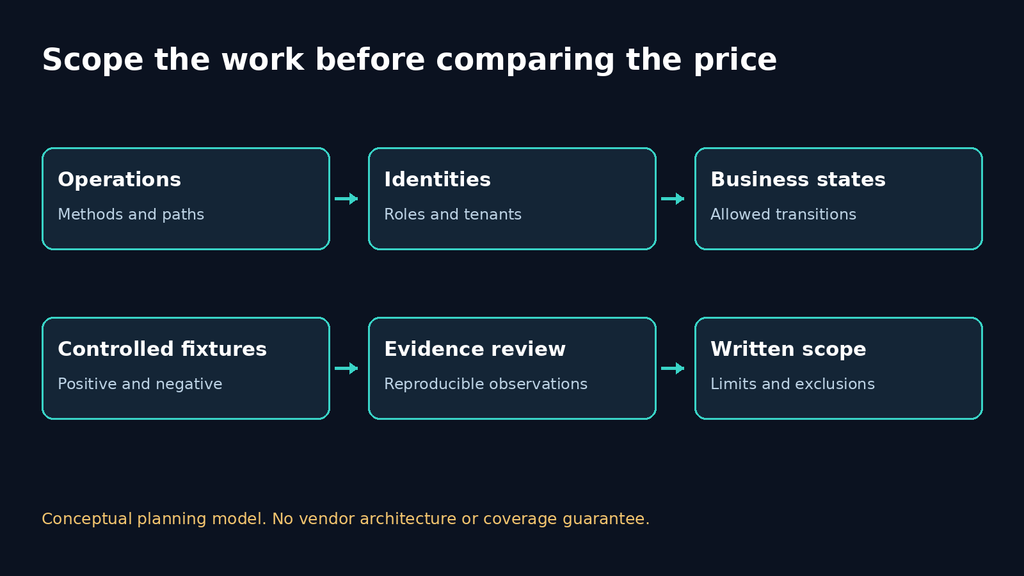
Start with an inventory, but do not mistake the inventory for the test plan. The OpenAPI 3.1.1 specification describes HTTP interfaces, including paths, operations, and security requirements. A specification is useful input for scoping. It does not establish that the deployed API matches the file or that the implementation enforces each caller’s permissions correctly.
Count methods with their paths. Reading an invoice, updating it, approving it, and exporting a batch can involve different permissions even if the objects look similar. Then record the identities, ownership relationships, and allowed state transitions. A route that works for one account says little about whether another account can access the same object.
For example, consider a fictional invoice read operation. Give two controlled customers their own test objects and accounts. The intended owner must be able to read its own object; the other customer must be denied without receiving protected data. A failed cross-customer request is inconclusive if the account cannot authenticate or the route is unavailable. Positive controls make the denial meaningful.
OWASP’s BOLA guidance explains that object-level authorization must validate the requested action on the requested object. Access to a function and access to an object are distinct questions. Use that distinction in the statement of work: “authenticated API testing” should say which object and role boundaries are being examined.
| Fictional case | Identity and object | Expected observation | Why budget for it |
|---|---|---|---|
| Owner control | Customer A account, A invoice | Authorized data is returned | Establishes working access and usable fixtures |
| Cross-customer check | Customer A account, B invoice | Denied; protected data absent | Examines object isolation using controlled records |
| Second owner control | Customer B account, B invoice | Authorized data is returned | Confirms the second fixture is reachable |
| Restricted action | Read-only account, approval operation | Unauthorized state change does not occur | Examines a different permission boundary |
This matrix is an example, not an exhaustive test count. Real work may need delegated administration, service identities, resource sharing, revoked access, or asynchronous exports. Avoid a mechanical “routes multiplied by roles” price formula: some combinations are irrelevant, while a single sensitive workflow can require several carefully prepared states.
Make the quote describe a deliverable
NIST SP 800-115 places technical testing within planning, execution, analysis, and mitigation work. Apply those stages to the purchase. Ask who prepares accounts, who verifies findings, and who explains coverage limits. A report export is only one part of delivery.
Preparation can materially change the practical cost. Expired tokens, missing object ownership records, incomplete API descriptions, or unavailable test data consume coordination time. Agree whether the engagement clock starts at signing or after access readiness, and how blocked days are treated. Providing good documentation should improve preparation, rather than serve as a reason to omit undocumented but authorized surfaces.
| Quote item | Write down before signing | Cost or acceptance risk |
|---|---|---|
| 인벤토리 | Hosts, API versions, operation groups, environment, approved third-party boundaries | Important surfaces omitted or assumed included |
| 인증 | Roles, tenant fixtures, token renewal, MFA assistance, responsible contact | Paid time lost to blocked access |
| Sensitive workflows | Permitted actions, synthetic records, cleanup and stopping rules | Superficial coverage or unintended production changes |
| Finding review | Reviewer, reproduction artifacts, impact reasoning and dispute process | Internal team pays to investigate unsupported findings |
| Remediation verification | Window, attempts, deployed version, included findings and extra charges | “Retest included” has a narrower meaning than expected |
| Recipient requirements | Required assessor independence, methodology and report fields | Technically useful work is rejected for the intended contractual purpose |
Do not quietly include disruptive resource-exhaustion tests under a generic API-security label. Agree safe limits and permitted methods separately. Likewise, testing your application does not grant authorization to assess its payment provider or another customer’s infrastructure. The boundary belongs in both the quote and the execution configuration.
A runnable budget model with visible assumptions
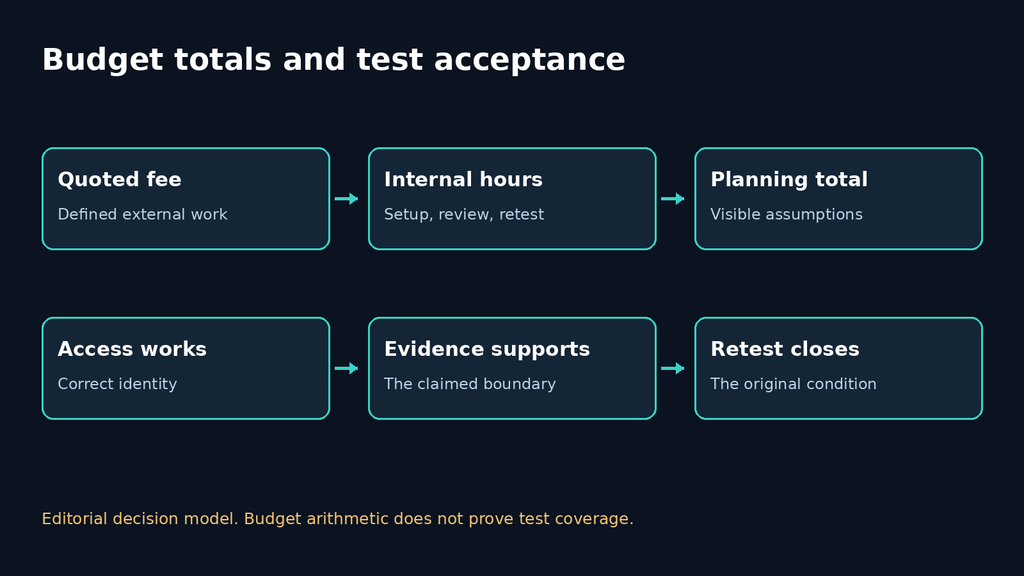
A low external fee can still require substantial internal preparation and review. The following Python model adds a quoted fee to three categories of internal work. The example assumes a fictional $5,000 fee, four setup hours, six review hours, two retest-coordination hours, and an $80 internal hourly rate. None is a market rate, supplier quote, or observed customer result.
Run it with Python 3 using only the standard library. We executed four valid-input checks and three invalid-input checks on October 25, 2026; all seven matched their expected outcomes. It makes no network requests. It rounds the final planning total to cents and rejects negative or nonfinite inputs.
from decimal import Decimal, ROUND_HALF_UP

def budget(fee, setup_hours, review_hours, retest_hours, hourly_rate):
    values = [Decimal(str(x)) for x in
              (fee, setup_hours, review_hours, retest_hours, hourly_rate)]
    if any(not x.is_finite() or x < 0 for x in values):
        raise ValueError('Use finite, nonnegative inputs')
    fee, setup, review, retest, rate = values
    return (fee + (setup + review + retest) * rate).quantize(
        Decimal('0.01'), rounding=ROUND_HALF_UP)

cases = [
    ((5000, 4, 6, 2, 80), Decimal('5960.00')),
    ((5000, 4, 12, 2, 80), Decimal('6440.00')),
    ((0, 0, 0, 0, 80), Decimal('0.00')),
    ((100, '0.5', '0.25', '0.25', 80), Decimal('180.00')),
]
for inputs, expected in cases:
    assert budget(*inputs) == expected
for invalid in (-1, 'NaN', 'Infinity'):
    try:
        budget(invalid, 4, 6, 2, 80)
    except ValueError:
        pass
    else:
        raise AssertionError('Invalid input accepted')
print('7/7 cases passed')
print('Fictional baseline:', budget(5000, 4, 6, 2, 80))
print('Fictional higher review:', budget(5000, 4, 12, 2, 80))
The fictional baseline is $5,960.00. If review grows from six to twelve hours, the total becomes $6,440.00, an additional $480. Those figures illustrate sensitivity to review effort; they do not demonstrate savings from automation. The model excludes taxes, additional usage charges, remediation engineering, and any other cost not entered in the fee or hours. Extend the budget explicitly rather than assuming the total is all-inclusive.
Estimate hours from a representative pilot when possible. Record time spent restoring authentication, clarifying false positives, redacting evidence, and confirming the fixed deployment. These activities can remain necessary even when tool execution is fast. An unattended job’s elapsed time is not the same measure as the team’s delivery effort.
Where automation changes the buying decision
Automation can support repeated checks against known workflows, while an external assessment may provide assigned specialist attention and an agreed independent review. Choose against the outcome required. If a customer contract requires an independent assessor, an internally operated tool does not satisfy that requirement simply because its software comes from another company.
Penligent’s documented workflow connects authorized targets, task execution, finding verification, and editable report delivery. Evaluate it using the same controlled API accounts and evidence expectations as other options. This guide does not report a head-to-head benchmark, guarantee support for a particular authentication setup, or convert credits into a guaranteed number of completed API assessments.
During a pilot, choose a previously understood permission boundary and preserve both permitted and forbidden controls. Inspect the resulting artifacts and time the review. If authentication fails, record blocked coverage. If the result cannot distinguish a denial from a login error, repair the testing prerequisites before scaling to more routes.
Questions to resolve before purchase
Does a single GraphQL endpoint mean a small assessment?
No. One transport URL can expose many queries, mutations, object relationships, and authorization decisions. Ask how the provider scopes operations and business workflows instead of applying a REST path count to GraphQL.
Does remediation testing include testing every new release?
Only if the agreement says so. Verifying named original findings within a defined window is different from reassessing new endpoints, changed roles, or new business logic. State the expansion rule and additional charges before the first report is delivered.
Can a cheaper automated run replace an external quote?
Compare scope, evidence, review responsibility, and recipient requirements first. A tool may serve internal release checks while the external engagement serves independent assurance. Do not subtract their prices and label the difference savings without establishing that the required work is still delivered.
Send providers one consistent scope packet: inventory, controlled identities, tenant fixtures, sensitive workflows, permitted actions, delivery criteria, and retest expectations. The right API testing budget is the cost of producing the evidence you need within those boundaries, with the remaining work and limitations visible.
 Korean
 English
 German
 French
 Spanish
 Portuguese
 Japanese
 Hindi
 Arabic
 Turkish
 Hebrew