
Cisco has released a new Catalyst SD-WAN security hardening update addressing a group of critical vulnerabilities discovered during an internal security review. At the top of that release is CVE-2026-20303, a critical improper input validation vulnerability group with a maximum CVSS 3.1 score of 9.9.
The advisory was first published on August 5, 2026. Cisco says the vulnerabilities affect Cisco Catalyst SD-WAN Software regardless of device configuration, across on-premises deployments, Cisco SD-WAN Cloud-Pro, Cisco-managed SD-WAN Cloud, and Cisco SD-WAN for Government deployments. Cisco has released fixed software and states that there are no workarounds for the vulnerabilities covered by the advisory. (sec.cloudapps.cisco.com)
For defenders, however, CVE-2026-20303 requires more careful interpretation than a normal single-bug CVE.
Cisco has changed the disclosure granularity for this hardening release. Instead of assigning an individual CVE to every internally discovered defect, the company grouped multiple issues according to their underlying Common Weakness Enumeration, or CWE, class. CVE-2026-20303 therefore represents an improper-input-validation vulnerability class containing one or more underlying security defects. Cisco explicitly says this grouping includes input-validation problems, path traversal, and external path control. The 9.9 score represents the maximum potential severity of the most impactful underlying vulnerability within that group. (sec.cloudapps.cisco.com)
That distinction matters.
There is currently no public Cisco description of a specific vulnerable endpoint, request format, filename parameter, traversal sequence, or end-to-end CVE-2026-20303 exploit chain. Security teams should therefore avoid treating speculative exploit examples as confirmed technical details.
What is confirmed is serious enough: the vulnerable software is part of an SD-WAN architecture where centralized components determine network policy, routing behavior, device relationships, and overlay control. Input-validation failures in that environment deserve considerably more attention than an equivalent bug buried in a low-value application.
CVE-2026-20303 at a Glance
| 필드 | Confirmed information |
|---|---|
| CVE | CVE-2026-20303 |
| Vendor | Cisco |
| 제품 | Cisco Catalyst SD-WAN Software |
| Advisory | Cisco Catalyst SD-WAN Software Security Hardening Release: August 2026 |
| First published | August 5, 2026 |
| 심각도 | 중요 |
| Maximum CVSS 3.1 | 9.9 |
| CWE | CWE-20: 부적절한 입력 유효성 검사 |
| Vulnerability grouping | Input validation, path traversal, external path control |
| 공격 벡터 | 네트워크 |
| Attack complexity | 낮음 |
| Privileges required | 낮음 |
| 사용자 상호 작용 | 없음 |
| 범위 | Changed |
| Confidentiality impact | 높음 |
| Integrity impact | 높음 |
| Availability impact | 높음 |
| Device configuration dependency | None stated; Cisco says affected regardless of device configuration |
| Workaround | 없음 |
| Primary remediation | Upgrade to a fixed Cisco Catalyst SD-WAN release |
| Public malicious exploitation | Cisco says none known as of the advisory |
| Public exploit details | Cisco has not published an exploit chain for CVE-2026-20303 |
| Discovery | Cisco internal testing using existing processes and frontier AI models |
Cisco publishes the CVSS vector as:
CVSS:3.1/AV:N/AC:L/PR:L/UI:N/S:C/C:H/I:H/A:H
The combination explains why CVE-2026-20303 reaches 9.9 rather than a more conventional high-severity score. The maximum-rated underlying issue is remotely reachable over a network, requires low privileges rather than administrative privileges, requires no victim interaction, has low attack complexity, crosses a security scope boundary, and can potentially produce high confidentiality, integrity, and availability impact. (sec.cloudapps.cisco.com)
The vulnerability should nevertheless not be described as an unauthenticated remote code execution bug. PR:L explicitly indicates that the maximum-scoring issue requires some level of privileges.
That is an important boundary when discussing CVE-2026-20303 accurately.
What Exactly Is CVE-2026-20303?
Cisco describes CVE-2026-20303 as:
CWE-20 — Improper Input Validation
and says the grouping covers:
- input validation;
- path traversal;
- external path control.
The terminology is broader than the usual one-line CVE description because Cisco intentionally grouped multiple internally discovered weaknesses beneath a single CWE-level CVE identifier. (sec.cloudapps.cisco.com)
This means a security engineer should not mentally translate:
CVE-2026-20303 = one path traversal endpoint.
That conclusion is not supported by the advisory.
A more accurate representation is:
CVE-2026-20303
        |
        +-- CWE-20 Improper Input Validation
                |
                +-- one or more input-validation defects
                +-- potentially path-traversal-related defects
                +-- potentially external-path-control defects
                |
                +-- highest-impact underlying issue:
                        CVSS 3.1 = 9.9
Cisco explains that the CVSS score associated with each CVE ID in the hardening advisory represents the maximum potential severity of the single most impactful underlying vulnerability within that CWE category. (sec.cloudapps.cisco.com)
This disclosure model has an interesting consequence for vulnerability management.
A traditional scanner may expect:
1 CVE
=
1 vulnerability
=
1 endpoint
=
1 exploitation condition
=
1 remediation state
That is not necessarily true here.
For CVE-2026-20303, a more appropriate model is:
1 CVE
=
1 vulnerability class
=
multiple possible underlying implementation defects
=
1 consolidated patching decision
From a patch-management perspective, the distinction does not reduce urgency. Cisco still tells customers to move to the fixed releases.
From a penetration-testing perspective, however, it substantially limits what can responsibly be claimed from public information.
Why Improper Input Validation Can Become a Critical SD-WAN Problem
Input validation vulnerabilities sound deceptively generic.
Almost every application-security engineer has encountered malformed input, unexpected characters, filename manipulation, numeric-boundary errors, or directory traversal. Many such bugs are low or medium severity.
What changes the risk equation is where the input is processed and what authority the receiving component has.
Cisco Catalyst SD-WAN is not simply a web application attached to a router.
Cisco describes the architecture as separating the management plane, control plane, and data plane. Cisco Catalyst SD-WAN Manager provides centralized provisioning, configuration, operational visibility, software management, and administrative functions. SD-WAN Controllers distribute routing, policy, topology, security, and reachability information to WAN edge devices through the Overlay Management Protocol. (Cisco)
The architecture can be simplified as:
                    Administrative Users
                            |
                            v
                +-----------------------+
                | Catalyst SD-WAN       |
                | Manager               |
                | Management Plane      |
                +-----------+-----------+
                            |
                   configuration/policy
                            |
                            v
                +-----------------------+
                | Catalyst SD-WAN       |
                | Controllers           |
                | Control Plane         |
                +-----------+-----------+
                            |
                     OMP / control
                            |
             +--------------+--------------+
             |              |              |
             v              v              v
        WAN Edge        WAN Edge        WAN Edge
        Branch A        Branch B        Data Center
             \              |              /
              \_____________|_____________/
                       Data Plane
Cisco says the SD-WAN Controller operates as the centralized decision point for the overlay and exchanges routes, transport locators, policy information, topology information, and other control-plane data with edge devices. (Cisco)
Consequently, the security value of SD-WAN infrastructure is disproportionately high.
A vulnerability that merely reads an unintended file on a disposable web server and a vulnerability belonging to the same CWE class inside centralized network infrastructure may share a taxonomy while having radically different operational consequences.
That is why the S:C또는 Scope: Changed, component of the published CVSS vector deserves attention.
It indicates that exploitation of the maximum-rated underlying vulnerability can affect security authority beyond the vulnerable component’s initial scope.
Cisco does not disclose enough technical detail to state exactly how CVE-2026-20303 crosses that boundary, so it would be inaccurate to invent an exploitation sequence.
But the architectural context explains why defenders should not dismiss a low-privileged input-validation flaw simply because authentication is required.
Why CVE-2026-20303 Is Rated CVSS 9.9
The score becomes much easier to understand when its components are examined separately.
Network Attack Vector
AV:N means the highest-scoring underlying vulnerability can be reached across a network rather than requiring physical or local host access.
For an enterprise management platform, this materially changes risk because an attacker who has already obtained some access to the management environment does not necessarily need interactive shell access on the affected system.
Low Attack Complexity
AC:L means Cisco’s scoring does not depend on exceptional race conditions, rare environmental states, or unusually complicated prerequisites.
This should not be interpreted as “public exploitation is trivial.”
Attack complexity and public exploit availability are different things.
Cisco has not publicly documented the request structure required to exploit CVE-2026-20303.
Low Privileges Required
PR:L is one of the most important values.
The maximum-scoring underlying vulnerability is not scored as pre-authentication.
Some valid level of access is required.
That makes credential protection, role separation, administrative access controls, and compromise detection particularly relevant.
It also means organizations should consider CVE-2026-20303 in the context of attack chains rather than isolated bugs.
A credential obtained through phishing, password reuse, token theft, another SD-WAN vulnerability, or compromised administrative infrastructure could potentially satisfy the initial privilege requirement for a subsequent vulnerability.
That is a general attack-path consideration rather than a claim that any particular technique has been demonstrated against CVE-2026-20303.
No User Interaction
UI:N means exploitation does not require another user to click a link, open a file, approve a request, or otherwise participate once the attacker has the necessary conditions.
Changed Scope
S:C indicates that the effect can cross a security authority boundary.
Combined with high confidentiality, integrity, and availability impacts, this is what pushes the maximum score extremely close to 10.
High Confidentiality, Integrity, and Availability Impact
Cisco assigns:
C:H
I:H
A:H
to the maximum-rated underlying vulnerability.
That means the vulnerability class contains at least one issue for which successful exploitation can potentially produce severe effects across all three classical security dimensions.
Again, because Cisco has not disclosed the internal vulnerability details, those values should not be converted into unverified claims such as “CVE-2026-20303 definitely gives root shell access.”
CVSS tells us the severity properties.
It does not reveal the missing exploit implementation.
Affected Cisco Catalyst SD-WAN Deployments
The scope is unusually broad.
Cisco states that the vulnerabilities in the August 2026 Catalyst SD-WAN hardening release affect Cisco Catalyst SD-WAN Software regardless of device configuration. (sec.cloudapps.cisco.com)
Cisco specifically lists:
| Deployment model | 영향을 받는 |
|---|---|
| On-Prem Deployment | 예 |
| Cisco SD-WAN Cloud-Pro | 예 |
| Cisco SD-WAN Cloud, Cisco Managed | 예 |
| Cisco SD-WAN for Government, FedRAMP | 예 |
This is important because configuration-dependent vulnerability assumptions often delay remediation.
A team may normally ask questions such as:
Do we have feature X enabled?

Is the vulnerable API exposed?

Are we using the affected plugin?

Does the device run in controller mode?

Did we disable the vulnerable service?
For this advisory, Cisco’s affected-products statement removes the broadest version of that escape route: customers should not assume a particular deployment is safe merely because they believe they do not use a specific optional feature.
Version remains the primary remediation question.
CVE-2026-20303 Fixed Versions
Cisco provides the following upgrade matrix for the Catalyst SD-WAN hardening vulnerabilities. (sec.cloudapps.cisco.com)
| Current Catalyst SD-WAN release | First fixed release |
|---|---|
| Earlier than 20.9 | Migrate to a fixed release |
| 20.9 | 20.9.10 |
| 20.10 | 20.12.8.1 |
| 20.11 | 20.12.8.1 |
| 20.12 | 20.12.8.1 |
| 20.13 | 20.15.6 |
| 20.14 | 20.15.6 |
| 20.15 | 20.15.6 |
| 20.16 | 20.18.4 |
| 20.18 | 20.18.4 |
| 26.1 | 26.1.2 |
Cisco notes that releases 20.11, 20.13, 20.14, and 20.16 have reached End of Software Maintenance and recommends moving to a supported release rather than remaining on an obsolete train. (sec.cloudapps.cisco.com)
For Cisco-managed SD-WAN Cloud environments, Cisco says the vulnerabilities have also been addressed in Release 20.15.602, and no customer action is required for that specific Cisco-managed cloud upgrade. (sec.cloudapps.cisco.com)
That does not mean every organization using the word “cloud” in its deployment inventory can automatically close the vulnerability.
Teams should confirm which Cisco service model they actually use.
A Simple CVE-2026-20303 Version Triage Script
For large environments, version triage should preferably come from authoritative inventory rather than manual screenshots.
The following defensive Python example does not probe or exploit anything. It simply compares manually exported Catalyst SD-WAN release information against the first fixed releases disclosed by Cisco.
from packaging.version import Version

fixed_branches = {
    "20.9": Version("20.9.10"),
    "20.12": Version("20.12.8.1"),
    "20.15": Version("20.15.6"),
    "20.18": Version("20.18.4"),
    "26.1": Version("26.1.2"),
}

systems = [
    {"name": "sdwan-prod-01", "version": "20.9.8"},
    {"name": "sdwan-prod-02", "version": "20.9.10"},
    {"name": "sdwan-dr-01", "version": "20.15.4"},
    {"name": "sdwan-new-01", "version": "26.1.2"},
]

def evaluate(version_string):
    current = Version(version_string)

    for branch, fixed in fixed_branches.items():
        if version_string.startswith(branch + "."):
            return "FIXED" if current >= fixed else f"UPGRADE TO >= {fixed}"

    return "MANUAL REVIEW REQUIRED"

for system in systems:
    status = evaluate(system["version"])
    print(f'{system["name"]:20} {system["version"]:12} {status}')
For production use, teams should adapt the script to their CMDB, device inventory, or configuration-management export and should preserve the distinction between release trains.
The Cisco advisory itself remains the authoritative source for fixed releases.
There Is No Workaround for CVE-2026-20303
Cisco is unusually clear on this point:
There are no workarounds that address these vulnerabilities. (sec.cloudapps.cisco.com)
That sentence should influence patch planning.
Network segmentation, MFA, access restrictions, jump hosts, and RBAC remain valuable compensating controls, but they should not be represented internally as equivalent to remediation.
A mature ticket should distinguish:
Risk reduction:
    management interface restrictions
    MFA
    RBAC
    OOB network
    logging
    trusted administration hosts

Actual remediation:
    upgrade to a Cisco fixed release
This distinction is especially important for compliance programs.
A firewall rule may reduce exploitability.
It does not change vulnerable code into fixed code.
Is CVE-2026-20303 Being Exploited?
As of August 7, 2026, Cisco says its Product Security Incident Response Team is not aware of public announcements or malicious use involving the vulnerabilities in this hardening advisory. (sec.cloudapps.cisco.com)
That is the strongest public statement currently available.
It should not be rewritten as:
CVE-2026-20303 cannot be exploited.
Nor should it become:
CVE-2026-20303 is already being exploited.
Neither claim is supported by Cisco’s August 5 disclosure.
Independent reporting from The Hacker News and SecurityWeek similarly describes CVE-2026-20303 as one of three 9.9-rated Catalyst SD-WAN vulnerability groups fixed in the August update, while reporting Cisco’s statement that the newly disclosed SD-WAN hardening vulnerabilities were not known to be actively exploited. (해커 뉴스)
That distinction will become particularly important if exploit research appears after publication.
Is There a CVE-2026-20303 PoC?
At the time of writing, Cisco’s advisory does not provide public exploit instructions, a vulnerable endpoint, or a proof-of-concept for CVE-2026-20303.
Search results for a newly disclosed critical CVE often fill quickly with pages using titles such as:
CVE-2026-20303 PoC
CVE-2026-20303 exploit
CVE-2026-20303 RCE
CVE-2026-20303 path traversal exploit
Those keywords should not be mistaken for evidence.
The Cisco advisory supports the statement that CWE-20 includes path traversal and external-path-control issues.
It does not currently support a specific traversal payload such as:
../../../../etc/passwd
against a named Catalyst SD-WAN endpoint.
Publishing a generic traversal string and labeling it a CVE-2026-20303 PoC would therefore be technically misleading.
This is particularly important because Cisco has grouped multiple vulnerabilities behind the same CVE identifier.
A PoC for one underlying issue would not automatically prove that every weakness represented by CVE-2026-20303 has the same trigger.
Why the Control Plane Changes the Risk Calculation
To understand the urgency, defenders need to understand the SD-WAN architecture rather than the CVE alone.
Cisco Catalyst SD-WAN separates network functions into different logical planes. WAN edge devices forward user traffic in the data plane. Controllers operate the centralized control plane. SD-WAN Manager provides centralized management and orchestration capabilities. (Cisco)
The Controller uses OMP to exchange information including routes, next hops, transport locators, policy information, and security information with edge routers. Centralized policies can then influence connectivity across many distributed sites. (Cisco)
This creates a fundamental security asymmetry.
Compromising one ordinary application server may compromise:
one workload
Compromising authority associated with centralized networking can potentially influence:
many sites
many routers
many segments
many routing relationships
many policy decisions
That does not mean Cisco has confirmed CVE-2026-20303 can perform all those actions.
Rather, it explains why security boundaries protecting SD-WAN administrative and control infrastructure deserve Tier-0-like treatment.
This broader control-plane threat is not theoretical in the Cisco ecosystem.
Earlier in 2026, Cisco disclosed CVE-2026-20182, a separate maximum-severity Catalyst SD-WAN authentication-bypass vulnerability rated CVSS 10.0. Cisco documented that issue as affecting control-connection handshaking and later published compromise-checking guidance. (Cisco)
Cisco also disclosed CVE-2026-20262, an arbitrary file-write vulnerability in Catalyst SD-WAN Manager. That separate issue involves insufficient validation during a file-upload process and can allow an authenticated remote attacker with the required permissions to create or overwrite files. (Cisco)
These vulnerabilities should not be conflated with CVE-2026-20303.
But together they demonstrate why SD-WAN control and management components should not be treated like routine network appliances that can be patched months later.
For additional context on the earlier control-plane authentication issue, Penligent previously analyzed the operational implications of CVE-2026-20182 and why SD-WAN compromise can become a fabric-level problem. CVE-2026-20182 Cisco SD-WAN control-plane analysis
CVE-2026-20303 Is Part of a Larger August 2026 SD-WAN Hardening Release
CVE-2026-20303 should not be patched in isolation.
Cisco’s August hardening advisory contains five CVE groups:
| CVE | Maximum CVSS | CWE / vulnerability class |
|---|---|---|
| CVE-2026-20303 | 9.9 | CWE-20 Improper Input Validation |
| CVE-2026-20304 | 9.9 | CWE-284 Improper Access Control |
| CVE-2026-20310 | 9.9 | CWE-59 Improper Link Resolution Before File Access |
| CVE-2026-20312 | 8.8 | CWE-312 Cleartext Storage of Sensitive Information |
| CVE-2026-20313 | 7.7 | CWE-1284 Improper Validation of Specified Quantity in Input |
Cisco says all five resulted from its internal security review. (sec.cloudapps.cisco.com)
The combination is more interesting than any individual label.
Input validation, access control, link resolution, cleartext sensitive-data storage, and quantity validation touch different layers of application security.
The hardening release therefore appears to address a broad family of implementation weaknesses rather than one narrowly scoped feature defect.
Independent reporting similarly identified CVE-2026-20303, CVE-2026-20304, and CVE-2026-20310 as the three 9.9-rated Catalyst SD-WAN CVE groups in the release. (해커 뉴스)
Cisco Says Frontier AI Models Helped Find the Vulnerabilities
One unusual detail in this disclosure is how the vulnerabilities were found.
Cisco states that its engineers discovered the vulnerabilities during internal security testing using existing testing processes as well as frontier AI models. (sec.cloudapps.cisco.com)
That deserves attention beyond the marketing interpretation of “AI found vulnerabilities.”
The more meaningful security-engineering implication is that AI-assisted vulnerability discovery is moving deeper into mature vendor secure-development processes.
A modern vulnerability-discovery pipeline can increasingly combine:
static code analysis
        +
manual security review
        +
fuzzing
        +
dynamic testing
        +
dependency analysis
        +
LLM-assisted code reasoning
        +
agentic tool execution
        =
larger searchable vulnerability surface
Frontier models can potentially help researchers connect functions across large repositories, identify unusual trust assumptions, generate test cases, reason about attacker-controlled input reaching sensitive sinks, and prioritize suspicious code paths.
But AI discovery does not change the fundamental standard for vulnerability verification.
A language model suggesting that a path is vulnerable is not enough.
A mature process still needs reproducibility, controlled validation, impact analysis, regression testing, and a patch.
The Cisco disclosure is noteworthy precisely because those findings made it through an enterprise vendor’s internal process and into coordinated fixed releases.
How Security Teams Should Validate CVE-2026-20303 Safely
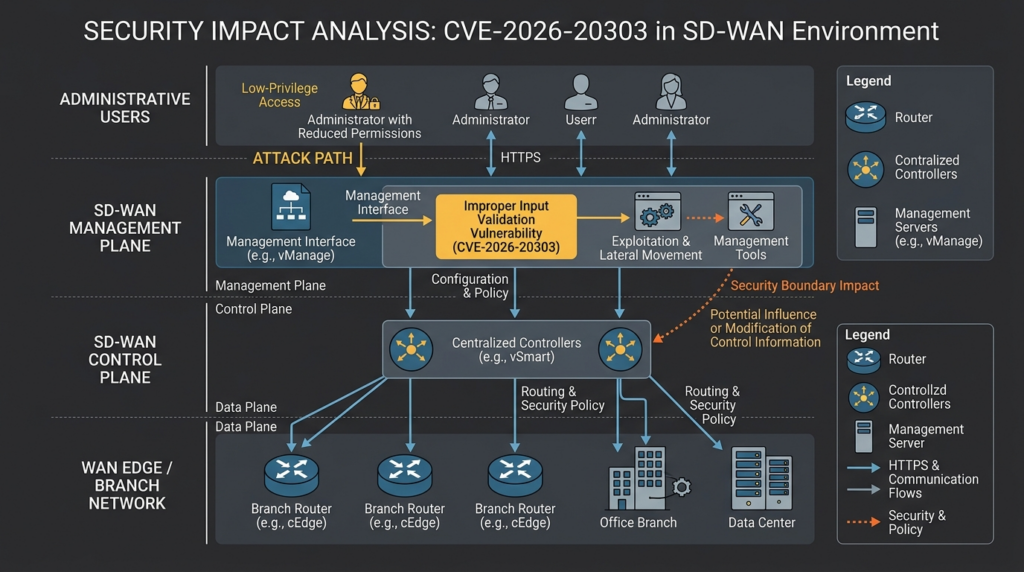
Because the underlying exploit mechanics have not been publicly disclosed, verification should begin with exposure and remediation validation, not speculative exploitation.
A useful validation workflow is:
Asset discovery
      |
      v
Identify Catalyst SD-WAN deployments
      |
      v
Collect exact release versions
      |
      v
Compare with Cisco fixed-release table
      |
      +---- Vulnerable/uncertain ----> Schedule upgrade
      |
      v
Review management-plane exposure
      |
      v
Review privileged and low-privileged accounts
      |
      v
Centralize and preserve logs
      |
      v
Upgrade
      |
      v
Confirm new versions
      |
      v
Regression-test fabric health
For CVE-2026-20303 specifically, this approach is more defensible than sending arbitrary traversal payloads to production controllers based only on the CWE label.
Step 1: Build an authoritative SD-WAN inventory
Do not rely on one vulnerability scanner.
Inventory:
SD-WAN Manager instances
SD-WAN Controllers
SD-WAN Validators
cluster members
DR systems
cloud-managed environments
management IP addresses
administrative access paths
software release trains
Cisco’s current naming matters as well.
Older environments and documentation may still contain:
vManage
vSmart
vBond
while newer Cisco terminology uses:
Catalyst SD-WAN Manager
Catalyst SD-WAN Controller
Catalyst SD-WAN Validator
Cisco formally documents those product-name transitions. (Cisco)
Searching only one vocabulary can create inventory gaps.
Step 2: Record exact software versions
Cisco’s advisory says customers can determine remediation status or software version using the Help function in the service GUI. (sec.cloudapps.cisco.com)
For vulnerability-management purposes, export the versions into a structured inventory rather than relying only on manual observation.
Step 3: Compare against the fixed release
The result should ultimately be simple:
Affected release?
        |
       Yes
        |
        v
Is installed version >= first fixed version?
        |
     No +------> Upgrade required
        |
       Yes
        |
        v
Patch requirement satisfied for this advisory
Step 4: Validate every relevant system
Clustered control infrastructure creates an easy operational mistake:
patching one node and considering the CVE closed.
Verification should cover all applicable nodes and service instances represented in the deployment inventory.
Step 5: Preserve evidence before disruptive remediation
Cisco’s August advisory says it is not aware of malicious exploitation of CVE-2026-20303, so there is currently no CVE-specific compromise-hunting procedure comparable to some earlier exploited SD-WAN vulnerabilities. (sec.cloudapps.cisco.com)
Nevertheless, preserving relevant logs before major control-plane upgrades remains good operational practice.
This is especially true for organizations with regulatory, forensic, or incident-response requirements.
Hardening Is Not a Substitute for Patching, but It Still Matter
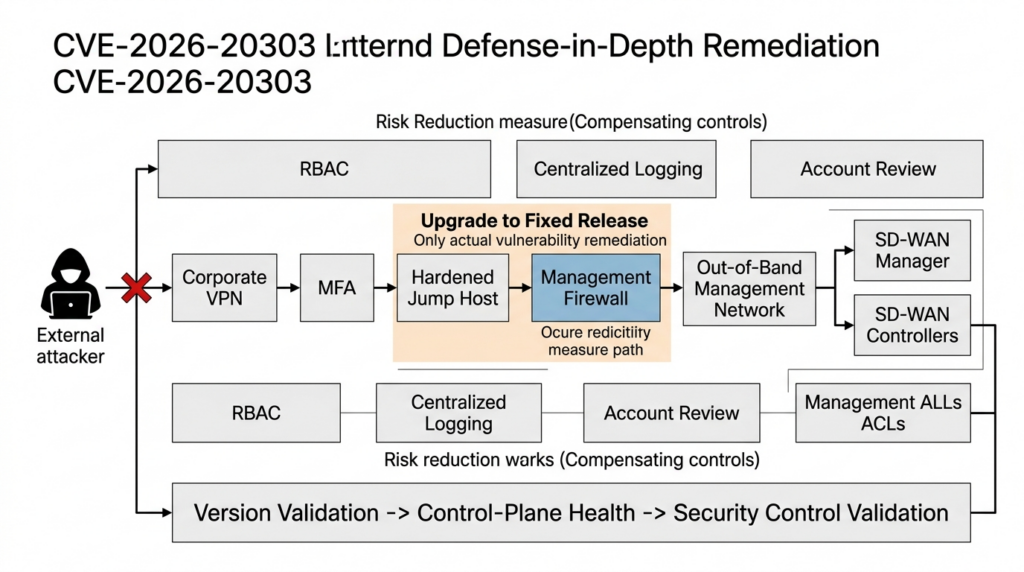
Cisco maintains a dedicated Catalyst SD-WAN Hardening Guide, and several recommendations are directly relevant to the attack prerequisites represented by CVE-2026-20303.
Cisco recommends keeping SD-WAN control components on an out-of-band management network and states that administrative interfaces should not be directly exposed to user networks or the internet. The guide recommends hardened jump hosts for administrative access and MFA around those administration paths. (Cisco)
That architecture should look more like:
Internet
   |
   X
   |
User Network
   |
   X
   |
Management Firewall
   |
Corporate VPN + MFA
   |
Hardened Jump Host
   |
Out-of-Band Management Network
   |
+-----------------------------+
| SD-WAN Manager              |
| SD-WAN Controller           |
| SD-WAN Validator            |
+-----------------------------+
and less like:
Internet/User Network
        |
        |
        v
SD-WAN Management Interface
Cisco specifically recommends not exposing administrative interfaces such as ports 443, 22, and 830 of SD-WAN components directly to the internet. (Cisco)
Again, these controls do not eliminate CVE-2026-20303.
They reduce the number of paths an attacker can use to reach vulnerable functionality.
Low Privileges Required Makes RBAC Particularly Important
Because the published CVSS vector contains PR:L, least privilege deserves more attention than it would for a purely pre-authentication vulnerability.
Cisco Catalyst SD-WAN supports role-based access control that can restrict users according to role, scope, sites, and policy permissions. Cisco describes granular RBAC as a mechanism for providing only the system and policy permissions required by a user’s role. (Cisco)
For CVE-2026-20303 remediation planning, administrators should therefore review:
active accounts
inactive accounts
local accounts
shared accounts
service accounts
read-only accounts
write-capable accounts
administrative roles
API credentials
external AAA mappings
The important question is not simply:
Who is an administrator?
It is:
Which identities have any access level that could satisfy a low-privilege attack prerequisite?
Unused accounts should be disabled.
Shared administrative credentials should be eliminated where possible.
Permissions should be reduced to the minimum required.
Authentication should be integrated with centralized identity infrastructure where appropriate.
None of those changes removes the vulnerable code.
But if exploitation requires authenticated low-privileged access, reducing the number of identities capable of reaching that state directly shrinks the attack surface.
Protect the SD-WAN Manager as a High-Value Administrative System
Cisco describes SD-WAN Manager as the main centralized portal for managing the Catalyst SD-WAN environment. It provides operational visibility and capabilities for provisioning, configuration, software management, and other fabric-wide operations. (Cisco)
That makes administrative workstation security part of SD-WAN security.
Consider an environment where the controller itself is heavily filtered, but administrators regularly access it from ordinary employee laptops.
An attacker who compromises one of those endpoints may inherit:
browser sessions
VPN access
SSH keys
stored credentials
authentication tokens
administrative reachability
That is why Cisco’s recommendation to use hardened jump hosts matters.
Control-plane protection cannot stop at the control-plane IP address.
The trust chain is closer to:
Administrator identity
        |
        v
Identity provider
        |
        v
MFA
        |
        v
Administrative endpoint
        |
        v
VPN
        |
        v
Jump host
        |
        v
Management firewall
        |
        v
SD-WAN management/control components
Weakness anywhere earlier in the chain may convert an external attacker into an authenticated internal attacker.
For a PR:L vulnerability, that transition is strategically important.
Centralize SD-WAN Logs
Cisco’s hardening guidance recommends centralized logging and external retention so that unexpected access can be investigated after an event. (Cisco)
A security team should not discover during incident response that the only relevant control-plane logs rotated away three days earlier.
At minimum, monitoring should establish baselines for:
authentication events
failed authentication
new administrative accounts
role changes
configuration changes
unexpected management source IPs
SSH sessions
API activity
unusual file operations where logged
service failures
unexpected restarts
policy changes
control-plane anomalies
Because Cisco has not released CVE-2026-20303-specific indicators of compromise, these should be understood as general SD-WAN security monitoring, not signatures proving exploitation.
That difference matters for incident response.
An unusual file operation might justify investigation.
It does not by itself mean CVE-2026-20303 was exploited.
Do Not Build Detection Rules Around an Invented Po
A common mistake immediately after a CVE disclosure is to create highly specific detection logic from an imagined exploit.
예를 들어
alert if URL contains "../../../../"
may be a perfectly reasonable generic path-traversal detection idea in some environments.
But without evidence that CVE-2026-20303 uses an HTTP URL, a particular parameter, or that traversal syntax, labeling such a rule:
CVE-2026-20303 Detection
would overstate what is known.
A more accurate name would be:
Generic Path Traversal Attempt Against SD-WAN Management Services
The rule can later be refined if Cisco, a researcher, or another trusted source publishes validated technical indicators.
This evidence-first approach becomes increasingly important as AI-generated security content floods search results.
A model can easily produce something that looks like a plausible exploit.
That is not evidence that the affected software implements the guessed endpoint.
Patch Priority Should Not Depend on Waiting for a PoC
Some vulnerability-management programs effectively use this workflow:
CVE disclosed
     |
     v
Wait for PoC
     |
     v
Wait for exploitation
     |
     v
Emergency patch
CVE-2026-20303 is a poor candidate for that strategy.
Cisco has already provided several strong risk signals:
Critical severity.
Maximum CVSS 9.9.
Network-reachable underlying issue.
Low privileges required.
No user interaction.
Changed security scope.
High confidentiality, integrity, and availability impact.
All configurations affected according to Cisco.
No workaround.
Fixed releases already available.
Waiting for public weaponization adds attacker information without improving the defender’s remediation options.
The patch already exists.
Why “Low Privilege Required” Does Not Mean Low Risk
Security teams sometimes see PR:L and downgrade a vulnerability mentally:
An attacker needs an account, so this is less urgent.
That reasoning ignores how modern intrusion chains work.
Initial access and high-impact exploitation are frequently separate stages.
Conceptually:
Phishing / stolen credential / previous vulnerability
                    |
                    v
             Low-privileged access
                    |
                    v
        CVE-2026-20303-class weakness
                    |
                    v
        Higher-impact security boundary
Again, this diagram is a threat model, not a confirmed CVE-2026-20303 exploit chain.
The distinction is crucial.
Low privileges are often easier for attackers to obtain than administrator privileges.
An organization might have:
20 full administrators

but

200 operators,
service identities,
automation identities,
monitoring accounts,
API users,
or delegated accounts
If any security defect can turn a lower-trust identity into a high-impact action, the population of relevant credentials can be much larger than the administrator list suggests.
That is one reason privilege escalation and post-authentication flaws remain common components of serious attack chains.
Validate the Entire SD-WAN Trust Path
A good CVE-2026-20303 review should therefore go beyond the patch ticket.
Security teams should answer four questions.
Is the software vulnerable?
This is the version question.
Compare each deployment against Cisco’s fixed releases.
Can an attacker reach the vulnerable trust boundary?
This is the segmentation question.
Review network paths to SD-WAN administrative and control components.
Can an attacker obtain the required identity?
This is the IAM question.
Review RBAC, credentials, API keys, SSO, MFA, service accounts, and administrative endpoints.
Would exploitation be detectable?
This is the telemetry question.
Verify that authentication, configuration, administrative, and relevant system logs are exported and retained.
That creates a more complete model:
Vulnerability
    x
Reachability
    x
Identity exposure
    x
Detection weakness
    =
Operational risk
CVSS captures important technical dimensions.
It does not replace environment-specific attack-path analysis.
Safe Penetration Testing for CVE-2026-20303
For authorized security teams, the lack of public exploit mechanics changes the testing strategy.
The first objective should be evidence of exposure, not forcing an assumed exploit.
A safe assessment can establish:
1. Is Cisco Catalyst SD-WAN present?

2. Which exact software train is deployed?

3. Is the release vulnerable according to Cisco?

4. Are management components reachable from untrusted networks?

5. Are administrative interfaces internet-accessible?

6. Are low-privileged accounts unnecessarily numerous?

7. Is MFA enforced on administrative paths?

8. Are jump hosts used?

9. Are logs centralized?

10. Has the fixed release actually been installed everywhere?
Only if a reliable vendor-approved or researcher-validated exploitation method becomes public should exploit reproduction be added to a controlled validation phase.
That sequencing prevents two common problems:
false positives from generic vulnerability payloads and accidental disruption of critical network infrastructure.
SD-WAN is a particularly poor environment for uncontrolled experimentation because control infrastructure can influence connectivity across multiple branches and production sites.
How AI-Assisted Pentesting Changes This Workflow
CVE-2026-20303 also illustrates an important shift in security testing.
Traditional vulnerability scanners tend to work well when the problem can be represented as:
version X
+
signature Y
=
vulnerable
But grouped CVE disclosures are more complicated.
An AI-assisted security workflow can reason across:
asset identity
software version
vendor advisory
deployment architecture
network reachability
authentication state
role permissions
adjacent vulnerabilities
available evidence
patch state
The correct goal is not to ask an AI model to hallucinate an exploit.
The goal is to let it continuously update an evidence-backed attack model.
예를 들어
Cisco advisory retrieved
        |
        v
Affected version confirmed
        |
        v
No public exploit mechanics
        |
        v
Agent suppresses speculative exploitation
        |
        v
Checks management exposure
        |
        v
Checks software version
        |
        v
Checks account surface
        |
        v
Validates patch
        |
        v
Produces evidence-backed result
That philosophy is relevant to platforms such as Penligent, where AI is useful when it can combine vulnerability intelligence with real security-tool output and preserve evidence rather than simply generate exploit-looking text.
For teams investigating related Cisco SD-WAN exposure, Penligent’s earlier analysis of CVE-2026-20262 also shows how version state, deployment model, file-system impact, and exploitation status need to be separated rather than compressed into one CVSS number. CVE-2026-20262 Cisco SD-WAN Manager analysis
Patch Validation After Upgradin
Closing CVE-2026-20303 should require more evidence than:
Change window completed successfully.
After the upgrade, verify at least three layers.
Software State
Confirm that every applicable component now runs a fixed release.
예를 들어
20.9.x  -> >= 20.9.10
20.12.x -> >= 20.12.8.1
20.15.x -> >= 20.15.6
20.18.x -> >= 20.18.4
26.1.x  -> >= 26.1.2
Older and end-of-maintenance trains may require migration rather than an in-place security update. (sec.cloudapps.cisco.com)
Control-Plane Health
Confirm that the upgrade did not create operational problems involving:
device connectivity
controller relationships
routing distribution
policy state
certificate trust
branch reachability
management access
The exact validation procedures will depend on the organization’s deployment.
Security Controls
Confirm that emergency upgrade work did not accidentally loosen:
firewall policies
management ACLs
MFA
AAA
RBAC
logging
SSH restrictions
jump-host requirements
Patch validation should prove both:
vulnerability removed
and:
security architecture preserved
The Bigger Cisco SD-WAN Security Lesson
CVE-2026-20303 arrives during a year in which Cisco has disclosed multiple significant vulnerabilities affecting Catalyst SD-WAN control and management infrastructure.
That does not mean Catalyst SD-WAN is uniquely insecure.
It does mean organizations need to stop treating network-control software as infrastructure that can sit outside normal application-security and vulnerability-management processes.
The traditional enterprise security model often monitors:
Windows endpoints
Linux servers
cloud workloads
containers
web applications
databases
very aggressively while giving considerably less visibility to:
network controllers
router management planes
SD-WAN managers
BMCs
hypervisor management
firewall managers
wireless controllers
The latter systems frequently possess more organizational authority than an ordinary workload.
They deserve asset inventory, centralized logging, vulnerability SLAs, hardened administrative paths, credential monitoring, and incident-response procedures of comparable maturity.
Frequently Asked Questions About CVE-2026-20303
What is CVE-2026-20303?
CVE-2026-20303 is a Cisco Catalyst SD-WAN vulnerability grouping covering CWE-20 Improper Input Validation, including input-validation, path-traversal, and external-path-control weaknesses. Cisco assigns the group a maximum CVSS 3.1 score of 9.9. (sec.cloudapps.cisco.com)
Is CVE-2026-20303 critical?
Yes.
Cisco rates it Critical with a maximum CVSS score of 9.9. (sec.cloudapps.cisco.com)
Does CVE-2026-20303 require authentication?
The maximum published CVSS vector contains PR:L, meaning low privileges are required.
It should therefore not be described as a pre-authentication vulnerability based on currently available evidence. (sec.cloudapps.cisco.com)
Does CVE-2026-20303 require user interaction?
No.
Cisco’s CVSS vector contains UI:N. (sec.cloudapps.cisco.com)
Is CVE-2026-20303 a path traversal vulnerability?
Cisco says the CWE-20 grouping represented by CVE-2026-20303 includes input validation, path traversal, and external path control.
Because Cisco grouped multiple underlying vulnerabilities under the CVE, it is more accurate to describe CVE-2026-20303 as an improper-input-validation vulnerability group that includes path-traversal-related weaknesses than to claim one specific publicly documented traversal endpoint exists. (sec.cloudapps.cisco.com)
Is CVE-2026-20303 an RCE?
Cisco does not currently describe CVE-2026-20303 as a specific remote-code-execution vulnerability.
Its maximum CVSS impact is severe, but the advisory does not disclose enough exploit mechanics to justify inventing an RCE claim.
Is there a CVE-2026-20303 PoC?
No validated CVE-2026-20303 exploit chain is disclosed in Cisco’s August 5 advisory.
Be cautious with pages claiming to offer an exploit unless their technical findings can be independently verified against the affected software.
Is CVE-2026-20303 being exploited in the wild?
Cisco says PSIRT is not aware of public announcements or malicious exploitation of the vulnerabilities covered by this advisory as of its publication. (sec.cloudapps.cisco.com)
Are all Cisco Catalyst SD-WAN configurations affected?
Cisco says the vulnerabilities affect Catalyst SD-WAN Software regardless of device configuration. (sec.cloudapps.cisco.com)
Is there a workaround?
No.
Cisco says there are no workarounds that address the vulnerabilities. (sec.cloudapps.cisco.com)
What version fixes CVE-2026-20303?
Depending on the release train, Cisco identifies the first fixed releases as 20.9.10, 20.12.8.1, 20.15.6, 20.18.4, and 26.1.2. Deployments earlier than 20.9 must migrate to a fixed release. (sec.cloudapps.cisco.com)
Final Assessment
CVE-2026-20303 deserves urgent remediation, but it also deserves precise language.
Cisco has confirmed a critical group of improper-input-validation weaknesses in Catalyst SD-WAN Software with a maximum CVSS score of 9.9. The affected scope is broad, Cisco says the vulnerabilities apply regardless of device configuration, and there is no workaround. Fixed releases are already available. (sec.cloudapps.cisco.com)
What Cisco has not publicly provided is equally important.
There is currently no public endpoint-specific CVE-2026-20303 exploit description, no confirmed traversal payload, and no disclosed end-to-end attack procedure that justifies publishing a fabricated PoC.
The right defender response is therefore not speculation.
It is:
inventory
→ version verification
→ exposure review
→ privilege review
→ evidence preservation
→ upgrade
→ post-upgrade validation
→ continued hardening
Cisco’s own Catalyst SD-WAN hardening guidance reinforces that architecture: isolate control components, avoid exposing management interfaces directly to untrusted networks, use hardened jump hosts, enforce MFA, apply RBAC, secure SSH access, centralize logs, and keep the platform on supported software. (Cisco)
CVE-2026-20303 ultimately highlights a broader change in enterprise security.
The most consequential vulnerabilities increasingly live not only on endpoints and application servers, but inside the systems that decide how the rest of the network behaves.
When the vulnerable system participates in centralized network management and control, patching is not routine housekeeping.
It is protection of the trust layer underneath the enterprise network itself.


 Korean
  English
  German
  French
  Spanish
  Portuguese
  Japanese
  Hindi
Hindi  Arabic
  Turkish
  Hebrew