
CVE-2026-23479 is not another case of Redis left open to the internet with no password. It is a real memory-safety bug in Redis server code. The vulnerable path sits in the blocked-client unblock flow: when Redis re-executes a pending blocked command, processCommandAndResetClient can return an error because the client was freed, but the caller continued to operate on that client pointer. Under the right authenticated conditions, that use-after-free can become remote code execution on the Redis host. NVD describes the issue in redis-server from 7.2.0 until 8.6.3, and GitHub’s advisory states that the problem exists in Redis 7.2 or newer. Redis published the coordinated security advisory on May 5, 2026. (nvd.nist.gov)
The important word is “authenticated,” not “safe.” Redis itself describes the issue as post-authentication, and the public technical analysis of the bug shows an exploit path requiring a Redis session with meaningful privileges, including command categories that many real deployments still give to application, maintenance, or default users. A Redis server does not have to be exposed directly to the public internet for this to matter. If an attacker compromises an app server, steals a Redis URL from an environment variable, lands inside a Kubernetes namespace, abuses SSRF into an internal service, or finds a staging Redis instance with weak controls, the “authenticated only” boundary can collapse fast. (Redis)
NVD rates CVE-2026-23479 as CVSS 3.1 8.8 High with network attack vector, low privileges required, no user interaction, and high impact to confidentiality, integrity, and availability. GitHub, acting as the CNA source shown by NVD, lists a CVSS 4.0 score of 7.7 High with high attack complexity and low privileges required. That difference should not distract defenders. The exploit engineering is non-trivial, but the blast radius of a successful Redis host compromise is serious: application data, session material, internal network reachability, credentials in configuration, and service availability can all be at stake. (nvd.nist.gov)
What defenders should know first
| 항목 | Practical meaning |
|---|---|
| CVE | CVE-2026-23479 |
| 제품 | Redis server, package name redis-server in the GitHub advisory |
| 취약성 등급 | Use-after-free |
| CWE | CWE-416, Use After Free |
| Primary vulnerable path | Blocked-client unblock flow, especially re-executing a pending command after unblocking |
| Key faulty behavior | processCommandAndResetClient can return an error when the client was freed, but the caller continued using the same client pointer |
| Required access | Authenticated Redis access with enough command privileges to reach the vulnerable and exploitable path |
| 최악의 경우 영향 | Remote code execution in the Redis server process context |
| NVD severity | CVSS 3.1 8.8 High |
| GitHub CNA severity | CVSS 4.0 7.7 High |
| NVD affected range | Redis 7.2.0 through versions before 8.6.3 |
| GitHub advisory affected range | Redis 7.2 or newer |
| Patch direction | Upgrade into the fixed release for the maintained branch in use |
| Immediate compensating controls | Restrict network reachability, enforce strong authentication, apply least-privilege ACLs, remove unnecessary admin, scripting, stream, restore, module, and replication privileges from application users |
| Exploitation evidence | Redis stated in its advisory that, as of publication, it had no evidence of exploitation in Redis or customer environments |
Redis’s own advisory grouped CVE-2026-23479 with four other Redis vulnerabilities disclosed on the same date: CVE-2026-25243, CVE-2026-25588, CVE-2026-25589, and CVE-2026-23631. That matters because a mature response should not patch one Redis RCE-class issue and leave adjacent command surfaces untouched. The same advisory recommends restricting network access, enforcing credentials, limiting permissions, and upgrading to the fixed releases. (Redis)
The bug is in client lifecycle handling, not Redis authentication
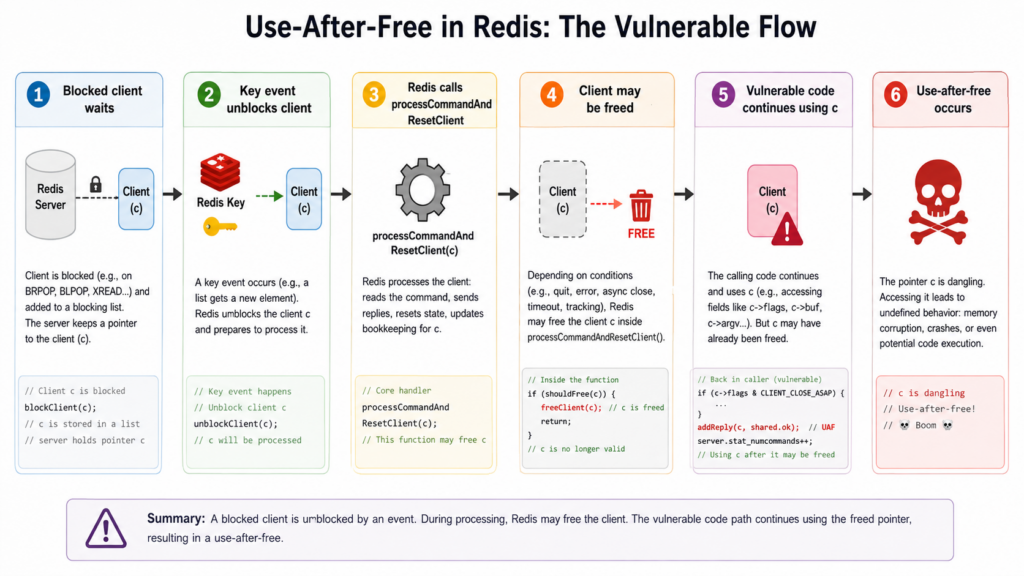
Redis has several command patterns that can block a client until a later event occurs. A blocking stream read is an easy mental model: one client waits, another command changes the relevant key, and Redis wakes the blocked client so execution can continue. Internally, that means Redis needs to manage client state, pending commands, event ordering, memory accounting, and reprocessing. CVE-2026-23479 lives in that kind of edge case. The problem is not that Redis forgot to ask for a password. The problem is that a client object could be freed during command processing while the unblock path still assumed the object was alive.
The vulnerable function discussed in the public deep dive is unblockClientOnKey in src/blocked.c. The vulnerable logic called processCommandAndResetClient(c) and then continued to read and write fields on c, including flags and later processing state. The function processCommandAndResetClient already documented a dangerous possibility: it could return C_ERR when the client had been freed as a side effect of processing the command. The caller did not honor that return value. That is the core of the bug. (ZeroDay.cloud)
A simplified version of the vulnerable pattern looks like this:
static void unblockClientOnKey(client *c, robj *key) {
    if (c->flags & CLIENT_PENDING_COMMAND) {
        c->flags &= ~CLIENT_PENDING_COMMAND;
        c->flags |= CLIENT_REEXECUTING_COMMAND;

        processCommandAndResetClient(c);

        if (!(c->flags & CLIENT_BLOCKED)) {
            queueClientForReprocessing(c);
        }

        afterCommand(c);
        c->flags &= ~CLIENT_REEXECUTING_COMMAND;
    }
}
The dangerous line is not visually dramatic. It is not a missing bounds check around a copy into a fixed-size stack buffer. It is a failure to respect ownership and lifetime after a call that can invalidate the object. In C, that is enough. Once an object has been freed, the old pointer is no longer safe to dereference. If another allocation reuses that region, the stale pointer may now refer to attacker-influenced data, unrelated data, allocator metadata, or simply memory that crashes the process. That is why CWE-416 has produced so many serious vulnerabilities across high-performance infrastructure.
The upstream fix is small, which is typical for lifecycle bugs. The Redis commit for CVE-2026-23479 changes the call so the return value is checked. If processCommandAndResetClient(c) == C_ERR, the function exits the execution unit, restores server.current_client, and returns immediately because the client was freed during command processing. The patch also adds a regression test around blocked client eviction during unblock. (GitHub)
if (processCommandAndResetClient(c) == C_ERR) {
    /* Client was freed during command processing, exit immediately */
    exitExecutionUnit();
    server.current_client = old_client;
    return;
}
This kind of patch is a useful lesson for security reviewers. The vulnerable behavior was not hidden behind a complex cryptographic primitive. The warning was effectively encoded in the callee contract. The bug existed because a caller ignored a return value that carried object-lifetime meaning. For maintainers of C and C++ systems, functions that can free, detach, invalidate, or reparent objects deserve special review treatment. They are security-sensitive even when they do not parse untrusted bytes directly.
Why a blocked client bug can become RCE
A use-after-free does not automatically mean reliable remote code execution. Many UAF bugs produce crashes. Some produce data corruption that is hard to steer. Some become exploitable only on specific builds, allocator states, or hardening profiles. CVE-2026-23479 is serious because the public analysis shows a path from stale client pointer use to an attacker-controlled primitive under authenticated conditions. ZeroDay.Cloud’s deep dive describes a three-stage chain: an information leak, a use-after-free trigger with heap reclaim, and a code execution stage that abuses Redis memory accounting behavior and writable relocation structures in the demonstrated environment. (ZeroDay.cloud)
For defenders, the useful takeaway is not the exact exploit recipe. It is the set of preconditions that make the recipe possible. The analysis says the demonstrated exploit required an authenticated session with privileges to tune client memory limits through CONFIG SET maxmemory-clients, execute Lua through EVAL, use stream commands such as XREAD 그리고 XADD, and perform ordinary reads and writes. In ACL category terms, the relevant permissions touch administrative, scripting, stream, read, and write capabilities. A deployment that denies CONFIG blocks the specific public exploit chain described in the analysis, although the underlying memory bug still requires patching. (ZeroDay.cloud)
This is why ACL review is not an optional hardening chore. Redis ACLs exist to limit both commands and keys after authentication. The official Redis ACL documentation states that ACLs can restrict what commands a connection may execute and which keys it may access. It also shows that a default-configured Redis 6 instance has a default user with nopass, access to every key pattern, access to every Pub/Sub channel pattern, and permission to call every command through +@all. That backward-compatible default is convenient, but it is a bad security boundary for production. (Redis)
A hardened production design should separate roles. Application workers that only need cache reads and writes should not be able to change server configuration, run arbitrary Lua, load modules, alter replication, restore serialized values, or inspect broad keyspace data outside their namespace. Operators may need administrative commands, but those accounts should be rare, monitored, protected by network controls, and kept out of application configuration files. CVE-2026-23479 makes that distinction concrete: the difference between “authenticated” and “authenticated with dangerous mixed privileges” is the difference between a contained bug and a plausible RCE path.
Affected versions and the version-table trap
There are three version signals defenders will encounter, and they do not look identical at first glance. NVD describes the affected range as Redis 7.2.0 until 8.6.3 and shows the CPE configuration as versions from 7.2.0 inclusive up to 8.6.3 exclusive. GitHub’s advisory says the affected versions are >= 7.2 and that the problem exists in Redis 7.2 or newer. ZeroDay.Cloud’s deep dive lists affected maintained branches as 7.2.x, 7.4.x, 8.2.x, 8.4.x, and 8.6.x, with fixed versions 7.2.14, 7.4.9, 8.2.6, 8.4.3, and 8.6.3. (nvd.nist.gov)
Redis’s combined advisory table also lists OSS and Community Edition fixed releases including 6.2.22, 7.2.14, 7.4.9, 8.2.6, 8.4.3, and 8.6.3 for the group of Redis issues disclosed in the same advisory. The safest way to read this is not to infer that every listed fixed branch has the exact same affected range for every CVE. For CVE-2026-23479 specifically, NVD and GitHub place the vulnerable code path at Redis 7.2 or newer. The operational conclusion remains simple: upgrade the Redis branch you actually run to the current fixed maintenance release or later, and do not rely on a single scanner’s raw version comparison without checking vendor context. (Redis)
| Redis line | Public affected signal for CVE-2026-23479 | Fixed version identified in the public deep dive | Practical action |
|---|---|---|---|
| 7.2.x | 7.2.0 through 7.2.13 | 7.2.14 | Upgrade to 7.2.14 or later in that line |
| 7.4.x | 7.4.0 through 7.4.8 | 7.4.9 | Upgrade to 7.4.9 or later in that line |
| 8.2.x | 8.2.0 through 8.2.5 | 8.2.6 | Upgrade to 8.2.6 or later in that line |
| 8.4.x | 8.4.0 through 8.4.2 | 8.4.3 | Upgrade to 8.4.3 or later in that line |
| 8.6.x | 8.6.0 through 8.6.2 | 8.6.3 | Upgrade to 8.6.3 or later |
| 6.2.x | NVD and GitHub do not place CVE-2026-23479’s affected range here | Redis’s combined advisory lists 6.2.22 among OSS/CE fixed releases for the broader disclosure set | Treat old branches as high-maintenance risk and follow vendor patch guidance for all Redis CVEs in the advisory |
The version-table trap is common in vulnerability management. A scanner may say “Redis < 8.6.3 vulnerable,” while a Linux distribution may backport a patch without changing the upstream-looking version string, and a managed service may silently apply a fixed build that does not map cleanly to OSS tags. The correct triage sequence is: identify product source, identify package source, check vendor advisory, check distro advisory if packaged, check managed-service notice if hosted, then validate runtime behavior and ACL exposure.
Exploitability depends on privileges, deployment shape, and Redis role design
The public chain for CVE-2026-23479 is not a one-packet unauthenticated worm path. That does not make it low priority. Redis is often deployed as a trusted internal component, and trusted internal components are exactly where credentials, admin shortcuts, and broad privileges accumulate. Many engineering teams treat Redis as “behind the app,” so they apply less monitoring than they would to a public API. That assumption fails when the app is compromised first.
Common routes to authenticated Redis access include leaked .env files, source-code repository secrets, CI variables, overly broad Kubernetes secrets, SSRF from an application into an internal Redis endpoint, developer VPN compromise, cloud metadata theft followed by lateral movement, shared staging credentials, or service mesh misrouting. None of those scenarios require Redis to listen on the public internet. They require an attacker to land somewhere that can reach Redis or steal something that can authenticate to Redis.
The exploitability question should be framed as a permission graph:
| Permission or condition | Why it matters for CVE-2026-23479 triage | Defensive target |
|---|---|---|
| Redis network reachability | An attacker needs to talk to the Redis server before Redis ACLs matter | Restrict to known app hosts, private subnets, service identities, and approved maintenance networks |
| Valid credentials or default authenticated access | The issue is post-authentication | Require named users, strong secrets, rotation, and no nopass production users |
CONFIG SET | Public exploit analysis says the demonstrated path used client memory limit tuning | Deny config changes to app users and monitor any admin use |
Lua scripting through EVAL | The public path used Lua in the exploit chain, and Redis has a history of Lua-related RCE bugs | Deny scripting to ordinary app users unless explicitly needed |
| Stream commands | The vulnerability sits in a blocked-client path, and the public path used streams | Grant stream permissions only to services that actually use them |
| Broad read and write access | Heap grooming and state manipulation generally become easier with broad data access | Limit key patterns per service |
| Writable or weakly hardened runtime | RCE reliability can change depending on build and runtime hardening | Use vendor builds, patched images, container hardening, seccomp, AppArmor, non-root users, and egress limits |
| Weak monitoring | Post-auth attacks can look like legitimate Redis traffic | Log admin commands, network source changes, crashes, process anomalies, and config drift |
A narrow Redis role can turn an RCE advisory into a contained patching task. A broad default user can turn it into an incident-response priority. That is the practical meaning of least privilege.
Safe validation, find affected Redis without reproducing the exploit
Do not validate CVE-2026-23479 by running public exploit logic against production Redis. You rarely need to. For most defenders, the correct goal is to determine whether an instance is affected, reachable, overprivileged, and patched. That can be done with safe checks.
Start with runtime version and build source:
redis-cli -h "$REDIS_HOST" -p "$REDIS_PORT" --tls INFO server | egrep 'redis_version|redis_git_sha1|redis_build_id|os|arch_bits|tcp_port|process_id'
If TLS is not enabled, omit --tls, but treat that as a separate hardening finding. Redis’s official security documentation notes that AUTH is sent like other Redis commands and does not protect against an attacker who can eavesdrop on the network; Redis also supports TLS for client connections, replication links, and cluster bus communication. (Redis)
Check whether the default user is still broad:
redis-cli -h "$REDIS_HOST" -p "$REDIS_PORT" ACL LIST
A dangerous production smell looks like this:
user default on nopass ~* &* +@all
That is not a CVE-2026-23479 proof by itself. It is a high-risk configuration because any connection accepted as the default user can access all keys, all channels, and all commands. The Redis ACL documentation shows this as the backward-compatible default shape for a freshly started default Redis 6 configuration. (Redis)
Inventory command categories used by real application users:
redis-cli ACL CAT admin
redis-cli ACL CAT scripting
redis-cli ACL CAT stream
Then map users to permissions. The goal is not to remove everything blindly. The goal is to answer concrete questions: Which users can run CONFIG? Which can run EVAL 또는 EVALSHA? Which can run stream blocking commands? Which can write outside their application key namespace? Which can run RESTORE, MODULE, replication commands, or other dangerous administrative operations?
A simple defensive inventory script can normalize version and ACL data without attempting exploitation:
#!/usr/bin/env python3
import argparse
import json
import socket
import subprocess
from dataclasses import dataclass, asdict

@dataclass
class RedisFinding:
    host: str
    port: int
    reachable: bool
    redis_version: str | None = None
    acl_default_risky: bool | None = None
    notes: list[str] | None = None

def run_redis_cli(host: str, port: int, args: list[str], timeout: int = 5) -> str:
    cmd = ["redis-cli", "-h", host, "-p", str(port), *args]
    result = subprocess.run(cmd, capture_output=True, text=True, timeout=timeout)
    if result.returncode != 0:
        raise RuntimeError(result.stderr.strip() or result.stdout.strip())
    return result.stdout

def parse_version(info: str) -> str | None:
    for line in info.splitlines():
        if line.startswith("redis_version:"):
            return line.split(":", 1)[1].strip()
    return None

def version_may_be_affected(version: str | None) -> bool | None:
    if not version:
        return None
    try:
        major, minor, patch = [int(x) for x in version.split(".")[:3]]
    except ValueError:
        return None

    # Conservative upstream check based on public CVE range.
    # Backported distro packages and managed services need vendor-specific confirmation.
    if (major, minor, patch) < (7, 2, 0):
        return False
    if (major, minor, patch) >= (8, 6, 3):
        return False
    return True

def assess(host: str, port: int) -> RedisFinding:
    notes = []
    try:
        info = run_redis_cli(host, port, ["INFO", "server"])
        version = parse_version(info)
        affected = version_may_be_affected(version)
        if affected is True:
            notes.append("Version is in the public upstream affected range. Confirm vendor patch status.")
        elif affected is False:
            notes.append("Version is outside the public upstream affected range, but confirm backports and branch fixes.")
        else:
            notes.append("Could not parse version reliably.")

        acl_default_risky = None
        try:
            acl = run_redis_cli(host, port, ["ACL", "LIST"])
            acl_default_risky = "user default on nopass ~* &* +@all" in acl
            if acl_default_risky:
                notes.append("Default user appears to allow all commands without password.")
        except Exception as acl_err:
            notes.append(f"ACL check failed or was not permitted: {acl_err}")

        return RedisFinding(host, port, True, version, acl_default_risky, notes)
    except (socket.timeout, subprocess.TimeoutExpired, RuntimeError) as err:
        return RedisFinding(host, port, False, notes=[str(err)])

def main():
    parser = argparse.ArgumentParser(description="Safe Redis CVE-2026-23479 exposure inventory")
    parser.add_argument("--target", action="append", required=True, help="host:port, repeatable")
    args = parser.parse_args()

    findings = []
    for target in args.target:
        host, port_s = target.rsplit(":", 1)
        findings.append(asdict(assess(host, int(port_s))))

    print(json.dumps(findings, indent=2))

if __name__ == "__main__":
    main()
This script is intentionally boring. It does not try to trigger blocked client eviction. It does not send exploit payloads. It gives a security team a review queue: affected-looking version, risky default ACL, and instances that require vendor-specific confirmation. That is the right first step for production.
Patch first, then use ACLs to reduce the next blast radius
For CVE-2026-23479, patching is the only clean remediation for the memory bug. ACLs reduce exploitability and blast radius, but they do not remove the vulnerable code from an affected server. Redis’s advisory tells self-managed users to upgrade and says the listed versions and future versions include the corrections. It also recommends restricting network access, enforcing strong authentication, limiting permissions, and updating regularly. (Redis)
A good Redis ACL model separates application behavior from operator behavior. For example, a cache writer might need string read/write operations only under a specific prefix. It does not need CONFIG, Lua scripting, module loading, replication control, or global keyspace inspection.
A restrictive application user can look like this conceptually:
ACL SETUSER app_cache on >REPLACE_WITH_LONG_RANDOM_SECRET resetkeys ~cache:app1:* resetchannels +@read +@write -@admin -@dangerous -eval -evalsha -function -config -restore -module -slaveof -replicaof
Do not copy that into production without testing your actual command set. Redis command categories change across versions, modules can add commands, and applications often use commands in non-obvious ways. The safe rollout process is:
- Create a named user with the minimum known command set.
- Point one non-critical service instance to that user.
- Monitor denied commands.
- Add only the commands that are required and understood.
- Move the remaining service instances.
- Disable or lock down the default user.
- Store Redis credentials in a managed secret system, not in source code or long-lived local files.
Redis’s official security documentation says ACLs are the recommended authentication method introduced in Redis 6, while the legacy requirepass mechanism sets a password for the default user. The same documentation warns that the old command-renaming approach is deprecated and says ACL rules should be used to disallow specific commands. (Redis)
Network exposure still decides how fast this becomes an incident
Memory corruption gets the headline, but network architecture often decides incident speed. Redis should not be reachable from arbitrary internet hosts. It usually should not be reachable from every pod, every VM, every developer laptop, or every CI runner either. The minimum safe pattern is to make Redis reachable only from the application components that require it, and only on the ports and identities required for that environment.
For a Kubernetes deployment, a Redis NetworkPolicy might look like this:
apiVersion: networking.k8s.io/v1
kind: NetworkPolicy
metadata:
  name: redis-allow-only-app
  namespace: production
spec:
  podSelector:
    matchLabels:
      app: redis
  policyTypes:
    - Ingress
    - Egress
  ingress:
    - from:
        - podSelector:
            matchLabels:
              app: api
      ports:
        - protocol: TCP
          port: 6379
  egress:
    - to:
        - podSelector:
            matchLabels:
              app: api
That policy is only a sketch. Real clusters may use namespace selectors, service mesh identities, TLS termination, Redis Sentinel, Redis Cluster, monitoring agents, or backup jobs. The principle is stable: Redis is not a general-purpose internal service for every workload to touch. Every additional path to Redis is an additional path to a post-auth vulnerability.
For VM or bare-metal deployments, apply the same idea with security groups, host firewalls, bind addresses, and VPN segmentation. Redis protected mode helps prevent accidental exposure by restricting replies to loopback when Redis is not explicitly configured for external access, but Redis documentation also notes that administrators can disable protected mode or bind all interfaces. Protected mode is a guardrail, not an architecture. (Redis)
Detection, what to look for after disclosure
Redis’s advisory says that, as of publication, Redis had no evidence of exploitation in Redis or customer environments. That statement is helpful, but it is not a reason to skip investigation. Once a patch and deep technical write-up are public, defenders should assume capable attackers can study the same material. Redis recommends looking for unauthorized or unknown access, anomalous ingress, Redis crashes, unexpected command execution by the redis-server user, anomalous egress, and unexpected file-system changes in directories hosting Redis persistent or configuration files. (Redis)
| 신호 | 중요한 이유 | False-positive risk | Next action |
|---|---|---|---|
| Redis connections from unknown internal IPs | May indicate lateral movement or stolen credentials | Medium, especially in dynamic clusters | Map source workload, owner, deployment time, and credential used |
CONFIG SET by an app user | Public exploit analysis says CONFIG SET maxmemory-clients was part of the demonstrated chain | Low if app users should never change config | Treat as suspicious, rotate credentials, review command history if available |
Unexpected EVAL 또는 EVALSHA | Lua scripting expands attack surface and appears in multiple Redis RCE histories | Medium if app uses Lua legitimately | Identify script source, owner, hash, and deployment history |
| Stream blocking commands from unusual clients | CVE-2026-23479 sits in blocked-client flow | Medium if streams are part of normal workload | Correlate with deployment, user, blocked client count, and config changes |
| Redis crash or restart | UAF exploitation attempts may crash before reliability is achieved | Medium, Redis can crash for operational reasons | Preserve core dumps, logs, container restart events, and memory limits |
| Shell, curl, wget, nc, python, or bash spawned by redis-server | Strong post-compromise signal | 낮음 | Isolate host, collect process tree, memory, disk, and network evidence |
| New outbound connections from Redis host | RCE often leads to callback, payload fetch, or lateral movement | Medium in backup or replication environments | Compare destination to allowlist and replication topology |
| Changes in Redis config, RDB, AOF, or module directories | Attackers may persist, alter persistence, or stage files | Medium | Hash known-good files, inspect timestamps, verify owner and process ancestry |
| Sudden ACL change | Attackers may create or widen users | Low to medium | Export ACL state, compare with baseline, rotate secrets |
If Redis runs in containers, do not stop at Redis logs. Pull container runtime events, Kubernetes audit logs, service account token usage, image digests, pod exec events, and network flow logs. Redis RCE inside a container may still expose application secrets mounted into the pod, cloud identity tokens, service mesh certificates, or internal APIs reachable from that namespace.
For Linux hosts, a quick first-pass check can identify obvious process anomalies:
ps -eo user,pid,ppid,comm,args | awk '$1 ~ /redis/ || $0 ~ /redis-server/ {print}'
sudo lsof -Pan -u redis -i
sudo find /var/lib/redis /etc/redis -xdev -type f -mtime -30 -ls
sudo journalctl -u redis --since "2026-05-01" --no-pager | egrep -i 'crash|segfault|config|eval|xread|xadd|restore|module|error'
These commands are not proof of compromise. They are triage tools. The standard for a confirmed incident should be evidence: source, credential, command, process, network connection, file change, or memory artifact that ties suspicious activity to Redis.
Scanner output is not proof
CVE-2026-23479 is a good example of why vulnerability management cannot stop at banner matching. A scanner may detect Redis 7.4.8 and label it vulnerable. That is useful. It does not answer whether the asset is reachable by untrusted networks, whether it is a distro build with a backported patch, whether the application user can execute the relevant command categories, whether Redis is managed by a cloud provider that already patched the service, or whether exploit attempts occurred.
A better record has these fields:
| Evidence field | Good example | Weak example |
|---|---|---|
| Asset identity | redis-prod-cache-3, private IP, owner team, namespace, cloud account | 10.0.4.18 Redis found |
| Runtime version | redis_version:7.4.8, package source and image digest | Redis < 8.6.3 |
| Vendor context | OSS Docker image, Debian package, managed Redis, Redis Software build | Unknown |
| Network exposure | Reachable only from api pods in production namespace | 내부 |
| Auth state | Named users required, default user disabled | Password protected |
| ACL risk | App user lacks CONFIG, EVAL, RESTORE, MODULE, replication controls | Authenticated |
| Patch plan | Upgrade to 7.4.9 in maintenance window, canary first | Patch later |
| Detection review | No unknown sources, no config changes, no Redis crash since May 5 | No alert fired |
| Retest result | Version confirmed fixed, ACL unchanged, app smoke tests passed | Ticket closed |
That is also where AI-assisted security workflows can be useful when kept inside a disciplined process. A tool should help map assets, normalize advisory data, compare runtime evidence against fixed versions, inspect ACL drift, generate safe validation scripts, and preserve evidence for retesting. Penligent’s own site positions the product around finding vulnerabilities, verifying findings, executing exploits under user control, one-click reports aligned with SOC 2 and ISO 27001, and support for 200-plus industry tools; the relevant use here is not “let the AI exploit Redis,” but “use an agentic workflow to move from advisory to scoped evidence, safe validation, remediation tracking, and retest.” (펜리전트)
Penligent also has a Redis RCE-focused resource that discusses Redis attack patterns, Lua and memory-corruption risk, and defense-in-depth controls. For a CVE-2026-23479 response, that kind of material is most useful when paired with current vendor advisories and used to structure authorized checks: version confirmation, ACL review, network exposure mapping, and reportable evidence. (펜리전트)
Redis hardening checklist for CVE-2026-23479 and the next Redis RCE
Treat the patch as step one. Then reduce the chance that the next Redis bug becomes a full host compromise.
| 제어 | Minimum action | Stronger action |
|---|---|---|
| 패치 관리 | Upgrade affected Redis branches to fixed releases | Track Redis advisories, distro backports, container image digests, and managed-service notices in one inventory |
| Default user | Require authentication and avoid nopass | Disable the default user or reduce it to no permissions after named users are deployed |
| Application ACLs | Remove @admin, CONFIG, EVAL, RESTORE, MODULE, replication controls unless required | Build per-service users with key-pattern restrictions and command allowlists |
| Network isolation | Bind Redis to private interfaces and restrict security groups | Enforce workload identity-aware access and namespace-level policies |
| TLS | Avoid cleartext credentials over untrusted networks | Use TLS for client, replication, and cluster communication where supported |
| 모니터링 | Alert on admin commands, ACL changes, crashes, and unknown sources | Baseline Redis command patterns by user and service |
| Runtime hardening | Run Redis as a dedicated non-root user | Add container hardening, read-only filesystems where practical, seccomp, AppArmor, and egress controls |
| Secret handling | Store Redis credentials in secret managers | Rotate credentials after app compromise, employee offboarding, and Redis CVE response |
| Backups and persistence | Protect RDB/AOF directories | Monitor file integrity and restrict write paths |
| Incident response | Preserve logs and container events | Capture process, network, and filesystem artifacts before rebuilding hosts |
Redis’s security documentation is blunt about the limits of authentication alone. Legacy requirepass is a redundancy layer if firewalling fails, but it is not encryption, and Redis AUTH is sent unencrypted unless protected by TLS. Redis ACLs provide the modern control plane for users, commands, keys, and channels. Use them. (Redis)
Related Redis CVEs that explain the pattern
CVE-2026-23479 belongs to a broader pattern: Redis RCE risk has moved far beyond the old “public Redis with CONFIG write to cron” story. Configuration abuse still happens, but recent high-impact Redis issues increasingly involve scripting, serialization, replication, memory management, and module-adjacent behavior.
| CVE | Why it is relevant | Exploit condition | Defensive lesson |
|---|---|---|---|
| CVE-2026-23479 | UAF in blocked-client unblock flow can lead to authenticated RCE | Authenticated Redis access with enough privileges to reach the chain | Patch Redis and remove mixed admin, scripting, stream, read, and write privileges from app users |
| CVE-2025-49844 | Redis Lua use-after-free, known as RediShell, showed how scripting and memory corruption can become host RCE | Authenticated user with ability to run crafted Lua script | Patch to fixed versions and prevent untrusted users from executing Lua scripts |
| CVE-2022-0543 | Debian-specific Lua sandbox escape due to packaging issue | Affected Debian-based Redis package and ability to use Lua path | Package source matters as much as upstream version |
| CVE-2026-25243 | RESTORE command invalid memory access may lead to RCE | Authenticated user with RESTORE permission and crafted serialized payload | Restrict dangerous data-loading commands with ACLs |
| CVE-2026-23631 | Lua UAF in master-replica synchronization path | Authenticated attacker abusing replication mechanism where replica-read-only is disabled or can be disabled | Replication and Lua permissions are security boundaries |
NVD describes CVE-2025-49844 as affecting Redis versions 8.2.1 and below with Lua scripting, allowing an authenticated user to use a crafted Lua script to manipulate garbage collection, trigger UAF, and potentially achieve RCE; it also states the issue is fixed in 8.2.2 and that preventing users from executing Lua scripts is a workaround when patching the executable is not immediately possible. (nvd.nist.gov)
CVE-2022-0543 is different but equally instructive. NVD describes it as a Debian-specific Redis Lua sandbox escape caused by a packaging issue that could result in remote code execution. That bug reminds defenders not to treat “Redis version” as the only truth. Distribution packaging choices, build flags, modules, and runtime configuration can change the effective security boundary. (nvd.nist.gov)
CVE-2026-25243 and CVE-2026-23631 are especially relevant because they were disclosed in the same Redis security wave. NVD describes CVE-2026-25243 as an invalid memory access in RESTORE that can be triggered through a crafted serialized payload by an authenticated attacker with RESTORE permission, and it names ACL restriction of RESTORE as a workaround. NVD describes CVE-2026-23631 as a Lua use-after-free in master-replica synchronization affecting replicas where replica-read-only is disabled or can be disabled, with workarounds including preventing Lua script execution or avoiding those replica configurations. (nvd.nist.gov)
The shared lesson is not “disable every Redis feature.” The lesson is to stop giving every application identity every Redis feature. Redis is fast, flexible, and widely used because those features are powerful. CVE response should preserve that value while narrowing the set of identities that can reach dangerous code paths.
The AI discovery angle matters, but not in the way hype suggests
CVE-2026-23479 received attention because Team Xint Code discovered it with an autonomous AI-powered security analysis tool, and the ZeroDay.Cloud write-up says a working exploit was demonstrated at ZeroDay.Cloud 2025 in London. Xint’s own announcement says Xint Code found critical zero-day RCE bugs in Redis, PostgreSQL, and MariaDB with no human intervention during analysis, and that the team used the top result from each report for demo exploits. (ZeroDay.cloud)
That is an important signal for defenders. It does not mean every AI tool can now reliably find and weaponize deep C memory corruption. It means the economics of vulnerability discovery are shifting. If automated systems can inspect large codebases, identify subtle lifecycle bugs, and produce enough context for expert validation, then defenders should expect more high-quality disclosures against foundational infrastructure. The defensive bottleneck moves from “Can anyone find these bugs?” to “Can we map, validate, patch, and retest exposure before attackers operationalize the public details?”
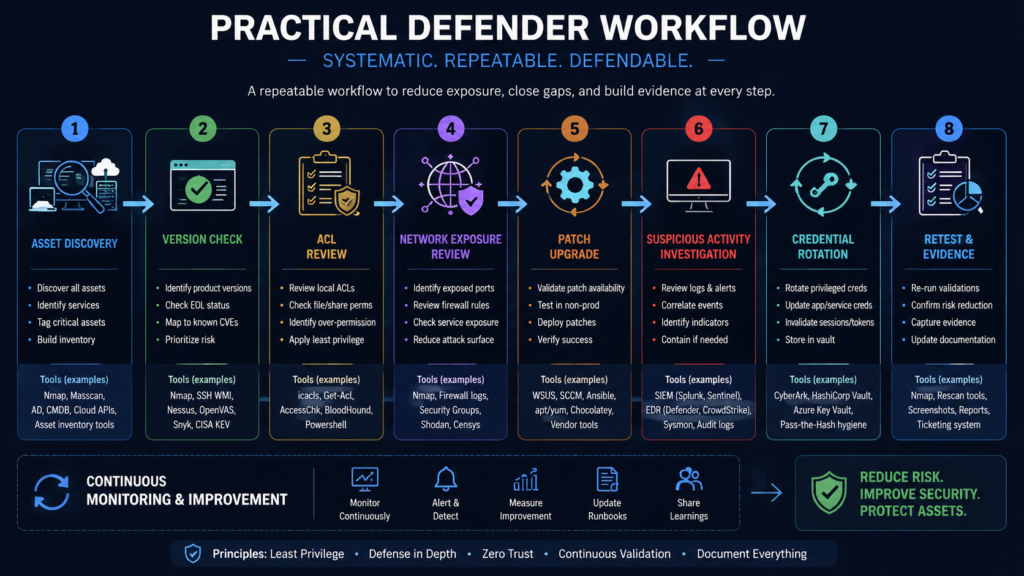
The response should be practical. Security teams need asset inventories that know where Redis runs, which build source it came from, which applications can reach it, which ACL user each application uses, which commands are allowed, which instances are managed by a provider, and which teams own remediation. Without that, a new Redis CVE becomes a spreadsheet panic. With it, CVE-2026-23479 becomes a controlled workflow: identify affected branches, apply fixed releases, remove dangerous permissions, investigate suspicious activity, and close with retest evidence.
Common mistakes during CVE-2026-23479 response
The first mistake is treating authentication as a complete mitigation. Authentication is a precondition, not a guarantee. If an application user has +@all, Redis authentication simply tells the attacker which stolen secret to use. The Redis ACL model is only valuable when command and key permissions actually reflect least privilege.
The second mistake is patching only the most visible Redis instance. Redis often appears in sidecars, job queues, feature stores, background workers, local developer stacks, CI services, analytics pipelines, and old staging environments. A central production cache may be patched quickly while a forgotten internal Redis remains reachable from compromised workloads.
The third mistake is trusting a scanner without checking vendor patch context. Distro packages can backport fixes. Managed services can apply fixed builds. Containers can pin old images. Redis Software builds may not map directly to OSS tags. A version string is evidence, not a verdict.
The fourth mistake is over-validating with exploit code. There is usually no need to trigger a UAF to prove a production system needs patching. Version, branch, build source, ACL exposure, and network reachability provide enough evidence for remediation. Exploit reproduction belongs in an isolated lab or tightly authorized red-team environment with written approval, service-owner consent, and rollback plans.
The fifth mistake is ignoring detection because no public exploitation was confirmed at disclosure time. Redis’s statement about no observed exploitation was tied to publication time. Public technical details change attacker capability. Teams should investigate before patch windows erase evidence.
A safe remediation runbook
A practical CVE-2026-23479 runbook should be short enough to execute and detailed enough to audit.
| 단계 | Owner | Evidence to collect | Done when |
|---|---|---|---|
| 1. Identify Redis assets | Platform, cloud, SRE | Host, port, namespace, image, package, owner, environment | Every Redis instance has an owner and environment |
| 2. Determine version and build source | SRE | INFO server, package manager output, image digest, managed-service notice | Each instance is classified as affected, fixed, not affected, or needs vendor confirmation |
| 3. Check network reachability | Cloud, network, platform | Security group, NetworkPolicy, firewall, service mesh policy | Redis is reachable only from expected clients |
| 4. Review ACLs | App owners, SRE | ACL LIST, named user mapping, command categories | App users lack unnecessary admin, scripting, restore, module, and replication permissions |
| 5. Patch or upgrade | SRE, app owners | Change ticket, target fixed version, canary result | Runtime version or vendor notice confirms fixed state |
| 6. Investigate suspicious activity | Security operations | Logs, flow data, process tree, crash events, file changes | No unexplained activity remains, or incident response is opened |
| 7. Rotate secrets if needed | Security, platform | Secret IDs, last rotation, app rollout status | Redis credentials used by risky workloads are rotated |
| 8. Retest | Security, SRE | Version proof, ACL proof, network proof, app smoke tests | Ticket closes with reproducible evidence |
For production, patch planning must consider Redis persistence, clustering, Sentinel, replication, connection pools, client library behavior, and application timeout handling. A rushed upgrade that breaks session storage can become an outage. But delaying because Redis is “internal only” is a poor trade. Use canaries, rolling upgrades, backups, and clear rollback criteria.
자주 묻는 질문
Is CVE-2026-23479 remotely exploitable if Redis is not exposed to the internet?
- Yes, it can still matter if an attacker reaches Redis from inside the network, from a compromised application host, from a pod in the same cluster, or with stolen Redis credentials.
- The public risk is lower when Redis is not internet-facing, but internal reachability plus broad ACLs can still create a serious post-authentication RCE path.
- Treat network isolation as one layer, not the fix. Patch the affected Redis version and review Redis users.
Does authentication make CVE-2026-23479 low risk?
- No. Authentication is required, but many real attacks begin by stealing application credentials or landing on a host that already has Redis access.
- Risk depends on what the authenticated Redis identity can do. A narrow cache-only user is much safer than a default user with
+@all. - If an application user can run
CONFIG, Lua scripting, streams, broad reads, and broad writes, the risk is materially higher.
Which Redis versions should I patch for CVE-2026-23479?
- NVD describes the affected upstream range as Redis 7.2.0 through versions before 8.6.3.
- GitHub’s advisory states the issue affects Redis 7.2 or newer.
- Public technical analysis lists fixed versions 7.2.14, 7.4.9, 8.2.6, 8.4.3, and 8.6.3 for the maintained lines discussed.
- If you use distro packages, Redis Software, Redis Cloud, or another managed service, confirm the vendor-specific fixed build rather than relying only on the upstream version string.
Can Redis ACLs fully mitigate CVE-2026-23479?
- ACLs can reduce exploitability and block the public exploit path if they remove required privileges such as
CONFIGfrom untrusted users. - ACLs do not remove the memory-safety bug from the Redis binary.
- The correct strategy is patch first, then use ACLs to reduce the blast radius of future Redis vulnerabilities.
What should I look for in logs after CVE-2026-23479 disclosure?
- Unknown Redis clients, especially from new internal IPs, pods, build agents, or jump hosts.
- Unexpected
CONFIG,EVAL, stream, module, restore, or replication-related commands. - Redis crashes, restarts, segmentation faults, or core dumps.
- Shell commands, network tools, or outbound connections spawned by the
redis-serveruser. - File changes in Redis configuration, persistence, module, or data directories.
Is a scanner version match enough to confirm exposure?
- No. It is a useful signal, not a complete finding.
- You need runtime version, package source, vendor patch context, network exposure, authentication state, ACL permissions, and owner confirmation.
- Backported patches and managed-service fixed builds can make raw version checks misleading.
How is CVE-2026-23479 different from older Redis RCE issues?
- Older Redis compromises often involved exposed unauthenticated Redis plus dangerous configuration writes.
- CVE-2026-23479 is a memory-safety bug in Redis’s blocked-client lifecycle handling.
- It is closer in spirit to modern Redis memory-corruption and scripting-related issues, where the question is not only “is Redis exposed?” but also “which authenticated identities can reach dangerous internal code paths?”
CVE-2026-23479 is a Redis lifecycle bug with a small patch and a large operational lesson. The vulnerable code path mishandled a freed client during blocked-command re-execution, but the real-world risk depends on the environment around it: Redis version, branch, build source, network reachability, ACL design, scripting permissions, admin command access, monitoring, and patch speed.
Do the direct work first: upgrade Redis into the fixed branch release, verify the running build, restrict Redis to expected clients, replace broad default users with named least-privilege users, monitor for suspicious command and process behavior, and preserve retest evidence. The teams that handle this well will not be the ones with the longest scanner output. They will be the ones that can prove which Redis instances were exposed, which were fixed, which users had dangerous privileges, and which controls now prevent the next Redis RCE from becoming a host compromise.

 Korean
  English
  German
  French
  Spanish
  Portuguese
  Japanese
  Hindi
Hindi  Arabic
  Turkish
  Hebrew