
Devin Vulnerability Fixes provides a structured way for coding agents to prepare runtime security updates. The difficult part is deciding what its output proves. A changed version in a pull request, a tested image and a repaired production instance are separate milestones, each requiring its own evidence.
Cognition’s MIT-licensed repository contains three Agent Skills for PHP, Node.js and self-managed GitLab. Its version 1.0.0 changelog records the first public release on October 22, 2026, with target versions drawn from October 21 advisories. Recheck current vendor guidance before using those targets for a new maintenance window.
We reviewed the published instructions on October 26, 2026. We did not install the plugin, run Devin, patch a customer repository or benchmark remediation success. The executable example below is an offline evidence classifier. The rest of the article explains how an operator can review a proposed patch without confusing preparation with deployment.
What the Three Skills Target
| Skill | Documented target | Verification boundary |
|---|---|---|
| fix-php-vuln | PHP2Shell, CVE-2026-109618 and CVE-2026-109619. | The installed PHP runtime and its deployment channel. |
| fix-node-vuln | The October 21 Node.js security release, including CVE-2026-111497. | Production, builder, CI and managed-runtime settings. |
| fix-gitlab-vuln | CVE-2026-110264 in self-managed GitLab. | The deployed package, image or chart and subsequent operational checks. |
This is a defined set of remediation playbooks. It does not establish coverage of every vulnerability in those products or every affected component in your environment. If a related library is embedded in another runtime, that artifact needs its own inventory and patch mapping.
The Documented Workflow and Its Approval Boundary
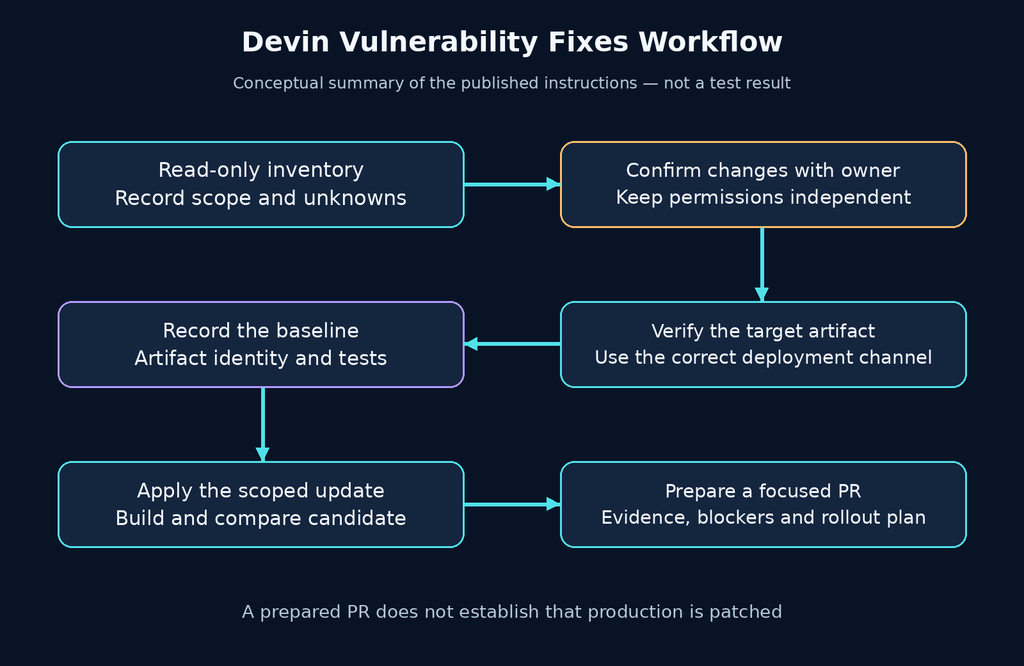
그리고 repository’s workflow begins with read-only discovery, asks which repositories may be changed, verifies the target artifact, compares tests before and after the update, and prepares a focused pull request. It requires access to the relevant repositories and, for builds, the registry or package source used by the environment. When target verification is blocked, the instructions call for reporting that limit.
The approval instruction is useful process design, but it remains an instruction to an agent. Enforce repository, branch, credential and deployment permissions independently. A reviewer should be able to inspect the allowed repository set, the proposed change and the permitted execution environment before granting wider access.
Also record the skill revision being evaluated. A mutable branch can change between two runs, so a reproducible review needs the actual content revision or recorded package lock alongside the agent and configuration. Updating the skill and updating the vulnerable application are different changes with different evidence.
Find the File That Selects the Runtime
그리고 PHP skill distinguishes official images, distribution packages, source builds and managed platforms. It explicitly leaves Composer’s PHP requirements and platform declaration unchanged because they do not select the deployed interpreter. For distribution and managed builds, it directs the agent to vendor package evidence rather than an upstream version-string comparison.
That distinction changes what a useful finding looks like. A dependency manifest might establish that an application uses PHP without identifying which interpreter serves requests. Follow the deployment inputs to the built artifact and the serving instance. If that connection is missing, record an unknown deployment state.
그리고 Node skill similarly inventories version files, base images, CI settings and managed runtime configuration. It separates production use from build or CI-only use and notes that an engines.node declaration does not install a runtime. It also calls for post-change testing in the relevant image rather than relying only on the host environment.
In a multi-stage build, verify which stage actually ships. Updating a builder can leave the final runtime untouched; updating only the final image can leave vulnerable build tooling in the release path. Label both scopes, then apply the current advisory to each relevant artifact instead of treating every mention of the product as the same exposure.
Verify the Artifact, Not Just the Tag
Docker’s build guidance explains that image tags can move while digest references identify a particular image. Pinning therefore improves artifact identity, but the pin needs an update process. Docker also distinguishes --pull, which checks the base image, from --no-cache, which disables reuse of build layers. A clean rebuild and a fresh base-image lookup answer different questions.
For a review record, preserve the original deployment identity, the candidate artifact identity, its platform and variant, the vendor evidence supporting the fix, and the output actually tested. Keep multi-platform image indexes and platform-specific images clearly identified rather than comparing unlike identifiers.
A subtle baseline error occurs when a team freshly pulls an old floating tag and calls it the production baseline. The tag may now identify a different artifact from the one already running. Record the identity observed in the deployed workload separately from the artifact resolved during a new build. If they differ, explain which comparison the test actually performs.
An artifact can exist without containing the required fix. Existence, integrity and remediation mapping are distinct checks. Confirm the vendor’s package revision or release evidence, preserve the selected identity, and state what could not be checked from the available environment. A registry timeout should leave verification open.
Make Regression Results Comparable
A useful comparison records the old and candidate artifact identities, test commands, fixtures, configuration and results. Keep pre-existing failures visible. If the baseline could not build, a candidate build that succeeds may be useful, but it is not a complete before-and-after regression comparison.
| Observation | What it establishes | What remains open |
|---|---|---|
| The repository version reference changed. | A proposed configuration change exists. | Target validity, build results and deployed state. |
| The candidate builds and existing tests pass. | The recorded test set passed in the recorded environment. | Untested behavior, vulnerability-specific repair evidence and rollout. |
| A new warning or failure appears. | The comparison found a change requiring review. | Whether the update caused it, its impact and the approved resolution. |
| The tested artifact is observed in deployment. | The recorded artifact reached that instance. | Coverage of other instances, service behavior and incident history. |
Do not silently drop a failing test, change the fixture or disable a security check to obtain a green result. If application changes are necessary, separate them clearly enough that a reviewer can understand the runtime update and the compatibility repair. Record new warnings and their disposition rather than treating warnings as equivalent to either failure or harmlessness in every environment.
Testing inside a builder or with extra development dependencies can be necessary. State that environment explicitly and add the relevant final-artifact smoke checks. A health response is useful operational evidence, but it does not establish that every authorization rule, extension or outbound integration still behaves correctly.
Self-Managed GitLab Needs a Deployment Plan
그리고 GitLab skill separates chart versions from application versions, calls for supported upgrade-path stops, and distinguishes configuration validation from post-deployment checks. Its checklist includes service status, background migrations, web access, Git over SSH and HTTPS, and runners. It explicitly allows completion as a prepared PR or a reported blocker; that does not mean the instance has been patched.
Rendering a chart or validating infrastructure syntax can catch preparation errors without touching the running instance. Preserve that value while stating its boundary. An infrastructure plan cannot show that database migrations completed, that every node restarted, or that the expected application version is serving users.
Agree on the maintenance owner, allowed disruption and recovery decision before deployment. A rollback reference is not a complete rollback plan when the update also changes persistent state. Verify the product’s supported recovery procedure, backup readiness and migration constraints for the actual upgrade path.
An Offline Patch-Evidence Exercise
This fictional classifier keeps incomplete evidence out of a “ready” bucket. It checks target verification, baseline and candidate test states, warning review and whether the deployment record names the tested artifact. Its output is a prompt for owner review, not a vulnerability-free verdict.
The labels synthetic-A 그리고 synthetic-B are invented record values, not registry digests. The script does not install Skills, call Devin, contact a registry, build an image, open a PR or deploy a service. The fields are assumed inputs; a real implementation must authenticate their provenance.
"""Offline evidence classifier. Values are fictional record labels."""
def verdict(row):
    if not row['target_verified']:
        return 'BLOCKED: target unverified'
    if row['baseline'] != 'pass':
        return 'REVIEW: baseline unresolved'
    if row['candidate'] != 'pass':
        return 'BLOCKED: candidate tests failed'
    if not row['warnings_reviewed']:
        return 'REVIEW: warnings unresolved'
    if row['deployed_artifact'] != row['tested_artifact']:
        return 'OPEN: deployment unverified'
    return 'READY FOR OWNER REVIEW'

base = dict(target_verified=True, baseline='pass', candidate='pass',
            warnings_reviewed=True, tested_artifact='synthetic-B',
            deployed_artifact='synthetic-B')
cases = [
    ('complete record', {}, 'READY FOR OWNER REVIEW'),
    ('unknown target', dict(target_verified=False), 'BLOCKED: target unverified'),
    ('baseline failed', dict(baseline='fail'), 'REVIEW: baseline unresolved'),
    ('baseline absent', dict(baseline='missing'), 'REVIEW: baseline unresolved'),
    ('candidate failed', dict(candidate='fail'), 'BLOCKED: candidate tests failed'),
    ('warning added', dict(warnings_reviewed=False), 'REVIEW: warnings unresolved'),
    ('not deployed', dict(deployed_artifact=None), 'OPEN: deployment unverified'),
    ('wrong artifact', dict(deployed_artifact='synthetic-A'), 'OPEN: deployment unverified'),
]
for name, changes, expected in cases:
    result = verdict(dict(base, **changes))
    assert result == expected, name
print(f'{len(cases)}/{len(cases)} synthetic evidence cases matched')
print('An evidence record is not an exploit or deployment test.')
print('Devin execution, builds and production remediation: NOT TESTED')
We ran all eight synthetic cases on October 26, 2026. Each returned the expected label:
8/8 synthetic evidence cases matched
An evidence record is not an exploit or deployment test.
Devin execution, builds and production remediation: NOT TESTED
The exercise deliberately cannot determine whether the target contains a fix or whether test results are honest. It shows why missing evidence and mismatched artifact identities should remain visible. For a real gate, integrate trusted build, registry and deployment records, preserve their timestamps, and define what happens when a source is unavailable.
Keep PR, Build and Deployment Evidence Separate
Use three review states rather than one “fixed” checkbox. The patch state records what changed and why. The build state identifies the tested artifact and results. The deployment state identifies the serving instances and operational observations. A change can advance through those states without erasing earlier limitations.
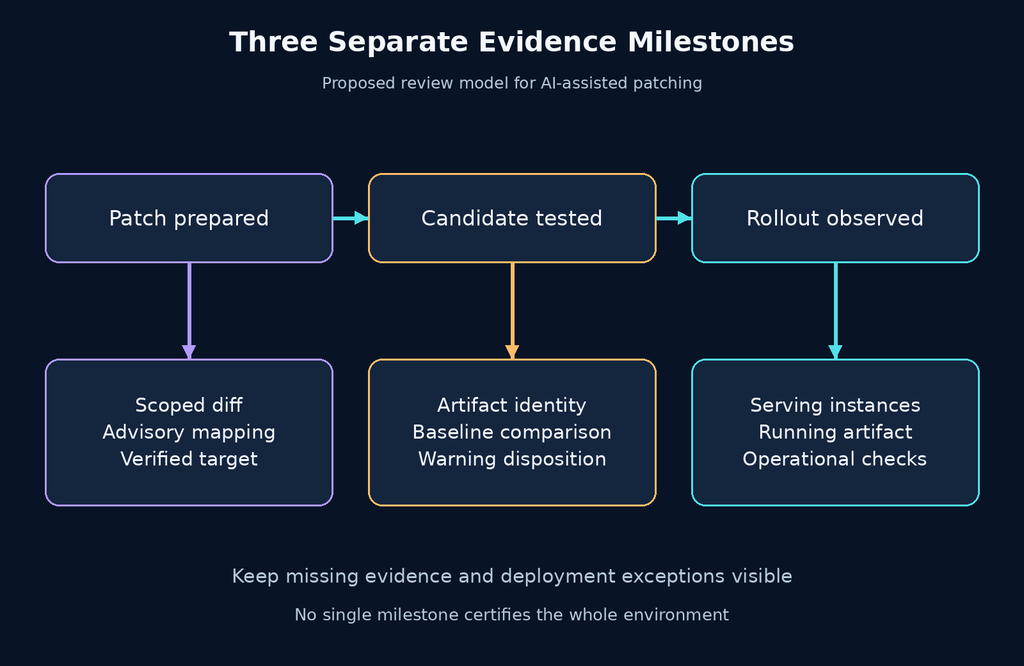
| Review state | Minimum useful record | Owner’s next decision |
|---|---|---|
| Patch prepared | Scoped diff, advisory mapping, verified target and stated blockers. | Approve the proposed change and compatibility scope. |
| Candidate tested | Artifact identity, comparable baseline, commands, results and warning disposition. | Accept or investigate the observed differences. |
| Rollout observed | In-scope instances, running artifact, service checks and remaining exceptions. | Close maintenance or assign unresolved deployments. |
Preserve the actual deployed pre-change artifact where your recovery policy requires it. Link the rollback decision to the relevant state and retention policy. A repository’s previous tag, a freshly rebuilt image and a historical production image can represent different artifacts even when their labels look similar.
After rollout, recheck the operations most likely to be affected by the change. Use harmless fixtures and controlled accounts for application behavior. If the service was exposed before patching, investigate suspicious history separately; updating software does not determine whether credentials or data were previously accessed.
Evaluate the Handoff Before Scaling Remediation
For a pilot, select one authorized repository with a known deployment path and a representative test set. Require the inventory, proposed change, artifact evidence, comparison results and deployment limitations. Expand only when the team can independently inspect that handoff and resolve the first blockers.
The open-source license does not establish a zero-cost workflow. Model usage, agent access, CI execution, registry traffic and reviewer time belong in a budget. Measure those costs during the pilot instead of inferring savings from the number of files changed or PRs opened.
For a separate authorized application assessment with Penligent, agree on dedicated accounts, relevant workflows and reviewable evidence after the update. Confirm that the available environment can exercise those cases. This article does not demonstrate Penligent installing the Cognition Skills, automatically patching repositories or providing a detector for the listed CVEs.
The video below introduces a general AI-assisted penetration testing workflow. It is not a Devin plugin execution or a patch-verification benchmark.
Devin Vulnerability Fixes Questions
Is the plugin limited to Devin?
- The repository describes Skills for compatible coding agents that read SKILL.md files. Compatibility and execution reliability were not tested in this article.
Does an approval instruction enforce repository permissions?
- Permissions need independent enforcement. Review the agent’s repository, branch, credential and deployment access alongside its instructions.
Does a passing test suite prove the CVE is fixed?
- It establishes the recorded tests passed in the recorded environment. Verify the vendor fix mapping, artifact identity and running deployment separately.
Should I copy the first release’s version targets forever?
- No. The changelog dates the initial targets to October 21 advisories. Check current guidance and your deployment channel before selecting an artifact.
What if the registry or test environment is unavailable?
- Keep the relevant verification step open, identify the missing access or evidence, and assign the next action. Do not convert an unverified target into a completed fix.
Can the Python classifier approve a production update?
- No. It evaluates invented evidence records and performs no build, security or deployment check.
When should remediation be considered complete?
- Use a scoped owner decision supported by the relevant fixed artifact, rollout observations, service checks and recorded exceptions. Keep any incident investigation open under its own criteria.
The most useful output of AI-assisted patching is a change another engineer can verify. Keep the advisory, proposed diff, tested artifact and running service connected by evidence. Leave a gap visible wherever that connection has not yet been established.

 Korean
 English
 German
 French
 Spanish
 Portuguese
 Japanese
 Hindi
 Arabic
 Turkish
 Hebrew