
On-premise AI pentesting places some or all of a security-testing workflow inside infrastructure the organization controls. The deployment becomes useful when that control can be demonstrated: where test credentials are used, which networks tools can reach, where prompts are processed, how evidence is retained, and who can authorize a consequential action. Installing an agent on a private server answers only part of that question.
Penligent plans to launch its private deployment edition within the next month, according to its product roadmap update dated October 19, 2026. Once the edition is available, organizations will be able to apply directly through the official website. This is a planned release, not a statement that the new application process is already open. Final deployment requirements, supported configurations, pricing, and availability will be confirmed with the release.
For enterprise buyers, the immediate work is to define the required boundaries and the evidence that would establish them. The architectures and tests below are recommended evaluation models, not specifications for the forthcoming Penligent edition. They help a team assess an offer without treating “private,” “self-hosted,” or “local” as complete security guarantees.
What private deployment should mean in a purchasing decision
Start with the requirement that created the purchase. An organization may need to reach internal applications, keep assessment artifacts in its own environment, restrict model processing, support customer-specific isolation, or manage operational availability. These are different needs. A deployment that solves one may leave another unresolved.
Write the requirement as an observable condition. “Test workers can reach the approved staging network and cannot reach the production database network” is testable. “Our data is private” is not specific enough to guide an architecture review. It leaves the relevant data, recipients, processing, and access controls undefined.
Separate ownership from location. A workload in a customer's cloud account may still call a hosted model endpoint or vendor control service. A vendor-operated dedicated environment may offer isolation without giving the customer direct administrative ownership. Neither arrangement should be described as inherently adequate or inadequate before the actual requirement is known.
Then identify the decision owner. The testing team can evaluate workflow quality, the platform team can assess operational fit, and security or procurement reviewers can assess the agreed data and access conditions. A private deployment works best when those groups share one scope document rather than approving different interpretations of the same label.
The buyer's goal is a supported operating model that meets a defined need. A private installation that nobody can patch, monitor, or recover may create more friction than it removes. Deployment control is valuable when it comes with explicit responsibility and a way to verify the resulting state.
On-premise, self-hosted, private cloud, and isolated are different claims
The following distinctions are working definitions for procurement. Suppliers may use the terms differently, so ask them to map their offer to the properties that matter. Do not let a marketing label replace the deployment diagram.
| 기간 | Question it commonly addresses | What remains to establish |
|---|---|---|
| On-premise | Is software deployed in the customer's environment? | Model location, external services, support access |
| Self-hosted | Does the customer operate the deployment? | Updates, privileges, telemetry, retention |
| Private cloud | Is the environment dedicated or customer-controlled? | Tenant boundaries and administrative ownership |
| Local inference | Is model processing performed locally? | Tool egress, downloads, updates, licensing |
| Restricted egress | Are outbound connections limited? | Actual enforcement and allowed data flows |
| Disconnected operation | Can an agreed workflow run without external connectivity? | Preparation, updates, activation, support procedures |
A private worker with cloud inference is one architecture. A private worker with an internal inference gateway is another. A fully disconnected environment has additional requirements around importing updates and maintaining a supported software set. Those differences affect both implementation and purchasing.
Treat the diagram as a statement that can be challenged. If a supplier says all data remains local, ask how model calls, telemetry, crash reporting, support bundles, package downloads, and report exports fit that statement. The answer may reveal approved exceptions rather than a defect, but the exceptions need to be visible.
Do the same for administrative access. Where a machine runs does not establish who can administer it. Document customer administrators, vendor support identities, platform service accounts, and automated deployment identities separately. Their access duration and scope can be more important than the geographical location of the host.
Draw the data flow before choosing the deployment topology
List the data classes before drawing boxes. A pentesting workflow can handle target URLs, authentication material, application responses, source excerpts, screenshots, tool output, candidate findings, and final reports. These objects have different sensitivity and retention requirements. A single arrow labeled “test data” hides too much.
For each class, identify the producer, processing destination, storage destination, and authorized reader. Record whether it can appear in prompts, logs, or support exports. This mapping reveals secondary flows that an ordinary product diagram may omit, such as a screenshot entering a model request or a credential appearing in a diagnostic trace.
Keep model processing distinct from artifact storage. A report stored on a local disk does not establish that the evidence used to generate it stayed inside the environment. Likewise, an internal model gateway does not establish that external tools or package managers have no network access. Each path needs its own assessment.
Map the control flow alongside the data flow. Who starts a job? Which identity authorizes a tool call? What enforces target scope? How does an operator stop execution? A design can retain data locally while still giving the testing runtime more authority than the buyer intended.
A useful first architecture review ends with a small set of explicit flows, not a promise that nothing ever moves. Some organizations will approve external inference for sanitized material. Others will require local processing for all assessment content. The appropriate topology follows that decision rather than preceding it.
Separate the control plane, workers, inference, and evidence
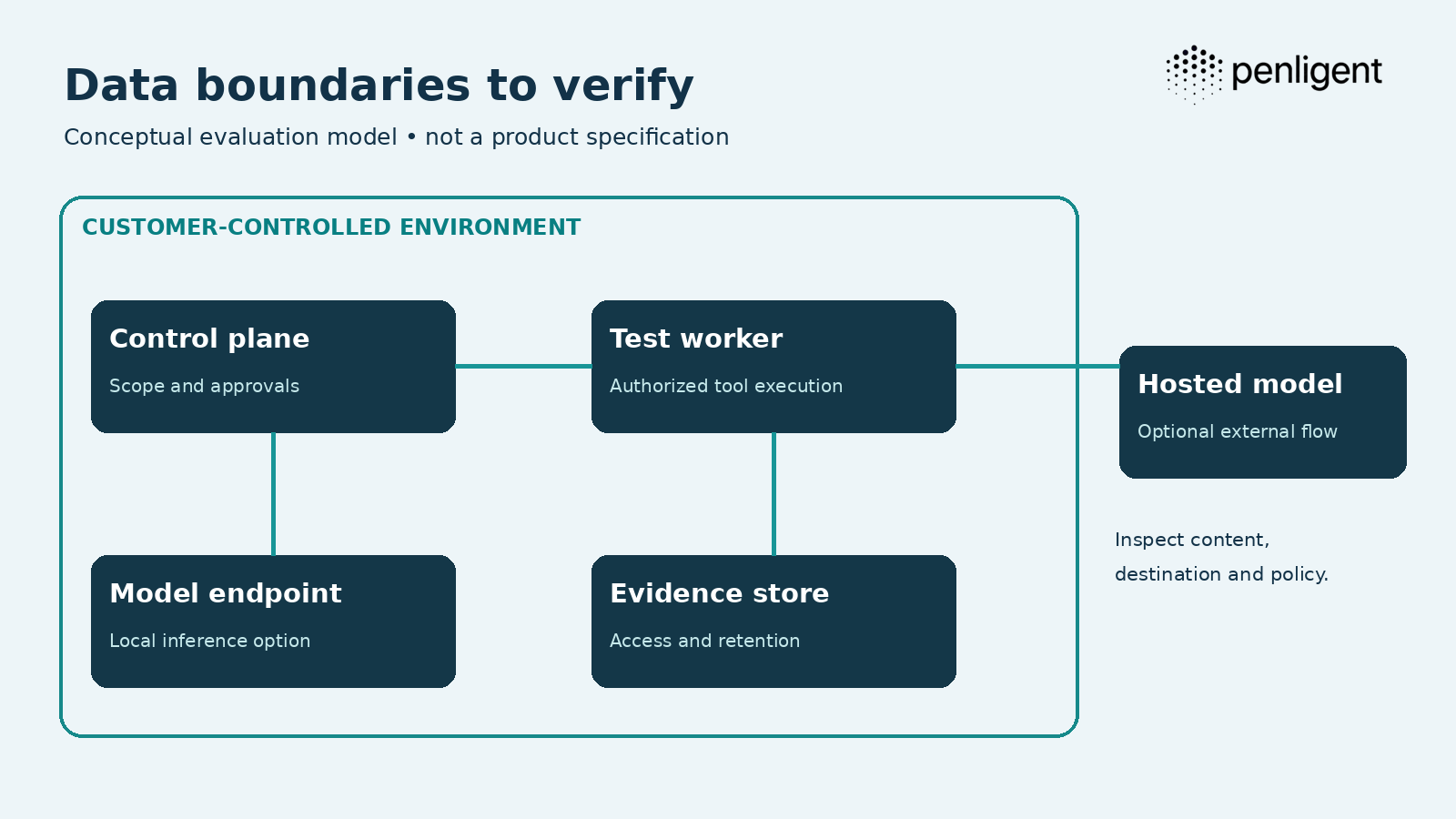
A conceptual private AI pentesting deployment has at least four responsibilities: coordinating jobs, executing tools, obtaining model outputs, and storing evidence. They do not have to be separate products or machines, but the review should distinguish their privileges and failure modes.
The control plane should express approved scope and operator permissions. A worker should receive only the access required for its assigned task. The inference service should process the intended input under the approved policy. The evidence store should preserve artifacts with access controls and a retention owner. These are design recommendations, not claims about a particular release's implementation.
This separation helps with incident containment. If a worker encounters malicious target content, its authority should not automatically include platform administration or unrestricted access to every assessment. If an inference service becomes unavailable, the system should retain a truthful incomplete state rather than silently changing destinations or scope.
It also helps with capacity planning. A job coordinator and an inference runtime have different resource profiles. A report store may need durable capacity even when no test is running. Asking one machine to perform every responsibility can be appropriate for a small pilot, but the buyer should still understand where the limits and dependencies are.
Review identities between the components. A shared administrative credential can collapse an architecture that looks separated on paper. Identify the actual service identities, permissions, and authentication paths. The diagram is useful only when it reflects how the running system communicates.
Explore Penligent and follow the planned private deployment release.
Decide whether cloud inference is acceptable
Cloud inference is not automatically incompatible with a private deployment requirement. It is incompatible when the required data boundary prohibits the planned processing or when the buyer cannot establish the relevant terms. Make that decision explicitly for the data classes involved.
A hybrid proposal should state which content enters a model request, which endpoint receives it, which organization operates the endpoint, and which retention and access terms apply. Do not treat a regional endpoint, a private network path, and locally operated inference as interchangeable. They describe different properties.
If the buyer approves external inference only for sanitized content, test the sanitization boundary with synthetic fixtures. A template that removes one obvious secret does not establish that screenshots, tool output, exception traces, and retrieved documents are covered. Define the categories and failure behavior instead of relying on a single redaction example.
Do not permit an unreviewed fallback to a different provider when the approved endpoint fails. A fallback can change recipients and processing terms. During acceptance, deliberately make the approved inference path unavailable in a controlled environment and observe whether the workflow stops, queues, or follows a documented approved alternative.
Keep the result bounded. An observed failure-closed test establishes behavior for the tested route and version. It does not certify every possible integration. Record the configuration and test conditions so the organization can repeat the check after relevant changes.
Local inference needs its own security review
Operating the model service internally moves responsibility; it does not remove it. The service needs controlled access, protected communication, appropriate resource limits, an update owner, and a clear relationship to the testing workers. Avoid exposing an inference runtime as though it were an ordinary unauthenticated development utility.
For a concrete example of why product-specific review matters, vLLM's security documentation warns that multi-node communication requires network isolation and explains limitations in API-key coverage. The presence of an API key does not, by itself, establish protection for every exposed interface. This is an example from vLLM, not a statement that Penligent uses it.
Inventory the interfaces actually enabled in the selected runtime. Distinguish the client-facing API from administrative, diagnostic, inter-node, and optional tool interfaces. Expose only what the approved architecture needs. Test access through the same network paths the workers and administrators will use.
Treat model and runtime versions as controlled artifacts. A change can affect tool-call formatting, context handling, error behavior, and resource use. The buyer should know which combinations the supplier supports and how an update is evaluated before it reaches a sensitive assessment environment.
Do not size hardware from a model name alone. Model choice, precision, context, concurrency, output volume, and runtime implementation all affect the operating requirement. Ask for a supported configuration and measure a representative workload rather than turning a rough parameter count into a purchasing guarantee.
Define network reachability independently of prompts
An instruction telling an agent to stay in scope is useful context, but it should not be the sole boundary around a tool runtime. The network design should express which targets and supporting services a worker can reach, with enforcement outside the model's interpretation of text.
Distinguish target access from infrastructure access. A worker may need an approved test application, a resolver, an inference gateway, and an artifact destination. It does not follow that it should reach every system on the same private network. A deployment inside the company perimeter can otherwise turn convenient access into unintended lateral reach.
For Kubernetes deployments, the NetworkPolicy documentation explains that policy enforcement depends on a supporting networking implementation. A policy object existing in the API is not enough to establish that the intended traffic boundary is enforced. Verify the actual plugin and observed behavior for the deployment.
Test both required and prohibited paths using approved synthetic destinations. A blocked connection is meaningful only when the test itself is valid, while an allowed connection demonstrates that the enforcement has not simply disabled all useful work. Record source workload, destination, protocol, time, and expected result.
Account for name resolution and redirects. A hostname policy and an IP-level policy describe different controls. A target can return another URL, and a tool can follow it. Decide how scope is evaluated across that transition rather than assuming the initial URL permanently bounds subsequent activity.
Containers are one isolation layer
Containers can organize tool execution and resource control, but an architecture review needs to consider privileges, mounts, runtime access, and the host. Docker's security guidance discusses the daemon attack surface and cautions that configuration and privileges affect isolation. Packaging a pentesting tool in a container does not make every resulting deployment equally contained.
Review access to the container runtime itself. A testing worker generally should not receive broad runtime-administration authority merely because it needs to execute a security tool. The exact capabilities depend on the supported design; document any exception and the boundary that contains it.
Inspect filesystem access. A read-only project mount, a writable scratch directory, and a host-wide mount grant different authority. Keep credentials and unrelated customer artifacts outside the worker's reach where the architecture allows. The review should identify what the worker can actually read and write, not just where its application directory lives.
Docker's rootless-mode documentation describes running the daemon and containers without root to reduce some runtime risks. That option has operational requirements and is not a universal product-installation instruction. Evaluate the supported deployment rather than applying a hardening setting without understanding compatibility.
Define cleanup and persistence deliberately. Temporary tool output may be disposable, while the accepted evidence needs to survive a worker replacement. A design that retains everything indefinitely increases exposure; one that deletes the only reproduction evidence undermines delivery. Assign each artifact class an explicit destination and lifecycle.
Keep test credentials out of general context
A private testing system can accumulate powerful credentials if account handling is treated as a convenience feature. Use dedicated assessment identities where possible, with permissions tied to the intended role and target. Do not supply an unrestricted production administrator because it is the easiest account to obtain.
그리고 OWASP Secrets Management Cheat Sheet recommends managing the credential lifecycle and discusses short-lived credentials and revocation. An application restart is not the same as revoking a credential at the backing service. For a pentesting deployment, the owner needs to know how an assessment identity is issued, used, rotated, and retired.
Separate secret retrieval from ordinary logging and report generation. A reviewer may need to know which role was used without seeing the token itself. Evidence can retain an identifier and a secure reference rather than copying the secret into every trace. The exact mechanism should be part of the supported implementation.
Test expiry and revocation with synthetic accounts. Observe how the workflow reports an expired credential and whether an operator can distinguish access failure from a passed security test. A stopped exploit path caused by a failed login is not evidence that the application fixed an authorization defect.
At engagement close, retire access according to the agreed procedure. Keep the revocation record separate from deleting the local task. Removing a workspace does not establish that an account, token, or external session no longer works. The credential owner must verify the relevant control.
Private deployment does not remove prompt injection risk
A security agent is expected to read untrusted material: web responses, source comments, documents, logs, and tool output. Moving the agent inside a private environment does not turn that material into trusted instructions. The deployment needs to preserve the distinction between evidence from a target and authority from the operator.
그리고 OWASP prompt-injection guidance recommends validating tool calls against permissions and context, applying least privilege, and monitoring relevant decisions. For procurement, ask where these controls are enforced and what an operator can inspect after a refusal or a suspicious request.
Design an acceptance case with harmless injected instructions in a synthetic document. The document might ask the agent to contact an unapproved example destination or to disclose a fabricated marker. The desired result is that target-supplied content does not grant authority for the action. Do not use live secrets or an external recipient to demonstrate this principle.
Grade both security and utility. A system that refuses every document may avoid the injected request while failing the legitimate assessment task. The pilot should show that the agent can use relevant evidence while the execution boundary rejects the unauthorized action.
Record the model, policy, tool versions, fixture, and observed behavior. One successful case is an acceptance observation, not a universal guarantee against prompt injection. Repeating the case after relevant updates is more useful than treating a single demonstration as permanent proof.
Use an offline policy example to clarify the boundary
The following Python example is a local teaching model. It checks a fabricated request against exact role, scheme, hostname, and port values. It does not make network connections, resolve DNS, execute tools, or implement a production egress gateway. Its purpose is to show that an execution decision can be evaluated outside the text a model produces.
from urllib.parse import urlsplit

ALLOWED = {
    ('assessment-worker', 'https', 'staging.example.test', 443),
    ('assessment-worker', 'https', 'inference.example.test', 443),
}

def policy_decision(identity, url):
    try:
        parsed = urlsplit(url)
        if parsed.username is not None or parsed.password is not None:
            return 'deny'
        if not parsed.hostname or parsed.scheme not in ('http', 'https'):
            return 'deny'
        port = parsed.port or (443 if parsed.scheme == 'https' else 80)
        destination = (identity, parsed.scheme, parsed.hostname, port)
        return 'allow' if destination in ALLOWED else 'deny'
    except ValueError:
        return 'deny'

cases = [
    ('assessment-worker', 'https://staging.example.test/health'),
    ('assessment-worker', 'https://inference.example.test/v1/health'),
    ('assessment-worker', 'https://staging.example.test.evil.invalid/'),
    ('report-reader', 'https://staging.example.test/'),
    ('assessment-worker', 'http://staging.example.test/'),
]
for identity, url in cases:
    print(policy_decision(identity, url), identity, url)
The first two cases are allowed by this toy policy; the remaining cases are denied. Matching a complete parsed hostname avoids accepting a lookalike merely because its text begins with an approved name. Checking identity and scheme shows that a destination alone is not the whole policy.
A real enforcement point requires substantially more design. It needs to address DNS results, redirects, proxy behavior, alternate protocols, address ranges, connection reuse, and the network path actually used by the worker. The toy's “allow” result is not a grant to contact a real system and is not a production-ready security control.
Use this distinction in a supplier review. Ask which component makes the actual decision, which attributes it evaluates, and what evidence proves that tools cannot bypass it through another path. A policy file that is never consulted by the running tool is documentation, not enforcement.
Evidence storage needs access and retention decisions
An assessment's artifacts can contain sensitive application behavior even when no secret is deliberately collected. Screenshots can reveal personal information. HTTP traces can include session material. Reports can describe a path to a meaningful business impact. Treat the evidence store as a security system, not an ordinary shared folder.
Decide which roles can view raw evidence, review findings, export reports, and administer retention. Those privileges need not be identical. A customer-facing report reader may not need the underlying request archive, and an infrastructure administrator's technical access should be reflected in the threat model.
Set retention by artifact class. A temporary cache and a final approved report have different purposes. Include backups, replicas, and support exports in the lifecycle discussion. Deleting an object from the primary interface does not by itself explain what remains elsewhere.
Preserve provenance without overcollecting. A reviewer should be able to connect a finding to the target, role, time, application build, and relevant observations. That does not require collecting every unrelated response body or keeping credentials in a transcript. Define what evidence is necessary for the agreed test.
Test an export and a deletion using synthetic data. Confirm what the authorized recipient receives and what the operator sees afterward. Record the limitations of the test; it cannot establish deletion from storage layers the evaluator did not inspect. Ask the supplier to document those layers and the applicable procedure.
Support access is part of the private boundary
Private deployment and vendor support are compatible when the access model is explicit. The customer should know whether support requires a remote session, a diagnostic bundle, a customer-operated command, or no direct access. Each route exposes different data and grants different authority.
Prefer a defined support procedure over an informal standing account. State who approves access, how long it lasts, what it reaches, and how the session or export is recorded. A support identity should not silently inherit the same authority as the customer's platform owner.
Review diagnostic bundles before treating them as routine attachments. They can include configuration, logs, target information, or credentials if collection is careless. Test the bundle with synthetic fixtures and identify which fields are redacted, omitted, or explicitly approved for export.
Plan for an incident in which ordinary support access is unacceptable. The supplier may need a customer-run collection process or a sanitized reproduction. Determine whether those procedures are supported before the environment becomes operationally important.
Support commitments also need a commercial boundary. Availability hours, response targets, remediation responsibilities, and supported versions should be stated in the offer. Do not infer a guaranteed response time from a product tier name or from a successful pre-sales conversation.
Disconnected operation is an end-to-end property
An environment can run a local model and still require Internet access for activation, package retrieval, vulnerability feeds, container images, time services, or support. An isolated-network requirement therefore needs a full workflow test, including startup and maintenance, rather than a screenshot of an offline model response.
List the dependencies that are needed before execution and those needed during it. An approved import process may supply images and databases before a disconnected test window. That arrangement can meet some requirements while differing from a permanently disconnected installation. Use the customer's actual requirement to judge it.
Ask how licensing behaves without a connection, how updates are obtained and verified, and how long an approved offline period is supported. These are product-specific questions. The forthcoming edition's answers must come from its release documentation and commercial terms, not from a general article about architecture.
Test failure behavior deliberately. If an update source or licensing service is unavailable, does the product stop safely, continue with a visible stale-data condition, or silently reduce functionality? The acceptable behavior depends on the intended workflow and the supported design. Record it as an operational decision.
Do not claim that disconnected operation makes all targets safe. The testing runtime still interacts with authorized applications and processes untrusted content. Network isolation changes available paths; it does not replace scope control, credential handling, or evidence review.
Establish update provenance and a rollback path
The deployment needs a supported method for obtaining software, tool, model, and policy updates. Ask the supplier how artifacts are identified, verified, approved, and introduced into the environment. The answer should distinguish a product release from an arbitrary dependency downloaded during a test.
Keep a record of the artifact set used for an assessment. A later reviewer needs to know which runtime, model, tools, and configuration produced the evidence. A mutable label such as “latest” is insufficient when it no longer identifies the original state.
Test the update process in a representative nonproduction environment. Include startup, authorized target access, a short assessment path, evidence export, and the applicable boundary checks. An update that installs successfully can still change a workflow's behavior or break an integration.
Define rollback consequences. Restoring an earlier version may also restore a security defect or an incompatible evidence format. The plan should state who decides, which data is retained, and which acceptance results become invalid after rollback. Availability and security status need to remain truthful throughout the transition.
For disconnected sites, maintenance can be a significant part of the operating model. Schedule the review and import work, identify required personnel, and confirm the supplier's supported release cadence. Private control is easier to sustain when these tasks are budgeted instead of treated as occasional exceptions.
Size the pilot around the work, not a GPU slogan
Hardware requirements depend on the supported deployment architecture. A worker using an approved external inference endpoint and a worker sharing a local model service have different resource needs. The application data, tool concurrency, model context, and report workload can all affect the result.
Request a workload definition with the supplier's sizing proposal. How many jobs run concurrently? Which model and runtime are used? What input and output sizes are representative? Which components share resources? A capacity number without those assumptions is difficult to evaluate.
Measure a complete pilot cycle. Startup, authentication preparation, tool execution, evidence handling, and report generation may stress different resources. Observe queueing and recovery as well as a successful steady-state run. A demonstration on an idle machine does not establish performance under the intended concurrency.
Keep quality criteria constant when comparing configurations. A faster small model that produces unusable evidence is not necessarily a better procurement choice, while a larger model may add cost without improving the particular task. Evaluate the supported combination against the agreed output, not a general model ranking.
Record the operating margin needed for the organization. Some buyers can tolerate queued work; others need a predictable maintenance window. Those requirements should guide the capacity decision. This article does not specify a GPU count, minimum memory, or throughput guarantee for an unreleased product.
Assign the operational responsibilities before purchase
A private deployment shifts work to the customer unless the agreement assigns it elsewhere. Make the division explicit across platform operations, identity, networking, model service, evidence storage, backups, updates, and incident response. A responsibility left between two teams is likely to become an outage-time argument.
| 책임 | Buyer should identify | Evidence before acceptance |
|---|---|---|
| Installation and configuration | Supplier and platform owner | Supported configuration record |
| Network policy | Network or platform team | Required and denied path tests |
| Test identity lifecycle | Application or identity owner | Issuance and revocation procedure |
| Model service | Internal operator or approved provider | Endpoint and failure behavior |
| Artifact retention | Evidence owner | Access and lifecycle test |
| Updates and rollback | Release owner | Representative maintenance rehearsal |
| Support access | Customer approver and supplier | Approved access or export process |
| Incident handling | Named response owner | Escalation and containment procedure |
Use the table to expose gaps rather than create bureaucracy. A small team can assign several responsibilities to one person, provided the person has the authority, access, and time to perform them. A larger organization may need a more formal handoff between teams.
Include routine costs in the purchase decision. Software licensing, infrastructure, inference, storage, and operator time can sit on different budgets. The purpose is not to discourage private deployment; it is to compare supported operating arrangements honestly.
Resolve ownership before scaling. A pilot operated entirely by the supplier may not reveal whether the customer can perform ordinary maintenance. Have the intended customer operator complete at least one routine task and one recovery task under the proposed support arrangement.
A representative acceptance pilot
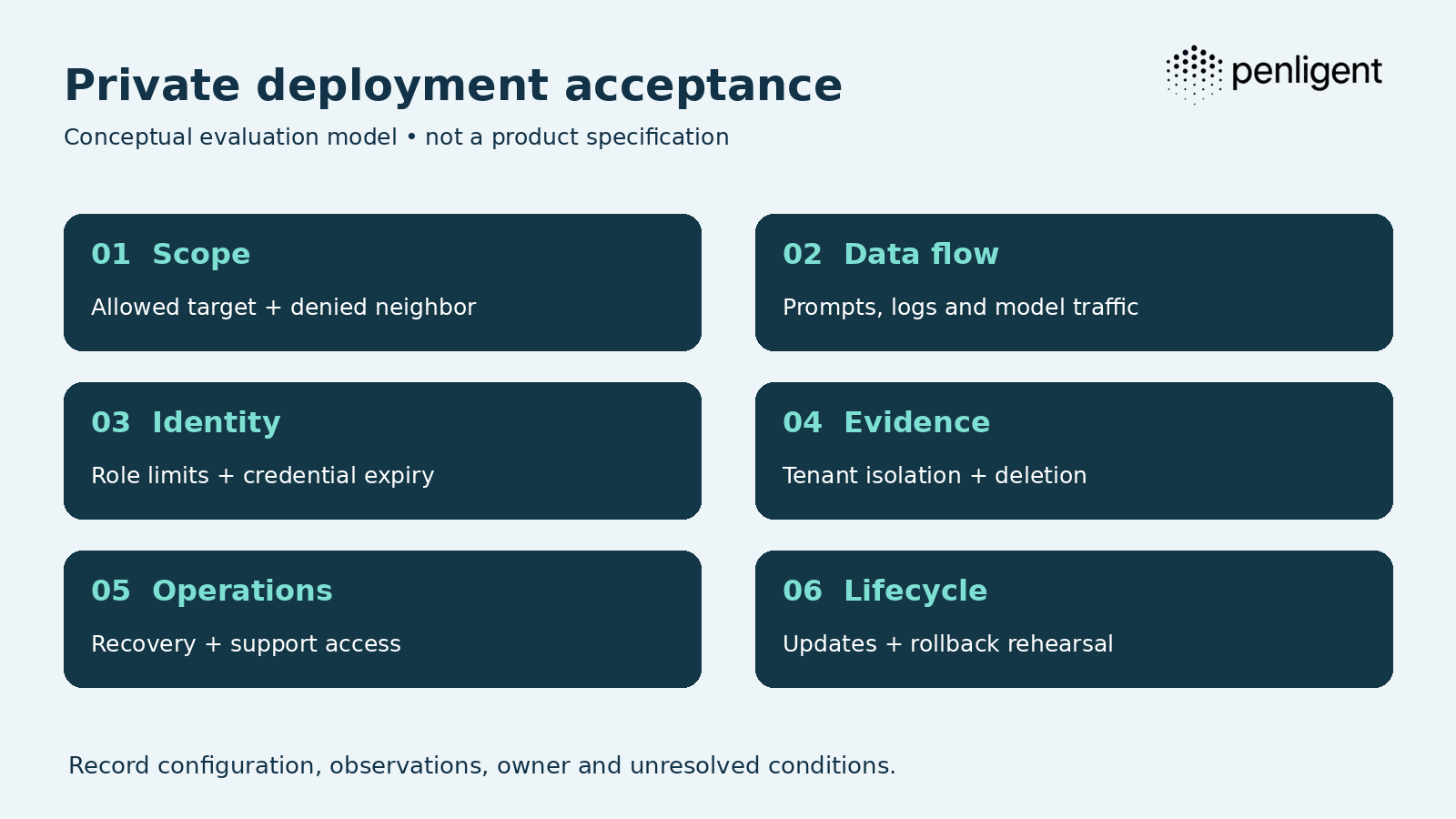
Choose an authorized application slice with synthetic data and known permissions. The pilot should include the hard requirement that motivated private deployment: an internal network path, a data-processing restriction, a customer boundary, or a deployment-control requirement. A public test page cannot stand in for all of those conditions.
Prepare positive and negative controls. A required target path should work, while a prohibited path should fail under the intended enforcement. An approved report reader should see its evidence, while another customer-shaped workspace should not. The point is to establish both useful operation and meaningful restriction.
Keep a test record for every claim the buyer intends to rely on. Record the input, expected result, observed result, evidence location, environment version, and reviewer. If access is unavailable, mark the test incomplete rather than assuming the architecture diagram proves it.
Include a controlled failure. Interrupt the approved inference path, revoke a synthetic credential, or replace a worker during a nonproduction task. Observe whether the system retains a truthful state and whether the operator can recover without broadening permissions or losing the relevant evidence.
Finish with a second-person review. Someone who did not run the task should be able to interpret a finding, understand its limits, and reproduce the approved verification in the test environment. That measures whether the private platform supports delivery, not merely execution.
Explore Penligent and follow the planned private deployment release.
Procurement evidence that makes a proposal comparable
A proposal should provide enough information to evaluate its deployment claims without requiring the buyer to infer them from a diagram. Request a supported topology, a data-flow description, a responsibility matrix, operating requirements, and the scope of the quoted service or license.
Ask which items are current supported features and which are planned. A roadmap can be useful for planning, but it should not be treated as an acceptance result. If a requirement depends on a future release, record the dependency and defer the corresponding acceptance decision until the capability can be evaluated.
For data handling, identify recipients and procedures rather than accepting an unexplained privacy adjective. For access control, ask for the relevant role and administrative model. For support, ask how sensitive diagnostic information is handled. For availability, ask what the supplier actually commits to in the agreement.
Compare exceptions visibly. One proposal may require approved cloud inference, another may require customer-operated model capacity, and another may support only a narrower isolated workflow. Those differences can matter more than a headline license number. The comparison should preserve them rather than compress every offer into “private deployment: yes.”
Use unresolved questions as an action list before purchase. A supplier can clarify a topology or demonstrate a boundary in a pilot. If the answer remains unknown, the buyer should know which requirement is affected and who has accepted that uncertainty.
An internal application pilot should include a prohibited neighbor
Consider a hypothetical enterprise that needs to test a staging application reachable only from its internal network. The easy demonstration is to show the agent loading the application. A stronger acceptance case also includes an approved synthetic destination representing a network the worker must not reach. Both observations are needed to evaluate useful constrained access.
Prepare the destinations with the network owner. Do not discover a prohibited path by probing an unrelated production service. The test fixture should have known addresses, known expected connectivity, and a harmless response. This makes an unexpected result interpretable without creating a separate operational risk.
Run the allowed test through the same worker configuration intended for assessments. Then test the denied fixture using an approved benign connection check. Retain the worker identity and the enforcement evidence. A test from the operator's laptop does not establish the boundary around the worker, and a failed DNS lookup does not necessarily establish the intended network block.
Repeat the relevant observation after a worker replacement or deployment update. A policy attached only to the original instance can disappear when the orchestrator creates another one. The acceptance record should show that the supported deployment process preserves the restriction, rather than relying on a manual change nobody will remember.
If the denied path succeeds, pause the pilot and identify the actual route. It might be a proxy, another interface, or a policy that was not applied to the workload. Repair the boundary and repeat both tests. Testing only denial after the repair can hide a configuration that blocks the legitimate application as well.
The final result should name the verified paths and the configuration tested. It should not claim that every possible unauthorized destination is impossible. The pilot provides evidence for the defined boundary and a reproducible method for checking it as the deployment changes.
A hybrid-inference pilot should inspect content as well as destination
Suppose another organization permits hosted inference only for sanitized assessment material. Showing that requests reach the approved endpoint answers the recipient question. It does not establish whether the content policy is working. The pilot needs synthetic data that exercises the intended classification and redaction rules.
Create fixtures that resemble the relevant artifact classes without containing real secrets. Use a fabricated token marker, a synthetic customer identifier, and a sample screenshot with a clearly fictional field. Establish which items should be removed, transformed, or permitted before the run. Otherwise the reviewer may change the expected result after seeing the output.
Inspect the supported evidence of the outbound content at the approved observation point. Do not introduce an unauthorized interception tool or export sensitive live traffic simply to verify a privacy requirement. The customer and supplier should agree on a safe test method for the representative environment.
Then exercise an error path. A failed request or tool exception may create a diagnostic message that contains the original value even when the normal path is sanitized. Ask whether those diagnostics reach the model, telemetry, support, or a local log. Privacy review should account for failures as well as the successful demonstration.
Record what the test establishes. It can demonstrate handling of the defined fixtures under the tested configuration. It cannot establish that all possible confidential content will always be recognized. If the organization's requirement cannot tolerate that uncertainty, the appropriate topology may require a stricter processing boundary rather than additional marketing assurance about redaction.
This is why a hybrid deployment should be chosen intentionally. It may provide a useful balance of operational convenience and control for one data policy while failing another. The buyer needs the observed flow and its limits to make that decision.
A multi-customer pilot should use distinct evidence markers
A consultancy evaluating private deployment should test customer separation directly. Create two synthetic customer-shaped workspaces with different test identities, targets, artifacts, and reviewers. Insert a unique fictional evidence marker into each. The marker makes an accidental cross-workspace result easier to detect without using real customer information.
Test ordinary authorized access first. A reviewer assigned to workspace A should be able to inspect the agreed findings and export its report. Then test the same role's access to workspace B through the normal supported interface. A blanket denial of everything would protect separation while making the product unusable; the two observations should be evaluated together.
Inspect exports and report templates as well as the interactive workspace. A product can display the correct customer while a reused template or exported archive retains another customer's name, attachments, or metadata. The delivery artifact is part of the boundary because it is what leaves the testing environment.
Evaluate shared infrastructure deliberately. A common inference service, artifact store, or administrator may be part of the approved design. Shared components are not automatically unacceptable, but the buyer should understand the access they create. Separate customer-facing roles from privileged platform operations in the threat model and responsibility matrix.
Repeat a relevant check after removing a reviewer or closing a workspace. Confirm what access is revoked and what retained evidence remains available under the lifecycle policy. Deleting a customer-shaped object in the user interface should not be assumed to revoke every associated credential or remove every backup.
The acceptance result should state which roles, interfaces, and artifacts were tested. It is a bounded demonstration of the proposed customer-separation model, not a universal multi-tenancy certification. The value lies in revealing a concrete delivery risk before real customer evidence enters the system.
A disconnected-site rehearsal should start from a clean supported state
For a disconnected environment, an already-running demonstration can conceal preparation dependencies. The model may be downloaded, the license already activated, and required packages cached. A stronger rehearsal starts from a documented supported state that matches how the customer will provision or recover the environment.
Inventory the imported artifacts and their provenance before disconnecting the approved test environment. Record the product build, model files, tool set, configuration, and any required databases. State which preparation steps required connectivity and which activities are expected to work afterward. The distinction makes the offline claim precise.
Run the agreed assessment slice and produce its report without restoring external access. Observe ordinary failures and the operator's recovery path. A tool that quietly skips an unavailable dependency can appear to finish while delivering a narrower assessment than the buyer expected. The report should preserve that limitation.
Then rehearse a supported update or recovery operation. How are new artifacts verified and introduced? Can the customer restore the evidence required for an ongoing engagement? Does the update change licensing or require a connection that the policy prohibits? Those questions decide whether the arrangement is maintainable rather than merely demonstrable once.
Do not improvise around product restrictions to make the rehearsal pass. If the supported edition requires a service the customer cannot permit, record the mismatch and request a supported design. An undocumented workaround can invalidate the supplier's support assumptions and leave the customer operating a configuration nobody owns.
The outcome may be full acceptance, acceptance for a defined offline window, or a decision that the current offer does not meet the requirement. Each is useful when it follows from the tested workflow. “Offline” should summarize those conditions, not erase them.
An upgrade test should preserve both controls and useful work
Private deployment buyers often focus on installation and underweight the first upgrade. Use the pilot to rehearse a supported update on a representative environment. Keep the previous artifact identity and a recoverable state, then apply the supplier's documented procedure under the intended operator's control.
Afterward, repeat a compact acceptance set: an authorized target path, a prohibited synthetic destination, model access, a short tool task, evidence retrieval, and report export. Include the prompt-injection fixture if the model, policy, or tool integration changed. The goal is to detect a changed boundary as well as an ordinary functional regression.
Check retained evidence from the previous generation. A new release should not make an ongoing engagement's artifacts uninterpretable without the buyer understanding the migration. If the supplier changes a format, record the supported compatibility and recovery process. A successful new job does not establish that old evidence survived correctly.
Rehearse the decision around rollback. Restoring the old environment may be technically possible while reintroducing a corrected issue. The acceptance owner should know which controls and results have changed and who authorizes the temporary state. Keep the operational record honest instead of retaining a permanent “passed” status from the newer version.
Finally, have the intended customer operator explain the procedure to another team member. If the process depends on an undocumented supplier intervention, make that dependency explicit in the support arrangement. The purpose of private deployment is not that the customer must do everything alone; it is that responsibilities and access are understood before the system becomes important.
The resulting evidence gives procurement a more useful answer than an installation screenshot: the organization can operate the supported lifecycle while retaining the required controls and deliverables.
Plan the initial application without sending unnecessary sensitive data
An initial private-deployment application should establish fit, not function as a full assessment handoff. Prepare the organization's deployment preference, broad target class, data-processing constraints, expected concurrency, and support requirements. Ranges and redacted diagrams are often sufficient for this first discussion.
Do not include production credentials, raw vulnerability evidence, or customer datasets merely to make the inquiry look detailed. If later technical evaluation requires sensitive material, agree on the recipient, transfer method, access scope, and retention first. A procurement conversation and an authorized testing engagement are different data-sharing events.
State which requirements are mandatory and which are preferences. A strict no-external-inference condition changes architecture selection. A preference for a particular orchestration platform may allow alternatives. Clear priorities help the supplier propose a supported arrangement instead of answering an ambiguous request for “maximum privacy.”
Include the decision the pilot must enable. For example, the organization may need to establish an internal network boundary, confirm an approved inference path, or validate customer-separated report delivery. That question gives the application a practical next step and keeps the evaluation from expanding into unrelated demonstrations.
When the forthcoming edition opens for applications, use the official website's actual process and current release details. This article intentionally does not invent an application URL, hardware specification, price, or guaranteed onboarding schedule. The planned launch establishes a direction; the released offer and observed pilot establish whether it fits a particular organization.
This preparation makes the eventual conversation more efficient. The buyer brings a requirement that can be evaluated, and the supplier can identify supported configurations and remaining gaps without requesting broad access to sensitive systems before the scope is defined.
Questions buyers ask about on-premise AI pentesting
Does on-premise deployment mean no data leaves the environment?
No. Establish the actual model, telemetry, update, support, and export flows. A local worker or local report store does not by itself establish local processing for every artifact.
Can a private deployment use a cloud model?
It can be designed that way when the organization approves the data flow and processing terms. That arrangement differs from local inference and should be described explicitly. Do not assume that a private network path changes who processes the data.
Does a local model remove the need for scope controls?
No. The model's location does not determine which targets tools can reach or what credentials they can use. Enforce and test those boundaries independently of the prompt.
Is a container enough to isolate a testing agent?
Assess the supported runtime, host access, mounts, capabilities, and network paths. A container is one layer; its configuration can materially change the authority it grants.
What hardware will Penligent's private edition require?
The release's supported deployment requirements have not been specified in this announcement. Obtain the final requirements and size a representative workload rather than inferring a minimum GPU or memory specification from a generic model example.
When can organizations apply for the planned Penligent edition?
As of the October 19, 2026 roadmap update, launch is planned within the following month. Applications will be available directly through the official website once the edition is released. This article does not represent the application process as already open.
Does private deployment automatically satisfy compliance requirements?
No. Evaluate the actual controls, evidence, operating responsibilities, and requirements applicable to the organization. A deployment location is not a certification or a guarantee of acceptance by a customer, auditor, or regulator.
A conditional acceptance should name the unresolved control, the person responsible for it, and the evidence required before production testing begins. For example, a pilot may demonstrate correct scope enforcement while leaving backup restoration untested. Record that distinction instead of converting a partial success into a general approval. A later reviewer should be able to tell which environment was exercised, which configuration was active, and which observation supports each decision. Attach the relevant configuration version and test record to the acceptance result. This makes a repeat evaluation possible when a model endpoint, network policy, or supported software version changes.
Prepare the application around a verifiable requirement
For an initial deployment discussion, prepare the intended target environment, data-processing restrictions, expected concurrency, identity requirements, and the evidence needed for acceptance. Use ranges and redacted architecture details where sufficient; an initial inquiry should not include live credentials or confidential vulnerability artifacts.
The strongest private-deployment decision connects a real testing need to an operating model the organization can support. Know where data moves, which authority the worker receives, how the model is connected, and what demonstrates that the boundaries hold. Those answers make an upcoming release something the enterprise can evaluate rather than merely anticipate.
 Korean
 English
 German
 French
 Spanish
 Portuguese
 Japanese
 Hindi
 Arabic
 Turkish
 Hebrew