
The phrase “OpenSTAManager 2.9.8 exploit” is misleading if it is treated as one exploit script for one bug. The real risk is a cluster of public vulnerability disclosures around OpenSTAManager 2.9.8 and earlier, with repeated patterns across SQL query construction, permission enforcement, PDF or print templates, AJAX endpoints, global search, and user-management actions. Several advisories point to database-read impact, exposure of customer and financial records, and in one case unauthenticated modification of user group membership. For defenders, the right question is not whether a public PoC exists. The right question is whether a business-management system that stores invoices, customers, contracts, payment schedules, work orders, inventory data, and user accounts is reachable by people who should not be able to reach it.
OpenSTAManager is a PHP and MySQL web application for technical assistance, invoicing, accounting, warehouse management, customer and supplier records, sales and purchase documents, and related business workflows, according to the official GitHub repository description. The official website also emphasizes that organizations can either use a hosted cloud option or download the software to install it on their own server. That deployment flexibility matters for security because self-hosted business applications are often placed behind weak VPNs, old reverse proxies, shared technician accounts, or small-business hosting panels rather than mature enterprise access controls. (GitHub)
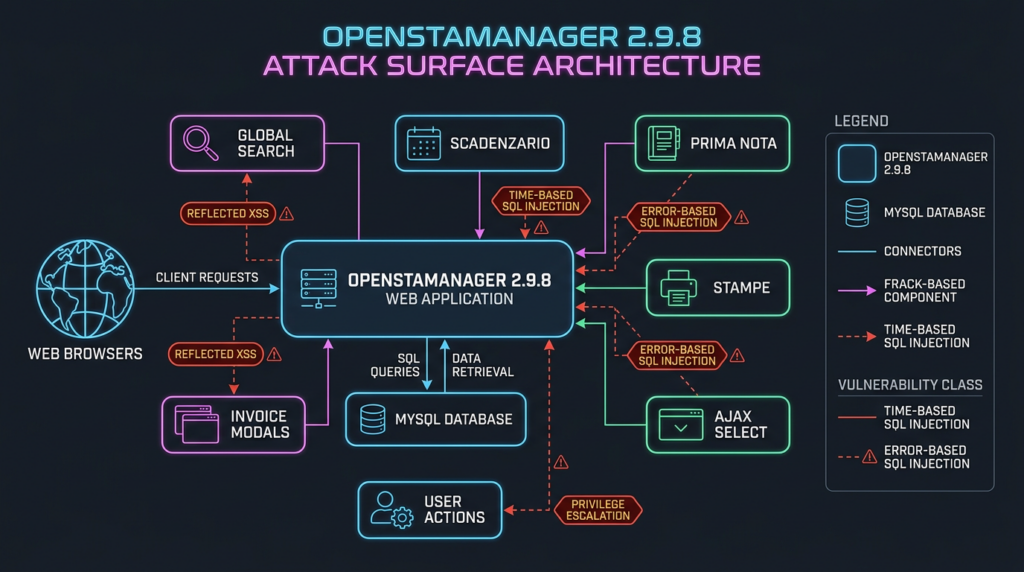
The most important OpenSTAManager 2.9.8 exploit discussions center on SQL injection and authorization weaknesses. CVE-2026-24418 covers an error-based SQL injection in the Scadenzario bulk operations module. CVE-2026-24417 covers time-based blind SQL injection in global search. CVE-2026-24416 covers time-based blind SQL injection in article pricing completion. CVE-2026-24419 covers error-based SQL injection in the Prima Nota journal-entry module. CVE-2025-69214, CVE-2025-69215, and CVE-2025-69216 describe additional SQL injection issues in ajax_select.php, the Stampe module, and the Scadenzario print template. CVE-2026-27012 is separate but even more operationally dangerous because it describes unauthenticated privilege escalation through modules/utenti/actions.php. CVE-2026-24415 adds a reflected XSS issue in modification modals. (NVD)
What “OpenSTAManager 2.9.8 exploit” really points to
A useful way to read the public information is to group the issues by weakness pattern rather than by CVE number alone. The OpenSTAManager 2.9.8 exploit surface is not one route. It is a set of recurring implementation mistakes:
| 취약성 | Primary weakness | Route or component | 인증 | Practical impact |
|---|---|---|---|---|
| CVE-2026-27012 | Missing authentication and authorization for a critical function | modules/utenti/actions.php | Public advisory says no authentication is required | Existing users can be promoted or demoted by changing idgruppo |
| CVE-2026-24418 | Error-based SQL injection in an IN clause | Scadenzario bulk operations, /actions.php?id_module=18 | Low privileges required in the advisory | Database contents may be exposed through SQL error behavior |
| CVE-2026-24417 | Time-based blind SQL injection | Global search, /ajax_search.php, term parameter | Authenticated | Database contents may be inferred through response timing across multiple modules |
| CVE-2026-24416 | Time-based blind SQL injection | Article pricing completion, /ajax_complete.php?op=getprezzi, idarticolo | Authenticated | Database contents may be inferred through timing |
| CVE-2026-24419 | Error-based SQL injection in an IN clause | Prima Nota, /modules/primanota/add.php, id_documenti | Authenticated | Database information may be leaked through error output |
| CVE-2025-69214 | SQL injection in AJAX selection | ajax_select.php, componenti, options[matricola] | Authenticated | Equipment or component query path can be used as SQL injection entry point |
| CVE-2025-69215 | SQL injection in print configuration | Stampe module, modules/stampe/actions.php, module parameter | Authenticated | Database read impact and print-module abuse |
| CVE-2025-69216 | SQL injection in print template | Scadenzario PDF generation template, id_anagrafica | Authenticated | Sensitive database records may be exposed through template rendering |
| CVE-2026-24415 | 반영된 XSS | modifica_iva.php modals, righe parameter | Advisory text describes victim interaction and authenticated user context | Session theft, CSRF token theft, or action execution in a victim’s browser |
This table also shows why raw CVSS alone is not enough. A medium NVD score on a SQL injection in a business-management application may still deserve urgent attention if the system contains customer records, billing data, supplier data, administrator accounts, payment schedules, or invoice attachments. NVD lists CVE-2026-24418 with a CVSS 3.1 base score of 6.5 from NIST but also shows the GitHub CNA CVSS 4.0 base score as 8.7 high, and the NVD change history includes CISA ADP SSVC enrichment with exploitation marked as PoC and technical impact marked as total. That discrepancy should push defenders to read the advisory and assess exposed business data, not stop at one score. (NVD)
Why the business context changes severity
OpenSTAManager is not a brochure website. It is closer to an ERP-style operational system for smaller organizations: technical assistance, electronic invoicing, accounting, warehouse, schedules, documents, customer and supplier records. The official site describes cloud and self-hosted use, accounting management, technical assistance, warehouse management, due dates, history, and customization. It also states that users can install it on their own server or use hosted servers in Italy. (OpenSTA Manager)
That context changes how defenders should think about an OpenSTAManager 2.9.8 exploit. A SQL injection in a public blog can leak posts, authors, and user emails. That is serious. A SQL injection in OpenSTAManager can be much closer to a finance and operations incident. Depending on deployment and usage, the database may contain:
| Data class | Why attackers care | Operational consequence |
|---|---|---|
| User accounts and password hashes | Enables offline cracking, credential reuse, or account takeover | Compromise may spread to email, accounting portals, hosting panels, or technician accounts |
| Customer records | PII, addresses, contact details, service history | Privacy reporting, customer trust damage, targeted phishing |
| Invoices and payment data | Business relationships, amounts, dates, tax data | Fraud, invoice manipulation, business email compromise support |
| Supplier and warehouse records | Supply-chain mapping and asset inventory | Physical and operational targeting |
| Work orders and technical assistance notes | Internal asset details and customer environments | Follow-on attacks against customers or serviced systems |
| Attachments and backups | Files often contain contracts, exports, signatures, PDFs, or system data | Higher-value breach material than ordinary web content |
This is why the phrase “OpenSTAManager 2.9.8 exploit” should be handled carefully. A safe, authorized validation should prove exploitability without dumping the database. A remediation plan should not end at “block one payload.” It should include exposure reduction, version upgrade, account review, credential rotation, and evidence collection.
Version reality, why 2.9.8 became the pivot
The OpenSTAManager GitHub releases page lists 2.9.8 as released on December 23, 2025. The same release notes include normal bug fixes and one line that translates to corrected SQL injection prevention, but the public advisories disclosed in February and March 2026 still identify OpenSTAManager 2.9.8 or earlier as affected in several places. The releases page later lists 2.10.4 as the latest stable release, released April 28, 2026, while the public download page currently highlights a 2.11.1 beta. (GitHub)
That creates a practical lesson. Security teams should not rely on one of these signals alone:
| Weak signal | Why it is not enough | Better check |
|---|---|---|
| “The dashboard says we are updated” | Web apps can have partial upgrades or stale files | Confirm version from the app, filesystem, Git tag, package metadata, and release archive |
| “The Docker tag says latest” | Tags move, local images may be cached, and Compose files may pin old images | Check image digest, container creation date, file contents, and app version |
| “NVD says patched version is not listed” | Advisory metadata may lag project releases | Read project release notes, vendor advisory, GitHub advisory, and deployed source |
| “Only authenticated users can exploit this” | Small businesses often share technician accounts or expose demo credentials | Review login exposure, weak passwords, MFA, IP allowlists, and account audit logs |
| “A WAF blocks SLEEP” | SQL injection can use many dialect-specific variants and business logic paths | Fix query construction and permission checks in code |
The Docker Hub page for devcodesrl/openstamanager also shows a quick-start flow that exposes the app locally on port 8080 and uses a MySQL container, which is useful for testing but also a reminder that many real deployments may be simple Compose-based installs managed by small teams. Docker convenience is not a vulnerability by itself, but it makes accurate version and exposure checking essential. (Docker Hub)
The recurring root cause, dynamic SQL built from user-controlled values
Most of the SQL injection issues disclosed around OpenSTAManager 2.9.8 share the same underlying pattern: input is fetched from a request, lightly cleaned or split, then concatenated into a SQL string. The vulnerable data often appears to be an integer ID or list of IDs. That makes it easy for developers to assume the value is safe. The problem is that the database only sees the final query string, not the developer’s intention.
MITRE CWE-89 describes SQL injection as improper neutralization of special elements used in a SQL command. OWASP’s SQL Injection Prevention Cheat Sheet recommends prepared statements with parameterized queries, stored procedures where appropriate, allow-list input validation, and least privilege as major defenses. OWASP’s general injection guidance emphasizes that prepared statements prevent attackers from changing the intent of a query even if SQL syntax is inserted as input. (CWE)
The OpenSTAManager advisories show several variants of the same failure mode. CVE-2026-24418 describes id_records[] reaching a Scadenzario bulk operation where array values are cleaned for emptiness but not validated as integers before use in an SQL IN() clause. CVE-2026-24419 describes id_documenti values split by comma and later joined into an IN() clause without type validation. CVE-2025-69214 describes options[matricola] reaching an IN() clause in the componenti operation. (GitHub)
The important coding mistake is not “the developer forgot to block a bad string.” It is that the code creates a query by mixing code and data. Filtering empty values, replacing a character, or validating one parameter while leaving another unchecked does not create a security boundary.
A safer pattern for integer ID lists starts by rejecting the idea that a request parameter is already an integer list. Treat it as hostile text, normalize it, validate each element, and then pass it to the database through a safe construction pattern.
function parsePositiveIntegerList(string $raw): array
{
    $parts = array_filter(array_map('trim', explode(',', $raw)), 'strlen');

    $ids = [];
    foreach ($parts as $part) {
        if (!ctype_digit($part)) {
            throw new InvalidArgumentException('Invalid ID list');
        }

        $value = (int) $part;
        if ($value <= 0) {
            throw new InvalidArgumentException('Invalid ID value');
        }

        $ids[] = $value;
    }

    return array_values(array_unique($ids));
}
For PDO, the next step is to create placeholders rather than concatenate raw values into the query text.
$ids = parsePositiveIntegerList($_GET['id_documenti'] ?? '');

$placeholders = implode(',', array_fill(0, count($ids), '?'));

$stmt = $pdo->prepare(
    "SELECT idanagrafica
     FROM co_documenti
     WHERE id IN ($placeholders)"
);

$stmt->execute($ids);
$result = $stmt->fetch(PDO::FETCH_ASSOC);
This example is intentionally defensive. It rejects unexpected strings instead of trying to “clean” them into something safe. It uses placeholders for the values. It also keeps query intent separate from request text. That is the central lesson from the OpenSTAManager 2.9.8 exploit cluster.
Error-based SQL injection, why database errors become data leaks
Error-based SQL injection is dangerous because the application does not need to render a normal query result. It only needs to expose enough database error text for an attacker to infer or leak data. Several OpenSTAManager disclosures use this pattern.
CVE-2026-24418 describes an error-based SQL injection in Scadenzario bulk operations, where elements of id_records[] are not validated as integers before being used in an IN() clause. The GitHub advisory says the issue can expose complete database contents including user credentials, customer PII, and financial records through XML error messages. NVD describes the same flaw and lists CWE-89. (GitHub)
CVE-2026-24419 describes a similar IN() clause failure in the Prima Nota module. The public repository write-up traces request input from get('id_documenti'), through explode, and into a query that uses implode without type validation. The NVD description similarly states that comma-separated values from id_documenti are not validated as integers before use in SQL IN() clauses. (GitHub)
CVE-2025-69215 describes SQL injection in the Stampe module. The GitHub advisory points to modules/stampe/actions.php, where a module parameter from POST data is concatenated into an SQL 업데이트 query while another parameter is converted with intval. That is a classic partial-validation trap: one value appears protected, another equally important value remains untrusted. (GitHub)
CVE-2025-69216 describes an authenticated SQL injection in the Scadenzario print template. The GitHub advisory identifies templates/scadenzario/init.php에서 id_anagrafica is concatenated into query text during PDF generation. NVD describes the same issue as allowing any authenticated user to extract sensitive data from the database, including administrator credentials, customer information, and financial records. (GitHub)
The defensive implication is direct: do not expose raw SQL errors to users. That does not fix SQL injection, but it reduces the attacker’s feedback channel. Production systems should use generic application errors on the front end, structured exception handling in the application, and protected logs for developers and responders.
| 제어 | What it prevents | What it does not prevent |
|---|---|---|
| 매개 변수화된 쿼리 | Query intent being changed by input | Business authorization mistakes |
| Strong integer-list parsing | Non-integer payloads entering ID-based filters | SQL injection in non-ID fields |
| Generic production error pages | Database output leaking through HTTP | Blind SQL injection timing inference |
| Least-privilege DB user | Full database or file-system level damage | Leakage of data the app account can read |
| Centralized logs | Evidence loss and blind incident response | Exploitation by itself |
| WAF rule | Some known payload strings and automated probes | Root cause in application code |
Time-based blind SQL injection, why “no error” does not mean “safe”
Time-based blind SQL injection is quieter than error-based SQL injection. The attacker does not need database output or an error page. The application only has to respond slower when a database condition is true. Over repeated requests, the attacker can infer data one bit or one character at a time.
CVE-2026-24416 describes a time-based blind SQL injection in the article pricing completion handler. The affected parameter is idarticolo, the affected endpoint is /ajax_complete.php?op=getprezzi, and the advisory says the application fails to properly sanitize the parameter before using it in SQL queries. (GitHub)
CVE-2026-24417 is broader. GitHub’s advisory describes a critical time-based blind SQL injection in global search, with the term parameter passed through /ajax_search.php and into multiple module-specific search handlers. The advisory lists affected modules including Articoli, Ordini, DDT, Fatture, Preventivi, Anagrafiche, Impianti, Contratti, Automezzi, and Interventi. The public repository write-up adds an important operational detail: one malicious request may trigger SQL injection across multiple search handlers, multiplying delay and causing gateway timeouts. (GitHub)
That amplification matters. A defender may see 504 responses, slow PHP workers, database CPU spikes, or repeated AJAX calls before seeing obvious data theft. Time-based blind SQL injection often leaves performance artifacts rather than neat “dumped table” evidence.
A safe validation in an authorized lab should measure timing only. It should not extract secrets. The following Python example compares a baseline request against a deliberately delayed test request in a local, approved environment. The payload is represented as a placeholder because production data extraction is not needed to prove the class of issue.
import statistics
import time
import requests

BASE_URL = "http://127.0.0.1:8080"
COOKIES = {"PHPSESSID": "replace-with-authorized-lab-session"}

def measure(path: str, samples: int = 5) -> list[float]:
    timings = []

    for _ in range(samples):
        start = time.perf_counter()
        response = requests.get(
            BASE_URL + path,
            cookies=COOKIES,
            timeout=15,
        )
        elapsed = time.perf_counter() - start

        # We care about timing, not body content.
        timings.append(elapsed)
        print(response.status_code, round(elapsed, 3))

    return timings

baseline = measure("/ajax_search.php?term=invoice")
probe = measure("/ajax_search.php?term=AUTHORIZED_LAB_DELAY_PROBE")

print("baseline median:", round(statistics.median(baseline), 3))
print("probe median:", round(statistics.median(probe), 3))
A timing probe is not conclusive by itself. Network jitter, database load, PHP-FPM worker saturation, reverse proxy timeout settings, and background jobs can create false positives. The right validation compares several samples, checks server-side logs, verifies the vulnerable code path, and repeats the test in a quiet lab. If the issue is confirmed, stop. Do not proceed to database extraction unless the rules of engagement explicitly require it and the environment is isolated.
The authorization bug that changes the attack chain
SQL injection dominates the OpenSTAManager 2.9.8 exploit discussion, but CVE-2026-27012 deserves its own priority. NVD describes it as a privilege escalation and authentication bypass vulnerability in OpenSTAManager 2.9.8 and earlier that allows an attacker to change a user’s group, idgruppo, by directly calling modules/utenti/actions.php. The GitHub advisory lists the affected package as devcode-it/openstamanager, affected versions as <= 2.9.8, patched versions as none in that advisory metadata, and severity as critical. (NVD)
The GitHub advisory explains that modules/utenti/actions.php is reachable directly and processes privileged information without authentication or authorization checks on fields such as idgruppo. It also notes that the file sets $skip_permissions = true, includes core.php, and that permission enforcement is then skipped. The advisory states that sensitive fields can be updated without verifying the requester. (GitHub)
This is a different kind of risk from SQL injection. SQL injection attacks the database through query construction. CVE-2026-27012 attacks the permission boundary directly. If an attacker can reach the vulnerable route and knows or guesses an existing user record, the advisory indicates that the attacker can promote a user into the administrator group or demote administrators. That can turn a low-noise HTTP request into full application control.
A defensive response to this issue should include more than patching:
| Response action | 중요한 이유 |
|---|---|
Restrict direct access to modules/utenti/actions.php immediately | Reduces exposure while patching or upgrading |
| Review user group changes | idgruppo changes may be the core compromise artifact |
| Check recently modified users | Attackers may promote an existing low-privilege account instead of creating a new one |
| Reset passwords and sessions | Privilege abuse may have exposed additional account data |
| Review admin panel activity | A promoted account may have changed invoices, settings, templates, API credentials, or exports |
| Check web logs for unauthenticated POSTs to user actions | The route itself is a high-signal indicator |
| Validate permission enforcement in code | Route-level access controls must not depend on hidden UI buttons |
For organizations using OpenSTAManager in a business workflow, this issue should be treated as an application-control-plane incident. If an attacker could change who is an administrator, every sensitive action after that point may be suspect.
Reflected XSS as an account-takeover helper
CVE-2026-24415 is a reflected cross-site scripting issue tied to modifica_iva.php modals and the righe parameter. The GitHub advisory text says OpenSTAManager contains reflected XSS vulnerabilities in invoice, order, and contract modification modals because user-supplied input is reflected into an HTML value attribute without proper sanitization. The same search result shows a notable version-range tension: the metadata lists affected versions as < 2.9.8 and patched version as 2.9.8, while the description text says “OpenSTAManager v2.9.8 contains” the vulnerable pattern. That kind of inconsistency is exactly why teams should inspect the affected files in their deployed code instead of relying on a single summary line. (GitHub)
XSS is not a sideshow in a business-management system. If an authenticated administrator opens a malicious URL while logged in, attacker-controlled JavaScript may be able to act within the browser context. Depending on cookie flags, CSRF design, CSP, and UI structure, XSS can help steal tokens, perform actions as the victim, modify page content, or guide a user into approving malicious changes.
OWASP’s XSS Prevention Cheat Sheet explains that output encoding should convert untrusted input into a safe form so it is displayed as data rather than executed as browser code. In an HTML attribute context, that means correct attribute encoding, not a generic string replacement. (OWASP 치트 시트 시리즈)
The correct fix is contextual output encoding plus input validation where appropriate. In PHP templates, a hidden input value should not echo raw request data.
<input
    type="hidden"
    name="righe"
    value="<?= htmlspecialchars($_GET['righe'] ?? '', ENT_QUOTES, 'UTF-8') ?>"
>
That example does not replace authorization checks, CSRF protection, cookie hardening, or Content Security Policy. It only addresses one core rule: untrusted input must be encoded for the exact place where it is rendered.
Why the old Exploit-DB entry should not be mixed into the 2.9.8 story
Exploit-DB has an older Open STA Manager 2.3 entry for arbitrary file download, published in October 2018, with no CVE assigned. It references modules/backup/actions.php?op=getfile&file=[FILE] and belongs to a different version and vulnerability class. (익스플로잇 데이터베이스)
That historical exploit is useful context, but it should not be confused with the OpenSTAManager 2.9.8 exploit cluster. Mixing old PoC paths with new CVEs causes bad testing, false confidence, and noisy reports. A tester who checks only the old arbitrary file download path has not validated the 2026 SQL injection or privilege escalation advisories. A defender who blocks only a backup file path has not addressed the 2.9.8 SQL injection and authorization issues.
The same principle applies across vulnerability research: product name similarity is not proof of exploitability. Version, route, parameter, authentication state, database backend, code path, and deployment context all matter.
Safe validation workflow for authorized testing
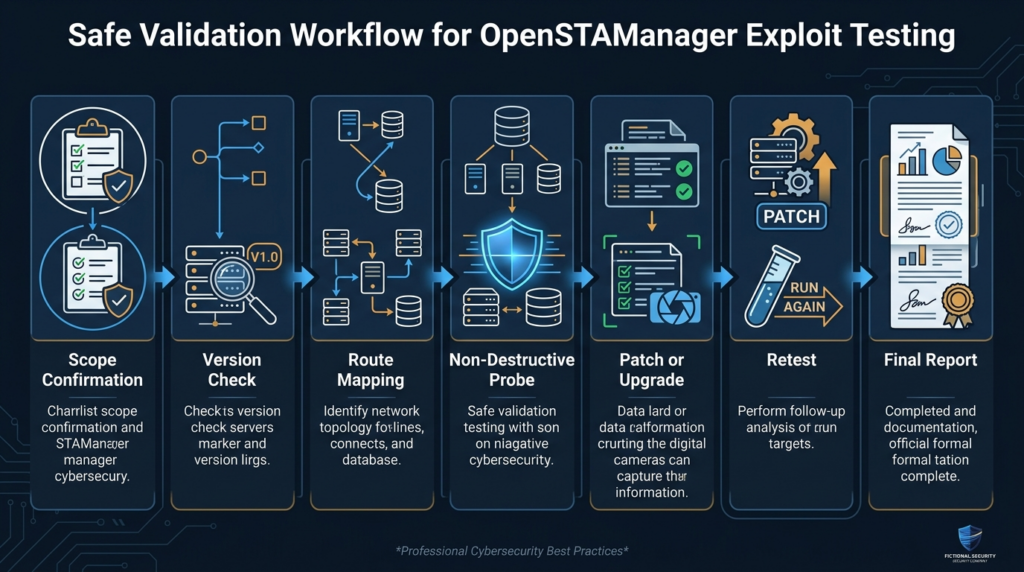
A responsible OpenSTAManager 2.9.8 exploit validation should be evidence-driven and non-destructive. The goal is to determine whether the system is affected, whether the vulnerable route is reachable, whether exploitability can be proven safely, and whether remediation worked.
A practical workflow looks like this:
| 단계 | What to do | What to avoid |
|---|---|---|
| 범위 | Confirm written authorization, hostnames, IPs, test accounts, time window, and data-handling limits | Testing third-party hosted instances or demo systems without explicit permission |
| 인벤토리 | Confirm OpenSTAManager version, deployment model, reverse proxy, database, PHP version, and exposed routes | Assuming the version from a UI label only |
| Account model | Identify test roles such as technician, agent, customer, admin | Using real employee accounts unnecessarily |
| Non-destructive probing | Use timing checks, route reachability checks, and controlled error handling in a lab | Dumping tables, extracting password hashes, or modifying real users |
| 증거 | Capture request metadata, response code, timing, logs, stack traces, and screenshots where allowed | Storing customer data as proof |
| 해결 방법 | Upgrade or patch, restrict access, fix code, rotate secrets, review accounts | Relying only on WAF pattern blocking |
| Retest | Repeat the same safe test cases after patching | Expanding scope after remediation without approval |
| 신고 | Tie each finding to route, parameter, impact, evidence, and fix | Submitting generic “SQLi found” text without business context |
Version checks should combine application and infrastructure evidence. The following commands are safe examples for authorized hosts you control.
# Inspect a local deployment directory for version-like markers.
grep -R "2.9.8\|2.10\|2.11" -n /var/www/html/openstamanager 2>/dev/null | head -50

# Check Docker containers and image tags.
docker ps --format "table {{.Names}}\t{{.Image}}\t{{.CreatedAt}}\t{{.Ports}}"

# Check Compose files for pinned images.
grep -R "openstamanager" -n ./docker-compose.yml ./compose.yml 2>/dev/null

# Confirm whether a reverse proxy exposes the app.
ss -ltnp | grep -E ':80|:443|:8080'
For web logs, defenders can look for high-signal paths and SQLi function names. This does not prove exploitation by itself, but it helps narrow the review.
# Nginx access log examples for OpenSTAManager routes discussed in advisories.
zgrep -Ei "ajax_search\.php|ajax_select\.php|modules/utenti/actions\.php|modules/primanota/add\.php|pdfgen\.php|modules/stampe/actions\.php" \
  /var/log/nginx/access.log* | tail -200

# Look for common SQLi timing and error-based probes.
zgrep -Ei "sleep[[:space:]]*\(|benchmark[[:space:]]*\(|extractvalue[[:space:]]*\(|updatexml[[:space:]]*\(|gtid_subset[[:space:]]*\(" \
  /var/log/nginx/access.log* /var/log/apache2/access.log* 2>/dev/null | tail -200

# Look for repeated gateway timeouts around AJAX search.
zgrep -E "ajax_search\.php" /var/log/nginx/access.log* 2>/dev/null | awk '$9 ~ /500|502|503|504/ {print}'
For database logs, the exact location depends on MySQL or MariaDB configuration. A useful check is whether SQL errors reached logs around the same timestamp as suspicious HTTP requests.
# Common Linux log locations vary by distro and container image.
sudo grep -RiE "XPATH syntax error|SQLSTATE|EXTRACTVALUE|UPDATEXML|SLEEP\\(" \
  /var/log/mysql /var/log/mariadb /var/lib/mysql 2>/dev/null | tail -100
In authorized environments, Penligent can sit in the validation and reporting part of this workflow rather than replacing engineering judgment. For a business app like OpenSTAManager, the useful work is mapping reachable surfaces, running controlled checks, preserving command and response evidence, separating confirmed exploitability from version-only suspicion, and producing a retestable report. Penligent’s public site describes it as an AI-powered pentesting platform, and its SQL injection write-up on Ghost’s Content API is a useful example of framing SQLi around the asset behind the bug rather than treating it as a generic payload exercise. (펜리전트)
Detection logic, what defenders should look for
Detection should be built around the routes, parameters, behavior, and timing described in the advisories. It should not rely only on one payload string. Attackers can encode values, use different SQL functions, change whitespace, or route through normal application workflows.
| 신호 | Possible meaning | Confidence |
|---|---|---|
POSTs to modules/utenti/actions.php from unauthenticated or unusual clients | Possible CVE-2026-27012 probing or exploitation | High if paired with user group changes |
Requests to /actions.php?id_module=18 with unusual id_records[] values | Possible Scadenzario bulk SQLi probing | Medium to high |
Requests to /modules/primanota/add.php?id_documenti= with encoded SQL syntax | Possible Prima Nota SQLi probing | 높음 |
/ajax_search.php?term= requests followed by long response times or 504 errors | Possible time-based SQLi or performance probing | Medium |
/ajax_select.php?op=componenti with malformed options[matricola] | Possible componenti SQLi probing | Medium to high |
/pdfgen.php?ptype=scadenzario&id_anagrafica= with SQL syntax | Possible print-template SQLi probing | 높음 |
modifica_iva.php?righe= containing encoded quotes, tags, or event handlers | Possible reflected XSS attempt | Medium to high |
| SQL error strings in HTTP responses | Error-based SQLi feedback channel | 높음 |
| Sudden admin group membership changes | Possible privilege escalation or insider action | 높음 |
| Repeated requests from a single IP with non-browser user agents | Scanner or PoC activity | Medium |
A good detection rule combines multiple weak signals into a stronger case. For example, a request to /ajax_search.php?term=abc is normal. A burst of requests to /ajax_search.php containing SQL function names, followed by 504 responses, database slow queries, and a non-browser user agent is much more suspicious. A POST to modules/utenti/actions.php is especially concerning if it comes from an unauthenticated session and is followed by a user’s idgruppo changing.
Database-side detection should also watch for function names commonly used in SQL injection testing, but defenders should avoid overfitting to a single function. The stronger evidence is an unexpected query shape, application route, request parameter, and timing or error behavior matching a known vulnerable path.
Incident response checklist after suspected exploitation
If an organization discovers that an OpenSTAManager 2.9.8 instance was internet-accessible or sees evidence of probing, the response should be broader than a code patch.
| 단계 | 액션 | Reason |
|---|---|---|
| 1 | Take a backup before changes | Preserve forensic evidence and support rollback |
| 2 | Restrict access at the network edge | Stop ongoing exploitation attempts |
| 3 | Snapshot web, app, database, and reverse proxy logs | Logs may rotate quickly on small servers |
| 4 | Review user group changes and new accounts | CVE-2026-27012 centers on group modification |
| 5 | Reset sessions and force password rotation for privileged users | SQLi and XSS can expose credentials or sessions |
| 6 | Rotate database credentials | A database-read incident may expose configuration secrets |
| 7 | Review invoice, customer, supplier, and payment changes | Business data tampering may be more damaging than data theft |
| 8 | Upgrade or patch the application | Remove known vulnerable code paths |
| 9 | Retest with safe, scoped checks | Confirm the route, parameter, and permission boundary are fixed |
| 10 | Document business impact | Compliance, customer notification, and insurance decisions need evidence |
For CVE-2026-27012, pay special attention to administrator accounts, technician accounts, agents, and any account that changed group membership after suspicious route access. For SQL injection issues, focus on whether the application’s database user had broad read access, whether backups were stored in reachable directories, whether password hashes were exposed, and whether the same credentials were reused elsewhere.
Why WAF-only mitigation is not enough
A WAF can be useful during emergency containment. It can block obvious strings such as SLEEP(, UPDATEXML(, EXTRACTVALUE(, encoded quotes, or suspicious requests to specific paths. But a WAF does not repair a query that concatenates request input into SQL. It also does not fix a route that skips permission enforcement.
CISA and the FBI have urged software manufacturers to eliminate SQL injection by using parameterized queries with prepared statements so user input is treated as data rather than executable SQL code. OWASP gives the same core recommendation. These are design and coding controls, not edge-filter controls. (CISA)
Emergency WAF rules should be treated as temporary guardrails:
# Example emergency filter pattern for a controlled reverse proxy.
# Tune carefully to avoid breaking legitimate business workflows.
location ~* ^/(ajax_search\.php|ajax_select\.php|pdfgen\.php|modules/.*/actions\.php|modules/primanota/add\.php)$ {
    if ($query_string ~* "(sleep\s*\(|benchmark\s*\(|extractvalue\s*\(|updatexml\s*\(|union\s+select)") {
        return 403;
    }

    proxy_pass http://openstamanager_backend;
}
This example is deliberately conservative and incomplete. Attackers can encode strings, vary functions, or avoid obvious keywords. It should never be presented as the fix. The real fix is to upgrade, remove vulnerable concatenation, enforce authorization, disable detailed error output, and keep the application behind strong access controls.
Code-level remediation patterns
Several OpenSTAManager 2.9.8 exploit paths involve ID values. Developers often make the mistake of thinking that “ID” means “safe.” It does not. An ID is safe only after it has been parsed and validated.
For a comma-separated list, safe handling needs all of the following:
| 요구 사항 | Bad pattern | Better pattern |
|---|---|---|
| Type enforcement | explode(',', $_GET['ids']) 그리고 implode(',', $ids) | Validate each element with ctype_digit, convert to integer, reject invalid input |
| Query construction | "WHERE id IN (" . $_GET['ids'] . ")" | Use placeholders or a trusted integer array |
| Error handling | Display SQL exception to browser | Log exception internally and return generic user-facing error |
| 권한 부여 | Hide UI buttons from low-privilege users | Enforce permission checks on every route |
| Request method | Trust route because it is “internal” | Treat every directly reachable PHP file as internet-reachable unless blocked |
| Output rendering | Echo $_GET into HTML attribute | Use context-specific encoding |
For search fields such as term, the fix is not to strip a few symbols. Search terms are text, and text can contain quotes, percent signs, underscores, slashes, spaces, and Unicode. Use prepared statements and escape LIKE wildcards intentionally.
function escapeLike(string $value, string $escapeChar = '\\'): string
{
    return str_replace(
        [$escapeChar, '%', '_'],
        [$escapeChar . $escapeChar, $escapeChar . '%', $escapeChar . '_'],
        $value
    );
}

$term = trim($_GET['term'] ?? '');

$stmt = $pdo->prepare(
    "SELECT id, title
     FROM mg_articoli
     WHERE title LIKE ? ESCAPE '\\\\'
     LIMIT 20"
);

$stmt->execute(['%' . escapeLike($term) . '%']);
$rows = $stmt->fetchAll(PDO::FETCH_ASSOC);
For authorization, the safest default is to fail closed. A route that changes users, groups, settings, templates, print configuration, invoices, or database records should explicitly require an authenticated session and the correct permission. A local include flag such as skip_permissions should never be usable on a directly reachable route that processes state-changing operations.
Deployment hardening for OpenSTAManager
Even after patching, OpenSTAManager should be deployed like a business-critical back-office application. The public internet is rarely the right place for an invoicing and service-management admin panel.
| Hardening control | 권장 사항 |
|---|---|
| Network exposure | Place the app behind VPN, private network, identity-aware proxy, or strict IP allowlist |
| TLS | Use modern TLS and redirect HTTP to HTTPS |
| 인증 | Enforce unique accounts, strong passwords, and MFA where available |
| Default or demo accounts | Remove demo credentials and shared technician accounts |
| Reverse proxy | Add request size limits, timeouts, rate limits, and centralized logs |
| PHP settings | Disable display of errors in production and log errors securely |
| Database account | Use least privilege, not root or DBA-level credentials |
| Backups | Store backups outside web root and protect them with separate access controls |
| File uploads | Restrict executable uploads and verify attachment directories cannot execute scripts |
| 모니터링 | Alert on admin changes, route anomalies, 500 or 504 spikes, and suspicious SQL strings |
| Patch process | Track upstream releases, advisories, and internal deployment status |
The official Docker Hub page recommends mounting volumes for /files, /backup, or both to persist attachments and backups. That is operationally sensible, but those paths should be reviewed carefully in production. Backups and attachments often contain the highest-value data in a breach. They should not be directly web-readable unless the application enforces authorization on every access path. (Docker Hub)
Related CVEs that clarify the pattern
The OpenSTAManager 2.9.8 exploit story is part of a wider pattern: old SQL injection lessons keep reappearing in modern systems, but the asset behind the injection changes the incident response.
CVE-2026-26980 in Ghost CMS is a useful comparison. Penligent’s analysis describes it as a SQL injection in Ghost’s Content API affecting Ghost 3.24.0 through 6.19.0 and fixed in 6.19.1, with risk tied to arbitrary database reads and potential exposure of Admin API key material. The lesson is similar but the asset is different: in Ghost, the issue can become a content and API-key problem; in OpenSTAManager, SQL injection can become a finance, customer, invoice, and operations-data problem. (펜리전트)
CVE-2026-42208 in LiteLLM Proxy is another useful comparison. Penligent’s article frames that issue as a pre-auth SQL injection in an AI gateway credential path rather than a generic database bug. That distinction matters. SQL injection in a credential-routing layer can affect model provider keys, budgets, and API access decisions. SQL injection in OpenSTAManager affects a different but still sensitive control plane: business records, users, invoices, customer relationships, and payment schedules. (펜리전트)
The shared rule is simple: do not score SQL injection only by the injection primitive. Score it by the reachable asset, the required privilege, the exposure path, the available feedback channel, and the blast radius if the database is read or modified.
Common mistakes during validation
Security teams often lose time on OpenSTAManager 2.9.8 exploit validation because they test the wrong thing or over-test the right thing.
| Mistake | Why it causes trouble | Better approach |
|---|---|---|
| Treating every result as the same exploit | Different CVEs affect different routes and parameters | Map each CVE to route, parameter, role, and code path |
| Running aggressive automated dumping | Creates legal, privacy, and business risk | Use non-destructive proof and stop after confirmation |
| Ignoring authenticated bugs | Low-privilege accounts may be easy to obtain or shared | Test with realistic roles and review account hygiene |
| Trusting UI-level permissions | Hidden buttons do not protect direct PHP routes | Verify server-side authorization |
| Checking only one module | Global search and templates span multiple modules | Cover search, print, bulk, AJAX, and user actions |
| Treating WAF blocks as remediation | Payload blocking does not fix unsafe queries | Patch code and retest vulnerable paths |
| Skipping incident review after patching | Attackers may already have changed users or read data | Review logs, accounts, data changes, and credentials |
A good report should not say only “OpenSTAManager 2.9.8 SQLi found.” It should say which route was reachable, which parameter was unsafe, whether authentication was required, what role was used, what non-sensitive evidence proved the issue, which business data class was at risk, which fix was applied, and which retest confirmed closure.
자주 묻는 질문
What is the OpenSTAManager 2.9.8 exploit people are searching for?
- It usually refers to a group of public vulnerabilities affecting OpenSTAManager 2.9.8 or earlier, not one single exploit.
- The most important issues include SQL injection in Scadenzario, global search, article pricing, Prima Nota, Stampe, and AJAX selection paths.
- CVE-2026-27012 is especially important because it describes unauthenticated privilege escalation through
modules/utenti/actions.php. - Treat the search term as a signal to assess the whole exposed OpenSTAManager attack surface, not as a prompt to run one PoC.
Is OpenSTAManager 2.9.8 vulnerable to SQL injection?
- Public advisories and NVD entries describe multiple SQL injection vulnerabilities affecting OpenSTAManager 2.9.8 or earlier.
- The recurring pattern is direct concatenation of request-controlled values into SQL queries.
- Several vulnerable paths involve ID lists or parameters that look numeric but are not safely validated before reaching SQL.
- The practical risk depends on exposure, authentication, user roles, database privileges, and whether detailed SQL errors are visible.
Does an attacker need to log in?
- For many SQL injection issues, the advisories describe authenticated exploitation.
- Authentication should not be treated as strong mitigation if the application has shared technician accounts, weak passwords, missing MFA, exposed demo credentials, or easy account creation.
- CVE-2026-27012 is different because public advisories describe it as unauthenticated privilege escalation.
- XSS exploitation generally depends on a victim user opening a crafted URL while authenticated.
Which CVE should defenders prioritize first?
- Prioritize CVE-2026-27012 immediately if the instance is reachable from untrusted networks, because it concerns unauthenticated user group modification.
- Prioritize SQL injection issues that expose Scadenzario, Prima Nota, Stampe, global search, and AJAX selection paths.
- Prioritize based on reachable routes, user roles, database contents, and whether the instance stores real customer or financial data.
- Do not rely only on one CVSS score if the system contains sensitive business records.
Is running sqlmap enough to validate the issue?
- No. Automated tools can help in an authorized lab, but they are not a complete validation plan.
- For production or customer systems, avoid data dumping unless explicitly authorized and necessary.
- Safer validation proves route reachability, parameter influence, timing behavior, error behavior, and vulnerable code path without extracting sensitive data.
- A useful report should include business impact, logs, affected role, remediation, and retest evidence.
What should I check after patching or upgrading?
- Confirm the running version from the application, filesystem, container image, and deployment artifact.
- Retest the specific routes and parameters tied to the advisories.
- Review user group changes, newly created users, admin activity, invoice or customer changes, and suspicious exports.
- Rotate privileged passwords, invalidate sessions, and rotate database credentials if exploitation may have occurred.
- Keep OpenSTAManager behind restricted access even after patching.
Should OpenSTAManager be exposed to the public internet?
- In most business environments, no.
- It should be treated as a back-office system that contains operational and financial data.
- Use VPN, private networking, identity-aware proxy, or strict IP allowlisting.
- If public exposure is unavoidable, enforce strong authentication, rate limiting, logging, alerting, and rapid patch management.
How can I verify safely without dumping data?
- Work only on systems where you have written authorization.
- Use a lab clone or staging system whenever possible.
- Prefer timing comparison, controlled route checks, generic error verification, and code review over database extraction.
- Capture non-sensitive evidence such as request metadata, response timing, HTTP status, log lines, and vulnerable code snippets.
- Stop once exploitability is proven and move to remediation.
Closing judgment
OpenSTAManager 2.9.8 exploit risk is not defined by a single public script. It is defined by a repeated failure pattern across SQL query construction, permission enforcement, template rendering, and browser output. The most dangerous deployments are not necessarily the ones with the loudest PoC. They are the ones where a self-hosted business-management system is reachable from the internet, uses shared or weak accounts, exposes detailed errors, stores real customer and financial data, and has not been reviewed after public disclosure.
The practical path is straightforward: confirm the running version, restrict exposure, patch or upgrade, fix unsafe SQL construction, enforce route-level authorization, disable detailed error output, review user and business-data changes, rotate credentials where needed, and retest with non-destructive evidence. That is the difference between chasing an “exploit” and actually reducing risk.


 Korean
  English
  German
  French
  Spanish
  Portuguese
  Japanese
  Hindi
Hindi  Arabic
  Turkish
  Hebrew