
Strix and Penligent both belong on an AI pentesting shortlist. The useful distinction is how you want to operate the testing workflow: inspect and adapt an open-source agent, use a managed service, or procure a deployment with organization-specific controls. Treating the choice as “real pentesting versus a CVE scanner” obscures the decisions a security team actually has to make.
For teams that want to inspect an agent’s implementation and change its testing methodology, Strix’s public code is a concrete starting point. For teams evaluating Penligent, the important questions are the required engagement workflow and the plan that supplies the necessary controls. Published by Penligent; product documentation was checked on October 17, 2026. Performance judgments below are proposed evaluation criteria, not results of a head-to-head test.
Start with the deployment you would actually buy
그리고 official Strix repository documents a local CLI, managed cloud, and enterprise options. Strix’s open-source and hosted deployment guide also explains the relationship between the open-source agent and hosted service. Compare the chosen edition, rather than combining every enterprise feature into a description of the free CLI.
Penligent’s current product and plan descriptions describe black-box web and API testing, verification and reporting, with CI/CD integration in Team and on-premises deployment and a private model gateway in Enterprise. Those plan boundaries matter. A feature offered in an enterprise agreement should not be presented as an entitlement in every subscription.
| Decision | Strix public documentation | Penligent public documentation |
|---|---|---|
| Agent implementation | Public source repository | Review the offered deployment and contract |
| Managed operation | Hosted service described | Hosted product described |
| CI/CD | Documented integration route | Listed for Team |
| Private deployment | Enterprise/self-hosting options described | Listed for Enterprise |
| Evidence and remediation | Validation and remediation workflows described | Verification, reporting, and retesting described |
These are documented product positions, not test results. The table does not establish detection rates, false-positive rates, or equivalent behavior across editions. It also does not turn an unverified requirement into a missing feature: where a capability is essential, request a demonstration in the deployment you will use.
Why the existing comparison needs qualification
Strix’s published Penligent comparison characterizes Penligent narrowly and marks several deployment and integration capabilities as unavailable. The current Penligent plan descriptions above do not support those blanket exclusions. A fair comparison must distinguish availability by plan from absence across the product.
The correction should stop there. It would be equally misleading to claim that documentation proves Penligent finds more vulnerabilities. Public feature pages can establish what a vendor offers; they cannot establish how either product performs on your application. Neither the number of agents nor the length of a tool list substitutes for a reproducible result.
Compare what happens after a finding
Imagine an authorized assessment of a staging application with two customer tenants. The useful output is not merely a statement that an object identifier looks predictable. A reviewer needs to see which role made the request, which object belonged to the other tenant, what response crossed the boundary, and why that response demonstrates unauthorized access. Use synthetic records so the test proves the condition without exposing real customer data.
Ask each product to produce the same small evidence package. It should identify the tested build, relevant request and response, account context, expected policy, and a reproduction path that another tester can follow. If a conclusion depends on hidden state or undocumented manual help, record that dependency. A polished narrative with an irreproducible conclusion should receive less credit than a modest finding with complete proof.
Then make the exercise harder in a useful way: remove the seeded flaw and retest with the same accounts. A failed reproduction is meaningful only if the test reached the same function under comparable conditions. A login failure, expired session, or unreachable endpoint is an inconclusive retest, even when a report labels it “fixed.” This acceptance rule should apply to both products.
CI/CD deserves its own acceptance test
An integration checkbox leaves several questions unanswered. What starts the job? How are ephemeral test URLs and credentials delivered? What keeps a test from continuing after an environment has been destroyed? What event blocks a release, and can the result be traced back to the build that produced it? These operational details determine whether the integration is usable.
For a pilot, choose a small pre-production application and a fixed execution window. Require a machine-readable completion signal, a durable report location, and a documented handling path for interrupted runs. Distinguish a confirmed security failure from an infrastructure error. A pipeline that blocks every timeout can become as disruptive as one that silently passes an incomplete assessment.
Also separate suggested remediation from changes to source code. If an automated fix workflow is important, demonstrate its repository permissions, review path, and retest behavior explicitly. A vendor’s ability to explain a fix does not establish that it can safely submit a change to your repository, and a generated patch does not establish that the vulnerability is closed.
Open source changes the work you own
A source-visible agent offers inspection and customization opportunities. Those are valuable when a team has the people to review changes and maintain a deployment. They do not remove the need to patch dependencies, restrict network access, manage model credentials, and decide which run artifacts are retained. Include that work in the evaluation rather than treating installation as the end of deployment.
A managed option shifts some infrastructure work to the vendor, while creating procurement questions about retention, access, subprocessors, and deletion. Private deployment changes those questions again. Ask for a data-flow diagram covering prompts, source material, credentials, tool output, and reports. “Self-hosted” and “managed” are starting points for that diagram, not complete answers about where data travels.
Source-assisted testing and black-box testing need separate trials
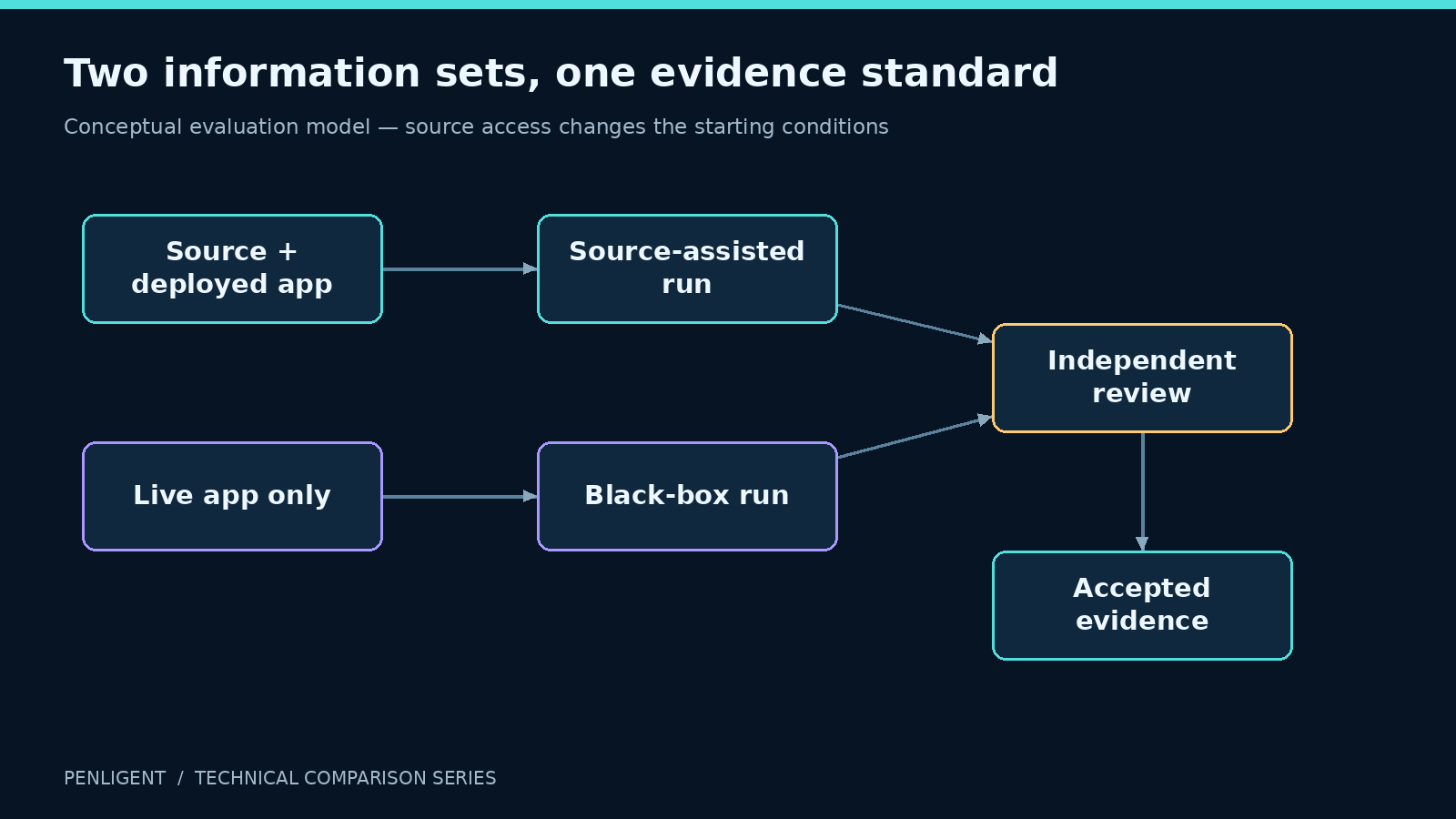
An agent with source access starts with a different information set from one given only a running application. Routes, handlers, authorization checks, and configuration can expose hypotheses that are expensive to discover through the network. A comparison that gives one candidate the repository and the other only a URL measures that information advantage along with the tools. It cannot isolate the effect of the testing system.
Use two trials if source access is part of the decision. In the first, provide the same running staging application, accounts, business rules, and time budget. In the second, provide the source and deployment context to the candidates that support the required workflow. Keep the results separate. A source-assisted finding may be valuable even when it is not reachable in the deployed configuration; that reachability question should be resolved before assigning application impact.
For example, a handler might contain a dangerous-looking operation behind a feature flag that is disabled in the tested build. Record the code concern separately from a demonstrated exposure. The opposite situation is also possible: a weakness may arise from reverse-proxy routing, identity configuration, or deployed permissions that are not visible in the application repository. Include the deployment assumptions in the evidence record so a reviewer knows what the agent could and could not observe.
This distinction also changes remediation ownership. A source-level problem may belong to the application team, while an exposed internal route may belong to platform engineering. The report should connect the observed behavior to the responsible component rather than assuming every successful test ends with a source patch. Score the quality of that connection during the pilot.
Browser access is a shared capability, not a unique differentiator
Strix’s browser documentation describes Playwright-driven Chrome with traffic routed through Caido, including authenticated navigation and request capture. Browser-based testing should therefore not be presented as exclusive to Penligent. The useful comparison is how reliably each workflow establishes and preserves the intended application state.
For an application with organizations and role switching, ask the operator to show the active tenant and role immediately before the sensitive action. A browser can display one workspace while a replayed API request uses credentials associated with another session. That mismatch can create either a false alarm or a missed issue. Require a finding to explain the identity attached to the evidence, not merely the identity visible in a screenshot.
Multi-step features need equally careful treatment. A checkout, invitation, or export may depend on an earlier state transition. Reset the synthetic test object before repeating the action. If one run changes the object for the next run, the candidates are no longer testing equivalent conditions. Preserve the reset procedure and distinguish business-state failures from failures in browser navigation.
In the demonstration, ask for one request-level proof and the corresponding visible behavior. Each helps check the other. A response with a success status may contain an authorization error, while a screenshot of a success toast may omit the server-side outcome. Neither observation should automatically overrule contradictory evidence. The agent or reviewer should reconcile them before the issue reaches the report.
Strix publishes concrete CI behavior that should be checked
그리고 Strix CI/CD documentation describes non-interactive execution, quick scans, diff scoping, and severity-based failure thresholds. It distinguishes execution error from vulnerability detection through exit codes. It also notes that a passing thresholded job can still contain lower-severity findings. These are useful operational details that a simple integration checkbox misses.
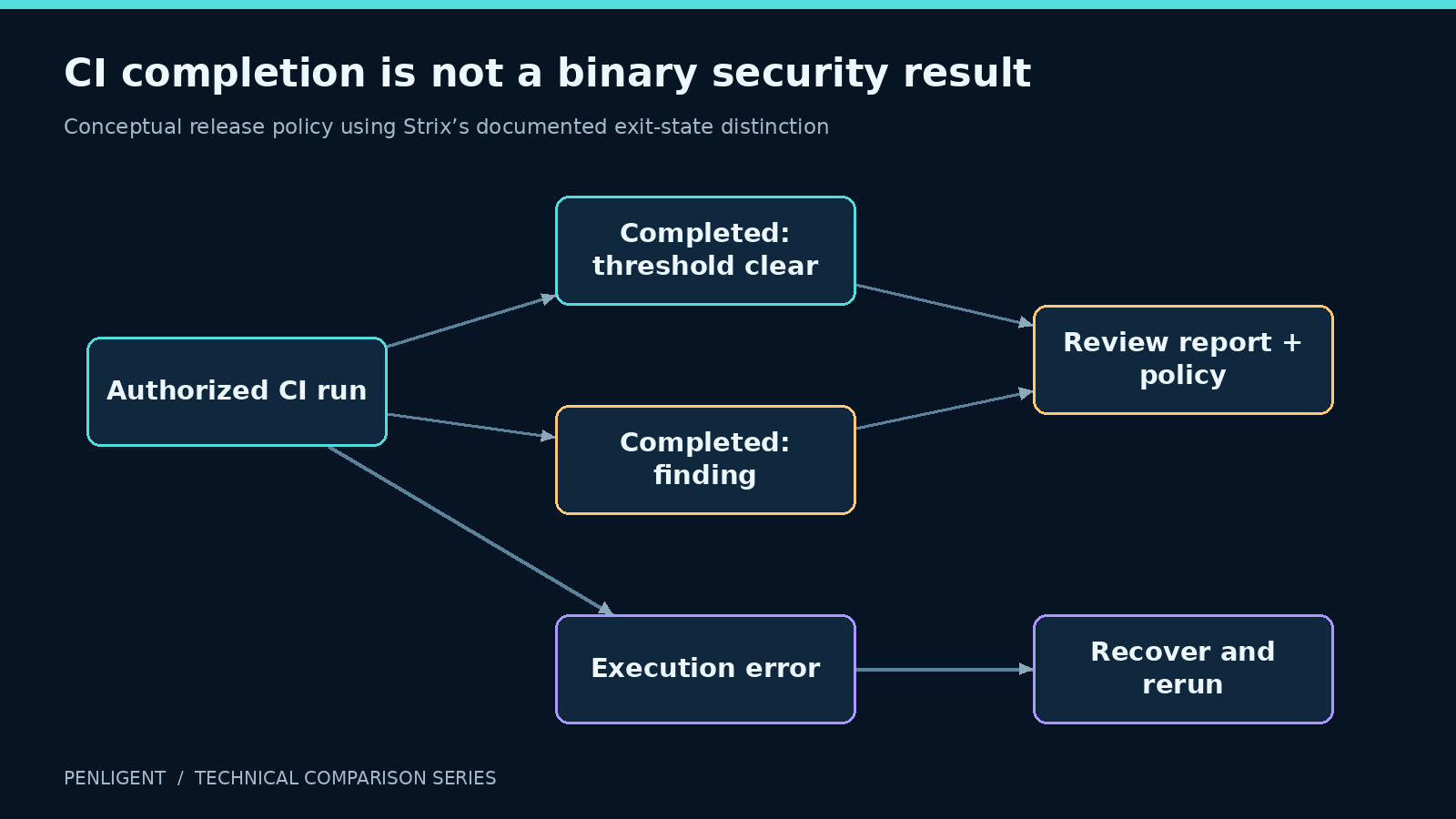
In a release workflow, there are at least three outcomes: assessment completed without a blocking finding, assessment completed with a blocking finding, and assessment did not complete. Preserve the third state. If a wrapper translates every nonzero exit code into “vulnerability found,” engineering teams may investigate infrastructure failures as security defects. If it translates every error into success, failed assessments may disappear from release history.
Diff-scoped testing also needs a clear promise. It is useful for quickly examining changed code, but authorization and data-flow effects can cross unchanged files and services. A small pull-request check and a broader scheduled assessment can complement each other. Do not describe the quick check as complete coverage of the deployed application. Record which mode produced each result and retain the relevant scope alongside it.
# Illustrative CI wrapper; not executed against either product.
# Prerequisites: Strix installed, Docker available, provider configured.
# ./app must contain only the repository you are authorized to assess.
set +e
strix -n --target ./app --scan-mode quick --fail-on high
scan_status=$?
set -e
case "$scan_status" in
  0) printf "%s\n" "Completed: no finding at the blocking threshold" ;;
  2) printf "%s\n" "Completed: review findings at the blocking threshold" ;;
  *) printf "%s\n" "Incomplete: investigate execution failure" >&2 ;;
esac
exit "$scan_status"
The wrapper preserves the documented distinction rather than inventing a Penligent CLI or assuming identical exit codes. For Penligent’s proposed integration, request the supported completion and error contract, then build the equivalent release policy around that contract. Archive reports through the supported workflow even when the job blocks the release.
Local model support has an execution contract
Strix’s local-model guide documents self-hosted endpoints and warns that tool calls must arrive as structured calls rather than ordinary assistant text. This is a compatibility condition, not a cosmetic formatting issue. A model that prints something resembling a command has not caused the runner to execute it.
For any private inference proposal, start with a harmless tool task and inspect the complete round trip: request, structured action, execution result, and next decision. A successful chat response verifies only text generation. It does not demonstrate that the endpoint can support the agent’s tool schemas, context size, or recovery behavior. Keep the actual gateway and model configuration in the test record.
Next, increase the task context to resemble an assessment rather than a one-line smoke test. Include several observations and a small number of unrelated results. Check whether the system still calls the intended tool and uses the returned evidence. This is a proposed compatibility test, not a measured claim about either product. It helps separate an inference-routing problem from a problem in the testing methodology.
Compare private deployments under the privacy constraints you actually need. If those constraints rule out external model processing, an impressive result from a cloud model is not an eligible substitute. Equally, do not assume a local model will provide equivalent reasoning at the same latency. Measure accepted findings, failed tool interactions, and elapsed time for the configuration that would be deployed.
Budget the complete release cycle
The initial scan is only one part of operating cost. Include report review, remediation discussion, reruns after environment failures, and retesting after a patch. Record model and infrastructure consumption separately from engineer time so the tradeoff remains visible. A fast run that produces ambiguous findings may move work from the tool into the review queue rather than remove it.
Use a stable finding identifier through the first report, patch discussion, and retest. If every rerun produces a new title for the same issue, deduplication becomes an operational task. Demonstrate how the proposed workflow associates the new evidence with the original finding. Do not assume that a persistent project view necessarily provides reliable finding lineage.
Ask the team to price a realistic month of changes: routine pull requests, a scheduled broader assessment, an interrupted run, and a retest. Treat that as a scenario rather than a forecast of guaranteed spend. The resulting estimate is more informative than comparing an open-source license price with a subscription while excluding the labor and services required on either side.
Separate a proposed fix from a verified remediation
A remediation recommendation should identify the control that failed. For a role-boundary issue, “validate input” is not enough if the missing decision is whether the current identity may access the requested object. Require the reviewer to connect the recommendation to the observed failure and to explain which test would fail after the change. This is a quality check on the assessment deliverable, not a demand that the tool generate application code.
If a workflow proposes a patch, review its assumptions against the deployed architecture. Moving an authorization check into one handler may leave another route exposed. A patch that blocks the demonstration account may also break legitimate access without restoring the intended policy. Use both the original failing case and a permitted control case when deciding whether to accept the remediation.
The patch review should also consider where enforcement belongs. An application check, gateway rule, or configuration change may each affect the demonstrated path differently. Record whether the proposed change fixes the root condition, narrows exposure temporarily, or merely prevents the exact demonstration. Those are different outcomes and should not share a single “resolved” label.
In the comparison, ask each candidate to carry one finding through that reasoning. The useful result is a reviewer who can explain why the change addresses the observed risk and what remains outside the retest. Do not award a remediation advantage solely because a tool produces more code or a more confident recommendation.
How to make the choice
Shortlist Strix when implementation access and the ability to adapt the agent are central requirements. Evaluate its hosted offering separately if the goal is to reduce operations work. Shortlist Penligent when its documented assessment and team workflow match your requirements, then verify the controls in the appropriate plan. Neither choice should depend on a competitor’s unchecked feature matrix.
Run the same authorized target, role set, time budget, and evidence review for both. Count confirmed findings and missed seeded cases, but also record operator time, incomplete runs, and the effort needed to hand a finding to an engineer. The stronger option for your team is the one that produces defensible results within the operating model you can sustain.

 Korean
  English
  German
  French
  Spanish
  Portuguese
  Japanese
  Hindi
Hindi  Arabic
  Turkish
  Hebrew