
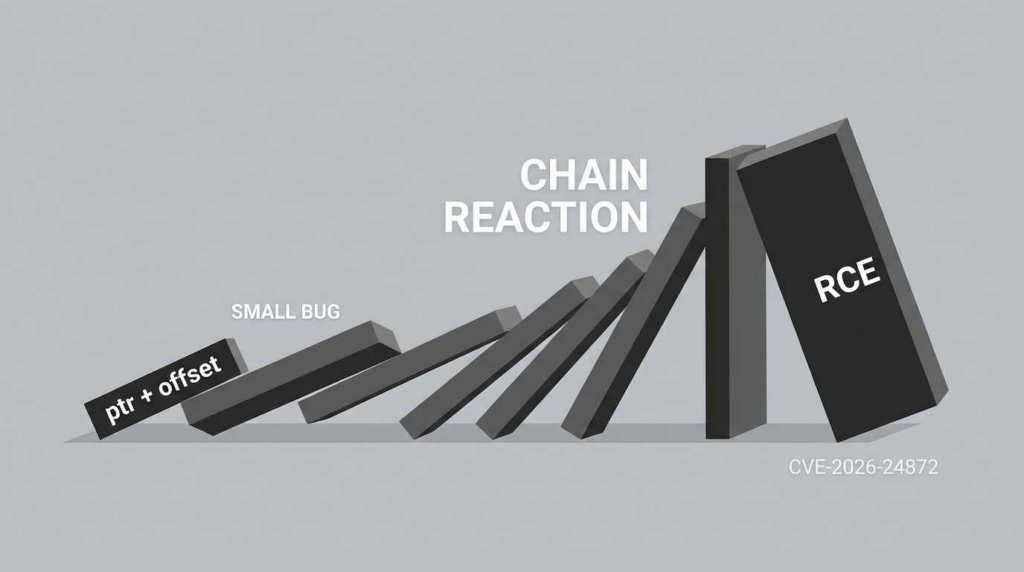
공개 CVE-2026-24872 on January 28, 2026, sent ripples through the decentralized world-building community. Affecting ProjectSkyfire’s SkyFire_548 component, this vulnerability represents a “Critical” (CVSS 9.8) failure in low-level memory handling. At its core, it is a Pointer Arithmetic Error (CWE-468) that enables unauthenticated remote attackers to achieve full system compromise without any user interaction.
Architectural Context: The SkyFire_548 Processing Pipeline
ProjectSkyfire is an open-source engine designed for high-concurrency virtual environments. To maintain real-time performance, SkyFire_548 utilizes custom memory allocators and high-speed packet parsing logic written in C++.
The engine processes binary streams using a “sliding window” parser. When a packet arrives, the engine calculates the location of the next data segment by adding an offset (extracted from the packet header) to the current base pointer.
The Root Cause: Unchecked Offset Addition
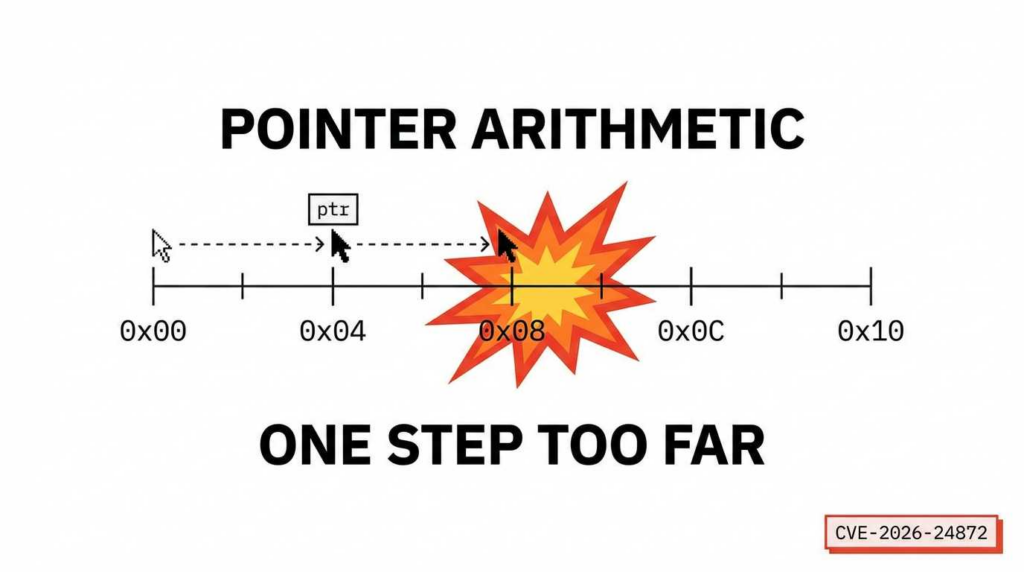
취약점은 WorldSession::HandleBufferUpdate function. In versions prior to 5.4.8-stable5, the engine trusts the segment_length 그리고 next_offset fields provided in the incoming UDP/TCP stream.
Detailed Code Analysis
Let’s look at the assembly-level logic often found in the vulnerable module:
C++
`// Decompiled representation of the vulnerable routine in SkyFire_548 void WorldSession::HandleBufferUpdate(Packet& packet) { uint8_t* base_ptr = this->internal_buffer; uint32_t header_offset = packet.ReadUInt32(); // Attacker-controlled uint32_t payload_size = packet.ReadUInt32(); // Attacker-controlled
/* * CRITICAL FAILURE:
 * The engine fails to verify if (header_offset + payload_size)
 * exceeds the bounds of internal_buffer_size.
 */

uint8_t* write_target = base_ptr + header_offset;

// This results in an Out-of-Bounds (OOB) Write
memcpy(write_target, packet.GetPayload(), payload_size);
}`
By providing a header_offset that pushes the write_target beyond the internal_buffer, an attacker can selectively overwrite adjacent memory structures. In a 64-bit environment, this is often used to target:
- Function Pointers: Overwriting pointers in the Global Offset Table (GOT).
- Stack Canaries/Return Addresses: Hijacking the control flow during the function epilogue.
- Heap Metadata: Corrupting chunk headers to trigger an exploit during subsequent
malloc또는freecalls.
Comparative Vulnerability Landscape (2025-2026)
To understand the severity, we must compare CVE-2026-24872 to other “Titan” vulnerabilities that share similar memory corruption primitives:
| CVE ID | Impacted System | 근본 원인 | CVSS |
|---|---|---|---|
| CVE-2026-24872 | ProjectSkyfire | Pointer Arithmetic / OOB Write | 9.8 |
| CVE-2026-21962 | Linux Kernel | Integer Overflow in create_elf_tables | 10.0 |
| CVE-2025-49201 | OpenSSL | Side-channel in RSA key parsing | 7.5 |
| CVE-2026-24830 | Commander-Genius | Buffer Overflow in SDL2 processing | 8.8 |
The “Zero-Click” nature of CVE-2026-24872 puts it in a rare category of vulnerabilities, similar to the “Stagefright” or “Heartbleed” eras, where simply being reachable on the network is sufficient for compromise.

Exploitation Strategy: From Memory Corruption to RCE
For a security engineer, the path to an exploit (PoC) involves bypasses for modern mitigations like ASLR (Address Space Layout Randomization) 그리고 DEP/NX (Data Execution Prevention).
- Information Leak: The attacker first uses a secondary vulnerability (or a variation of the same pointer error) to read memory, leaking the base address of the engine’s executable.
- Pointer Pivot: Using the OOB write in CVE-2026-24872, the attacker overwrites a specific object’s VTable.
- ROP Chain Execution: The next time the engine calls a virtual method on that object, the instruction pointer (
RIP) is redirected to a 반환 지향 프로그래밍(ROP) chain crafted by the attacker, leading to the execution of a reverse shell or malware stager.
Advanced Mitigation: The Shift to AI-Native Pentesting
The discovery of CVE-2026-24872 highlights a significant gap in traditional security tooling. Static Analysis (SAST) often misses these arithmetic errors due to complex data-flow paths, and Fuzzing (DAST) can take weeks of compute time to find the exact “magic” packet structure.
Enter Penligent.ai: The Agentic Advantage
This is where the industry is pivoting. Penligent.ai represents the next generation of “Agentic Hacker” platforms. Unlike standard scanners, Penligent utilizes an AI-native reasoning engine to understand the 의미론 of the ProjectSkyfire protocol.
- Logic-Aware Fuzzing: Instead of brute-forcing, Penligent’s AI agents analyze the engine’s source code or binary and reason that the
header_offsetis a potential point of failure. - Autonomous Chain Construction: Once a memory corruption primitive is found, the platform doesn’t just report a “crash.” It autonomously attempts to chain the vulnerability with other environmental factors to prove RCE, providing engineers with a full, validated exploit path.
- Privacy-First Deployment: For teams handling sensitive infrastructure, Penligent can be deployed in a “Private Agent” mode—similar to the M4 Mac Mini setups discussed by the community—ensuring that the vulnerability data and exploit logic never leave the internal network.
통합 Penligent.ai into the CI/CD pipeline ensures that deep-seated logic flaws like CVE-2026-24872 are caught during the build phase, rather than discovered by threat actors in production.
Remediation and Hardening Guidelines
If you are running any ProjectSkyfire-based instances, follow this priority list:
- Immediate Upgrade: Move to SkyFire_548 Version 5.4.8-stable5 or higher. This patch introduces strict
bounds_checkmacros on all pointer arithmetic operations. - Kernel Hardening: 보장
kptr_restrict그리고perf_event_paranoidare set to their most restrictive levels to prevent easy information leaks. - 네트워크 세분화: Isolate virtual world management ports behind a VPN or Zero-Trust Gateway to minimize the exposure of the “Zero-Click” attack surface.
- Continuous Testing: Use agentic AI platforms to perform regular, deep-logic audits of custom engine modules.
참조
- NVD CVE-2026-24872 Detail – The official government record.
- MITRE CVE-2026-24872 – The industry-standard vulnerability identifier.
- ProjectSkyfire GitHub Advisory – Direct patch notes and security analysis from the maintainers.
- CWE-468: Pointer Arithmetic Issues – Deep dive into the underlying software weakness.
- Penligent.ai Blog: The Future of Agentic Pentesting – How AI is automating the discovery of memory safety flaws.


 Korean
  English
  German
  French
  Spanish
  Portuguese
  Japanese
  Hindi
Hindi  Arabic
  Turkish
  Hebrew