
CVE-2026-42530 is not a generic “NGINX is vulnerable” story. It is a specific memory-safety bug in the NGINX Open Source HTTP/3 implementation, inside ngx_http_v3_module, where a specially crafted HTTP/3 session can reopen a QPACK encoder stream and trigger a use-after-free in an NGINX worker process. The immediate impact is worker restart and denial of service. F5 and NVD also describe possible code execution when Address Space Layout Randomization, or ASLR, is disabled or can be bypassed. NVD lists the issue as CWE-416, Use After Free, with CVSS v3.1 8.1 High from the CNA and CVSS v4.0 9.2 Critical from the CNA. (NVD)
The highest-risk deployment pattern is narrow but important: NGINX Open Source 1.31.0 or 1.31.1, built with HTTP/3 support, actively accepting attacker-controlled QUIC traffic, usually over UDP 443. NGINX’s own security advisory marks 1.31.0-1.31.1 as vulnerable and 1.31.2+ as not vulnerable for this HTTP/3 use-after-free. (Nginx)
That distinction matters. A server running NGINX is not automatically exposed. A server running NGINX 1.31.1 is not automatically exploitable. A server advertising HTTP/3 through a CDN may not have a vulnerable origin process reachable over QUIC. The correct question is more precise: can an untrusted party send HTTP/3 traffic to an affected NGINX worker that contains the vulnerable QPACK state machine?
CVE-2026-42530 at a glance
| Campo | Practical meaning |
|---|---|
| CVE | CVE-2026-42530 |
| Product named in the CVE record | NGINX Open Source |
| Affected module | ngx_http_v3_module |
| Classe de vulnerabilidade | Use-after-free |
| CWE | CWE-416 |
| Trigger described by NVD and F5 | A specially crafted HTTP/3 session reopens a QPACK encoder stream |
| Attacker position | Remote |
| Authentication required | Não |
| User interaction required | Não |
| Impacto primário | NGINX worker process restart, service degradation or denial of service |
| Conditional worst case | Code execution if ASLR is disabled or bypassed |
| NGINX Open Source affected versions | 1.31.0 and 1.31.1 |
| NGINX Open Source fixed version | 1.31.2 and later |
| Immediate workaround when patching is delayed | Disable HTTP/3 by removing quic from all relevant listen directives |
| Scoring caveat | CVSS v3.1 and CVSS v4.0 use different scoring systems, so “8.1 High” and “9.2 Critical” can both appear in reliable references |
NGINX released 1.31.2 mainline on June 17, 2026, and the release note explicitly says 1.31.2 includes a fix for a use-after-free vulnerability in ngx_http_v3_module, tracked as CVE-2026-42530. (Nginx)
Why HTTP/3 changes the NGINX attack surface
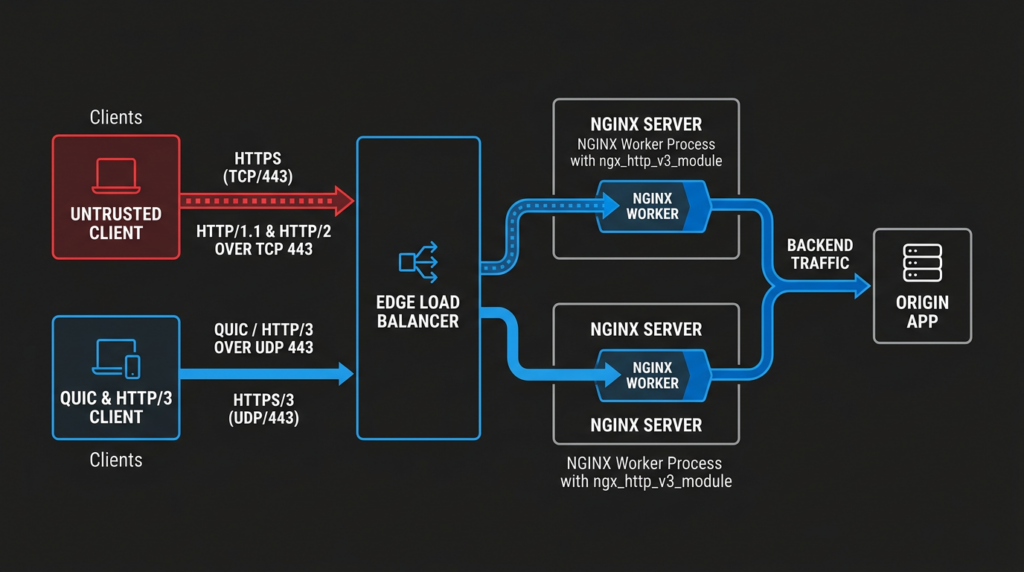
HTTP/1.1 and HTTP/2 usually reach NGINX over TCP. HTTP/3 reaches NGINX over QUIC, and QUIC uses UDP. That is not a cosmetic protocol swap. It changes firewall rules, load-balancer behavior, observability, traffic capture, middlebox inspection, and the code path that parses connection-level protocol state.
NGINX’s QUIC and HTTP/3 documentation says support is available since NGINX 1.25.0 and is included in Linux binary packages. The same documentation says the listen directive has a quic parameter that enables HTTP/3 over QUIC on the specified port. (Nginx)
A typical HTTP/3-capable NGINX virtual server may look like this:
server {
    listen 443 ssl;
    listen 443 quic reuseport;

    ssl_certificate     /etc/nginx/tls/example.crt;
    ssl_certificate_key /etc/nginx/tls/example.key;

    add_header Alt-Svc 'h3=":443"; ma=86400';

    location / {
        proxy_pass http://app_backend;
    }
}
The first listen line accepts TLS over TCP. The second accepts QUIC over UDP. If only TCP 443 is inspected, tested, or blocked, the HTTP/3 path can remain untouched. That is why CVE-2026-42530 should be triaged as a protocol exposure issue, not merely as a package version issue.
NGINX’s ngx_http_v3_module documentation also shows the use of listen ... quic reuseport, Alt-Svc for advertising HTTP/3, and the $http3 embedded variable for logging negotiated HTTP/3 connections. It also notes that the HTTP/3 module is experimental. (Nginx)
The operational mistake is easy to make. A team sees nginx: 1.31.1 in an asset inventory and panics, or it sees TCP scans clean and assumes it is safe. Neither result is enough. You need runtime version, build support, effective NGINX configuration, UDP listener ownership, upstream load-balancer behavior, and reachability from untrusted networks.
QPACK is the key to understanding this bug
QPACK is the HTTP/3 field compression mechanism. It is not NGINX proxy caching. It is not gzip. It is not a static file cache. It is a protocol-level compression system that lets HTTP/3 endpoints compress repeated header fields while avoiding the head-of-line blocking problems that HTTP/2’s HPACK design would create over QUIC.
RFC 9204 defines QPACK as a compression format for HTTP/3 fields. It defines two unidirectional stream types: an encoder stream and a decoder stream. The encoder stream carries encoder instructions, and the decoder stream carries decoder instructions. Most importantly for CVE-2026-42530, each endpoint must initiate at most one encoder stream and at most one decoder stream; receiving a second instance of either stream type must be treated as an HTTP/3 connection error. (Rastreador de dados da IETF)
That single-stream rule is the center of the issue. Reopening a QPACK encoder stream is not like opening another ordinary request stream. It touches connection-level compression state. If the implementation frees stream-scoped memory but leaves connection-scoped state pointing at it, later logic can treat freed memory as valid.
The public patch makes the lifetime mistake unusually clear. The NGINX commit associated with the fix is titled “HTTP/3: allocate insert buffer from connection pool.” Its patch note says the insert buffer was previously allocated from the encoder stream pool, which could lead to a use-after-free if the stream was closed and another encoder stream was opened. The code change moves the allocation from c->pool para c->quic->parent->pool, shifting the buffer lifetime from the stream pool to the connection pool. (GitHub)
That is the cleanest defensive explanation of CVE-2026-42530:
- QPACK encoder state belongs to the HTTP/3 connection.
- The vulnerable buffer was allocated with a shorter stream lifetime.
- A crafted session could close or replace the relevant stream state.
- NGINX could later access memory that had already been freed.
- The worker process could crash, or memory corruption could become exploitable under weaker hardening conditions.
The fixed code aligns the buffer lifetime with the connection lifetime, which is exactly the kind of correction defenders expect for this class of bug.
Use-after-free in a worker process is not just a crash
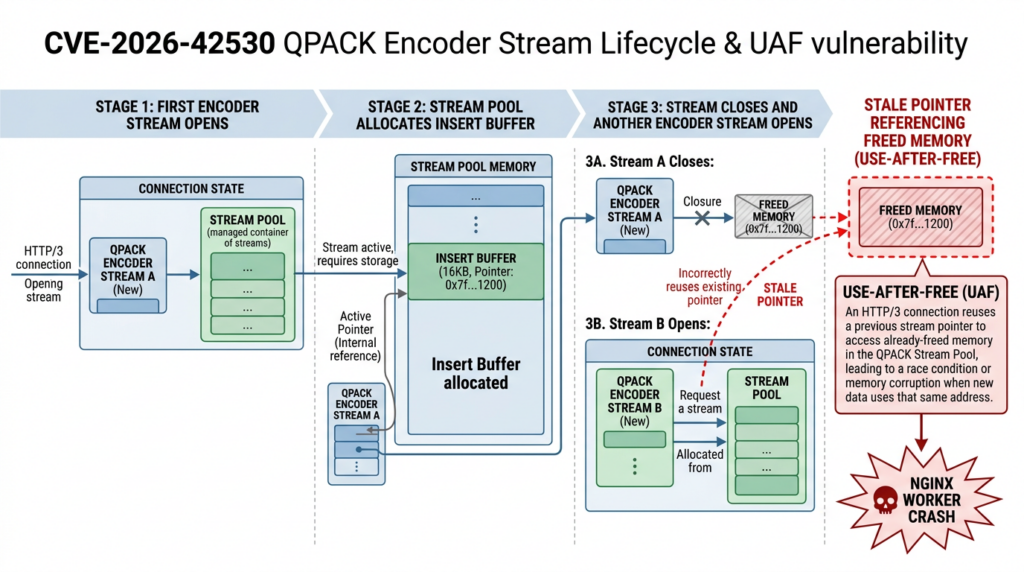
A use-after-free happens when software releases an object but later continues to access that object through a stale pointer. In C code, that stale pointer may still contain a plausible address. The memory region may remain mapped. It may be reused by another allocation. It may contain data that looks valid enough for the program to continue until a later read, write, callback, or pointer dereference fails.
In an NGINX worker, the affected object may sit inside a network-facing parsing path. The attacker does not need an account. The attacker does not need a logged-in user to click anything. The attack surface is the protocol parser itself.
NGINX’s master-worker model can hide how serious this is. A worker crash may be followed by a replacement worker, so the service appears to recover. That is good for availability, but it is not a security verdict. Repeated worker exits can reduce capacity, break active requests, increase latency, generate core dumps, and create a denial-of-service condition. If exploitation moves beyond a crash, the worker process may have access to TLS material, upstream credentials, request data, mounted configuration, service-mesh tokens, internal networks, and logs.
ASLR changes exploit reliability, not vulnerability existence. NVD states that code execution is possible when ASLR is disabled or when the attacker can bypass ASLR. It does not say that ASLR fixes the use-after-free. (NVD)
A hardened process can still crash. A process with ASLR can still be affected. A container can still expose secrets. A non-root worker can still reach sensitive upstreams. Treat ASLR as one layer of exploit mitigation, not as a remediation plan.
Who is affected
For NGINX Open Source, the clean upstream answer is simple: 1.31.0 and 1.31.1 are listed as vulnerable; 1.31.2 and later are listed as not vulnerable. (Nginx)
The deployment answer is more complicated. The Cyber Security Agency of Singapore summarized the broader affected product set for CVE-2026-42530 as including NGINX Open Source 1.31.0 through 1.31.1, NGINX Instance Manager 2.17.0 through 2.22.0, NGINX Gateway Fabric 2.0.0 through 2.6.3, NGINX Gateway Fabric 1.3.0 through 1.6.2, and several NGINX Ingress Controller branches, including 5.0.0 through 5.5.0, 4.0.0 through 4.0.1, and 3.5.0 through 3.7.2. (Cyber Security Agency of Singapore)
That product list should not be read as “every NGINX-adjacent deployment is exposed in the same way.” It means teams using F5-supported NGINX components, Kubernetes data planes, gateway products, or packaged distributions should follow the relevant vendor advisory instead of copying only the Open Source version table.
Linux distributions add another layer. A distribution may backport a fix into a package with an older upstream version string. Debian’s tracker for CVE-2026-42530 shows multiple Debian nginx packages as fixed, and it separately notes that unstable was not affected because the vulnerable code was not present. (security-tracker.debian.org)
That creates a common false positive. A scanner reports nginx/1.22.1, someone maps that to a generic upstream version, and the team assumes the host is vulnerable. The right process is to check the package revision, distribution security tracker, build flags, runtime configuration, and reachability. Version banners are useful hints, not proof.
Exposure depends on reachability, not just installed code
CVE-2026-42530 requires more than an installed package. It requires a reachable HTTP/3 path into the vulnerable module.
A practical exposure model looks like this:
| Condition | Por que é importante | Prioridade |
|---|---|---|
| NGINX Open Source 1.31.0 or 1.31.1 | This is the upstream vulnerable range | Required for the clean Open Source case |
ngx_http_v3_module available | The bug is in the HTTP/3 module | Necessário |
listen ... quic in the effective config | This usually exposes HTTP/3 over QUIC | Alta |
| UDP 443 or another QUIC port reachable | HTTP/3 traffic must reach the NGINX worker | Alta |
Alt-Svc advertises HTTP/3 | Clients may be encouraged to use QUIC | Useful signal, not proof |
| CDN terminates QUIC before origin | Origin NGINX may not receive HTTP/3 | Can lower origin exposure |
| Direct origin IP accepts UDP QUIC | Attackers may bypass CDN controls | Raises priority |
| Kubernetes Service exposes UDP | Cluster ingress may expose QUIC even if TCP-only checks pass | Raises priority |
| Internal tenant network can reach QUIC | Multi-tenant or compromised internal hosts may attack | Still important |
| No active QUIC listener | Vulnerable code may exist but not be remotely reachable | Lower immediate risk, still patch |
The highest priority is an internet-facing edge server or ingress data plane that is both vulnerable and directly reachable over QUIC. The next priority is an internal or partner-facing QUIC path where untrusted or semi-trusted clients can reach the listener. The lowest immediate priority is a vulnerable binary with no active HTTP/3 listener, but even that should be patched because future configuration changes can reactivate the vulnerable path.
How to check exposure safely
Start with the running binary, not the Dockerfile, SBOM, package manifest, or intended deployment state.
nginx -v
nginx -V
nginx -v reports the version. nginx -V gives build details and configure arguments. You are looking for the actual process on the host or inside the container that is serving traffic.
Next, inspect the effective configuration:
sudo nginx -T 2>/tmp/nginx-config-errors.txt | grep -nE '\blisten\b.*\bquic\b|http3|Alt-Svc'
A listen directive with quic is a high-value signal. Alt-Svc is also useful, but it is not conclusive. A CDN, load balancer, or separate edge tier may advertise HTTP/3 while the origin only receives HTTP/1.1 or HTTP/2. The opposite can also happen: a direct origin address may accept QUIC even when the public hostname normally goes through another layer.
Check UDP listeners:
sudo ss -lunp | grep -E ':(443|8443|9443)\b'
For a broader view:
sudo ss -lunp
sudo lsof -nP -iUDP
Map every UDP listener to a process, container, service, firewall rule, security group, and external load balancer. Do not assume the QUIC port is always 443. Some environments test HTTP/3 on alternate ports such as 8443.
Check whether clients can negotiate HTTP/3 from an authorized network location:
curl --http3-only -I https://example.com/
That command is not an exploit. It simply tests whether the endpoint can complete an HTTP/3 request. Use it only against systems you own or are authorized to test. If the request succeeds, you still need to confirm which layer terminated QUIC.
In Kubernetes, focus on the actual data plane:
kubectl get deploy,daemonset,statefulset -A -o wide | grep -i nginx
kubectl get pods -A -o wide | grep -i nginx
kubectl get svc -A -o wide | grep -i nginx
kubectl get svc -A -o yaml | grep -nE 'protocol: UDP|port: 443|quic|http3'
Also check Helm values, image digests, admission policies, node ports, LoadBalancer annotations, and any cloud load balancer that maps UDP 443 to ingress pods.
The record you want at the end of triage is concrete:
| Evidence item | Good evidence | Weak evidence |
|---|---|---|
| Runtime version | nginx -v from the running process | Dockerfile base image |
| Build support | nginx -V showing relevant module/build context | Package name alone |
| Effective config | nginx -T showing listen ... quic or no quic | A copied config snippet |
| UDP listener | ss -lunp mapped to NGINX process | TCP scan only |
| External reachability | Authorized HTTP/3 test from the relevant network | Browser behavior alone |
| Kubernetes exposure | Service YAML and image digest | Namespace naming convention |
| Remediation proof | Patched binary plus restarted workers | Package install log only |
| Vendor status | Official advisory or distribution tracker | Unverified scanner text |
A platform such as Penligent can be useful in this kind of work when it keeps the distinction between “version matched,” “configuration found,” and “attack path verified.” Penligent describes itself as an agentic AI pentesting tool for security engineers, pentesters, and red teams, with workflows for finding vulnerabilities, verifying findings, and producing one-click reports. (Penligente) For CVE-2026-42530, the practical value is not firing an exploit at production; it is correlating asset data, NGINX runtime evidence, QUIC reachability, configuration state, remediation proof, and reportable artifacts in a controlled, authorized workflow. Penligent also has a focused technical page on CVE-2026-42530 that summarizes the HTTP/3 QPACK use-after-free and its exposure conditions. (Penligente)
How to patch without fooling yourself
The authoritative fix for NGINX Open Source is NGINX 1.31.2 or later. NGINX’s release note says 1.31.2 includes the fix for CVE-2026-42530, and the security advisory marks 1.31.2+ as not vulnerable. (Nginx)
A safe rollout should prove three things:
- The patched artifact is the one you intended to deploy.
- The running worker processes are actually using it.
- Normal HTTP/3, HTTP/2, and HTTP/1.1 behavior still works after the change.
A practical rollout sequence:
# Record current state
nginx -v
nginx -V
sudo nginx -T > /secure-evidence/nginx-effective-config-before.txt
sudo ss -lunp > /secure-evidence/udp-listeners-before.txt

# Test intended config before reload
sudo nginx -t

# Reload or restart through your normal process
sudo systemctl reload nginx

# Confirm running state after rollout
nginx -v
sudo ss -lunp | grep ':443'
For containerized workloads, avoid mutable tags as evidence. Record the image digest:
kubectl get pods -A -o jsonpath='{range .items[*]}{.metadata.namespace}{" "}{.metadata.name}{" "}{.status.containerStatuses[*].imageID}{"\n"}{end}' | grep -i nginx
Then confirm the rollout:
kubectl rollout status deployment/<nginx-deployment> -n <namespace>
kubectl get pods -n <namespace> -o wide
For a large edge fleet, do not assume “package installed” equals “risk removed.” Old workers can survive during graceful reload. Autoscaling groups can recreate old images. A regional edge pool can lag behind. A standby environment can keep an old template. A Kubernetes node can run a stale DaemonSet pod. A container registry tag can be repointed.
The remediation record should contain:
| Remediation proof | Por que é importante |
|---|---|
| New runtime version or vendor-fixed package revision | Shows the code should contain the fix |
| Image digest or package build ID | Prevents mutable tag confusion |
| Effective config after rollout | Confirms QUIC is intended or disabled |
| Worker restart timestamp | Shows old workers were replaced |
| HTTP/3 functional test | Confirms legitimate traffic still works, if HTTP/3 remains enabled |
| TCP fallback test | Confirms HTTP/2 and HTTP/1.1 still work |
| Monitoring window | Catches crash loops, UDP failures, and client compatibility issues |
| Rollback plan | Prevents an emergency patch from becoming an outage |
Temporary mitigation when patching is delayed
If you cannot patch immediately, remove the vulnerable HTTP/3 path from untrusted reachability. CSA Singapore’s advisory lists the interim mitigation for CVE-2026-42530 as disabling HTTP/3 by removing quic from all listen directives. (Cyber Security Agency of Singapore)
A before-and-after example:
# Before
server {
    listen 443 ssl;
    listen 443 quic reuseport;

    add_header Alt-Svc 'h3=":443"; ma=86400';
}
# Temporary mitigation
server {
    listen 443 ssl;

    # Remove HTTP/3 advertisement while QUIC is disabled.
    # add_header Alt-Svc 'h3=":443"; ma=86400';
}
Then validate and reload:
sudo nginx -t
sudo systemctl reload nginx
sudo ss -lunp | grep ':443'
If UDP 443 is still listening, find out why. It may be another NGINX instance, a sidecar, a different gateway, a host-networked pod, a cloud load balancer, or a stale worker.
Also remove or update Alt-Svc. Leaving Alt-Svc: h3=":443" in place while disabling QUIC can cause client retries, confusing telemetry, and avoidable latency. It is not the vulnerability by itself, but it is part of the operational state.
At the network layer, block or remove UDP exposure if needed:
| Camada | Temporary action | Risk if skipped |
|---|---|---|
| Host firewall | Block UDP 443 or the custom QUIC port | Direct host access may remain |
| Cloud security group | Remove inbound UDP rule | Internet QUIC path may remain |
| Load balancer | Disable UDP listener | Edge still forwards QUIC |
| Kubernetes Service | Remove UDP port mapping | Pods still reachable through Service |
| CDN or reverse proxy | Disable origin QUIC forwarding | CDN may still pass QUIC to origin |
| DNS and direct IPs | Check origin bypass paths | Attackers may skip the intended edge |
Temporary mitigation should be time-boxed. Disabling HTTP/3 may be acceptable for emergency risk reduction, but it can affect latency-sensitive clients and any product decisions that depended on QUIC. The patch is the durable fix.
Detection and investigation
CVE-2026-42530 does not come with a single guaranteed log line. You are looking for crash patterns and HTTP/3 activity that deserve investigation, not a magic signature.
Useful signals include:
| Sinal | Where to look | Por que é importante |
|---|---|---|
| Worker exits or signal crashes | NGINX error log, systemd journal, container logs | The known direct impact is worker restart |
| Segmentation faults | journalctl, kernel logs, container runtime logs | Common symptom of memory corruption |
| Core dumps | coredumpctl, configured core dump directory | May preserve crash context, but can contain secrets |
| Pod restarts | Kubernetes restartCount, events, container status | Repeated crashes may be visible at orchestration level |
| HTTP/3 negotiated requests | NGINX access logs with $http3 | Confirms real HTTP/3 traffic reached NGINX |
| QUIC debug messages | Debug builds or special logging | Helps confirm protocol-level behavior |
| UDP traffic spikes | Flow logs, packet metadata, LB telemetry | Attack attempts may appear as unusual QUIC activity |
| Direct origin access | Firewall, cloud flow logs, CDN bypass logs | Attackers may target origin IPs |
NGINX’s HTTP/3 module supports $http3, which reports negotiated protocol identifiers for HTTP/3 or hq connections. Its QUIC troubleshooting documentation recommends ensuring clients are actually sending QUIC requests and checking debug logs for quic messages when deeper investigation is needed. (Nginx)
A useful access log format for future visibility:
log_format quic_ext '$remote_addr [$time_local] '
                    '"$request" $status $body_bytes_sent '
                    'host="$host" http3="$http3" '
                    'ua="$http_user_agent" request_time="$request_time"';

access_log /var/log/nginx/access-quic.log quic_ext;
For systemd-based hosts:
journalctl -u nginx --since "2026-06-17" | grep -Ei 'segfault|signal|worker process|exited|core'
coredumpctl list nginx
For Kubernetes:
kubectl get pods -A | grep -i nginx
kubectl describe pod <pod> -n <namespace> | grep -Ei 'restart|OOM|error|signal|terminated'
kubectl logs <pod> -n <namespace> --previous
Do not overstate findings. A worker crash during the exposure window is not proof of exploitation. A lack of crashes is not proof of safety. If code execution is suspected, move from vulnerability management into incident response: isolate the node, preserve volatile evidence where policy permits, collect core dumps securely, inspect unexpected processes, review credential access, rotate exposed secrets, and hunt for similar patterns across the edge fleet.
Core dumps deserve special handling. They can contain TLS material, request data, headers, cookies, upstream credentials, internal URLs, and secrets. Disable or restrict core dumps in production unless your incident response process can store and analyze them safely.
Why WAF rules may not be enough
Many web application firewalls operate after TLS termination and after the HTTP parser has produced a request. CVE-2026-42530 sits in HTTP/3 and QPACK connection processing. A generic HTTP rule that matches paths, parameters, or headers may never see the malformed state that triggers the bug.
A WAF can help only if it is actually in the relevant path and safely terminates or filters QUIC before the vulnerable NGINX worker sees it. If the WAF handles TCP traffic but UDP QUIC bypasses it, it does not mitigate this CVE. If a CDN terminates HTTP/3 and forwards only HTTP/2 or HTTP/1.1 to origin, that may reduce origin exposure, but you must verify direct origin access and alternate UDP listeners.
The same logic applies to load balancers. “The site is behind a load balancer” is not enough. Ask:
- Does the load balancer terminate QUIC?
- Does it forward UDP to NGINX?
- Does the origin also accept direct UDP traffic?
- Are there internal paths that bypass the intended edge?
- Do health checks and access logs cover UDP listeners?
For protocol parser vulnerabilities, topology is part of the vulnerability assessment.
CVE-2026-42530 and CVE-2026-42055 should be triaged together
CVE-2026-42530 was disclosed in the same emergency NGINX security window as CVE-2026-42055. They are different bugs in different protocol paths, but defenders should triage them together because both sit on high-value edge infrastructure and both can be missed by simple package matching.
The Hacker News summarized CVE-2026-42055 as a heap-based buffer overflow in ngx_http_proxy_v2_module e ngx_http_grpc_module, reachable under specific HTTP/2 or gRPC proxying conditions, including proxy_http_version 2 ou grpc_pass, ignore_invalid_headers offe large_client_header_buffers larger than 2 MB. The same report listed the mitigation for CVE-2026-42530 as disabling HTTP/3 and the mitigation for CVE-2026-42055 as removing ignore_invalid_headers off or reducing large_client_header_buffers below 2 MB. (Notícias do Hacker)
CSA Singapore also grouped the two issues and advised immediate updates, with interim mitigations for each. (Cyber Security Agency of Singapore)
A combined edge review should look like this:
| CVE | Protocol path | Main condition | Immediate check | Temporary mitigation |
|---|---|---|---|---|
| CVE-2026-42530 | HTTP/3 over QUIC | Affected NGINX with reachable HTTP/3/QPACK path | listen ... quic, UDP listener, HTTP/3 negotiation | Disable HTTP/3 by removing quic |
| CVE-2026-42055 | HTTP/2 or gRPC proxying | Specific proxy/gRPC config with large headers and invalid header handling relaxed | proxy_http_version 2, grpc_pass, ignore_invalid_headers off, large_client_header_buffers | Remove ignore_invalid_headers off or reduce large header buffers below 2 MB |
The operational lesson is the same: modern NGINX exposure depends on protocol modules and configuration, not just the product name.
Related NGINX HTTP/3 CVEs that make this risk easier to understand
CVE-2026-42530 is not the first NGINX security issue in the HTTP/3 path. NGINX’s security advisory history lists several HTTP/3-related vulnerabilities, including HTTP/3 address spoofing in CVE-2026-40460, buffer overwrite in CVE-2024-32760, stack overflow and use-after-free in CVE-2024-31079, NULL pointer dereference in CVE-2024-35200, memory disclosure in CVE-2024-34161, NULL pointer dereference in CVE-2024-24989, and use-after-free in CVE-2024-24990. (Nginx)
These should not be treated as a single exploit family. They are useful because they show where defenders should look: HTTP/3 state machines, stream lifecycle handling, QUIC address behavior, buffer boundaries, and parser error handling.
| CVE | NGINX area | Why it matters to CVE-2026-42530 triage |
|---|---|---|
| CVE-2026-42530 | HTTP/3 QPACK encoder stream lifecycle | Current QPACK use-after-free under discussion |
| CVE-2026-40460 | HTTP/3 address spoofing | Shows HTTP/3 risk can involve state and address boundaries, not only crashes |
| CVE-2024-24990 | HTTP/3 use-after-free | Earlier HTTP/3 UAF, useful for historical pattern recognition |
| CVE-2024-31079 | HTTP/3 stack overflow and use-after-free | Reinforces the need to test exceptional stream lifecycle states |
| CVE-2024-32760 | HTTP/3 buffer overwrite | Highlights memory safety risk in HTTP/3 parsing paths |
| CVE-2024-35200 | HTTP/3 NULL pointer dereference | Shows crash-class bugs in HTTP/3 error paths |
| CVE-2024-34161 | HTTP/3 memory disclosure | Reminds defenders that HTTP/3 bugs may affect confidentiality as well as availability |
For defenders, the conclusion is not “HTTP/3 is unsafe.” HTTP/3 is a real protocol with real performance and operational benefits. The conclusion is that enabling HTTP/3 adds a separate network protocol path and a separate parser state machine. That path needs the same inventory, logging, fuzzing awareness, patch process, and rollback plan as TCP-based HTTP.
Cloud and Kubernetes pitfalls
Kubernetes makes this class of issue easier to miss because the thing you need to verify is split across many resources.
The NGINX process may run in a Deployment, DaemonSet, or vendor-managed controller. The UDP listener may be exposed through a Service. The public endpoint may be created by a cloud load balancer annotation. The image may be pinned by tag in Helm values but actually resolved to a digest at runtime. A CDN may sit in front of the public hostname while direct node or load-balancer addresses remain reachable.
A good Kubernetes review should answer:
| Kubernetes layer | What to check | Erro comum |
|---|---|---|
| Controller image | Exact image digest and NGINX build | Trusting latest, mainline, or a human-readable tag |
| Pod runtime | Running container image ID and restart history | Looking only at Helm chart values |
| ConfigMap or mounted config | listen ... quic, http3, Alt-Svc | Checking only the source repository |
| Service | UDP ports and target ports | Reviewing only TCP ports |
| LoadBalancer | Cloud annotations and listener protocols | Assuming HTTPS means TCP only |
| NetworkPolicy | UDP ingress from untrusted namespaces | Policies may cover TCP but not UDP as intended |
| Node exposure | HostNetwork, NodePort, direct node firewall | Public node path bypasses ingress assumptions |
| Rollout state | Old pods, failed rollout, stale ReplicaSets | Patch appears deployed but old pods still serve traffic |
A useful one-liner for UDP services:
kubectl get svc -A -o jsonpath='{range .items[*]}{.metadata.namespace}{" "}{.metadata.name}{" "}{range .spec.ports[*]}{.protocol}{":"}{.port}{"->"}{.targetPort}{" "}{end}{"\n"}{end}' | grep UDP
For image digests:
kubectl get pods -A -o jsonpath='{range .items[*]}{.metadata.namespace}{" "}{.metadata.name}{" "}{range .status.containerStatuses[*]}{.name}{":"}{.imageID}{" "}{end}{"\n"}{end}' | grep -i nginx
For controller configs:
kubectl get configmap -A -o yaml | grep -nE 'listen .*quic|http3|Alt-Svc|quic'
Do not run destructive tests against production ingress. For production verification, prove that the fixed runtime is deployed and that normal HTTP/3 works. Invalid stream regression tests belong in isolated, authorized environments.
A safe verification workflow
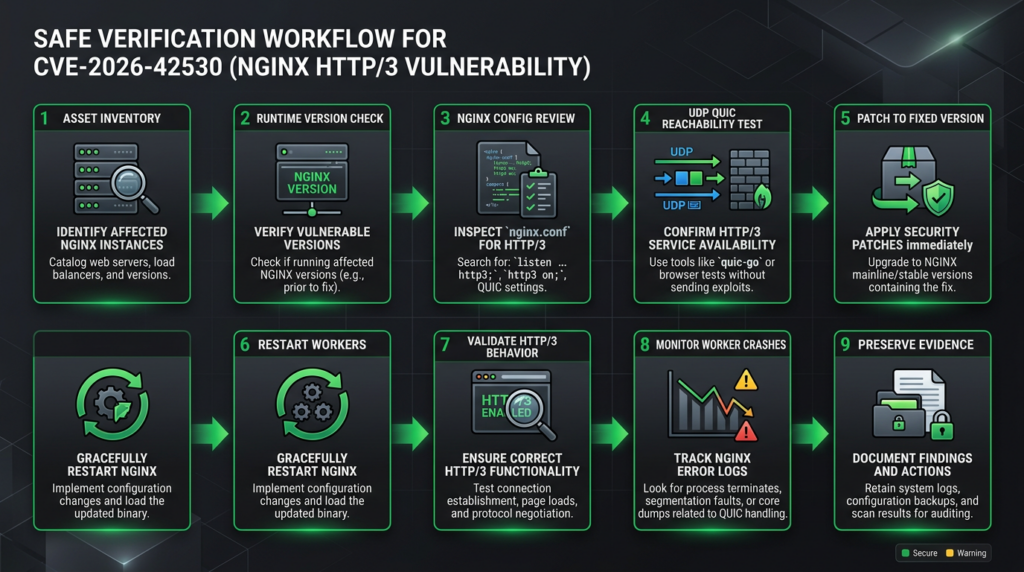
A good verification workflow separates four states:
- Vulnerable code present.
- Vulnerable code reachable.
- Fix deployed.
- Fix verified at runtime.
Many teams collapse these into one scanner result. That creates both panic and complacency.
A clean workflow:
Inventory → Runtime version → Build support → Effective config → UDP reachability
→ Vendor status → Patch or disable HTTP/3 → Restart workers → Verify runtime
→ Verify protocol behavior → Monitor → Record evidence
Each step should leave an artifact. For example:
| Etapa | Artifact |
|---|---|
| Runtime version | Command output from the host or container |
| Build support | nginx -V output |
| Effective configuration | Redacted nginx -T output |
| UDP reachability | Listener mapping and authorized HTTP/3 test |
| Patch source | Vendor advisory, package revision, image digest |
| Implantação | Change record, rollout status, worker restart time |
| Post-fix validation | HTTP/3 and TCP fallback test results |
| Monitoramento | No abnormal worker exits during the observation window |
| Residual risk | Any remaining internal or unsupported deployments |
That final “residual risk” row matters. Some product branches or unsupported environments may not map cleanly to the upstream Open Source version range. F5’s advisory language, reflected in NVD, notes that software versions beyond End of Technical Support were not evaluated. (NVD) Unsupported software should not be treated as safe simply because it is absent from an affected-version table.
Hardening beyond the patch
Patching CVE-2026-42530 removes the known bug. It does not remove the need to harden edge infrastructure.
Start with protocol inventory. Keep a record of which services terminate HTTP/1.1, HTTP/2, HTTP/3, gRPC, WebSocket, raw TCP, and UDP. Include whether the service is directly exposed, behind a CDN, internal-only, partner-facing, or tenant-facing.
Then reduce the blast radius of an NGINX worker compromise:
| Controle | Por que é importante |
|---|---|
| Run workers as a dedicated unprivileged user | Limits immediate privilege if worker code execution occurs |
| Keep Linux capabilities minimal | Prevents unnecessary privileged operations |
| Use read-only container filesystems where possible | Reduces post-exploitation write paths |
| Apply seccomp, AppArmor, or SELinux | Adds syscall and file access constraints |
| Keep TLS keys and upstream secrets out of worker reach where architecture permits | Reduces credential exposure |
| Restrict outbound egress from edge proxies | Makes callback and lateral movement harder |
| Centralize worker crash telemetry | Prevents auto-restart from hiding memory corruption |
| Treat core dumps as sensitive | They may contain secrets and request data |
| Pin image digests and package revisions | Prevents accidental downgrade or rollback |
| Rehearse HTTP/3 disablement | Lets teams remove QUIC exposure quickly during an emergency |
Also review QUIC-specific settings. NGINX documentation includes options such as quic_retry, quic_gso, quic_host_key, and troubleshooting guidance for QUIC clients and debug logs. (Nginx) These are not CVE-2026-42530 fixes by themselves, but they belong in the operational ownership model for HTTP/3.
A rollback plan is especially important. HTTP/3 often improves latency and user experience, but organizations should be able to disable QUIC without breaking core HTTPS service. That means TCP listeners, certificates, health checks, CDN settings, and client fallback paths must be tested before an emergency.
Common mistakes during CVE-2026-42530 response
| Mistake | Why it is wrong | Better approach |
|---|---|---|
| Treating every NGINX server as exposed | The vulnerable path requires HTTP/3/QUIC reachability | Check version, module, config, UDP listener, and network path |
| Checking only TCP 443 | HTTP/3 uses QUIC over UDP | Inspect UDP listeners and load-balancer UDP rules |
Trusting Alt-Svc alone | It may be added by a CDN or stale config | Confirm where QUIC terminates |
| Trusting package install logs | Old workers or pods may still run | Confirm runtime process and worker restart |
| Ignoring older distro versions | Backported fixes may keep older version strings | Use distro security trackers and package revisions |
| Assuming ASLR fixes it | ASLR affects exploit reliability, not the UAF | Patch or disable HTTP/3 temporarily |
| Depending on WAF signatures | The bug is in protocol stream state | Verify the WAF terminates and controls QUIC before NGINX |
| Running random PoCs on production | Can crash workers and create legal risk | Use safe runtime verification and isolated regression testing |
| Forgetting direct origin access | CDN-protected hostnames may not be the only path | Test origin IP exposure and firewall rules |
| Skipping post-patch monitoring | Emergency changes can break QUIC or leave old workers | Monitor crash, error, and negotiation telemetry |
Frequently asked questions
Does CVE-2026-42530 affect every NGINX server?
- No. The upstream NGINX Open Source affected range is 1.31.0 through 1.31.1, with 1.31.2 and later listed as not vulnerable. (Nginx)
- The vulnerable code path is HTTP/3-specific and involves
ngx_http_v3_module. - A server that only accepts HTTP/1.1 or HTTP/2 over TCP does not expose the published HTTP/3 QPACK trigger.
- F5-supported products, ingress controllers, and distribution packages may have separate advisories or backported fixes, so check the vendor record.
How do I know whether HTTP/3 is enabled in NGINX?
- Executar
nginx -Vto inspect build information. - Executar
nginx -Tand search forlisten ... quic,http3eAlt-Svc. - Uso
ss -lunpto identify UDP listeners. - Test from an authorized client with
curl --http3-only -I https://your-host/. - Confirm where QUIC terminates. A CDN may handle HTTP/3 while the origin receives only TCP.
Is CVE-2026-42530 remote code execution or denial of service?
- The most direct described impact is a use-after-free in the NGINX worker process leading to restart.
- NVD and F5 state that code execution may be possible when ASLR is disabled or bypassed. (NVD)
- Treat it as a serious memory-safety vulnerability, but do not claim reliable public RCE unless you have a trustworthy source proving that.
- In production, prioritize patching exposed HTTP/3 edge systems regardless of whether you classify the immediate operational impact as DoS or potential RCE.
Does ASLR protect my servers enough?
- No. ASLR can make code execution harder, but it does not remove the use-after-free.
- A worker crash is still possible with ASLR enabled.
- ASLR can be weakened by information leaks, predictable environments, non-PIE components, or other exploit primitives.
- The durable fix is patched NGINX code or, temporarily, removing the HTTP/3 attack path.
Can I mitigate by blocking UDP 443?
- Blocking the actual QUIC listener can remove the external HTTP/3 path while the block is complete.
- You must check custom QUIC ports, direct origin access, internal paths, cloud load balancers, Kubernetes Services, and CDN forwarding behavior.
- Remove or update
Alt-Svcif HTTP/3 is no longer available. - Treat network blocking as temporary unless it is part of an intentional decision to stop serving HTTP/3.
Will a WAF block CVE-2026-42530?
- A traditional HTTP WAF may not see the malformed QPACK stream state before NGINX processes it.
- A WAF helps only if it safely terminates or filters QUIC before traffic reaches the vulnerable worker.
- If QUIC bypasses the WAF and goes directly to NGINX, WAF rules do not mitigate the CVE.
- Verify topology before relying on any control.
Should I patch CVE-2026-42055 at the same time?
- Yes, if your environment may be affected. CVE-2026-42055 was patched in the same NGINX emergency window and affects different HTTP/2 and gRPC proxying paths. (Notícias do Hacker)
- CVE-2026-42530 is about HTTP/3 and QPACK. CVE-2026-42055 is about HTTP/2 or gRPC proxying with specific configuration conditions.
- Edge systems often support multiple protocols, so a single review should cover HTTP/3, HTTP/2, gRPC, proxy settings, and buffer configuration.
How can I verify the fix without running an exploit?
- Confirm the runtime version or vendor-fixed package revision.
- Confirm the image digest or package build ID.
- Confirm all old workers or pods were restarted.
- Confirm
nginx -Tshows the intended HTTP/3 state. - Confirm UDP listener behavior matches the intended state.
- Test normal HTTP/3 behavior if HTTP/3 remains enabled.
- Monitor worker exits, error logs, and restart counts after rollout.
Useful resources to keep open
NGINX’s security advisory page is the cleanest source for upstream vulnerable and fixed version ranges across NGINX CVEs. (Nginx)
NVD’s CVE-2026-42530 record is useful for the official description, CWE mapping, CVSS vectors, affected Open Source version metadata, and CISA ADP enrichment status. (NVD)
The NGINX QUIC and HTTP/3 documentation is useful for build, configuration, listen ... quic, TLS, troubleshooting, and debug logging details. (Nginx)
RFC 9204 is worth reading if you need to understand why QPACK encoder and decoder streams have strict lifecycle rules in HTTP/3. (Rastreador de dados da IETF)
Julgamento final
CVE-2026-42530 is serious because it sits at the edge, requires no authentication, and reaches memory-unsafe code through HTTP/3 protocol state. It is also easy to mis-triage because exposure depends on more than an NGINX version string.
The strongest response is evidence-driven. Identify NGINX 1.31.0 and 1.31.1. Prove whether HTTP/3 and QUIC are reachable. Patch to 1.31.2 or a vendor-fixed build. If patching is delayed, remove quic from exposed listeners and close the UDP path. Then verify the running workers, not just the package database.

 Portuguese
  English
  German
  French
  Spanish
  Japanese
  Korean
  Hindi
Hindi  Arabic
  Turkish
  Hebrew