
CVE-2026-104286 is the kind of vulnerability that changes an ordinary patching discussion into an incident-response problem.
Fortinet disclosed the flaw on October 1, 2026, as a critical vulnerability affecting FortiMail. It carries a CVSS 3.1 score of 9.8, requires no authentication, can be reached over the network, requires no user interaction, and—most importantly—Fortinet says it has already been exploited in real attacks. CERT-FR subsequently warned that exploitation could lead to arbitrary remote code execution, while CISA enrichment data marks exploitation as active, the attack as automatable, and the technical impact as total. CERT-FR
At the center of CVE-2026-104286 is a path traversal problem in FortiMail’s web-facing functionality. But describing it merely as a “path traversal vulnerability” understates what defenders are dealing with.
The flaw can allow an unauthenticated attacker to write arbitrary files to the underlying FortiMail system through specially crafted HTTP or HTTPS requests. Once an attacker can decide where a file is written on an appliance that runs privileged network services, the distance between “file write” and “persistent code execution” can become very short.
Fortinet’s own indicators from observed compromises demonstrate exactly that progression: malicious or modified system files, a library referenced through ld.so.preload, additional service binaries, altered web-server configuration, attacker-controlled infrastructure and a suspicious remote archive account. This is therefore not a theoretical vulnerability waiting for somebody to turn it into an exploit. The post-exploitation artifacts are already known. Narracomm
What Is CVE-2026-104286?
CVE-2026-104286 is a critical vulnerability affecting Fortinet FortiMail. Fortinet characterizes the underlying weakness as an improper restriction of a pathname to a permitted directory—CWE-22, Path Traversal—combined in its advisory description with improper handling of NULL characters.
An unauthenticated remote attacker can send crafted HTTP or HTTPS requests and potentially cause FortiMail to write files outside the directory where the application expects them to be stored. The resulting impact identified by Fortinet is execution of unauthorized code or commands. XHack
The CVSS vector explains why the vulnerability received a 9.8 score:
| Métrico | CVE-2026-104286 |
|---|---|
| CVSS | 9.8 Critical |
| Vetor de ataque | Network |
| Attack Complexity | Baixa |
| Privilégios necessários | Nenhum |
| Interação com o usuário | Nenhum |
| Confidentiality Impact | Alta |
| Integrity Impact | Alta |
| Availability Impact | Alta |
| Primary weakness | CWE-22 Path Traversal |
| Exploração | Confirmed active |
| Authentication required | Não |
Those characteristics are particularly dangerous on an internet-facing security appliance. There is no stolen administrator password prerequisite, no phishing victim who has to click something, and no local foothold required first. If the relevant web service is exposed and the appliance is running a vulnerable version, an external attacker may have a direct route into the underlying filesystem.
CISA’s vulnerability enrichment classifies exploitation as ativo, describes the attack as automatable, and rates its technical impact as total. CVE-2026-104286 was also associated with CISA’s Known Exploited Vulnerabilities process following disclosure. OpenCVE
Why This FortiMail Vulnerability Matters More Than an Ordinary Path Traversal
Path traversal vulnerabilities vary dramatically in severity.
A simple directory traversal vulnerability might let somebody retrieve a configuration file that should not be accessible. That is bad, but the attack can remain primarily a confidentiality problem.
CVE-2026-104286 is different because the important primitive is arbitrary file write.
Consider the conceptual difference:
Typical directory traversal:

Remote request
      ↓
Path validation failure
      ↓
Read file outside allowed directory
      ↓
Information disclosure


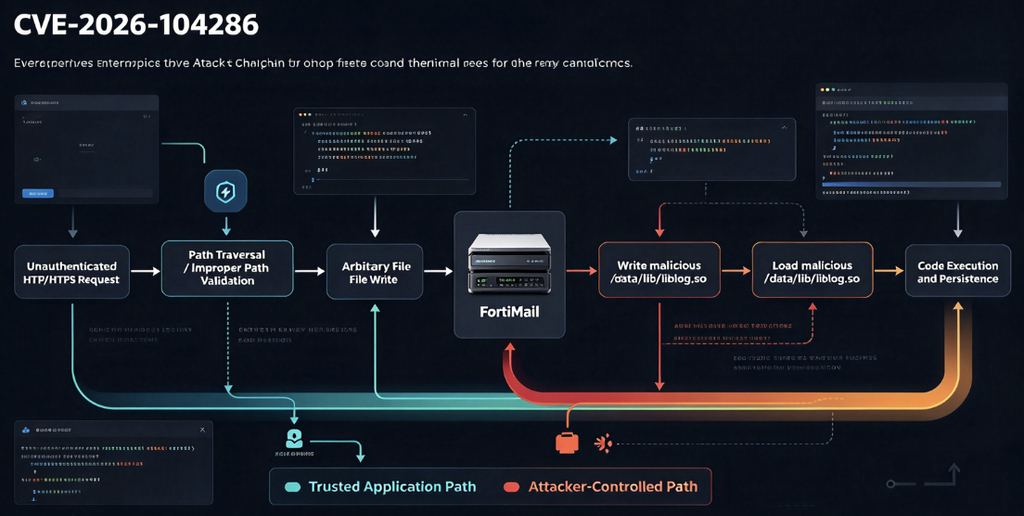
CVE-2026-104286-style impact:

Remote unauthenticated request
      ↓
Path handling failure
      ↓
Write attacker-controlled file outside intended directory
      ↓
Reach security-sensitive filesystem location
      ↓
System or service loads attacker-controlled content
      ↓
Code execution / persistence
The dangerous part is not simply escaping a directory. It is what becomes possible after escaping it.
Applications routinely interact with locations that influence application startup, service configuration, executable code, scheduled tasks, dynamic libraries and web server behavior. An arbitrary file-write vulnerability gives an attacker opportunities to target exactly those kinds of locations.
That becomes even more consequential on a mail gateway because the appliance often sits at a highly trusted point in the enterprise network and processes some of the organization’s most sensitive communications.
The Identity-Based Encryption Connection
Fortinet’s mitigation guidance provides an important clue about the vulnerable attack surface.
Until fixed releases are available, administrators are advised to disable FortiMail’s Identity-Based Encryption, or IBE, functionality or remove internet accessibility from the relevant management interface. CERT Santé similarly describes the affected component as part of the FortiMail administration web interface and identifies IBE as associated with the vulnerable path. Portail du CERT Santé
Fortinet’s documented workaround is:
config system encryption ibe
set status disable
end
Administrators should treat this as an operational mitigation rather than as a substitute for remediation.
Disabling IBE may affect legitimate encrypted-mail workflows. Organizations therefore need to understand whether they depend on the feature before making the change, but the security trade-off is unusually clear while exploitation is active.
The second mitigation—removing public access to FortiMail’s management interface—is equally important.
A management interface for a security appliance generally should not be unnecessarily reachable from arbitrary internet hosts in the first place. CVE-2026-104286 demonstrates why. A single remotely reachable vulnerability in that management plane can turn a perimeter defense product into the attacker’s initial foothold.
How a Path Traversal Becomes Remote Code Execution
There is an important distinction between what the vulnerability directly provides and what an attacker does afterward.
The vulnerability gives the attacker an arbitrary file-write capability. Remote code execution is a consequence of writing attacker-controlled data into security-sensitive locations and arranging for the operating system or an application to load it.
Observed CVE-2026-104286 compromises provide a particularly revealing example.
One artifact disclosed in connection with the attacks is:
/data/etc/ld.so.preloadOn Linux systems, /etc/ld.so.preload or an appliance-specific equivalent can specify shared libraries that the dynamic linker should load into processes.
Conceptually:
Process starts
     ↓
Dynamic linker initializes
     ↓
Preload configuration is evaluated
     ↓
Specified shared library is loaded
     ↓
Library code executes inside process
If an attacker controls the referenced shared library and the preload configuration, this becomes a very powerful persistence mechanism.
Fortinet’s indicators include both an added ld.so.preload file and an added library:
/data/etc/ld.so.preload
/data/lib/liblog.so
That combination is significant.
Rather than merely dropping a standalone executable and hoping somebody launches it, the attacker can potentially influence how legitimate processes load libraries. This can give malicious code opportunities to execute repeatedly and potentially interfere with application behavior.
Fortinet’s published indicators also include new binaries named webconsole e mailservice, as well as modifications to existing components including httpd.conf. Narracomm
This is why CVE-2026-104286 should not be interpreted as an abstract file-handling bug. The exploitation evidence shows a complete intrusion chain.
What the Real-World Intrusion Appears to Look Like
Based on the artifacts disclosed by Fortinet and subsequently documented by incident-response researchers, the broad attack sequence can be reconstructed without relying on a public weaponized exploit.
It likely resembles the following:
Internet attacker
      ↓
Reach vulnerable FortiMail HTTP/HTTPS service
      ↓
Exploit CVE-2026-104286
      ↓
Obtain arbitrary file-write capability
      ↓
Place or modify security-sensitive files
      ↓
Load malicious shared library / binaries
      ↓
Establish persistence
      ↓
Modify FortiMail configuration
      ↓
Communicate with attacker infrastructure
      ↓
Potentially access or export email data
The particularly worrying part comes near the end.
Fortinet’s published indicators reportedly include creation of an archive account called:
archive234associated with remote infrastructure at:
79.141.169[.]187and an /uploads path.
A FortiMail archive configuration can be used to copy or retain email. In the context of an unauthorized configuration created after appliance compromise, a remote archive destination therefore raises an obvious concern: the attack is potentially useful not merely for maintaining control over the appliance, but also for obtaining mail content.
Reports reproducing Fortinet’s IOC material identify this archive configuration as part of observed malicious activity. The CyberSec Guru
That is an important distinction for incident responders. If a vulnerable FortiMail appliance shows evidence of exploitation, the question is not merely whether the appliance itself has been altered.
Investigators need to ask whether communications processed by it may also have been exposed.
Known Indicators of Compromise for CVE-2026-104286
Fortinet published unusually concrete post-exploitation indicators, which gives defenders a useful starting point.
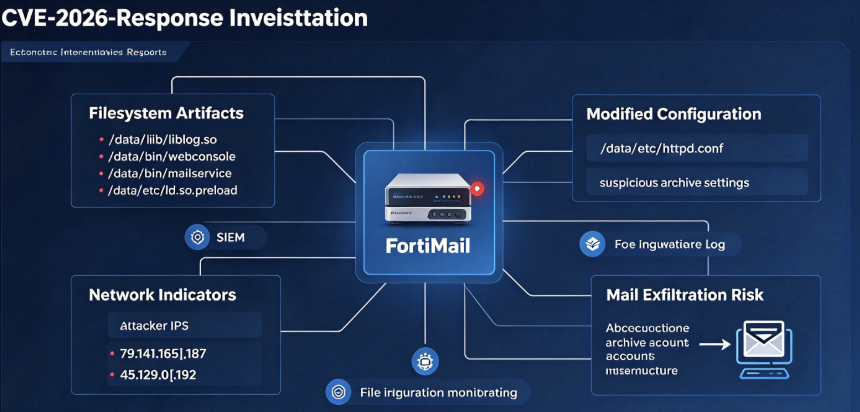
Reported added files include:
/data/lib/liblog.so
/data/bin/webconsole
/data/bin/mailservice
/data/etc/ld.so.preload
Reported modified files include:
/bin/smit
/data/etc/httpd.conf
/data/migadmin.tar.gz
Fortinet’s IOC set includes SHA-256 hashes for these artifacts. Among the published values are:
| Arquivo | Status | SHA-256 |
|---|---|---|
/data/lib/liblog.so | Added | 8015f34dc84922b03688399d7f9fe7a00361789f7e420c7e2a2cdb23e75cef84 |
/data/bin/webconsole | Added | 7a6cea9f5c9e2e9994d4e3c4da73f86cf5acd05ea5d312c066c9d1dafd69ee38 |
/data/bin/mailservice | Added | 4000276a150a165d3c2537d1e19fb393c4de8333076a16655e28059cae82157b |
/data/etc/ld.so.preload | Added | 8953ec7960b09f544a880b072ad4e6cfda7a8303f486251d3478dcfdfbac23b6 |
/bin/smit | Modified | 77324ac428bde86d351fc5fc06f6d64a6bfe737dfb2743df1d4c5ac2418a5b6a |
/data/etc/httpd.conf | Modified | 703e97c64e61e41dc3aaba580d82bb2aa7b6a11b54ee6fb467ed5d5a3bffdef5 |
/data/migadmin.tar.gz | Modified | d6fe51c22b91776f4c961ea58bcac5917f15d560a619d7ce726d3d51795609d3 |
These indicators have been reproduced from Fortinet’s advisory by multiple security organizations. Narracomm
Two IP addresses have also been associated with the observed activity:
79.141.169[.]187
45.129.0[.]192
Administrators should search firewall, proxy, SIEM and FortiMail logs for historical communication involving these addresses.
However, IOC matching should not become the entire investigation.
Attackers can rotate infrastructure, change filenames, alter binaries or create new implants once public reporting reveals existing indicators. The absence of these specific hashes or IP addresses therefore cannot prove that an appliance was never compromised.
Treat the IOCs as high-confidence positive indicators, not as an exhaustive definition of every possible CVE-2026-104286 intrusion.
Additional Log Indicators
Fortinet reportedly disclosed several other traces visible in system logs or configuration.
One involves a root cron execution associated with /migadmin. Another includes an unusual administrative logout entry referencing (null). The advisory also documents errors associated with IBE processing and the suspicious archive configuration mentioned earlier. Truesec
Security teams should therefore hunt across several data sources rather than relying only on filesystem hashes:
FortiMail system logs
Web management access logs
Firewall logs
Outbound network telemetry
Configuration change history
Archive-account configuration
Cron or scheduled execution records
System file integrity data
Administrative authentication logs
This also illustrates why traditional vulnerability scanning alone is insufficient here.
A vulnerability scanner can tell you whether an appliance appears to run an affected version. It generally cannot tell you whether an attacker compromised the appliance two days before the organization patched it.
That requires incident-response work.
Which FortiMail Versions Are Affected?
Fortinet’s updated advisory information identifies the following branches as affected:
| FortiMail branch | Versões afetadas | Remediation target |
|---|---|---|
| 8.0 | 8.0.0–8.0.1 | 8.0.2 or later |
| 7.6 | 7.6.0–7.6.6 | 7.6.7 or later |
| 7.4 | 7.4.0–7.4.8 | 7.4.9 or later |
| 7.2 | 7.2.0–7.2.9 | Migrate to a supported fixed branch |
CERT-FR independently reflects these ranges in its October 2 advisory and directs administrators back to Fortinet’s bulletin FG-IR-26-175 for remediation. CERT-FR
There is an important detail here for anybody researching CVE-2026-104286 through automated vulnerability databases.
Early CVE records captured narrower version boundaries in some fields—for example, some records show FortiMail 7.6 only through 7.6.5 or FortiMail 7.4 only through 7.4.6—while the later advisory material lists 7.6.6 and 7.4.8 as affected as well. OpenCVE
That means defenders should not blindly rely on an early cached CVE JSON object when determining exposure.
For this vulnerability, use the live Fortinet PSIRT advisory as the final authority on version applicability.
A Complication: The Fixes Were Initially Listed as Upcoming
When Fortinet disclosed CVE-2026-104286, the vendor described several fixed releases as upcoming rather than immediately available.
Those targets were:
FortiMail 8.0.2
FortiMail 7.6.7
FortiMail 7.4.9
For the 7.2 branch, organizations were directed toward migration rather than a 7.2 fix.
CERT Polska specifically warned on October 2 that, at the time of its notice, the security update had not yet been released and recommended disabling IBE and restricting management access while waiting for patched builds. moje.cert.pl
This makes the distinction between “a fixed version has been identified” and “a patched build is currently downloadable” very important.
Do not schedule an upgrade simply because a version number appears in an advisory. Confirm that Fortinet has actually published the relevant build for your appliance before beginning the maintenance procedure.
Because the situation is changing rapidly, administrators reading this article after October 3 should check Fortinet’s live FG-IR-26-175 advisory for the latest release availability.
What Organizations Should Do Immediately
For an actively exploited zero-day on an internet-facing security appliance, the priority order is different from ordinary monthly patching.
First, determine whether you actually have affected FortiMail systems.
You need the exact version, deployment model and exposure state—not simply the product name.
An asset inventory should answer:
Which FortiMail appliances exist?
Which software version does each run?
Is the management interface internet reachable?
Is IBE enabled?
Which addresses expose HTTP/HTTPS management?
When was the appliance last upgraded?
Are historical management and firewall logs available?
Second, if an affected instance is publicly accessible, reduce exposure immediately.
The vendor-supported temporary controls are to disable IBE or restrict the management interface to trusted private networks. moje.cert.pl
Third, preserve evidence before performing aggressive cleanup.
If exploitation has already occurred, rebooting, deleting files, reinstalling software or modifying configurations may destroy information that would otherwise help determine what happened.
Fourth, hunt for compromise.
Check the published file hashes, network indicators, suspicious archive configuration, configuration changes and anomalous system events.
Fifth, install a fixed release as soon as the appropriate vendor-supported build is actually available.
And sixth—which organizations routinely forget—continue the incident investigation after patching.
Patching Does Not Remove an Existing Compromise
This point deserves emphasis.
Suppose an attacker exploited CVE-2026-104286 on Monday.
They obtained arbitrary file write, installed a persistent library, created an additional service and modified configuration.
On Tuesday, the administrator installs a patched FortiMail build.
The vulnerability might now be closed.
The attacker might still be there.
The difference is fundamental:
Patch status ≠ compromise statusA patch prevents the vulnerable code path from being exploited again. It does not automatically establish that previously dropped files, unauthorized configuration, stolen credentials, persistence mechanisms or external attacker access have disappeared.
For CVE-2026-104286 specifically, Fortinet’s published evidence of malicious system-file changes makes compromise assessment particularly important.
Any organization that operated a vulnerable and reachable FortiMail appliance during the exploitation window should consider answering two separate questions:
1. Are we still vulnerable?
2. Were we already compromised?
They require different evidence.
Detection Strategy for Security Teams
A useful defensive investigation can be divided into filesystem, configuration, network and historical-access analysis.
Filesystem Integrity
Start by checking for the known malicious additions and modifications.
The presence of any published malicious hash should be treated as a major incident indicator.
But defenders should also compare affected appliances against known-good systems or vendor baselines where possible. Attackers responding to public reporting may simply recompile their tooling and produce entirely different hashes.
Unexpected shared libraries, executable files, new preload configuration and modifications to web-service configuration deserve particular attention.
Network Telemetry
Search historical data for connections involving the known attacker infrastructure:
79.141.169[.]187
45.129.0[.]192
Then broaden the search.
Look for unusual outbound connections initiated by FortiMail appliances, particularly connections that are inconsistent with known mail-delivery, DNS, NTP, update, directory-service or administrative dependencies.
A mail security appliance initiating arbitrary outbound sessions to unfamiliar infrastructure deserves investigation even when the destination is not currently in a public IOC list.
Administrative and Configuration Activity
Review changes to:
Archive accounts
IBE settings
Administrator accounts
HTTP/HTTPS management settings
Remote destinations
Scheduled jobs
Web-service configuration
Mail routing
Authentication configuration
The reported archive234 configuration is especially useful as a known IOC, but defenders should look for the behavioral pattern rather than that exact string alone.
An attacker can call the next account something entirely different.
Management Interface Logs
Correlate web-management requests with authentication events and known administrator source addresses.
Because CVE-2026-104286 is unauthenticated, suspicious activity may occur without a corresponding legitimate login.
That discrepancy itself can become useful:
Management-side changes
+
No valid administrator session
+
Unexpected HTTP/HTTPS activity
=
High-priority investigation
How to Validate Your Own Environment Safely
Security teams sometimes respond to a newly disclosed CVE by immediately searching the internet for proof-of-concept exploit code.
That is not necessary to establish whether an organization is at risk from CVE-2026-104286.
The safest first-stage validation is version- and exposure-based.
For assets you own or are explicitly authorized to test, determine:
FortiMail version
Management interface exposure
IBE configuration
Patch state
Presence of published IOCs
Unexpected configuration changes
Historical network communication
A simple conceptual workflow is:
def assess_fortimail(asset):
    if not asset.is_fortimail:
        return "not_applicable"

    if asset.version in affected_versions:
        if asset.management_internet_exposed:
            return "critical_priority"

        if asset.ibe_enabled:
            return "high_priority"

        return "affected_requires_remediation"

    return "verify_against_latest_vendor_advisory"
This is intentionally not exploit code. In a production environment, the first objective should be establishing exposure and detecting compromise without changing the appliance state.
Active exploitation testing should be limited to controlled systems where the organization has explicit authorization and understands the possibility of service disruption.
Why FortiMail Is an Attractive Target
CVE-2026-104286 also demonstrates why attackers increasingly focus on edge and security infrastructure.
A FortiMail appliance is not an ordinary application server.
It occupies a privileged architectural position.
It may inspect inbound mail, process outbound messages, connect to internal identity infrastructure, handle encrypted communication, maintain message archives and sit at the boundary between the public internet and private networks.
That creates several forms of attacker value at the same time.
First, compromising an edge appliance can bypass many endpoint controls because the device itself is frequently treated as trusted infrastructure.
Second, traditional EDR coverage on specialized appliances is often much weaker than on Windows or Linux workstations and servers.
Third, administrators may patch security appliances less frequently because upgrades can disrupt critical infrastructure.
Fourth, a mail gateway naturally has access to extremely sensitive information.
And finally, appliances often maintain long-lived configurations and credentials that can help an intruder move further into the environment.
This is why vulnerabilities in VPN concentrators, firewalls, email gateways and remote-management appliances repeatedly become high-priority targets after—and sometimes before—public disclosure.
CVE-2026-104286 Is a Zero-Day in the Operational Sense
The term “zero-day” is sometimes used carelessly.
In this case, however, calling CVE-2026-104286 a FortiMail zero-day is operationally reasonable because Fortinet disclosed active exploitation while fixed builds were, at least initially, still described as upcoming.
Fortinet did not merely state that exploitation was theoretically possible. Its advisory contained forensic indicators from compromised systems. CERT-FR likewise explicitly states that Fortinet reports active exploitation. CERT-FR
That places defenders in the classic zero-day situation:
Attackers already have a working technique
           ↓
Defenders learn about the vulnerability
           ↓
Full patch availability may lag disclosure
           ↓
Temporary mitigations become necessary
The important defensive response is therefore not debating terminology. It is shortening the time between disclosure, exposure reduction, threat hunting and remediation.
What CVE-2026-104286 Teaches About Appliance Security
The deeper lesson from this vulnerability is that security appliances must be managed as high-value servers rather than as invisible network boxes.
A product designed to protect an organization does not automatically protect itself.
Security teams should maintain:
Accurate appliance inventory
Exact firmware/software versions
Management-plane exposure mapping
Centralized logging
Configuration backups
File integrity or baseline capability where supported
Restricted administrative networks
Emergency upgrade procedures
Vendor advisory monitoring
Incident-response playbooks specifically for appliances
Management interfaces deserve especially strict treatment.
There are legitimate cases where administrators need remote access, but directly exposing privileged administration services to the entire internet creates an unnecessarily large attack surface.
The safer design is generally:
Internet
   ↓
VPN / Zero Trust access layer
   ↓
Restricted management network
   ↓
FortiMail management interface
rather than:
Internet
   ↓
FortiMail management interface
No architecture eliminates software vulnerabilities. Good architecture reduces how many attackers can reach them.
Frequently Asked Questions About CVE-2026-104286
Is CVE-2026-104286 actively exploited?
Yes. Fortinet reports exploitation in the wild, and CISA vulnerability data identifies exploitation as active. CERT-FR also explicitly warns that the vulnerability is being exploited. CERT-FR
What is the CVSS score?
CVE-2026-104286 has a CVSS 3.1 base score of 9.8, Critical. OpenCVE
Does exploitation require authentication?
No.
The vulnerability can be exploited by an unauthenticated attacker through crafted HTTP or HTTPS requests. OpenCVE
Does it require user interaction?
No.
The published CVSS vector specifies UI:N, meaning no user interaction is required.
Is CVE-2026-104286 a path traversal vulnerability?
Yes.
It is associated with CWE-22, Improper Limitation of a Pathname to a Restricted Directory, commonly called path traversal. Fortinet’s description additionally refers to improper handling of NULL characters. XHack
Can CVE-2026-104286 lead to remote code execution?
Yes, according to the vendor’s impact description and government CERT reporting.
The direct primitive is arbitrary file write, but an attacker can use carefully chosen filesystem destinations to obtain unauthorized code or command execution. CERT-FR categorizes the risk as remote arbitrary code execution. CERT-FR
What FortiMail versions are affected?
The current advisory information identifies:
8.0.0 – 8.0.1
7.6.0 – 7.6.6
7.4.0 – 7.4.8
7.2.0 – 7.2.9
Administrators should verify against Fortinet’s live FG-IR-26-175 advisory because vendor information can change as investigations continue. CERT-FR
What are the fixed versions?
Fortinet identified:
8.0.2 or later
7.6.7 or later
7.4.9 or later
with migration required for the affected 7.2 branch.
At disclosure, these releases were described as upcoming, so administrators should verify current availability directly with Fortinet before planning remediation. Suped
What is the temporary workaround?
Fortinet recommends disabling IBE:
config system encryption ibe
set status disable
end
or preventing internet access to the management interface and restricting access to trusted private networks. moje.cert.pl
Is a public exploit required to consider the vulnerability urgent?
No.
Real-world exploitation is stronger evidence of operational risk than the existence of a public proof of concept. As of the initial disclosure window, public reporting did not identify a broadly available public exploit, yet Fortinet had already observed successful attacks. CVETodo
Final Assessment
CVE-2026-104286 should be treated as both a vulnerability-management issue and a potential incident-response event.
The technical conditions are unusually favorable to attackers: exploitation is remote, authentication is unnecessary, attack complexity is low, and no user interaction is required. The resulting primitive is powerful—arbitrary file write on the underlying FortiMail appliance—and the artifacts disclosed by Fortinet show attackers turning that capability into persistent access and system modification.
The evidence also appears to go beyond simply establishing execution. A suspicious remotely configured archive account raises the possibility that attackers targeted the information FortiMail exists to process: enterprise email.
For defenders, the most important sequence is therefore straightforward.
Identify affected FortiMail systems. Remove unnecessary internet management exposure. Disable IBE where the workaround is operationally acceptable. Preserve evidence. Search for Fortinet’s published indicators and behavioral signs of compromise. Install a vendor-supported fixed release as soon as it is actually available. Then investigate whether exploitation occurred before remediation.
Do not consider the incident closed merely because a version number changed.
With an actively exploited edge-device vulnerability such as CVE-2026-104286, the crucial question is no longer simply “Are we vulnerable?”
It is also “Was somebody already here?”
For authoritative updates, administrators should continue monitoring Fortinet’s FG-IR-26-175 advisory. France’s CERT-FR has also published advisory CERTFR-2026-AVI-1257, explicitly citing the Fortinet bulletin and confirming the active-exploitation warning. CISA’s CVE enrichment likewise records active exploitation and automatable exploitation characteristics. CERT-FR
Fortinet PSIRT advisory FG-IR-26-175
CERT-FR advisory CERTFR-2026-AVI-1257


 Portuguese
  English
  German
  French
  Spanish
  Japanese
  Korean
  Hindi
Hindi  Arabic
  Turkish
  Hebrew