
A PDF attachment is rarely treated as a serious security threat. Employees open invoices, legal agreements, financial statements, and project documents every day, often without thinking about the software responsible for displaying them. That familiarity is precisely what makes vulnerabilities in PDF readers particularly concerning. A document that appears entirely legitimate can potentially exploit a flaw in the application processing it, turning an ordinary file-opening operation into an opportunity for arbitrary code execution.
CVE-2026-81983 is a critical memory corruption vulnerability affecting Adobe Acrobat Reader and related Adobe Acrobat products. The flaw could allow an attacker to execute arbitrary code in the security context of the current user when a specially crafted malicious PDF file is opened. Adobe assigned the vulnerability a CVSS v3.1 score of 7.8 and classified it as critical, reflecting the potentially serious consequences of successful exploitation.
The vulnerability was disclosed on September 8, 2026, as part of Adobe’s security bulletin APSB26-141, which addressed multiple security weaknesses in Acrobat and Acrobat Reader for Windows and macOS. According to Adobe’s official security advisory, CVE-2026-81983 involves an out-of-bounds write condition, identified as CWE-787, that can result in arbitrary code execution. The National Vulnerability Database also confirms that exploitation requires the victim to open a malicious file, making social engineering and document-based delivery important elements of the threat.
Although Adobe stated in its September advisory that it was not aware of active exploitation of the vulnerabilities addressed in that update, the absence of confirmed attacks should not be confused with the absence of risk. PDF files are deeply embedded in business workflows, and a vulnerability that crosses the boundary between document content and executable code deserves attention even before exploitation is publicly documented.
For security teams, CVE-2026-81983 highlights a persistent problem in endpoint security: a file does not need to be an executable to create an execution risk. Sometimes, the dangerous behavior begins inside the application trusted to open it.
What Is CVE-2026-81983?
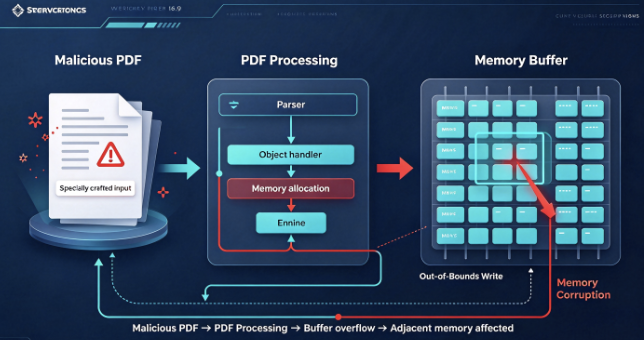
CVE-2026-81983 is an out-of-bounds write vulnerability in Adobe Acrobat Reader that may enable arbitrary code execution through a malicious PDF document. An out-of-bounds write occurs when software attempts to write data outside the memory region allocated for a particular operation. Depending on the location and contents of the unintended memory modification, the result can range from application instability to corruption of internal data structures and, under exploitable conditions, control over program execution.
Adobe identifies the vulnerability as CWE-787, a category of memory safety weaknesses associated with writes beyond valid buffer boundaries. The MITRE CWE-787 definition explains that this behavior can corrupt memory, modify program state, and sometimes enable unauthorized code execution.
In practical terms, the vulnerability affects how Acrobat Reader handles certain untrusted document data. A malicious PDF could cause the vulnerable application to perform an invalid memory write while processing the file. If an attacker can turn that memory corruption into a reliable exploit, the attack may progress from malformed document content to execution of attacker-controlled instructions.
One important distinction is that CVE-2026-81983 is not publicly documented as a general-purpose PDF JavaScript vulnerability or a security warning bypass. Adobe’s advisory specifically classifies it as an out-of-bounds write. The public bulletin does not identify the exact parser function, vulnerable PDF object type, or memory corruption primitive required to build an exploit. Claims that a particular JavaScript API, font parser, or embedded object is responsible would therefore require additional technical evidence.
The available information does establish the security consequence: successful exploitation could execute arbitrary code with the privileges of the user running the affected Adobe application. If that user has access to confidential documents, corporate credentials, connected storage, or sensitive internal resources, the potential business impact extends well beyond an Acrobat application crash.
CVE-2026-81983 Affected Versions and Patch Information
Adobe’s September 2026 security bulletin identifies several affected product lines across Windows and macOS. The vulnerability is not limited to the free Acrobat Reader application; Adobe Acrobat installations also require attention.
For Adobe Acrobat and Acrobat Reader on the Continuous track, versions 26.002.21900 and earlier are affected. Adobe addressed the vulnerability in version 26.002.21901, released as part of the September 8 security update. Organizations running Acrobat 2024 on the Classic track are affected if they use version 24.001.30383 or earlier, with version 24.001.30429 providing the corresponding security fix.
These version thresholds are documented in Adobe Security Bulletin APSB26-141 e o NVD entry for CVE-2026-81983. Both sources identify Windows and macOS as affected platforms.
The version numbers are particularly important for enterprise vulnerability management. Security administrators should not assume that a system is protected merely because the application has been updated at some point during 2026. A deployment can contain a relatively recent Acrobat build while still lacking the specific September security fix.
The minimum fixed version for the Continuous track is 26.002.21901, while the minimum fixed Acrobat 2024 Classic version is 24.001.30429. These are the initial fixed builds, not necessarily the latest builds available today. Organizations should deploy the newest supported update for their installed product track rather than stopping at an older fixed release.
Adobe assigned APSB26-141 a vendor update priority rating of 2. This is a patch deployment classification and should not be confused with the individual vulnerability’s critical severity designation. The CVE itself carries a CVSS score of 7.8, while the broader security bulletin contains multiple vulnerabilities with different impacts and scores.
How Does CVE-2026-81983 Work?
Understanding CVE-2026-81983 begins with understanding what happens when a PDF document is opened. A modern PDF reader does considerably more than display text and images. It interprets document structures, reconstructs page layouts, decompresses embedded content, processes fonts, handles annotations, and may interact with forms, multimedia, and other interactive features.
Each of these operations requires the application to interpret data supplied by the document. Because that data may originate from an untrusted source, the parsing process represents an important security boundary. The PDF reader must transform potentially attacker-controlled bytes into an internal representation without allowing those bytes to corrupt the application’s memory or alter its intended behavior.
CVE-2026-81983 represents a failure of memory safety within that broader processing environment. Adobe identifies the underlying weakness as an out-of-bounds write, meaning that a memory write can occur outside an intended buffer. Such a condition may overwrite adjacent data, disturb application state, or damage information that the program subsequently relies upon.
To understand the concept, imagine an application allocates 128 bytes of memory to store data extracted from a document. If a software defect causes it to write 160 bytes into that region, the additional data may overwrite memory that belongs to another structure. Whether this causes an immediate crash or creates an exploitable condition depends on how the memory is organized and what information is modified. This example illustrates the general vulnerability class, not the specific implementation of CVE-2026-81983.
The security consequences become more serious when memory corruption affects information controlling program behavior. In some circumstances, carefully controlled writes can influence pointers, object metadata, or other execution-relevant structures. An attacker who can reliably manipulate those structures may be able to redirect execution or otherwise cause the program to perform unintended operations.
This is why an out-of-bounds write can be more dangerous than an ordinary application error. A malformed PDF that simply crashes Acrobat Reader is a stability problem. A malicious PDF that enables an attacker to control the behavior of the running process presents a much more serious security concern.
The important limitation is that the public advisory does not disclose the exact sequence of memory operations involved in CVE-2026-81983. There is no publicly documented exploit chain in the authoritative sources reviewed here that establishes the specific input structure, memory layout, or reliability requirements. The general memory corruption mechanism is understood, but the precise exploitation technique should not be presented as confirmed without supporting reverse engineering or a detailed technical disclosure.
How a Malicious PDF Could Trigger CVE-2026-81983
The attack scenario associated with CVE-2026-81983 starts with a malicious document rather than a network service exposed directly to the internet. Adobe explicitly states that successful exploitation requires user interaction: the victim must open a malicious file.
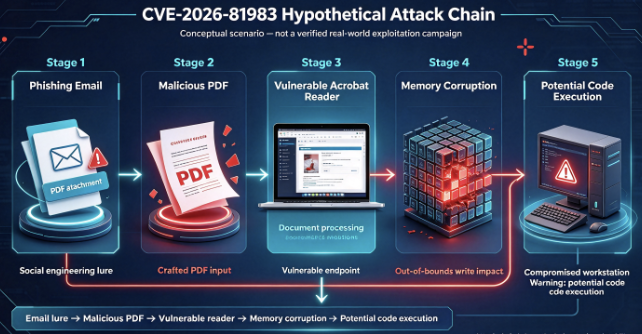
This requirement shapes the likely threat model. An attacker could attempt to deliver a crafted PDF through a phishing email, a compromised website, an impersonated document-sharing notification, or another distribution channel. The attacker would then need the intended recipient to open that document using a vulnerable Adobe application.
Consider a hypothetical business email claiming to contain an overdue supplier invoice. The message appears to come from a familiar organization, uses appropriate formatting, and includes a PDF attachment named like a routine financial document. A recipient opens the attachment because reviewing invoices is part of their normal responsibilities. If that PDF contains an exploit targeting CVE-2026-81983 and the installed Reader version remains vulnerable, the document-opening action could expose the endpoint to the memory corruption flaw.
The malicious content would need to reach the vulnerable parsing or processing operation inside Acrobat Reader. Rather than relying on an obvious executable attachment, the attacker would attempt to place exploit-triggering data inside the document itself. In a successful exploit, the program’s handling of that data would move beyond normal document interpretation and into unintended code execution.
The resulting activity could potentially be used to initiate a second stage, such as running another program, interacting with accessible files, or establishing communication with attacker-controlled infrastructure. These are examples of possible post-exploitation objectives, not observed behavior specifically attributed to CVE-2026-81983.
An important point is that user interaction does not necessarily imply a user must click a suspicious button inside the PDF, approve a security warning, or enable an embedded script. Adobe states that the victim must open a malicious file, but the advisory does not establish that additional interaction is required. Security teams should therefore avoid assuming that disabling PDF JavaScript or training users not to click links inside documents is sufficient protection against this particular memory corruption issue.
Similarly, although the vulnerability is frequently described in terms of remote code execution through malicious PDFs, its CVSS attack vector is classified as local. This is because exploitation requires the crafted file to be processed by the application on the victim’s system. The malicious file may originate from a remote attacker, but the attack is not equivalent to unauthenticated exploitation of a network-facing service.
That distinction matters when interpreting the technical severity of the vulnerability and when describing the actual attack path.
CVE-2026-81983 CVSS Score and Security Impact
CVE-2026-81983 has a CVSS v3.1 base score of 7.8, corresponding to a High numerical severity rating under the CVSS v3.1 scale. Adobe separately classifies the vulnerability as Critical in its security bulletin.
The official CVSS vector is CVSS:3.1/AV:L/AC:L/PR:N/UI:R/S:U/C:H/I:H/A:H.
The local attack vector reflects the requirement for malicious content to be processed on the vulnerable endpoint. Low attack complexity indicates that the rating does not assume additional specialized conditions that would substantially increase exploitation difficulty. No privileges are required from the attacker within the vulnerable application, but user interaction is necessary.
The confidentiality, integrity, and availability impacts are all rated High. This combination explains why the vulnerability remains serious despite requiring a victim to open a file.
From a confidentiality perspective, successful arbitrary code execution may allow access to information available within the affected user’s security context. Depending on the environment and the attacker’s capabilities, that could include documents, application data, or authentication material accessible to the user.
From an integrity perspective, attacker-controlled code may be able to modify accessible files or perform unauthorized actions. In environments where a user regularly interacts with shared resources, those actions can affect information beyond a single document.
Availability can also be affected. Memory corruption may cause application termination or instability, while successful code execution could potentially be used to disrupt broader user activity.
The CVSS vector also specifies unchanged scope, meaning the score does not assume a direct impact across a separate security authority. This should not be interpreted as a guarantee that a compromised system cannot be used as a stepping stone for further attacks. It simply describes the security impact evaluated for this individual vulnerability.
Is CVE-2026-81983 Being Exploited in the Wild?
The distinction between a potentially exploitable vulnerability and one that has been observed in active attacks is essential.
When Adobe published APSB26-141 on September 8, 2026, the company explicitly stated that it was not aware of exploits in the wild for the vulnerabilities addressed by the update. That statement includes CVE-2026-81983.
The public information reviewed for this article does not establish a confirmed campaign exploiting CVE-2026-81983, nor does it provide a verified malicious PDF sample, attacker infrastructure, or a documented post-exploitation payload uniquely associated with the flaw.
Accordingly, it would be inaccurate to describe this vulnerability as an actively exploited zero-day based solely on its severity or the existence of a vendor patch.
The distinction does not make patching optional. Public disclosure gives defenders the information needed to identify and remediate affected software, but it also reveals the existence of the underlying weakness. Once a security update is available, researchers and potential attackers may compare vulnerable and patched software to understand what changed.
Patch analysis can sometimes help identify vulnerable code paths or infer the conditions necessary to trigger a previously undisclosed bug. That possibility is a general consideration in vulnerability management, not evidence that anyone has successfully developed a weaponized exploit for CVE-2026-81983.
For organizations with large numbers of endpoints, the safest practical response is to verify patch installation rather than wait for evidence of exploitation. The cost of applying a supported security update is generally far lower than responding to a potentially compromised employee workstation.
Why Adobe Acrobat Reader Vulnerabilities Are Attractive to Attackers
Adobe Acrobat Reader operates in an unusual part of the enterprise security landscape. It is not generally thought of as an administrative tool, development environment, or remote access utility. Yet it regularly processes documents obtained from outside an organization’s trust boundary.
That combination creates a valuable opportunity for attackers. A security vulnerability in a commonly installed document reader can potentially be reached through ordinary user activity, without requiring the attacker to persuade the recipient to install an unfamiliar application.
Document-based attacks also benefit from the social legitimacy of their delivery mechanism. Employees are trained to recognize suspicious executable attachments, but PDF documents remain central to many legitimate business processes. A person who would never intentionally run an unknown program may still open an unfamiliar PDF because it appears to contain information relevant to their work.
Attackers can exploit this expectation by presenting malicious documents as contracts, invoices, insurance notices, purchase orders, compliance forms, recruitment materials, or project reports. These document categories are especially effective as social engineering themes because they create plausible reasons for recipients to inspect an attachment.
The risk is amplified when organizations rely on older or unmanaged software installations. A fully patched PDF reader and an outdated installation may look nearly identical to the person using them. From the user’s perspective, both successfully open documents, which means the security difference can remain invisible until the vulnerability is exploited or a software inventory reveals the outdated version.
Another complication is that PDF files are structured containers rather than simple text documents. Their content can include compressed streams, embedded resources, references between objects, and features requiring specialized interpretation. Security tools may inspect these structures, but analyzing complex document formats comprehensively is difficult.
A malicious document does not necessarily need a suspicious filename or obvious script to expose a parser vulnerability. A flaw can exist in the native code responsible for handling document data, making behavioral monitoring, software patching, and application isolation important even when content scanning is already deployed.
Adobe Acrobat Reader Sandbox Protection and Its Limitations
Modern PDF readers contain security features intended to reduce the consequences of malicious or malformed documents. Adobe Acrobat includes Protected Mode, Protected View, and Enhanced Security controls that can restrict certain operations performed by documents and the application processes handling them.
Protected Mode is an important defense-in-depth mechanism. It is designed to limit the resources accessible to the application when processing potentially untrusted content. Adobe describes it as a primary security mechanism for reducing the impact of vulnerabilities and recommends keeping it enabled in production environments.
De acordo com Adobe’s Protected Mode documentation, the feature is enabled by default in supported Acrobat environments and should only be disabled temporarily for troubleshooting or testing.
This protection matters because arbitrary code execution within an application process does not automatically mean unrestricted access to the entire operating system. The outcome depends on the privileges of the process, sandbox restrictions, operating system controls, and whether an attacker possesses additional methods for escaping those restrictions.
An exploit that successfully corrupts memory inside Acrobat Reader might still encounter barriers that restrict file access, process creation, or other sensitive operations. Those restrictions can reduce the potential impact of exploitation.
However, sandboxing should not be treated as a replacement for a security update. The effectiveness of containment depends on the exact vulnerable component, the application’s security architecture, and the capabilities of the exploit. Adobe has not published sufficient details to conclude that Protected Mode completely prevents exploitation of CVE-2026-81983 in every configuration.
Enhanced Security offers another protective layer by restricting certain operations involving external resources, local files, and cross-domain communication. Adobe explains these settings in its Enhanced Security guide.
For enterprises, the practical objective should be to maintain multiple independent protections. A patched application addresses the known defect, sandboxing limits the consequences of application compromise, endpoint detection tools monitor suspicious behavior, and document security controls reduce exposure to potentially malicious content.
No single layer should be expected to provide complete protection against every possible PDF-based attack.
How to Detect Potential CVE-2026-81983 Exploitation
Detecting potential exploitation of CVE-2026-81983 requires a different approach from detecting a conventional malicious executable. The initial attack material is a PDF document, and the suspicious activity may begin inside a legitimate, digitally signed Adobe application.
Because no verified vulnerability-specific indicators of compromise were identified in the authoritative sources reviewed for this article, defenders should focus on behavioral indicators associated with document-based exploitation. These indicators are useful for hunting and investigation, but they cannot independently confirm that CVE-2026-81983 has been exploited.
One useful starting point is monitoring the behavior of Acrobat-related processes, including AcroRd32.exe e Acrobat.exe on Windows. Security teams should examine situations in which these applications unexpectedly initiate command interpreters, scripting engines, unfamiliar executables, or other processes inconsistent with normal document viewing. Examples worth investigating include unexpected execution of powershell.exe, cmd.exeou wscript.exe following the opening of an untrusted PDF.
Not every child process is malicious. Adobe applications use supporting processes and legitimate integrations that vary across versions and enterprise configurations. Detection logic should therefore consider executable paths, digital signatures, command-line arguments, the originating document, and whether similar behavior is normal for the affected endpoint.
Network activity provides another potential source of evidence. A PDF reader that unexpectedly connects to an unfamiliar external host shortly after processing an untrusted document may warrant investigation, particularly if the connection is associated with additional process execution, unusual file activity, or a newly created persistence mechanism.
Application crashes can also provide useful leads. Since CVE-2026-81983 involves memory corruption, defenders may find it valuable to investigate abnormal Acrobat termination events, access violations, and unusual crash patterns. Repeated crashes associated with opening the same external document may suggest a malformed or intentionally crafted input.
However, a crash is not proof of exploitation, and a successful exploit may not produce a visible crash. Application instability should be correlated with other telemetry instead of being treated as a definitive detection signal.
Endpoint detection and response systems can improve visibility by connecting process events, file access, network connections, and other activity into a single timeline. For example, an analyst might observe that a PDF was downloaded from an unfamiliar domain, opened in an outdated Acrobat installation, followed by an unexpected process launch and network communication. The complete sequence is more informative than any individual event.
Organizations should also examine the origins of suspicious documents. Email security records, browser download histories, document-sharing logs, and endpoint file metadata may help determine whether the same PDF was distributed to multiple employees.
Where potentially malicious documents are collected for analysis, they should be handled in a properly isolated environment. Security teams should preserve the original file, calculate its cryptographic hash, record its source, and avoid opening it on ordinary workstations. Hash values can support internal correlation, but no universal malicious PDF hash can be attributed to CVE-2026-81983 without an independently verified exploit sample.
How to Patch CVE-2026-81983 in Adobe Acrobat Reader
The most reliable remediation for CVE-2026-81983 is to install an Adobe update containing the security fix.
For Acrobat and Acrobat Reader on the Continuous track, Adobe released version 26.002.21901 to address the vulnerability. For Acrobat 2024 on the Classic track, the corresponding fixed release is 24.001.30429. Later supported builds should also be considered, with administrators consulting Adobe’s current release documentation before deploying updates.
Individual users can update Acrobat Reader by opening the application and selecting Help, followed by Check for Updates. Adobe provides platform-specific instructions in its official manual update documentation. On Windows, the update option is available through the application’s menu and help interface; on macOS, users can select Help and check for available updates.
Acrobat Reader normally supports automatic updates, but administrators should not assume that automatic updating guarantees every endpoint has received the fix. Updates may be delayed by device management policies, disconnected systems, installation problems, or other environmental constraints.
Adobe also documents situations where Windows installations fail to update automatically because of restrictive system policies, disabled patching, or administrative installation configurations. Its Reader update troubleshooting documentation provides guidance for identifying and resolving these conditions.
For enterprise deployments, administrators should first identify all installed Acrobat and Reader products, including installations on secondary workstations, shared computers, and systems outside normal device management groups. The inventory should record both the installed product track and build number.
This distinction matters because the Continuous and Classic tracks use different version sequences. Comparing versions without considering the product track can lead to incorrect vulnerability assessments.
Next, administrators should deploy the relevant update through their existing endpoint management infrastructure. Adobe supports managed deployment workflows for Windows and macOS, and its Acrobat Enterprise Release Notes provide information about available releases and installers.
After installation, security teams should verify that the expected fixed or newer build is actually present. A successful software deployment job does not always establish that every target system has been remediated, particularly when installations are pending restart, devices are offline, or update operations have failed.
Organizations should continue monitoring compliance until vulnerable builds have been replaced or affected applications have been removed from systems where they are no longer required.
Additional Mitigations for Malicious PDF Attacks
Patching CVE-2026-81983 addresses this known vulnerability, but reducing future PDF-related risks requires broader security controls.
Email security remains important because PDF attachments are frequently exchanged through ordinary business correspondence. Organizations should inspect inbound attachments, apply appropriate malware analysis policies, and investigate messages that use suspicious document-sharing themes or unexpected external senders.
Advanced attachment analysis can be particularly useful when a PDF contains unusual structures, embedded resources, or behavior inconsistent with its apparent purpose. However, malicious PDF detection is not guaranteed, especially when an attack targets an unknown parsing flaw rather than a known malicious payload.
Endpoint protection adds another layer. Application behavior monitoring can identify suspicious process execution or network communication even when the initial PDF file was not detected as malicious. Application control policies can further reduce the ability of unauthorized programs to execute following a successful compromise.
Privilege management also affects the consequences of exploitation. Adobe identifies arbitrary code execution in the context of the current user, meaning the permissions available to that user influence what the attacker may be able to access or modify. Running ordinary document-processing applications without unnecessary administrative privileges reduces the potential impact of a successful attack.
For particularly sensitive environments, organizations can isolate document processing from critical business systems. High-risk documents may be opened in managed virtual environments or dedicated analysis systems, while network access and file-sharing permissions can be limited according to business requirements.
Adobe’s Protected Mode and Enhanced Security settings should remain enabled wherever supported. Organizations should avoid broadly configuring privileged locations that exempt large collections of untrusted documents from normal restrictions.
User education also has a role, but its limitations should be acknowledged. Employees can be trained to verify unexpected attachments, scrutinize suspicious senders, and use trusted document-sharing channels. They cannot reasonably be expected to identify hidden memory corruption exploits simply by looking at a PDF.
The objective is to make user caution one component of a layered defense, rather than the only mechanism preventing exploitation.
What Should Security Teams Do After a Suspected Malicious PDF Is Opened?
If an employee reports opening a suspicious PDF on a potentially vulnerable system, the response should begin with determining whether the file was processed by an affected application version.
Administrators should establish the Acrobat or Reader build installed at the time of the event, the origin of the document, and whether the endpoint generated unusual security telemetry around the opening of the file.
The absence of obvious symptoms does not conclusively rule out exploitation. A malicious document may fail to trigger a visible crash, while suspicious activity may occur in the background. At the same time, simply opening a suspicious PDF does not establish that the vulnerability was successfully exploited.
If endpoint telemetry shows unexpected process execution, suspicious network communication, unauthorized file modification, or other indicators of compromise, the security team should follow its established incident response procedures. Depending on the evidence, that may include isolating the affected system, preserving forensic data, examining related activity, and determining whether credentials or sensitive information were exposed.
The suspicious document should be retained securely for analysis. Analysts should collect relevant endpoint telemetry, file metadata, process trees, security alerts, and timestamps before remediation activities destroy potentially useful evidence.
Investigators should also determine whether other users received or opened the same document. Email and file-sharing records can help identify additional endpoints that may require attention.
If compromise is confirmed, installing the Adobe patch alone is not sufficient to establish that the environment is clean. A security update corrects the underlying software vulnerability, but it does not automatically remove malicious software, reverse unauthorized changes, or invalidate credentials exposed during an earlier compromise.
Remediation should therefore address both the vulnerable application and any post-exploitation activity identified during the investigation.
CVE-2026-81983 and the Broader Problem of Document-Based Code Execution
The significance of CVE-2026-81983 extends beyond one security update. It illustrates how vulnerabilities in software that processes external content can expose endpoints to attacks that originate from seemingly ordinary business activities.
Many organizations invest heavily in protecting internet-facing infrastructure, authentication systems, and cloud resources. Those investments are necessary, but they do not eliminate the risk associated with applications that interpret files from untrusted sources.
PDF readers, office applications, image processors, archive utilities, and other document-handling tools all operate across a similar boundary. They must process complex and sometimes attacker-controlled input while protecting the system from unintended consequences.
Memory corruption vulnerabilities become particularly dangerous when those applications contain native code handling complex data formats. Even a relatively small programming error can have significant consequences if attackers can manipulate the input required to reach it.
CVE-2026-81983 is especially relevant because its exploitation path begins with a routine action: opening a PDF. The user does not necessarily need to download an obviously suspicious executable or knowingly install software from an untrusted source.
For defenders, this means document-handling applications should be included in vulnerability management policies alongside browsers, operating systems, and other commonly targeted software.
Security teams can also use such vulnerabilities to test the effectiveness of their overall detection architecture. Questions worth examining include whether the organization can accurately inventory Acrobat installations, identify outdated versions, associate suspicious files with the processes that opened them, and detect unexpected application behavior.
These capabilities remain valuable even after CVE-2026-81983 has been patched. They provide a reusable foundation for responding to future vulnerabilities affecting PDF readers and other desktop applications.
Frequently Asked Questions About CVE-2026-81983
Is CVE-2026-81983 a remote code execution vulnerability?
CVE-2026-81983 can enable arbitrary code execution when a malicious PDF is opened in a vulnerable Adobe application. Although the attack may be initiated by a remote adversary through email or another delivery channel, the CVSS vector classifies the vulnerability as local and requiring user interaction. It is therefore more accurately described as user-assisted arbitrary code execution through a malicious document than as a remotely exploitable network service vulnerability.
Can CVE-2026-81983 be exploited without opening a PDF?
Adobe’s published vulnerability description states that exploitation requires a victim to open a malicious file. The authoritative disclosures reviewed do not establish a reliable exploitation method that works without this interaction. It would be inaccurate to claim that merely receiving an email containing a malicious PDF is sufficient for exploitation.
Does CVE-2026-81983 affect macOS?
Yes. Adobe identifies both Windows and macOS installations of affected Acrobat and Acrobat Reader product lines in APSB26-141. Mac users should verify their installed versions and apply the appropriate security updates rather than assuming the vulnerability is limited to Windows.
Is CVE-2026-81983 a zero-day vulnerability?
A zero-day generally refers to a vulnerability exploited before an effective fix is available or before the defender has had an opportunity to remediate it. Adobe released a security update for CVE-2026-81983 on September 8, 2026, and stated that it was not aware of active exploitation at the time. The available evidence does not justify labeling this vulnerability as a confirmed exploited zero-day.
Is disabling JavaScript in Acrobat Reader enough to prevent exploitation?
No such protection has been established. Adobe classifies CVE-2026-81983 as an out-of-bounds write vulnerability and has not publicly identified PDF JavaScript as the required trigger. Disabling unnecessary interactive features may reduce exposure to some document-based threats, but it should not be considered a verified substitute for installing the security fix.
What Adobe Acrobat Reader version fixes CVE-2026-81983?
Adobe Acrobat and Acrobat Reader Continuous track version 26.002.21901 is the first fixed release identified in APSB26-141. Acrobat 2024 Classic track version 24.001.30429 provides the corresponding fix for that product line. Users should install the latest supported version available rather than relying on an older release.
Can antivirus software detect PDFs exploiting CVE-2026-81983?
Security products may detect malicious documents through known signatures, document analysis, exploit prevention, or suspicious behavior. However, the public information reviewed does not provide a validated exploit sample or detection signature specific to CVE-2026-81983. Antivirus protection can contribute to defense, but patching remains the most reliable way to address the identified vulnerability.
Considerações finais
CVE-2026-81983 demonstrates why the security of everyday desktop applications deserves the same attention as more visible parts of enterprise infrastructure. Adobe Acrobat Reader is routinely trusted to open documents that originate outside an organization’s security boundary, making vulnerabilities in its document-processing components potentially consequential.
The vulnerability is a critical out-of-bounds write issue that can lead to arbitrary code execution when a malicious PDF is opened. It affects Adobe Acrobat and Acrobat Reader versions 26.002.21900 and earlier on the Continuous track, as well as Acrobat 2024 versions 24.001.30383 and earlier on the Classic track. Adobe addressed the flaw through the September 8, 2026 security update.
Although Adobe did not report known exploitation in the wild when the patch was released, the technical impact warrants remediation. Organizations should verify their installed versions, deploy the latest supported patches, retain Adobe’s sandbox protections, and monitor document-handling applications for unexpected behavior.
The larger lesson is straightforward: the trustworthiness of a document is not determined by its file extension or professional appearance. A PDF may be an ordinary business document, but the application interpreting it remains software that must safely process untrusted input.
For organizations that regularly exchange external documents, keeping that software patched and properly monitored is an essential part of endpoint security.

 Portuguese
  English
  German
  French
  Spanish
  Japanese
  Korean
  Hindi
Hindi  Arabic
  Turkish
  Hebrew