
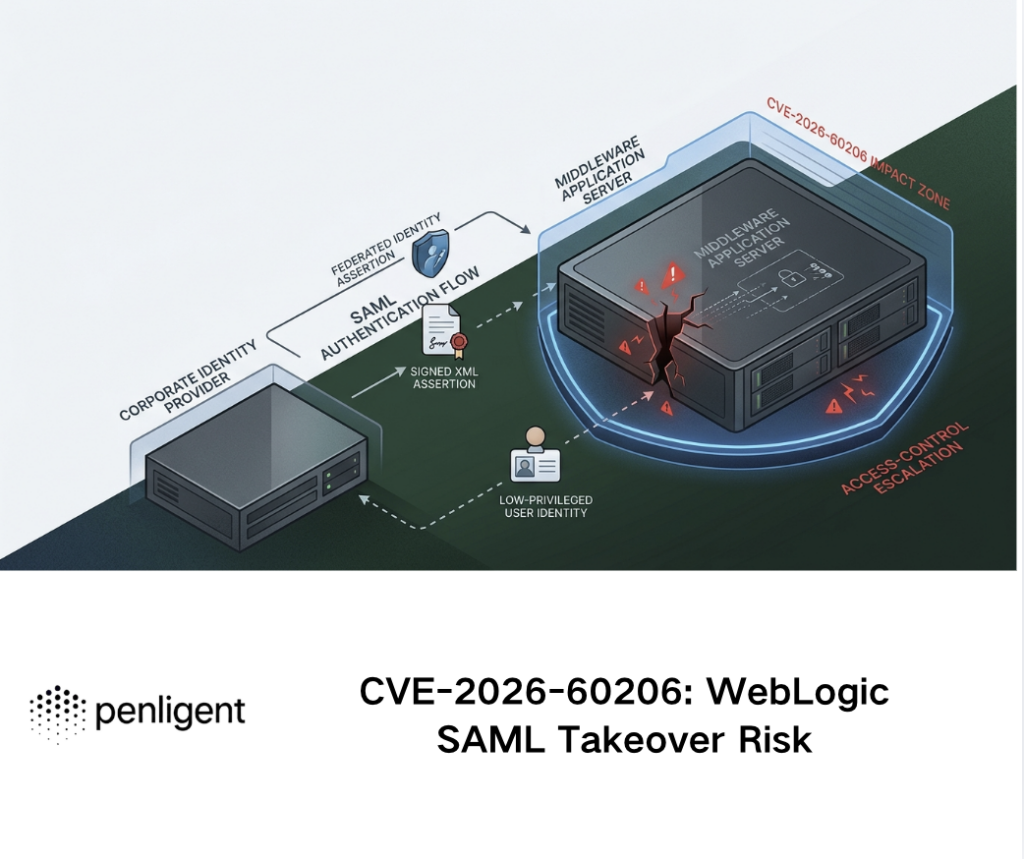
CVE-2026-60206 is a critical vulnerability in the Core component of Oracle WebLogic Server. Oracle disclosed and addressed the issue in its July 2026 Critical Patch Update. The vulnerability is reachable through a SAML-related network path and can be exploited remotely by an attacker who already has low-level privileges.
Successful exploitation may allow an attacker to take over the affected WebLogic Server. Oracle also classifies the vulnerability as scope-changing, meaning that the consequences may extend beyond the vulnerable WebLogic component and significantly affect applications or products that depend on the compromised server.
Oracle assigned CVE-2026-60206 a CVSS 3.1 base score of 9.9:
The vector describes a vulnerability that is remotely reachable, requires low attack complexity, needs a low-privileged identity, requires no user interaction, crosses a security scope boundary, and may have a high impact on confidentiality, integrity, and availability.
The affected Oracle WebLogic Server versions are:
| Oracle WebLogic Server version | Affected |
|---|---|
| 12.2.1.4.0 | Sim |
| 14.1.1.0.0 | Sim |
| 14.1.2.0.0 | Sim |
| 15.1.1.0.0 | Sim |
The breadth of this affected-version list matters. CVE-2026-60206 is not limited to an obsolete WebLogic branch. Oracle identifies multiple supported release lines, including WebLogic Server 15.1.1.0.0.
Organizations should therefore not assume that a recently installed or upgraded WebLogic environment is protected. The decisive question is whether the appropriate July 2026 security patch has been installed and successfully loaded by every relevant WebLogic process.
What Is CVE-2026-60206?
CVE-2026-60206 is an Oracle WebLogic Server vulnerability involving the Core component and a network-accessible SAML path.
According to Oracle’s advisory, an attacker with low privileges and network access through SAML may be able to compromise WebLogic Server. Successful exploitation may result in a complete takeover of the server.
The available vulnerability records associate CVE-2026-60206 with CWE-306, Missing Authentication for Critical Function. This classification suggests that a security-sensitive function may not consistently enforce the authentication checks that should protect it.
However, CWE classifications are broad categories. They do not reveal the exact vulnerable method, Java class, SAML validation step, security provider, request parameter, or code path involved.
The following information is currently established:
| Property | Confirmed information |
|---|---|
| Vendor | Oráculo |
| Produto | Oracle WebLogic Server |
| Product family | Oracle Fusion Middleware |
| Componente | Core |
| Network path | SAML |
| Vetor de ataque | Network |
| Attack complexity | Baixa |
| Required privileges | Baixa |
| User interaction | Nenhum |
| Escopo | Changed |
| Potential outcome | WebLogic Server takeover |
| CVSS 3.1 score | 9.9 Critical |
| Remediation source | Oracle July 2026 Critical Patch Update |
Oracle has not publicly disclosed the specific root cause, vulnerable Java class, affected SAML handler, corrected source-code logic, exact request sequence, or an official proof of concept.
That lack of technical detail is important. Security teams should not automatically describe CVE-2026-60206 as XML Signature Wrapping, unsigned assertion acceptance, arbitrary SAML assertion forgery, audience-validation bypass, assertion replay, NameID confusion, or group-attribute injection.
All of those are known classes of SAML security failure, but none should be attributed to CVE-2026-60206 without authoritative technical evidence.
Why the CVSS Score Is 9.9
The difference between a CVSS score of 9.9 and the more familiar 9.8 rating is central to understanding CVE-2026-60206.
Many critical unauthenticated vulnerabilities receive a vector containing PR:N, meaning that no privileges are required. CVE-2026-60206 instead uses PR:L, indicating that the attacker must already possess some form of low-level privilege.
At first glance, this prerequisite may make the vulnerability appear less urgent than an unauthenticated remote code execution flaw. That interpretation would underestimate the actual risk.
The remainder of the vector shows that the vulnerability:
- Is remotely reachable.
- Has low attack complexity.
- Requires no action from another user.
- Crosses a security scope boundary.
- Can have high confidentiality impact.
- Can have high integrity impact.
- Can have high availability impact.
The practical question is therefore not only whether authentication is required. The more important question is how difficult it would be for an attacker to obtain a low-privileged identity capable of reaching the relevant SAML workflow.
In enterprise environments, low-privileged identities may include employees, contractors, suppliers, customers, students, test users, partner identities, application accounts, or users created through self-service registration.
An attacker may also obtain such an identity through phishing, credential stuffing, password reuse, malware, browser-session theft, endpoint compromise, token theft, or compromise of a trusted partner.
The resulting privilege transition may look like this:
Low-privileged federated identity
              ↓
     Vulnerable SAML path
              ↓
 WebLogic security-boundary failure
              ↓
 Complete WebLogic compromise
              ↓
 Applications, credentials, data sources,
 services, and connected systems at risk
The low-privilege prerequisite is meaningful, but it should not be confused with an administrative prerequisite. A vulnerability that transforms an ordinary federated identity into control of a WebLogic domain remains an urgent enterprise risk.
How SAML Fits into Oracle WebLogic Server
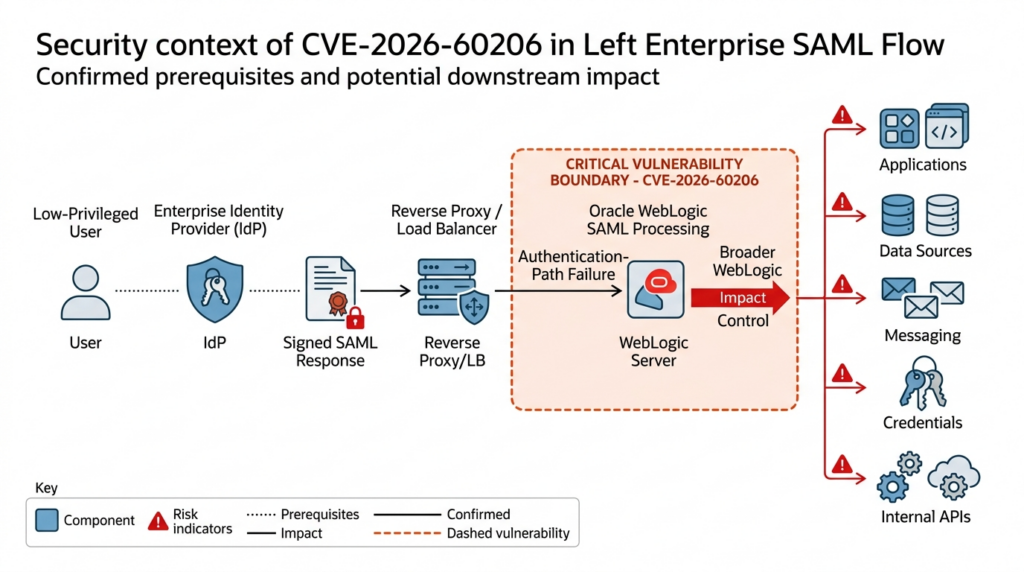
Security teams do not need a complete public exploit chain to understand why a WebLogic SAML vulnerability may have server-level consequences.
Security Assertion Markup Language, or SAML, is commonly used to exchange authentication and identity information between an Identity Provider and a Service Provider.
In a typical enterprise single sign-on workflow, the Identity Provider authenticates the user and creates a SAML response. The Service Provider receives that response, validates its security properties, extracts the asserted identity, and creates an authenticated application session.
Oracle WebLogic Server may act as a Service Provider, an Identity Provider, or participate in other SAML identity-assertion scenarios depending on the domain configuration.
A simplified workflow looks like this:
User
  |
  | 1. Requests a protected application
  v
WebLogic-hosted Service Provider
  |
  | 2. Redirects the user to the Identity Provider
  v
Enterprise Identity Provider
  |
  | 3. Authenticates the user
  | 4. Issues a SAML response
  v
WebLogic SAML processing
  |
  | 5. Validates the issuer, signature, destination,
  |    audience, time conditions, partner trust,
  |    replay state, and identity attributes
  v
WebLogic authenticated subject
  |
  | 6. Applies groups, roles, policies, and
  |    application authorization
  v
Protected application or service
The transition from externally supplied SAML identity information to a WebLogic authenticated subject is a critical trust boundary.
A secure SAML consumer must generally establish that:
- The assertion came from an explicitly trusted issuer.
- The relevant XML element is correctly signed.
- The signed element is the same element interpreted by the application.
- The response is intended for the correct recipient.
- The assertion has the correct audience.
- The assertion is within its permitted time window.
- The destination matches the expected service endpoint.
- Replay conditions are properly handled.
- Identity attributes cannot produce unauthorized local privileges.
- Partner metadata and certificates are trusted and current.
CVE-2026-60206 indicates that an important authentication boundary associated with the SAML path was not adequately enforced.
Oracle has not publicly identified which validation step failed. Any more specific explanation should therefore be labeled as unconfirmed research rather than established fact.
What Oracle Has Not Disclosed
Oracle Critical Patch Update advisories are designed primarily to communicate risk and patch requirements. They do not always contain the implementation-level detail that security researchers or defenders would prefer.
For CVE-2026-60206, the public advisory does not currently identify:
- The affected Java package or class.
- The vulnerable function.
- The precise SAML profile involved.
- Whether browser SSO, web-service SAML, or both are affected.
- Whether WebLogic must be acting specifically as a Service Provider.
- Whether a particular Authentication Provider is required.
- Whether a particular Identity Assertion Provider is required.
- Whether only certain partner configurations are vulnerable.
- The exact type of low-privileged identity required.
- The intermediate security primitive obtained by the attacker.
- The precise endpoint involved.
- The request sequence required for exploitation.
- A reliable pre-patch network detection signature.
- An official Oracle proof of concept.
This absence of detail changes the recommended verification strategy.
Rather than attempting to recreate an assumed exploit from incomplete information, security teams should prioritize version identification, patch inventory, SAML exposure mapping, configuration review, and controlled post-patch validation.
Is CVE-2026-60206 an Authentication Bypass?
CWE-306 places CVE-2026-60206 within the broader category of missing authentication for a critical function. It is therefore reasonable to describe the issue as an authentication-boundary vulnerability.
It is not accurate, based on Oracle’s published vector, to claim that any unauthenticated internet user can exploit it.
Oracle assigns PR:L, meaning that low privileges are required. The vulnerability should therefore be distinguished from a traditional unauthenticated WebLogic remote code execution flaw.
A more accurate description is:
CVE-2026-60206 is a critical Oracle WebLogic Server SAML-path vulnerability that may allow a low-privileged remote attacker to compromise and take over the WebLogic Server.
Calling it an “unauthenticated SAML bypass” would conflict with the published privilege requirement unless later authoritative research demonstrates a different attack prerequisite.
Why WebLogic Takeover Can Have an Enterprise-Wide Impact
Oracle WebLogic Server is often far more than an isolated web application process.
A WebLogic domain may host:
- Business-critical Java applications.
- Administrative and deployment functions.
- Integration services.
- Authentication components.
- Messaging workloads.
- JDBC data sources.
- JMS resources.
- Application credentials.
- Keystores and certificates.
- API integrations.
- Connections to downstream enterprise systems.
A complete WebLogic takeover may therefore amount to control of a middleware trust hub.
The possible post-compromise consequences depend on the server’s operating-system privileges, the applications deployed to the domain, network segmentation, secret-management practices, administrative architecture, and access granted to data sources.
Potential consequences may include:
| Security area | Potential consequence |
|---|---|
| Application confidentiality | Access to data processed by hosted applications |
| Application integrity | Modification or replacement of deployed applications |
| Autenticação | Impersonation or creation of trusted identities |
| Authorization | Manipulation of roles, groups, policies, or providers |
| Data access | Abuse of configured JDBC data sources |
| Messaging | Access to JMS queues, topics, or integrations |
| Segredos | Exposure of credentials, tokens, or keystore material |
| Availability | Server shutdown, destructive changes, or deployment disruption |
| Lateral movement | Use of the middleware server to reach connected systems |
These are risk scenarios, not confirmed descriptions of the CVE-2026-60206 exploit chain.
They explain why a successful WebLogic takeover can justify high confidentiality, integrity, and availability impact ratings.
Understanding the Scope-Changed Rating
O S:C element in the CVSS vector means Scope Changed.
In CVSS terminology, this indicates that successful exploitation may affect resources managed by a different security authority from the vulnerable component.
For WebLogic Server, the vulnerable SAML-processing component may be the initial point of entry, while the resulting compromise may affect applications, services, products, or data sources that rely on the WebLogic domain.
This is particularly concerning when a WebLogic installation serves as a shared platform for multiple applications or integrations.
A single identity-processing flaw may therefore create consequences across:
- Multiple deployed applications.
- Shared database connections.
- Messaging systems.
- Enterprise authentication flows.
- Internal APIs.
- Administrative services.
- Connected Oracle or third-party products.
Oracle warns that exploitation may significantly affect additional products, but the public advisory does not enumerate a fixed list of downstream products for CVE-2026-60206.
Which Environments Should Patch First?
Every affected WebLogic environment should receive the appropriate Oracle security patch. Prioritization should determine patch order, not whether remediation is necessary.
The highest-priority environments include:
- Internet-facing WebLogic applications using SAML.
- Partner or supplier portals.
- Customer-facing federated applications.
- Applications available to large employee populations.
- Systems that accept identities from external organizations.
- Domains connected to sensitive databases.
- WebLogic environments hosting multiple business-critical applications.
- Servers with weak network segmentation.
- Domains using broadly accessible low-privileged accounts.
- Environments where SAML is exposed through a reverse proxy or load balancer.
A useful prioritization model is:
Priority =
    affected WebLogic version
  × SAML reachability
  × ease of obtaining a low-privileged identity
  × privilege of the WebLogic domain
  × sensitivity of connected applications
  × weakness of network segmentation
An internal-only WebLogic environment should not automatically receive a low priority.
If an ordinary employee or contractor account can access the SAML workflow, an attacker who compromises one of those identities may already satisfy the privilege prerequisite.
Similarly, restricting the WebLogic Administration Console does not necessarily remove exposure. Oracle identifies SAML as the attack path, so the vulnerable processing may be reachable through an ordinary application login flow.
Asset Discovery for CVE-2026-60206
An effective response begins with an authoritative WebLogic inventory.
Security teams should not limit discovery to visible login pages or internet-facing domain names. WebLogic may be hidden behind reverse proxies, load balancers, application gateways, private DNS records, containers, or internal application platforms.
The inventory should capture:
| Inventory field | Por que é importante |
|---|---|
| Business service | Identifies operational impact and ownership |
| WebLogic domain | Defines the deployment and management boundary |
| Oracle Home | Identifies where patches must be applied |
| WebLogic version | Determines whether the release is affected |
| Administration Server | Identifies management-plane dependencies |
| Managed Servers | Identifies application-serving nodes |
| Cluster members | Prevents partially patched clusters |
| SAML role | Shows whether the domain acts as an SP, IdP, or both |
| Identity Provider partners | Defines external trust relationships |
| Exposed hostnames | Maps reachable SAML surfaces |
| Proxies and load balancers | Identifies routing and logging controls |
| Deployed applications | Defines the potential blast radius |
| Data sources | Identifies downstream data exposure |
| Integration credentials | Identifies secrets at risk |
| Patch owner | Assigns remediation responsibility |
| Maintenance window | Supports patch planning |
Discovery should also include:
- Disaster-recovery systems.
- Standby nodes.
- Test environments cloned from production.
- Dormant domains.
- Container images.
- Golden machine images.
- Autoscaling templates.
- Cloud marketplace deployments.
- Duplicate Oracle Homes.
- Servers scheduled for future reactivation.
An inactive vulnerable node can reintroduce risk when it is later restored to service.
How to Confirm the Installed WebLogic Version
WebLogic administrators can use the weblogic.version utility to inspect the base product release.
On Unix-like systems, a typical command is:
java -cp "$WL_HOME/server/lib/weblogic.jar" weblogic.version
This information is useful, but the base release alone does not prove whether CVE-2026-60206 has been fixed.
Oracle security updates are commonly applied to an existing Oracle Home without changing the main WebLogic release string. A correctly patched system may therefore continue to identify itself as WebLogic Server 12.2.1.4.0, 14.1.2.0.0, or another affected base release.
Version identification must be combined with patch inventory evidence.
How to Inspect the Oracle Patch Inventory
Oracle OPatch provides inventory commands for viewing patches installed in an Oracle Home.
A common command is:
export ORACLE_HOME=/path/to/oracle/home
"$ORACLE_HOME/OPatch/opatch" lsinventory -detail
Administrators may also use:
"$ORACLE_HOME/OPatch/opatch" lsinventory
"$ORACLE_HOME/OPatch/opatch" lsinventory -detail
"$ORACLE_HOME/OPatch/opatch" lsinventory -patch
The available options depend on the installed OPatch version.
The collected evidence should record:
Host:
Oracle Home:
WebLogic base version:
OPatch version:
Installed patch IDs:
Patch descriptions:
Patch application dates:
Inventory log location:
Command exit status:
A patch should not be considered valid merely because it has a recent date or a description containing “WebLogic.”
The installed patch must be compared with the exact patch required for:
- The WebLogic release.
- The operating system.
- The installed Fusion Middleware components.
- The Oracle Home layout.
- The existing patch baseline.
- Any one-off patches.
- The supported OPatch version.
- The deployment architecture.
The relevant My Oracle Support documentation and the README included with the patch package should be treated as authoritative.
Do Not Generalize Patch IDs Across Every Environment
A patch identifier documented for one operating system, cloud image, WebLogic release, or Fusion Middleware stack should not automatically be applied to every deployment.
Patch selection may differ because of:
- WebLogic version.
- Platform architecture.
- Operating system.
- Coherence installation.
- Shared Oracle components.
- Existing bundle patches.
- Existing one-off fixes.
- OPatch version.
- Stack Patch Bundle usage.
- Cloud image lifecycle.
- Product certification requirements.
The correct process is to identify the exact WebLogic environment, locate the July 2026 remediation through Oracle Support, review the patch README, perform conflict checks, and follow the documented installation procedure.
Determining Whether SAML Is Exposed
An affected WebLogic version proves that vulnerable software is present. It does not alone prove that the SAML attack path is reachable in a particular domain.
Exposure analysis should answer four questions:
- Is SAML functionality configured?
- Is WebLogic consuming or issuing SAML assertions?
- Which network routes can reach the SAML-processing workflow?
- Which low-privileged identities can interact with that workflow?
Administrators should review the WebLogic security realm and relevant SAML providers through supported management interfaces.
The review should identify:
- SAML Identity Assertion Providers.
- SAML Authentication Providers.
- Service Provider configuration.
- Identity Provider configuration.
- Trusted partner metadata.
- Signing and encryption certificates.
- Entity identifiers.
- Assertion Consumer Service configuration.
- Redirect and response routes.
- Local authentication providers.
- Group and role mappings.
- Application-specific authorization rules.
- Reverse-proxy routing.
- Load-balancer behavior.
A practical exposure record may look like this:
Application: Supplier Portal
WebLogic domain: supplier-prod
WebLogic version: 14.1.2.0.0
Oracle Home: /opt/oracle/middleware
SAML enabled: Yes
WebLogic role: Service Provider
Trusted IdP: Corporate Identity Platform
Reachability: Internet through reverse proxy
Eligible users: Employees and approved suppliers
Administration Console exposure: Internal only
Sensitive integrations: ERP database and document service
July 2026 patch status: Pending
This system should remain a critical remediation target even though the Administration Console is not public. The supplier-facing SAML workflow may satisfy the network and low-privilege prerequisites.
Safe CVE-2026-60206 Validation Workflow
Because Oracle has not publicly documented the root cause, the safest initial validation approach is evidence-based rather than exploit-based.
A mature workflow contains six stages:
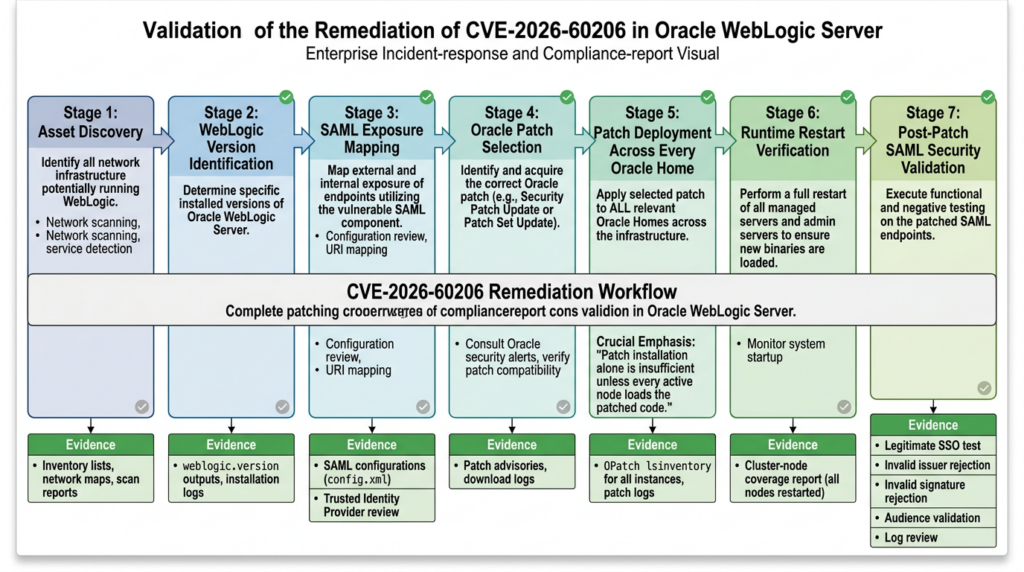
Stage 1: Obtain Explicit Authorization
Testing should be limited to systems that the operator is authorized to assess.
The authorization should define:
- Target hostnames.
- Environments.
- WebLogic domains.
- Approved test identities.
- Identity Providers.
- Maintenance windows.
- Prohibited actions.
- Logging requirements.
- Evidence-retention rules.
- Rollback procedures.
- Escalation contacts.
CVE-2026-60206 affects an authentication path that may lead to complete server compromise. Uncontrolled testing could affect active sessions, SAML integrations, application availability, audit systems, or administrative state.
Stage 2: Establish a Pre-Patch Baseline
Before changing the environment, collect:
- WebLogic base version.
- OPatch version.
- Full OPatch inventory.
- Oracle Home path.
- Domain topology.
- Cluster topology.
- SAML provider configuration.
- Trusted SAML partners.
- Load-balancer routes.
- Reverse-proxy routes.
- Startup scripts.
- Running process information.
- WebLogic server logs.
- Identity Provider logs.
- Application health results.
- Valid low-privileged SSO behavior.
- Expected authorization denials.
This baseline allows the organization to distinguish patch-related regressions from pre-existing configuration problems.
Stage 3: Confirm SAML Functionality Without Exploitation
Use a legitimate low-privileged test identity to complete the standard SAML login flow.
Record:
Test identity:
Identity Provider:
Application:
Login start time:
Assertion issue time:
WebLogic session creation:
Expected local roles:
Expected denied resources:
Logout behavior:
Identity Provider event ID:
WebLogic log correlation:
This confirms that the application uses SAML and establishes the expected authorization level of the test identity.
Do not attempt to prove exposure in production by submitting arbitrary unsigned, modified, or attacker-generated assertions based on an unverified public exploit theory.
Such testing may exercise the wrong vulnerability class, produce misleading results, or disrupt the authentication service.
Stage 4: Apply the Oracle July 2026 Patch
Follow the version-specific Oracle Support documentation and the README included with the patch.
The installation process may include:
- Prerequisite checks.
- OPatch version updates.
- Inventory backups.
- Domain backups.
- Conflict analysis.
- Service shutdown.
- Rolling or non-rolling patch procedures.
- Patch application.
- Component-specific post-installation steps.
- Server restart.
- Application health validation.
Do not assume that every WebLogic patch supports the same rolling installation strategy. The correct process depends on the patch, WebLogic version, domain architecture, and Oracle documentation.
Stage 5: Verify Every Oracle Home
Run OPatch inventory against every Oracle Home used by:
- Administration Servers.
- Managed Servers.
- Cluster members.
- Disaster-recovery nodes.
- Standby servers.
- Container images.
- Golden images.
- Autoscaling templates.
- Deployment automation.
A cluster is not fully remediated if traffic can still reach one unpatched member.
A patch-evidence table may look like this:
| Node | Oracle Home | Expected patch | Inventory result | Restarted | Status |
|---|---|---|---|---|---|
| admin-01 | /opt/oracle/fmw | Confirmed through Oracle Support | Present | Sim | Pass |
| app-01 | /opt/oracle/fmw | Confirmed through Oracle Support | Present | Sim | Pass |
| app-02 | /opt/oracle/fmw | Confirmed through Oracle Support | Present | Sim | Pass |
| dr-app-01 | /opt/oracle/fmw | Confirmed through Oracle Support | Missing | Não | Fail |
Stage 6: Perform Post-Patch Security Validation
Post-patch validation should prove more than basic availability.
It should confirm that legitimate SAML authentication still works and that invalid identity conditions continue to be rejected.
In a controlled staging environment, or during an explicitly approved production test window, teams should validate:
| Test | Expected result |
|---|---|
| Valid assertion from trusted IdP | Accepted |
| Valid low-privileged identity | Receives only intended roles |
| Access to administrative resource | Denied unless explicitly authorized |
| Assertion from untrusted issuer | Rejected |
| Assertion for incorrect audience | Rejected |
| Assertion for incorrect recipient | Rejected |
| Expired assertion | Rejected |
| Not-yet-valid assertion | Rejected |
| Invalid signature | Rejected |
| Modified signed content | Rejected |
| Improperly replayed assertion | Rejected |
| Missing required identity attribute | Rejected or handled safely |
| Unexpected group value | Does not grant unauthorized privilege |
| Unexpected role value | Does not grant administrative access |
These are general SAML security properties. They should not be described as a confirmed reproduction of CVE-2026-60206 unless Oracle or authoritative technical research establishes the exact vulnerability mechanism.
Why a Vulnerability Scanner May Not Be Enough
A conventional vulnerability scanner may detect an exposed WebLogic service, identify a version string, or discover a SAML-related route.
Each of those observations answers a different question:
Version detection:
“Is an affected WebLogic release present?”

Exposure detection:
“Can the relevant SAML workflow be reached?”

Patch inventory:
“Is Oracle’s security remediation installed?”

Functional validation:
“Does legitimate SSO still work?”

Security validation:
“Are invalid SAML conditions rejected?”

Impact validation:
“Can observed behavior cross an authorization boundary?”
A banner-based result can create a false positive when the patch is installed without changing the base release string.
It can also create a false negative when the server hides or modifies version information.
The strongest CVE-2026-60206 evidence combines:
- Authenticated host inventory.
- Oracle Home identification.
- OPatch inventory.
- WebLogic configuration evidence.
- SAML exposure analysis.
- Identity Provider records.
- Proxy and load-balancer logs.
- Controlled functional testing.
- Controlled negative security testing.
Logging and Detection Opportunities
Oracle has not published a definitive network detection signature for CVE-2026-60206.
Detection should therefore focus on identity behavior, authorization anomalies, administrative changes, and post-authentication consequences rather than one assumed malicious XML pattern.
Useful telemetry sources include:
| Data source | Detection value |
|---|---|
| Identity Provider logs | Authentication, MFA, device, source, and assertion issuance |
| Reverse-proxy logs | Requests reaching SAML application routes |
| Load-balancer logs | Routing across WebLogic cluster nodes |
| WebLogic server logs | SAML processing and application events |
| WebLogic audit provider | Authentication and authorization decisions |
| Administrative audit logs | Configuration and deployment changes |
| Application logs | User actions after SSO |
| Database audit logs | Downstream access through JDBC data sources |
| Endpoint telemetry | Process, file, and command activity on the host |
| Network telemetry | Unexpected outbound or lateral connections |
SAML debug logging may provide additional detail, but it should be enabled carefully.
Authentication logs may contain:
- User identifiers.
- Partner identifiers.
- Assertion metadata.
- Destination information.
- Certificate details.
- Session identifiers.
- Group or role information.
Production SAML debugging should therefore use a defined collection window, restricted access, retention controls, and a rollback plan.
Suspicious Authentication Sequences
Detection engineering should correlate low-privileged SAML activity with actions that do not match the user’s expected authorization level.
Por exemplo:
Low-privileged SAML login
        +
Access to a normally administrative application
        +
New deployment or configuration change
Federated user authentication
        +
Unexpected WebLogic management request
        +
New outbound connection from the server
SAML session creation
        +
Security-provider modification
        +
Logging configuration change
Ordinary application identity
        +
Access to sensitive data sources
        +
High-volume data retrieval
No single sequence proves exploitation of CVE-2026-60206. Each should trigger investigation when observed on an affected or previously affected WebLogic environment.
Indicators Worth Investigating
Security teams should investigate:
- SAML logins from unusual locations, networks, or devices.
- Impossible travel involving federated identities.
- Low-privileged users reaching administrative functions.
- Unexpected access to deployment interfaces.
- Changes to authentication providers.
- Changes to Identity Assertion Providers.
- Changes to trusted SAML partners.
- Changes to role or group mappings.
- Newly deployed applications.
- Modified deployment archives.
- Changes to JDBC data sources.
- Changes to JMS resources.
- Changes to server startup arguments.
- New WebLogic administrative users.
- New privileged groups.
- Unexplained server restarts.
- SAML sessions without matching expected IdP transactions.
- Repeated assertion errors followed by a privileged session.
- Unexpected outbound traffic from WebLogic servers.
- Disabled or reduced logging.
- Missing log intervals.
- Access to multiple sensitive applications by an unusual identity.
A WebLogic session that appears to originate from SAML but lacks a corresponding Identity Provider event deserves particular attention.
This discrepancy may result from a logging failure, a different authentication route, a configuration problem, or an identity-processing anomaly. It is not proof of exploitation, but it warrants investigation.
Patch Validation Must Include Runtime Evidence
An OPatch inventory entry proves that a patch was registered in an Oracle Home. It does not prove that every running WebLogic process has loaded the corrected code.
Runtime validation should confirm that:
- The relevant Oracle Home contains the expected patch.
- Every required server process has been restarted.
- Running processes use the patched Oracle Home.
- Load balancers no longer route traffic to unpatched nodes.
- Containers were recreated from patched images.
- Disaster-recovery systems were updated.
- Autoscaling templates were updated.
- Golden images no longer contain the vulnerable baseline.
- Legitimate SAML login still succeeds.
- Invalid SAML conditions remain rejected.
- Application authorization still behaves correctly.
One common failure occurs when an administrator patches one Oracle Home while a Managed Server starts from another.
Another occurs when a running cloud instance is patched manually but the autoscaling template still launches an older vulnerable image.
For every active Java process, administrators should map:
Running process
      ↓
Domain Home
      ↓
WebLogic Home
      ↓
Oracle Home
      ↓
Installed patch inventory
Temporary Mitigations When Patching Is Delayed
The Oracle security patch is the primary remediation.
Compensating controls may reduce practical exposure, but they should not be recorded as equivalent fixes.
Restrict SAML Reachability
Limit access to SAML-facing application routes to expected networks, users, gateways, or identity infrastructure where the business architecture permits it.
For internal applications, require access through a managed VPN, zero-trust access gateway, or dedicated enterprise network.
For public applications, confirm that direct backend access cannot bypass the approved reverse proxy or identity gateway.
This control does not prevent attacks from compromised legitimate users.
Isolate the WebLogic Management Plane
Restrict access to:
- Administration Console.
- Node Manager.
- Deployment services.
- Administrative APIs.
- Management ports.
- Internal management protocols.
These interfaces should be accessible only from dedicated administrative networks or trusted management systems.
Management-plane isolation does not repair CVE-2026-60206, but it may reduce post-compromise opportunities.
Disable Unused SAML Services
If a WebLogic domain no longer needs SAML, disable unused SAML services and providers through the supported WebLogic configuration process.
Before disabling them, confirm application dependencies and prepare a rollback plan.
Removing one public proxy route is not sufficient if the underlying SAML service remains reachable through another hostname, port, or internal route.
Reduce Federated Privilege
Review mappings from SAML attributes and groups to:
- WebLogic groups.
- Application roles.
- Administrative policies.
- Deployment permissions.
- Sensitive application functions.
Remove unnecessary mappings and confirm that ordinary federated attributes cannot grant administrative roles.
Least privilege will not fix missing authentication for a critical function, but it can reduce the number of identities with useful access.
Review Trusted SAML Partners
Review every configured partner and remove obsolete entries.
Validate:
- Partner metadata.
- Entity identifiers.
- Signing certificates.
- Encryption certificates.
- Certificate expiration.
- Assertion Consumer Service configuration.
- Allowed redirect destinations.
- Group and role mappings.
- Partner ownership.
- Business justification.
Strengthen Identity Provider Controls
MFA, conditional access, device trust, session controls, risk-based authentication, and short-lived sessions may reduce the likelihood that an attacker obtains a usable low-privileged identity.
These measures do not fix the vulnerable WebLogic processing path.
Increase Monitoring
Until patching and validation are complete, increase monitoring around:
- SAML authentication.
- WebLogic administration.
- Application deployment.
- Security-provider changes.
- Role and group changes.
- Data-source access.
- Server restarts.
- Outbound network connections.
- Logging changes.
Do Not Depend on a Generic WAF Rule
SAML uses structured XML, signatures, canonicalization, references, encoded responses, redirects, and deployment-specific routes.
Without an authoritative exploit pattern, a generic WAF rule may block legitimate authentication while missing the real vulnerability condition.
A WAF may reduce obvious abuse or enforce route restrictions, but it should not be treated as remediation for CVE-2026-60206.
Incident Response for Suspected Exploitation
If an affected WebLogic Server shows evidence of unauthorized privilege, unusual SAML sessions, administrative changes, or unexpected deployment activity, incident response should go beyond patch installation.
Patching prevents future exploitation of the corrected condition. It does not remove persistence, restore modified applications, revoke stolen secrets, or explain what an attacker accessed before remediation.
A reasonable response sequence is:
Preserve evidence
      ↓
Restrict access
      ↓
Identify affected identities and sessions
      ↓
Review WebLogic and IdP activity
      ↓
Determine configuration and deployment changes
      ↓
Inspect downstream systems
      ↓
Rebuild or restore trusted state
      ↓
Rotate exposed credentials and keys
      ↓
Patch and validate
      ↓
Monitor for recurrence
Evidence preservation should include:
- WebLogic server logs.
- Identity Provider events.
- Reverse-proxy records.
- Load-balancer logs.
- Application logs.
- Operating-system telemetry.
- Process information.
- Deployment archives.
- Domain configuration.
- OPatch inventory.
- Filesystem metadata.
- Database audit logs.
- Network telemetry.
- Authentication-provider configuration.
- SAML partner metadata.
Responders should determine whether the suspicious identity or session:
- Accessed administrative resources.
- Changed the security realm.
- Modified authentication providers.
- Added trusted partners.
- Changed role mappings.
- Deployed an application.
- Modified an existing deployment.
- Accessed sensitive databases.
- Retrieved credentials or keys.
- Created persistent administrative access.
- Used WebLogic to reach other systems.
Where server takeover is credible, rebuilding from a trusted baseline is generally stronger than attempting to prove that every attacker modification has been removed from the existing environment.
Credential and Key Rotation
Routine preventive patching does not automatically prove that secrets were compromised.
However, if logs or forensic evidence suggest possible exploitation, organizations should identify credentials and cryptographic material available to the affected WebLogic domain.
Potentially exposed secrets may include:
- WebLogic administrative credentials.
- Application service accounts.
- Database usernames and passwords.
- API tokens.
- Integration credentials.
- Keystore passwords.
- Private keys.
- TLS certificates.
- SAML signing keys.
- SAML encryption keys.
- Cloud credentials.
- Messaging credentials.
- Credentials embedded in deployment files.
Rotation should be prioritized according to evidence and exposure, but teams should avoid assuming that patching alone invalidates credentials already obtained by an attacker.
Public Exploit Claims
Public repositories and social-media posts using the CVE-2026-60206 identifier may appear after disclosure.
Their existence does not prove that they accurately reproduce the Oracle vulnerability.
A repository may:
- Test a normal SAML error condition.
- Target an unrelated endpoint.
- Misinterpret an HTTP 200 response.
- Exploit a deployment-specific misconfiguration.
- Contain nonfunctional code.
- Contain harmful code.
- Describe an unconfirmed root cause.
- Use the correct CVE identifier for visibility.
A script that receives a redirect, reaches a SAML route, or obtains a generic application response has not necessarily demonstrated CVE-2026-60206.
Security teams should treat public proof-of-concept claims as unverified until the behavior is supported by authoritative analysis, patch comparison, reproducible evidence, or vendor confirmation.
Should Organizations Wait for Confirmed Exploitation?
No.
The absence of a confirmed exploitation campaign should not delay remediation of a vendor-rated CVSS 9.9 WebLogic takeover vulnerability.
Oracle’s published assessment already establishes that the issue:
- Is remotely reachable.
- Requires low attack complexity.
- Needs only low privileges.
- Requires no user interaction.
- Crosses a security scope.
- May produce complete WebLogic compromise.
That combination is sufficient to justify urgent patching, especially in SAML-enabled environments exposed to large user populations or external partners.
Using Penligent for Controlled CVE Validation
CVE-2026-60206 demonstrates why CVE verification should be treated as an evidence-driven workflow rather than a single exploit attempt.
Within an explicitly authorized environment, Penligent can support a process that begins with asset identification, records version and service evidence, examines SAML exposure, collects authorized patch-inventory output, coordinates controlled validation, and preserves evidence for remediation reporting.
A responsible CVE-2026-60206 task should instruct the testing agent to:
1. Confirm that the target is explicitly authorized.
2. Identify the WebLogic release using multiple evidence sources.
3. Record whether SAML is configured and reachable.
4. Identify trusted Identity Provider relationships.
5. Collect OPatch inventory where host access is authorized.
6. Compare the evidence with Oracle’s July 2026 remediation.
7. Avoid destructive or speculative exploit payloads.
8. Validate legitimate SSO after patching.
9. Test agreed negative authentication properties in staging.
10. Preserve commands, responses, timestamps, and approvals.
11. Separate confirmed findings from technical hypotheses.
12. Produce an editable remediation report.
The platform should not be instructed to execute unverified public exploit code against a production identity system solely because the repository uses the CVE identifier.
For a vulnerability with limited public root-cause information, disciplined evidence collection is more reliable than forcing an assumed exploit chain.
Penligent should only be used for authorized security testing with a defined target scope, controlled credentials, operator approval, and appropriate rollback procedures.
Recommended Remediation Checklist
| Ação | Required outcome |
|---|---|
| Identify affected releases | All affected WebLogic installations are recorded |
| Identify SAML-enabled domains | SP, IdP, provider, and partner configurations are documented |
| Map network exposure | SAML routes, proxies, load balancers, and hostnames are recorded |
| Identify eligible identities | Low-privileged user and partner populations are understood |
| Obtain Oracle patch | Exact July 2026 patch is selected through Oracle Support |
| Review patch README | Prerequisites, conflicts, OPatch version, and restart steps are confirmed |
| Back up the environment | Domain configuration and recovery material are preserved |
| Patch every Oracle Home | Administration, Managed Server, DR, and image homes are updated |
| Verify inventory | Expected patch appears in OPatch inventory |
| Restart correctly | Every relevant process loads patched code |
| Validate availability | Applications and integrations remain healthy |
| Validate legitimate SAML | Trusted single sign-on succeeds |
| Validate security properties | Invalid issuer, signature, timing, audience, and role conditions are rejected |
| Review logs | No unexplained privileged sessions or configuration changes are found |
| Update templates | Images, containers, automation, and DR baselines are corrected |
| Retain evidence | Patch and validation records are available for audit |
Common Patch-Validation Failures
Checking Only the Login Page
A functioning login page proves that the application is available. It does not prove that the July 2026 patch is installed.
Trusting the Base Version String
A patched WebLogic installation may continue to report the same base release. Patch inventory is still required.
Patching Only the Administration Server
Managed Servers may use separate Oracle Homes. Every active Oracle Home must be verified.
Forgetting Disaster-Recovery Nodes
A vulnerable disaster-recovery server can become production during failover.
Forgetting Golden Images
A corrected running server may later be replaced by an instance created from an outdated image.
Forgetting Autoscaling Templates
New nodes may reintroduce the vulnerable patch baseline even after existing nodes are updated.
Treating One Proxy Rule as Complete Mitigation
Alternative hostnames, direct ports, internal routes, or secondary proxies may still expose SAML processing.
Running an Unverified PoC as the Main Test
A third-party script may target the wrong vulnerability mechanism while still reporting apparent success.
Performing Only Positive Login Testing
A successful legitimate login proves compatibility. It does not prove that invalid assertions are rejected.
Skipping Authorization Testing
Authentication may work correctly while group or role mappings grant unintended privileges.
Closing the Finding Without Evidence
A remediation ticket should contain patch IDs, inventory output, node coverage, restart evidence, test results, and residual-risk conclusions.
Frequently Asked Questions
Is CVE-2026-60206 remotely exploitable?
Yes. Oracle assigns the vulnerability a network attack vector and identifies SAML as the relevant access path.
Is CVE-2026-60206 unauthenticated?
Not according to Oracle’s published CVSS vector. The vulnerability requires low privileges.
Can an ordinary user exploit CVE-2026-60206?
Oracle states that a low-privileged attacker is required, but it does not publicly define the exact type of identity, group membership, or application access needed.
Organizations should assume that an ordinary federated user may satisfy the prerequisite until their environment-specific analysis proves otherwise.
Can CVE-2026-60206 lead to complete WebLogic takeover?
Yes. Oracle states that successful exploitation may result in takeover of Oracle WebLogic Server.
Is CVE-2026-60206 remote code execution?
Oracle describes the final impact as server takeover but does not publicly document the intermediate security primitive.
The vulnerability may involve code execution or an equivalent form of administrative control, but a specific RCE mechanism should not be claimed without technical evidence.
Is CVE-2026-60206 a SAML authentication bypass?
It is a critical vulnerability involving a SAML authentication path and is associated with missing authentication for a critical function.
However, Oracle has not disclosed the exact bypass mechanism. Claims involving unsigned assertions, signature wrapping, arbitrary assertion forgery, or audience bypass remain unconfirmed.
Which WebLogic versions are affected?
Oracle lists:
- 12.2.1.4.0
- 14.1.1.0.0
- 14.1.2.0.0
- 15.1.1.0.0
Is WebLogic Server 15.1.1.0.0 affected?
Yes. A recent WebLogic release is not automatically protected without the appropriate July 2026 patch.
Is an affected version vulnerable when SAML is disabled?
Oracle identifies SAML as the relevant network path. A domain with no reachable SAML functionality may have lower practical exposure.
The affected software should still be patched because configurations change, hidden dependencies may exist, and version-level remediation is more reliable than depending permanently on a feature remaining unused.
Does hiding the WebLogic Administration Console mitigate CVE-2026-60206?
Not by itself.
The vulnerable SAML path may be exposed through an ordinary business application even when the Administration Console is restricted to an internal network.
Can a WAF block CVE-2026-60206?
A WAF may restrict access to SAML routes or block some malformed requests.
Oracle has not publicly documented an authoritative exploit signature, so a WAF should not be treated as a replacement for the security patch.
How can I verify that the patch is installed?
Identify the WebLogic base release, inspect the exact Oracle Home with OPatch, compare the installed patches with Oracle’s July 2026 patch documentation, verify every cluster node, and confirm that all required services were restarted.
Is opatch lsinventory enough?
No.
It is important evidence, but validation should also confirm that:
- Every running server uses the patched Oracle Home.
- Required restarts occurred.
- No unpatched cluster members remain.
- Old images and templates were replaced.
- Legitimate SAML still works.
- Invalid SAML conditions are rejected.
Should I run a public CVE-2026-60206 proof of concept?
Not against production merely to confirm patch status.
Public code may be inaccurate, malicious, or based on an unconfirmed vulnerability mechanism. Begin with patch, version, configuration, and exposure evidence.
Where deeper testing is required, use an authorized staging environment, controlled identities, source review, monitoring, and rollback procedures.
Should credentials be rotated after patching?
Preventive patching alone does not prove that credentials were exposed.
If evidence suggests possible exploitation or server takeover, identify and rotate credentials, tokens, certificates, keys, and service-account secrets accessible to the affected WebLogic environment.
What is the most reliable way to close a CVE-2026-60206 finding?
A strong closure record contains:
Affected asset and owner
WebLogic base version
SAML exposure determination
Oracle Home
Required July 2026 patch
Installed patch ID and description
OPatch inventory output
Coverage for every cluster node
Restart confirmation
Application health results
Valid SAML login result
Negative SAML security-test results
Log-review result
Residual-risk statement
Approver and completion date
Final Assessment
CVE-2026-60206 should be treated as an urgent WebLogic identity-boundary vulnerability.
The attacker prerequisite is limited, but the potential result is not. Oracle’s CVSS 9.9 rating describes a remotely reachable, low-complexity path from a low-privileged identity to complete WebLogic Server compromise, with possible consequences beyond the original vulnerable component.
At the same time, defenders should avoid unsupported technical certainty.
Oracle has not publicly disclosed the exact SAML validation failure, vulnerable Java class, request sequence, or official exploitation method. Public repositories using the CVE identifier do not independently prove the root cause.
The most defensible response is to:
- Identify every affected WebLogic installation.
- Map SAML configuration and network reachability.
- Determine which low-privileged identities can access the workflow.
- Obtain the exact July 2026 patch from Oracle.
- Patch every relevant Oracle Home.
- Restart every affected process.
- Verify the patch through OPatch inventory.
- Validate legitimate SAML authentication.
- Confirm that invalid identity conditions are rejected.
- Review logs for unauthorized privilege or configuration changes.
- Update disaster-recovery systems, containers, and deployment templates.
- Preserve evidence for remediation and audit.
For CVE-2026-60206, installing the patch is only the beginning of verification—not the end.


 Portuguese
  English
  German
  French
  Spanish
  Japanese
  Korean
  Hindi
Hindi  Arabic
  Turkish
  Hebrew