
CVE-2026-69836 is a maximum-severity remote code execution vulnerability in Microsoft Entra ID, Microsoft’s cloud identity and access management platform formerly known as Azure Active Directory.
On paper, almost every part of the vulnerability looks severe.
Microsoft assigned CVE-2026-69836 a CVSS 3.1 base score of 10.0. The vulnerability is remotely reachable, requires low attack complexity, requires no prior privileges, and requires no user interaction. Microsoft classified the underlying weakness as CWE-502: Deserialization of Untrusted Data. The official CVE description states that unsafe deserialization in Microsoft Entra ID could allow an unauthorized attacker to execute code over a network. (NVD)
There is, however, an unusually important qualification.
Early reporting on August 21, 2026 described CVE-2026-69836 as an actively exploited vulnerability because Microsoft’s initial security metadata reportedly marked it as Exploited: Yes. That status was subsequently corrected. Reporting published on August 22 states that Microsoft changed the field to Exploited: No, while the current NVD enrichment from CISA marks exploitation as nenhum. (Forkast)
That correction materially changes how the vulnerability should be described.
As of August 22, 2026, it is accurate to call CVE-2026-69836 a critical, remotely exploitable Microsoft Entra ID RCE that Microsoft has already mitigated server-side. It is no longer accurate to state as an established fact that the vulnerability is currently being exploited in the wild.
The distinction matters because the first wave of vulnerability reporting is already indexed across search engines, threat feeds, social networks, and automated CVE databases. Security teams therefore need to separate the technical severity of CVE-2026-69836 from the evolving evidence about real-world exploitation.
CVE-2026-69836 at a Glance
| Atributo | CVE-2026-69836 |
|---|---|
| CVE | CVE-2026-69836 |
| Produto | Microsoft Entra ID / Microsoft Entra |
| Tipo de vulnerabilidade | Execução remota de código |
| Fraqueza | CWE-502: Deserialization of Untrusted Data |
| CVSS 3.1 | 10.0 Critical |
| Vetor de ataque | Network |
| Attack complexity | Baixa |
| Privileges required | Nenhum |
| User interaction | Nenhum |
| Escopo | Changed |
| Confidentiality impact | Alta |
| Integrity impact | Alta |
| Availability impact | Alta |
| Hosted model | Microsoft-operated cloud service |
| CVE tag | exclusively-hosted-service |
| Customer patch required | Não |
| Public technical exploit details | Not disclosed |
| PoC pública | None confirmed in Microsoft’s disclosure |
| Current exploitation assessment | Microsoft reportedly corrected to No; CISA SSVC currently shows exploitation: none |
NVD currently reproduces Microsoft’s vector as:
CVSS:3.1/AV:N/AC:L/PR:N/UI:N/S:C/C:H/I:H/A:H
and identifies the affected product as Microsoft Entra. NVD also labels the vulnerability an Exclusively Hosted Service and, as of August 22, is still enriching the entry. (NVD)
What Is CVE-2026-69836?
The official public description is short:
“Deserialization of untrusted data in Microsoft Entra ID allows an unauthorized attacker to execute code over a network.”
That sentence tells us three important things.
First, the vulnerable component existed somewhere inside the Microsoft-operated Entra service rather than inside software that customers install on their own servers.
Second, attacker-controlled information could reach a deserialization operation.
Third, successful exploitation could cross the boundary between processing data and executing code.
What Microsoft has não publicly disclosed is equally important.
There is currently no authoritative public description of the vulnerable API endpoint, protocol, serialized object format, affected backend service, application framework, gadget chain, request structure, or command-execution primitive.
Therefore, diagrams or articles claiming that CVE-2026-69836 works through a specific HTTP endpoint, JSON property, .NET BinaryFormatter object, Java serialization stream, OAuth token field, SAML assertion, or Microsoft Graph request should be treated skeptically unless Microsoft or a credible technical researcher later publishes evidence supporting that claim.
CWE-502 describes a vulnerability family. It does not disclose the actual CVE-2026-69836 exploit chain.
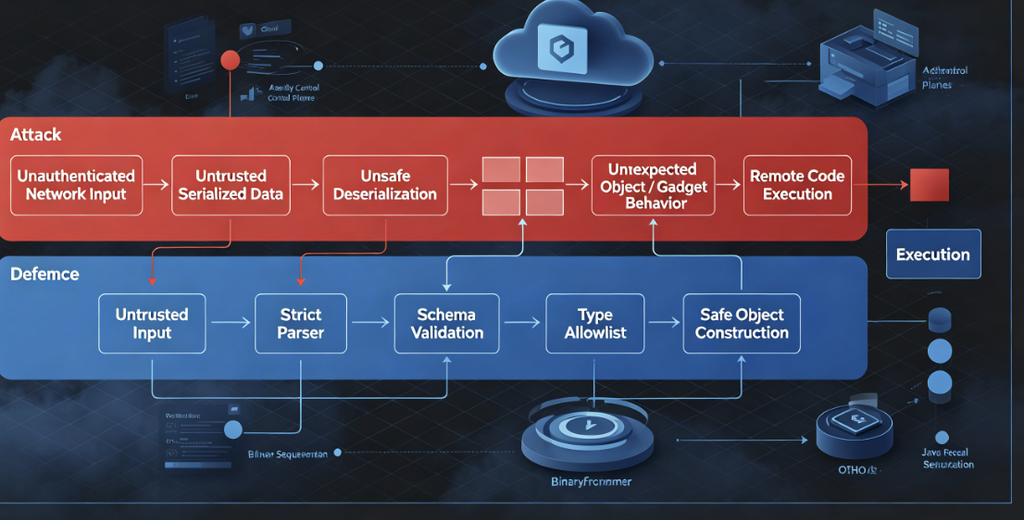
Why Deserialization Can Become Remote Code Execution
Serialization is the process of converting application state or objects into a representation that can be stored or transmitted.
Deserialization reverses the process.
Conceptually:
Application object
        |
        v
   Serialization
        |
        v
Serialized representation
        |
     Network
        |
        v
  Deserialization
        |
        v
Reconstructed object
There is nothing inherently vulnerable about this process.
The security problem occurs when software accepts attacker-controlled serialized data and reconstructs it without sufficiently restricting what can be instantiated or what behavior can occur while the object is reconstructed.
MITRE defines CWE-502 as a situation in which a product deserializes untrusted data without sufficiently ensuring that the resulting data is valid. MITRE notes that consequences can include unexpected object manipulation and, depending on available functionality, attacker-controlled gadget chains capable of causing unauthorized actions or code execution. (CWE)
A simplified unsafe design might look conceptually like this:
Untrusted network input
        |
        v
Deserialize directly
        |
        v
Instantiate attacker-influenced object
        |
        v
Unexpected method / gadget behavior
        |
        v
Arbitrary operation
A safer architecture instead constrains the transition:
Untrusted input
        |
        v
Parse into inert data
        |
        v
Schema validation
        |
        v
Strict type allowlist
        |
        v
Construct safe application object
This is the general security model behind CWE-502.
It should não be interpreted as a reconstructed CVE-2026-69836 exploit chain. Microsoft’s public advisory does not currently provide enough detail to determine precisely how untrusted data reached the vulnerable deserializer.
Why CVE-2026-69836 Received a CVSS 10.0 Score
The CVSS vector deserves more attention than the number itself.
AV:N — Attack Vector Network
AV:N indicates that the vulnerable component could be attacked remotely over a network rather than requiring local access.
For an identity service exposed as part of a global cloud platform, this characteristic is particularly important.
AC:L — Attack Complexity Low
AC:L means the CVSS assessment does not assume complicated race conditions, highly specific environmental circumstances, or other exceptional prerequisites.
This does not mean a public exploit is easy to write.
Exploit development can still be difficult when the underlying protocol, object type, backend implementation, or vulnerable processing path has not been disclosed.
CVSS attack complexity and exploit-development difficulty are related but not identical concepts.
PR:N — Privileges Required None
The attacker does not need an authenticated account according to Microsoft’s CVSS assessment.
This makes CVE-2026-69836 fundamentally different from vulnerabilities requiring an already compromised Entra administrator, application owner, service principal, or tenant user.
UI:N — User Interaction None
There is no requirement for a victim to click a link, open a document, approve a consent request, or otherwise participate in exploitation.
S:C — Scope Changed
O S:C component is especially significant.
In CVSS 3.1, changed scope indicates that exploitation of the vulnerable component can affect resources governed by a different security authority.
The exact architecture producing this assessment has not been disclosed, so it would be speculative to map S:C to a particular Entra subsystem.
What can safely be said is that Microsoft’s own CVSS assessment considers the security consequences capable of crossing the original vulnerable component’s authority boundary.
C:H / I:H / A:H
Microsoft rated confidentiality, integrity, and availability impacts as High.
Taken together:
Remote
+
Low complexity
+
No authentication
+
No user interaction
+
Changed scope
+
High C/I/A impact
=
CVSS 10.0
NVD currently lists Microsoft’s complete base vector and 10.0 score while noting that NVD’s own enrichment remains in progress. (NVD)
Why an Entra ID RCE Is Different From an Ordinary Web RCE
Microsoft Entra ID is not simply another SaaS application.
It is an identity and authorization system.
Microsoft describes Entra ID as a cloud identity and access management solution providing authentication and authorization for Microsoft services including Microsoft 365, Dynamics 365, and Azure. (Microsoft Learn)
That creates a very different threat model from compromising an isolated web application.
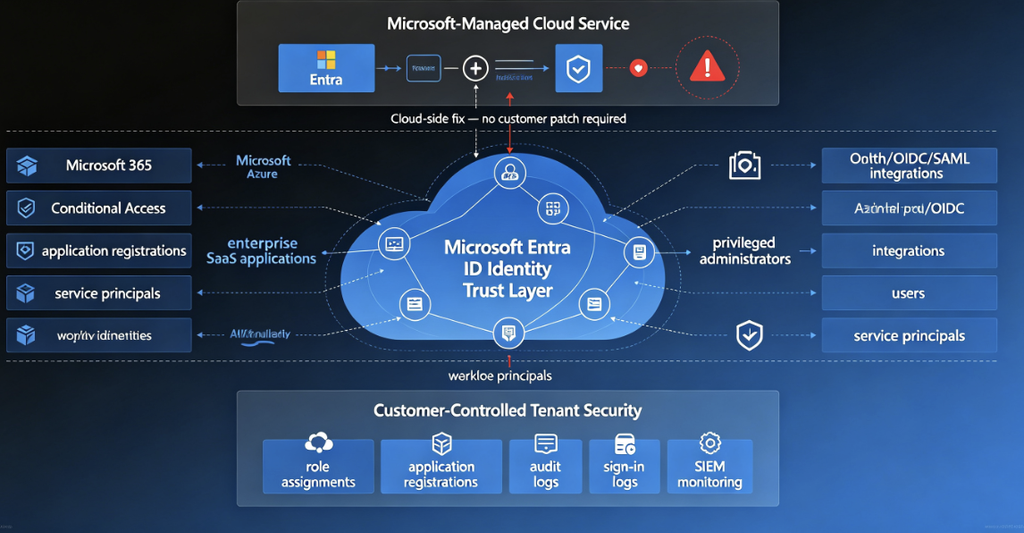
A simplified enterprise trust topology might look like this:
                    Microsoft Entra ID
                           |
          +----------------+----------------+
          |                |                |
          v                v                v
     Microsoft 365       Azure         SaaS / SSO apps
          |                |                |
       Exchange        Resources         Enterprise apps
       SharePoint      Subscriptions     OAuth/OIDC/SAML
       Teams           Workloads         Federated access
The identity layer determines who can authenticate and what many identities are permitted to access.
That is why identity-provider vulnerabilities deserve disproportionate attention even when the vulnerable infrastructure itself is vendor operated.
Security controls such as MFA, Conditional Access, privileged role management, application consent, service principal governance, workload identity restrictions, and device policies all ultimately depend on the integrity of the underlying identity platform.
This does não mean CVE-2026-69836 was demonstrated to bypass all of those controls. Microsoft has not published such an attack chain.
It means only that remote code execution within an identity infrastructure component potentially sits at a much more consequential trust boundary than RCE within an ordinary standalone application.
The Exploitation Status Changed After Disclosure
CVE-2026-69836 has already become a useful case study in why vulnerability intelligence needs timestamps.
On August 21, several major security publications reported that Microsoft had marked the vulnerability as exploited.
BleepingComputer, for example, reported that Microsoft had patched the flaw after exploitation had been observed. (BleepingComputer)
Those articles were not necessarily fabricating information. They were reporting what Microsoft’s security metadata apparently showed at that point in time.
The situation subsequently changed.
A report published on August 22 states that Microsoft’s initial Exploited: Yes classification was corrected to Não after an inquiry regarding the advisory. (Forkast)
More importantly, the current NVD record includes a CISA SSVC assessment with:
"exploitation": "none"
"automatable": "yes"
"technicalImpact": "total"
(NVD)
That makes the current evidence materially different from the early-August-21 reporting.
The Correct Way to Describe the Situation
A careful description is:
CVE-2026-69836 was initially reported by multiple security outlets as exploited because Microsoft’s advisory metadata reportedly showed
Exploited: Yes. Microsoft subsequently corrected the status toExploited: No; as of August 22, CISA’s enrichment in NVD also lists exploitation asnenhum.
This preserves both parts of the historical record.
Saying simply “CVE-2026-69836 is actively exploited” now overstates the available evidence.
Saying “the exploitation reports were completely invented” would also be misleading because early reports appear to have reflected Microsoft’s original metadata.
Does the Correction Make CVE-2026-69836 Less Serious?
Technically, no.
Threat intelligence and vulnerability severity answer different questions.
CVSS asks approximately:
If exploitation succeeds under the assessed conditions, how serious can the technical consequence be?
An exploitation-status field asks:
Do we currently have evidence that attackers are using this vulnerability?
Therefore:
CVSS 10.0
does not mean
actively exploited
and:
Exploited: No
does not mean
low severity
CVE-2026-69836 remains a maximum-severity unauthenticated network RCE based on Microsoft’s assessment even if no verified real-world exploitation is currently known.
What changes is prioritization and incident-response confidence.
A vulnerability with confirmed exploitation may justify an immediate compromise investigation even after patching.
A vulnerability with no known exploitation but a CVSS score of 10.0 still deserves serious review, but defenders should avoid claiming that an intrusion occurred merely because the vulnerability existed.
Microsoft Already Fixed the Vulnerability
One of the strangest-looking parts of the advisory is that a CVSS 10.0 vulnerability does not come with a patch customers need to install.
That is intentional.
NVD tags CVE-2026-69836 as:
Exclusively Hosted Service
(NVD)
Microsoft began formally issuing CVEs for important vulnerabilities in cloud services even when customers do not need to install updates.
In its cloud-service CVE transparency policy, Microsoft explains that historically cloud providers often did not publish CVEs for vulnerabilities that were fixed entirely by the provider. Microsoft changed that policy so significant cloud vulnerabilities could receive CVEs even when no customer remediation is necessary. (Microsoft)
Microsoft specifically uses the exclusively-hosted-service tag for this class of vulnerability and introduced Security Update Guide filtering so organizations can distinguish CVEs requiring customer action from vulnerabilities already remediated in Microsoft-hosted infrastructure. (Microsoft)
That appears to be exactly the model applicable to CVE-2026-69836.
Microsoft has stated that it identified and addressed the issue and that customers do not need to perform additional remediation. (Forkast)
Why Traditional Vulnerability Management Struggles With Cloud CVEs
A conventional vulnerability-management process assumes something like:
Asset
  |
  v
Installed software
  |
  v
Version detection
  |
  v
CVE matching
  |
  v
Patch
  |
  v
Rescan
That works well for:
Apache
Windows Server
Exchange Server
Tomcat
Cisco appliances
VPN gateways
Databases
CVE-2026-69836 does not fit that workflow.
The customer does not operate the vulnerable Entra backend.
There is no customer-accessible package version that a vulnerability scanner can compare against a fixed release.
There is no KB update to deploy.
There is no exposed Entra server belonging to the customer that should be fed a deserialization payload.
The actual flow is closer to:
Microsoft-hosted Entra service
          |
          v
Vulnerability discovered
          |
          v
Microsoft fixes backend
          |
          v
Cloud-service CVE published
          |
          v
Customer receives transparency
This is a significant change for vulnerability-management teams.
A security dashboard built around the question:
“Which of my machines are vulnerable?”
cannot adequately represent a vulnerability whose affected machine was never operated by the customer.
The relevant customer-side question becomes:
“Was a critical component of a service we trust vulnerable, and do we need to assess downstream identity state?”
Can Security Teams Scan for CVE-2026-69836?
Not in the traditional sense.
A customer cannot responsibly point a generic RCE scanner or custom deserialization exploit at Microsoft’s production Entra infrastructure and claim to be testing whether their tenant contains CVE-2026-69836.
The vulnerable component was a Microsoft-operated hosted service.
The lack of public technical detail introduces another problem: there is currently no reliable CVE-specific network signature available from the disclosed information alone.
An accurate vulnerability validation process therefore should não become:
Search GitHub
-> Find random CVE-2026-69836.py
-> Point it at login.microsoftonline.com
-> Assume response proves vulnerability
That would be technically unsound and could cross authorization boundaries.
For CVE-2026-69836, the customer-controlled validation surface begins downstream: identity configuration, privileged access, application registrations, service principals, authentication records, audit events, and other tenant artifacts.
There Is No Public Technical PoC to Reproduce Yet
Because Microsoft has not disclosed the vulnerable endpoint or serialization mechanism, a genuine standalone exploit cannot be derived from the CVE record.
An exploit would require knowledge resembling:
Reachable vulnerable service
        +
Accepted protocol
        +
Serialization format
        +
Attacker-controlled field
        +
Dangerous deserialization path
        +
Usable object / gadget behavior
        +
Execution primitive
Currently, public authoritative information essentially provides:
Microsoft Entra
+
CWE-502
+
Network RCE
+
CVSS conditions
Those are not equivalent.
Any “working CVE-2026-69836 exploit” published without evidence of the missing components should therefore be treated with considerable suspicion.
This is particularly important for defenders because fake exploit repositories are themselves a common malware-delivery mechanism.
What Security Teams Should Do Now
Microsoft does not require customers to install a patch.
That does not prevent security teams from reviewing their identity environment.
The goal should not be to “patch CVE-2026-69836 yourself.” The goal should be to establish whether the tenant contains unexpected or unexplained security-sensitive changes.
Microsoft’s Entra monitoring documentation identifies audit logs, sign-in logs, and provisioning logs as primary sources for understanding identity activity. Audit logs record changes to resources such as users, groups, applications, and licenses, while sign-in logs record authentication activity. Microsoft also supports streaming these logs into Azure Monitor, Event Hubs, storage, and other monitoring systems. (Microsoft Learn)
For organizations conducting additional review, useful areas include:
| Area | What to inspect |
|---|---|
| Directory roles | Unexpected privileged assignments |
| Applications | Newly created or unexpectedly modified app registrations |
| Service principals | Unknown or unexplained service principals |
| App credentials | Unexpected certificates, secrets, or credential changes |
| OAuth permissions | New high-impact delegated/application permissions |
| Admin consent | Unusual consent activity |
| Conditional Access | Unexpected policy changes |
| Authentication methods | Unexpected changes affecting privileged identities |
| Users | New or reactivated privileged users |
| Groups | Unexpected privileged group membership |
| Sign-ins | Unusual privileged or workload identity activity |
| Workload identities | Unexpected service-principal authentication |
These are compromise-assessment hypotheses, not CVE-2026-69836 indicators of compromise.
Microsoft has not publicly stated that exploitation of this CVE creates any particular one of these artifacts.
That distinction should remain explicit in incident reports.
Hunting for Privileged Role Changes
Microsoft documents that Entra audit logs can track changes to role assignments, group memberships, applications, and other directory objects. (Microsoft Learn)
A broad Microsoft Sentinel or Log Analytics hunt could begin with:
AuditLogs
| where TimeGenerated > ago(30d)
| where Category in (
    "RoleManagement",
    "ApplicationManagement",
    "UserManagement",
    "GroupManagement",
    "Policy"
)
| project
    TimeGenerated,
    Category,
    OperationName,
    Result,
    InitiatedBy,
    TargetResources,
    AdditionalDetails
| order by TimeGenerated desc
This is intentionally broad.
The query is not a detection signature for CVE-2026-69836. It is a way to establish a review window around high-value identity changes.
A useful investigation should then classify each sensitive event as:
Expected administrative operation
Known automation
Microsoft-managed operation
Approved application deployment
Unknown change
Potentially malicious change
The last two categories warrant deeper investigation.
Hunting for New Service Principals
Service principals deserve particular attention because they represent application identities inside a tenant.
Microsoft recently expanded Entra auditing around service principal creation, including properties intended to help defenders understand whether a service principal was provisioned by Microsoft, a subscription, a user, or another application. (Microsoft Learn)
A starting query could be:
AuditLogs
| where TimeGenerated > ago(30d)
| where Category == "ApplicationManagement"
| where OperationName has "service principal"
| project
    TimeGenerated,
    OperationName,
    Result,
    InitiatedBy,
    TargetResources,
    AdditionalDetails
| order by TimeGenerated desc
Security teams should correlate unusual results with change-management records and application-owner information.
Again, finding a new service principal does não prove exploitation of CVE-2026-69836.
The objective is to find unexplained persistence-capable identity changes.
Review Privileged Role Assignments
Microsoft emphasizes that privileged Entra roles can modify credentials, authentication or authorization policies, access restricted data, and manage other sensitive resources. Microsoft recommends least privilege, Privileged Identity Management, MFA for administrative accounts, recurring access reviews, and tight control over highly privileged role assignments. (Microsoft Learn)
An incident review should therefore examine both permanent and eligible role assignments.
Conceptually:
Current privileged assignments
          |
          +---- Expected administrators?
          |
          +---- Expected service principals?
          |
          +---- Correct assignment scope?
          |
          +---- Justified permanent access?
          |
          +---- Corresponding audit event?
Microsoft provides mechanisms to list Entra role assignments through the admin center, Microsoft Graph PowerShell, and Microsoft Graph API. (Microsoft Learn)
Review Sign-In Activity, but Understand Its Limits
Sign-in logs remain valuable for identifying suspicious activity involving identities after a security event.
Microsoft provides separate visibility into interactive users, non-interactive user activity, service principals, and other authentication scenarios, depending on the available logging configuration. (Microsoft Learn)
However, there is a conceptual limitation.
CVE-2026-69836 is described as unauthenticated RCE against a Microsoft service component.
Therefore:
No suspicious sign-in
does not necessarily imply:
The Entra backend was never attacked
A backend exploit might occur before the attacker interacts with normal tenant authentication telemetry.
What sign-in logs can help answer is whether unusual identity usage subsequently appeared within the organization.
Why “No Customer Action Required” Does Not Mean “Ignore Identity Security”
Microsoft’s statement has a precise operational meaning:
Customers do not need to deploy a fix for CVE-2026-69836.
It does not mean organizations should disable their normal identity monitoring.
Microsoft’s own Entra documentation recommends using activity logs for monitoring, security analysis, troubleshooting, and compliance, and supports exporting them to SIEM and long-term analysis environments. (Microsoft Learn)
A mature response therefore separates two workstreams:
Vulnerability remediation
        |
        +--> Microsoft owns this
and:
Identity assurance
        |
        +--> Customer still owns this
The first may already be complete.
The second is part of normal cloud security operations regardless of CVE-2026-69836.
CVE-2026-69836 and the Shared Responsibility Model
Cloud vulnerability management exposes an uncomfortable boundary.
Customers can configure Entra securely.
They can enforce MFA.
They can implement Conditional Access.
They can minimize Global Administrator privileges.
They can monitor application consent.
They can protect service principals.
They can export logs.
But they cannot patch the code running the underlying Entra identity service.
This produces two separate layers:
Microsoft responsibility
------------------------
Entra service code
Backend infrastructure
Service deployment
Vulnerability remediation
Platform engineering


Customer responsibility
------------------------
Tenant configuration
Identity lifecycle
Role assignments
Application consent
Workload identities
Monitoring
Incident response
CVE-2026-69836 lived primarily in the first layer.
Its potential consequences matter to the second.
Why Identity RCEs Have a Large Theoretical Blast Radius
Consider what authentication infrastructure normally controls:
Identity
   |
   +--> Authentication
   |
   +--> Authorization
   |
   +--> Token issuance
   |
   +--> Application access
   |
   +--> Privileged administration
   |
   +--> Workload identities
   |
   +--> Cloud resource access
A compromise at this layer can theoretically become more significant than compromising one downstream application.
That is why defenders should pay attention to S:C and the High confidentiality, integrity, and availability impacts in Microsoft’s CVSS assessment.
But responsible analysis must stop short of inventing post-exploitation behavior.
There is currently no public evidence proving that CVE-2026-69836 could be used to:
forge arbitrary Entra tokens
become Global Administrator
cross arbitrary tenants
steal every Microsoft 365 mailbox
bypass every Conditional Access policy
access Azure subscriptions automatically
Any of these might sound intuitively possible when discussing an identity-platform RCE.
They are nevertheless not established properties of CVE-2026-69836 based on the currently disclosed evidence.
A CVSS 10.0 rating does not substitute for an attack-chain analysis.
What CWE-502 Tells Defenders
Even without CVE-specific implementation details, the weakness classification has architectural value.
MITRE recommends avoiding direct reconstruction of arbitrary untrusted objects, validating data before it becomes application state, constraining allowable types, and reducing available gadget functionality. (CWE)
A simplified secure-development lesson is:
DO NOT

Network bytes
    ->
Generic object deserializer
    ->
Arbitrary object graph
Prefer:
Network bytes
    ->
Strict parser
    ->
Schema
    ->
Validated primitive values
    ->
Explicit object construction
Where serialization is unavoidable, teams should consider integrity protections, strict class/type constraints, minimal reachable functionality, isolation, and architectural designs that do not permit data reconstruction to trigger powerful behavior.
Those recommendations apply far beyond Microsoft Entra.
CWE-502 has repeatedly appeared in high-impact enterprise vulnerabilities because complex application frameworks often contain large object graphs and libraries with behaviors that can potentially be chained in unexpected ways.
Vulnerability Scanners May Not Represent This Risk Well
Traditional scanners are good at situations resembling:
192.0.2.20
Apache Tomcat 10.x
Version vulnerable
CVE detected
For CVE-2026-69836 the customer asset might instead appear simply as:
Organization uses Microsoft Entra ID
There is no customer-managed version string indicating vulnerable or fixed status.
A scanner therefore cannot meaningfully perform the normal equation:
Product fingerprint
+
Version
=
Exposure
This creates a broader challenge for security programs increasingly dependent on SaaS and cloud control planes.
Vulnerability management needs to expand beyond endpoint inventory toward service dependency inventory.
Organizations should know not only:
What software do we operate?
but also:
Which external cloud security services are part of our trust architecture?
That dependency graph might look like:
Corporate identities
       |
       v
Microsoft Entra
       |
       +--> Microsoft 365
       |
       +--> Azure
       |
       +--> GitHub Enterprise
       |
       +--> Salesforce
       |
       +--> Internal applications
       |
       +--> VPN / ZTNA
A vulnerability in the identity provider now intersects with every downstream system that delegates authentication to it, even though none of those applications contains the vulnerable Entra code.
Safe CVE Verification for CVE-2026-69836
For customer security teams, a sensible validation workflow is therefore defensive:
1. Confirm the advisory and current metadata.
2. Confirm Microsoft has mitigated the hosted vulnerability.
3. Preserve relevant Entra telemetry.
4. Review privileged identity changes.
5. Review application and service-principal changes.
6. Review workload identity credentials.
7. Examine suspicious authentication activity.
8. Validate Conditional Access and privileged-role configuration.
9. Investigate unexplained identity changes.
10. Preserve evidence and document conclusions.
O que deve ser não involve is attempting to recreate an undisclosed server-side attack against Microsoft’s production service.
This distinction is especially important for AI-assisted security systems.
For an ordinary customer-hosted CVE, an authorized penetration-testing workflow may fingerprint a service, verify the vulnerable version, reproduce a safe request, collect evidence, remediate the asset, and retest it.
For an exclusively hosted cloud-service CVE such as CVE-2026-69836, the evidence boundary is different.
Penligent’s broader CVE-verification approach is useful here mainly as an evidence and investigation workflow rather than as an exploit launcher: collect relevant identity evidence, correlate configuration and audit records, distinguish an external vendor-side vulnerability from customer-controlled exposure, and preserve the resulting findings for retesting and reporting. The same evidence-first principle is discussed in Penligent’s public material on repeatable CVE verification and pentest reporting. (Penligente)
The goal is not:
"CVE exists -> run exploit"
but:
CVE intelligence
      ->
Understand responsibility boundary
      ->
Determine what can actually be validated
      ->
Collect evidence
      ->
Investigate anomalies
      ->
Document residual risk
That is a much more appropriate model for cloud-native vulnerabilities.
Cloud CVEs Are Changing the Meaning of “Patch Management”
Microsoft’s cloud CVE policy is important beyond this individual vulnerability.
The company explicitly states that it now publishes significant cloud-service vulnerabilities even when no customer patch or action is necessary. (Microsoft)
That creates a new vulnerability category:
Critical vulnerability
+
Real CVE
+
Real technical impact
+
No customer-managed vulnerable binary
+
No customer patch
Traditional vulnerability management has historically associated a CVE with a patchable asset.
Cloud CVEs break that assumption.
The customer’s work becomes:
Awareness
Risk assessment
Dependency mapping
Telemetry preservation
Compromise assessment when warranted
Vendor assurance
instead of:
Patch deployment
CVE-2026-69836 is one of the clearest examples of this emerging model because the CVSS severity is extremely high while the customer remediation instruction is effectively zero.
Detection Engineering Recommendations
Regardless of whether CVE-2026-69836 was ever exploited, organizations dependent on Entra should treat identity telemetry as first-class security data.
Stream Entra Logs to a SIEM
Microsoft supports routing audit and sign-in information to Log Analytics, storage, Event Hubs, and partner solutions. (Microsoft Learn)
Do not depend exclusively on short interactive portal retention when investigating long-lived identity incidents.
Alert on High-Impact Role Changes
Prioritize:
Global Administrator
Privileged Role Administrator
Application Administrator
Cloud Application Administrator
Authentication Administrator
Privileged Authentication Administrator
as well as relevant Azure resource-control roles.
Monitor Application Credentials
Investigate unexpected additions of:
client secrets
certificates
federated identity credentials
application owners
service-principal credentials
especially when associated with highly privileged application permissions.
Review Application Consent
High-value permission combinations deserve careful monitoring because compromised application identities can provide durable access without relying on ordinary interactive sign-ins.
Monitor Workload Identities
User accounts are not the only identities that matter.
Service principals and managed/workload identities increasingly carry sensitive access across cloud environments.
Correlate Audit and Authentication Events
A high-confidence investigation often comes from relationships such as:
Unexpected app created
        |
        v
High privilege granted
        |
        v
New credential added
        |
        v
Service principal sign-in
        |
        v
Sensitive resource access
No single event necessarily proves malicious activity.
The chain does.
The Most Important Lesson From the Exploitation-Status Confusion
CVE-2026-69836 also demonstrates a problem with modern machine-speed vulnerability intelligence.
A field changes once:
Exploited: Yes
and within hours it propagates through:
Vendor feed
   ->
Security news
   ->
Threat intelligence
   ->
Social media
   ->
Search engines
   ->
AI summaries
   ->
Internal SOC tickets
Then the vendor changes it to:
Exploited: No
The first version does not magically disappear.
Search engines continue serving the old headline.
Threat feeds may retain cached metadata.
AI systems may summarize yesterday’s articles.
Analysts may copy the original statement into reports.
This is why time-sensitive fields should always be represented as time-sensitive evidence.
A better internal record is:
2026-08-21:
Initial Microsoft metadata reportedly indicated Exploited: Yes.

2026-08-22:
Microsoft reportedly corrected status to Exploited: No.
CISA/NVD enrichment currently reports exploitation: none.
That is substantially more useful than storing a timeless boolean.
Should Organizations Treat CVE-2026-69836 as an Incident?
Not automatically.
A vulnerability disclosure is not evidence that an individual tenant was compromised.
Given the current corrected exploitation status, opening an incident solely because an organization uses Microsoft Entra ID would likely overstate the evidence.
A better classification might be:
Critical vendor vulnerability advisory
        |
        v
Identity assurance review
        |
        +--> No anomalies -> document and monitor
        |
        +--> Suspicious changes -> investigate
        |
        +--> Confirmed compromise indicators -> incident response
If Microsoft later publishes evidence of exploitation, affected customers, indicators, or an exploitation timeframe, organizations can reassess the decision using the new facts.
Should Organizations Rotate Every Credential?
There is currently no public Microsoft instruction requiring every Entra customer to rotate all credentials because of CVE-2026-69836.
Blanket rotation without evidence can create significant operational risk.
Credential rotation should instead be driven by findings such as:
Unexpected application credential
Unexpected privileged account activity
Unauthorized secret access
Confirmed token exposure
Microsoft customer notification
Related incident evidence
If such evidence exists, incident-response procedures may justify wider credential revocation and reissuance.
Without it, ordinary credential and privileged-access hygiene is more defensible than an indiscriminate tenant-wide reset.
Can MFA Protect Against CVE-2026-69836?
Not against the initial vulnerability as described.
Microsoft rates the vulnerability:
PR:N
UI:N
meaning prior account privileges and victim interaction are not prerequisites.
MFA protects authentication.
CVE-2026-69836 affected the service itself.
That said, MFA remains extremely important for limiting unrelated identity compromise and potential downstream abuse of captured accounts.
The correct interpretation is:
MFA does not patch server-side RCE
not:
MFA is useless
Can Conditional Access Prevent Exploitation?
There is no public evidence showing that Conditional Access controls the vulnerable processing path.
Conditional Access evaluates access conditions associated with identities and resources.
The CVE is described as unauthenticated remote code execution inside Microsoft Entra ID itself.
Therefore organizations should not claim Conditional Access mitigates CVE-2026-69836 unless Microsoft later publishes specific guidance saying so.
Conditional Access remains valuable for reducing ordinary identity attack paths and limiting downstream unauthorized access.
Is CVE-2026-69836 a Zero-Day?
The term should be used cautiously.
Early reporting described exploitation before disclosure, which would normally support “zero-day” language.
That reporting now conflicts with the corrected exploitation status.
As of August 22, the safest wording is simply:
CVE-2026-69836 is a critical Microsoft Entra ID RCE that Microsoft fixed before or alongside public disclosure.
Unless Microsoft provides additional clarification confirming pre-disclosure exploitation, calling it a confirmed zero-day is no longer justified by the current metadata.
Is CVE-2026-69836 in CISA KEV?
Security teams should distinguish the CISA Known Exploited Vulnerabilities catalog from CISA’s SSVC enrichment attached to a CVE.
The current NVD record shows CISA SSVC enrichment with exploitation: none. (NVD)
That is the key current data point for exploitation assessment.
Organizations should verify live CISA KEV data rather than relying on cached third-party labels because this CVE’s exploitation metadata has already changed during its first days of disclosure.
What Microsoft Entra Administrators Should Verify
A practical review should focus on identity state rather than CVE exploitation.
Privileged access
Ask:
Who currently holds privileged roles?
Why?
Since when?
Permanent or eligible?
Was every assignment expected?
Applications
Ask:
Which applications were recently created?
Which applications gained new permissions?
Which credentials were recently added?
Which application owners changed?
Service principals
Ask:
Which service principals appeared recently?
Who or what created them?
Which tenant owns the application?
Which permissions do they hold?
Microsoft’s updated auditing capabilities specifically provide properties for understanding why service principals were created, making this a valuable part of routine investigations. (Microsoft Learn)
Authentication policies
Ask:
Were Conditional Access policies modified?
Were authentication methods changed?
Were exclusions added?
Were emergency accounts altered?
Workload identities
Ask:
Did a service principal begin authenticating unexpectedly?
Were workload credentials modified?
Were new federated identity relationships created?
These checks produce actionable identity assurance even if they ultimately find no CVE-related activity.
Lessons for Security Architecture
CVE-2026-69836 reinforces several broader security lessons.
Identity infrastructure is critical infrastructure
Identity services increasingly mediate access to nearly every important corporate resource.
The blast radius of identity-layer bugs must therefore be modeled differently from application-level bugs.
SaaS does not eliminate vulnerabilities
SaaS eliminates much of the customer’s patching burden.
It does not eliminate software defects in the provider’s infrastructure.
Cloud vulnerability transparency matters
Microsoft’s decision to publish CVEs for provider-fixed cloud vulnerabilities gives customers information that historically might never have appeared in traditional vulnerability-management systems. (Microsoft)
But transparency requires careful interpretation
A CVE does not necessarily imply that customers have something to patch.
A CVSS 10.0 score does not prove exploitation.
Um Exploited: Yes field can even be corrected.
Security processes need to preserve those distinctions.
Frequently Asked Questions About CVE-2026-69836
What is CVE-2026-69836?
CVE-2026-69836 is a remote code execution vulnerability affecting Microsoft Entra ID. Microsoft identifies the underlying weakness as CWE-502, Deserialization of Untrusted Data.
How severe is CVE-2026-69836?
Microsoft assigned the vulnerability a CVSS 3.1 base score of 10.0 Critical with the vector:
CVSS:3.1/AV:N/AC:L/PR:N/UI:N/S:C/C:H/I:H/A:H
(NVD)
Does CVE-2026-69836 require authentication?
No. Microsoft’s CVSS vector specifies PR:N, meaning no prior privileges are required.
Does exploitation require user interaction?
No. Microsoft’s assessment specifies UI:N.
What causes CVE-2026-69836?
Microsoft maps the vulnerability to CWE-502, Deserialization of Untrusted Data. The precise vulnerable endpoint, serialization technology, and internal exploit path have not been publicly disclosed.
Is CVE-2026-69836 being exploited in the wild?
The answer changed during disclosure.
Several reports published August 21 said Microsoft’s advisory marked the vulnerability as exploited. On August 22, reporting indicated Microsoft corrected the field from Exploited: Yes para Exploited: No. Current CISA enrichment visible through NVD lists exploitation as nenhum. (Forkast)
Therefore it should not currently be described as confirmed actively exploited without qualification.
Is there a public CVE-2026-69836 exploit?
Microsoft has not publicly disclosed the technical attack chain necessary to reproduce the vulnerability.
Treat repositories claiming to provide a working CVE-2026-69836 exploit cautiously unless they provide independently verifiable technical evidence.
Does CVE-2026-69836 affect Azure AD?
Microsoft Entra ID is the current name for the service previously known as Azure Active Directory or Azure AD.
Do customers need to install a patch?
No customer-side patch is required.
The vulnerability affects an exclusively hosted Microsoft service, and Microsoft says it has already addressed the issue.
Why issue a CVE if customers cannot patch it?
Microsoft has a cloud-service transparency policy under which significant cloud vulnerabilities can receive CVEs even when Microsoft has already fixed the issue and no customer remediation is required. (Microsoft)
Can Nessus, Nuclei, Qualys, or another scanner detect CVE-2026-69836?
Traditional asset scanners cannot reliably determine customer exposure through ordinary product-version fingerprinting because the vulnerable Entra backend is operated by Microsoft rather than installed in the customer’s environment.
Claims of CVE-specific detection should therefore be evaluated carefully.
Should security teams inspect Entra logs?
There is no customer patch to deploy, but organizations may reasonably review Entra audit, sign-in, application, role, and service-principal activity as part of normal identity assurance.
Microsoft documents these logs as core sources for tracking directory changes and authentication behavior. (Microsoft Learn)
Does finding suspicious activity prove CVE-2026-69836 exploitation?
No.
Microsoft has not released CVE-specific indicators of compromise or described what tenant-side artifacts successful exploitation would create.
Suspicious identity activity should be investigated on its own evidence.
Final Assessment
CVE-2026-69836 deserves attention not simply because it has a CVSS score of 10.0, but because of where the vulnerability existed.
Microsoft Entra ID forms part of the identity trust layer behind Microsoft 365, Azure, enterprise applications, users, administrators, and workload identities. Microsoft’s CVSS assessment says an unauthenticated remote attacker could reach a low-complexity code-execution vulnerability with no user interaction and potentially high confidentiality, integrity, and availability impact. (NVD)
At the same time, CVE-2026-69836 is a useful reminder not to convert severity into unsupported conclusions.
Microsoft has not publicly disclosed the vulnerable endpoint.
It has not published the serialization mechanism.
It has not published a gadget chain.
There is no authoritative public exploit chain.
And the most sensational part of the original disclosure — the claim that the flaw was already being exploited — changed almost immediately. The original Exploited: Yes reporting was followed by a correction to Exploited: No, while CISA’s current NVD enrichment records exploitation as none. (Forkast)
Microsoft has also already fixed the hosted service. Customers do not have an Entra server to patch, and the exclusively-hosted-service classification reflects Microsoft’s broader policy of assigning CVEs to significant cloud-service vulnerabilities even when remediation is entirely provider-side. (Microsoft)
For defenders, the appropriate response is therefore neither panic nor indifference.
Do not invent a PoC from a CWE number. Do not attack Microsoft’s production identity service trying to “verify” the CVE. Do not continue repeating outdated exploitation claims as established fact.
Instead, preserve identity telemetry, monitor privileged role and application changes, understand service-principal activity, maintain strong workload identity controls, stream Entra logs into a SIEM, and treat the security of the identity provider as a dependency worthy of the same architectural attention traditionally given to operating systems, network appliances, and databases.
CVE-2026-69836 is ultimately a cloud identity vulnerability, a deserialization vulnerability, and a vulnerability-management lesson at the same time.
In a world where the identity provider increasingly functions as the enterprise security perimeter, all three lessons matter.

 Portuguese
  English
  German
  French
  Spanish
  Japanese
  Korean
  Hindi
Hindi  Arabic
  Turkish
  Hebrew