
What MITRE ATT&CK is—and what it isn’t
ATT&CK is a behavioral model, not a vulnerability database
- ATT&CK answers: How do adversaries behave once they’re trying to achieve objectives?
- CVE answers: What specific weakness exists in a specific product/version?
ATT&CK does include techniques that look like “exploitation,” but the unit of value isn’t “a bug.” It’s the repeatable behavior chain: initial access, execution, credential access, discovery, lateral movement, collection, exfiltration, impact.
ATT&CK is not a replacement for frameworks like Kill Chain
Cyber Kill Chain is a lifecycle framing. ATT&CK is a behavior catalog with IDs, relationships, and a living matrix structure. In practice, teams often use Kill Chain (or similar) as a narrative, and ATT&CK as the engineering index.
The core vocabulary you must get right
MITRE’s own “Design and Philosophy” document is blunt about why this matters: teams confuse terms, then mappings become garbage, and metrics become theater. The distinctions below are the ones that keep the framework usable at scale.
Tactics = the “why”
Tactics represent an adversary’s tactical goal—the reason behind an action. MITRE’s Enterprise tactics page defines tactics exactly this way. (MITRE ATT&CK)
In Enterprise ATT&CK, tactics are the columns of the matrix—covering the intrusion lifecycle from Reconnaissance through Impact. (CrowdStrike)
Techniques and sub-techniques = the “how”
Techniques are how adversaries achieve a tactic. MITRE’s techniques catalog describes techniques as the “how” behind tactical goals. (MITRE ATT&CK)
Sub-techniques make the “how” more precise (for example, “Phishing” splits into specific variants). The practical reason to care: better specificity produces better detections and fewer fake metrics.
Procedures = the “what exactly happened in the wild”
MITRE emphasizes that procedures are the specific, observed implementations adversaries used—often spanning multiple techniques in a real intrusion. (MITRE ATT&CK)
That’s why ATT&CK stays useful even when tools change: procedures evolve, but many techniques remain stable.
What’s inside ATT&CK in 2026, the parts engineers actually use
The matrices
MITRE maintains matrices for multiple domains (Enterprise, Mobile, ICS). Enterprise is the one most defenders start with. (MITRE ATT&CK)
The technique pages
A technique page isn’t just a label. For defenders, the highest-value fields are:
- Technique ID (stable reference for mapping and metrics)
- Descrição (what you should detect)
- Procedure Examples (what real intrusions looked like)
- Mitigations (what reduces the likelihood or impact)
- Detections guidance (what telemetry tends to help)
MITRE’s Enterprise techniques index shows the scope is large and evolving (200+ techniques), which is why you need prioritization and metrics—not “map everything once and forget it.” (MITRE ATT&CK)
The high-click intent terms around “mitre attack framework”—and what they signal
Search results and “people also ask” behavior tends to cluster around a handful of phrases. You can treat these as a to-do list:
- “MITRE ATT&CK matrix” People want a bird’s-eye view: where attacks live, and how their controls line up.
- “tactics and techniques” People want the vocabulary so SOC, IR, threat intel, and red team stop talking past each other.
- “ATT&CK mapping” People want to connect detections, logs, alerts, incidents, and findings to technique IDs so coverage becomes measurable.
- “threat hunting with ATT&CK” People want a repeatable way to generate hypotheses and hunt behaviors—not IOCs.
- “ATT&CK Navigator” People want a visual artifact they can share with leadership and peers, without flattening nuance. MITRE’s Navigator is built exactly for that: annotate and explore matrices, visualize coverage, plan red/blue work. (mitre-attack.github.io)
Five workflows where ATT&CK becomes real engineering
1 Detection engineering, turning rules into coverage
The goal isn’t “we have 3,000 detections.” The goal is behavioral coverage against techniques that matter to your environment.
A minimum viable engineering loop looks like this:
- Inventory telemetry sources (EDR, Windows logs, auth, DNS, proxy, SaaS audit logs, cloud control plane).
- Map existing detections to ATT&CK technique IDs.
- Identify high-risk technique gaps (based on your threat model and your exposed surfaces).
- Build detections and response playbooks for those gaps.
- Continuously validate with emulation or controlled testing.
CrowdStrike’s explainer frames this as mapping alerts/analytics to highlight gaps where attackers can operate without triggering existing controls. (CrowdStrike)
A mapping format that scales
Use a simple structured object. YAML is common because it plays well with Git review.
detection_id: DET-AD-0012
name: Suspicious Kerberos Ticket Requests, potential credential dumping follow-up
attack:
  - technique: T1558
    subtechnique: T1558.003
    tactic: Credential Access
telemetry:
  - windows_security_eventlog
  - domain_controller
query_refs:
  - splunk_spl: "index=wineventlog EventCode=4769 ..."
  - kql: "SecurityEvent | where EventID == 4769 ..."
response:
  owner: identity_ir
  playbook: PB-IDENT-004
confidence:
  test_coverage: partial
  known_false_positives: ["backup service accounts"]
You’ll notice this structure separates mapping from query language. That’s deliberate: queries change; technique IDs are your stable index.
2 Threat hunting, building hypotheses from behaviors
ATT&CK shines when you stop asking “Do we have this IOC?” and start asking:
- If an adversary is in our environment, which technique would they likely use next?
- What does that look like in our telemetry?
- What would be “normal” vs “abnormal” for our org?
A practical hunting approach:
- Pick a tactic (Credential Access is a common high-value choice).
- Choose 1–3 techniques that match your environment’s reality (Windows-heavy? Cloud-heavy?).
- Define what “good telemetry” looks like.
- Hunt with time-bounded, testable hypotheses.
- Convert outcomes into detections, allowlists, or logging improvements.
3 Incident response, converting timelines into durable improvements
After an incident, ATT&CK lets you produce a “learning artifact” that isn’t tied to one malware family.
Instead of writing “They used tool X,” you produce:
- The technique chain, with timestamps and evidence.
- The detection gaps that allowed each step.
- The mitigation or logging actions that would have shortened dwell time.
This is how you stop repeating the same class of incident every quarter.
4 Purple teaming and emulation, validating what your matrix claims
ATT&CK is easy to “paint green” on a slide. It’s harder to prove.
A purple-team-friendly approach:
- Select a realistic technique chain (5–10 steps).
- Emulate with safe tooling (or controlled scripts) that exercise the same telemetry.
- Validate detections and response time.
- Update the Navigator layer based on evidence, not optimism.
Navigator exists to make this workflow shareable and repeatable. (mitre-attack.github.io)
5 Metrics, prioritizing work without lying to yourself
If you only take one thing from this article, take this:
ATT&CK metrics are only meaningful if they’re tied to evidence.
A good coverage metric is not “we mapped 70% of techniques.”
A useful metric is:
- For our top 20 techniques, what % are detected with high-fidelity telemetry?
- How many are validated by emulation at least quarterly?
- How long from technique execution to alert to containment?
Here’s a table template that teams actually use.
| Camada | What you measure | Evidence artifact | Anti-pattern to avoid |
|---|---|---|---|
| Coverage | % of priority techniques with detection logic | Rule IDs + mappings in Git | “Mapped” without telemetry proof |
| Quality | Precision/recall proxies | FP rates, analyst feedback | Counting alerts as success |
| Speed | MTTD/MTTR per tactic | Incident timestamps | Averaging away outliers |
| Resiliência | Repeatability under change | Emulation runs | One-off tabletop wins |
| Risco | Exposure-driven priority | Asset inventory + attack surface | “Top techniques globally” only |
The CVE-to-ATT&CK bridge, how to stop treating vulns and detections as separate worlds
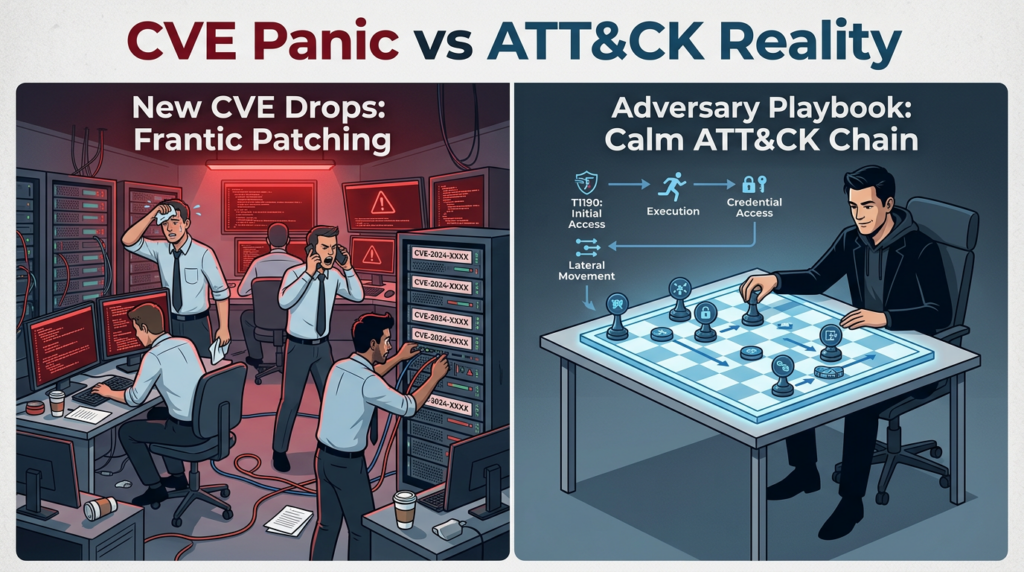
CVE tells you the door; ATT&CK tells you the path
When a high-impact vulnerability drops, teams often do two things:
- Patch (or mitigate).
- Add WAF signatures or IOC blocks.
But real intrusions aren’t one-step events. Attackers exploit the door, then they behave.
The simplest bridge is:
- Map exploitation to Acesso inicial techniques, especially T1190 Exploit Public-Facing Application. MITRE explicitly defines T1190 as exploiting a weakness in an internet-facing host/system to initially access a network. (MITRE ATT&CK)
- Then map likely follow-on behavior chains: execution, persistence, credential access, discovery, lateral movement, exfiltration, impact.
This is how you turn “CVE panic” into a durable detection plan.
Three CVE case studies, mapped to realistic ATT&CK behavior chains
Case study 1 Log4Shell CVE-2021-44228, the canonical “vuln → full intrusion” story
Why it still matters in 2026: it’s the cleanest mental model for how quickly vulnerability exploitation turns into environment-wide behavior.
Typical chain (high-level, not tool-specific):
- Initial Access: public-facing app exploitation (T1190)
- Execution: command execution via application runtime (often maps into scripting/interpreter execution families depending on platform)
- Persistence: web shells, scheduled tasks, service installs (varies)
- Credential Access: dumping creds, stealing tokens
- Discovery + Lateral Movement
- Collection + Exfiltration
- Impact (sometimes ransomware)
Even if you patched years ago, this chain is the template you should reuse for the next major RCE.
Case study 2 OpenSSH regreSSHion CVE-2024-6387, why “default config” bugs are operational nightmares
CVE-2024-6387 (“regreSSHion”) is widely documented as a race condition issue in OpenSSH’s server (sshd), involving unsafe function calls in a signal handler under LoginGraceTime conditions. (Palo Alto Networks Security)
Why defenders should care beyond patching:
- SSH is often exposed for admin access.
- Exploitation attempts may look like a storm of failed auth/handshake activity and timing behavior.
- The moment a foothold exists, follow-on techniques become predictable: credential access, remote service usage, lateral movement.
If your environment has internet-facing SSH (or vendor-managed SSH paths), you don’t just want a patch checklist. You want:
- Detection for abnormal SSH daemon behavior and bursts
- Hardening to reduce exposure surface
- Post-compromise monitoring aligned to the technique chain
Case study 3 Actively exploited network and platform vulnerabilities, why ATT&CK gives you the fastest triage structure
In February 2026 reporting, multiple outlets highlighted urgent attention around a critical Cisco Catalyst SD-WAN controller issue (CVE-2026-20127) with claims of exploitation history and high severity, emphasizing risk when management interfaces are exposed to the internet. (TechRadar)
Independently, the U.S. CISA KEV catalog is designed to list vulnerabilities with evidence of active exploitation, and it’s continuously updated. (CISA)
Even if you don’t memorize every new CVE, the ATT&CK approach stays stable:
- If it’s an internet-exposed management plane, model it as Initial Access via exploitation
- Pre-plan follow-on behaviors
- Use a coverage layer to ensure detections aren’t invented during the incident
ATT&CK Navigator, turning your program into something you can see
MITRE’s ATT&CK Navigator is a web-based tool to annotate and explore matrices, used to visualize defensive coverage and plan red/blue work. (mitre-attack.github.io)
A practical way to use it:
- Layer 1: “Telemetry coverage” (where you have logs)
- Layer 2: “Detection coverage” (where you have reliable detection logic)
- Layer 3: “Validated coverage” (where you have emulation evidence in the last 90 days)
This is how you avoid the most common failure mode: mapping that’s technically correct but operationally meaningless.
Pulling ATT&CK data via TAXII, real code you can run
MITRE provides an official ATT&CK TAXII 2.1 API endpoint (attack-taxii.mitre.org), documented in MITRE’s own repo and resources pages. (GitHub)
Below is a Python example that demonstrates the workflow: connect to the TAXII API root, enumerate collections, and pull ATT&CK objects (you may adapt it for your internal pipelines).
"""
Example: Pull ATT&CK STIX data from MITRE's TAXII 2.1 server.
Docs: <https://attack-taxii.mitre.org> (API root /api/v21/)
"""
from taxii2client.v21 import Server

API_ROOT = "<https://attack-taxii.mitre.org/api/v21/>"

server = Server(API_ROOT)
api_roots = server.api_roots
print(f"API roots: {len(api_roots)}")

root = api_roots[0]
collections = root.collections
print("Collections:")
for c in collections:
  print("-", c.title, c.id)

# Pick a collection (you may need to choose Enterprise ATT&CK collection by title)
enterprise = next(c for c in collections if "Enterprise" in (c.title or ""))
col = root.collection(enterprise.id)

# Pull a small page of objects (paginate for full dataset)
bundle = col.get_objects(limit=200)
objects = bundle.get("objects", [])
techniques = [o for o in objects if o.get("type") == "attack-pattern"]
print(f"Fetched objects={len(objects)} techniques={len(techniques)}")

# Print a few technique names + external IDs
for t in techniques[:10]:
  ext_refs = t.get("external_references", [])
  tid = next((r.get("external_id") for r in ext_refs if r.get("source_name") == "mitre-attack"), None)
  print(tid, "-", t.get("name"))
If you don’t want to build your own parser, MITRE’s ecosystem also includes tooling and data models meant for working with ATT&CK datasets programmatically. (npm)
Detection snippets, small but realistic examples
Sigma example, suspicious PowerShell download cradle pattern
This is not “ATT&CK magic.” It’s just how engineers link detections to technique IDs and keep them reviewable.
title: Suspicious PowerShell Download Cradle
id: 2e0a2a4f-xxxx-xxxx-xxxx-xxxxxxxxxxxx
status: experimental
description: Detects PowerShell invoking common download cradle patterns
references:
  - <https://attack.mitre.org/techniques/T1059/001/>
tags:
  - attack.execution
  - attack.t1059.001
logsource:
  product: windows
  category: process_creation
detection:
  selection:
    Image|endswith: '\\powershell.exe'
    CommandLine|contains:
      - 'IEX'
      - 'DownloadString'
      - 'Invoke-WebRequest'
      - 'FromBase64String'
  condition: selection
falsepositives:
  - Admin scripts
level: medium
Microsoft Defender KQL example, uncommon parent-child execution chain
DeviceProcessEvents
| where FileName =~ "powershell.exe"
| where InitiatingProcessFileName in~ ("w3wp.exe", "java.exe", "tomcat*.exe")
| project Timestamp, DeviceName, InitiatingProcessFileName, FileName, ProcessCommandLine
The point isn’t the exact query. The point is keeping the mapping stable and auditable.
For technique grounding, refer back to MITRE’s technique definitions when choosing IDs. (MITRE ATT&CK)
ATT&CK is a defender’s language for behavior and coverage. But in the real world, teams also need evidências: can this exposure be exploited in our environment, and what does the resulting behavior chain look like?
That’s where an automated, evidence-driven workflow is useful. Penligent positions itself as an AI-powered penetration testing platform that automates reconnaissance, CVE validation, exploitation, privilege escalation, and lateral movement to simulate realistic attack chains. (Penligente)
A practical way to connect it to ATT&CK—without forcing it:
- Use ATT&CK to define the behavior chain you care about (what should be detected).
- Use controlled validation (in lab or authorized targets) to generate proof artifacts: logs, traces, timings, and exploitability confirmation.
- Feed those artifacts back into detection engineering and incident playbooks.
Penligent has also published material focused on bridging “findings” to “proof,” including CVE-centered case studies that illustrate why verification matters. (Penligente)
Common mistakes that make ATT&CK programs fail
- Treating mapping as a one-time spreadsheet project If it’s not living in version control with owners, it dies.
- Counting “coverage” without telemetry quality If you can’t reliably observe the behavior, you don’t “cover” it.
- Mapping at the wrong level of specificity Over-broad technique mappings hide gaps; over-specific mappings create fake precision. Use sub-techniques when your telemetry supports it.
- Ignoring procedures and context The same technique can look benign or malicious depending on context. MITRE’s emphasis on procedures exists for a reason. (MITRE ATT&CK)
Referências
- MITRE ATT&CK Enterprise Matrix (MITRE ATT&CK)
- MITRE ATT&CK Tactics overview (MITRE ATT&CK)
- MITRE ATT&CK Enterprise Techniques index (MITRE ATT&CK)
- Technique T1190 Exploit Public-Facing Application (MITRE ATT&CK)
- MITRE ATT&CK Navigator (mitre-attack.github.io)
- MITRE ATT&CK Data & Tools, including TAXII (MITRE ATT&CK)
- MITRE ATT&CK Design and Philosophy PDF (MITRE ATT&CK)
- CrowdStrike overview of MITRE ATT&CK and common operational use cases (CrowdStrike)
- Palo Alto Networks Cyberpedia definition and scope framing (Palo Alto Networks)
- Microsoft Security “what is MITRE ATT&CK” overview (Microsoft)
- Splunk “MITRE ATT&CK: The Complete Guide” (practitioner-oriented framing) (Splunk)
- Claude Code Security and Penligent, From White-Box Findings to Black-Box Proof (Penligente)
- Overview of Penligent.ai’s Automated Penetration Testing Tool (Penligente)
- Exploit DB in 2026, CVE case-study roundup (Penligente)
- The 2026 Ultimate Guide to AI Penetration Testing, agentic red teaming workflows (Penligente)
 Portuguese
  English
  German
  French
  Spanish
  Japanese
  Korean
  Hindi
Hindi  Arabic
  Turkish
  Hebrew