XBOW alternatives are worth evaluating when a team's testing requirement, purchasing process, or operating model calls for a different fit. The useful comparison is not a leaderboard of AI claims. It is whether another approach can test the required application, maintain the intended permissions, produce defensible evidence, and fit the budget for repeated use.
As of October 19, 2026, XBOW's current pricing page asks buyers to request an environment-scoped quote. Comparing that offer with a public subscription price requires care: the products may include different scope, usage, support, and delivery responsibilities. A lower entry price can make a pilot accessible without establishing equivalent coverage or a lower total cost.
For a practical shortlist, consider an AI-assisted product workflow such as Penligent, a tester-operated toolkit such as Burp Suite Professional, a configured DAST workflow using ZAP, or a source-aware project such as Shannon. These are different operating choices. Choose the route that matches the work you can authorize, the inputs you can provide, and the review your team can perform.
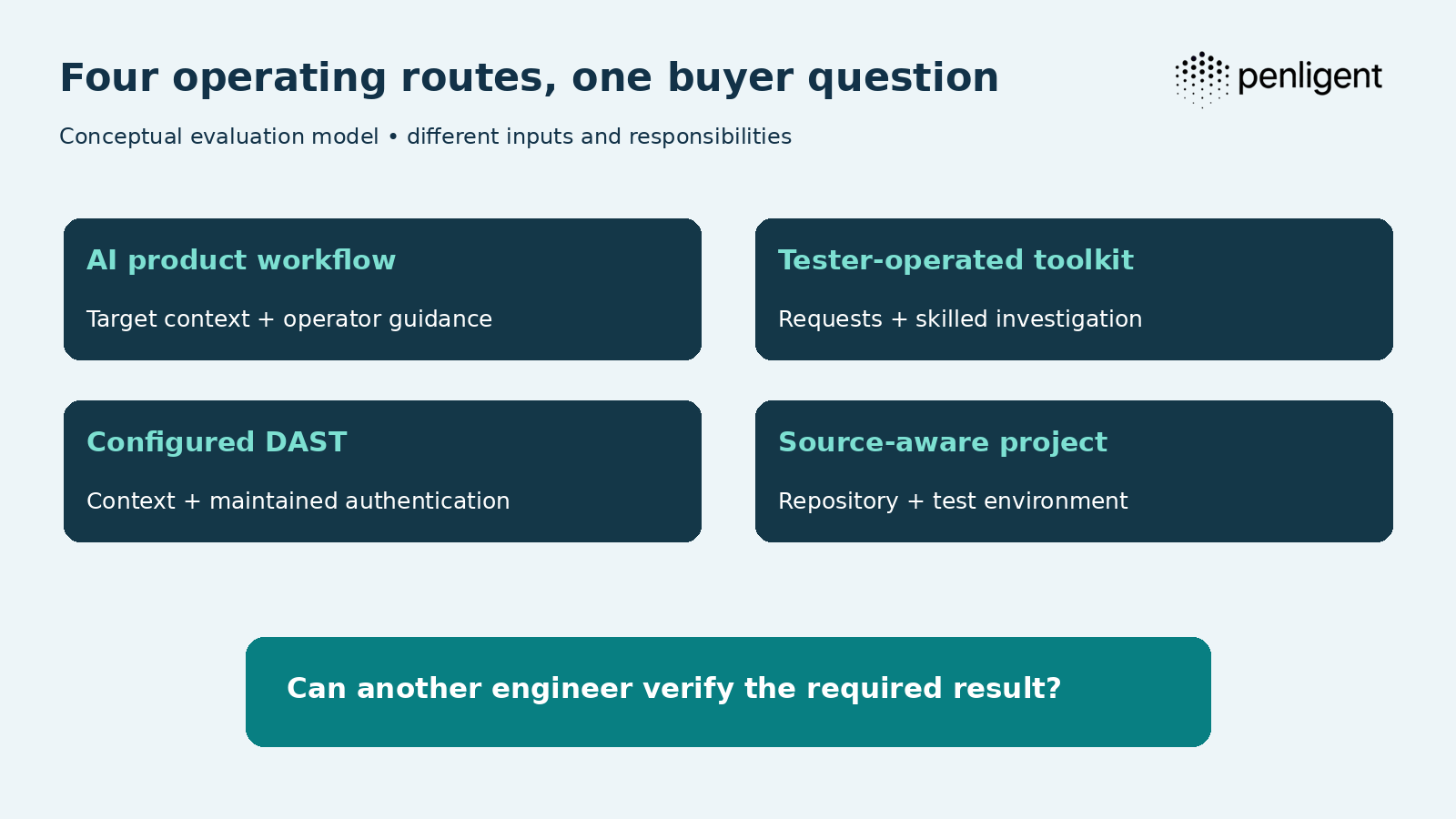
Conceptual model: different operating routes should answer the same practical buyer question.
A team may be seeking a smaller initial commitment, more direct operator control, source-aware analysis, a specific deployment boundary, or a workflow it can maintain internally. Those reasons lead to different shortlists. Writing them down prevents a demonstration from shifting the purchase toward whichever feature happens to look impressive.
Use a concrete requirement. A small application team might need to validate an authenticated sharing workflow before a release. A consultancy might need repeatable evidence and reports for several customers. An internal security team might need to integrate testing with an existing review process. Each needs more than a general assurance that the software finds vulnerabilities.
Distinguish a blocker from a preference. A strict prohibition on external processing can eliminate an architecture. A preference for a particular report layout may be resolved through an export or template. Treating every preference as mandatory can produce a long evaluation without improving the eventual decision.
Define what the existing process fails to deliver. If the problem is slow review of unsupported findings, buying faster execution may increase the backlog. If the problem is access to authenticated features, changing the model while retaining invalid test accounts will not fix it. The requirement should identify the missing outcome and the evidence that would show improvement.
An alternative can complement rather than replace a platform. A team may retain a broad recurring service while using an operator-controlled workflow for narrow investigations. Another may use a source-aware tool during development and a separate live assessment before release. Evaluate the additional value and duplicated operating work before calling either arrangement redundant.
The decision also has a time horizon. A one-off customer request and a year of frequent release testing justify different commitments. State the expected number and complexity of assessments, who will review them, and how soon the team needs a usable result. A quote has meaning only against that workload.
What XBOW's current pricing does and does not establish
XBOW's official pricing page describes usage-based pricing scoped to the buyer's environment and directs visitors to request a quote. It does not present a universal numeric subscription tier on that page. Buyers should obtain the current offer rather than assume that a figure quoted in an older launch announcement applies to their present scope.
A historical starting price can describe a real offer without being the correct basis for today's purchase. Product packaging, service scope, and commercial terms can change. The safe comparison uses the dated proposal the supplier will actually honor and the current plan the alternative makes available, with the billing period visible for both.
Ask the quote to identify its unit. Application, asset, assessment, usage allowance, and portfolio are different concepts. A change in roles or application complexity may affect effort even when the hostname count stays constant. Obtain an example showing how the proposed contract handles a representative assessment and a realistic expansion.
Clarify the treatment of retries and retests. A configuration failure, a repeated candidate investigation, and verification after a fix may be separate usage events. The buyer should know whether those events consume the same allowance, receive different treatment, or require another purchase. An unlimited-sounding label is not a substitute for the applicable terms.
Separate recurring commitment from variable spend. A usage-based offer may still have contractual minimums or other terms that need confirmation; do not assume them either way. The evaluation should identify the fixed amount, the permitted usage, any expiration or rollover treatment, and the process for approving additional consumption.
A pricing comparison should end with two numbers or ranges: the expected annual spend under the planned workload and the amount at risk in a plausible exception month. The latter might involve a major release, invalid preparation, or additional review. A low nominal run cost says little about predictability when the usage boundary is unclear.
Compare operating routes instead of inventing a universal winner
The following table is a shortlist of operating models, not an independent performance ranking. A product's inclusion does not mean that every buyer requirement is supported. The purpose is to identify which type of pilot to run and which responsibilities the buyer should expect to examine.
Route
Candidate to evaluate
Input that changes the comparison
Main buyer question
AI-assisted product workflow
Penligente
Target context and operator guidance
Does the workflow produce usable evidence with acceptable review effort?
Tester-operated web toolkit
Burp Suite Professional
Skilled tester time and captured requests
Does direct control fit the team's investigative work?
Configured DAST workflow
ZAP
Authentication and automation configuration
Can the team maintain useful coverage across releases?
Source-aware AI project
Shannon
Application source and a test environment
Does source access improve the required development-stage assessment?
Existing autonomous platform
XBOW
Current scoped offer and assessment configuration
Does the existing route already meet the requirement after configuration?
Use the same acceptance question across routes even when implementation differs. If the question is whether an unrelated test user can access a synthetic document after sharing is revoked, every route should produce an observation about that condition. The comparison should not reward one product for performing a different, easier test.
At the same time, do not force identical mechanics. A human tester may choose a request manually, a scanner may use a configured context, and an agent may navigate the application. Record those inputs and interventions. They are part of the operating cost, not evidence that the comparison is unfair by definition.
Avoid converting undocumented features into negative claims. If public documentation does not answer a requirement, mark it as a question for the supplier. Not publicly established is different from unsupported. A good comparison distinguishes what is documented, what the pilot demonstrated, and what remains unresolved.
The practical winner is the route that meets the mandatory conditions with an operating burden the buyer can sustain. That conclusion may differ for an experienced application-security team and a founder running a first assessment. A recommendation without that context is too broad to guide a purchase.
XBOW, Penligent, Burp, ZAP, and Shannon side by side
A shortlist becomes useful when each product is mapped to a concrete input, responsibility, and purchasing question. The table below uses the public descriptions reviewed on October 19, 2026. It does not assign a detection score or treat an undocumented feature as absent. A supplier claim still needs validation in the buyer’s own environment.
Produto
Documented starting point
Work to validate in your pilot
Commercial question
XBOW
Autonomous assessments with configurable attack types and scoped usage pricing.
Required attack type, authentication, evidence, and any preview prerequisites.
What usage, support, and retests does the current environment-scoped quote cover?
Penligente
Live black-box workflow, operator guidance, and evidence-oriented PDF or Markdown reporting.
Representative authenticated workflow and the review needed to accept the result.
Which current plan covers the workflow, and how many credits does the actual pilot consume?
Burp Suite Professional
Web penetration-testing toolkit.
How the intended tester investigates and documents the selected boundary.
Which edition and license fit the operator count and intended use?
ZAP
Contexts, users, session management, authentication methods, and verification.
Session-loss detection and configuration maintenance for the actual application.
Who owns configuration, updates, and alert review, and what does that work cost?
Shannon
Source-aware web and API AI pentesting described in its repository.
Repository-to-deployment match, supported setup, and resulting evidence.
What license, model usage, infrastructure, and maintenance apply to this deployment?
For a founder with one owned application and limited initial budget, the first useful step is a bounded product evaluation with dedicated test accounts. For an established pentester, operator control and the time needed to investigate an ambiguous request may carry more weight. A team with source access can add a source-aware route, but should record that additional input when comparing results. Those are different buying situations, so a single “best alternative” verdict would conceal the decision that matters.
Evaluate Penligent as a workflow, not a price shortcut
Penligent's AI pentesting product page describes live black-box application testing, validation of findings, operator guidance, and PDF or Markdown reporting. The same page displays Free access and a Pro option at $39.92 per month billed annually with 6,000 monthly credits. These are public product descriptions and the displayed annual-billing equivalent, not an independent benchmark or a monthly-cancelable price claim.
That route is worth piloting when a team wants to operate an AI-assisted assessment and examine the evidence itself. Use the available entry path to test a representative authorized workflow before increasing usage. Confirm current checkout terms and the plan needed for the required features; a public entry option does not establish every team's entitlement or expected consumption.
Do not turn the comparison into a claim that one low-priced subscription replaces every scoped assessment. Scope, preparation, support, review responsibility, and output acceptance can differ. The useful question is whether the product can perform the buyer's selected work with adequate evidence and a cost the team understands.
Keep the first pilot small enough to interpret. Provide a defined application, dedicated test identities, and a known harmless success condition. Review the resulting artifacts before expanding the target set. A large initial run can make it harder to distinguish a configuration issue from a capability gap.
Treat private deployment as a separate availability and procurement question. A roadmap or enterprise description should not be converted into a promise of immediate installation, a particular hardware profile, or an approved data boundary. Confirm the supported released configuration before making that condition part of a customer commitment.
Burp Suite Professional fits a tester-operated route
PortSwigger's Burp Suite Professional page presents a web penetration-testing toolkit. For a buyer, that route is meaningfully different from purchasing a finished assessment outcome: the team's tester remains central to planning, investigation, interpretation, and delivery. Compare the work that person can perform, not just the presence of automation in the interface.
A team that already understands its application's requests may value a workflow centered on direct investigation. The evaluation should use the actual tester and a representative task. Record the time required to prepare the session, examine the relevant behavior, collect evidence, and explain the finding to an engineer.
Do not count existing expertise as free merely because the tester is already employed. That person's time has an opportunity cost and limited capacity. A tool can be an excellent fit while the team still needs to budget for interpretation and reporting. Conversely, automation may not reduce total work if the operator must reconstruct every result afterward.
Avoid assuming that a human-led route lacks automation or AI assistance. Product boundaries change, and a category label is a starting point rather than a complete feature specification. Ask which edition and supported workflow the supplier proposes for the requirement being tested.
This route may also serve as an investigative reference during a pilot. A qualified tester can inspect an ambiguous observation and determine what additional evidence is needed. That is a role in the evaluation, not proof that the toolkit outperforms every other route across an entire application portfolio.
ZAP makes configuration responsibility visible
ZAP's authentication documentation separates application contexts, authentication methods, session management, users, and authentication verification. That distinction is useful when evaluating a configured DAST route: supplying credentials is only one part of maintaining an authenticated test state.
A buyer considering this approach should identify who will maintain the configuration as the application changes. A login page, token lifetime, or session indicator can change without the testing job itself failing obviously. The operating model needs a way to detect that the job no longer reaches the intended authenticated surface.
Use a representative role and a harmless protected object to confirm access. Then exercise a controlled loss of authentication. The result should make that loss visible rather than silently treating public pages as the full assessment. This is a proposed pilot condition, not a claim about the default behavior of every configuration.
The cost model should include configuration development, debugging, updates, and review of alerts. An internally maintained workflow can be a good choice when the team has the necessary skill and wants that responsibility. It is less useful to describe it as zero-cost while ignoring the work required to keep it meaningful.
A configured scanner can also provide a stable reference observation for selected checks. Use it for what the team can validate and maintain. Do not infer that it covers every business rule or replaces the need to understand the application's roles and state transitions.
Shannon changes the input contract through source access
Shannon's official repository describes an AI pentester for web applications and APIs that analyzes source code and seeks to demonstrate vulnerabilities. Source access changes the evaluation. A source-aware run receives information that a live black-box run may not have, so their outputs cannot be treated as a controlled comparison without recording that difference.
This route is relevant to a team that owns the application source and can provide a suitable test environment. Before running a pilot, establish the repository revision, the deployed build, the supported setup, and the model configuration. A finding about code that is not present in the running target may still be interesting, but it answers a different question from demonstrated exposure in that target.
Open-source availability does not make the operating burden disappear. The team still needs to review the license and supported configuration, manage dependencies, handle model access, protect credentials, and interpret results. Those responsibilities should appear in the comparison alongside any subscription or usage fees.
Do not import a benchmark percentage from a repository into a claim about the buyer's application. A benchmark can describe performance under its stated conditions. It does not establish authenticated coverage, operational safety, or review effort in another environment. The buyer's pilot should answer those questions directly.
The source-aware route can be complementary. It may inform development-stage investigation while another process validates a deployed system under a defined identity. Record the relationship between the two observations so the team does not count the same underlying defect twice or assume that a source finding proves runtime access.
Check the existing configuration before replacing a platform
A comparison should describe XBOW accurately as well as describe the alternatives accurately. XBOW's current attack-type reference lists several default vulnerability categories, common-flaw checks, focused retests, and optional features. It identifies IDOR testing as public preview. That is more specific than treating the platform as a generic scanner or assuming every capability has the same release status.
The buyer should map the required task to the currently supported feature and configuration. A missing result may reflect a feature not enabled, a prerequisite not supplied, a preview limitation, or a genuine capability gap. Those explanations have different consequences. Resolve them before using one unsuccessful run as evidence for a broad replacement claim.
XBOW's asset-protection guidance documents dedicated test accounts, domain scope, protected URLs, testing windows, and rate controls. It also notes that some settings cannot be changed after an assessment starts. The procurement consequence is to review configuration before execution and understand the supported change procedure, rather than assume every control is editable during a run.
This is not a reason to retain a product automatically. It is a way to make the decision fair. If correcting the configuration meets the requirement at an acceptable cost, replacement may add unnecessary migration work. If the supported configuration still does not meet a mandatory condition, the buyer has a concrete basis for seeking another route.
Keep that diagnosis in the evaluation record. A later reviewer should be able to distinguish a supplier limitation from a customer preparation problem. The same discipline applies to every alternative: do not credit an agent for a capability demonstrated only through an undocumented workaround, or reject it for inputs the team never provided.
Design a common pilot around one business boundary
A useful pilot can center on a fictional document-sharing application operated in an authorized test environment. Create an owner, an invited collaborator, and an unrelated user. Populate synthetic documents and agree how sharing, revocation, and export should behave. No customer files or production credentials are required for the example.
The question is whether each route can establish the important observations under the same scope. Can the owner access the document? Can the invited collaborator access it while the share is active? Can the unrelated user access it? What changes after revocation? These questions provide a compact exercise in authenticated discovery, authorization, state, and evidence.
Decide the expected outcomes before the run. If the team changes its interpretation after seeing a result, it risks rewarding the most convenient explanation. The application owner should supply the business rule, while the evaluator records the actual observation and supporting artifact. A product can help discover the behavior without deciding the customer's intended policy.
Use a known condition to check whether the route can reach the workflow. That condition can be a harmless protected object with a distinctive synthetic marker. If the tool never reaches it, the evaluator should investigate access and navigation before concluding that no defect exists. A negative finding is meaningful only when the relevant test was valid.
Keep the exercise bounded. The goal is not to compare every possible vulnerability category in one afternoon. It is to expose whether the proposed operating route can handle a task representative of the buyer's real need. A narrow pilot with traceable evidence can support a better decision than a broad run whose coverage nobody can explain.
Afterward, have an engineer who did not operate the tool review the output. Can that person identify the tested role, object, action, and observed result? Can they distinguish an untested path from a path that behaved as expected? That handoff tests whether the evidence is useful beyond the person who watched the demonstration.
Separate three kinds of product evidence
A vendor description, a controlled benchmark, and a buyer-operated pilot answer different questions. The description establishes what the supplier says it offers. A benchmark can measure selected behavior under stated conditions. A pilot can establish whether the buyer can operate the proposed route on a representative task. None should silently substitute for the others.
When a comparison cites a benchmark, ask what the agent received. Source code, hints, credentials, tool access, compute limits, and retry allowances can change the task. A result produced with one information set should not be treated as a direct estimate of another product's performance under a different one. The evaluation can still learn from the study without turning its percentage into a procurement guarantee.
Ask what counted as success. Discovering a candidate, demonstrating a condition, and producing a reviewed deliverable are distinct outcomes. A benchmark designed around a challenge flag may be useful for research while omitting authentication maintenance, application preparation, support, and reporting effort. Those omissions are limits of the measured question rather than reasons to dismiss the research.
The buyer's pilot should also state its limits. A synthetic document-sharing exercise does not establish coverage for every API, infrastructure service, or application framework. It establishes observations about the selected workflow and exposes some operating costs. Expanding the decision requires another representative question, not a broader claim attached to the same small result.
Keep a short evidence column in the purchase scorecard. Mark a capability as publicly described, demonstrated in the pilot, contractually confirmed, or unresolved. These categories can overlap, but they should remain distinguishable. A useful interface demonstration may still need a commercial entitlement confirmed, while a contract term may still need technical validation in the intended environment.
This approach also prevents an unfair comparison against an incumbent. A buyer may know every limitation of the product it operates while seeing only the polished path of a new candidate. Give the alternative a realistic failure condition and give the incumbent the inputs its supported workflow requires. The resulting comparison is more likely to identify a real improvement than to reward novelty.
If the team cannot obtain enough evidence for a mandatory claim, preserve the uncertainty in the decision. A limited paid pilot, a narrower purchase, or a deferred requirement may be appropriate. Do not fill the gap with an assumed architecture, an unverified score, or a confident statement copied from another comparison page.
Keep inputs equal enough to interpret the result
A live target URL, a source repository, an API definition, captured traffic, and a guided workflow provide different information. Each may be appropriate, but the comparison must record which route received which inputs. Otherwise a difference in preparation can be misreported as a difference in reasoning ability.
Use two views of the pilot if the inputs cannot be identical. First, evaluate each route under the information the buyer can realistically supply. Second, explain the advantage and cost of additional input. A source-aware workflow may produce a useful result precisely because the team can provide code; that is a legitimate fit difference rather than a defect in the comparison.
Record operator intervention. Did a tester manually identify the relevant request? Did an engineer write a login script? Did the evaluator explain the share-revocation rule? These interventions should not invalidate the result, but they belong in the effort record. A product that succeeds after two hours of skilled guidance has a different operating profile from one that succeeds with routine setup.
Record environment preparation separately. Fixing a broken test deployment is not the same activity as configuring the testing product. Both consume time, but the distinction matters when the buyer plans future use. If every product is blocked by the same application issue, replacing the testing route will not remove that dependency.
Use the same permitted actions and impact limits. One route should not receive permission to perform intrusive cross-system activity while another is restricted to a synthetic read check, then be credited with deeper coverage. The evaluation should compare results within the authorized boundary and identify any additional work that would require another approval.
Keep the final artifact simple: inputs supplied, configuration, interventions, observations, limitations, and effort. That record is enough to explain many differences without pretending to be a scientific benchmark. It also gives the team a reproducible starting point when a product or application version changes.
Authentication is a continuing condition
A successful login at the beginning of a run does not establish that subsequent tests remained authenticated. Sessions expire, roles change, and workflows may use more than one authorization mechanism. A buyer evaluating alternatives needs evidence that the intended identity was active when the important observation occurred.
Agree an authentication witness for the pilot. It might be access to a synthetic account-specific object through an ordinary supported request. The witness should be harmless and recognizable. Its purpose is to establish that the workflow reached the expected role context, not to store an entire session trace indefinitely.
Introduce a controlled session failure in the test environment. For example, invalidate the dedicated session through the application's supported mechanism between two observations. The evaluation should record whether the route detects the changed condition, reauthenticates appropriately, pauses, or continues with reduced coverage. Do not assume one behavior from a generic authentication checkbox.
A blocked login should remain a blocked login in the final report. It should not become a clean result merely because the job finished. The distinction matters commercially: a buyer pays for a defined assessment, and cannot judge value if inaccessible surfaces are silently counted as tested.
Check the role after sensitive transitions. An application may redirect through another service or change the effective identity during a workflow. The evaluator should understand what the test is actually observing rather than assume that a credential supplied at intake describes every later request.
The best route for a team may be the one whose authentication failures it can diagnose and maintain reliably. A sophisticated agent is not useful if the team cannot tell whether it reached the application state that matters. A more configurable approach is not useful if nobody can keep its configuration current.
Authorization needs observations about relationships
An authorization test asks whether a particular principal can perform an action on a particular resource under a particular state. The relationship matters. A page returning a successful response does not by itself establish an access-control failure, and a denial does not establish that legitimate access still works.
For the document pilot, keep the owner, collaborator, and unrelated user distinct. Use separate sessions and synthetic resources. Record which identity created the object, which identity received access, and what the revocation changed. This makes an unexpected observation interpretable without relying on account names as evidence.
Test the allowed case alongside the prohibited case. If the owner cannot access the document, an unrelated user's denial may simply reflect a broken application. If the collaborator retains access after revocation, determine whether the expected policy applies immediately or after a documented state transition. The application owner's rule gives the observation meaning.
Separate object-level and function-level questions. Reading a document belonging to another user and invoking an administrative export are different boundaries. A route that demonstrates one has not automatically covered the other. The report should identify the specific relationship tested and avoid expanding the claim beyond the evidence.
Do not use real sensitive data to make a finding seem more persuasive. A synthetic marker can demonstrate that the wrong principal received a protected object. The impact explanation can then state the class of information at risk under the supported conditions, while distinguishing that inference from data actually accessed.
This is also a useful way to compare review burden. Count how often the product's explanation needs correction because it misunderstood the role model, object ownership, or state. Those corrections are part of the cost of delivering trustworthy findings, even when the underlying request was executed automatically.
Require evidence that survives the demonstration
A live demonstration creates confidence through motion: requests appear, agents work, and a finding card turns red. The buying decision should rest on artifacts that remain useful after the screen is closed. Ask for the conditions, observations, and reasoning behind a representative finding.
A minimal evidence record should identify the application and environment, relevant role, action, object, timestamp, observed outcome, and the boundary the reviewer believes was violated. The exact format can vary. What matters is that another qualified person can follow the claim back to an observation rather than only to generated prose.
Distinguish raw evidence from a narrative. A summary can explain why a result matters, but it should not be the only record of what happened. Conversely, a large archive of requests may be difficult to interpret without a concise explanation. Evaluate whether the route produces a useful connection between the two.
Review an unsuccessful candidate as well as an accepted finding. The reason a candidate was rejected can reveal how the workflow handles ambiguity, false positives, and application context. A product that records uncertainty clearly may reduce future review work even when its dashboard contains fewer dramatic findings.
Ask whether exported evidence remains interpretable. A report may refer to platform-only objects or links that require an active subscription. That can be acceptable if the buyer understands the arrangement, but it should not be discovered during a customer handoff. Test the artifact in the form the actual recipient will receive.
Preserve version identity. A later correction should not silently rewrite the original observation or make it impossible to tell which report the recipient reviewed. The buyer needs a way to understand changes in scope, severity, or reproduction conditions without treating every version as a separate defect.
Measure coverage with a denominator
A finding count says nothing about the work that was not performed. A route can produce many low-value candidates while missing a required role or workflow. Define a small coverage denominator for the pilot before using the output to choose a platform.
For the sharing example, the denominator might be the agreed combinations of role, action, object state, and environment. Each combination receives a result such as observed expected behavior, supported finding, blocked prerequisite, or not attempted. Those states are more informative than a single completed flag.
Do not confuse a completed job with a complete assessment. The scheduler may have no remaining tasks while the operator still needs to investigate an authentication failure or review a candidate. The acceptance record should state which work is complete and which remains unresolved.
Treat discovered surface and tested surface separately. An endpoint in an inventory may not have received a meaningful authenticated test. A workflow encountered by a browser may still be outside the permitted method. The coverage record should reflect the test performed rather than credit every discovered item equally.
Use the denominator to compare repeated runs. If a later run finds fewer issues but tests fewer role combinations, the apparent improvement is ambiguous. If it exercises the same agreed conditions after a fix, the evidence is more useful. This discipline applies regardless of whether the route uses an agent, a scanner, or a human tester.
The denominator should stay proportional to the purchase. A small team does not need an elaborate measurement platform to compare one application workflow. A compact record with explicit states can provide enough information to make the first paid decision responsibly.
A concrete role matrix for the document-sharing pilot
Use four synthetic cases to turn “authenticated coverage” into something visible. The application owner approves the expected behavior before execution. The following example assumes that revocation should remove access immediately; change that assumption if the application’s documented policy differs.
Case
Identity and state
Expected observation
Evidence needed
owner-read
Owner; document exists.
Allow access to the synthetic document.
Verified owner session and the document’s fixture marker.
collaborator-read
Invited collaborator; share active.
Allow the shared synthetic document.
Verified collaborator session and active share state.
unrelated-read
Unrelated test user; never invited.
Deny the protected object.
Verified unrelated identity and observed object-access result.
revoked-read
Former collaborator; share revoked.
Deny under the agreed immediate-revocation rule.
Valid former-collaborator session, revocation record, and post-revocation observation.
Suppose route A reports an access-control finding in unrelated-read but loses authentication before revoked-read. Route B reports no findings, confirms three expected behaviors, and never attempts revoked-read. Both have valid observations for three of four cases. Route B’s zero-finding count is not evidence of complete coverage, and route A’s extra finding is not a reason to ignore its unverified case. The comparison needs the case-level record.
Run a local comparison of coverage and findings
Save the following example as compare_pilot.py and run python3 compare_pilot.py. It uses only fictional in-memory records, makes no network requests, and does not test any vendor. Route names are deliberately anonymous because this is an accounting demonstration, not measured product performance.
"""Offline pilot reconciliation using synthetic observations only."""
expected = {
    'owner-read': 'allow',
    'collaborator-read': 'allow',
    'unrelated-read': 'deny',
    'revoked-read': 'deny',
}
# Two fictional routes; these names do not represent products.
runs = {
    'route-a': {
        'owner-read': ('allow', True, 'trace-a1'),
        'collaborator-read': ('allow', True, 'trace-a2'),
        'unrelated-read': ('allow', True, 'trace-a3'),
        'revoked-read': ('deny', False, 'trace-a4'),
    },
    'route-b': {
        'owner-read': ('allow', True, 'trace-b1'),
        'collaborator-read': ('allow', True, 'trace-b2'),
        'unrelated-read': ('deny', True, 'trace-b3'),
        # revoked-read was not attempted.
    },
}

def reconcile(rows):
    counts = dict(expected=0, finding=0, unverified=0, missing=0)
    for case, wanted in expected.items():
        if case not in rows:
            counts['missing'] += 1
            continue
        observed, auth_valid, artifact = rows[case]
        if not auth_valid or not artifact or observed not in {'allow', 'deny'}:
            counts['unverified'] += 1
        elif observed == wanted:
            counts['expected'] += 1
        else:
            counts['finding'] += 1
    valid = counts['expected'] + counts['finding']
    return counts, f'{valid}/{len(expected)}'

for route, rows in runs.items():
    counts, coverage = reconcile(rows)
    print(route, 'valid coverage:', coverage, counts)
The important line is not simply the number of findings. Route A’s revoked-read result is unverified because its authentication prerequisite failed. Route B’s corresponding case is missing. Neither should be converted into a clean authorization result. A finding also requires review: the code labels a mismatch between expected and observed behavior, but cannot determine whether the fixture, policy, or evidence is correct.
The expected-case inventory is independent of the returned results, so an absent case stays visible. If the denominator were derived only from observations supplied by the product, missing work could disappear from the score. In a real pilot, bind each observation to the correct application revision, role, configuration, and evidence artifact before accepting the classification.
Do not generalize the three-of-four result into a detection rate. This fixture checks operational coverage for four agreed conditions. It does not measure precision, recall, vulnerability-class coverage, or performance on another application.
Include support in the purchasing comparison
A product can meet a technical requirement while its support model does not fit the buyer's delivery deadline. The relevant question is what happens when an assessment is blocked, evidence is disputed, or a configuration behaves unexpectedly. Ask which support level covers that situation and what the response commitment actually means.
XBOW's October 13, 2026 support brief describes Standard, Advanced, and Strategic offerings. It lists critical-issue response within one business day on a 24×5 basis for Standard, within four hours on a 24×7 basis for Advanced, and under two hours on a 24×7 basis for Strategic. These are stated response terms, not promises that an assessment or technical fault will be resolved within those intervals.
Compare like with like. A supplier's response time, a scheduled engineering session, and a human-reviewed assessment deliverable are different services. An alternative with an attractive entry plan may still require the buyer to perform most diagnosis. Another offer may include assistance that reduces internal effort. Obtain the applicable terms instead of estimating support from a general marketing label.
The pilot should include one ordinary support question relevant to the intended setup. Observe whether the answer identifies a supported configuration and a reproducible next step. A fast acknowledgement is useful, but it does not establish the quality of technical guidance. Record both elapsed waiting time and the work the team performs in response.
Review the evidence-sharing path. Troubleshooting should not require sending unrestricted customer artifacts to a recipient the organization has not approved. Establish what can be redacted, which diagnostic bundle is necessary, and how access is controlled. These are operating requirements for the buyer, not allegations about a particular supplier.
Model the cost of a completed assessment
The financial comparison should include the cost of obtaining an accepted result, not only the cost of starting a run. A simple model can separate access fees, usage, infrastructure, preparation, review, remediation verification, and coordination. Use the same workload assumptions for each route and leave unknown vendor charges visible until confirmed.
Consider a fictional team planning twelve assessments a year. For one route, assume $1,200 in annual access fees, $600 in usage and infrastructure, and forty-eight hours of preparation and review at an internal planning rate of $100 per hour. The modeled annual total is $6,600. These numbers are invented for arithmetic and are not a quote for any named product.
Now consider another fictional route with $3,000 in access fees, $900 in usage and infrastructure, and twenty-four hours at the same planning rate. Its modeled annual total is $6,300. The route with the higher access fee is less expensive under these assumptions because the operating effort differs. Whether that difference exists in practice is what the pilot must establish.
Fictional annual component
Route A
Route B
Access fees
$1,200
$3,000
Usage and infrastructure
$600
$900
Preparation and review
48 hours at $100
24 hours at $100
Modeled total
$6,600
$6,300
Evidence needed before purchase
Measured effort and current quote
Measured effort and current quote
This model is not a claim that higher-priced products save labor. It shows why the buyer needs measured operating effort rather than an assumption. A route that appears simpler may require more report repair, while a configurable tool may become efficient after a reusable setup is established.
Run a sensitivity check around the uncertain input. If preparation and review take twice as long, what happens to the total? If the team performs four assessments instead of twelve, how does a fixed commitment affect the cost per delivered result? Use ranges where the pilot is too small to support a single dependable estimate.
Include failed preparation. A test blocked by an expired account may still consume operator time and, depending on the applicable offer, usage. The buyer should understand the financial treatment and the workflow for correcting the input. Ignoring failed runs makes a purchase model look cleaner than the operating reality.
Keep the model separate from net business profit. Internal planning rates, accounting treatment, and the value of time vary. The purpose is to make the decision transparent enough that another stakeholder can replace the assumptions and understand the result.
Run the cost sensitivity instead of assuming labor is free
The earlier annual example has a useful break-even point. Route B carries $2,100 more in access and usage assumptions, while requiring 24 fewer operating hours per year. At an hourly planning rate above $87.50, its modeled total becomes lower. Below that rate, route A is less expensive under the same assumptions. These are fictional routes and inputs, not quotes or measured productivity claims.
"""Fictional annual workload, not a quote or detection benchmark."""
from decimal import Decimal as D
routes = {
'route-a': {'access': D('1200'), 'usage': D('600'),
'hours_per_assessment': D('4')},
'route-b': {'access': D('3000'), 'usage': D('900'),
'hours_per_assessment': D('2')},
}
assessments = D('12')
for hourly_rate in map(D, ('50', '100', '150')):
costs = {
name: row['access'] + row['usage']
+ assessments * row['hours_per_assessment'] * hourly_rate
for name, row in routes.items()
}
print(f'hourly_rate=${hourly_rate}:',
', '.join(f'{name}=${cost:.0f}' for name, cost in costs.items()))
# Access + usage differ by $2,100; labor differs by 24 hours/year.
print('break-even hourly rate:
A staging environment can be the right place to evaluate a new route, but it may omit the constraints that matter in production. Differences in identity, third-party dependencies, data, rate limits, and network paths can change the useful coverage. Record which production conditions the pilot represents and which it does not.
Use synthetic fixtures and agreed low-impact observations. The goal is to establish that the testing route can reach and evaluate the selected workflow, not to maximize visible disruption. A demonstrated boundary failure with harmless data can be sufficient evidence for a purchasing decision without escalating into a broad cross-system exercise.
Identify third-party domains explicitly. An application may need to visit a hosted identity service or load a dependency while the buyer has no authority to assess that service. The test plan should distinguish necessary application access from permission to direct testing at the dependency. Record that distinction in the scope supplied to every route.
Agree operational monitoring and a stop contact. The evaluator should know who can identify unacceptable application behavior and how execution is paused. Test the supported pause procedure before relying on it during sensitive work. A job status should not be assumed to describe every already-running process unless the supplier explains that behavior.
Do not generalize one application's request rate into a safe default for another. The acceptable load depends on the environment and permitted methods. Use an agreed conservative pilot configuration and observe application behavior with the operations owner. A setting that completed quickly on a demonstration system does not establish a universal production recommendation.
Data handling can eliminate an otherwise attractive option
Before supplying source, credentials, screenshots, or application responses, map where each class of information is processed and retained. Distinguish the execution worker, model endpoint, artifact store, report delivery path, and support diagnostics. A product running on a local machine may still communicate with external services.
Ask the supplier for the actual supported arrangement relevant to the selected plan. Do not infer a data boundary from a broad label such as private, local, enterprise, or dedicated. The buyer needs to understand recipients, access, retention, and any exceptions that matter under its own policy.
Use redacted architecture information during initial scoping. A supplier generally does not need live credentials or a complete vulnerability archive to explain the commercial and deployment model. If a technical pilot requires sensitive material, agree the transfer and access conditions before providing it.
Review model fallback behavior when it matters to the data policy. An approved endpoint becoming unavailable should not silently create an unreviewed processing destination. The evaluation can ask how the supported workflow represents that failure and whether an alternative path requires a deliberate configuration choice.
A route that fails a mandatory data-processing condition should not remain the preferred option solely because its demonstration found a useful bug. Technical discovery and permitted operation are separate acceptance questions. Both must be satisfied for the purchase to fit the organization.
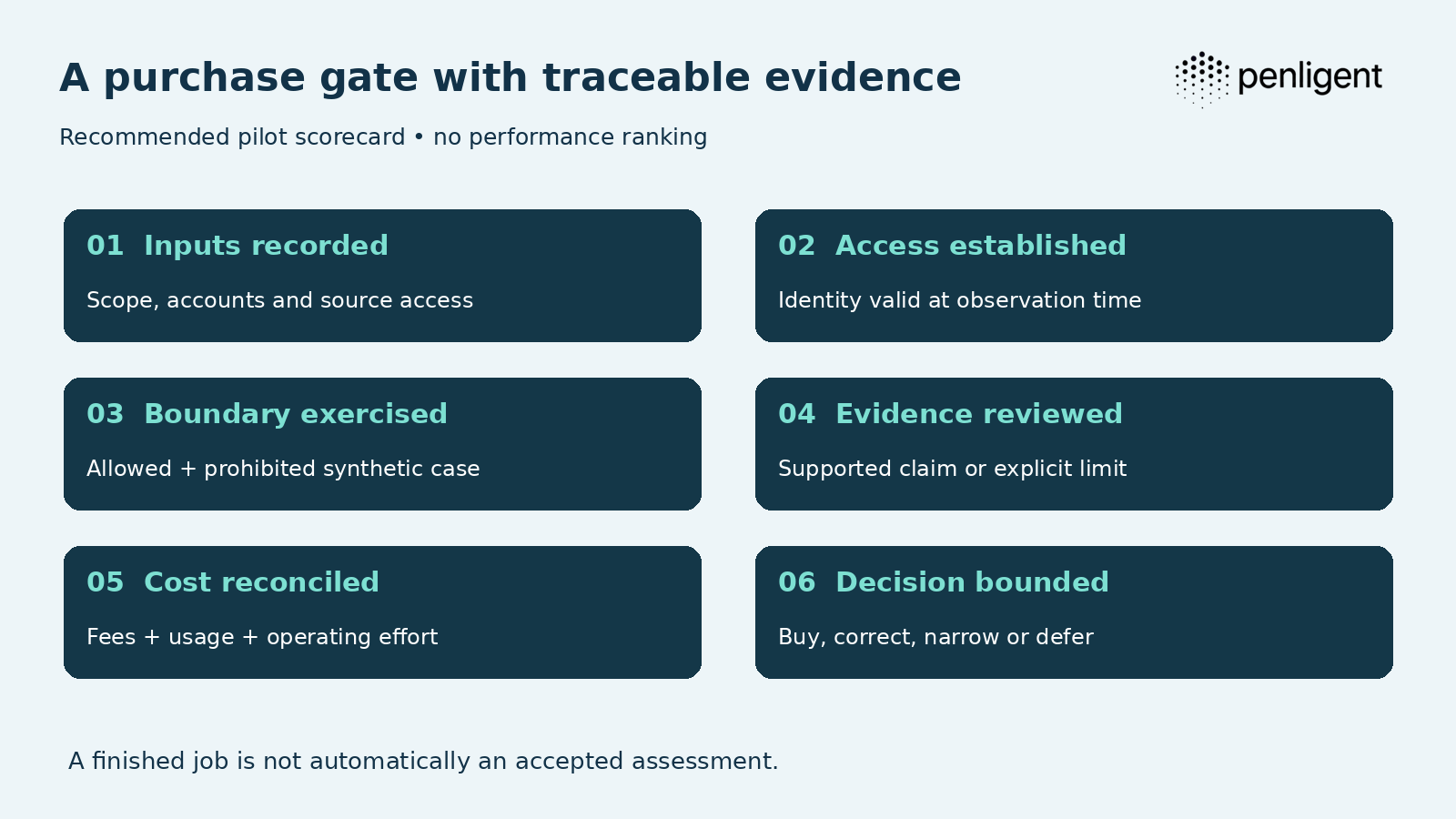
Recommended evaluation gates, not a performance ranking. Record inputs, observations, limits, and cost.
Decide what would justify paying after the first pilot
A first payment should buy a defined next increment of useful work. That might be additional validated scope, more frequent assessments, a required collaboration feature, or a supported operating arrangement. It should not be based solely on a large finding count or excitement about an agent's activity.
Write a purchase gate before the pilot. For example, the route must reach the agreed authenticated workflow, preserve the role boundary, produce reviewable evidence, and fit the estimated operating allowance. If a mandatory condition fails, decide whether a supported correction can resolve it before increasing commitment.
A successful narrow pilot can justify expanding scope gradually. Add another representative workflow or environment and check whether preparation and review remain predictable. Do not assume that success on one application establishes equal performance across a portfolio with different authentication and business rules.
A failed pilot can still provide a useful answer. It may show that the chosen route needs inputs the team cannot supply, that the application is not ready for assessment, or that a different operating model is necessary. Preserve the reason instead of buying more usage in the hope that the same invalid setup will improve.
The buyer should also know when to stop comparing. Once a route meets the mandatory conditions, produces useful evidence, and has acceptable terms, another round of generic demonstrations may add little. Spend the next evaluation effort on the real application's difficult workflow rather than repeatedly watching the same convenient example.
Have the procurement owner sign off on the same scorecard the technical reviewer used. That reconciliation catches a common mismatch: a technically successful pilot attached to a commercial offer that excludes the tested workflow.
Migration should preserve useful history
Replacing a platform can break the relationship between old findings and new observations. Before moving, export the accepted reports, relevant evidence, scope records, and remediation state under the existing agreement. Confirm that the team can interpret those records without relying on someone else's memory of the engagement.
Map finding identity carefully. Two products may give the same underlying defect different names or scores. Use the affected behavior, root cause where supported, and reproduction conditions to decide whether the new observation represents the same issue. A dashboard count should not double simply because the identifier changed.
Run the first replacement assessment against a limited agreed scope. Check authentication, evidence quality, delivery format, and retest handling before expanding. A controlled transition gives the team a chance to correct configuration and report mappings without confusing a large customer-facing delivery.
Retire unused authority. Remove old test accounts, integration tokens, scheduled jobs, and access rules according to the organization's process. Retaining a report does not require retaining every permission used to create it. Keep retention and access revocation as separate closeout decisions.
If the existing route remains useful for another purpose, define that division of work. A portfolio platform, a source-aware tool, and a tester-operated workflow can coexist, but the team should know which observation is authoritative for each delivery decision and who owns unresolved discrepancies.
Questions buyers ask about XBOW alternatives
What is the best XBOW alternative for a small team?
Start with the workflow the team can operate and review. Penligent, a tester-led toolkit, a configured DAST route, and a source-aware project have different input and staffing requirements. A small authorized pilot is more useful than an unsupported universal ranking.
Does XBOW publish a fixed subscription price?
The official pricing page reviewed on October 19, 2026 describes environment-scoped, usage-based pricing and requests a quote. Use the current proposal for the intended workload rather than assuming an older announcement is a universally available offer.
Is a lower public entry price proof of lower total cost?
No. Include preparation, usage, infrastructure, review, support, and retesting under the same workload assumptions. Lower initial commitment and lower annual operating cost are separate purchasing questions.
Can a source-aware tool be compared with black-box testing?
Yes, if the comparison records the different inputs and answers a common practical question. Source access can change what the tool knows; it should not be hidden when interpreting the result.
What should a useful AI pentesting pilot prove?
It should establish authorized access to a representative workflow, meaningful observations about the required boundary, reviewable evidence, visible limitations, and a plausible operating cost. A completed job alone does not establish those properties.
Does an AI-generated report guarantee customer or audit acceptance?
No. Agree the required scope, methodology, evidence, and review expectations with the responsible recipient. A report format is part of delivery, while acceptance depends on the work and requirements behind it.
Should a team replace XBOW after one unsuccessful assessment?
Diagnose the result first. Invalid preparation, unsupported prerequisites, configuration, and a genuine capability mismatch call for different actions. Replace the route when the supported operating model does not meet the requirement at acceptable cost and terms.
Buy the next useful assessment
Choose one representative application, define a harmless test fixture and the required role boundary, and ask the shortlisted route to produce evidence another engineer can review. Record the inputs, interventions, limitations, and cost. That is the shortest credible path from comparing AI pentesting products to making a supported purchase decision.
An alternative earns its place when it improves the work the team actually needs to deliver. Keep the comparison tied to that outcome, use current commercial terms, and expand only after the first assessment establishes a dependable basis for the next one.
The arithmetic does not prove that a more expensive subscription saves time. Replace the assumed hours with the pilot’s measured preparation, review, and retest effort. Then replace the fictional fees with current applicable offers. Keep the workload identical: comparing twelve completed assessments on one side with twelve job launches on the other would distort the result.
For a first paid decision, also inspect the cash commitment. A lower annual model may still require a larger upfront payment, while a small entry purchase may limit the initial exposure. The right choice depends on both operating economics and the buyer’s available budget; those should appear as separate decisions.
Make production constraints part of the pilot
A staging environment can be the right place to evaluate a new route, but it may omit the constraints that matter in production. Differences in identity, third-party dependencies, data, rate limits, and network paths can change the useful coverage. Record which production conditions the pilot represents and which it does not.
Use synthetic fixtures and agreed low-impact observations. The goal is to establish that the testing route can reach and evaluate the selected workflow, not to maximize visible disruption. A demonstrated boundary failure with harmless data can be sufficient evidence for a purchasing decision without escalating into a broad cross-system exercise.
Identify third-party domains explicitly. An application may need to visit a hosted identity service or load a dependency while the buyer has no authority to assess that service. The test plan should distinguish necessary application access from permission to direct testing at the dependency. Record that distinction in the scope supplied to every route.
Agree operational monitoring and a stop contact. The evaluator should know who can identify unacceptable application behavior and how execution is paused. Test the supported pause procedure before relying on it during sensitive work. A job status should not be assumed to describe every already-running process unless the supplier explains that behavior.
Do not generalize one application's request rate into a safe default for another. The acceptable load depends on the environment and permitted methods. Use an agreed conservative pilot configuration and observe application behavior with the operations owner. A setting that completed quickly on a demonstration system does not establish a universal production recommendation.
Data handling can eliminate an otherwise attractive option
Before supplying source, credentials, screenshots, or application responses, map where each class of information is processed and retained. Distinguish the execution worker, model endpoint, artifact store, report delivery path, and support diagnostics. A product running on a local machine may still communicate with external services.
Ask the supplier for the actual supported arrangement relevant to the selected plan. Do not infer a data boundary from a broad label such as private, local, enterprise, or dedicated. The buyer needs to understand recipients, access, retention, and any exceptions that matter under its own policy.
Use redacted architecture information during initial scoping. A supplier generally does not need live credentials or a complete vulnerability archive to explain the commercial and deployment model. If a technical pilot requires sensitive material, agree the transfer and access conditions before providing it.
Review model fallback behavior when it matters to the data policy. An approved endpoint becoming unavailable should not silently create an unreviewed processing destination. The evaluation can ask how the supported workflow represents that failure and whether an alternative path requires a deliberate configuration choice.
A route that fails a mandatory data-processing condition should not remain the preferred option solely because its demonstration found a useful bug. Technical discovery and permitted operation are separate acceptance questions. Both must be satisfied for the purchase to fit the organization.
Recommended evaluation gates, not a performance ranking. Record inputs, observations, limits, and cost.
Decide what would justify paying after the first pilot
A first payment should buy a defined next increment of useful work. That might be additional validated scope, more frequent assessments, a required collaboration feature, or a supported operating arrangement. It should not be based solely on a large finding count or excitement about an agent's activity.
Write a purchase gate before the pilot. For example, the route must reach the agreed authenticated workflow, preserve the role boundary, produce reviewable evidence, and fit the estimated operating allowance. If a mandatory condition fails, decide whether a supported correction can resolve it before increasing commitment.
A successful narrow pilot can justify expanding scope gradually. Add another representative workflow or environment and check whether preparation and review remain predictable. Do not assume that success on one application establishes equal performance across a portfolio with different authentication and business rules.
A failed pilot can still provide a useful answer. It may show that the chosen route needs inputs the team cannot supply, that the application is not ready for assessment, or that a different operating model is necessary. Preserve the reason instead of buying more usage in the hope that the same invalid setup will improve.
The buyer should also know when to stop comparing. Once a route meets the mandatory conditions, produces useful evidence, and has acceptable terms, another round of generic demonstrations may add little. Spend the next evaluation effort on the real application's difficult workflow rather than repeatedly watching the same convenient example.
Have the procurement owner sign off on the same scorecard the technical reviewer used. That reconciliation catches a common mismatch: a technically successful pilot attached to a commercial offer that excludes the tested workflow.
Migration should preserve useful history
Replacing a platform can break the relationship between old findings and new observations. Before moving, export the accepted reports, relevant evidence, scope records, and remediation state under the existing agreement. Confirm that the team can interpret those records without relying on someone else's memory of the engagement.
Map finding identity carefully. Two products may give the same underlying defect different names or scores. Use the affected behavior, root cause where supported, and reproduction conditions to decide whether the new observation represents the same issue. A dashboard count should not double simply because the identifier changed.
Run the first replacement assessment against a limited agreed scope. Check authentication, evidence quality, delivery format, and retest handling before expanding. A controlled transition gives the team a chance to correct configuration and report mappings without confusing a large customer-facing delivery.
Retire unused authority. Remove old test accounts, integration tokens, scheduled jobs, and access rules according to the organization's process. Retaining a report does not require retaining every permission used to create it. Keep retention and access revocation as separate closeout decisions.
If the existing route remains useful for another purpose, define that division of work. A portfolio platform, a source-aware tool, and a tester-operated workflow can coexist, but the team should know which observation is authoritative for each delivery decision and who owns unresolved discrepancies.
Questions buyers ask about XBOW alternatives
What is the best XBOW alternative for a small team?
Start with the workflow the team can operate and review. Penligent, a tester-led toolkit, a configured DAST route, and a source-aware project have different input and staffing requirements. A small authorized pilot is more useful than an unsupported universal ranking.
Does XBOW publish a fixed subscription price?
The official pricing page reviewed on October 19, 2026 describes environment-scoped, usage-based pricing and requests a quote. Use the current proposal for the intended workload rather than assuming an older announcement is a universally available offer.
Is a lower public entry price proof of lower total cost?
No. Include preparation, usage, infrastructure, review, support, and retesting under the same workload assumptions. Lower initial commitment and lower annual operating cost are separate purchasing questions.
Can a source-aware tool be compared with black-box testing?
Yes, if the comparison records the different inputs and answers a common practical question. Source access can change what the tool knows; it should not be hidden when interpreting the result.
What should a useful AI pentesting pilot prove?
It should establish authorized access to a representative workflow, meaningful observations about the required boundary, reviewable evidence, visible limitations, and a plausible operating cost. A completed job alone does not establish those properties.
Does an AI-generated report guarantee customer or audit acceptance?
No. Agree the required scope, methodology, evidence, and review expectations with the responsible recipient. A report format is part of delivery, while acceptance depends on the work and requirements behind it.
Should a team replace XBOW after one unsuccessful assessment?
Diagnose the result first. Invalid preparation, unsupported prerequisites, configuration, and a genuine capability mismatch call for different actions. Replace the route when the supported operating model does not meet the requirement at acceptable cost and terms.
Buy the next useful assessment
Choose one representative application, define a harmless test fixture and the required role boundary, and ask the shortlisted route to produce evidence another engineer can review. Record the inputs, interventions, limitations, and cost. That is the shortest credible path from comparing AI pentesting products to making a supported purchase decision.
An alternative earns its place when it improves the work the team actually needs to deliver. Keep the comparison tied to that outcome, use current commercial terms, and expand only after the first assessment establishes a dependable basis for the next one.

 Portuguese
 English
 German
 French
 Spanish
 Japanese
 Korean
 Hindi
 Arabic
 Turkish
 Hebrew