
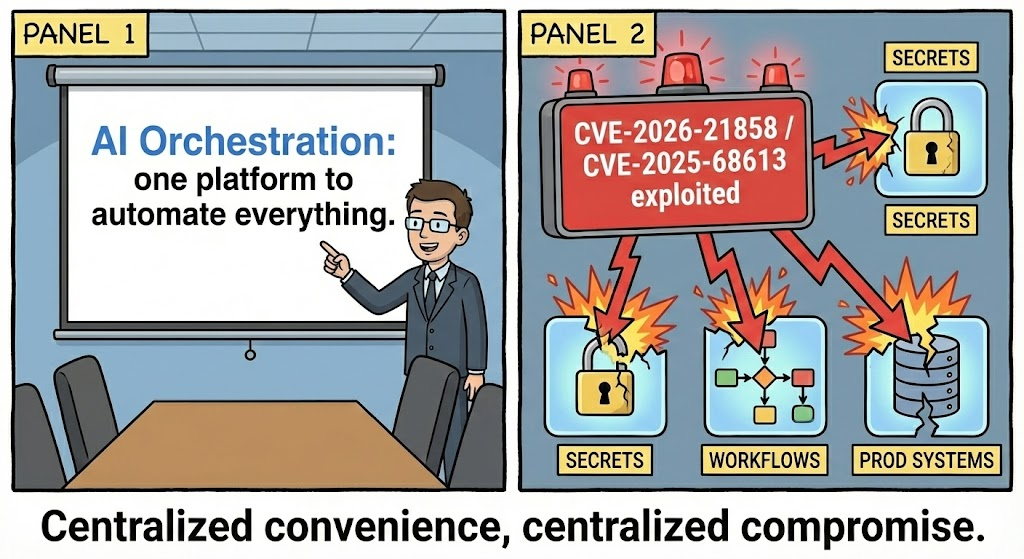
The era of “Model Security” is evolving into “Infrastructure Security.” While the industry spent 2025 worrying about Prompt Injection, the real devastation has arrived in the orchestration layer.
January 2026 has opened with a catastrophic disclosure for the AI engineering community: CVE-2026-21858, a CVSS 10.0 unauthenticated Remote Code Execution (RCE) vulnerability in n8n. This comes less than a month after the disclosure of CVE-2025-68613, a critical authenticated RCE in the same platform.
For security engineers and Red Teamers, n8n is not just a “tool”; it is the backbone of thousands of autonomous AI agents, connecting LLMs (OpenAI, Anthropic) to internal databases and APIs. Compromising n8n means compromising the entire AI supply chain.
This article deconstructs the exploit chains for both vulnerabilities, analyzes the root causes, and provides actionable remediation paths.
The “Ni8mare”: Deconstructing CVE-2026-21858 (Unauthenticated RCE)
Severity: Critical (CVSS 10.0)
Vector: Network / Unauthenticated
Impact: Full Server Takeover
Dubbed “Ni8mare” by researchers at Cyera, CVE-2026-21858 represents the worst-case scenario for AI infrastructure: a zero-click, unauthenticated takeover.
The Root Cause: Content-Type Confusion
The vulnerability resides in n8n’s webhook handling logic and how it processes incoming HTTP requests. n8n uses a middleware to parse incoming data based on the Content-Type header.
In vulnerable versions (prior to 1.121.0), the application failed to strictly enforce the relationship between the declared Content-Type and the actual parsing logic used for internal state management.
An attacker can send a specially crafted HTTP request that:
- Declares a benign
Content-Type(e.g.,application/json) to bypass initial firewall (WAF) checks. - Manipulates the body structure to trick the internal parser into overriding the
req.bodyobject. - Injects malicious configuration parameters that the application blindly trusts.
The Exploit Path
The critical flaw allows an attacker to “confuse” the server into accepting a file upload path that overwrites internal configuration files, such as config or database.sqlite.
Once the configuration is overwritten, the attacker can:
- Reset Authentication: Overwrite the admin user credentials.
- Extract Secrets: Read the
.envor config files containing API keys for third-party services (AWS, OpenAI, Stripe). - Execute Code: Use the now-accessible “Execute Command” node to spawn a reverse shell.
JavaScript
`// Pseudo-code illustrating the logic flaw // VULNERABLE LOGIC: Trusting user input for file handling without strict type checks
app.post(‘/webhook/:id’, (req, res) => { // The parser assumes if ‘files’ exists in body, it was a valid upload // But a crafted JSON body can simulate this structure if (req.body.files && req.body.files.config_override) { // CRITICAL: Overwriting internal state based on unauthenticated input internalState.updateConfig(req.body.files.config_override.path); } executeWorkflow(req.params.id); });`
Because n8n often runs with high privileges to execute system tasks, this RCE effectively grants root-level access to the host container.
The Precursor: CVE-2025-68613 (Authenticated RCE)
Severity: Critical (CVSS 9.9)
Vector: Network / Authenticated (Low Privilege)
Before the unauthenticated “Ni8mare,” there was CVE-2025-68613. While less severe due to the authentication requirement, it highlighted the fragility of Expression Evaluation in AI workflows.
The Root Cause: Expression Injection
n8n allows users to write JavaScript expressions to transform data between nodes. The vulnerability (affecting versions prior to 1.122.0) allowed an attacker with “Member” or low-level access to break out of the expression sandbox.
By crafting a malicious workflow with a specific JavaScript payload inside an expression field (e.g., inside a Set node), an attacker could access the Node.js process object.
Attack Scenario
- Access: Attacker gains access to a low-privileged account (e.g., via a leaked invite link or weak password).
- Payload: Create a workflow utilizing the
FunctionorCodenode. - Escape: Use
return global.process.mainModule.require('child_process').execSync('id');to bypass restrictions. - Execution: The moment the workflow is “Tested” or “Activated,” the code executes on the server.
Technical Comparison: The 2026 vs. 2025 Threat Landscape
| Feature | CVE-2026-21858 (“Ni8mare”) | CVE-2025-68613 |
|---|---|---|
| Authentication | None (Unauthenticated) | Required (Low Priv) |
| CVSS Score | 10.0 (Critical) | 9.9 (Critical) |
| Root Cause | Content-Type / Parser Confusion | Sandbox Escape / Expression Injection |
| Attack Vector | Webhook Endpoints | Workflow Editor UI |
| Primary Target | Public-facing Webhook listeners | Internal/Shared Dev Environments |
Why This Matters for AI Security
These vulnerabilities are not just “server bugs”; they are AI Supply Chain breaches.
- RAG Poisoning: An attacker controlling n8n can intercept documents flowing into your Vector Database, injecting backdoors or false data into your corporate knowledge base.
- Agent Hijacking: Autonomous agents built on n8n can be reprogrammed to exfiltrate data or launch attacks on other internal systems.
- Credential Theft: n8n acts as a “Key Vault” for LLM providers. A single RCE exposes your
OPENAI_API_KEY,ANTHROPIC_API_KEY, and database credentials.
Mitigation and Remediation
Immediate Action Required:
- Patch Immediately: Upgrade n8n to version 1.122.0 or higher immediately. This patches both CVEs.
- Network Isolation: Never expose the n8n dashboard interface (port 5678) directly to the public internet. Use a VPN or reverse proxy with strict authentication (e.g., Cloudflare Access, Authelia).
- Sanitize Webhooks: If you must expose webhooks, ensure they are behind an API Gateway that validates the request schema before it reaches the n8n instance.
Automated Validation: The Agentic Approach
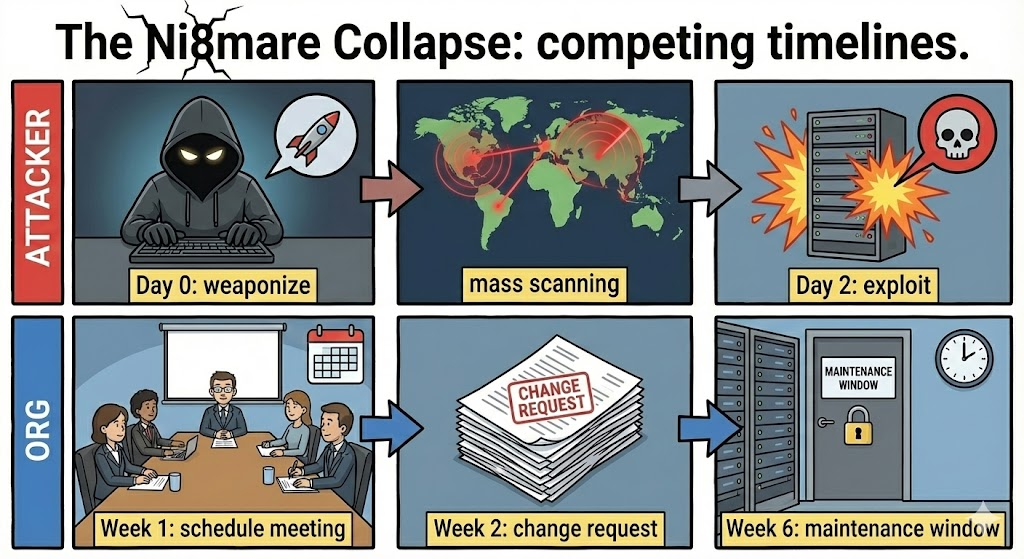
In the fast-moving world of 2026, relying on manual patch management or annual pentests is insufficient. Vulnerabilities like CVE-2026-21858 appear overnight and are weaponized within hours.
This is where Penligent changes the paradigm. As an AI-powered automated penetration testing platform, Penligent doesn’t just scan for known signatures; it behaves like an attacker.
When pointed at your infrastructure, Penligent’s agentic core can:
- Autonomously Discovery: Identify exposed n8n instances and webhook endpoints that human auditors might miss.
- Safe Exploitation: Validate CVE-2026-21858 by attempting the Content-Type manipulation logic without destructively overwriting configs, proving the risk with zero downtime.
- Continuous Monitoring: Unlike static scanners, Penligent provides “Human-in-the-loop” validated intelligence, ensuring your AI orchestration layer remains resilient against the next wave of zero-days.
Final Thought: The security of your AI Agents depends entirely on the security of the tools that build them. Don’t let your orchestration layer be the weakest link.
References:
 English
  German
  French
  Spanish
  Portuguese
  Japanese
  Korean
  Hindi
Hindi  Arabic
  Turkish
  Hebrew