The cybersecurity landscape has shifted permanently. In 2025, the question is no longer “Should I use AI for penetration testing?” but “Which AI tool is actually capable of replacing manual grunt work?”
With the explosion of Large Language Models (LLMs), we have seen a flood of “AI hacking tools” hit the market. Some are merely ChatGPT wrappers that offer generic advice, while others are sophisticated Autonomous Agents capable of actively discovering and exploiting vulnerabilities.
If you are confused by the options, you are not alone. In this comprehensive guide, we cut through the hype and compare the top contenders: the open-source pioneer PentestGPT, the wrapper-based PentestAI/PentestTool, and the new agentic challenger, Penligent.ai.
AI Pentest Tool Penligent
Quick Verdict: The Comparison Table
Don’t have time to read the full breakdown? Here is how the top tools stack up against each other.
(Note: Google loves tables. This summary highlights the key differences in automation and execution.)
Feature
PentestGPT (Open Source)
PentestTool / Generic Wrappers
Penligent.ai (Agentic AI)
Core Technology
GPT-4 Wrapper (Guidance only)
Static Scanners + Chatbot
Reasoning Agent + Execution Engine
Automation Level
Low: You must copy-paste terminal output manually.
Medium: Automated scanning, manual verification.
High: Autonomous planning, execution, and verification.
Human-in-the-Loop
N/A (Manual Loop)
Passive
Active: AI asks for permission before critical actions.
Vulnerability Detection
Text Analysis only
Regular Expressions / Known CVEs
Logical Reasoning & Business Logic
Exploitation
Manual (Generates code snippets)
None
One-Click Auto Exploit
Best For
Students & Hobbyists
Basic Compliance Scanning
Pro Red Teams & Developers
PentestGPT: The Open Source Copilot
PentestGPT made waves as one of the first tools to leverage GPT-4 for interactive penetration testing. Hosted on GitHub, it acts as a “copilot” for security researchers.
How it works
PentestGPT operates on a guidance model. It cannot “see” your system directly.
You run a scan (e.g., Nmap).
You copy the output.
You paste it into PentestGPT.
It analyzes the text and suggests the next command.
The Pros
Open Source & Free: Accessible for researchers and students on a budget.
Educational Value: Because it forces you to execute every command manually, it is excellent for learning the ropes of penetration testing.
Community Driven: Active updates from the open-source community.
The Cons
The “Copy-Paste” Fatigue: You act as the middleware. In a real-world engagement with thousands of assets, manually copying data back and forth is unscalable.
Context Limit Issues: In long sessions, the model often loses track of previous findings or the broader attack surface.
No Execution Capability: It can suggest an exploit, but it cannot run it for you. You are still doing the heavy lifting.
PentestAI / PentestTool: The “Wrappers”
Tools often labeled as “PentestAI” or found on aggregation sites usually fall into the category of LLM Wrappers. These are typically web interfaces that combine standard scanners (like ZAP or SQLMap) with a chatbot window.
The Pros
User-Friendly UI: Usually very easy to set up. Good for beginners who want to click a button and get a result.
Compliance Reporting: Good at generating generic summary reports suitable for basic compliance checks.
The Cons
Lack of Depth: They rely heavily on traditional scanners for discovery. If the underlying scanner misses a logic bug, the AI misses it too.
Hallucinations: Without a grounding mechanism or a real runtime environment, these chatbots often invent vulnerabilities that don’t exist (False Positives), wasting your time.
Penligent.ai: The “Agentic” Revolution
This is where the industry is heading in 2025. Penligent is not just a chatbot; it is a fully autonomous Security Agent.
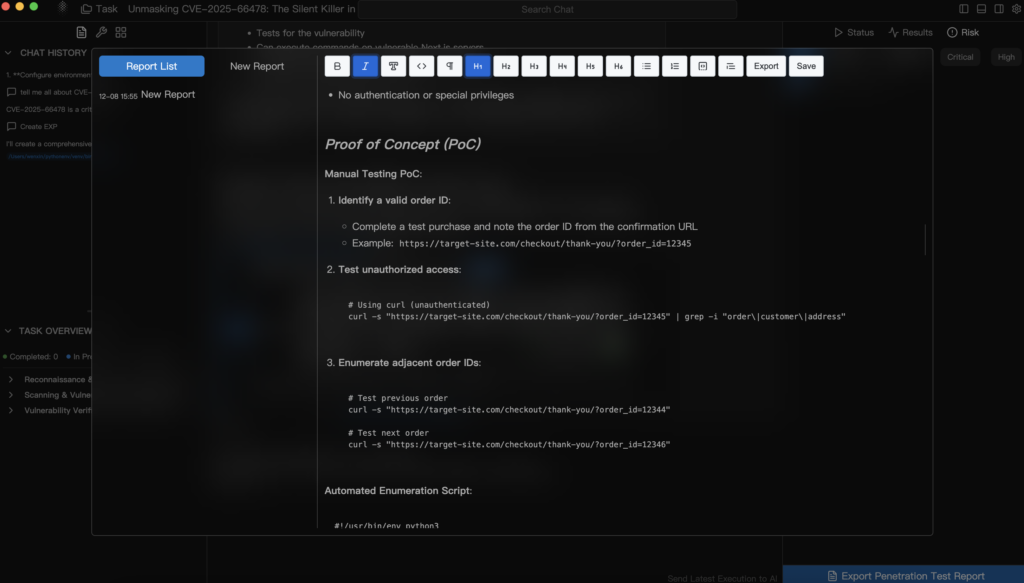
Unlike PentestGPT, Penligent has its own runtime environment. It connects directly to your infrastructure or Kali Linux instance. It doesn’t just suggest a command; it executes it, analyzes the return traffic, and plans the next move—all autonomously.
AI Pentest Tool
Why “Agentic” Matters
Imagine you want to check for SQL Injection.
With PentestGPT: You run sqlmap, paste results, ask “is this vulnerable?”, get a “maybe”, try to craft a payload manually…
With Penligent: You simply say: “Check the login page for SQLi.”
The Agent browses the page.
It identifies input vectors.
It crafts and tests payloads.
Crucially: When it finds a potential breach, it pauses and asks you: “I found a high-probability injection. Should I attempt to dump the database schema?”
Key Features
Reasoning, Not Regex: It uses Large Language Models to understand business logic, allowing it to chain vulnerabilities together (e.g., finding an exposed API key and using it to elevate privileges).
One-Click PoC: It automatically generates and verifies Proof-of-Concept scripts. No more guessing if a vulnerability is real.
Human-in-the-Loop: The core philosophy of Penligent. It offers the speed of a machine but keeps the critical decision-making power in your hands. It will never crash a server or exfiltrate sensitive data without explicit human authorization.
Final Verdict: Which Tool Should You Choose?
The right tool depends on your role and your goals.
Choose PentestGPT if: You are a student, you have zero budget, and you want to learn by manually typing every command to understand the basics.
Choose PentestAI/Wrappers if: You need a quick, superficial scan for a simple compliance checkbox and don’t require deep logic testing.
Choose Penligent.ai if: You are a Red Teamer, Developer, or Business Owner who wants results. You need the efficiency of AI automation combined with the precision of human oversight. You want to move beyond “scanning” and into “reasoning.”
The future of hacking isn’t about typing faster; it’s about thinking smarter. Stop copying and pasting. Start collaborating with an Agent.
Ready to upgrade your red team arsenal?
Try Penligent.ai for free and experience the first Human-in-the-loop security agent today.
AI Pentest Tool Penligent
FAQ: Common Questions About AI Pentesting
Q: Can AI tools replace human penetration testers?
A: Not entirely. Tools like Penligent are designed to act as a “force multiplier.” They handle the repetitive reconnaissance and scanning tasks (the 80% of the work), allowing human experts to focus on complex logic flaws and strategic decisions.
Q: Is it safe to use AI for penetration testing?
A: It depends on the tool. Open-ended agents can be risky if uncontrolled. Penligent uses a “Human-in-the-loop” approach, meaning it requires user authorization before performing any high-risk actions, ensuring safety and compliance.
Q: What is the difference between a Scanner and an AI Agent?
A: A scanner (like Nessus) matches patterns against a database. An AI Agent (like Penligent) “reasons” about the target. It can understand how a website works, fill out forms intelligently, and chain multiple small issues into a significant exploit.





 English
  German
  French
  Spanish
  Portuguese
  Japanese
  Korean
  Hindi
Hindi  Arabic
  Turkish
  Hebrew