
CVE-2026-42055 is a heap-based buffer overflow in NGINX Plus and NGINX Open Source that matters most when NGINX is used as an HTTP/2 or gRPC proxy, not when it is simply serving a static site with default header handling. The vulnerable area is tied to the ngx_http_proxy_v2_module ve ngx_http_grpc_module code paths. The triggering configuration is narrow but operationally realistic: NGINX is configured to proxy HTTP/2 traffic using proxy_http_version 2 veya grpc_pass, ignore_invalid_headers is set to offve large_client_header_buffers size is larger than 2 megabytes. Under those conditions, a remote unauthenticated attacker may be able to send large headers while an upstream request is being created, causing a heap-based buffer overflow in an NGINX worker process. NVD lists the issue as CWE-122 and shows F5’s CVSS v3.1 score as 8.1 High and CVSS v4.0 score as 9.2 Critical. (NVD)
The practical risk is not “every NGINX instance is instantly exploitable.” The practical risk is that many modern environments use NGINX as an API gateway, ingress controller, service edge, or gRPC front end, and the vulnerable condition may be hidden inside generated configuration, Helm values, inherited snippets, or old compatibility settings. NGINX’s own security advisory page lists CVE-2026-42055 as a buffer overflow in ngx_http_proxy_v2_module ve ngx_http_grpc_module, marks NGINX 1.13.10 through 1.31.1 as vulnerable, and lists 1.31.2 and 1.30.3 as not vulnerable. (nginx.org)
The immediate action is simple: patch to a fixed version. The careful work is harder: identify whether your fleet has the dangerous configuration combination, avoid unsafe production “proof of concept” testing, check Kubernetes and gateway templates instead of only checking one hand-written nginx.conf, and leave evidence that the risk was actually removed.
What defenders need to know first
| Saha | Confirmed detail |
|---|---|
| CVE | CVE-2026-42055 |
| Affected software | NGINX Plus and NGINX Open Source, with downstream products and platform components depending on embedded or bundled versions |
| Vulnerable modules | ngx_http_proxy_v2_module ve ngx_http_grpc_module |
| Zayıflık | CWE-122, heap-based buffer overflow |
| Triggering pattern | HTTP/2 upstream proxying through proxy_http_version 2 or gRPC proxying through grpc_pass, with ignore_invalid_headers offve large_client_header_buffers size greater than 2 MB |
| Attacker position | Remote and unauthenticated, according to the CVE description |
| Main impact | NGINX worker process overflow and restart, producing denial-of-service symptoms |
| RCE boundary | Code execution is described as possible when ASLR is disabled or when the attacker can bypass ASLR |
| Fixed Open Source versions | NGINX 1.30.3 stable and 1.31.2 mainline |
| Interim mitigation | Remove ignore_invalid_headers off or reduce large_client_header_buffers below 2 MB |
| Exploitation status | Public advisories reviewed here do not confirm active exploitation as of June 19, 2026; treat this as a fast-moving patch priority rather than proof of active compromise |
The most important detail in the table is the configuration dependency. NVD’s description explicitly ties CVE-2026-42055 to proxy_http_version 2 veya grpc_pass, ignore_invalid_headers offve large_client_header_buffers larger than 2 MB. That means a clean triage should not stop at “we run NGINX.” It should answer four questions: which version, which module path, which header policy, and which buffer size. (NVD)
NGINX released 1.30.3 stable and 1.31.2 mainline on June 17, 2026, with fixes for the buffer overflow in ngx_http_proxy_v2_module ve ngx_http_grpc_module, alongside a separate buffer overread fix in ngx_http_charset_module; the mainline 1.31.2 release also includes a fix for CVE-2026-42530 in HTTP/3. (nginx.org)
Where the vulnerable path sits in a real deployment
NGINX often sits at the boundary between clients and application services. In a simple reverse proxy, NGINX receives a client request, forwards it to an upstream server, receives the response, and returns that response to the client. The official NGINX reverse proxy documentation describes this pattern directly: NGINX sends the request to a specified proxied server, fetches the response, and sends it back to the client. (docs.nginx.com)
CVE-2026-42055 lives in a more specific version of that pattern. The vulnerable path matters when NGINX is dealing with HTTP/2 upstream proxying or gRPC proxying. The ngx_http_grpc_module exists to pass requests to a gRPC server and requires the HTTP/2 module; the official documentation shows a basic gRPC configuration with http2 on ve grpc_pass 127.0.0.1:9000. (nginx.org)
That matters because gRPC is common in places where teams may not think of themselves as “running a public website.” You may find it in API gateways, internal service-to-service edges, observability pipelines, service mesh boundary components, mobile API backends, and Kubernetes ingress controllers. The affected configuration can therefore sit in the layer that brokers traffic between an external client and internal RPC services.
The other path is HTTP/2 upstream proxying through proxy_http_version 2. NGINX’s proxy_http_version directive supports 1.0, 1.1ve 2, with 1.1 as the documented default. (nginx.org) That distinction is important: a server can support HTTP/2 from clients without necessarily using HTTP/2 to speak to upstreams. CVE-2026-42055 is tied to creating an upstream request under the vulnerable header-handling conditions, so the upstream proxy configuration deserves close inspection.
The three configuration conditions that make this bug reachable
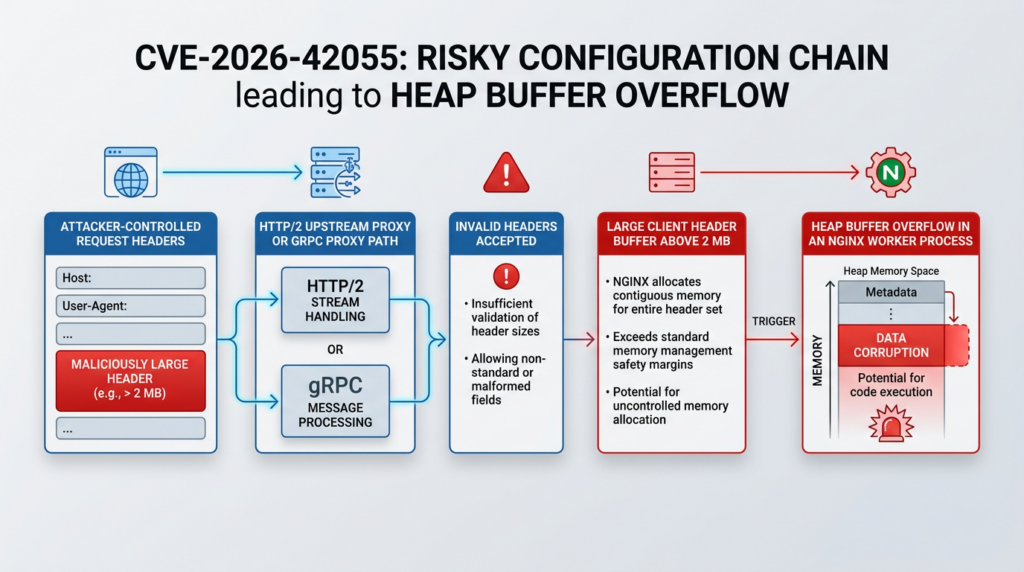
The first condition is an HTTP/2 proxying path. That can appear as proxy_http_version 2 in an HTTP proxy location or as grpc_pass in a gRPC location. For gRPC, this is not unusual. NGINX’s own gRPC module documentation and community examples show grpc_pass as the normal way to forward gRPC traffic through NGINX. (nginx.org)
The second condition is ignore_invalid_headers off. By default, NGINX sets ignore_invalid_headers on; the directive controls whether header fields with invalid names should be ignored, and valid names are composed of English letters, digits, hyphens, and possibly underscores depending on underscores_in_headers. (nginx.org) Teams sometimes turn this off to preserve non-standard headers for legacy applications, old API clients, certain upstream frameworks, or security products that want to inspect unusual header names. That choice may be operationally understandable, but it expands the set of request headers that flow into later processing.
The third condition is unusually large request header buffering. NGINX documents large_client_header_buffers with a default of 4 8k; each request line or request header field must fit inside a single buffer, and the buffers are allocated only on demand. (nginx.org) CVE-2026-42055 specifically involves a large_client_header_buffers directive size larger than 2 MB. That is far above the default and should be rare in a carefully governed edge configuration.
| Configuration element | Safer default or normal state | Risky condition for CVE-2026-42055 | Why teams may have changed it | Better direction |
|---|---|---|---|---|
proxy_http_version | 1.1 by default | proxy_http_version 2 on an affected path | Upstream HTTP/2 performance, API gateway behavior, protocol consistency | Patch first; only keep HTTP/2 upstream where required |
grpc_pass | Only present on gRPC proxy locations | Present on a path handling attacker-controlled traffic | Native gRPC routing, microservices, OTLP, internal RPC exposure | Patch; narrow exposure; validate header limits |
ignore_invalid_headers | on by default | off | Legacy headers, underscores, non-standard API clients | Tercih et on; use targeted exceptions only when justified |
large_client_header_buffers | 4 8k | Single buffer size greater than 2 MB | Large cookies, SSO tokens, legacy clients, overly broad “fix 400 errors” changes | Reduce below 2 MB; solve application header bloat upstream |
A common mistake is to treat large_client_header_buffers as a harmless way to “fix” 400 errors from large cookies or SSO headers. It is a resource and parsing boundary. Raising it globally can change the behavior of every server block that inherits it. If the reason for a large value is one application with oversized cookies, the right remediation is usually to reduce cookie bloat, split the application boundary, or apply a narrowly scoped exception after risk review.
Affected versions and products
For NGINX Open Source, NGINX’s security advisory page lists CVE-2026-42055 as affecting versions 1.13.10 through 1.31.1, with 1.31.2 and 1.30.3 listed as not vulnerable. (nginx.org) NVD’s affected data also lists NGINX Open Source version ranges and NGINX Plus ranges, including NGINX Plus 37.0 before 37.0.2.1 and R36 before R36 P6, while noting that end-of-technical-support versions were not evaluated. (NVD)
Several security advisories and reports also list affected F5 NGINX ecosystem products. Singapore’s Cyber Security Agency reported that CVE-2026-42055 affects NGINX Plus 37.0.0 through 37.0.1, NGINX Plus R33 through R36, NGINX Open Source 1.31.1 and 1.30.0 through 1.30.2, as well as NGINX Instance Manager, F5 WAF for NGINX, NGINX App Protect WAF, F5 DoS for NGINX, NGINX App Protect DoS, NGINX Gateway Fabric, and NGINX Ingress Controller version ranges. (Singapur Siber Güvenlik Ajansı)
That does not mean every deployment of those products is equally exposed. It means security teams should check both the package or product version and the live generated configuration. Packaged appliances, ingress controllers, and gateway products may render NGINX configuration from higher-level settings. A team that only greps /etc/nginx/nginx.conf on one node may miss the actual running config inside an ingress controller container or gateway pod.
Why the risk is higher than a normal worker crash
A worker process restart can sound minor if you are used to NGINX’s master-worker model. NGINX is built to keep serving traffic when workers are replaced, and a single crash does not necessarily mean the whole service goes down. But edge infrastructure risk is rarely about a single clean crash in isolation.
A repeated worker crash can produce intermittent 502s, connection resets, failed HTTP/2 streams, gRPC UNAVAILABLE errors, upstream retry storms, and noisy autoscaling behavior. In Kubernetes, it may also look like ingress controller instability, pod restarts, readiness probe failures, or short bursts of application errors that are hard to correlate with a single request source.
The RCE angle must be handled carefully. The public CVE description says attackers can execute code on systems with ASLR disabled or when ASLR can be bypassed. (NVD) That does not prove a reliable public exploit exists for every affected deployment. It means defenders should not down-rank the issue as “just DoS” when the affected component is internet-facing, privileged in the network path, and handling attacker-controlled headers.
Heap-based buffer overflows in a process that parses network input deserve a conservative response. The realistic priority is: patch fast, remove the dangerous configuration combination if patching cannot happen immediately, and verify that ASLR and worker privilege boundaries are not weaker than expected.
How to audit a host safely
Do not begin by firing oversized headers at production. Start with version and configuration inspection.
# Show the NGINX version.
nginx -v

# Show build flags and modules.
nginx -V 2>&1 | tr ' ' '\n' | sort

# Dump the fully loaded configuration.
# Run with appropriate privileges on the host or inside the container.
nginx -T > /tmp/nginx-expanded.conf 2>/tmp/nginx-expanded.err
Then look for the three relevant configuration markers.
CONF=/tmp/nginx-expanded.conf

grep -nE 'proxy_http_version\s+2\s*;' "$CONF"
grep -nE 'grpc_pass\s+' "$CONF"
grep -nE 'ignore_invalid_headers\s+off\s*;' "$CONF"
grep -nE 'large_client_header_buffers\s+' "$CONF"
A crude grep is not enough because NGINX configuration inherits across http, serverve konum contexts. A large_client_header_buffers value may be set globally while grpc_pass appears in one location and ignore_invalid_headers off appears at the server level. Still, grep is a good first triage step because it identifies which files and contexts deserve manual review.
For a more structured local check, use a conservative script that flags likely risky combinations without attempting exploitation:
#!/usr/bin/env bash
set -euo pipefail

CONF_DUMP="${1:-/tmp/nginx-expanded.conf}"

if [[ ! -s "$CONF_DUMP" ]]; then
  echo "Usage: $0 /path/to/nginx-expanded.conf"
  echo "Tip: nginx -T > /tmp/nginx-expanded.conf 2>/tmp/nginx-expanded.err"
  exit 1
fi

echo "[*] Checking for CVE-2026-42055 configuration indicators in $CONF_DUMP"
echo

has_h2_proxy=0
has_grpc=0
has_ignore_off=0
has_large_gt_2m=0

if grep -Eq 'proxy_http_version\s+2\s*;' "$CONF_DUMP"; then
  has_h2_proxy=1
  echo "[!] Found proxy_http_version 2"
  grep -nE 'proxy_http_version\s+2\s*;' "$CONF_DUMP"
fi

if grep -Eq 'grpc_pass\s+' "$CONF_DUMP"; then
  has_grpc=1
  echo "[!] Found grpc_pass"
  grep -nE 'grpc_pass\s+' "$CONF_DUMP"
fi

if grep -Eq 'ignore_invalid_headers\s+off\s*;' "$CONF_DUMP"; then
  has_ignore_off=1
  echo "[!] Found ignore_invalid_headers off"
  grep -nE 'ignore_invalid_headers\s+off\s*;' "$CONF_DUMP"
fi

# This intentionally catches simple values like 3m, 4M, 2049k.
# It does not fully parse variables or all unit formats.
while read -r line; do
  value="$(awk '{print $3}' <<< "$line" | tr -d ';' | tr '[:upper:]' '[:lower:]')"
  case "$value" in
    *m)
      n="${value%m}"
      if [[ "$n" =~ ^[0-9]+$ ]] && (( n > 2 )); then
        has_large_gt_2m=1
        echo "[!] Found large_client_header_buffers with size above 2m: $line"
      fi
      ;;
    *k)
      n="${value%k}"
      if [[ "$n" =~ ^[0-9]+$ ]] && (( n > 2048 )); then
        has_large_gt_2m=1
        echo "[!] Found large_client_header_buffers with size above 2048k: $line"
      fi
      ;;
  esac
done < <(grep -nE 'large_client_header_buffers\s+[0-9]+\s+[0-9]+[kKmM]\s*;' "$CONF_DUMP" || true)

echo
if (( (has_h2_proxy || has_grpc) && has_ignore_off && has_large_gt_2m )); then
  echo "[HIGH] Configuration indicators match the risky CVE-2026-42055 pattern."
  echo "      Patch NGINX and remove the dangerous header configuration combination."
else
  echo "[INFO] Did not find the full risky pattern with this simple scanner."
  echo "       Review inheritance, generated configs, and product-specific templates before closing the finding."
fi
This script is intentionally cautious. It does not prove exploitability, and it does not parse every NGINX inheritance edge case. It gives responders a quick way to find the configuration smells that should trigger a deeper review.
A Python scanner for CI and repository review
Many NGINX configurations are not edited on hosts. They live in Git, Helm charts, Terraform modules, Ansible roles, Kubernetes ConfigMaps, Docker images, or internal platform templates. A lightweight scanner can help catch risky changes before they reach production.
#!/usr/bin/env python3
"""
Conservative CVE-2026-42055 configuration indicator scanner.

It scans text files for:
- proxy_http_version 2 or grpc_pass
- ignore_invalid_headers off
- large_client_header_buffers with a single buffer size above 2 MB

It is not a full NGINX parser. Use it as a CI guardrail, not as a final
vulnerability determination.
"""

from __future__ import annotations

import pathlib
import re
import sys
from dataclasses import dataclass


H2_PROXY = re.compile(r"\bproxy_http_version\s+2\s*;", re.I)
GRPC_PASS = re.compile(r"\bgrpc_pass\s+", re.I)
IGNORE_OFF = re.compile(r"\bignore_invalid_headers\s+off\s*;", re.I)
LARGE_BUFFERS = re.compile(
    r"\blarge_client_header_buffers\s+(\d+)\s+(\d+)([kKmM])\s*;",
    re.I,
)


@dataclass
class Finding:
    file: pathlib.Path
    line: int
    kind: str
    text: str


def size_to_bytes(value: int, unit: str) -> int:
    unit = unit.lower()
    if unit == "k":
        return value * 1024
    if unit == "m":
        return value * 1024 * 1024
    return value


def scan_file(path: pathlib.Path) -> list[Finding]:
    findings: list[Finding] = []
    try:
        lines = path.read_text(errors="ignore").splitlines()
    except OSError:
        return findings

    for index, line in enumerate(lines, start=1):
        stripped = line.strip()
        if H2_PROXY.search(stripped):
            findings.append(Finding(path, index, "http2_upstream_proxy", stripped))
        if GRPC_PASS.search(stripped):
            findings.append(Finding(path, index, "grpc_proxy", stripped))
        if IGNORE_OFF.search(stripped):
            findings.append(Finding(path, index, "invalid_headers_allowed", stripped))

        match = LARGE_BUFFERS.search(stripped)
        if match:
            count = int(match.group(1))
            size = int(match.group(2))
            unit = match.group(3)
            if size_to_bytes(size, unit) > 2 * 1024 * 1024:
                findings.append(
                    Finding(
                        path,
                        index,
                        "large_header_buffer_above_2mb",
                        f"{stripped}  # count={count}",
                    )
                )

    return findings


def main() -> int:
    if len(sys.argv) < 2:
        print("Usage: scan_nginx_cve_2026_42055.py <path> [<path> ...]")
        return 2

    all_findings: list[Finding] = []

    for root_arg in sys.argv[1:]:
        root = pathlib.Path(root_arg)
        if root.is_file():
            all_findings.extend(scan_file(root))
            continue

        for path in root.rglob("*"):
            if path.is_file() and path.suffix in {".conf", ".template", ".yaml", ".yml", ".txt"}:
                all_findings.extend(scan_file(path))

    for finding in all_findings:
        print(f"{finding.file}:{finding.line}: {finding.kind}: {finding.text}")

    kinds = {finding.kind for finding in all_findings}
    risky = (
        ("http2_upstream_proxy" in kinds or "grpc_proxy" in kinds)
        and "invalid_headers_allowed" in kinds
        and "large_header_buffer_above_2mb" in kinds
    )

    if risky:
        print("\nHIGH: Found indicators matching the risky CVE-2026-42055 configuration pattern.")
        return 1

    print("\nINFO: Full risky pattern not found by conservative text scan.")
    return 0


if __name__ == "__main__":
    raise SystemExit(main())
Use it against rendered configuration, not only source templates. For Helm-based deployments, render first:
helm template my-ingress ./chart -f values-prod.yaml > /tmp/rendered-ingress.yaml
python3 scan_nginx_cve_2026_42055.py /tmp/rendered-ingress.yaml
A scanner like this should be noisy by design. It should send the security engineer to the right config block, not pretend to be a full NGINX interpreter.
Kubernetes and ingress checks
Kubernetes ingress deployments often hide the final NGINX config behind controller settings. You may need to inspect ConfigMaps, Helm values, annotations, and the generated configuration inside the running controller pod.
Start with the controller ConfigMap:
kubectl -n ingress-nginx get configmap ingress-nginx-controller -o yaml \
  | grep -Ei 'ignore-invalid-headers|large-client-header-buffers|http2|grpc'
Then inspect Helm values if the controller is managed by Helm:
helm -n ingress-nginx list
helm -n ingress-nginx get values ingress-nginx --all \
  | grep -Ei 'ignore-invalid-headers|large-client-header-buffers|http2|grpc'
If possible, inspect the generated NGINX configuration from the controller container:
POD="$(kubectl -n ingress-nginx get pod \
  -l app.kubernetes.io/component=controller \
  -o jsonpath='{.items[0].metadata.name}')"

kubectl -n ingress-nginx exec "$POD" -- nginx -T > /tmp/ingress-nginx-expanded.conf 2>/tmp/ingress-nginx-expanded.err

grep -nE 'proxy_http_version\s+2\s*;|grpc_pass|ignore_invalid_headers\s+off|large_client_header_buffers' \
  /tmp/ingress-nginx-expanded.conf
The ingress-nginx ConfigMap documentation lists ignore-invalid-headers with a default of gerçek ve large-client-header-buffers with a default of 4 8k; it also notes that older HTTP/2 max field and max header settings are deprecated in favor of large-client-header-buffers. (kubernetes.github.io) This is useful because it helps responders distinguish default ingress posture from manually loosened header settings.
Be careful with emergency changes in Kubernetes. Removing HTTP/2 or changing gRPC behavior without application owner review can break gRPC services, observability pipelines, mobile clients, and internal service calls. A safer first mitigation for CVE-2026-42055 is to remove ignore_invalid_headers off where possible or reduce large_client_header_buffers below the vulnerable threshold while patch rollout proceeds. Singapore CSA gives the same two mitigations for CVE-2026-42055: remove ignore_invalid_headers off and reduce large_client_header_buffers below 2 MB. (Singapur Siber Güvenlik Ajansı)
How to validate without turning triage into an attack
A responsible validation plan does not need to send dangerous oversized headers to production. Use a three-layer approach.
First, validate versions. Confirm the exact NGINX Open Source, NGINX Plus, ingress controller, gateway, or product version running in the affected environment. If the asset is on a fixed version and the configuration has been reloaded, record the evidence.
Second, validate configuration. Dump the live configuration after all includes and templates are resolved. Confirm whether the risky directives still exist in the same effective context. The evidence should show both the absence of ignore_invalid_headers off and the absence of a large_client_header_buffers single buffer size above 2 MB on relevant HTTP/2 or gRPC paths.
Third, validate service behavior safely. Use normal protocol checks, not crash probes. For example, confirm that HTTP/2 and gRPC services still work after mitigation:
# Confirm negotiated HTTP/2 support without oversized headers.
curl --http2 -I https://example.com/

# For gRPC health checks, use grpcurl against an authorized endpoint.
grpcurl -authority api.example.com \
  -d '{}' \
  api.example.com:443 grpc.health.v1.Health/Check
If you need to reproduce the vulnerable condition for research, do it only in an isolated lab that you own, with a patched-versus-unpatched comparison and controlled resource limits. Do not run oversized-header payloads against customer systems, bug bounty targets outside the written scope, shared ingress controllers, or production APIs.
Logging and detection signals
CVE-2026-42055 may appear operationally as instability rather than a clean security alert. Useful signals include NGINX worker exits, segmentation faults, unexplained restarts, ingress controller pod restarts, spikes in 502/499/504 responses, gRPC UNAVAILABLE responses, and abnormal request length patterns.
A more useful access log format can help triage HTTP/2 and gRPC edge behavior:
log_format edge_json escape=json
  '{'
  '"time":"$time_iso8601",'
  '"remote_addr":"$remote_addr",'
  '"request":"$request",'
  '"status":$status,'
  '"body_bytes_sent":$body_bytes_sent,'
  '"request_length":$request_length,'
  '"request_time":$request_time,'
  '"http2":"$http2",'
  '"host":"$host",'
  '"uri":"$uri",'
  '"upstream_addr":"$upstream_addr",'
  '"upstream_status":"$upstream_status",'
  '"upstream_response_time":"$upstream_response_time",'
  '"request_id":"$request_id"'
  '}';

access_log /var/log/nginx/edge_access.json edge_json;
For error logs and platform logs, look for patterns like these:
# Host-based NGINX logs.
grep -Ei 'worker process.*exited|signal|segmentation fault|core dumped|upstream prematurely closed' \
  /var/log/nginx/error.log

# Kubernetes pod instability.
kubectl -n ingress-nginx get pods
kubectl -n ingress-nginx describe pod "$POD" | grep -Ei 'restart|oom|killed|probe|back-off'

# Container logs.
kubectl -n ingress-nginx logs "$POD" --since=6h \
  | grep -Ei 'worker process|signal|segmentation|upstream|http2|grpc'
None of these signals prove exploitation by themselves. A worker can crash for many reasons. A gRPC service can return UNAVAILABLE because the backend is down. A large request can be a legitimate SSO cookie. Treat these signals as investigation pivots, then correlate them with version, configuration, timing, source concentration, and any unusual header patterns captured by safe telemetry.
Patch and mitigation plan
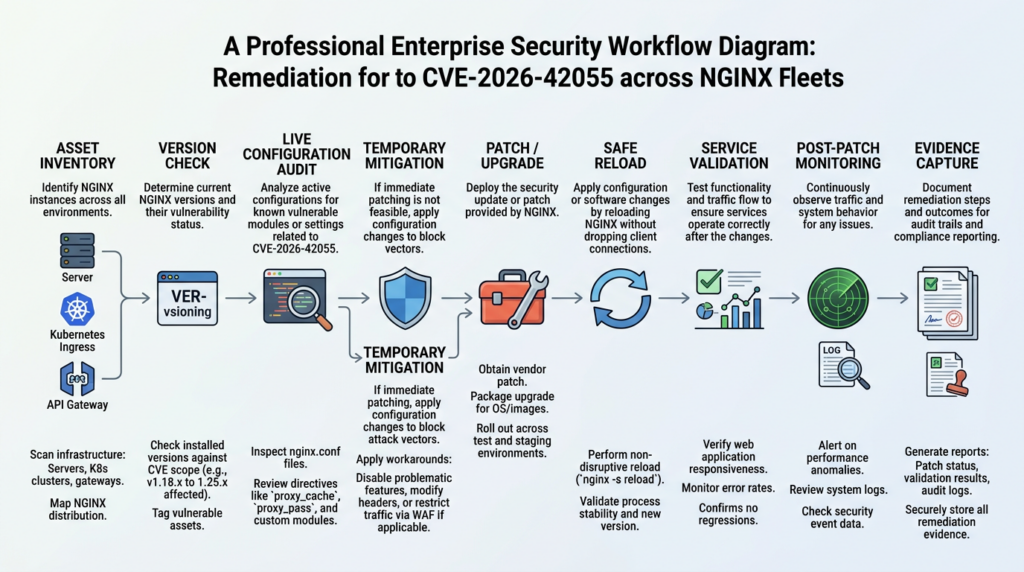
The clean fix is to move to a fixed release. For NGINX Open Source, upgrade to 1.30.3 stable or 1.31.2 mainline. NGINX’s download page lists 1.31.2 as the current mainline version and 1.30.3 as the stable version. (nginx.org) For NGINX Plus and F5 NGINX products, follow the vendor product-specific advisory and fixed release path; NVD’s affected data and public reporting identify fixed NGINX Plus versions including 37.0.2.1 and R36 P6 for the relevant Plus branches. (NVD)
If you cannot patch immediately, apply the configuration mitigations that remove the vulnerable condition. The two public mitigations are to remove ignore_invalid_headers off and reduce large_client_header_buffers below 2 MB. (Singapur Siber Güvenlik Ajansı)
A safer baseline might look like this:
http {
    # Keep the default behavior unless a specific application has a documented need.
    ignore_invalid_headers on;

    # Keep request header buffers small and intentional.
    # Adjust only after application-owner review.
    large_client_header_buffers 4 16k;

    server {
        listen 443 ssl http2;
        server_name api.example.com;

        location / {
            proxy_pass http://app_backend;
            proxy_http_version 1.1;
            proxy_set_header Host $host;
            proxy_set_header X-Request-ID $request_id;
        }

        location /grpc.health.v1.Health/ {
            grpc_pass grpc://grpc_backend;
        }
    }
}
If a legacy application truly requires non-standard headers, avoid turning the behavior into a global edge policy. Document the application, isolate the server block, keep buffer sizes below the vulnerable threshold, and add monitoring around request length and error rates.
A production rollout should include:
| Adım | Eylem | Evidence to keep |
|---|---|---|
| Inventory | Identify NGINX Open Source, NGINX Plus, ingress, gateway, and WAF components | Version output, package list, container image digest |
| Config review | Dump live config and search for risky directives | nginx -T output, rendered Helm manifests, ConfigMap export |
| Patch | Upgrade to fixed versions | Change ticket, package version, image digest |
| Mitigate | Remove ignore_invalid_headers off or reduce buffer size below 2 MB if patching is delayed | Config diff and reload confirmation |
| Reload safely | Koşmak nginx -t, canary, reload, observe | Test output and deployment logs |
| Validate service | Check HTTP/2 and gRPC normal behavior | curl/grpcurl results, application health checks |
| Monitör | Watch worker exits, 5xx, gRPC errors, pod restarts | SIEM query results and dashboards |
| Close | Record why each asset is fixed, mitigated, or not applicable | Final evidence bundle |
Do not rely only on package inventory. The vulnerable condition is configuration-sensitive. The most defensible closure note says something like: “Asset runs NGINX 1.30.3, live config dump contains no ignore_invalid_headers off, no large_client_header_buffers size above 2 MB, and gRPC health checks passed after reload.”
ASLR and process hardening still matter
The RCE caveat in the public description is important: code execution is possible on systems with ASLR disabled or when the attacker can bypass ASLR. (NVD) Patch management removes the vulnerability, but platform hardening reduces the blast radius of memory corruption bugs that are not yet patched or not yet known.
Check ASLR on Linux hosts:
cat /proc/sys/kernel/randomize_va_space
Typical secure systems should not have ASLR disabled. A value of 0 means disabled; values 1 veya 2 indicate randomization is enabled, with 2 being the common full randomization setting for supported memory regions.
Also review how NGINX workers run. Avoid unnecessary root privileges in worker processes. Keep container capabilities minimal. Use read-only filesystems where practical. Separate public ingress from sensitive internal control-plane networks. A heap overflow in an edge worker should not become a path to secrets, service account tokens, cloud metadata, or internal admin interfaces.
Hardening does not replace the patch. It changes the consequence if something goes wrong before the patch lands everywhere.
Related CVEs that help explain the risk
CVE-2026-42055 is not an isolated lesson. It belongs to a broader history of NGINX and HTTP/2-related edge risk where protocol features, header parsing, stream behavior, and proxy translation create surprising failure modes.
CVE-2026-42530 is the closest companion issue because it was patched in the same out-of-band NGINX update cycle. It is a use-after-free in ngx_http_v3_module, reachable through a specially crafted HTTP/3 session when NGINX Open Source is configured to use HTTP/3 QUIC. Public reporting lists it alongside CVE-2026-42055, with fixed Open Source version 1.31.2. (The Hacker News) If you expose HTTP/3, do not treat the CVE-2026-42055 patch cycle as only an HTTP/2 task. Check QUIC and HTTP/3 exposure at the same time.
CVE-2023-44487, known as HTTP/2 Rapid Reset, is relevant because it showed how HTTP/2 stream behavior can be weaponized for server resource exhaustion at enormous scale. NVD describes it as a denial-of-service issue where request cancellation can reset many streams quickly, and CISA stated that it had been exploited in the wild from August through October 2023. (NVD) The mechanism is different from CVE-2026-42055, but the defender lesson is similar: HTTP/2 behavior at the edge deserves protocol-aware monitoring and conservative resource limits.
CVE-2019-9511 is another useful comparison. NVD describes it as a class of HTTP/2 implementation issue where attackers manipulate window size and stream priority to force inefficient queuing, consuming CPU or memory. (NVD) CVE-2019-9516 and CVE-2018-16843 also sit in the same historical neighborhood of HTTP/2 memory pressure and NGINX resource handling; NGINX’s advisory page lists several HTTP/2 denial-of-service issues from 2018 and 2019, including excessive CPU and memory usage. (nginx.org)
CVE-2026-42926 is relevant because it affected NGINX HTTP/2 proxy behavior shortly before CVE-2026-42055. NGINX’s security advisories list CVE-2026-42926 as an HTTP/2 request injection issue in ngx_http_proxy_module, fixed in 1.31.0 and 1.30.1. (nginx.org) The lesson is not that all HTTP/2 should be disabled forever. The lesson is that HTTP/2 proxying, request translation, and header behavior should be part of regular edge security review.
| CVE | Why it is relevant | Main condition | Defender takeaway |
|---|---|---|---|
| CVE-2026-42055 | Current NGINX heap overflow in HTTP/2 and gRPC proxying paths | Specific header and buffer configuration | Patch and verify live config, not only package inventory |
| CVE-2026-42530 | Same NGINX out-of-band patch cycle, but HTTP/3 | HTTP/3 QUIC enabled on affected versions | Check HTTP/3 exposure during the same emergency window |
| CVE-2026-42926 | Recent NGINX HTTP/2 proxy issue | Affected HTTP/2 proxy versions | Keep NGINX advisories in continuous review |
| CVE-2023-44487 | HTTP/2 protocol abuse exploited in the wild | Rapid stream resets causing resource exhaustion | Monitor HTTP/2 behavior, not only status codes |
| CVE-2019-9511 | Historical HTTP/2 resource exhaustion pattern | Window and stream priority manipulation | Resource limits and protocol telemetry matter |
| CVE-2018-16843 | NGINX HTTP/2 excessive memory consumption | NGINX compiled with HTTP/2 module and configured with HTTP/2 | HTTP/2 features need version-aware patching |
Common mistakes during response
The first mistake is closing the ticket after seeing that NGINX is “not public.” Internal gRPC gateways can still be reachable by compromised clients, partner networks, internal service accounts, VPN users, or SSRF paths. If a proxy is reachable from any untrusted or semi-trusted source, treat the configuration seriously.
The second mistake is disabling HTTP/2 globally without understanding dependency chains. HTTP/2 may be required for gRPC, mobile performance, internal RPC, or observability traffic. A rushed protocol disablement can create an outage larger than the risk it was meant to reduce. Prefer patching and targeted configuration mitigation.
The third mistake is assuming ignore_invalid_headers off is harmless because it was added years ago to support underscores. NGINX has a separate underscores_in_headers directive, and the core module documentation explains that underscores are controlled separately from invalid header handling. (nginx.org) If the real need is only underscores, do not keep a broader invalid-header policy without review.
The fourth mistake is using exploit-style validation in production. A crash test is not a vulnerability management process. For production, validate version, effective configuration, service health, and logs. Use isolated labs for dangerous reproduction.
The fifth mistake is checking only one layer. In modern stacks, effective NGINX behavior may come from Helm values, ConfigMaps, snippets, annotations, mounted templates, sidecar-generated files, or vendor product defaults. The live nginx -T output is often the best ground truth.
From emergency patching to repeatable validation
A vulnerability like CVE-2026-42055 is a good example of why CVE validation should be repeatable. The hard part is not reading the advisory. The hard part is proving which assets are actually affected, which are only version-matched but not configuration-exposed, which are fixed, and which still need compensating controls.
For teams running many edge proxies and API gateways, AI-assisted security workflows can help with authorized configuration review, evidence capture, safe command generation, and report drafting, as long as they stay inside scope and do not automatically launch dangerous payloads. Penligent describes itself as an AI-powered penetration testing platform, and its related HTTP/2 header-limit write-up is useful background for teams thinking about header accounting and HTTP/2 validation in practice. See Penligent’s main site and its HTTP/2 header-limit analysis for context on authorized validation workflows and the broader class of header-related risk. (Penligent)
The important standard is not whether a tool says “vulnerable.” The standard is whether the evidence is decision-grade: exact version, exact live configuration, affected route or service, safe validation result, mitigation diff, reload confirmation, and post-change health check.
A practical remediation runbook
Use this runbook when you need to coordinate engineering, platform, and security teams.
- Declare the asset scope. Include public NGINX, internal NGINX, NGINX Plus, ingress controllers, gateway products, WAF modules, API gateways, and product appliances that embed NGINX.
- Collect versions. Use package managers, container image digests, vendor product inventories,
nginx -v, and controller release information. Mark Open Source versions below 1.30.3 stable or 1.31.2 mainline for upgrade review. - Dump effective configuration. Kullanım
nginx -Ton hosts and inside controller containers. Export Kubernetes ConfigMaps and rendered Helm manifests. - Search for trigger indicators. Aramak için
proxy_http_version 2,grpc_pass,ignore_invalid_headers offvelarge_client_header_buffersabove 2 MB. - Classify assets. Use four categories: fixed, vulnerable configuration, version-affected but configuration not exposed, and unknown. Unknown should not be treated as safe.
- Patch first where exposed. Prioritize internet-facing or semi-trusted HTTP/2 and gRPC proxy paths, then internal high-value gateways.
- Apply temporary mitigation where patching is delayed. Remove
ignore_invalid_headers offor reducelarge_client_header_buffersbelow 2 MB. Confirm business impact before changing protocol behavior. - Reload safely. Koşmak
nginx -t, deploy via canary if possible, reload, and watch service health. - Validate normally. Use safe
curl --http2vegrpcurlhealth checks. Do not send crash probes. - Monitor after change. Track worker exits, ingress restarts, 5xx spikes, gRPC error rates, and request length anomalies.
- Document closure. Store the evidence bundle in the ticket so the finding can survive audit, handoff, and later incident review.
SSS
Is CVE-2026-42055 exploitable on every NGINX server?
- No. Public descriptions tie CVE-2026-42055 to specific HTTP/2 upstream proxying or gRPC proxying configurations.
- The key indicators are
proxy_http_version 2veyagrpc_pass,ignore_invalid_headers offvelarge_client_header_bufferswith a size greater than 2 MB. - Static file servers or reverse proxies using safer defaults may not expose the vulnerable path, but they should still be inventoried and patched if they run affected versions.
What configuration makes CVE-2026-42055 reachable?
- A relevant HTTP/2 upstream path, usually
proxy_http_version 2, or a gRPC path usinggrpc_pass. ignore_invalid_headers off, which disables the default behavior of ignoring invalid header names.large_client_header_buffersconfigured with a single buffer size above 2 MB.- An affected NGINX or NGINX Plus version before the fixed release.
Is CVE-2026-42055 only a denial-of-service issue?
- The most direct operational symptom is an NGINX worker process overflow and restart, which can produce denial-of-service symptoms.
- Public CVE data also states that code execution is possible when ASLR is disabled or when an attacker can bypass ASLR.
- Treat it as a high-priority memory corruption issue, especially on exposed edge systems.
Does disabling HTTP/2 fix CVE-2026-42055?
- Disabling the affected HTTP/2 or gRPC path can reduce exposure, but it may break gRPC or performance-sensitive services.
- The preferred fix is to upgrade to a fixed NGINX version.
- If patching is delayed, remove
ignore_invalid_headers offor reducelarge_client_header_buffersbelow 2 MB as the published mitigation.
How do I check Kubernetes ingress for CVE-2026-42055?
- Inspect the ingress controller version and container image digest.
- Export the controller ConfigMap and Helm values.
- Dump the generated NGINX configuration from the running controller pod with
nginx -T. - Search for
grpc_pass,proxy_http_version 2,ignore_invalid_headers off, and oversizedlarge_client_header_buffers.
Should I test CVE-2026-42055 by sending very large headers?
- Do not send oversized header payloads to production or third-party systems.
- Use version checks, configuration review, and safe service health checks for production validation.
- If exploit reproduction is needed, do it only in an isolated lab you own and control.
What should I patch first if I also run HTTP/3?
- Patch NGINX versions affected by both CVE-2026-42055 and CVE-2026-42530.
- CVE-2026-42530 affects the HTTP/3 QUIC path and was fixed in the same NGINX 1.31.2 mainline release.
- Prioritize internet-facing HTTP/2, gRPC, and HTTP/3 edge services before internal low-risk assets.
Closing judgment
CVE-2026-42055 is dangerous because it combines a memory-corruption bug with a configuration pattern that can exist in real API gateway and gRPC deployments. It is also easy to overstate. The right response is neither panic nor dismissal. Patch to a fixed NGINX release, remove the risky header-handling combination where patching is delayed, verify the live generated configuration, and keep enough evidence to prove that each exposed HTTP/2 or gRPC path was actually reviewed.


 Turkish
  English
  German
  French
  Spanish
  Portuguese
  Japanese
  Korean
  Hindi
Hindi  Arabic
  Hebrew