
A critical memory safety flaw identified as CVE‑2026‑55200 affects the widely used libssh2 library and exposes systems to potential remote code execution. The vulnerability originates from improper validation of packet length values during SSH transport processing, enabling attackers to trigger an out‑of‑bounds memory write under certain conditions.
libssh2 is commonly embedded in automation platforms, developer tooling, backup systems, and infrastructure management software. Because of this widespread adoption, flaws in its packet‑handling logic can have far‑reaching consequences across Linux servers, cloud workloads, and embedded environments.
Public vulnerability records published through the CVE program and the National Vulnerability Database classify this issue as high to critical severity, primarily because it can be triggered remotely over the network and does not require prior authentication in some deployment scenarios.
Understanding the role of libssh2 in modern infrastructure
libssh2 is a client‑side SSH implementation library written in C. Instead of providing a standalone SSH service like OpenSSH, the library is designed to be embedded inside other applications.
Common use cases include:
- automated deployment systems
- CI/CD pipelines
- infrastructure automation tools
- remote backup agents
- network equipment management software
- embedded Linux devices
Many programs rely on libssh2 to perform tasks such as file transfers via SCP/SFTP, executing remote commands, or establishing encrypted tunnels.
Because the library processes SSH protocol packets directly, parsing errors in its transport layer can expose memory safety issues.
The vulnerability behind CVE‑2026‑55200
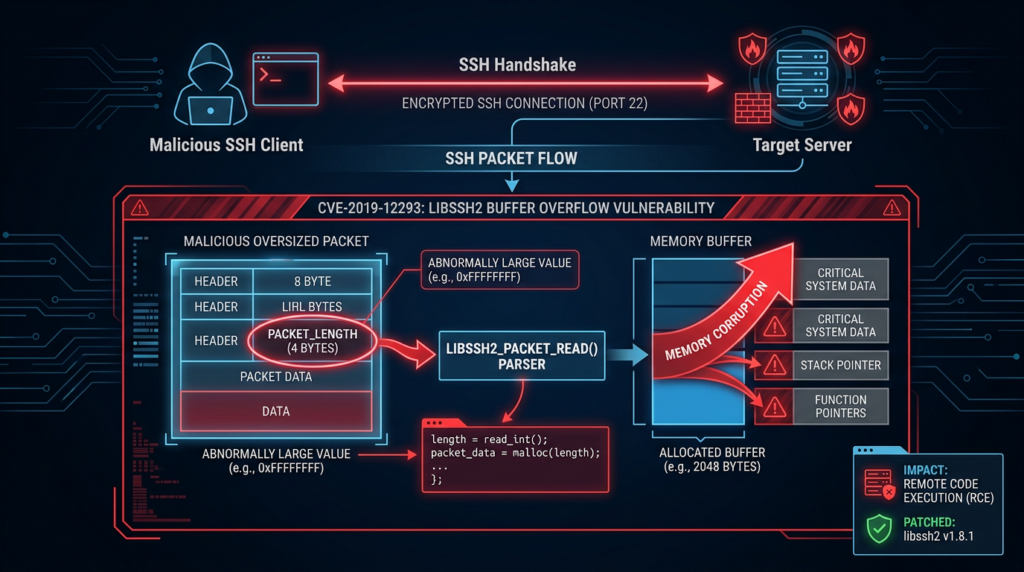
Security advisories and vulnerability databases describe CVE‑2026‑55200 as an out‑of‑bounds write condition in the SSH transport layer of libssh2.
The flaw occurs during the handling of inbound SSH packets. Each SSH packet contains a length field that defines the size of the payload. Proper implementations must validate that this value is within expected bounds before allocating memory or copying packet contents.
In affected versions of libssh2, the packet length field may not be sufficiently validated before it is used in memory operations. Under certain conditions, an attacker could send a specially crafted packet that leads to memory corruption.
A simplified representation of the risky pattern looks like this:
uint32_t packet_length = read_packet_length();

char *buffer = malloc(packet_length);
memcpy(buffer, incoming_data, packet_length);
Eğer packet_length is attacker‑controlled and not checked against reasonable limits, the operation may attempt to copy data beyond allocated memory boundaries.
Such out‑of‑bounds writes are dangerous because they can corrupt adjacent memory structures, which may eventually lead to process crashes or potentially controlled execution flow.
Why this type of bug is dangerous
Memory corruption vulnerabilities inside network protocol implementations are historically associated with severe security outcomes.
Possible consequences include:
- Denial of service through application crashes
- Heap corruption, destabilizing program execution
- Control flow manipulation, which can lead to remote code execution under favorable conditions
The exact exploitability of CVE‑2026‑55200 depends on several factors:
- compiler protections
- operating system mitigations
- how the host application integrates libssh2
- memory allocator behavior
Security researchers generally treat remotely triggerable heap corruption vulnerabilities as high‑risk because exploitation techniques often evolve after disclosure.
Attack surface and exposure scenarios
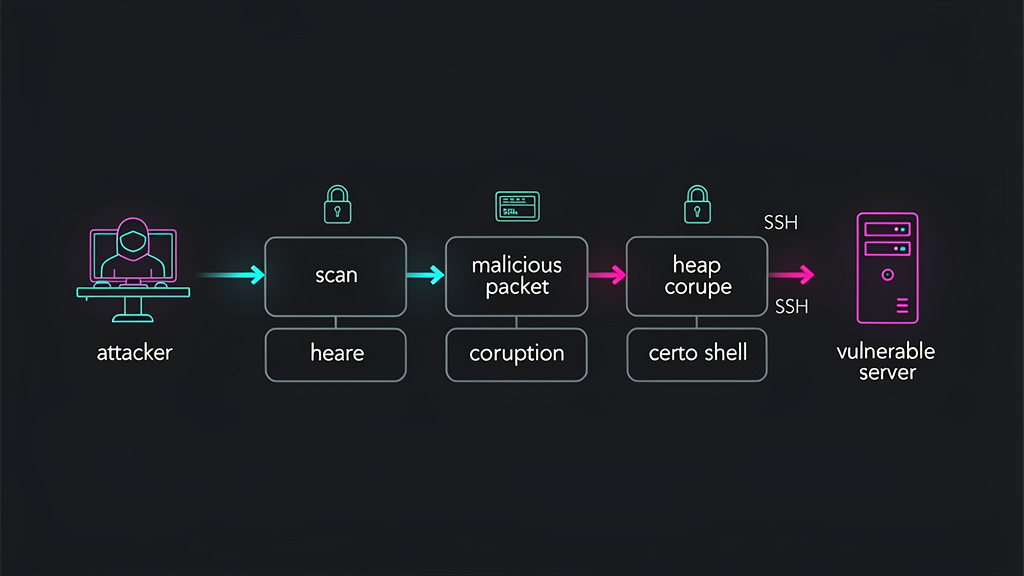
Although libssh2 itself is not a server, applications embedding it often expose SSH connectivity features.
Several practical attack scenarios exist.
Compromising automation systems
Deployment pipelines frequently use SSH libraries to connect to infrastructure nodes. If the pipeline component running libssh2 communicates with an attacker‑controlled host, malicious packets could trigger the vulnerability.
Client‑side exploitation
When a client application connects to a malicious SSH server, the server may send crafted packets designed to exploit weaknesses in packet parsing.
Man‑in‑the‑middle injection
In environments where attackers can intercept traffic, a malicious intermediary could inject malformed packets into an SSH session before encryption negotiation is fully established.
Conditions required for exploitation
Based on publicly available vulnerability records, the attack characteristics generally include:
| Factor | Açıklama |
|---|---|
| Saldırı Vektörü | Network |
| Gerekli Ayrıcalıklar | Hiçbiri |
| Kullanıcı Etkileşimi | None in some scenarios |
| Karmaşıklık | Low to moderate depending on environment |
These characteristics explain why the vulnerability received a high severity score in vulnerability databases.
Affected versions of libssh2
Public vulnerability advisories report that the flaw affects libssh2 versions up to 1.11.1.
Software packages bundling those versions may also inherit the vulnerability.
Operating systems where libssh2 is commonly distributed include:
- Debian‑based distributions
- Ubuntu releases
- SUSE Linux Enterprise
- other Linux and Unix‑like environments
However, exposure depends on whether the vulnerable library is actually used by an application handling SSH traffic.
Detecting vulnerable systems
The first step in vulnerability management is determining whether the library is present.
On Debian or Ubuntu systems:
dpkg -l | grep libssh2On RPM‑based systems:
rpm -qa | grep libssh2Security scanning tools also incorporate checks for the issue. For example, vulnerability scanning platforms such as Nessus reference this issue through dedicated detection plugins.
Indicators during runtime
In some cases, exploitation attempts may produce detectable signals.
Örnekler şunları içerir:
| Sinyal | Possible Meaning |
|---|---|
| sudden SSH client crashes | potential malformed packet handling |
| segmentation faults in logs | memory corruption |
| abnormal packet sizes | crafted transport payload |
Monitoring these signals can assist incident responders during active investigations.
Relationship with other libssh2 vulnerabilities
CVE‑2026‑55200 was disclosed alongside additional libssh2 issues, including CVE‑2026‑55199, which involves a separate flaw affecting the same library.
Although the two vulnerabilities differ technically, they illustrate a recurring theme in network libraries: complex packet parsing logic combined with insufficient input validation.
When multiple vulnerabilities affect the same component, patching becomes particularly urgent because attackers may chain weaknesses or choose the easiest path to exploitation.
Practical mitigation strategies
Mitigation typically follows a layered approach.
Upgrade the library
The most direct fix is installing a patched version of libssh2 released after the vulnerability disclosure.
Package maintainers in major Linux distributions usually backport security patches to supported releases.
Restrict network exposure
Systems that do not require external SSH connectivity should enforce firewall restrictions.
Harden runtime protections
Modern operating systems include mitigation technologies that complicate exploitation:
- Address Space Layout Randomization
- stack canaries
- hardened memory allocators
Although these mechanisms cannot eliminate vulnerabilities, they often raise the difficulty of reliable exploitation.
Security testing and large‑scale validation
Organizations running thousands of servers often struggle to verify whether embedded libraries are vulnerable. Dependency trees may include SSH functionality through third‑party packages, making manual inspection impractical.
In practice, some security teams use automated testing pipelines capable of mapping dependencies, simulating attack conditions, and collecting verification evidence across large environments. Platforms built for automated security validation, including tools designed around agent‑driven testing workflows such as https://penligent.ai/, can help orchestrate repeatable verification tasks across infrastructure fleets.
In these workflows, the goal is not only to detect outdated packages but also to confirm whether a vulnerability can actually be triggered within the application context.
Defensive monitoring strategies
Defenders should treat network protocol parsing bugs as potential intrusion vectors.
Recommended monitoring techniques include:
- SSH session telemetry
- crash log aggregation
- anomaly detection on packet sizes
- vulnerability scan correlation
Combining runtime monitoring with patch management reduces the likelihood that a newly disclosed flaw remains exploitable in production environments.
Frequently asked questions about CVE‑2026‑55200
What exactly is CVE‑2026‑55200
- A memory corruption vulnerability in the libssh2 library.
- Triggered through malformed SSH packet processing.
- Can lead to out‑of‑bounds writes during packet handling.
Which systems are most likely affected
- Applications embedding libssh2 versions up to 1.11.1.
- Linux servers running automation tools that rely on the library.
- Software performing SSH connections through libssh2 APIs.
Does OpenSSH use libssh2 internally
- No. OpenSSH is a separate implementation of the SSH protocol.
- Systems running only OpenSSH are not automatically affected unless another application bundles libssh2.
Is remote code execution guaranteed
- Not necessarily.
- Memory corruption vulnerabilities sometimes lead only to crashes.
- Exploitability depends on memory layout, mitigations, and application context.
How can administrators quickly check exposure
- Identify installed libssh2 versions using package managers.
- Review software dependencies in applications using SSH features.
- Run vulnerability scans with updated detection signatures.
What is the fastest mitigation if patching is delayed
- Restrict SSH connectivity to trusted networks.
- Monitor application logs for crashes.
- Apply temporary network filtering rules.
Are embedded devices at risk
- Potentially yes.
- Many embedded systems use lightweight SSH libraries such as libssh2.
- Vendors must release firmware updates if vulnerable versions are included.
Closing perspective
CVE‑2026‑55200 highlights a recurring challenge in infrastructure security: widely used libraries quietly become critical attack surfaces. Even when a vulnerability exists deep inside a dependency, it can expose entire automation systems or infrastructure pipelines.
For defenders, the lesson is straightforward. Track dependencies, patch quickly, and validate exposure rather than assuming safety. Memory corruption bugs in network protocol libraries remain among the most dangerous classes of vulnerabilities, particularly when they are reachable over the network.

 Turkish
  English
  German
  French
  Spanish
  Portuguese
  Japanese
  Korean
  Hindi
Hindi  Arabic
  Hebrew