
CVE-2026-8451 is a NetScaler ADC and NetScaler Gateway memory overread vulnerability that matters most when the appliance is configured as a SAML Identity Provider. It is not a blanket statement that every NetScaler appliance is exploitable. The exposure question starts with three facts: whether the appliance runs an affected build, whether it is configured as a SAML IdP, and whether it has been upgraded to a fixed release.
The public record is still narrow, but it is specific enough for defenders to act. NVD lists CVE-2026-8451 as an “insufficient input validation” issue in NetScaler ADC and NetScaler Gateway that can lead to memory overread when the appliance is configured as a SAML IdP. NVD also identifies the weakness as CWE-125, Out-of-bounds Read, and shows the NetScaler CNA CVSS 4.0 base score as 8.8 High. The same NVD entry lists the fixed build thresholds for affected NetScaler ADC and Gateway branches and records June 30, 2026 as the publication date. (NVD)
That combination makes the vulnerability operationally urgent even if the public evidence does not support claims of active exploitation at the time of publication. NVD’s CISA-ADP record for CVE-2026-8451 lists exploitation as “none,” automatable as “yes,” and technical impact as “total.” Those fields should be read carefully: they do not prove that nobody will exploit the bug, and they do not reduce the need to patch; they simply describe the state captured in that public record at that time. (NVD)
The facts that matter first
CVE-2026-8451 is tied to a narrow but sensitive deployment role. NetScaler appliances often sit at an identity and access boundary, handling remote access, authentication, SAML flows, application delivery, and policy enforcement. A memory overread in that path can become more serious than the leaked byte count alone suggests, especially if the affected system also handles tokens, cookies, identity metadata, or privileged routing decisions.
The confirmed affected products and fixed build thresholds are as follows. NVD lists these affected NetScaler branches, and the Canadian Centre for Cyber Security advisory repeats the same product families and upgrade guidance. (NVD)
| Product line | Affected condition | Fixed threshold listed in public advisories | Practical note |
|---|---|---|---|
| NetScaler ADC 14.1 | Builds before 14.1-72.61 | Upgrade to 14.1-72.61 or later | Check both version and SAML IdP configuration. |
| NetScaler Gateway 14.1 | Builds before 14.1-72.61 | Upgrade to 14.1-72.61 or later | Gateway exposure often overlaps with remote access and identity traffic. |
| NetScaler ADC 13.1 | Builds before 13.1-63.18 | Upgrade to 13.1-63.18 or later | Do not assume a 13.1 appliance is safe without checking the exact build. |
| NetScaler Gateway 13.1 | Builds before 13.1-63.18 | Upgrade to 13.1-63.18 or later | Prioritize internet-facing authentication paths. |
| NetScaler ADC 14.1-FIPS | Builds before 14.1-72.61-FIPS | Upgrade to 14.1-72.61-FIPS or later | FIPS branches need branch-specific updates. |
| NetScaler ADC 13.1-FIPS and 13.1-NDcPP | Builds before 13.1-37.272 | Upgrade to 13.1-37.272 or later | Compliance-flavored builds are not automatically protected. |
The most important defensive mistake is to treat the product name alone as the exposure condition. CVE-2026-8451 is specifically described as requiring the NetScaler appliance to be configured as a SAML IdP. A NetScaler appliance can be deployed in many roles, and the difference between “NetScaler exists” and “NetScaler is processing SAML IdP authentication traffic in an affected build” is the difference between a general asset inventory concern and a high-priority remediation item.
A second mistake is to wait for a public exploit before patching. NetScaler vulnerabilities have a history of moving from advisory to real-world abuse quickly when they affect authentication, remote access, or memory disclosure paths. For CVE-2026-8451, the right response is controlled urgency: confirm exposure, upgrade fixed builds, preserve evidence, retest safely, and avoid running untrusted proof-of-concept code against production appliances.
Who is actually exposed
Exposure requires more than a vulnerable version string. A practical triage decision should answer the following questions in order.
| Question | How to check | Neden önemli | Action if yes |
|---|---|---|---|
| Is the appliance NetScaler ADC or NetScaler Gateway? | Asset inventory, appliance management UI, CLI version output | The CVE is product-specific. | Continue triage. |
| Is the build below the fixed threshold for its branch? | Compare exact version and build against the fixed thresholds | Branch numbers alone are not enough. | Schedule upgrade or emergency change window. |
| Is SAML IdP configured? | Review authentication samlIdPProfile configuration and authentication vServer bindings | The public CVE description names SAML IdP configuration as the precondition. | Treat as potentially exposed. |
| Is the SAML endpoint reachable from untrusted networks? | Network path review, firewall policy, external exposure management | External reachability changes exploitation risk and urgency. | Prioritize patching and monitoring. |
| Does the appliance protect high-value applications? | Identity architecture review, app dependency mapping | Memory disclosure at an identity boundary can have downstream impact. | Expand logging, response, and retest scope. |
| Are FIPS or NDcPP builds in use? | Version and platform inventory | Fixed thresholds differ from standard builds. | Use the correct branch-specific upgrade target. |
A basic authorized version check can start with the NetScaler CLI:
show ns version
show version
Configuration review should then focus on whether SAML IdP profiles exist. NetScaler’s own command reference documents show authentication samlIdPProfile as the command that displays configured SAML SSO profiles, including fields such as the SAML SP certificate name, SAML IdP certificate name, Assertion Consumer Service URL, and whether unsigned requests are rejected. (Netscaler Developer Docs)
show authentication samlIdPProfile
show authentication vserver
On an appliance where reviewing the saved configuration is acceptable under change-control policy, the running or saved configuration can be searched for SAML IdP profile definitions and authentication bindings:
shell
grep -Ei 'add authentication samlIdPProfile|bind authentication vserver.*saml|samlIdPProfile' /nsconfig/ns.conf
Those commands do not exploit CVE-2026-8451. They answer the first defensive question: whether the appliance matches the configuration precondition described in the public records. Any further validation should be performed only inside an authorized scope, preferably with a vendor-supported detection workflow or a controlled lab instance that mirrors production configuration without exposing production traffic.
Why the SAML IdP role changes the risk
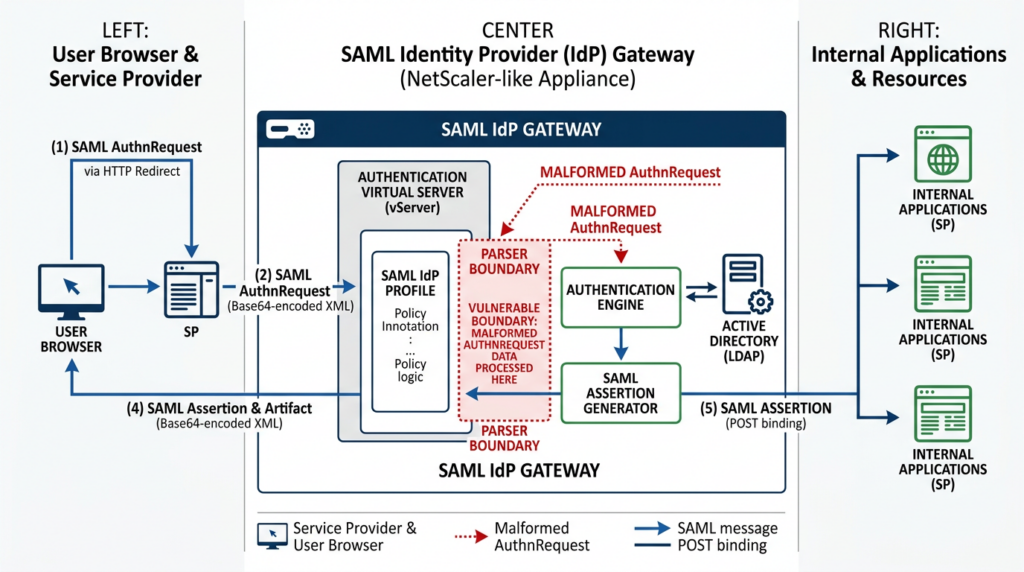
SAML is not just another login option. In a SAML federation, an Identity Provider receives an authentication request from a Service Provider, authenticates the user, generates a SAML assertion, and sends that assertion back to the Service Provider. NetScaler’s SAML IdP documentation describes that flow directly: the IdP receives requests from the SP, redirects users to a logon page, authenticates users through configured methods such as Active Directory or LDAP, and generates SAML assertions. The requests are received by an authentication virtual server associated with a SAML IdP profile. (docs.netscaler.com)
That architecture explains why CVE-2026-8451 is not merely a parser bug in isolation. The affected path processes SAML AuthnRequest data, identity metadata, assertion consumer URLs, issuer values, IDs, certificates, and binding behavior. Small parsing mistakes can become meaningful because the parser is sitting on a boundary between untrusted request data and security-sensitive authentication state.
NetScaler’s documentation also shows why configuration details matter. A SAML IdP profile can be configured with parameters such as an Assertion Consumer Service URL rule, signing behavior, encryption options, request rejection settings, and certificate material. The docs recommend using a full ACS URL in acsUrlRule and explain that regular expressions can be used when an SP is imported from metadata, while also showing the security-relevant behavior around ACS URL handling. (docs.netscaler.com)
The IdP role also creates a response path. NetScaler documentation notes that with POST binding, if the incoming SAML request carries an AssertionConsumerServiceURL, that URL is used for posting the SAML response; otherwise, the configured SAML IdP profile URL is used. (docs.netscaler.com) If a parser mishandles malformed XML attributes on that path, the downstream effect may appear in a redirect, cookie, response state, log line, crash, or internal authentication workflow. That is why defenders should pay attention to both request parsing and response artifacts.
Root cause, strict XML rules met permissive parsing
The public technical research on CVE-2026-8451 points to SAML AuthnRequest parsing behavior rather than a generic network parsing bug. watchTowr Labs reported that the vulnerability can be reached through /saml/login using a SAML AuthnRequest carried as base64-encoded XML, and that the affected code path involves a custom XML parser. (watchTowr Labs)
Their analysis describes parsing behavior around quoted and unquoted XML attribute values, attribute terminators, whitespace handling, and the point at which the parser decides where an attribute value ends. In the examined parsing logic, quoted values are terminated by the matching quote character, while unquoted values use a space as a terminator. The loop continues until it sees the chosen terminator, a null byte, or a closing angle bracket. watchTowr called out that this behavior is suspicious because XML whitespace is broader than a single space and because the termination logic lacks obvious bounds checks. (watchTowr Labs)
That may sound abstract, but the security issue is familiar: a parser accepts input that is malformed enough to confuse its internal boundaries, then later code trusts the resulting pointer and length as if they came from a well-formed XML document. In a safe parser, the syntax rules and memory boundaries fail closed. In a brittle parser, the syntax rules drift away from the memory rules.
A simplified vulnerable pattern looks like this:
/*
 * Simplified educational example.
 * This is not NetScaler source code and not an exploit.
 */
char *parse_unquoted_attr(char *p, char *buffer_end, size_t *len_out) {
    char *start = p;

    /*
     * Unsafe idea: accept only a single space or '>' as a terminator.
     * Real XML whitespace includes more than ordinary space, and the
     * parser must also enforce document and buffer boundaries.
     */
    while (*p != ' ' && *p != '>' && *p != '\0') {
        p++;
    }

    *len_out = (size_t)(p - start);
    return start;
}
A safer mental model is different. The parser should not just look for a convenient terminator. It should enforce the grammar it claims to parse, reject invalid attribute forms, respect the original input buffer bounds, and never let a pointer-length pair outlive the validated object that produced it.
/*
 * Simplified defensive pattern.
 * The important idea is fail-closed parsing with explicit bounds.
 */
bool parse_attr_value(
    const char *p,
    const char *end,
    const char **value_start,
    size_t *value_len
) {
    if (p >= end) {
        return false;
    }

    if (*p != '"' && *p != '\'') {
        /*
         * For security-sensitive SAML parsing, reject unquoted
         * attribute values instead of trying to recover.
         */
        return false;
    }

    char quote = *p++;
    const char *start = p;

    while (p < end && *p != quote) {
        /*
         * Additional XML validation would happen here:
         * entity handling, invalid control characters, encoding rules,
         * namespace behavior, and maximum length enforcement.
         */
        p++;
    }

    if (p >= end) {
        return false;
    }

    *value_start = start;
    *value_len = (size_t)(p - start);
    return true;
}
The practical lesson for CVE-2026-8451 is that defenders do not need to reverse engineer the full binary to understand the risk class. The CVE is a memory overread caused by insufficient input validation in a SAML IdP parsing path. If malformed input can cause the parser to define an attribute boundary incorrectly, later code may read bytes outside the intended XML attribute. NVD’s CWE-125 classification captures the same core issue: the program reads beyond the intended memory boundary. (NVD)
What leaks and why a few bytes can still matter
A memory overread does not automatically mean a full credential dump. The impact depends on what memory is adjacent, how much is returned, whether the leak is repeatable, whether response artifacts expose it, and whether the attacker can combine it with another weakness.
For CVE-2026-8451, public research is more restrained than the worst NetScaler memory disclosure examples. watchTowr reported that crafted SAML input could cause parsed values to be embedded in the NSC_TASS cookie, allowing memory not intended to leave the process to appear in the response. They also emphasized that, unlike the earlier CitrixBleed-style issue that leaked kilobytes, this condition tends to stop at control characters such as null bytes or >, often leaking only a few bytes. (watchTowr Labs)
That smaller leak size matters, but it does not make the vulnerability harmless. A few bytes may still disclose a partial pointer, object metadata, stale request data, or process state. If an attacker can vary request shape and observe changes, repeated small leaks can sometimes provide enough information to support another bug. watchTowr also noted that malformed requests could crash the nsppe process, creating a denial-of-service angle. (watchTowr Labs)
A useful way to think about CVE-2026-8451 is as an identity-edge information disclosure primitive. On its own, the publicly described leak is not equivalent to a reliable session hijack. In the wrong environment, however, an information disclosure primitive on a remote access or authentication appliance can reduce uncertainty for an attacker. That is why mature response teams do not ask only, “Can it dump sessions?” They ask:
| Risk question | Why it matters for CVE-2026-8451 |
|---|---|
| Can the endpoint be reached by an unauthenticated remote client? | The CNA vector lists network access, low attack complexity, no privileges, and no user interaction. (NVD) |
| Does the appliance process SAML IdP traffic for high-value apps? | The bug sits near identity assertions and authentication routing. |
| Can the leak disclose pointers or memory layout clues? | Small memory leaks can weaken exploit mitigations when chained. |
| Can malformed input crash a critical process? | A crash on an identity edge device can become an availability incident. |
| Are logs sufficient to reconstruct attempted abuse? | Default logs may not capture request bodies or response cookies. |
| Is the appliance part of a larger access path? | A boundary device may protect many applications behind it. |
The defensive conclusion is simple: do not oversell the leak, and do not underreact to the placement.
How attackers would think about it
Defenders should understand the attacker workflow without copying it into production. A realistic attacker would not start by guessing memory contents. They would start with exposure and configuration.
First, they would look for NetScaler endpoints reachable over the network. Then they would try to identify authentication paths, SAML endpoints, and whether the appliance appears to be acting as an IdP. Next, they would send malformed SAML AuthnRequest data to the relevant endpoint and observe response behavior, cookies, redirects, errors, and process stability. Public research identified /saml/login and a SAML AuthnRequest path as important to the bug’s behavior. (watchTowr Labs)
That flow creates several defender-visible surfaces. Even when the exact body is not logged, a team may still see abnormal request volume to SAML endpoints, odd 302 patterns, unexpected response cookie size or byte distribution, spikes in authentication errors, or process instability around the same time window. None of those signals proves exploitation alone. Together, they can justify deeper review.
The dangerous operational pattern is a public-facing appliance that is both below the fixed version and configured as a SAML IdP. In that case, waiting for commodity scanner coverage is a poor control. By the time a scanner has a reliable check, the window for quiet manual probing may already have existed.
Safe exposure verification
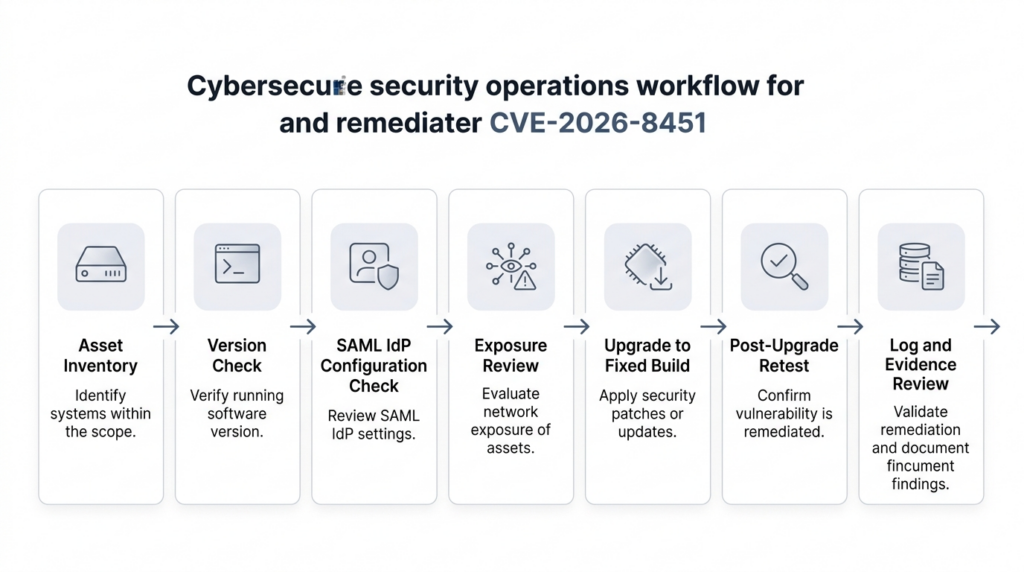
A safe validation workflow for CVE-2026-8451 should separate exposure confirmation from exploit reproduction. Most organizations do not need to leak memory from their own production appliances to make a patch decision. They need to prove whether the appliance is in scope, whether the fixed build is installed, whether SAML IdP is configured, and whether the relevant endpoint is reachable.
A practical workflow looks like this:
| Adım | Evidence to collect | Example command or source | Decision |
|---|---|---|---|
| Identify appliance role | Product, hostname, business owner, internet exposure | CMDB, external exposure inventory, load balancer records | Decide priority. |
| Confirm exact build | Version and build number | show ns version | Compare to fixed thresholds. |
| Confirm SAML IdP configuration | SAML IdP profile and authentication vServer bindings | show authentication samlIdPProfile | Determine whether the CVE precondition applies. |
| Confirm endpoint exposure | Network path and access policy | Firewall rules, reverse proxy logs, packet capture under change control | Prioritize internet-facing systems. |
| Yükseltme | Change ticket, backup, snapshot, vendor upgrade path | NetScaler Console or CLI upgrade workflow | Move to fixed release. |
| Retest | Same version and config checks after upgrade | Repeat version and SAML config checks | Close the technical finding. |
| Preserve logs | Pre-change and post-change logs | SIEM export, appliance logs, authentication logs | Support incident review. |
NetScaler Console documentation describes a specific CVE Detection workflow for CVE-2026-8451. The page says administrators can search for CVE-2026-8451 in the Security Advisory dashboard, run detection, and proceed to an upgrade workflow for impacted instances. It also states that remediation is a single step: upgrade vulnerable NetScaler instances to a fixed release or build. (docs.netscaler.com)
That is the cleanest operational message in the entire vulnerability cycle. Detection is useful for prioritization, but remediation is upgrade. Compensating controls can reduce exposure while a change window is prepared; they should not become the long-term answer.
Configuration checks that help without exploiting the bug
The following commands are defensive checks. They should be run by authorized administrators or responders on appliances they own or are explicitly allowed to assess.
show ns version
show version
show authentication samlIdPProfile
show authentication vserver
To inspect saved configuration for SAML IdP profile definitions:
shell
grep -Ei 'add authentication samlIdPProfile' /nsconfig/ns.conf
grep -Ei 'bind authentication vserver|samlIdPProfile|saml' /nsconfig/ns.conf
To look for obvious SAML IdP hardening settings in configuration:
shell
grep -Ei 'rejectUnsignedRequests|acsUrlRule|samlIdPCertName|samlSPCertName|NameIDExpr' /nsconfig/ns.conf
A SAML IdP profile is not automatically unsafe. It is the business feature that places the appliance on the affected code path. NetScaler documentation shows that SAML IdP profiles include settings such as the SAML SP certificate, SAML IdP certificate, Assertion Consumer Service URL, and rejection of unsigned requests. (Netscaler Developer Docs) Those settings become important after patching because they help reduce the broader SAML attack surface.
One useful review item is the ACS URL rule. NetScaler documentation recommends a full ACS URL in acsUrlRule and discusses regular expression use when importing metadata. (docs.netscaler.com) In practice, broad ACS URL rules can make federated identity flows harder to reason about, especially when multiple service providers, legacy metadata, or migration exceptions accumulate over time.
A defensive review might produce a table like this:
| Configuration item | What to look for | Neden önemli |
|---|---|---|
| SAML IdP profile existence | add authentication samlIdPProfile | Confirms whether the CVE configuration precondition may apply. |
| Authentication vServer binding | SAML IdP policy bound to a reachable authentication vServer | Determines whether the code path is active. |
| ACS URL rule | Overly broad regex, wildcard-like behavior, outdated SP URLs | Reduces trust in where assertions are sent. |
| Unsigned request handling | rejectUnsignedRequests disabled where signing is expected | Unsigned requests increase SAML abuse surface. |
| Certificate references | Old or unknown IdP and SP certificates | Certificate drift can weaken trust boundaries. |
| Exposure path | Public reachability of SAML endpoint | Changes urgency and monitoring requirements. |
The goal is not to redesign SAML during an emergency patch window. The goal is to avoid treating CVE-2026-8451 as a one-line version update while ignoring the identity configuration that made the bug relevant.
Detection that respects the limits of the evidence
Memory overread vulnerabilities are hard to detect cleanly from ordinary HTTP logs. The most valuable evidence may be in request bodies, response cookies, process crash logs, authentication logs, or packet captures, and many environments do not retain all of those fields. That does not make detection impossible. It means defenders should avoid pretending there is a perfect indicator.
For CVE-2026-8451, useful hunting starts around the SAML IdP endpoint and malformed SAML request patterns. Public research identified /saml/login, malformed AuthnRequest parsing, and response behavior involving the NSC_TASS cookie as important artifacts. (watchTowr Labs)
A SIEM query can start with endpoint-level anomalies:
index=proxy OR index=web OR index=netscaler
(uri_path="/saml/login" OR uri="/saml/login" OR url="*/saml/login*")
| stats count min(_time) as first_seen max(_time) as last_seen values(status) as statuses values(src_ip) as src_ips by host, uri_path
| where count > 20 OR mvcount(statuses) > 3
That query does not detect exploitation. It finds concentrated activity against the relevant path. The next layer should look for request or response fields if the organization logs them.
index=proxy OR index=web OR index=netscaler
(uri_path="/saml/login" OR uri="*/saml/login*")
("SAMLRequest=" OR "AuthnRequest" OR "AssertionConsumerServiceURL" OR "NSC_TASS")
| table _time host src_ip uri status user_agent request_body response_headers
If request bodies are available, responders can look for malformed SAML signals without publishing exact exploit payloads:
index=proxy OR index=web OR index=netscaler
(uri_path="/saml/login" OR uri="*/saml/login*")
| eval malformed_saml=if(match(request_body, "AuthnRequest") AND match(request_body, "AssertionConsumerServiceURL"), 1, 0)
| stats count values(status) as statuses values(user_agent) as user_agents by src_ip, host, malformed_saml
| where malformed_saml=1 AND count > 5
Process stability also matters. Public reporting indicated that malformed requests could terminate the nsppe process in some conditions. (watchTowr Labs) A responder with appliance log access can search for crash or restart indicators around suspicious SAML traffic windows:
shell
grep -Ei 'nsppe|crash|core|saml|AuthnRequest|NSC_TASS' /var/log/ns.log
A useful detection table should be honest about confidence:
| Sinyal | Possible meaning | Confidence | Common false positives | Follow-up |
|---|---|---|---|---|
Repeated requests to /saml/login from unusual sources | Probing or abnormal federation traffic | Orta | SSO misconfiguration, SP retry loops | Compare source IPs with known SPs and IdP partners. |
| Malformed SAML AuthnRequest fields | Possible vulnerability testing | Medium to high if body is visible | Broken SAML client, bad metadata migration | Preserve request body, user agent, TLS metadata, and response headers. |
Unusual NSC_TASS response cookie behavior | Possible memory overread artifact | Orta | Normal appliance state cookies may vary | Compare with known-good flows and patched behavior. |
nsppe crash or restart near SAML requests | Possible DoS side effect | Orta | Appliance instability, unrelated bug | Correlate with SAML endpoint traffic and firmware build. |
| Spike in 302, 400, or 5xx around SAML endpoint | Probing, malformed requests, or auth failures | Low to medium | SP outage, certificate change, metadata drift | Review SAML partner changes and request sources. |
| Authentication errors after patching | SAML config compatibility issue | Low as exploit signal, high as ops signal | Strict validation changes, old SP metadata | Validate SP metadata, ACS rules, signing requirements. |
Teams should preserve both negative and positive evidence. If request body logging is unavailable, record that limitation. If only summarized logs exist, do not overclaim “no exploitation.” State the evidence boundary: no suspicious SAML endpoint activity was observed in available logs for the reviewed period.
Remediation, upgrade first, compensate only temporarily
The primary remediation for CVE-2026-8451 is to upgrade affected NetScaler ADC and NetScaler Gateway instances to fixed builds. Public guidance from the Canadian Centre for Cyber Security tells users to apply the necessary updates, and NetScaler Console documentation describes upgrading impacted instances as the remediation step. (Canadian Centre for Cyber Security)
A practical remediation plan should include:
| Aşama | Eylem | Neden önemli |
|---|---|---|
| Preparation | Export configuration, confirm appliance role, identify SAML dependencies | Prevents breaking identity flows without understanding blast radius. |
| Önceliklendirme | Patch internet-facing SAML IdP appliances first | Exposure and identity role drive risk. |
| Yükseltme | Move to the fixed branch build listed for the product line | Version thresholds are branch-specific. |
| Doğrulama | Re-run version and SAML profile checks | Confirms the finding is closed. |
| İzleme | Watch SAML endpoint logs and process stability after upgrade | Catches broken SP metadata or suspicious retry activity. |
| Kanıtlar | Store before-and-after version, config, and log artifacts | Supports audit, incident review, and compliance reporting. |
Temporary compensating controls may be justified when an immediate upgrade is not possible. They should be time-boxed and documented. Depending on business constraints, possible measures include restricting access to relevant authentication endpoints, limiting management and administration exposure, temporarily disabling SAML IdP functionality if the business can tolerate it, and tightening access paths to known Service Provider networks. Beazley Security’s summary recommends patching, disabling SAML IdP temporarily where feasible, and limiting access to trusted or administrative networks. (Beazley Security)
Compensating controls are weaker than a fixed build because CVE-2026-8451 is a parsing issue in the appliance code path. Network restrictions may reduce who can reach the path, but they do not correct the parser. Disabling SAML IdP may remove the relevant precondition, but it can break business authentication flows. WAF rules may help suppress obvious malformed traffic in some architectures, but they are not a reliable substitute for patching a gateway or ADC that terminates and processes the affected protocol path.
Hardening the SAML IdP path after the fix
The patch closes the known vulnerability. It does not automatically make the SAML deployment well designed. Because CVE-2026-8451 touches a SAML IdP path, it is a good trigger for a broader SAML configuration review.
Start with ACS URL handling. A tight ACS URL rule reduces ambiguity about where SAML responses can be sent. NetScaler documentation recommends full ACS URLs in acsUrlRule and shows examples of expression-based matching. (docs.netscaler.com) For production identity systems, overly broad regular expressions should be treated as technical debt, especially when they were created during migrations or emergency onboarding.
Next, review signed request behavior. NetScaler’s SAML IdP feature supports rejecting unsigned requests and configuring signature and digest algorithms. (docs.netscaler.com) If a Service Provider is expected to sign AuthnRequests, unsigned requests should not be accepted merely for convenience. Exceptions should be documented with a business owner, expiration date, and compensating controls.
Certificate hygiene is equally important. Stale SP certificates, unknown IdP certificates, and inconsistent metadata create confusion during incident response. When a SAML incident occurs, defenders need to know which SPs are legitimate, which ACS URLs are expected, which certificates are trusted, and which algorithms are acceptable. A clean metadata inventory shortens the time between “we saw strange SAML traffic” and “we know whether this was malicious.”
A post-patch hardening checklist should include:
SAML IdP hardening checklist

[ ] Confirm appliance is on a fixed build for its exact branch.
[ ] Export current SAML IdP profile configuration.
[ ] List all Service Providers that rely on this IdP.
[ ] Confirm expected ACS URLs for each Service Provider.
[ ] Replace broad ACS URL rules with exact or tightly scoped expressions where feasible.
[ ] Require signed AuthnRequests where supported by the SP.
[ ] Review IdP and SP certificates for ownership, expiration, and rotation plan.
[ ] Remove stale SAML profiles, policies, and authentication vServer bindings.
[ ] Verify logging for SAML endpoint activity and authentication errors.
[ ] Document rollback behavior before changing identity rules.
Hardening should not delay emergency patching. The safest order is patch first, then configuration cleanup under normal change control. If the SAML configuration is already fragile, create a minimal immediate change that fixes CVE-2026-8451, then schedule a separate identity hardening change after application owners can test their SSO flows.
Lessons from related NetScaler CVEs
CVE-2026-8451 should not be viewed in isolation. NetScaler has had several high-impact vulnerabilities involving memory disclosure, identity boundaries, remote access, and appliance-level exposure. The exact root causes differ, but the operational lessons overlap.
| CVE | Product context | Core issue | Why it is relevant to CVE-2026-8451 | Savunma dersi |
|---|---|---|---|---|
| CVE-2023-4966, CitrixBleed | NetScaler ADC and Gateway configured as Gateway or AAA virtual server | Sensitive information disclosure | Demonstrated how memory disclosure at an access boundary can enable serious downstream compromise | Patch quickly, kill or invalidate sessions when vendor guidance calls for it, and hunt for session abuse. |
| CVE-2025-5777 | NetScaler ADC and Gateway configured as Gateway or AAA virtual server | Insufficient input validation leading to memory overread | Another NetScaler memory overread tied to authentication-facing deployment roles | Do not treat memory overread as low-risk merely because it is not code execution. |
| CVE-2026-3055 | NetScaler ADC and Gateway configured as SAML IdP | Insufficient input validation leading to memory overread | Shares the SAML IdP precondition and CWE class with CVE-2026-8451 | Build a repeatable SAML IdP exposure and patch workflow. |
| CVE-2026-8451 | NetScaler ADC and Gateway configured as SAML IdP | Insufficient input validation leading to memory overread | Current issue, narrower than all NetScaler deployments but sensitive in identity environments | Confirm SAML IdP role, patch fixed builds, monitor SAML endpoint anomalies. |
CVE-2023-4966 is the cautionary example. NVD describes it as sensitive information disclosure in NetScaler ADC and Gateway when configured as Gateway or AAA virtual server, and CISA added it to the Known Exploited Vulnerabilities catalog in October 2023. (NVD) A joint advisory from CISA, FBI, MS-ISAC, and ACSC later described LockBit 3.0 affiliates exploiting CVE-2023-4966, known as CitrixBleed, and explained that valid cookies could allow authenticated sessions without a username, password, or multifactor authentication challenge. (cyber.gov.au)
CVE-2025-5777 is another relevant comparison. NVD describes it as insufficient input validation leading to memory overread in NetScaler ADC and Gateway when configured as Gateway or AAA virtual server. It was also added to CISA’s Known Exploited Vulnerabilities catalog, with CISA-ADP marking exploitation as active and automatable. (NVD) The lesson is not that CVE-2026-8451 has the same exploitation profile. The lesson is that NetScaler memory overread bugs in authentication-facing paths deserve disciplined response before they become part of commodity playbooks.
CVE-2026-3055 is the closest neighbor. NVD describes it as insufficient input validation in NetScaler ADC and NetScaler Gateway when configured as SAML IdP, leading to memory overread, and CISA’s record shows it in the Known Exploited Vulnerabilities catalog. (NVD) That makes CVE-2026-8451 easier to triage conceptually: the SAML IdP role is not an incidental detail; it is the organizing condition for exposure management.
These comparisons also help prevent two bad reactions. One is panic: assuming every NetScaler appliance is already compromised. The other is complacency: assuming a memory overread is not urgent because it is not remote code execution. The correct middle ground is version-specific, configuration-specific, evidence-driven remediation.
Session hygiene and incident response considerations
For CVE-2026-8451, the public vendor-linked remediation language focuses on upgrading affected builds. There is no publicly supported basis to claim that every exposed appliance must be treated exactly like a CitrixBleed session-theft incident. At the same time, responders should understand why session hygiene enters the conversation.
When CVE-2023-4966 was actively exploited, Singapore’s Cyber Security Agency advised organizations that had patched affected NetScaler appliances to terminate active sessions with commands such as kill aaa session -all, kill icaconnection -all, kill rdp connection -all, and related cleanup commands. (Singapur Siber Güvenlik Ajansı) That advice was tied to a different vulnerability and exploitation scenario. It should not be blindly copied into a CVE-2026-8451 runbook without considering business impact and vendor guidance.
A sensible response model for CVE-2026-8451 is risk-based:
| Durum | Suggested response posture |
|---|---|
| Appliance is below fixed build, SAML IdP disabled | Upgrade according to normal vulnerability SLA, verify no SAML IdP profile is active. |
| Appliance is below fixed build, SAML IdP enabled, not internet-facing | Prioritize upgrade, review logs, confirm reachable sources. |
| Appliance is below fixed build, SAML IdP enabled, internet-facing | Treat as urgent, upgrade quickly, preserve logs, hunt SAML endpoint activity. |
| Suspicious SAML traffic or process crashes observed | Open incident review, preserve appliance logs and traffic evidence, consider session and credential hygiene based on findings. |
| Evidence of session token exposure or abuse | Escalate to incident response, rotate affected credentials or sessions according to identity architecture and vendor guidance. |
The distinction matters. Security teams lose credibility when they trigger disruptive session resets without evidence or vendor support. They also create risk when they refuse to invalidate sessions despite suspicious activity. The right decision depends on what the appliance did, what logs show, what applications sit behind it, and how much trust the organization places in active sessions.
Operational patch planning for high-availability NetScaler environments
Many NetScaler deployments are not single appliances. They may be high-availability pairs, multi-site deployments, FIPS builds, separate test and production clusters, or appliances embedded in managed service arrangements. CVE-2026-8451 response should account for that complexity.
A high-availability upgrade plan should answer:
| Planning item | Neden önemli |
|---|---|
| Active and standby node versions | Mixed versions during upgrade can create asymmetric behavior. |
| Configuration synchronization state | A stale standby can reintroduce vulnerable configuration or break failover. |
| SAML IdP profile consistency | Identity behavior must remain predictable after failover. |
| SP metadata dependencies | Some SPs may be sensitive to certificate, ACS URL, or binding changes. |
| Maintenance window and rollback | Authentication failures can become business outages quickly. |
| Post-upgrade smoke tests | Login success does not prove all SPs work; test representative applications. |
A minimal smoke test set after upgrade should include:
Post-upgrade SAML smoke tests

1. Confirm the fixed build is installed on every node.
2. Confirm HA pair status is healthy.
3. Confirm SAML IdP profiles still exist only where expected.
4. Authenticate to at least one representative SP for each SAML IdP profile.
5. Confirm expected ACS URL behavior.
6. Confirm signed request behavior if enforced.
7. Check authentication logs for unusual errors.
8. Confirm no unexpected process restarts after test authentication.
The best patch plans also define what not to do. Do not make broad SAML rule changes and a firmware upgrade in the same emergency window unless a broken configuration requires it. Do not run public exploit tools from random workstations against production appliances. Do not leave a standby node unpatched because it is “not active.” During a failover, today’s standby can become tomorrow’s exposed edge.
Why “no public exploitation” is not the same as low risk
The public record around CVE-2026-8451 is cautious. NVD’s CISA-ADP record says exploitation is “none” at the time captured in the entry. (NVD) Some security summaries also stated that there was no active exploitation reported at disclosure time. Beazley Security, for example, summarized CVE-2026-8451 as a pre-authenticated memory overread affecting NetScaler SAML IdP deployments and said no active exploitation had been reported at that time. (Beazley Security)
That should shape communication. A responsible advisory to executives should not say, “This is being exploited everywhere,” unless new evidence supports that statement. It should say something closer to:
We have an 8.8 High NetScaler ADC and Gateway vulnerability that affects appliances configured as SAML Identity Providers. Public records do not currently show confirmed exploitation for this CVE, but the vulnerability is remotely reachable, automatable according to CISA-ADP, and located in an identity-facing appliance role. We are checking which appliances match the affected configuration, upgrading those below the fixed build thresholds, and reviewing SAML endpoint logs for suspicious activity.
That language is precise. It gives leadership a reason to approve emergency work without exaggerating the evidence.
The same precision matters in bug bounty and red team contexts. A researcher who reports CVE-2026-8451 exposure should include product version, build, SAML IdP configuration evidence, reachability, and safe validation artifacts. A vague report that only says “NetScaler vulnerable” is weak. A report that includes exploit output from a production appliance may violate rules of engagement. Good vulnerability work proves risk without creating unnecessary harm.
Avoid these response mistakes
The most common mistakes in CVE-2026-8451 response are predictable.
| Mistake | Why it is wrong | Better approach |
|---|---|---|
| Checking only the product name | The CVE depends on version and SAML IdP configuration. | Check build, branch, and SAML IdP profiles. |
| Treating every NetScaler as equally exposed | Deployment role changes the risk. | Prioritize SAML IdP and internet-facing authentication paths. |
| Waiting for a public exploit | Memory disclosure bugs can be weaponized after disclosure. | Patch based on affected configuration, not exploit availability. |
| Running public PoC code in production | It may crash processes or leak sensitive memory. | Use vendor detection, config checks, lab validation, and controlled evidence collection. |
| Ignoring FIPS and NDcPP branches | Fixed thresholds differ. | Track branch-specific build numbers. |
| Assuming logs prove no exploitation | Default logs may omit request bodies and response cookies. | Document visibility limits and correlate multiple sources. |
| Upgrading only the active HA node | Failover can expose a vulnerable standby. | Patch and validate every node. |
| Cleaning up sessions blindly | CVE-2026-8451 is not automatically the same as CitrixBleed. | Use evidence and vendor guidance to decide session hygiene. |
A subtle mistake is relying only on scanner output. Scanners can be useful, but they may miss configuration preconditions, FIPS build branches, nonstandard management access, or appliances hidden behind other routing layers. They may also report a version finding without understanding whether SAML IdP is active. For a vulnerability like CVE-2026-8451, scanner output should start the conversation, not end it.
Evidence driven validation workflows
CVE-2026-8451 is a good example of why vulnerability validation needs evidence, not just alert volume. A complete finding should contain the appliance identity, exact build, affected branch, SAML IdP configuration evidence, exposure path, remediation target, post-upgrade proof, and monitoring notes. That evidence bundle is what allows security teams, infrastructure owners, auditors, and incident responders to agree that the risk was handled.
In an authorized testing program, AI-assisted workflows can help organize that evidence if they remain bounded by scope and human approval. Penligent describes an AI-powered penetration testing workflow that focuses on finding, verifying, exploiting, and reporting security findings, and that type of workflow is most useful here when it is constrained to safe checks, configuration review, evidence capture, and post-patch retesting rather than uncontrolled exploit execution. (Penligent) Penligent has also published adjacent analysis on NetScaler CVE-2026-3055 and the SAML IdP memory overread pattern, which is relevant background for teams building a repeatable NetScaler SAML triage process. (Penligent)
The key is to keep automation honest. A validation workflow should not claim that it “proved no exploitation” unless it reviewed the logs that would actually contain exploit evidence. It should not claim that a system is safe because a payload failed. It should not turn public proof-of-concept logic into a production testing habit. The strongest workflow is boring in the best way: gather facts, compare versions, confirm configuration, patch, retest, and keep the evidence.
A useful finding template for CVE-2026-8451 might look like this:
finding:
  title: "NetScaler SAML IdP memory overread exposure, CVE-2026-8451"
  asset:
    hostname: "netscaler-idp-01.example.internal"
    product: "NetScaler ADC"
    branch: "14.1"
    build: "14.1-xx.xx"
  exposure:
    saml_idp_configured: true
    internet_reachable: true
    authentication_vserver: "auth-vsrv-prod"
  evidence:
    version_command: "show ns version"
    saml_profile_command: "show authentication samlIdPProfile"
    config_reference: "/nsconfig/ns.conf"
    log_window_reviewed: "2026-06-25T00:00Z to 2026-07-01T00:00Z"
  remediation:
    target_build: "14.1-72.61 or later"
    change_ticket: "CHG-12345"
    post_upgrade_verified: false
  notes:
    - "No exploit payload executed against production."
    - "Request-body logging unavailable for reviewed period."
    - "SAML endpoint access logs preserved in SIEM."
That template is not a compliance artifact by itself. It is a way to keep security work falsifiable. A future reviewer should be able to see why the asset was considered exposed, what evidence supported the conclusion, what was changed, and what evidence limits remained.
Bug bounty and red team handling
For bug bounty hunters, red teamers, and pentesters, CVE-2026-8451 creates a familiar boundary problem. It is tempting to prove impact by reproducing a memory leak. On real third-party infrastructure, that can cross program rules, disrupt identity services, or expose sensitive data unrelated to the researcher’s test.
A responsible report should avoid destructive or privacy-invasive validation. Strong evidence can include:
| Evidence type | Acceptable defensive value | Risk level |
|---|---|---|
| Exact product and build evidence from allowed sources | Shows likely affected version | Düşük |
| SAML IdP configuration evidence from authorized access | Confirms the precondition | Low to medium |
| Public advisory mapping to fixed thresholds | Supports severity | Düşük |
| Non-invasive endpoint reachability | Shows attack surface | Low if allowed |
| Production memory leak output | May prove exploitability but can expose sensitive data | Yüksek |
| Process crash in production | Demonstrates availability impact by causing harm | Yüksek |
If a program explicitly allows safe verification, researchers should still minimize data exposure. Capture only what is necessary, redact secrets, avoid repeated probing, and stop immediately if unexpected sensitive data appears. In many cases, the best report says: “I did not attempt memory disclosure because doing so could expose sensitive data; the asset appears to meet the public vulnerability preconditions based on version, build, and SAML IdP exposure.”
For internal red teams, the bar is different but still controlled. The team may be allowed to test a lab clone or a production-like staging appliance. They should coordinate with identity owners, define stop conditions, capture logs, and avoid testing during peak authentication windows. Memory disclosure bugs on identity infrastructure are not good candidates for casual Friday-afternoon experimentation.
Detection engineering details
A detection strategy for CVE-2026-8451 should combine edge telemetry, appliance telemetry, and identity telemetry. No single layer is enough.
At the edge layer, look for requests to SAML endpoints, unusual clients, suspicious user agents, and abnormal source distribution. At the appliance layer, look for authentication errors, SAML parsing warnings, process instability, core dumps, and response anomalies. At the identity layer, look for unexpected SSO failures, repeated AuthnRequest errors, SP metadata mismatches, or sudden changes in SAML login success rates.
A more structured SIEM hunt could use a three-window approach:
Window A: 14 days before disclosure
Purpose: baseline normal SAML endpoint behavior.

Window B: disclosure day through patch day
Purpose: identify probing after public release.

Window C: post-patch
Purpose: detect broken integrations, continued probing, or residual exposure.
A generic field-normalized query might look like this:
index=* sourcetype IN ("netscaler:*", "proxy:*", "web:*")
(uri_path="/saml/login" OR url="*/saml/login*" OR request="*SAMLRequest*")
| eval time_bucket=strftime(_time, "%Y-%m-%d")
| stats count dc(src_ip) as unique_sources values(status) as statuses values(user_agent) as agents by time_bucket, host
| sort time_bucket
To identify unusual source IPs compared with known Service Provider infrastructure:
index=* (uri_path="/saml/login" OR url="*/saml/login*")
| lookup known_saml_partners ip as src_ip OUTPUT partner_name
| eval source_class=if(isnull(partner_name), "unknown", "known_partner")
| stats count values(status) as statuses values(user_agent) as user_agents by host, src_ip, source_class
| where source_class="unknown" AND count > 3
To correlate possible process instability:
index=* ("nsppe" OR "core" OR "process restart" OR "crash")
| bin _time span=10m
| stats count values(host) as hosts values(message) as messages by _time
Then join or compare those windows with SAML endpoint activity. The output should be treated as a lead queue, not a verdict. A source IP that hits /saml/login may be a legitimate Service Provider. A process restart may be unrelated. A malformed request may come from a broken integration. Detection engineering is the art of narrowing uncertainty without overclaiming.
Hardening beyond the single CVE
Once CVE-2026-8451 is patched, teams should use the incident as a forcing function to clean up NetScaler ownership and identity-edge governance. The most useful long-term controls are mundane.
Maintain an authoritative inventory of NetScaler appliances, including branch, build, deployment role, internet exposure, HA relationship, and business owner. Track which appliances provide Gateway, AAA, SAML IdP, load balancing, or internal-only functions. Separate emergency patch policy by role: an internet-facing identity appliance should not have the same SLA as a low-risk internal load balancer.
Create a SAML dependency map. Each IdP profile should have an owner, associated Service Providers, expected ACS URLs, certificate references, signing policy, and logging location. Stale profiles should be removed. Temporary exceptions should expire. Broad regex rules should be reviewed.
Ensure logs can answer real incident questions. For SAML paths, teams often discover too late that they lack request metadata, response headers, appliance process logs, or authentication error detail. Logging everything forever is not realistic, but high-value identity gateways deserve enough telemetry to support a 30-day incident review after a major disclosure.
Finally, test the patch process before the next emergency. NetScaler upgrades can be routine when backups, HA failover behavior, application smoke tests, and rollback plans are documented. They become risky when the first time a team practices is during a public vulnerability window.
SSS
Does CVE-2026-8451 affect every NetScaler appliance?
- No. Public records describe CVE-2026-8451 as affecting NetScaler ADC and NetScaler Gateway when the appliance is configured as a SAML Identity Provider.
- Exposure depends on the exact product branch, build number, and SAML IdP configuration.
- A NetScaler appliance that is not configured as a SAML IdP may still need normal patch management, but it does not match the key configuration precondition described for this CVE.
- Do not decide based on product name alone. Check the exact build and SAML IdP profiles.
What fixed versions should I look for?
- For NetScaler ADC and Gateway 14.1, public records list builds before 14.1-72.61 as affected.
- For NetScaler ADC and Gateway 13.1, public records list builds before 13.1-63.18 as affected.
- For NetScaler ADC 14.1-FIPS, public records list builds before 14.1-72.61-FIPS as affected.
- For NetScaler ADC 13.1-FIPS and 13.1-NDcPP, public records list builds before 13.1-37.272 as affected.
- Always confirm against the latest vendor advisory before making a production change, because vendor guidance can be updated after initial publication. (NVD)
How can I safely check whether SAML IdP is enabled?
- Use authorized administrative access to run
show authentication samlIdPProfile. - Review authentication vServer bindings to confirm whether SAML IdP policy is active and reachable.
- Search
/nsconfig/ns.confiçinadd authentication samlIdPProfileand related SAML bindings if configuration file review is allowed. - Avoid probing third-party systems or running public exploit code. Configuration evidence is usually enough to prioritize patching.
Is CVE-2026-8451 the same as CitrixBleed?
- No. CitrixBleed, CVE-2023-4966, was a different NetScaler sensitive information disclosure issue and was actively exploited in the wild.
- CVE-2026-8451 is also a memory overread issue, but public research describes a narrower SAML IdP parsing path and smaller leak behavior.
- The operational lesson from CitrixBleed still applies: memory disclosure on an authentication or remote access appliance can become serious quickly.
- Do not assume CVE-2026-8451 allows the same session theft behavior unless new evidence supports that claim.
Do I need to kill active sessions after patching CVE-2026-8451?
- Public remediation guidance for CVE-2026-8451 centers on upgrading affected builds.
- Session termination guidance from prior NetScaler incidents, such as CVE-2023-4966, should not be copied blindly to this CVE.
- Consider session hygiene if logs show suspicious SAML traffic, memory disclosure evidence, process crashes, or signs of session abuse.
- If sensitive data exposure is suspected, involve incident response and identity owners before deciding how broadly to invalidate sessions.
Can a WAF rule mitigate CVE-2026-8451?
- A WAF or upstream filter may reduce obvious malformed traffic in some architectures.
- It is not a reliable substitute for upgrading because the vulnerable parsing behavior exists in the appliance code path.
- SAML payloads can vary, and overly aggressive filtering may break legitimate SSO flows.
- Treat filtering as a temporary compensating control only when immediate upgrade is not possible.
What should I monitor after upgrading?
- Confirm that every active and standby appliance is on a fixed build.
- Watch
/saml/logintraffic for continued probing or unusual sources. - Monitor authentication failures, SAML errors, and Service Provider login issues.
- Check appliance logs for process instability or
nsppecrashes. - Preserve before-and-after evidence so the remediation can be audited and reviewed.
What should bug bounty hunters avoid when testing for CVE-2026-8451?
- Do not attempt to leak production memory unless the program explicitly authorizes that testing.
- Do not crash authentication services to prove availability impact.
- Do not submit sensitive memory contents as proof unless unavoidable and permitted; redact aggressively if sensitive data appears.
- Prefer safe evidence: version, build, SAML IdP exposure, public advisory mapping, and non-invasive reachability.
Final Thinking
CVE-2026-8451 is not a reason to panic about every NetScaler appliance, and it is not a vulnerability to ignore because public records did not show active exploitation at disclosure time. It sits in a sensitive place: a SAML Identity Provider path on an appliance that often fronts authentication and remote access workflows. The confirmed response is straightforward: identify affected builds, confirm whether SAML IdP is configured, upgrade to the fixed release for the correct branch, preserve useful logs, and retest the evidence.
The deeper lesson is that identity-edge devices need faster, cleaner vulnerability operations than ordinary infrastructure. A memory overread near SAML parsing may leak only a few bytes, or it may become the first link in a more serious chain. Defenders do not need speculation to act. They need accurate inventory, branch-specific patching, disciplined validation, and enough telemetry to know what happened before and after the fix.

 Turkish
  English
  German
  French
  Spanish
  Portuguese
  Japanese
  Korean
  Hindi
Hindi  Arabic
  Hebrew