
CVE-2018-15473 is an unauthenticated username-enumeration vulnerability in OpenSSH. An attacker who can reach an affected SSH server can submit a deliberately malformed authentication request and observe whether the server follows the behavior associated with an existing account or a nonexistent one.
The vulnerability does not disclose passwords, steal private keys, create accounts, or provide a shell by itself. Its value lies in removing uncertainty. Instead of guessing both a username and a credential, an attacker can first identify likely valid accounts and then concentrate password attacks, credential reuse, phishing, or social engineering on those identities.
The official CVE description identifies OpenSSH through version 7.7 as affected. OpenSSH 7.8, released on August 24, 2018, changed the request-processing behavior so that an invalid user would not cause an early exit before the authentication packet had been fully parsed. The same release also introduced additional timing-attack countermeasures for failed authentication. (NVD)nerability does not make it irrelevant. SSH servers are embedded in operating systems, hypervisors, storage appliances, routers, industrial systems, backup products, file-transfer gateways, management controllers, and custom virtual appliances. Some of these systems receive security backports while retaining old-looking version numbers. Others remain operational years after normal support has ended.
That distinction is central to an accurate CVE-2018-15473 assessment:
An old OpenSSH banner is evidence of a potentially old codebase, but it is not conclusive evidence that the username-enumeration flaw remains unpatched.
A security team must determine which package or firmware supplied sshd, whether the vendor backported the fix, whether the fixed package is installed, and whether the running process is actually using the updated binary.
CVE-2018-15473 at a glance
| Saha | Practical answer |
|---|---|
| CVE | CVE-2018-15473 |
| Bileşen | OpenSSH server authentication handling |
| Güvenlik açığı sınıfı | Username enumeration through observable request-processing differences |
| Upstream affected versions | OpenSSH through 7.7 |
| Upstream fix | OpenSSH 7.8 |
| Authentication required | Hayır |
| User interaction required | Hayır |
| Network access required | The attacker must be able to reach the SSH service |
| Primary security impact | Disclosure of whether candidate usernames are likely to exist |
| Direct code execution | Hayır |
| Direct password disclosure | Hayır |
| NVD CVSS v3.1 | 5.3 Medium |
| NVD vector | AV:N/AC:L/PR:N/UI:N/S:U/C:L/I:N/A:N |
| Main technical cause | Invalid users could exit an authentication handler before the full request was parsed |
| Reliable remediation | Install the vendor-fixed OpenSSH package or firmware and verify the running daemon |
| Common assessment error | Treating an upstream version banner as definitive package-patch evidence |
NVD currently records a 5.3 Medium base score, with network reachability, low attack complexity, no required privileges, no user interaction, and a low confidentiality impact. NVD also displays a separate CISA ADP assessment with a different vector, illustrating why severity metadata should not replace environment-specific analysis. (NVD)name-enumeration flaw still matters
Username enumeration is sometimes dismissed because it does not complete an intrusion. That view is too narrow.
Authentication is a search problem. A remote attacker typically starts with several unknowns:
- Which hosts expose SSH
- Which usernames are valid
- Which authentication methods are accepted
- Which users are privileged
- Which credentials may have been reused
- Which accounts are monitored
- Which accounts are locked or dormant
CVE-2018-15473 can reduce one of those unknowns. That may not sound dramatic, but reducing the search space changes the economics of a password attack.
Consider an attacker with 2,000 candidate usernames derived from employee names, email addresses, documentation, code repositories, leaked databases, and common service-account conventions. Without an enumeration oracle, the attacker must spread authentication attempts across every candidate and interpret a large amount of noise. With a reliable username oracle, the attacker may be able to reduce the list to a much smaller set of probable local accounts.
The remaining accounts may include names such as:
kökYöneticiubuntuec2-userdeployyedeklemeoraclepostgresgitjenkinsansiblesvc_backup- A first-name and last-name convention
- An email address without its domain
- An employee identifier
A valid username still does not provide access. It can, however, support a more focused sequence of attacks:
- Test whether leaked passwords are reused.
- Target valid users with phishing or MFA fatigue attempts on other services.
- Identify naming conventions for additional infrastructure.
- Correlate local Unix accounts with public email addresses.
- Prioritize high-value service accounts.
- Reduce the volume of obvious invalid-user log events during later password guessing.
- Tailor social engineering to accounts that are known to exist.
The vulnerability becomes more important when the exposed server also permits password authentication, uses predictable account names, lacks source restrictions, or belongs to a legacy environment with weak monitoring.
The disclosure and fix timeline
The technical history of CVE-2018-15473 is useful because it shows how security impact can become visible through a public source-code change before a formal advisory is available.
On July 31, 2018, the OpenBSD source tree received a commit titled “delay bailout for invalid authenticating user until after the packet containing the request has been fully parsed.” The change modified three SSH authentication handlers:
auth2-gss.cauth2-hostbased.cauth2-pubkey.c
The commit moved invalid-user checks until after request parsing and adjusted cleanup paths. The public diff shows the previous early returns being removed and equivalent checks being performed later in each handler. (GitHub) security significance while reviewing recent OpenSSH commits. On August 15, 2018, the Qualys Security Advisory team posted a technical explanation to the oss-security mailing list. Qualys described how a malformed or truncated public-key authentication request could distinguish an invalid username from a valid one:
- For an invalid user, the vulnerable function returned before parsing the rest of the request.
- For a valid user, parsing continued, encountered the malformed data, and terminated the connection through a fatal parsing path.
Qualys stated that it had traced the affected behavior back as far as OpenSSH 2.3.0, released in November 2000. The formal CVE scope is expressed more simply as OpenSSH through 7.7. (Openwall) published on August 17, 2018. OpenSSH 7.8 followed on August 24. Its release notes described two directly relevant changes:
- Countermeasures against timing attacks used for account validation and enumeration
- A bug fix to avoid observable differences in request parsing that could reveal whether a target user was valid
The release implemented a minimum failed-authentication delay and corrected the request-parsing discrepancy. (OpenSSH)s subsequently delivered backported fixes. Debian fixed affected supported releases without requiring every system to report an upstream OpenSSH 7.8 version. Ubuntu did the same for 14.04, 16.04, and 18.04. This backport model is why banner-only vulnerability detection is unreliable.
Where the flaw appears in the SSH connection
SSH is often described as an encrypted remote-login protocol, but that summary hides several distinct protocol phases. Understanding those phases helps explain why this vulnerability is not merely a different password error message.
A simplified SSH session progresses through the following stages:
- TCP connectionThe client connects to the server’s listening port, commonly TCP 22.
- Protocol identificationBoth sides exchange identification strings such as an OpenSSH version banner.
- Key exchangeClient and server negotiate cryptographic algorithms, authenticate the server host key, and establish shared session keys.
- Encrypted transport activationSubsequent SSH protocol messages are protected by the negotiated encryption and integrity mechanisms.
- User authentication serviceThe client requests the SSH user-authentication service.
- Authentication method requestThe client sends a username, service name, and authentication method such as public key, password, keyboard interactive, GSSAPI, or host based.
- Authentication resultThe server accepts the request, rejects it, asks for more data, or closes the connection.
- Connection channelsAfter successful authentication, the client may request a shell, execute a command, start SFTP, or establish an authorized forwarding channel.
CVE-2018-15473 occurs during the user-authentication stage, after the encrypted SSH transport is normally established. This matters for detection: a passive network sensor can see connection metadata, packet sizes, timing, and connection termination, but it generally cannot read the username or authentication request fields inside the encrypted SSH session.
The vulnerability therefore creates an oracle for the remote SSH client, which participates in the encrypted session and can interpret the server’s behavior. It does not necessarily create a plaintext username leak visible to every network observer.
The root cause is an authentication control-flow difference
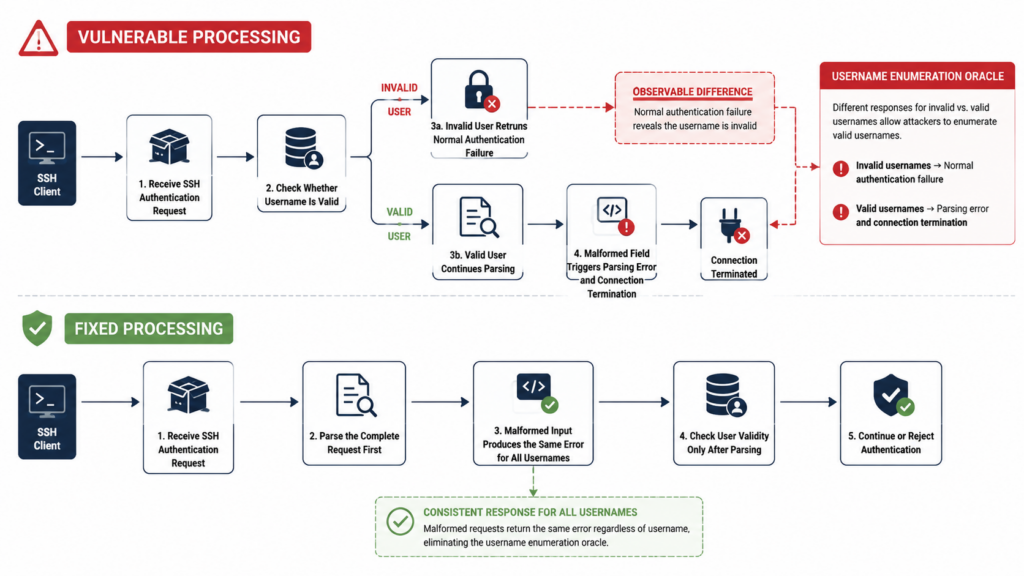
The vulnerable logic can be understood as a sequence-ordering problem.
The server receives an authentication request containing:
- A target username
- The requested SSH service
- An authentication method
- Method-specific fields
Before entering the method-specific authentication handler, OpenSSH has already created an authentication context. Part of that context indicates whether the supplied username maps to an account that the server considers valid for the current authentication process.
In the vulnerable implementation, some handlers effectively followed this order:
1. Check whether the user is valid.
2. If the user is invalid, return an authentication failure.
3. If the user is valid, parse the method-specific request fields.
4. If parsing fails, terminate the connection.
5. Otherwise, continue authentication.
This ordering is efficient but dangerous. It allows an attacker to construct a request for which step three cannot complete. The server’s observable result then depends on whether step two happened first.
For a nonexistent user, the server exits early and returns a normal failure path.
For an existing user, the server reaches the malformed field, produces a parsing failure, and closes or otherwise terminates the session differently.
The attacker does not need to know the server’s internal account database. The attacker only needs to compare two network-visible outcomes.
The fixed logic follows a safer order:
1. Parse the complete method-specific request.
2. Reject malformed input consistently.
3. After parsing, apply the user-validity decision.
4. Continue authentication only when the request and user are valid.
This is a common defensive principle in authentication engineering: secret or sensitive state should not determine whether untrusted input is parsed, how far parsing proceeds, or which externally visible error path occurs.
OpenSSH’s July 2018 commit demonstrates exactly this change. In auth2-pubkey.c, the invalid-user early return was removed from the beginning of the function. The function instead initialized its buffers safely, parsed the request, and checked the authentication context later. Similar changes were made in the GSSAPI and host-based handlers. (GitHub)nput produces a stronger oracle than timing alone
OpenSSH had faced username-enumeration concerns before CVE-2018-15473. Some earlier issues depended on differences in computation time. For example, CVE-2016-6210 involved measurable timing differences when password authentication performed expensive password-hash work for valid users but not equivalent work for invalid users. That issue was addressed before OpenSSH 7.3. (NVD)e operational challenges:
- Network latency adds noise.
- Server load changes response time.
- Packet loss distorts measurements.
- Virtualization introduces scheduling variation.
- A reliable result may require many samples.
- Rate limiting may interfere with measurement.
- Geographic distance can overwhelm a small timing signal.
CVE-2018-15473 offered a more direct distinction. Instead of measuring a small delay, an attacker could observe protocol behavior such as:
- A normal authentication failure versus a connection termination
- A received SSH failure message versus no equivalent response
- Different exception conditions in the client
- Different session state transitions
- Different packet and connection-length patterns
This does not mean every network, client library, patched distribution, or configuration produces an equally clean signal. Proxies, wrappers, vendor modifications, authentication settings, and connection handling can alter the output. The important point is that the underlying issue was an observable branch in the server’s request-processing logic, not merely a small difference in CPU time.
The affected authentication handlers
The CVE description names auth2-gss.c, auth2-hostbased.cve auth2-pubkey.c. These files correspond to different SSH authentication mechanisms.
Public-key authentication
Public-key authentication is the most operationally significant path because it is widely enabled and is generally recommended over reusable passwords.
An SSH public-key authentication request contains fields indicating whether a signature is included, which key algorithm is being used, and the public-key blob. In the vulnerable code, an invalid user could be rejected before those fields were fully parsed.
A malformed request therefore behaved differently depending on whether the authentication context described an existing user.
This does not mean public-key cryptography was broken. The attacker was not forging a signature, deriving a private key, or bypassing key validation. The attacker was abusing the ordering of account validation and packet parsing.
Host-based authentication
Host-based authentication allows a client host to authenticate on behalf of a user under configured trust relationships. It is less commonly enabled on modern general-purpose systems, but it remains relevant in certain controlled environments and older infrastructure.
The vulnerable host-based handler also checked user validity too early. The patch moved that decision until after the authentication request had been parsed.
GSSAPI authentication
GSSAPI authentication is commonly associated with Kerberos-integrated environments. OpenSSH’s affected GSSAPI handler also returned early for an invalid user before consuming the full method-specific request.
The existence of multiple affected handlers demonstrates that the flaw was not a single malformed public-key parser bug. It was a broader authentication design pattern in which account validity affected how much attacker-controlled input was parsed.
Attack prerequisites and practical limits
An attacker needs relatively little to test an affected service:
- Network connectivity to the SSH server
- The ability to complete the SSH transport handshake
- A candidate username
- Access to an authentication method that reaches an affected handler
- A client capable of sending a malformed method-specific request
No valid credentials are required. No local account is required. No victim interaction is required.
However, several limits are equally important.
The result is not authentication
A probable valid username does not prove that:
- The account is allowed to log in through SSH
- The account has a password
- The account has an authorized key
- The account is unlocked
- The account has an interactive shell
- The account is not expired
- The account is permitted by
AllowUsersveyaAllowGroups - The account can pass PAM or MFA controls
- The account has elevated privileges
The oracle reveals information about how the server classifies the supplied username in the affected path. The exact relationship between that classification and usable SSH access depends on the operating system and configuration.
Candidate usernames are still needed
CVE-2018-15473 is most useful when the attacker already has a list of plausible names. Those names may come from:
- Public staff directories
- Email addresses
- Git commit metadata
- Leaked credential databases
- Documentation
- Job postings
- Default cloud-image usernames
- Service-account conventions
- Source code
- Previous compromises
- Other exposed login interfaces
The vulnerability does not magically list every account. It tests candidate identities.
Network controls may block practical exploitation
A vulnerable daemon reachable only through a tightly controlled management network presents a different risk from the same daemon exposed to the public internet.
Source IP allowlists, VPN access, bastions, zero-trust access proxies, private network segmentation, and firewall rules can substantially reduce who can reach the vulnerable path. They are valuable compensating controls, although they do not correct the software flaw.
Vendor modifications can change behavior
Network appliances and embedded products frequently modify OpenSSH, wrap it in another management service, restrict available authentication methods, or backport selected patches. The upstream version range is therefore a starting point, not the final product-impact decision.
What username enumeration changes in a real attack
The direct confidentiality loss is small: the attacker learns whether a proposed username probably exists. The downstream value depends on the rest of the environment.
Focused password guessing
Without enumeration, an attacker may generate large numbers of Invalid user events while guessing both usernames and passwords. After identifying probable accounts, the attacker can concentrate attempts on a smaller set.
This can improve the chance of finding:
- Reused passwords
- Weak service-account passwords
- Temporary operational passwords
- Accounts excluded from normal password rotation
- Accounts without MFA
- Credentials left behind after migration
Disabling password authentication greatly reduces this path. It does not retroactively fix the parsing flaw, but it prevents the discovered username from being combined with a normal SSH password guess.
Kimlik bilgileri doldurma
Credential stuffing uses username and password pairs obtained from other breaches. Unix account names often differ from public email addresses, so an attacker may not know whether alice.smith@example.com, asmith, alice, or an employee number is used locally.
A username oracle can help map public identities to local account names before a limited set of stolen passwords is tested.
Identification of privileged or operational accounts
Account names can reveal function:
yedeklememonitordeploydbadminoraclepostgresgitjenkinsansiblesvc-cisvc-sftp
The name alone does not prove privilege, but it can guide an attacker toward identities that may possess keys, automation access, data access, or broad trust relationships.
Social engineering
Knowing that a specific employee or service identity exists on a server can make a phishing pretext more credible. An attacker might impersonate an infrastructure administrator, request a key rotation, claim an SSH access failure, or target an employee whose name maps directly to a local account.
Cross-service reconnaissance
Organizations often reuse naming conventions across SSH, VPN, webmail, source-code platforms, cloud consoles, databases, and directory services. A valid SSH username may therefore help refine attacks against another authentication surface even when SSH itself is strongly protected.
Contextual risk scoring
A Medium CVSS score is a reasonable general description of CVE-2018-15473, but operational priority should reflect the asset.
| Environment | Factors | Suggested priority |
|---|---|---|
| Public SSH, password authentication enabled, predictable administrator accounts | Easy reachability and a direct path from enumeration to password attacks | Yüksek |
| Public SSH, key-only authentication, modern MFA or certificate controls | Enumeration remains possible, but direct credential guessing has less value | Orta |
| Internal SSH available to broad corporate networks | A compromised workstation or insider may reach the service | Medium to High |
| SSH restricted to a small management CIDR through a bastion | Strong reachability control reduces exposure | Low to Medium |
| Vendor appliance with old firmware and no supported patch | CVE may be one symptom of broader unsupported management-plane risk | Yüksek |
| Banner reports OpenSSH 7.6 but the distribution package is vendor-fixed | Version-only scanner result may be a false positive | Informational until package evidence is reviewed |
| Dormant SSH listener on an unused interface | Unnecessary exposure with no business value | Remove the service |
| Embedded device where the vendor confirms no affected code path | Upstream CPE match may not reflect product reality | Document vendor evidence |
A useful prioritization formula is:
Practical risk =
    exploitability
  × network reachability
  × account value
  × authentication weakness
  × platform age
  × monitoring gap
This is not a mathematical CVSS replacement. It is a decision model. A low-impact information leak on a public management plane with reusable passwords can deserve faster action than a higher-scoring vulnerability on an isolated test system.
Safe PoC demonstrating the control-flow oracle
The following Python program is a local toy model. It does not implement SSH, open a socket, send packets, enumerate operating-system users, or interact with a real server.
Its only purpose is to demonstrate why checking whether a user exists before parsing the complete request creates an observable difference.
#!/usr/bin/env python3
"""
Local educational model for CVE-2018-15473.

This program:
- does not create network traffic;
- does not implement the SSH protocol;
- does not read local account databases;
- cannot enumerate users on a real system.

It models only the vulnerable and fixed control-flow ordering.
"""

from dataclasses import dataclass


class PacketParseError(Exception):
    """Raised when the toy authentication request is incomplete."""


@dataclass(frozen=True)
class ToyAuthRequest:
    has_signature_flag: bytes
    algorithm_length: bytes
    algorithm_name: bytes


def parse_toy_request(request: ToyAuthRequest) -> str:
    """
    Parse a deliberately simplified request.

    A real SSH packet has a different binary format and is protected
    by the SSH transport layer. This parser is intentionally incomplete
    and unsuitable for network use.
    """
    if len(request.has_signature_flag) != 1:
        raise PacketParseError("missing signature-present flag")

    if len(request.algorithm_length) != 1:
        raise PacketParseError("missing toy algorithm length")

    expected_length = request.algorithm_length[0]
    if len(request.algorithm_name) != expected_length:
        raise PacketParseError("truncated toy algorithm field")

    return request.algorithm_name.decode("ascii", errors="strict")


def vulnerable_handler(user_exists: bool, request: ToyAuthRequest) -> str:
    """
    Vulnerable ordering:
    account validity changes whether parsing happens.
    """
    if not user_exists:
        return "AUTHENTICATION_FAILURE"

    try:
        parse_toy_request(request)
    except PacketParseError:
        return "CONNECTION_TERMINATED_DURING_PARSE"

    return "CONTINUE_AUTHENTICATION"


def fixed_handler(user_exists: bool, request: ToyAuthRequest) -> str:
    """
    Fixed ordering:
    parse the same request before applying the account-validity decision.
    """
    try:
        parse_toy_request(request)
    except PacketParseError:
        return "MALFORMED_REQUEST"

    if not user_exists:
        return "AUTHENTICATION_FAILURE"

    return "CONTINUE_AUTHENTICATION"


def main() -> None:
    truncated_request = ToyAuthRequest(
        has_signature_flag=b"\x00",
        algorithm_length=b"\x07",
        algorithm_name=b"ssh",
    )

    print("Vulnerable implementation")
    print("Existing user:   ", vulnerable_handler(True, truncated_request))
    print("Nonexistent user:", vulnerable_handler(False, truncated_request))

    print("\nFixed implementation")
    print("Existing user:   ", fixed_handler(True, truncated_request))
    print("Nonexistent user:", fixed_handler(False, truncated_request))


if __name__ == "__main__":
    main()
Expected output:
Vulnerable implementation
Existing user:    CONNECTION_TERMINATED_DURING_PARSE
Nonexistent user: AUTHENTICATION_FAILURE

Fixed implementation
Existing user:    MALFORMED_REQUEST
Nonexistent user: MALFORMED_REQUEST
The vulnerable model exposes a direct oracle: the same malformed input generates different outcomes depending on user_exists.
The fixed model parses the untrusted request first. Both candidate users therefore receive the same malformed-request outcome. The protected account state no longer controls whether parsing occurs.
This is the key defensive lesson from CVE-2018-15473. Authentication systems should avoid observable branches in which secret account state determines:
- Whether a request is parsed
- Which parser is invoked
- Whether an expensive operation runs
- Which error type is returned
- Whether the connection closes
- How much response data is sent
- How long the operation takes
The example is intentionally non-operational. A production validation should use vendor package evidence or an isolated, authorized laboratory environment rather than a weaponized enumeration script.
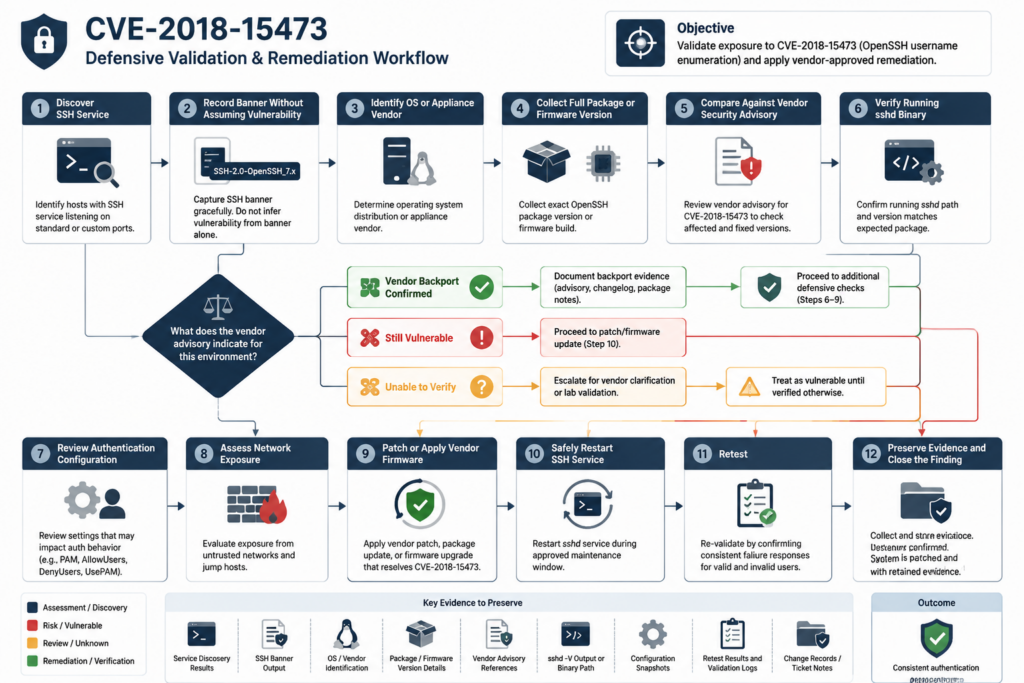
Determining whether a system is affected
A reliable assessment requires more than one piece of evidence.
The most useful process has five layers:
- Identify the listening SSH service.
- Determine the operating system, appliance, firmware, or package source.
- Record the full installed package version.
- compare it with the vendor’s fixed version.
- Confirm that the running process uses the updated binary.
Identify SSH listeners locally
Linux'ta:
sudo ss -lntp | grep -E '(:22[[:space:]]|sshd)'
Alternative:
sudo lsof -nP -iTCP -sTCP:LISTEN | grep ssh
Check whether multiple daemon instances exist:
ps -ef | grep '[s]shd'
Review the service definition:
systemctl cat sshd 2>/dev/null || systemctl cat ssh
Do not assume the listener uses /usr/sbin/sshd. Appliances, containers, development tools, and manually compiled installations may use a different executable.
Record the full package version
For Debian and Ubuntu:
dpkg-query -W -f='${Package}\t${Version}\n' \
    openssh-server openssh-client 2>/dev/null
Review available and installed versions:
apt-cache policy openssh-server
Search the package changelog for the CVE when the distribution exposes it:
zgrep -i 'CVE-2018-15473' \
    /usr/share/doc/openssh-server/changelog.Debian.gz 2>/dev/null
For RHEL, Rocky Linux, AlmaLinux, Fedora, and similar RPM systems:
rpm -q openssh openssh-server openssh-clients
Review changelog entries:
rpm -q --changelog openssh | grep -i -A3 -B3 'CVE-2018-15473'
On SUSE-family systems:
rpm -q openssh
zypper info openssh
On Alpine Linux:
apk info -v openssh openssh-server 2>/dev/null
On FreeBSD with a portable OpenSSH package:
pkg info | grep -i openssh
For an appliance, the meaningful version may be the firmware release rather than an independently visible OpenSSH package. Use the product vendor’s security advisory and fixed firmware table.
Check the effective SSH configuration
A configuration file can contain includes, distribution defaults, conditional Match sections, and command-line overrides. Inspect the effective configuration rather than relying only on /etc/ssh/sshd_config.
sudo sshd -T
Filter relevant controls:
sudo sshd -T | grep -E \
'^(passwordauthentication|kbdinteractiveauthentication|permitrootlogin|pubkeyauthentication|gssapiauthentication|hostbasedauthentication|maxauthtries|maxstartups|allowusers|allowgroups|loglevel)'
For configurations using Match blocks, evaluate a representative connection context where supported:
sudo sshd -T \
  -C user=example-admin,addr=192.0.2.10,host=server.example
Replace the values only with authorized test data from your environment.
Identify the running binary
On Linux, locate the oldest parent sshd process and inspect its executable:
pid="$(pgrep -o sshd)"
printf 'sshd PID: %s\n' "$pid"
sudo readlink -f "/proc/$pid/exe"
Inspect package ownership:
binary="$(sudo readlink -f "/proc/$pid/exe")"
dpkg -S "$binary" 2>/dev/null || rpm -qf "$binary" 2>/dev/null
A path ending in (deleted) can indicate that the package was replaced while the old process remained running:
sudo ls -l "/proc/$pid/exe"
That condition does not automatically prove vulnerability, but it is a strong reason to verify whether the daemon was restarted after the update.
Compare against vendor-fixed package versions
The upstream statement “fixed in OpenSSH 7.8” is not the correct test for every Linux distribution.
Debian’s tracker records the following historical fixes:
- Debian Jessie:
1:6.7p1-5+deb8u5 - Debian Stretch:
1:7.4p1-10+deb9u4 - Debian unstable at the time:
1:7.7p1-4
The fixed Jessie and Stretch packages retained upstream version numbers below 7.8 because Debian backported the correction. (Debian Security Tracker)sory listed:
- Ubuntu 18.04:
1:7.6p1-4ubuntu0.1 - Ubuntu 16.04:
1:7.2p2-4ubuntu2.6 - Ubuntu 14.04:
1:6.6p1-2ubuntu2.11
Again, every fixed package reported an upstream version below 7.8. (Ubuntu)on is not:
Does the banner say OpenSSH 7.8 or later?
Doğru soru şu:
Does the installed vendor package or firmware contain the CVE-2018-15473 fix, and is the updated code currently running?
Why banner-based scanning produces false positives
An SSH identification string may look like:
SSH-2.0-OpenSSH_7.6p1 Ubuntu-4ubuntu0.5
A simple scanner may extract 7.6p1, compare it with the upstream fix boundary of 7.8, and report the host as vulnerable.
That conclusion can be wrong for several reasons.
Distribution backports
Enterprise distributions maintain stable software branches and apply selected security fixes without replacing the entire upstream codebase. The upstream version remains old while the vendor release number changes.
Vendor suffixes are not always visible
Some SSH banners include distribution information. Others suppress or modify it. Even when a suffix is visible, a scanner needs accurate vendor-specific package intelligence to interpret it.
Firmware vendors may patch privately
An appliance can contain a modified OpenSSH build with a vendor patch that does not map neatly to an upstream release.
Custom builds create the opposite problem
A binary may advertise a recent-looking version while containing local changes, incomplete patches, or a misleading version string. Banner age is therefore neither a complete proof of vulnerability nor a complete proof of safety.
Reverse proxies and SSH gateways obscure origin
A bastion, access gateway, load balancer, port-forwarding service, or container front end may present a banner that does not represent the final managed endpoint.
The evidentiary value of common signals can be ranked as follows:
| Kanıtlar | Confidence | Main limitation |
|---|---|---|
| SSH banner only | Düşük | Cannot reliably identify backports |
| Banner plus OS fingerprint | Low to Medium | OS fingerprint may be wrong or incomplete |
| Authenticated package inventory | Yüksek | Must still verify vendor advisory and runtime |
| Vendor fixed-version advisory | Yüksek | Must match the exact product and support branch |
| Package changelog containing the CVE | Yüksek | Custom builds and incomplete deployments remain possible |
| Running binary mapped to fixed package | Çok Yüksek | Does not by itself prove network controls or configuration |
| Authorized isolated behavior test | Yüksek | Must avoid production impact and interpret vendor differences carefully |
| Vendor support confirmation | Yüksek | Quality depends on specificity and product scope |
A defensible vulnerability report should distinguish between:
- Version-indicated exposure
- Vendor-confirmed affected package
- Behaviorally verified vulnerability
- Patched package with a stale banner
- Unsupported product with unknown patch status
The Ubuntu regression is an important patch-management lesson
Canonical published USN-3809-1 on November 6, 2018, with fixed OpenSSH package versions for Ubuntu 14.04, 16.04, and 18.04. Years later, Canonical published USN-3809-2, stating that the CVE-2018-15473 update for Ubuntu 18.04 had been incomplete and could introduce a regression in certain environments.
The 2021 notice identified 1:7.6p1-4ubuntu0.5 as the corrected Ubuntu 18.04 package version. (Ubuntu)rs for vulnerability operations.
A system may have received the original 2018 security update but missed later maintenance. A database field saying “CVE patched in 2018” would not capture that nuance. Security teams should retain:
- The complete installed package version
- The repository or vendor channel
- The date of the last package update
- The operating-system support state
- Relevant superseding advisories
- The current running binary
- The latest vendor assessment
This is also why copying a fixed-version table from an old blog post can be dangerous. Security advisories may be revised, superseded, or corrected.
Detecting attempted username enumeration
Detection is possible, but CVE-2018-15473 does not produce a universal log line or network signature.
The exploit operates inside an encrypted SSH session and intentionally causes abnormal authentication processing. Detection should combine host logs, connection telemetry, source behavior, and subsequent authentication events.
Host-side SSH logs
On systems using systemd:
sudo journalctl -u sshd --since "24 hours ago"
Some distributions use a service named ssh:
sudo journalctl -u ssh --since "24 hours ago"
Filter broadly rather than relying on one exact exploit message:
sudo journalctl -u sshd --since "24 hours ago" |
  grep -Ei 'invalid user|authentication failure|fatal|parse|preauth|disconnect|closed'
On Debian-family systems, authentication logs may also be written to /var/log/auth.log:
sudo grep -Ei \
'invalid user|authentication failure|fatal|parse|preauth|disconnect|closed' \
/var/log/auth.log
On RHEL-family systems, review /var/log/secure where applicable:
sudo grep -Ei \
'invalid user|authentication failure|fatal|parse|preauth|disconnect|closed' \
/var/log/secure
Do not turn one string into a universal detection rule. Log behavior varies according to:
- OpenSSH version
- Distribution patching
LogLevel- PAM configuration
- Authentication method
- Vendor modifications
- Whether the malformed request reaches the same parser
- Whether a wrapper terminates the connection first
- Whether logs are rate-limited
- Whether the server is containerized
- Whether the source uses one connection per username
Useful patterns include:
- One source opening many short SSH connections
- Repeated pre-authentication disconnects
- A source testing many distinct usernames
- A distributed set of sources testing the same candidate list
- Parsing-related failures followed by password attempts
- Enumeration activity followed by a successful login
- Activity concentrated on administrator or service-account names
- Connections outside normal maintenance windows
- Client software fingerprints not used by the organization
Network telemetry
A network sensor outside the SSH endpoint can generally observe:
- Source and destination IP addresses
- TCP ports
- Connection counts
- SSH version exchange
- Session duration
- Packet sizes
- Direction of connection termination
- TCP resets
- Approximate client behavior
- Repeated key exchanges
- Distributed scanning patterns
It usually cannot observe:
- The encrypted username
- The authentication method fields after encryption
- The malformed internal field
- Whether the candidate maps to a real local account
- The exact server-side parser error
This limits the value of a simple IDS signature. A rule that alerts on every short SSH session will generate substantial noise from:
- Monitoring systems
- Health checks
- Failed automation
- Key mismatch
- Network interruption
- Inventory scanners
- Compliance tools
- Users cancelling logins
- Client compatibility failures
Network detection becomes more useful when it evaluates sequences rather than isolated connections.
Örneğin:
Alert when:
- one source creates an unusual number of encrypted SSH sessions;
- each session ends during pre-authentication;
- the sessions have similar byte counts and durations;
- the source has no normal administrative role;
- and the behavior is followed by password guessing or successful access.
A distributed attacker can evade simple per-IP thresholds. Longer-term aggregation should therefore consider:
- Source autonomous system
- Source subnet
- TLS or SSH client fingerprints where available
- Candidate account timing inferred from host logs
- Reused infrastructure
- Common connection-size patterns
- Repeated targeting of the same server group
Identity correlation
Username enumeration becomes more serious when the tested names correspond to valuable identities.
Correlate SSH events with:
- Active employee directories
- Privileged access management records
- Service-account inventories
- Terminated employee accounts
- Accounts with password authentication exemptions
- Accounts with stale authorized keys
- Accounts excluded from MFA
- Accounts associated with deployment or backup systems
- Previously leaked email addresses
- Cloud default users
A source that tests random-user-82461 is less concerning than one that tests a precise list of current administrators, backup operators, database owners, and deployment accounts.
Common sources of false positives
Not every burst of invalid-user or pre-authentication activity is malicious.
Güvenlik açığı tarayıcıları
Authenticated and unauthenticated scanners may check SSH versions, authentication methods, or known CVEs. Some scanners perform behavior-based checks; others report purely from the banner.
Confirm:
- Whether the source belongs to an approved scanner
- Whether the scan window was authorized
- Which plugin produced the result
- Whether the plugin performed active enumeration
- Whether rate limits were respected
- Whether the finding is version-based or behavior-based
Configuration management errors
Ansible, backup agents, deployment systems, monitoring tools, and file-transfer jobs may repeatedly connect with an account that was renamed, deleted, locked, or moved to another authentication method.
These events often have stable source infrastructure and predictable schedules.
SSH key rotation failures
A valid account with an outdated private key can produce large numbers of failed public-key attempts. This may resemble attack traffic at a high level, but host logs and source ownership usually distinguish it.
Inventory and host-key collection
Aşağıdaki gibi araçlar ssh-keyscan establish short SSH connections without completing user authentication. Modern OpenSSH documentation even warns that aggressive penalties for clients that disconnect without authentication can affect legitimate scanning tools. (OpenBSD Manual Pages)ility
Load balancers, firewalls, NAT timeouts, packet loss, and unstable remote links can terminate sessions during authentication.
Security research
An internal red team or authorized penetration tester may validate the issue. The activity should still be logged and attributable to a change ticket or rules-of-engagement document.
Remediation begins with the vendor package
The preferred remediation is to install a supported package or firmware containing the fix.
For upstream OpenSSH, version 7.8 corrected the observable request-parsing differences. For managed operating systems and appliances, use the vendor’s fixed package or firmware release rather than assuming that an upstream version upgrade is required. (OpenSSH) distribution OpenSSH casually
Compiling a current OpenSSH release directly from source may look attractive, but replacing a distribution-managed SSH daemon can introduce:
- PAM integration failures
- SELinux policy problems
- systemd unit conflicts
- Missing vendor patches
- Unsupported configurations
- Package-manager drift
- Host-key path changes
- Authentication-module incompatibility
- Future update failures
- Remote lockout
Use the supported vendor channel whenever one exists.
A source build may be appropriate for a controlled product team that owns the entire platform lifecycle, but it should not be an improvised response on a remotely administered production server.
Validate configuration before restarting
After changing packages or configuration:
sudo sshd -t
A successful command normally produces no output.
Inspect the effective configuration:
sudo sshd -T | less
Keep an existing privileged SSH session open while testing a new connection from a second terminal. Do not close the original session until the new session succeeds and required administrative functions have been verified.
Restart the service safely
Depending on the distribution:
sudo systemctl restart sshd
or:
sudo systemctl restart ssh
Then verify:
sudo systemctl status sshd 2>/dev/null ||
sudo systemctl status ssh
Check the process start time:
ps -o pid,lstart,cmd -p "$(pgrep -o sshd)"
Map the running executable to the package again:
pid="$(pgrep -o sshd)"
binary="$(sudo readlink -f "/proc/$pid/exe")"

printf 'Running binary: %s\n' "$binary"
dpkg -S "$binary" 2>/dev/null || rpm -qf "$binary" 2>/dev/null
Package installation does not always guarantee that a long-running process has loaded the new code. Some package managers restart services automatically; some policies suppress restarts; containers may need redeployment; appliances may require a controlled reboot.
Handle appliances through vendor guidance
For a network, storage, security, or industrial appliance:
- Identify the exact hardware and firmware release.
- Locate the vendor advisory for CVE-2018-15473.
- Determine whether SSH is exposed on the management, data, or control plane.
- Install the vendor-supported firmware.
- Verify whether a reboot is required.
- Restrict management access during the maintenance window.
- Recheck SSH behavior and version evidence afterward.
- Plan replacement if the vendor no longer provides a fix.
Do not copy a generic OpenSSH binary onto an appliance unless the vendor explicitly supports that action.
Compensating controls when patching is delayed
A compensating control should reduce who can reach the vulnerable code or reduce the value of the enumerated account.
Restrict network reachability
The strongest temporary measure is to make the SSH service unreachable from untrusted networks.
Kullan:
- Cloud security groups
- Host firewalls
- Network ACLs
- Management VLANs
- Bastion hosts
- VPN access
- Zero-trust access gateways
- Source-address allowlists
- Private service endpoints
An example host-firewall concept is:
Allow TCP 22 only from:
- the approved bastion subnet;
- the emergency management network;
- designated monitoring infrastructure.

Deny TCP 22 from:
- the public internet;
- user workstation networks;
- guest networks;
- partner networks without explicit need.
Firewall syntax differs by platform. Apply changes through an approved method that preserves emergency access.
Disable reusable password authentication
A key-only SSH service is less useful to an attacker who has enumerated usernames.
A modern baseline may include:
PasswordAuthentication no
KbdInteractiveAuthentication no
PubkeyAuthentication yes
PermitRootLogin no
The appropriate keyboard-interactive setting depends on the MFA design. Some PAM-based MFA systems require keyboard-interactive authentication. Do not disable it blindly.
The current OpenSSH manual documents PasswordAuthentication, PermitRootLogin, public-key authentication, authentication-method composition, and access-control directives. Defaults vary across versions and vendor distributions, so verify the effective configuration rather than relying on upstream defaults. (OpenBSD Manual Pages) authentication does not eliminate the vulnerable packet-processing behavior. It reduces the usefulness of the information for ordinary SSH password guessing.
Limit which users may access SSH
Use an allowlist based on managed groups rather than permitting every local account to attempt remote login:
AllowGroups ssh-admins
or, for a small static environment:
AllowUsers admin-a admin-b deploy-bot
OpenSSH supports username and source-host patterns in AllowUsers, including CIDR-based host criteria. (OpenBSD Manual Pages)es the remotely accessible identity set, but it should not be treated as the CVE fix. Depending on the version and authentication context, the difference between an existing but disallowed account and a nonexistent account may require separate testing.
Reduce unauthenticated connection pressure
OpenSSH supports controls such as:
MaxAuthTries 3
MaxStartups 10:30:60
MaxAuthTries limits authentication attempts per connection. MaxStartups limits concurrent unauthenticated connections and can probabilistically drop new sessions as concurrency increases. (OpenBSD Manual Pages) useful for resource protection but have limitations:
- An enumerator can open a new connection for every username.
- A low-rate attacker may stay below concurrency thresholds.
- Distributed sources can evade per-address limits.
- Aggressive values may disrupt legitimate automation.
Current OpenSSH releases also support per-source controls such as PerSourceMaxStartups ve PerSourcePenalties. The latter can penalize invalid-user attempts, authentication failures, clients that exceed the grace period, and certain other suspicious conditions. These features are not available in every legacy version, which is another reason not to copy a modern configuration directly onto an old daemon. (OpenBSD Manual Pages)vileged authentication
For administrator access, consider:
- Hardware-backed FIDO keys
- SSH certificates with short validity periods
- Privileged access management
- Just-in-time account provisioning
- Separate named administrator accounts
- MFA enforced through a supported design
- Removal of shared root access
- Restricted source networks
- Central key revocation
- Short-lived cloud access mechanisms
A discovered username should not be enough to begin a meaningful credential attack.
A practical hardened configuration
The following is an example starting point for a modern administrative SSH server. It must be adapted to the installed OpenSSH version, distribution defaults, MFA system, automation requirements, and recovery process.
# Authentication
PermitRootLogin no
PubkeyAuthentication yes
PasswordAuthentication no

# Set this according to the actual MFA design.
KbdInteractiveAuthentication no

# Restrict SSH access to a managed group.
AllowGroups ssh-admins

# Reduce repeated authentication attempts per connection.
MaxAuthTries 3

# Apply random early drop to excessive unauthenticated connections.
MaxStartups 10:30:60

# Disable forwarding unless explicitly required.
AllowAgentForwarding no
X11Forwarding no
AllowTcpForwarding no

# Increase authentication visibility.
LogLevel VERBOSE
On newer versions, additional controls may be available:
PerSourceMaxStartups 5
PerSourcePenalties authfail:10s invaliduser:10s grace-exceeded:30s
Before deploying:
sudo sshd -t
sudo sshd -T
Then validate all required use cases:
- Administrator login
- Break-glass access
- SFTP
- Backup jobs
- Deployment automation
- Configuration management
- Port forwarding that is genuinely required
- MFA
- Certificate authentication
- Recovery-console access
Security hardening that breaks emergency administration may create a different operational risk. The goal is controlled access, not a configuration copied without context.
Controls that do not fix CVE-2018-15473
Several common responses may reduce noise or downstream risk, but they are not substitutes for a patched implementation.
Changing the SSH port
Moving SSH from port 22 to another port can reduce opportunistic scanning. It does not change the authentication parser. Targeted attackers can identify the service through scanning or protocol detection.
Treat a nonstandard port as an operational choice, not a vulnerability fix.
Hiding the version banner
Removing a distribution suffix or limiting banner detail may make version-based reconnaissance less convenient. It does not prevent an attacker from performing behavior-based enumeration.
Banner suppression can also make defensive asset identification harder.
Deploying Fail2ban alone
Fail2ban can block sources after matching configured log patterns. Its effectiveness depends on:
- Whether the exploit attempt produces a matching log line
- Whether the attacker uses one source
- Whether the request volume reaches the threshold
- Whether the log format is supported
- Whether blocking occurs before useful enumeration is completed
Fail2ban is a rate-control layer, not a code fix.
Lowering MaxAuthTries
MaxAuthTries applies within a connection. An attacker can reconnect for each candidate username.
Disabling root login only
PermitRootLogin no is good practice for many environments, but other valid accounts remain enumerable.
Disabling password authentication only
Key-only authentication sharply limits password guessing. The username oracle can still reveal account names, and those names may have value against other services.
Relying only on IDS
Because SSH user authentication is encrypted, a passive IDS usually cannot inspect the candidate username or malformed field. Behavioral analytics can help, but the endpoint and package state remain critical.
Marking the scanner result as accepted risk
A scanner exception may be appropriate when vendor evidence proves a backport. It is not appropriate when the organization simply cannot determine the package status.
An exception should include:
- Exact package or firmware version
- Vendor advisory
- Fixed-version evidence
- Runtime verification
- Network exposure
- Expiration date
- Sahibi
- Retest plan
Legacy SSH exposure is broader than this CVE
An OpenSSH 7.x or earlier banner should trigger two separate questions:
- Is CVE-2018-15473 patched through a vendor backport?
- Why is this legacy SSH branch still operating, and what other security or support risks remain?
A distribution-supported backport can make the first answer reassuring while leaving the second answer unresolved.
As of July 2026, the OpenSSH project lists OpenSSH 10.4 as its current release, published on July 6, 2026. That does not mean every enterprise server should be manually upgraded to 10.4. Supported operating-system vendors maintain their own branches and compatibility commitments. It does show how far a 7.x codebase is from current upstream development. (OpenSSH)ents may lack newer capabilities, defaults, and mitigations related to:
- Modern key-exchange algorithms
- Stronger default signature policies
- Improved source penalties
- Better forwarding restrictions
- Security-key authentication
- Updated cryptographic policy
- Strict key-exchange protections
- Newer logging and configuration controls
- Removal of obsolete compatibility behavior
The right response is not always “compile the newest OpenSSH.” It is often:
- Upgrade the operating system.
- Replace the appliance.
- Move the service behind a managed access layer.
- Remove the SSH listener.
- Migrate an SFTP workload.
- Replace long-lived local accounts with certificates.
- Eliminate a forgotten management interface.
- Move automation to a supported platform.
The presence of CVE-2018-15473 on an unsupported device should be treated as a lifecycle finding, not merely a single missing patch.
Building a defensible SSH asset inventory
A mature SSH inventory should not contain only IP addresses and banners.
For each service, record:
| Saha | Neden önemli |
|---|---|
| Asset owner | Establishes remediation accountability |
| Business function | Distinguishes critical administration from obsolete exposure |
| Listening address and port | Determines reachability |
| Public or private exposure | Drives exploitability |
| Server implementation | OpenSSH is not the only SSH implementation |
| Full package or firmware version | Required for vendor-specific CVE status |
| Vendor support status | Determines whether future fixes are available |
| Authentication methods | Changes downstream risk |
| Root login policy | Identifies direct privileged access |
| Allowed users or groups | Defines the exposed identity set |
| Source restrictions | Limits attacker reach |
| Bastion or access gateway | Adds policy and logging context |
| Logging destination | Determines investigation capability |
| Last patch date | Reveals maintenance gaps |
| Last daemon restart | Confirms runtime activation |
| Exception expiration | Prevents permanent temporary risk |
| Replacement date | Provides an exit path for unsupported systems |
Do not limit the inventory to ordinary servers. Include:
- Network appliances
- Storage systems
- Hypervisors
- BMC and out-of-band controllers
- SFTP gateways
- Backup appliances
- CI runners
- Build systems
- Development environments
- Kubernetes nodes
- Cloud images
- Containers that run
sshd - Industrial gateways
- Security appliances
- Vendor support tunnels
- Disaster-recovery systems
Internal-only SSH is not automatically safe. An attacker with access to a compromised workstation, VPN account, application server, or cloud workload may use internal SSH exposure for lateral movement.
Related OpenSSH vulnerabilities
CVE-2018-15473 is easier to understand when compared with other SSH flaws that have different prerequisites and consequences.
| CVE | Main issue | Attacker position | Birincil etki | Key distinction |
|---|---|---|---|---|
| CVE-2016-6210 | Username enumeration through authentication timing differences | Remote network attacker | Account discovery | Relies on timing, not malformed-request control flow |
| CVE-2018-15473 | Username enumeration through observable parsing differences | Remote network attacker | Account discovery | Malformed request causes different outcomes for valid and invalid users |
| CVE-2023-48795 | Terrapin prefix-truncation weakness in SSH transport negotiation | Active man-in-the-middle | Downgrade or removal of selected early encrypted messages | Protocol-integrity issue, not account enumeration |
| CVE-2024-6387 | Signal-handler race condition in affected sshd versions | Unauthenticated remote attacker | Potential remote code execution on affected platforms | Far greater direct impact, with different version and platform conditions |
CVE-2016-6210
CVE-2016-6210 is a username-enumeration issue, but its mechanism differs from CVE-2018-15473. The older issue involved authentication timing differences associated with expensive password-hash processing.
A remote attacker could compare response times for valid and invalid accounts. Reliable exploitation depended on measurement quality, latency, server load, and repeated sampling.
CVE-2018-15473 instead exposed a more explicit parsing and connection-behavior difference through malformed requests.
The shared defensive lesson is that authentication code must equalize not only error messages but also:
- Computation
- Parsing
- State transitions
- Connection handling
- Logging side effects
- Response size
- Response timing
CVE-2023-48795
CVE-2023-48795, known as Terrapin, concerns SSH transport integrity. Under affected algorithm and implementation conditions, an active network attacker may be able to remove selected messages at the beginning of the encrypted channel.
It requires a man-in-the-middle capability and is not a username-enumeration vulnerability. The response also differs: defenders must consider both clients and servers, negotiated algorithms, and strict key-exchange support.
OpenSSH identifies versions before 9.6 as relevant to the strict key-exchange countermeasure. (OpenSSH)tters because a scanner that labels both findings as “SSH Medium” hides their entirely different attack models.
CVE-2024-6387
CVE-2024-6387, widely known as regreSSHion, is a signal-handler race condition affecting certain Portable OpenSSH versions and platforms. NVD describes a condition in which an unauthenticated attacker may trigger unsafe signal handling by failing to authenticate within a configured time period. (NVD) page identifies Portable OpenSSH 8.5p1 through 9.7p1 as affected and describes potential remote code execution as root on non-OpenBSD systems under relevant conditions. (OpenSSH)ot directly part of CVE-2018-15473, but it reinforces a practical point: an SSH server cannot be governed through a one-time vulnerability exception. The service needs continuing package, platform, configuration, and runtime review.
A detailed regreSSHion analysis and validation workflow provides additional context on runtime patch verification and legacy SSH exposure.
Automated validation should preserve evidence
CVE-2018-15473 is a good example of why vulnerability validation needs evidence from several layers.
A useful automated workflow should collect:
- The discovered SSH endpoint
- The server identification string
- The asset owner and operating system
- The full installed package or firmware version
- The relevant vendor advisory
- The vendor’s fixed version
- The effective authentication configuration
- Firewall and security-group exposure
- The running daemon executable
- The daemon start time
- Relevant authentication logs
- Patch and restart history
- Compensating controls
- Retest evidence
An AI-assisted validation platform can help correlate these artifacts, identify conflicts between banner evidence and package evidence, and convert findings into a reproducible remediation record. A platform such as Penligent is most useful here when it supports authorized testing, evidence collection, human review, and retesting rather than treating a version match as automatic proof of exploitation.
Automation should not erase uncertainty. A good result distinguishes:
- Confirmed vulnerable
- Version-indicated but unverified
- Patched by vendor backport
- Mitigated but unpatched
- Not reachable from the tested network
- Unsupported and awaiting vendor confirmation
- False positive
- Unable to assess
That vocabulary is more valuable than a binary vulnerable-or-safe label.
A practical validation workflow
The following process avoids unnecessary exploitation while producing strong evidence.
Step 1 — Confirm ownership and authorization
Before active testing, document:
- The asset owner
- The approved target
- The permitted source address
- The test window
- Allowed request volume
- Stop conditions
- Recovery contacts
- Whether production behavior testing is permitted
Username enumeration is not harmless merely because it does not log in. It can create logs, connection load, alerts, and operational concerns.
Step 2 — Determine reachability
Test from the networks that matter:
- Public internet
- Corporate user network
- Management network
- Partner network
- Cloud workload network
- VPN
- Bastion
- Disaster-recovery environment
A host may be protected externally but broadly exposed internally.
Step 3 — Collect passive service evidence
Record:
- IP address
- Port
- SSH identification
- DNS name
- Network path
- Firewall rule
- Load balancer or proxy
- Observed client restrictions
Do not conclude vulnerability from the banner.
Step 4 — Collect authenticated package evidence
Use configuration management, endpoint tooling, an SSH administrator session, or vendor management interfaces to obtain the complete package or firmware version.
Step 5 — Resolve vendor status
Match:
- Ürün
- Release branch
- Mimarlık
- Package epoch
- Versiyon
- Release suffix
- Advisory
- Superseding advisory
- Support status
For Ubuntu 18.04, for example, a historical assessment must account for the later USN-3809-2 correction rather than stopping at the original 2018 update.
Step 6 — Inspect authentication exposure
Determine:
- Is password authentication enabled?
- Is keyboard-interactive authentication enabled?
- Is MFA enforced?
- Is root login permitted?
- Are all local users eligible for SSH?
- Are service accounts remotely accessible?
- Is public-key authentication managed?
- Are SSH certificates used?
- Are forwarding features available?
- Are logs centralized?
Step 7 — Verify the runtime
Confirm the updated daemon is running and was restarted after patching.
Step 8 — Use behavior testing only when necessary
A behavior-based check may be justified when:
- Package evidence is unavailable
- The vendor advisory is ambiguous
- A custom build is used
- A scanner result is disputed
- A patch is claimed but cannot be confirmed
- An isolated clone can reproduce production software safely
Perform the test in a local lab or an approved test instance. Avoid bulk username lists, production-wide scanning, high concurrency, or public targets.
Step 9 — Retest and close with evidence
Closure evidence should include:
- Fixed package or firmware version
- Installation timestamp
- Service restart
- Effective configuration
- Network restrictions
- Behavior test result where approved
- Residual risk
- Replacement plan for unsupported assets
Reporting the finding accurately
A weak report says:
OpenSSH 7.6 detected. CVE-2018-15473 is present. Upgrade to 7.8.
That wording can be wrong on a backported distribution.
A stronger report looks like this:
Finding
The SSH service may be affected by CVE-2018-15473, an unauthenticated OpenSSH username-enumeration vulnerability caused by observable differences in malformed authentication-request processing.
Asset
Hostname: sftp-legacy-01
Address: 192.0.2.25
Port: 22
Owner: Data Integration
Environment: Production
Exposure: Partner network and internal management network
Kanıtlar
Observed SSH identification:
SSH-2.0-OpenSSH_7.4p1 Debian-10+deb9u3
Installed package:
openssh-server 1:7.4p1-10+deb9u3
Vendor status
Debian lists 1:7.4p1-10+deb9u4 as the fixed Stretch package. The installed package is below that fixed release. (Debian Security Tracker) exposure
PasswordAuthentication yes
PermitRootLogin prohibit-password
AllowGroups not configured
Risk
A remote party with access to the partner network may be able to test candidate local usernames. Because password authentication is enabled, successful enumeration could improve the efficiency of password guessing or credential-reuse attacks.
İyileştirme
- Update to the latest supported vendor package.
- Restart the SSH service safely.
- Verify the running binary.
- Disable password authentication if compatible with business requirements.
- Restrict TCP 22 to approved partner and management sources.
- Review recent authentication logs for enumeration and password attempts.
- Retest after remediation.
- Upgrade or replace the unsupported operating-system release.
Residual risk
If the service must remain temporarily unpatched, restrict network access and disable reusable password authentication. These controls reduce practical risk but do not correct the vulnerable parsing behavior.
Frequently asked questions
What is CVE-2018-15473?
- CVE-2018-15473 is an OpenSSH username-enumeration vulnerability.
- It affects upstream OpenSSH versions through 7.7.
- A remote unauthenticated attacker can send a malformed authentication request and observe different behavior for valid and invalid usernames.
- OpenSSH 7.8 corrected the request-parsing difference.
- Distribution vendors also backported the fix to older version branches.
Does CVE-2018-15473 allow an attacker to log in?
- No. The vulnerability does not bypass authentication by itself.
- It does not reveal a password, private key, or authorized-key file.
- It identifies whether a candidate username is likely to exist.
- The result may support later password guessing, credential stuffing, phishing, or account targeting.
- Actual access still requires valid authentication or another vulnerability.
Is every OpenSSH 7.7 or older banner vulnerable?
- No. Linux distributions frequently backport security fixes.
- Debian fixed affected releases while retaining upstream versions such as 6.7p1 and 7.4p1.
- Ubuntu fixed supported releases while retaining upstream versions such as 6.6p1, 7.2p2, and 7.6p1.
- Check the complete package version and vendor advisory.
- Confirm that the running daemon uses the fixed binary.
Does disabling password authentication fix the vulnerability?
- No. The root cause is a request-processing difference in affected authentication handlers.
- Disabling passwords reduces the value of an enumerated username for SSH password guessing.
- The software should still be patched.
- Key-only authentication, MFA, source restrictions, and user allowlists are valuable defense-in-depth controls.
- Do not disable keyboard-interactive authentication without checking whether the organization’s MFA system depends on it.
How can defenders verify the patch safely?
- Record the complete installed package or firmware version.
- Compare it with the vendor’s current security advisory.
- Review package changelogs when available.
- Confirm the running
sshdexecutable belongs to the fixed package. - Verify that the service was restarted after the update.
- Use behavior-based testing only in an isolated or explicitly authorized environment.
- Avoid downloading and running an unreviewed public exploit against production.
Can an IDS detect CVE-2018-15473 enumeration?
- A network sensor can detect repeated short SSH sessions, unusual connection rates, and termination patterns.
- It usually cannot read the encrypted username or authentication request.
- Host logs may show invalid users, pre-authentication disconnects, parsing failures, or related events.
- Log wording varies across versions and vendors.
- Correlate network behavior, host logs, identity data, and later password attempts.
Does changing the SSH port prevent exploitation?
- No. A different port does not change the vulnerable code.
- It may reduce low-effort automated scanning.
- Targeted scanning can still identify SSH on a nonstandard port.
- Use network allowlists, bastions, strong authentication, and patching instead.
- Treat port changes as noise reduction, not remediation.
How urgently should an organization patch CVE-2018-15473?
- Prioritize public SSH servers that allow password authentication.
- Raise priority for administrative, backup, database, deployment, and SFTP accounts.
- Raise priority when the platform is unsupported or poorly monitored.
- A vendor-patched backport may require no CVE-specific update, but the legacy platform should still be reviewed.
- An isolated, key-only service behind strict source controls may have lower immediate risk.
- The long-term fix is supported software, verified runtime patching, strong authentication, and limited management-plane exposure.
Nihai değerlendirme
CVE-2018-15473 is not an SSH takeover vulnerability. It is an authentication oracle created by inconsistent request-processing behavior. Its direct output is narrow, but it can make identity attacks more precise by confirming which account names deserve further attention.
The technical fix is straightforward in principle: parse malformed authentication requests consistently before allowing account validity to influence the result. Operational remediation is more complicated because OpenSSH is frequently maintained through distribution backports, appliance firmware, and long-lived platform branches.
Do not close the finding from an SSH banner alone. Do not declare the host vulnerable from an upstream version alone. Use the complete vendor package, advisory history, effective configuration, running binary, network exposure, and authentication controls.
When a system still depends on OpenSSH 7.x or an even older branch, the final question should extend beyond CVE-2018-15473. Even when this particular flaw has been backported, the service may still represent an aging management plane that deserves stronger access controls, better logging, modern authentication, and a defined replacement path.


 Turkish
  English
  German
  French
  Spanish
  Portuguese
  Japanese
  Korean
  Hindi
Hindi  Arabic
  Hebrew