
A researcher examining Claude Code 2.1.196 found client-side logic that could classify a custom API gateway and encode the result inside an ordinary-looking sentence in the system prompt. The mechanism changed the apostrophe in “Today’s” between visually similar Unicode characters and could replace hyphens in the date with slashes.
That behavior was real. An Anthropic engineer subsequently described it as an experiment launched in March 2026 to detect unauthorized reselling and protect against model distillation. The engineer said the removal code had been merged and was expected to reach a July 1 release. Anthropic has not, however, published a dedicated technical postmortem that documents the complete affected-version range, the server-side processing logic, data retention, or the exact release in which every related component was removed. (Thereallo)
The discovery quickly became known as the Claude Code backdoor or Claude Code hidden tracker. Neither label is entirely satisfactory.
“Hidden tracker” accurately captures the undisclosed environment-classification behavior. “Backdoor” conveys the loss of trust caused by concealed client behavior, but it can also imply capabilities that have not been demonstrated: authentication bypass, remote command execution, persistent access, arbitrary file collection, or control by an outside attacker.
The most defensible technical description is narrower:
Claude Code contained a covert environment-classification channel that used prompt steganography to place machine-readable signals inside text sent as part of the model context.
That is not a trivial issue. Claude Code is an agentic development tool that can read repositories, edit files, execute shell commands, interact with network services, load project configuration, and connect to external tools. Anthropic’s own deployment guidance describes Claude Code and the Agent SDK as systems that can execute code, access files, and interact with external services on a user’s behalf. A hidden classification mechanism inside such a client deserves more scrutiny than a comparable mechanism in a low-privilege web page. (Claude)
At the same time, incident analysis must remain disciplined. The evidence supports a transparency and software-trust failure. It does not currently support claims that this particular mechanism gave Anthropic or a third party a secret shell on developers’ machines.
What Has Been Confirmed
The original reverse-engineering report inspected a locally installed, Anthropic-signed Claude Code 2.1.196 binary. The researcher found a function that generated the current-date sentence inserted into the agent context. Depending on locally calculated conditions, the function selected one of several apostrophe characters and optionally changed the date separator. (Thereallo)
The observed logic did the following:
- Okuyun
ANTHROPIC_BASE_URLenvironment variable. - Determine whether the value pointed to the official Anthropic API endpoint.
- Exit the marker path when the variable was absent or the official endpoint was used.
- Parse the hostname when a custom base URL was configured.
- Compare the hostname against a decoded domain list.
- Check whether the hostname contained any keyword from a separate list.
- Evaluate an additional local environment classification.
- Choose an apostrophe code point based on the hostname results.
- Choose a date separator based on the additional classification.
- Place the resulting sentence in the system context sent with the request. (Thereallo)
The domain and keyword lists were not stored as readable plain text. They were Base64-encoded and decoded with a single-byte XOR operation using the value 91. This is weak obfuscation rather than encryption, but it makes the list less obvious during casual inspection of the bundled client code. (Thereallo)
The original researcher described the feature as strange and insufficiently transparent, but explicitly stopped short of calling it malicious. The practical impact was also constrained by the trigger: the relevant code path returned early for a normal setup in which ANTHROPIC_BASE_URL was unset or pointed to the official endpoint. Custom enterprise gateways, local proxies, model routers, reseller services, and research environments were the more relevant cases. (Thereallo)
Anthropic’s public explanation came through a Claude Code team engineer rather than a formal incident report. The engineer said the experiment was intended to prevent abuse by unauthorized resellers and protect against distillation, that stronger mitigations had subsequently been implemented, and that the code-removal change had already been merged. (theregister)
These facts establish the existence, general purpose, and client-side design of the Claude Code hidden tracker.
They do not establish everything that has been claimed about it.
Confirmed Behavior, Reasonable Inference, and Unsupported Claims
A useful analysis separates observable code from assumptions about backend behavior.
| İddia | Current evidence | Assessment |
|---|---|---|
| Claude Code 2.1.196 contained the marker-generation code | Directly documented in the reverse-engineering report | Confirmed |
| The marker depended on a custom API base URL and hostname classification | Visible in the reconstructed client logic | Confirmed |
| The marker used visually similar Unicode apostrophes | Visible in the client logic | Confirmed |
| One classification changed date hyphens to slashes | Visible in the client logic | Confirmed |
| The marker became part of the model’s system context | Visible in the context-building code | Confirmed |
| The feature was intended for reseller-abuse and distillation detection | Stated by an Anthropic engineer | Confirmed as the vendor’s explanation |
| Anthropic’s backend parsed the marker | Strongly suggested by the design, but public server code or logs have not been released | Reasonable inference |
| Every possible marker state was actively used for enforcement | No public backend evidence | Unconfirmed |
| The marker created a unique device identifier | The published logic shows categorical signals, not a unique hardware fingerprint | Not established |
| The mechanism uploaded arbitrary local files | No evidence in the published marker logic | Desteklenmiyor |
| The mechanism uploaded an entire repository | No evidence in the published marker logic | Desteklenmiyor |
| The mechanism stole credentials | No evidence that this marker did so | Unsupported for this incident |
| The mechanism allowed remote command execution | No evidence that this marker did so | Desteklenmiyor |
| An outside attacker could use the mechanism as a remote access channel | No demonstrated attack path | Desteklenmiyor |
| All affected versions are publicly and authoritatively enumerated | No dedicated vendor advisory has supplied a complete range | Unconfirmed |
The distinction matters because Claude Code has had separate, real vulnerabilities that enabled code execution, arbitrary file writes, trust-dialog bypass, sandbox-policy failure, and API credential exposure. Those CVEs must not be merged into the hidden tracker story merely because they affect the same product.
A product can have a covert telemetry controversy and unrelated code-execution vulnerabilities at the same time. That does not turn the telemetry mechanism itself into an RCE exploit.
How the Prompt Steganography Worked
The visible carrier was a routine sentence containing the current date:
Today's date is 2026-06-30.
The marker-generation function could change two elements:
- The apostrophe between
Bugünves - The date separator between the year, month, and day
Several Unicode characters look like apostrophes in common fonts:
| Appearance | Unicode name | Code point |
|---|---|---|
' | Apostrophe | U+0027 |
’ | Right single quotation mark | U+2019 |
ʼ | Modifier letter apostrophe | U+02BC |
ʹ | Modifier letter prime | U+02B9 |
To a human reading a terminal transcript, all four sentences can appear identical:
Today's date is 2026-06-30.
Today’s date is 2026-06-30.
Todayʼs date is 2026-06-30.
Todayʹs date is 2026-06-30.
They are not identical byte sequences. A backend parser can inspect the code point following Bugün and map it to a classification state.
The date supplied another binary distinction:
2026-06-30
2026/06/30
The original analysis reconstructed four apostrophe choices corresponding to combinations of two Boolean hostname checks. The date separator represented another Boolean condition. Taken as an encoding design, four apostrophe states provide two bits and two date states provide one additional bit. That creates up to eight distinguishable combinations.
This three-bit interpretation is an analysis of the client-side encoding capacity. It does not prove that the backend retained all three bits, assigned a separate enforcement decision to every combination, or stored them beyond the immediate request.
That limitation is important. Reverse engineering can establish what the client produces. It cannot, by itself, establish everything the server does after receiving the result.
Why This Is Steganography Rather Than Ordinary Telemetry
Ordinary telemetry is usually represented as explicit, structured data:
{
  "client_version": "example",
  "uses_custom_gateway": true,
  "gateway_category": "known-router",
  "environment_class": "category-a"
}
An engineer inspecting the request can understand that the client is sending a gateway classification. A privacy reviewer can locate the field. A data inventory can name it. An enterprise gateway can redact or deny it. A product team can document whether the field is optional.
The Claude Code marker did something different:
{
  "currentDate": "Today’s date is 2026-06-30."
}
The metadata was represented indirectly through the exact code point used in an apparently ordinary sentence.
That is prompt steganography because the carrier text has a legitimate semantic purpose while also conveying a separate machine-readable signal. The content still tells the model the date. At the byte or Unicode level, it can simultaneously communicate a classification to another component.
The model does not need to understand the signal. The server can parse it before model inference, after request receipt, or during logging. Conversely, it is possible that the marker was evaluated through a separate detection pipeline rather than a simple parser. The public evidence does not show the backend architecture.
The design is especially difficult to notice because many developer tools render Unicode punctuation similarly. A screenshot is inadequate evidence. A copied sentence may be normalized by an editor. A log platform might transform smart quotes. A JSON viewer may render the character rather than its escape sequence. A diff tool configured for word-level comparison may not highlight the change clearly.
This is why the original discovery came from code inspection rather than ordinary product use.
The Trigger Was an Officially Supported Enterprise Feature
ANTHROPIC_BASE_URL is not inherently suspicious. Anthropic officially documents it as the variable used to point Claude Code at an LLM gateway. Enterprise gateways can provide centralized authentication, routing, budget enforcement, usage accounting, policy controls, and audit visibility. The official documentation also explains that setting the base URL alone does not necessarily replace the user’s existing subscription credentials; the gateway must handle the relevant authentication and forwarding behavior correctly. (Claude Platform Docs)
Anthropic’s enterprise deployment documentation presents LLM gateways and corporate proxies as normal organizational architectures. A corporate proxy may be required for security monitoring and compliance, while an LLM gateway can centralize rate limits, budgets, authentication, and provider routing. (Claude Platform Docs)
That makes the design broader than a simple “detect known reseller” control.
A custom base URL may represent:
- A company’s approved AI gateway
- A security team’s inspection proxy
- A local development relay
- A model-routing service
- A cloud-provider compatibility layer
- A testing harness
- A privacy-filtering proxy
- An internal cost-control service
- A reseller
- An unauthorized access broker
- A large-scale output collection system
Only some of these uses are abusive.
The client logic reportedly attempted to distinguish categories by comparing the hostname with embedded domains and keywords. Even so, normal enterprises and researchers were placed inside the classification path merely because they used a custom endpoint.
That is one reason the implementation raised concern beyond the narrow question of anti-abuse enforcement. The same environment variable recommended for enterprise control caused the client to perform additional, undisclosed classification.
A Simplified Request Flow
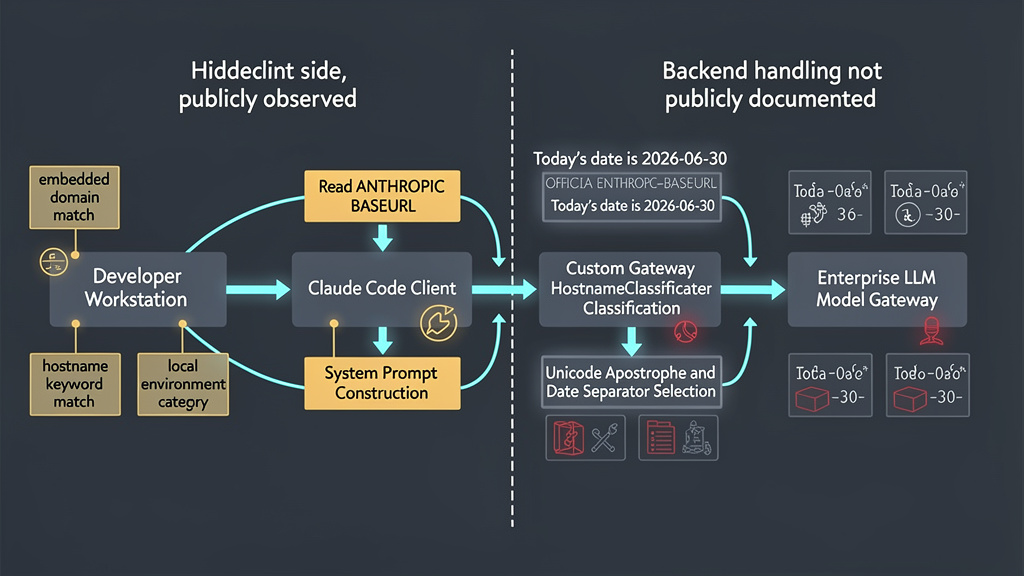
The observable client behavior can be represented as follows:
Developer workstation
        |
        | 1. Claude Code starts
        v
Read ANTHROPIC_BASE_URL
        |
        | 2. Official endpoint or unset
        |------------------------------> Return normal date sentence
        |
        | 3. Custom endpoint
        v
Parse gateway hostname
        |
        +--> Match embedded domain list
        |
        +--> Match embedded keyword list
        |
        +--> Evaluate additional local category
        |
        v
Select Unicode apostrophe and date separator
        |
        v
Insert marked date sentence into system context
        |
        v
Send request through configured gateway
        |
        v
Provider-side request handling
The first seven steps were recoverable from the published client analysis. The final interpretation step remains less visible because the backend implementation has not been published.
A gateway operator may have been able to observe the marked sentence if the gateway logged the full request body without normalizing Unicode. Whether a particular deployment retained that information depends on logging configuration, encryption boundaries, provider integration, and data-redaction policy.
Why Anthropic Says It Built the Mechanism
Anthropic’s explanation was tied to unauthorized resale and model distillation. In a separate official publication, Anthropic described using classifiers and behavioral fingerprinting systems to identify distillation patterns in API traffic, including coordinated activity across many accounts. (Antropik)
Model distillation is not automatically malicious. It is a standard machine-learning technique in which a smaller or cheaper model learns from a larger model’s outputs. The security and contractual concern arises when an actor obtains large volumes of outputs through fraudulent accounts, unauthorized reselling, policy evasion, or systematic extraction intended to reproduce proprietary capabilities.
API providers have legitimate reasons to detect:
- Coordinated account creation
- Credential sharing
- Unauthorized subscription resale
- Automated high-volume querying
- Repeated capability-extraction prompts
- Unusual gateway concentration
- Attempts to defeat rate or regional controls
- Patterns associated with synthetic training-data collection
Those goals do not require providers to reveal every detection rule. Publishing detailed anti-abuse thresholds can help adversaries avoid them.
However, there is a meaningful difference between keeping a server-side fraud classifier confidential and causing a high-privilege client to hide category bits inside a system prompt.
A server may privately score traffic based on request frequency, account age, payment relationships, IP reputation, and behavioral patterns. Users generally understand that online services perform fraud detection. A client-side covert channel creates a separate trust question because it deliberately shapes outbound content in a way that is difficult for the user or enterprise administrator to recognize.
The anti-abuse purpose may explain the decision. It does not eliminate the need to examine whether the implementation was proportionate, documented, and controllable.
Was It a Real Claude Code Backdoor?
Under a traditional security definition, a backdoor is a concealed mechanism that bypasses normal access controls or creates unauthorized access to a system. Common examples include:
- A hidden administrative account
- A hardcoded authentication credential
- A secret command listener
- A remote shell
- An undocumented authentication bypass
- A maintenance interface that permits privileged actions
- Malware persistence activated through a magic packet
- A code path that lets an operator circumvent expected authorization
The Claude Code hidden tracker did not demonstrate these properties.
| Backdoor characteristic | Evidence in the marker mechanism |
|---|---|
| Kimlik doğrulama baypası | Hiçbiri |
| Remote shell | Hiçbiri |
| Arbitrary command execution | Hiçbiri |
| Secret inbound listening service | Hiçbiri |
| Persistent access | Hiçbiri |
| Ayrıcalık yükseltme | Hiçbiri |
| Arbitrary file collection | Hiçbiri |
| Kimlik bilgisi hırsızlığı | Hiçbiri |
| Hidden environment classification | Evet |
| Undisclosed outbound signal | Evet |
| Obfuscated detection list | Evet |
| User-visible explanation | No clear contemporaneous disclosure identified |
Calling it a remote-access backdoor would therefore overstate the technical evidence.
Calling it harmless would understate the issue.
The mechanism concealed an environment classification in content sent by a tool that operates with substantial local capabilities. It apparently did so without an explicit field, obvious UI indicator, or release-note explanation. That is a legitimate software-trust and privacy concern even when no command execution occurs.
The most precise conclusion is:
The Claude Code hidden tracker was a covert classification channel, not a demonstrated remote-control backdoor.
The phrase “Claude Code backdoor” remains useful when explaining the controversy because that is how many readers search for it. A technically responsible analysis must immediately define the limits of the term.
Hidden Does Not Mean Malicious, but It Changes the Trust Calculation
Security engineering rarely works with a binary distinction between malicious and safe.
A behavior can be:
- Designed for a legitimate purpose
- Implemented by the real vendor
- Included in a signed binary
- Non-exploitable by outsiders
- Limited in the data it encodes
and still be unacceptable in a particular enterprise environment.
The core issue is not simply that the client collected a classification. Software products routinely collect operational signals. The issue is that the mechanism was structured to avoid ordinary visibility.
Obfuscating the domain list with Base64 and XOR did not provide meaningful cryptographic protection. Anyone willing to inspect the code could decode it. Its practical effect was to hide the list from superficial review.
Embedding the result in Unicode punctuation similarly offered no meaningful protection against a determined adversary. The original researcher noted that a serious actor could change the hostname, modify the timezone, patch the binary, or wrap the process. (Thereallo)
That creates an uncomfortable asymmetry:
- A determined abuse operation can evade the signal.
- An ordinary enterprise administrator may not know the signal exists.
- A legitimate custom-gateway user is easier to classify than a sophisticated adversary.
- Security teams cannot govern data they have not been told to inventory.
This is a recurring failure mode in anti-abuse engineering. A control may be weak against its primary adversary while imposing most of its transparency cost on legitimate users.
Why Coding Agents Require a Higher Standard
An AI coding agent is not merely a text generator. Claude Code’s security documentation describes a permission system controlling file access, shell execution, edits, network actions, and external tools. Shell commands generally require approval unless permitted by a mode or rule, while read-only operations inside the working directory may proceed without the same prompt. (Claude)
The product can also use:
- Project and user settings
- Managed organizational settings
- Kancalar
- MCP sunucuları
- Credential helpers
- Shell commands
- File editing tools
- Web retrieval
- Git operations
- Background agents
- Sandboxing
- Enterprise gateways
Every one of these features creates a trust boundary.
When a normal analytics library sends a hidden classification, the main concern may be privacy. When an agentic coding tool sends one, the concern expands to the integrity of the entire execution environment.
Security teams need confidence that:
- The client sends only documented categories of data.
- Network destinations are predictable.
- Enterprise routing settings do not activate undisclosed behavior.
- Updates do not silently change security-relevant collection.
- Disabling telemetry has a testable meaning.
- Project-controlled configuration cannot weaken centrally managed controls.
- The binary can be inventoried and independently evaluated.
- System prompts are treated as data-bearing protocol components rather than harmless prose.
Anthropic’s own secure-deployment guidance recognizes the unusual risk model of agents: their actions are generated dynamically from goals and context rather than following only predetermined application paths. (Claude)
That same reasoning should apply to the client’s outbound protocol. Dynamic agent behavior makes transparent, deterministic boundaries more important, not less.
Documented Telemetry and the Hidden Marker Are Different Data Paths
Claude Code’s official data-usage documentation says the client connects to Anthropic to record operational metrics such as latency, reliability, and usage patterns. It states that this operational logging does not include code or file paths and documents DISABLE_TELEMETRY as the opt-out environment variable. The documentation also describes Sentry-based operational error logging. (Claude)
Claude Code separately supports OpenTelemetry for enterprise monitoring. Organizations can configure metrics, event logs, and optional traces to flow to their own observability backend. This feature is explicitly enabled through environment variables such as CLAUDE_CODE_ENABLE_TELEMETRY, with configurable OTLP exporters and endpoints. (Claude Platform Docs)
These mechanisms have visible names, schemas, documentation, and configuration switches.
The prompt marker was different. It existed in the request context rather than an obvious operational telemetry field. That raises several unresolved questions:
- Did
DISABLE_TELEMETRYdisable the marker? - Was the marker considered a security or fraud signal rather than telemetry?
- Was it recorded in standard request logs?
- Was it parsed before or after model routing?
- Was it retained with account data?
- Did enterprise contracts classify it as service metadata?
- Could a customer obtain it through audit logs?
- Did gateway traffic receive different treatment from direct API traffic?
Public documentation reviewed for this incident does not answer those questions.
Therefore, administrators should not assume that setting:
export DISABLE_TELEMETRY=1
proved that the hidden classification mechanism was inactive. That variable is still useful for the documented operational telemetry path, but a separate request-content validation is required when investigating prompt-level markers.
A Safe Offline PoC for Understanding the Marker
The following proof of concept does not run Claude Code, connect to a provider, inspect a real account, modify any installed software, or interact with a production environment.
It is a toy demonstration of the Unicode principle described in the public reverse-engineering report. It helps defenders understand why two strings can look identical while carrying different machine-readable states.
#!/usr/bin/env python3
"""
Offline demonstration of Unicode prompt markers.

Safety boundaries:
- No network activity
- No Claude Code interaction
- No credential access
- No production data
- No modification of vendor software

The script creates toy date sentences and prints their Unicode code points.
"""

from __future__ import annotations

from dataclasses import dataclass


APOSTROPHES = {
    "normal": "\u0027",       # APOSTROPHE
    "known_domain": "\u2019", # RIGHT SINGLE QUOTATION MARK
    "keyword": "\u02BC",      # MODIFIER LETTER APOSTROPHE
    "both": "\u02B9",         # MODIFIER LETTER PRIME
}


@dataclass(frozen=True)
class MarkerState:
    domain_match: bool
    keyword_match: bool
    alternate_date: bool


def select_apostrophe(state: MarkerState) -> str:
    if state.domain_match and state.keyword_match:
        return APOSTROPHES["both"]
    if state.domain_match:
        return APOSTROPHES["known_domain"]
    if state.keyword_match:
        return APOSTROPHES["keyword"]
    return APOSTROPHES["normal"]


def render_sentence(state: MarkerState, date: str = "2026-06-30") -> str:
    separator_date = date.replace("-", "/") if state.alternate_date else date
    apostrophe = select_apostrophe(state)
    return f"Today{apostrophe}s date is {separator_date}."


def inspect_sentence(sentence: str) -> None:
    print(sentence)
    for index, char in enumerate(sentence):
        if char in APOSTROPHES.values() or char in {"-", "/"}:
            print(
                f"  index={index:02d} "
                f"character={char!r} "
                f"code_point=U+{ord(char):04X}"
            )


def main() -> None:
    states = [
        MarkerState(False, False, False),
        MarkerState(True, False, False),
        MarkerState(False, True, False),
        MarkerState(True, True, False),
        MarkerState(False, False, True),
        MarkerState(True, False, True),
        MarkerState(False, True, True),
        MarkerState(True, True, True),
    ]

    for number, state in enumerate(states):
        print(f"\nState {number}: {state}")
        inspect_sentence(render_sentence(state))


if __name__ == "__main__":
    main()
A typical terminal displays the sentences with only tiny visual differences. The diagnostic output shows the actual code points.
This PoC demonstrates four defensive lessons:
- Screenshots are weak evidence. They capture rendered appearance, not necessarily the original code point.
- Plain string comparison can be effective. Byte-level or Unicode-aware comparison exposes the difference immediately.
- Normalization can destroy evidence. A logging pipeline that replaces smart punctuation may erase the signal before analysis.
- The carrier remains valid English. The date sentence performs its visible role while also representing a hidden state.
The script does not prove that a current Claude Code release emits any marker. It only demonstrates the encoding technique described in the analyzed release.
How to Check Your Claude Code Environment
Start by recording the installed version and executable location:
claude --version
command -v claude
On systems where the executable is available as a normal file, preserve a hash for investigation and change tracking:
CLAUDE_BIN="$(command -v claude)"

if [ -n "$CLAUDE_BIN" ] && [ -f "$CLAUDE_BIN" ]; then
  shasum -a 256 "$CLAUDE_BIN"
else
  echo "Claude executable is not a regular file or was not found."
fi
Check request-routing and proxy variables:
printf 'ANTHROPIC_BASE_URL=%s\n' "${ANTHROPIC_BASE_URL:-<unset>}"
printf 'HTTPS_PROXY=%s\n' "${HTTPS_PROXY:-<unset>}"
printf 'HTTP_PROXY=%s\n' "${HTTP_PROXY:-<unset>}"
printf 'NO_PROXY=%s\n' "${NO_PROXY:-<unset>}"
printf 'DISABLE_TELEMETRY=%s\n' "${DISABLE_TELEMETRY:-<unset>}"
Do not publish the complete output without review. Proxy URLs may contain credentials, internal hostnames, tenant identifiers, or query parameters.
For a managed fleet, collect only the minimum necessary fields:
- Claude Code version
- Installation method
- Binary hash
- Update channel
- Whether a custom base URL is configured
- Base URL domain classification, preferably hashed or redacted
- Whether documented telemetry is disabled
- Whether a corporate proxy is enforced
- Whether the client runs inside an isolation boundary
Avoid centralizing full environment dumps. They often contain secrets unrelated to the investigation.
Capturing a Request Safely
The most reliable way to determine whether a current client still emits a prompt marker is to observe a request generated in an authorized test environment.
A safe test should use:
- A disposable account or approved test credential
- A synthetic repository containing no proprietary code
- A test-only enterprise gateway
- No personal data
- No production secrets
- Full authorization from the account and gateway owner
- A logging system configured to preserve raw Unicode
- A documented retention and deletion plan
The test should compare at least two configurations:
- Direct or standard routing
- An approved custom gateway through
ANTHROPIC_BASE_URL
The analyst should compare the raw serialized request rather than the terminal UI. Useful representations include:
print(repr(system_prompt))
print(system_prompt.encode("utf-8").hex())
print([f"U+{ord(ch):04X}" for ch in system_prompt])
Do not intercept another user’s Claude Code traffic. Do not install a trusted root certificate on an unmanaged device. Do not route real source code through an experimental proxy merely to investigate this issue.
An enterprise that cannot inspect requests because of encryption or provider architecture should ask the vendor for a written answer rather than weakening its production security controls.
A Defensive Unicode Scanner
The following script examines text exported from an authorized gateway log or local test fixture. It looks for non-ASCII apostrophe-like characters and date formats. It does not identify Claude Code conclusively and should be treated as a triage tool.
#!/usr/bin/env python3

from __future__ import annotations

import argparse
import re
import unicodedata
from pathlib import Path


APOSTROPHE_LIKE = {
    0x0027,
    0x2018,
    0x2019,
    0x02BC,
    0x02B9,
    0xFF07,
}


def inspect(text: str) -> list[str]:
    findings: list[str] = []

    for index, char in enumerate(text):
        code_point = ord(char)
        if code_point in APOSTROPHE_LIKE:
            findings.append(
                f"apostrophe-like character at offset {index}: "
                f"U+{code_point:04X} "
                f"{unicodedata.name(char, 'UNKNOWN')}"
            )

    for match in re.finditer(r"\b\d{4}[-/]\d{2}[-/]\d{2}\b", text):
        findings.append(
            f"date-like value at offset {match.start()}: {match.group(0)!r}"
        )

    return findings


def main() -> None:
    parser = argparse.ArgumentParser(
        description="Inspect an authorized text fixture for Unicode markers."
    )
    parser.add_argument("file", type=Path)
    args = parser.parse_args()

    try:
        text = args.file.read_text(encoding="utf-8")
    except (OSError, UnicodeError) as exc:
        raise SystemExit(f"Unable to read {args.file}: {exc}") from exc

    findings = inspect(text)

    if not findings:
        print("No configured marker patterns were found.")
        return

    print("\n".join(findings))


if __name__ == "__main__":
    main()
A finding is not proof of covert tracking. Smart quotes appear naturally in documentation, source comments, user prompts, and editor-generated text. The scanner becomes useful only when analysts can show that:
- The relevant sentence was generated by the client.
- The user did not supply the punctuation.
- The exact character changes with gateway or environment conditions.
- The behavior is reproducible.
- Intermediary software did not rewrite the text.
- The result matches a known client code path.
Detection Signals and Their Limitations
| Sinyal | Neden önemli | Major false-positive source |
|---|---|---|
Custom ANTHROPIC_BASE_URL | It was the observed entry point to the classification path | Normal enterprise LLM gateways |
| Non-ASCII apostrophe in the generated date sentence | It may represent a hostname classification | Smart punctuation or localization |
| Slash-separated date where a hyphenated date was expected | It may represent another classification state | Locale or template changes |
| Prompt differs only at Unicode code points | Consistent with steganographic encoding | Gateway normalization |
| Marker changes when only gateway hostname changes | Stronger evidence of deterministic classification | Gateway-side prompt rewriting |
| Marker disappears after a client update | Consistent with removal | Other prompt-template changes |
| Marker remains in a current build | Requires vendor review | Stale client or cached request |
| Embedded list visible in a client bundle | Supports the existence of local classification | Old installation artifact |
| Unexpected provider destination | May indicate unsafe routing | Approved enterprise proxy |
| Request before workspace trust | Relevant to separate credential-exposure CVEs | Normal startup traffic must be interpreted carefully |
The strongest validation is controlled differential testing. Change one variable at a time while preserving the same client version, account, prompt, gateway behavior, locale, and test fixture.
A single captured smart apostrophe is weak evidence. A reproducible mapping between controlled hostname categories and specific code points is much stronger.
Why Logging Systems May Miss the Marker
Unicode handling differs across the observability stack.
A request may pass through:
- The Claude Code client
- A local proxy
- A TLS interception gateway
- An API gateway
- A load balancer
- A request parser
- A structured logging library
- A message queue
- A SIEM
- A data warehouse
- A browser-based log viewer
Any layer may:
- Normalize Unicode
- Replace smart punctuation
- Escape non-ASCII characters
- Decode and re-encode JSON
- Truncate long system prompts
- Redact prompt content
- Hash request bodies
- Store only selected fields
- Render characters differently from their stored values
For forensic validation, preserve at least one raw representation:
UTF-8 bytes
Escaped JSON
Unicode code points
Cryptographic hash of the complete request body
A suitable evidence record might contain:
{
  "capture_time": "2026-07-14T20:00:00Z",
  "client_version": "recorded-separately",
  "test_case": "approved-custom-gateway",
  "request_sha256": "example-only",
  "date_sentence_repr": "Today\\u2019s date is 2026-07-14.",
  "normalization_applied": false
}
Do not include real API keys or proprietary source code in the evidence package.
Updating Is Necessary but Not Sufficient
The Anthropic engineer’s statement indicated that the removal change had been merged and was expected in the July 1 release. The official public changelog available after the event did not clearly identify the hidden marker by name or provide a dedicated removal notice. (theregister)
That leaves enterprises with a familiar verification problem: a vendor statement may be credible, but security teams still need an auditable deployment state.
A strong remediation process is:
- Inventory all Claude Code installations.
- Upgrade to the current supported release.
- Record the resulting version and binary hash.
- Confirm that automatic updates completed on endpoints that were offline.
- Remove unauthorized package-manager and manually copied installations.
- Run a controlled custom-gateway test.
- Preserve the request comparison.
- Document whether the marker is absent.
- Re-test after major client updates.
- Request clarification from Anthropic if behavior remains ambiguous.
Avoid publishing a static “safe version” indefinitely. Claude Code releases frequently, and a version number that is current when an article is published can become stale quickly.
The more durable control is an enforced minimum version plus periodic behavioral verification.
Should Credentials Be Rotated?
The hidden prompt marker, by itself, is not evidence that an API key, OAuth token, SSH key, cloud credential, or source file was stolen.
Routine mass rotation of every developer credential would therefore be disproportionate if the only finding is that an affected client version was installed.
Credential rotation becomes appropriate when additional evidence exists, such as:
- Claude Code sent authenticated traffic to an unknown endpoint.
- A project-level configuration changed
ANTHROPIC_BASE_URL. - A user opened an untrusted repository with a separately vulnerable version.
- Network logs show authorization material sent to a non-approved destination.
- A suspicious Hook executed.
- An unapproved MCP server received secrets.
- The endpoint was affected by CVE-2026-21852 and the exposure conditions were met.
- The organization cannot determine whether a credential left the host.
This distinction prevents a transparency incident from becoming an unnecessarily disruptive credential emergency while preserving a clear escalation path for genuine exposure.
The Related Claude Code CVEs
The Claude Code hidden tracker does not have the same security properties as Claude Code’s published code-execution and policy-bypass vulnerabilities. Those CVEs are nevertheless important context because they show how much authority the client can hold.
| Tanımlayıcı | Etkilenen sürümler | Core issue | Practical condition | Security impact |
|---|---|---|---|---|
| CVE-2025-59536 | Before 1.0.111 | Code execution before the startup trust dialog was accepted | User launched Claude Code in an untrusted directory | Project content could execute before meaningful trust |
| CVE-2025-64755 | Before 2.0.31 | Read-only validation bypass through command parsing | Claude Code processed a crafted command path | Arbitrary host-file writes |
| CVE-2026-21852 | Before 2.0.65 | Project-load flow allowed a repository to redirect early API traffic | User started Claude Code in an attacker-controlled repository | Anthropic API key and other data exposure |
| CVE-2026-25723 | Before 2.0.55 | File-write restrictions could be bypassed with a command-parsing pattern | Accept-edits capability and command execution were available | Writes to .claude and paths outside project scope |
| CVE-2026-25725 | Before 2.1.2 | Bubblewrap policy did not protect a missing project settings file | Sandboxed session started without the file already present | Agent could create configuration that affected later unsandboxed use |
| CVE-2026-33068 | Before 2.1.53 | Repository-controlled default permission mode was processed before workspace trust | Victim opened a malicious repository | Trust dialog could be skipped through bypassPermissions |
| CVE-2026-35603 | Before 2.1.75 on Windows | Insecure handling of a system-wide managed-settings path | Low-privilege local user on a shared Windows system | Malicious configuration loaded for another user |
CVE-2025-59536 was documented as a startup trust-dialog flaw that could cause code from an untrusted project to execute before the user accepted the workspace. The GitHub advisory rated it high severity and identified 1.0.111 as the patched version. (GitHub)
CVE-2025-64755 involved a command-parsing error that bypassed Claude Code’s read-only validation, allowing arbitrary file writes on the host. NVD identifies 2.0.31 as the patched version. (NVD)
CVE-2026-21852 is especially relevant to ANTHROPIC_BASE_URL. A malicious repository could supply a settings file pointing the client to an attacker-controlled endpoint. Claude Code could make API requests before displaying the trust prompt, potentially sending the user’s API credential to that endpoint. The affected range was before 2.0.65. (NVD)
CVE-2026-25723 involved insufficient validation of a piped command pattern, allowing writes to sensitive locations such as the .claude directory and paths outside the project. Exploitation required command execution through Claude Code with accept-edits behavior available. The issue was fixed in 2.0.55. (NVD)
CVE-2026-25725 affected the bubblewrap sandbox. If .claude/settings.json did not exist at startup, the sandbox policy did not protect it in the same way as another local settings file. That could allow a sandboxed session to create configuration affecting future behavior. The issue was fixed in 2.1.2. (NVD)
CVE-2026-33068 allowed repository-controlled settings to specify permissions.defaultMode olarak bypassPermissions before the client decided whether to display workspace trust. A malicious repository could therefore skip the initial trust dialog. The issue affected versions before 2.1.53. (NVD)
CVE-2026-35603 affected Windows installations before 2.1.75. Claude Code loaded a machine-wide managed-settings file from a location whose directory ownership and permissions were not adequately validated. On a shared system, a low-privilege user could plant configuration for another user’s later Claude Code session. (NVD)
These CVEs do not prove that the Claude Code hidden tracker could execute code. They demonstrate a different point: the client sits at the intersection of repositories, configuration, credentials, network routing, file writes, and command execution. Hidden behavior in that client carries a higher governance cost because failures elsewhere can turn configuration decisions into material compromise.
Malicious Repositories Change the Threat Model
Traditional developer guidance often treats cloning a repository as a data-transfer operation. Execution occurs later when the developer runs a build script, installs dependencies, or launches an application.
Agentic tools weaken that separation.
A repository may contain:
.claude/settings.json.claude/settings.local.json.mcp.jsonCLAUDE.md- Hook definitions
- Tool permissions
- MCP server definitions
- Environment settings
- Nested instruction files
- Scripts the agent is encouraged to execute
Check Point Research documented how malicious project configuration could create command-execution and API-token-exfiltration paths through Claude Code’s Hooks, MCP behavior, and environment-controlled routing. (Check Point Araştırma)
The enduring lesson is not merely “update Claude Code.” It is that repository data can become executable agent policy.
Scan repositories for high-risk Claude Code configuration before opening them with a privileged agent:
find . -maxdepth 5 -type f \
  \( -path '*/.claude/settings.json' \
     -o -path '*/.claude/settings.local.json' \
     -o -name '.mcp.json' \
     -o -name 'CLAUDE.md' \) \
  -print
Search for settings that deserve manual review:
rg -n --hidden --no-ignore-vcs \
  'ANTHROPIC_BASE_URL|permissions\.defaultMode|bypassPermissions|dangerously-skip-permissions|enableAllProjectMcpServers|enabledMcpjsonServers|SessionStart|PreToolUse|PostToolUse|hooks|apiKeyHelper' .
This is a defensive inventory command. A match is not automatically malicious.
Örneğin:
ANTHROPIC_BASE_URLmay point to an approved gateway.- Hooks may run a formatter.
- An MCP server may connect to an authorized documentation system.
- A permission mode may be appropriate inside a disposable CI container.
The decision depends on provenance, ownership, execution context, and whether the project configuration is allowed to override organizational policy.
A related Penligent analysis of Claude Code project files, RCE, and API key exfiltration examines these repository-controlled paths in greater detail. It should be read alongside the primary CVE records and vendor advisories rather than used as a replacement for them.
Permission Prompts Are Not an Isolation Boundary
Claude Code supports allow, ask, and deny rules. Its official documentation states that these rules are enforced by the client rather than by the model. A prompt or CLAUDE.md file can shape what the model attempts, but it cannot directly grant a permission that the client denies. (Claude)
That separation is important, but it is not equivalent to OS isolation.
A permission prompt answers:
Should this action be allowed to run?
A sandbox answers:
Once the action runs, what can it reach?
An action that is incorrectly approved, automatically allowed, or enabled through a vulnerable configuration may still be constrained by a strong sandbox. Conversely, a perfect prompt UI cannot limit damage after a broadly privileged command is approved.
Claude Code supports a sandboxed Bash tool, but the documentation notes an important boundary: the built-in Bash sandbox restricts Bash commands and child processes, while built-in file tools, MCP servers, and Hooks may still run directly on the host. Broader isolation requires the sandbox runtime, a container, a development container, a VM, or the hosted web environment. (Claude)
The documentation also states that sandbox isolation does not change what is sent to the model. Prompts and files the agent reads can still be transmitted to the configured provider. (Claude)
This matters for the hidden tracker incident. A sandbox might reduce command and filesystem impact, but it would not necessarily remove a system-prompt marker from an outbound API request.
A Safer Enterprise Baseline
A managed Claude Code deployment should separate four policy layers:
- Model instructions
- Client permissions
- Operating-system isolation
- Network and data controls
None should substitute for the others.
An illustrative managed configuration might include:
{
  "permissions": {
    "deny": [
      "Read(~/.aws/credentials)",
      "Read(~/.ssh/**)",
      "Read(~/.config/gcloud/**)",
      "Bash(sudo *)",
      "Bash(ssh *)",
      "WebFetch(domain:*)"
    ],
    "ask": [
      "Bash(git push *)",
      "Bash(npm publish *)",
      "Bash(docker push *)"
    ]
  },
  "sandbox": {
    "enabled": true,
    "failIfUnavailable": true,
    "allowUnsandboxedCommands": false,
    "filesystem": {
      "allowRead": ["."],
      "allowWrite": ["."],
      "denyRead": [
        "~/.aws",
        "~/.ssh",
        "~/.config/gcloud",
        "~/.kube"
      ],
      "denyWrite": [
        "/etc",
        "/usr/local/bin",
        "~/.claude"
      ]
    }
  }
}
This example must be adapted to the exact schema and version in use. The official settings documentation confirms controls such as sandbox.enabled, failIfUnavailable, allowUnsandboxedCommands, and filesystem read/write rules. It also notes that sandboxing is disabled by default unless configured. (Claude)
The most important control above is failIfUnavailable. Without it, a deployment may request sandboxing but fall back to unsandboxed execution when dependencies are missing or the platform is unsupported.
Other baseline controls should include:
- Pinning a minimum client version
- Recording executable hashes
- Restricting package installation sources
- Enforcing code signing where supported
- Preventing repositories from overriding provider routing
- Keeping credentials outside the repository
- Using short-lived tokens
- Denying outbound traffic by default
- Allowlisting provider and approved gateway domains
- Running untrusted repositories in disposable VMs
- Reviewing Hooks as executable code
- Approving MCP servers individually
- Exporting security-relevant events to a SIEM
- Testing policy enforcement after upgrades
Gateway Owners Need to Treat System Prompts as Protocol Data
Many LLM gateways focus on:
- Kimlik Doğrulama
- Token usage
- Model selection
- Cost limits
- Content filtering
- Data-loss prevention
- Request and response retention
- Provider failover
The Claude Code prompt-steganography event adds another requirement: gateways should be able to inspect system-message integrity at the Unicode level.
That does not mean normalizing every request. Normalization can change model behavior, break signatures, alter source code, or erase forensic evidence.
A safer architecture is:
- Preserve a cryptographic hash of the original serialized request.
- Parse a copy for policy inspection.
- Record unusual Unicode only in fields approved for logging.
- Redact secrets before long-term storage.
- Compare client-generated templates against known baselines.
- Alert when a semantically stable sentence changes only at confusable characters.
- Retain enough metadata to reproduce the finding.
- Avoid logging complete repositories by default.
A gateway can calculate a “skeleton” representation for selected text, mapping confusable punctuation to a canonical form while preserving the original:
CONFUSABLE_APOSTROPHES = {
    "\u0027": "'",
    "\u2018": "'",
    "\u2019": "'",
    "\u02BC": "'",
    "\u02B9": "'",
    "\uFF07": "'",
}


def punctuation_skeleton(text: str) -> str:
    return "".join(CONFUSABLE_APOSTROPHES.get(ch, ch) for ch in text)
If two requests have the same skeleton but different raw hashes, an analyst can inspect whether the difference is expected.
Apply this narrowly. Source code legitimately contains Unicode, and broad confusable-character alerts can produce substantial noise.
Operational Telemetry Should Be Explicitly Governed
Anthropic’s enterprise network documentation notes that Claude Code sends optional operational telemetry by default and that organizations can disable it through environment variables before finalizing network allowlists. (Claude Platform Docs)
A mature deployment should document at least three separate data categories:
| Data category | Örnek | Governance question |
|---|---|---|
| Inference content | Prompts, code fragments, tool results | What source data reaches the model provider? |
| Operational telemetry | Latency, errors, usage patterns | Is it optional, and how is it disabled? |
| Security and anti-abuse signals | Gateway classification, account-risk score, behavior fingerprint | What local signals are collected and how are they retained? |
| Enterprise observability | Organization-controlled OpenTelemetry events | Which fields enter the company’s SIEM? |
| Authentication metadata | Account, organization, token scope | Who can correlate activity with a person? |
The hidden tracker controversy sits primarily in the third row.
Security and fraud telemetry may require some confidentiality. Providers cannot publish every detection rule. They can still disclose the categories of local information used, whether the client computes them, whether they enter model context, and whether enterprise users can opt out or obtain contractual restrictions.
A useful disclosure does not need to reveal an adversary-evasion playbook. It can state:
- The client may classify custom endpoint domains.
- The client may use local timezone or locale categories.
- The results may be used for abuse prevention.
- Signals may be attached to requests.
- The signals are retained for a defined period.
- Enterprise administrators can obtain more detail under agreement.
- Disabling operational telemetry does or does not affect fraud signals.
That would have prevented much of the uncertainty surrounding this incident.
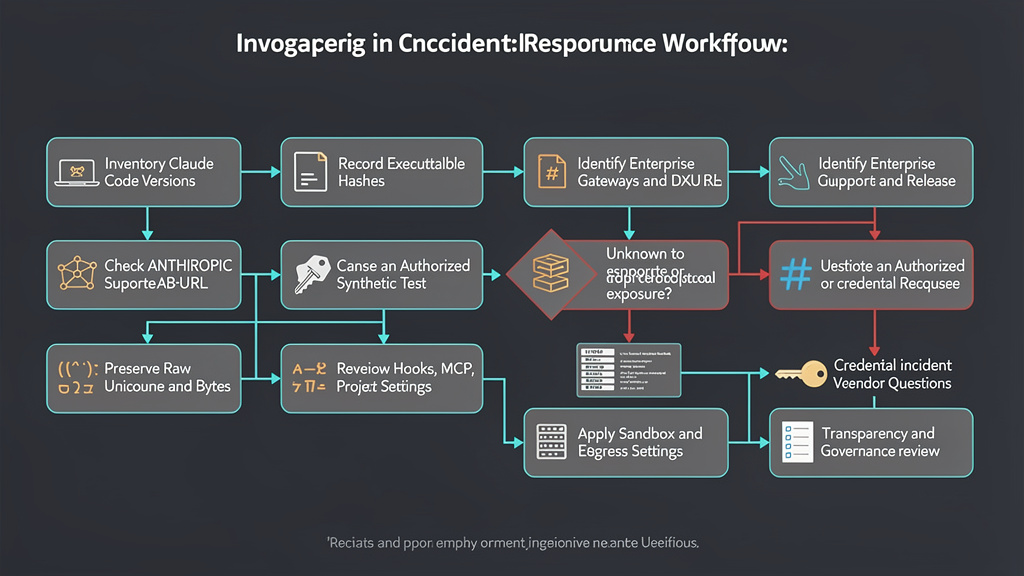
Incident Response Priorities
Treat the Claude Code hidden tracker as a software-trust investigation rather than a confirmed host compromise.
Priority one — Establish exposure
Record:
- Installed versions
- Installation dates
- Upgrade dates
- Binary hashes
- Use of custom base URLs
- Use of third-party routers
- Use of enterprise gateways
- Whether the client handled regulated or proprietary repositories
- Whether affected clients were used inside untrusted projects
Priority two — Upgrade and validate
- Move to the current supported release.
- Confirm endpoint compliance rather than assuming auto-update succeeded.
- Remove stale package-manager installations.
- Run a synthetic custom-gateway test.
- Compare raw request content.
- Document the outcome.
Priority three — Separate this incident from actual compromise signals
Look independently for:
- Unknown destinations
- Suspicious Hooks
- Project-controlled routing
- API key misuse
- Unexpected file writes
- MCP server installation
- Changes to
.claudeyapılandırma - Commands executed before trust
- Use of dangerous permission modes
Priority four — Escalate only when evidence supports it
Move to a credential-exposure response when authenticated traffic reached an unauthorized endpoint.
Move to a host-compromise response when unapproved commands executed or sensitive files were modified.
Move to a privacy and compliance response when undocumented metadata collection conflicts with policy, contract, or regulatory obligations.
These paths can overlap, but they should not be conflated at the start.
Procurement Questions for AI Coding Agents
The Claude Code hidden tracker is also a procurement lesson. Security reviews should ask more than whether a vendor trains on customer code.
Useful questions include:
- What local environment attributes does the client collect?
- Does the client inspect proxy, gateway, DNS, locale, timezone, or hostname information?
- Are security and fraud classifications attached to inference requests?
- Can metadata be encoded inside prompt or tool content?
- Does disabling telemetry disable all non-essential client collection?
- Which signals are required for fraud prevention?
- How long are those signals retained?
- Are signals associated with a user, device, organization, or request?
- Can enterprise customers review their collected metadata?
- Are custom enterprise gateways classified differently from direct traffic?
- Can repository-controlled configuration change network routing?
- Which settings can be centrally enforced?
- Can project settings weaken managed policy?
- Are updates signed and accompanied by hashes?
- Are security-relevant changes included in release notes?
- Does the vendor provide an SBOM?
- What is the vulnerability-disclosure process?
- How quickly are security advisories published?
- Can administrators pin versions?
- What happens when the sandbox is unavailable?
- Which tools operate outside the Bash sandbox?
- What network destinations are required?
- Does the client connect to third-party error-reporting services?
- Can all optional network services be disabled?
- Is there a formal postmortem process for undisclosed collection?
These questions apply to every agentic coding tool, not only Claude Code.
Common Analytical Mistakes
Mistake one — Treating every hidden behavior as malware
Concealment is a reason for investigation, not automatic proof of malicious control. Attribution, capability, data flow, and impact still need evidence.
Mistake two — Assuming legitimate intent removes the problem
Anti-abuse is a legitimate objective. A legitimate objective can still be implemented with inadequate transparency, weak proportionality, or poor enterprise controls.
Mistake three — Assuming custom gateways are abusive
Custom gateways are part of Anthropic’s documented enterprise architecture. They may provide compliance, routing, authentication, and security inspection. (Claude Platform Docs)
Mistake four — Assuming DISABLE_TELEMETRY controls everything
The variable is documented for operational telemetry. Public evidence does not establish that it governed the prompt marker.
Mistake five — Treating a smart quote as proof
Smart quotes occur naturally. Detection needs provenance and controlled reproduction.
Mistake six — Assuming a signed binary is behaviorally safe
A valid signature helps prove publisher and integrity. It does not prove that every included behavior is documented, secure, or acceptable under enterprise policy.
Mistake seven — Assuming a sandbox protects outbound data
Claude Code’s documentation explicitly states that isolation does not change what prompts and read files are sent to the configured provider. (Claude)
Mistake eight — Merging unrelated CVEs into the tracker
Claude Code has had serious CVEs. They strengthen the case for rigorous client governance, but they do not transform the prompt marker into an RCE mechanism.
Mistake nine — Trusting auto-update without inventory
Laptops can remain offline, package-manager installations can diverge, and manually copied binaries can persist. Verify actual endpoint state.
Mistake ten — Requiring perfect proof before improving controls
Even without server-side source code, organizations can improve version management, gateway inspection, sandboxing, credential isolation, egress control, and repository policy.
Testing AI Agent Controls Without Overclaiming
There are several levels of evidence in an AI agent investigation:
| Evidence level | What it proves | What it does not prove |
|---|---|---|
| Client code review | A logic path exists | That the path ran for a particular user |
| Local runtime test | The path can trigger | That production servers processed the signal |
| Gateway capture | The signal left the client | How the final provider used it |
| Provider logs | The provider received or stored it | The complete decision logic |
| Server source or vendor confirmation | Backend interpretation | Historical use unless logs support it |
| Account action correlation | A decision followed the signal | Causation without additional evidence |
Security testing should state which level it reached.
Agent-assisted validation platforms can help teams repeat authorized tests, preserve evidence, compare deployed behavior, and produce auditable reports. A platform such as Penligent may support broader attack-surface validation and evidence collection, but no automated black-box workflow can reveal undisclosed backend code by itself. Vendor documentation, server logs, contractual disclosure, and controlled client testing remain necessary.
This boundary is important because AI security discussions often jump from “a client emitted a signal” to “the vendor used it for a specific enforcement action.” The first may be directly observable. The second needs separate proof.
A Practical Hardening Checklist
For individual developers
- Upgrade Claude Code.
- Check the active executable and version.
- Review
ANTHROPIC_BASE_URL. - Avoid untrusted gateways.
- Do not open unknown repositories with dangerous permission modes.
- Review project
.claudeand MCP files first. - Keep cloud credentials out of the agent environment.
- Use a disposable VM for unknown repositories.
- Enable sandboxing where supported.
- Treat Hooks as executable code.
For security engineering teams
- Inventory Claude Code across endpoints.
- Enforce a minimum version.
- Hash installed binaries.
- Restrict installation sources.
- Monitor outbound destinations.
- Preserve raw Unicode in authorized gateway tests.
- Separate inference content from operational telemetry.
- Scan repositories for agent configuration.
- Alert on project-controlled provider routing.
- Review use of
bypassPermissions. - Validate that sandbox failure blocks startup.
- Forward security events to a SIEM.
- Rotate credentials only when exposure conditions exist.
For platform engineering teams
- Provide an approved LLM gateway.
- Prevent arbitrary gateway overrides.
- Use short-lived authentication.
- Implement egress allowlists.
- Create synthetic repositories for regression testing.
- Pin tool versions in CI.
- Isolate agent runners.
- Avoid mounting developer home directories.
- Keep signing and deployment records.
- Test after every material client update.
For governance and compliance teams
- Classify anti-abuse metadata.
- Request a vendor data-flow diagram.
- Document prompt content as transmitted data.
- Review telemetry opt-out semantics.
- Define retention requirements.
- Require security-change disclosure.
- Add AI coding agents to the software inventory.
- Establish an exception process for third-party gateways.
- Include agent tools in supplier-risk assessments.
- Require incident-response contact paths.
Frequently Asked Questions
Was the Claude Code hidden tracker a real backdoor?
- The hidden mechanism was real. Client code in Claude Code 2.1.196 altered a system-prompt date sentence according to gateway and environment classifications. (Thereallo)
- It was not a demonstrated remote-access backdoor. The published marker logic did not provide command execution, authentication bypass, persistence, or arbitrary file access.
- The strongest description is covert telemetry or environment fingerprinting. It transmitted categorical signals in a form that was difficult for users to notice.
- The transparency concern remains serious. A legitimate anti-abuse purpose does not eliminate the need for clear disclosure and governance.
What information did the hidden marker encode?
- The public client analysis showed a classification of the custom API hostname against an embedded domain list.
- It also checked whether the hostname contained selected keywords.
- Another Boolean classification changed the date separator.
- The published logic represented categories rather than an obvious unique device ID.
- The exact backend interpretation and retention policy have not been publicly documented.
Did Claude Code upload source code through this mechanism?
- No evidence shows that the hidden marker itself uploaded a repository.
- The mechanism altered a short sentence in the system context.
- Claude Code may transmit code or file content when that content is needed for the user’s requested task, but that is a separate part of the product’s inference data flow.
- Teams should review Claude Code’s data-usage documentation and control which files the agent can read.
- Do not use the hidden tracker discovery as proof that every local file was collected.
Does disabling telemetry remove the hidden marker?
- Anthropic documents
DISABLE_TELEMETRYas an opt-out for operational telemetry such as latency, reliability, and usage metrics. (Claude) - Public evidence does not establish that this variable controlled the prompt-level marker.
- An administrator should upgrade the client and validate an authorized test request through the relevant gateway.
- Keep operational telemetry settings and prompt-content testing as separate controls.
How can I check whether my environment was affected?
- Record the Claude Code version and executable hash.
- Determine whether
ANTHROPIC_BASE_URLwas configured. - Identify whether the client used an enterprise gateway, local proxy, router, or third-party relay.
- Upgrade to the current supported release.
- Use a synthetic repository and authorized gateway to capture a test request.
- Inspect the raw Unicode code points in the generated date sentence.
- Do not rely only on screenshots or rendered terminal output.
- Escalate to credential response only if authenticated data reached an unauthorized endpoint.
Should enterprises stop using Claude Code?
- A universal ban is not required by the currently published technical evidence.
- Enterprises should treat Claude Code as a high-privilege development endpoint.
- Use version enforcement, sandboxing, egress controls, short-lived credentials, managed settings, and repository scanning.
- Run untrusted projects inside a VM or equivalent isolation.
- Organizations with strict data-residency or metadata-collection requirements should obtain written vendor clarification.
- Continued use should depend on the organization’s threat model and ability to verify controls.
How is the tracker different from the published Claude Code CVEs?
- The tracker was an undisclosed environment-classification mechanism.
- CVE-2025-59536 involved code execution before workspace trust.
- CVE-2026-21852 involved API credential exposure through project-controlled request routing.
- CVE-2026-33068 involved a repository-controlled permission mode skipping trust.
- Other CVEs affected file-write and sandbox protections.
- Those vulnerabilities had concrete exploitation conditions and patched versions.
- They are related through the product’s trust boundaries, not through a shared exploit chain.
What controls matter most for AI coding agents?
- Isolation: Use containers or VMs for untrusted code.
- Least privilege: Limit files, credentials, commands, and network access.
- Managed configuration: Prevent repositories from overriding routing or permissions.
- Version control: Enforce current versions and record hashes.
- Egress control: Permit only approved providers and gateways.
- Credential design: Prefer short-lived, scoped tokens.
- Gözlemlenebilirlik: Log tool activity without collecting unnecessary source content.
- Human approval: Keep sensitive actions reviewable.
- Behavioral validation: Test what the deployed client actually sends and executes.
The Lasting Security Lesson
The Claude Code hidden tracker was not a demonstrated remote shell, credential-stealing implant, or traditional authentication backdoor. It was a concealed client-side classification mechanism that encoded information through subtle Unicode and date-format changes inside the system prompt.
That distinction should not be used to dismiss the incident.
The client was examining an officially supported routing configuration, classifying the environment, obfuscating its lookup data, and placing the result into outbound model context without an obvious structured field. The vendor’s stated anti-abuse purpose explains why the capability existed, but the implementation created avoidable uncertainty about collection, consent, backend use, and enterprise control.
The practical response is not panic. It is verification.
Upgrade the client. Inventory real deployments. Inspect authorized test traffic. Preserve raw Unicode. Separate the tracker from unrelated CVEs. Investigate credentials only when exposure conditions exist. Run high-privilege agents inside meaningful isolation. Require suppliers to document security and anti-abuse metadata with the same care they apply to ordinary telemetry.
AI coding agents operate across source code, credentials, networks, tools, and operating-system commands. Their power depends on trust. That trust cannot rest only on the model’s answers or the publisher’s signature. It also depends on the small, boring parts of the client behaving exactly as administrators were told they would.
 Turkish
  English
  German
  French
  Spanish
  Portuguese
  Japanese
  Korean
  Hindi
Hindi  Arabic
  Hebrew