
CVE-2026-16812 is a critical OS command injection vulnerability affecting on-premises Arista VeloCloud Orchestrator deployments. It requires no tenant or operator credentials, carries a CVSS score of 10.0 under both CVSS v3.1 and CVSS v4.0, and is known to have been exploited in real attacks.
The vulnerable functionality was intended for internal use but became remotely accessible through the VeloCloud Orchestrator web interface. A successful attacker may compromise the confidentiality, integrity, and availability of the orchestrator host and the data it manages. Arista also warns that compromise of the platform may give an attacker access to managed VeloCloud Edge devices. (arista.com)
That combination changes the incident priority. This is not simply a vulnerable web page running on an ordinary application server. VeloCloud Orchestrator is a management-plane component with authority over distributed SD-WAN infrastructure. A compromise may expose configuration data, administrator activity, device inventory, certificates, credentials, database contents, and the mechanisms used to manage remote branches.
CISA added CVE-2026-16812 to its Known Exploited Vulnerabilities Catalog on July 27, 2026, with a remediation deadline of July 30, 2026, for affected federal civilian agencies. The unusually short deadline reflects the vulnerability’s active exploitation, unauthenticated attack path, automatable nature, and potential for total technical impact. (NVD)
| Saha | Confirmed information |
|---|---|
| CVE | CVE-2026-16812 |
| Ürün | Arista VeloCloud Orchestrator On-Prem |
| Zayıflık | CWE-78, OS command injection |
| Authentication required | Hayır |
| User interaction required | Hayır |
| Network condition | Attacker must reach the VCO web interface |
| CVSS v3.1 | 10.0 |
| CVSS v4.0 | 10.0 |
| İstismar | Confirmed active exploitation |
| Birincil etki | Compromise of the VCO host and managed data |
| Wider risk | Possible access to managed VeloCloud Edge devices |
| Hosted environment | Patched before public disclosure |
| Recommended response | Restrict access, preserve evidence, patch, investigate, and restore trust |
Why the VeloCloud Name Now Appears Under Arista
The vendor name can initially look confusing because VeloCloud was historically associated with VMware and, later, Broadcom. Arista acquired the VeloCloud SD-WAN portfolio from Broadcom in 2025. Arista’s July 1, 2025 announcement describes the acquisition as part of an expansion into branch and WAN networking, and current product documentation identifies the affected on-premises product as “VeloCloud Orchestrator On-Prem, formerly VeloCloud Orchestrator by Broadcom.” (Arista Networks)
CVE-2026-16812 was therefore assigned and disclosed by Arista Networks, and the authoritative vendor document is Arista Security Advisory 0144. The advisory was published on July 27, 2026, and tracks the issue internally as BUG 1901675. (Arista Networks)
This history matters operationally. Asset inventories, procurement systems, vulnerability scanners, certificates, DNS names, virtual-machine labels, and support contracts may still refer to VMware SD-WAN, Broadcom VeloCloud, VCO, VECO, or Arista VeloCloud. A search that uses only the latest vendor name can miss vulnerable systems.
During emergency inventory work, security teams should search for all relevant naming variants:
Arista VeloCloud
VeloCloud Orchestrator
VCO
VECO
VMware SD-WAN Orchestrator
Broadcom VeloCloud
Edge Cloud Orchestrator
The same problem can affect scanner matching. A vulnerable virtual appliance may have an old product banner, an internal DNS name based on VMware terminology, and a current Arista support entitlement. Product lineage should be normalized before teams decide that their environment is unaffected.
What VeloCloud Orchestrator Controls
An on-premises VeloCloud architecture separates management, control, and data-plane functions. Arista’s deployment documentation identifies the Orchestrator as the management-plane component, the VeloCloud Controller as the control and routing-plane component, and the Edge or Hub infrastructure as the data-plane component. (Arista Networks)
That separation does not make the Orchestrator unimportant. The management plane is where administrators define intent, enroll devices, observe state, manage operational data, and coordinate changes. Edges communicate with the Orchestrator for activation and ongoing management. The Orchestrator also communicates with the Controller, which participates in control-plane routing and tunnel operations. (Arista Networks)
Arista’s documentation also states that the Orchestrator participates in the public-key infrastructure lifecycle for Edges and SD-WAN Controllers. Certificates are used to authenticate management-plane TLS connections and control or data-plane tunnels, while an on-premises Orchestrator may integrate with an external certificate authority. (Arista Networks)
The practical asset is therefore not merely the VCO virtual machine. It is the authority represented by that system.
Depending on the deployment, the Orchestrator may hold or access:
- Device inventory and topology information
- Enterprise and operator configuration
- Administrative accounts and role assignments
- Device activation state
- Edge and Gateway operational data
- Database records
- Configuration templates and profiles
- Certificates and certificate-lifecycle information
- API integrations
- Monitoring and alerting settings
- Historical link, flow, and routing information
- Support diagnostic bundles
- Information needed to manage distributed branches
Some of these items are explicitly named in Arista’s compromise guidance. The advisory tells operators to investigate unexpected access to VCO database contents, configuration data, device inventory, credentials, certificates, and key material. It also warns that a compromised VCO platform may give attackers access to VeloCloud Edge devices. (Arista Networks)
This is why a management-plane vulnerability has a different blast radius from a vulnerability in a single branch application. An application compromise usually begins with the data and privileges of that application. A management-plane compromise begins with trust over other systems.
What Arista Has Confirmed
The public advisory makes several important facts clear.
First, the vulnerability affects the on-premises edition of VeloCloud Orchestrator. Arista says Hosted and Dedicated VCO environments had already been patched before the advisory was released. The affected-platform section identifies VeloCloud Orchestrator On-Prem as vulnerable and lists VeloCloud Orchestrator Hosted, VeloCloud Gateway, and VeloCloud Edge among the products not affected by this specific vulnerability. (Arista Networks)
Second, credentials are not required. Arista states that VCO tenant and operator credentials are unnecessary for exploitation. A successful attack requires network access to the VCO web interface. (Arista Networks)
Third, the exposed functionality was designed for internal use. The vulnerability allowed a remote attacker to reach privileged internal functionality and affect the VCO host. That language suggests a failed trust-boundary or route-exposure control in addition to the OS command injection sink, although Arista has not publicly described the complete request-processing path. (Arista Networks)
Fourth, the weakness is mapped to CWE-78. This classification means externally influenced data reaches an operating-system command context without adequate neutralization. The exact command, input field, endpoint, and execution path have not been publicly specified by Arista. (Arista Networks)
Fifth, exploitation is not theoretical. Arista says the vulnerability was discovered externally and is known to be actively exploited. The company also published three IP addresses observed conducting attacks. (Arista Networks)
Finally, the possible impact extends beyond the web service. Successful exploitation may compromise the VCO host and its managed data, and post-remediation guidance explicitly raises the possibility of attacker access to managed Edge devices. (Arista Networks)
What Is Still Unknown
The public advisory intentionally does not provide enough detail to reconstruct a working exploit.
As of the initial advisory, Arista has not publicly documented:
- The vulnerable HTTP route
- The affected request parameter
- The internal function name
- The shell command being constructed
- The command interpreter involved
- The service account executing the command
- Whether command execution initially occurs as root
- The exact response behavior
- A safe remote-detection signature
- A vendor-supported standalone scanner
- The complete post-exploitation behavior seen in attacks
- The identity or motivation of the attackers
These gaps matter because unsupported technical claims can create bad detection rules and unsafe validation procedures.
CVE-2026-16812 should not automatically be described as “unauthenticated root RCE.” The public evidence supports unauthenticated OS command injection affecting the VCO host, with critical system and subsequent-system impact. It does not publicly establish the initial command-execution user or prove that the first command runs as root.
The difference may not reduce operational urgency, but it matters for technical accuracy. A command injection running as an application user can still be catastrophic if that user can read database credentials, invoke privileged maintenance tools, access orchestration secrets, or manipulate application state. Conversely, claiming root execution without evidence can cause defenders to build detection logic around the wrong process, user, or file paths.
The safest interpretation is:
An unauthenticated remote attacker who can reach the VCO web interface may access internal privileged functionality and trigger OS command injection on the Orchestrator host. The public advisory does not disclose the precise endpoint, payload, or execution account.
How OS Command Injection Crosses the Data-to-Code Boundary
MITRE defines CWE-78 as a condition in which a product constructs all or part of an operating-system command using externally influenced input without correctly neutralizing special elements. The operating system or shell then interprets attacker-controlled data as part of the command syntax. (Common Weakness Enumeration)
Consider an application that wants to run a harmless diagnostic command:
command = f"/opt/vendor/bin/run_check --label {user_label}"
subprocess.run(command, shell=True)
The developer may expect user_label to contain a value such as:
branch-office-17
The resulting command would be:
/opt/vendor/bin/run_check --label branch-office-17
The problem appears when the input is not constrained as data. Shell metacharacters may change how the command is parsed:
branch-office-17; second-command
The shell no longer sees one argument. It sees the end of one command and the beginning of another.
The specific VeloCloud payload is not public, and defenders should not infer one from this generic pattern. The example only demonstrates the weakness category.
A secure design avoids the shell when possible:
subprocess.run(
    ["/opt/vendor/bin/run_check", "--label", user_label],
    shell=False,
    check=True,
)
In the safer form, user_label is supplied as one argument. Characters that would have special meaning to a shell remain part of the data because no shell is asked to parse them.
MITRE recommends using library calls instead of external processes whenever possible. Where process execution is unavoidable, developers should separate command arguments, constrain inputs to the expected data type, reduce process privileges, and use operating-system isolation such as mandatory access controls or sandboxing to limit impact. (Common Weakness Enumeration)
For CVE-2026-16812, the command sink is only one part of the risk. Arista also says the relevant functionality was intended for internal use and was not supposed to be remotely accessible. That indicates a second security question: how did an unauthenticated network request reach a privileged internal operation?
A defensible abstract model has two failed boundaries:
- Reachability boundary — an external request reaches functionality intended only for internal callers.
- Execution boundary — data influenced by that request reaches an OS command context.
Fixing only one boundary may reduce exploitability, but secure design should address both. Internal functionality should still authenticate and authorize its caller, and any command execution should still treat all inputs as untrusted.
A Defensive Model of the Attack Chain
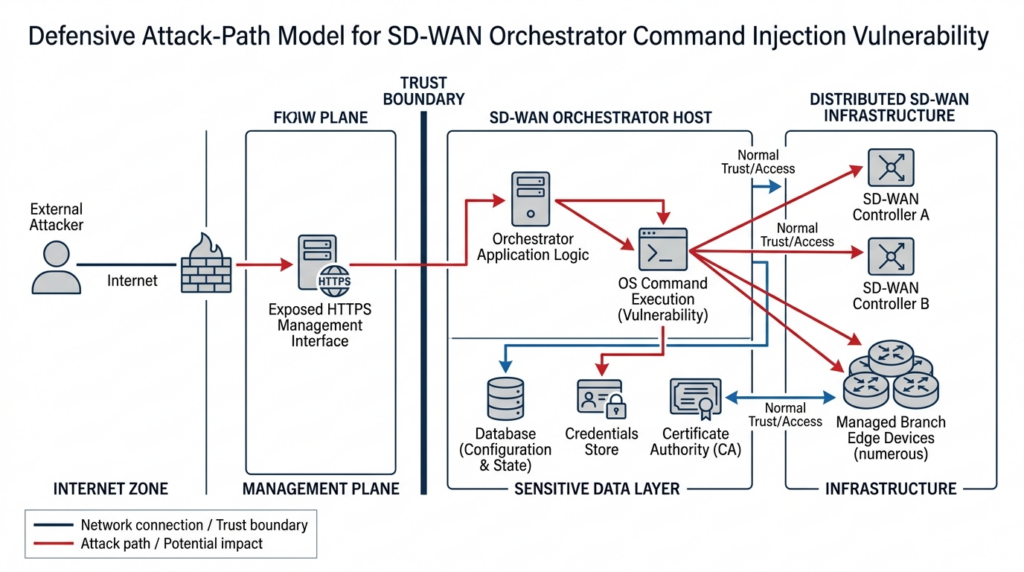
Arista has not published a complete exploit chain, so the following model is intentionally high level. It maps the confirmed vulnerability class to the documented VCO architecture without supplying a real endpoint or payload.
| Sahne | Defensive interpretation | Evidence to seek |
|---|---|---|
| Initial reachability | Attacker can connect to the VCO web interface | Firewall, load balancer, proxy and flow logs |
| Boundary crossing | Request reaches internal-only functionality | Unusual URL structures, encoded characters, backend route anomalies |
| Command injection | Externally influenced data reaches an OS command | Process telemetry, shell activity, child processes, service logs |
| Host impact | Attacker affects files, processes, database access or system state | System logs, file timestamps, process history, database audit data |
| Credential and data access | Attacker seeks configuration, credentials, certificates or key material | File access, database queries, archive creation, export activity |
| Orchestrator abuse | Attacker uses legitimate VCO authority | Administrator audit events, API calls, configuration changes |
| Edge impact | Managed devices receive unauthorized actions or configuration | Edge state, config diffs, activation events, certificate activity |
| Persistence or concealment | Attacker creates durable access or alters evidence | New accounts, keys, services, scheduled jobs, deleted or truncated logs |
The first two stages are strongly supported by the advisory: the attacker requires access to the web interface, credentials are unnecessary, and internal-only functionality is remotely exposed. The command-execution stage is supported by the CWE-78 classification. Later stages are investigation hypotheses derived from the assets Arista explicitly tells customers to review. (Arista Networks)
Defenders should not assume that every successful exploitation attempt completed every stage. Some requests may fail before command execution. Some attackers may perform reconnaissance only. Others may execute a command but fail to establish persistence. Incident response must determine which boundaries were crossed in each environment.
Affected and Fixed VeloCloud Orchestrator Versions
Arista identifies four affected release families.
| Release train | Etkilenen sürümler | Fixed boundary | Operational guidance |
|---|---|---|---|
| VCO 5.2.x | Earlier than 5.2.3.14 | 5.2.3.14 or later | Upgrade within the supported 5.2 train or move to a supported release |
| VCO 6.1.x | Earlier than 6.1.3.4 | 6.1.3.4 or later | Upgrade immediately |
| VCO 6.4.x | Earlier than 6.4.2.4 | 6.4.2.4 or later | Upgrade immediately |
| VCO 7.0.x | Earlier than 7.0.0.1 | Affected-software section indicates 7.0.0.1 as the boundary | Confirm the currently supported fixed image with Arista TAC |
| End-of-support releases | Not assessed | Not established | Do not interpret absence from the table as safety |
The NVD configuration data follows the same affected boundaries: 5.2.0 through versions before 5.2.3.14, 6.1.0 through versions before 6.1.3.4, 6.4.0 through versions before 6.4.2.4, and 7.0.0 before 7.0.0.1. (NVD)
There is a small but important documentation inconsistency. Arista’s Affected Software section lists “VCO 7.0.x releases prior to 7.0.0.1,” but the Resolution section explicitly names fixed releases only for the 5.2, 6.1, and 6.4 trains. (Arista Networks)
The affected-version language strongly indicates that 7.0.0.1 is the relevant safe boundary, but operators should not guess during an emergency change. A 7.0 deployment should be checked against the latest revision of Security Advisory 0144, the Arista software-download portal, and TAC guidance.
The advisory also says end-of-support versions have not been assessed. That does not mean an older train is unaffected. It means the vendor has not made a public determination. Unsupported releases should be treated as requiring migration, isolation, or direct vendor review.
Confirming the Installed Version
Arista’s current Orchestrator deployment documentation says operators can verify VCO package versions with:
dpkg -l | grep vco
The same version should also appear in the Orchestrator interface for an authenticated operator. (Arista Networks)
Use local evidence as the primary source of truth. CMDB records, vulnerability scanner fingerprints, appliance names, and old deployment tickets can be stale.
A basic evidence record should include:
Asset ID:
Hostname:
Management IP:
Public IP or NAT:
Deployment type:
Current VCO version:
Version evidence source:
Release train:
Fixed threshold:
Internet reachable:
VPN reachable:
Management VLAN reachable:
Patch owner:
Patch window:
Logs preserved:
Compromise review status:
For disaster-recovery pairs, record the active and standby versions separately. An upgraded active node does not prove that a standby, recovery image, snapshot, or replacement template is patched.
Why CISA KEV Changes the Response
CISA’s Known Exploited Vulnerabilities Catalog is not a list of vulnerabilities that might eventually become useful to attackers. Inclusion indicates evidence of exploitation in the wild.
CVE-2026-16812 was added on July 27, 2026. CISA assigned a July 30, 2026 due date and directed affected federal agencies to follow vendor mitigations, risk-based update requirements under Binding Operational Directive 26-04, and applicable forensic-triage requirements. (NVD)
BOD 26-04 replaced earlier federal vulnerability-remediation directives and emphasizes prioritization based on practical risk. Although its binding requirements apply to covered federal agencies, the underlying decision model is useful for private organizations: actual exploitation, internet exposure, asset criticality, technical impact, and available remediation should outweigh a simple backlog ordered only by CVSS. (CISA)
For CVE-2026-16812, the relevant risk factors align:
- Exploitation is confirmed.
- Authentication is not required.
- The interface is exposed by default within the product’s expected operation.
- Network access to the web interface is sufficient.
- The vulnerable system is a management-plane component.
- The CVSS base score is 10.0.
- Confidentiality, integrity, and availability may all be compromised.
- Managed Edge devices may be affected.
- CISA assesses the vulnerability as automatable with total technical impact. (NVD)
The correct workflow is therefore not “open a patch ticket and wait for the normal monthly cycle.” It is a coordinated vulnerability and incident-response operation.
The Published Exploitation Indicators
Arista published three IP addresses observed conducting attacks:
8.19.75.217
206.72.242.124
206.72.242.162
Operators are advised to block these addresses and search historical logs for activity from them. (Arista Networks)
These indicators are useful, but they are not a complete detection strategy.
An IP address can represent:
- One scanner in a larger infrastructure set
- A compromised host
- A temporary virtual server
- An exit node
- A relay
- An address later reassigned to an unrelated user
- A source that never contacted a particular organization
Attackers can also rotate infrastructure as soon as an indicator becomes public. Absence of these three addresses does not establish absence of exploitation.
Treat an address match as a high-priority lead, not a standalone conclusion. Correlate it with:
- Requested URL
- HTTP method
- Response code
- Request size
- User-agent behavior
- Session state
- Subsequent outbound traffic
- Backend application events
- Host process activity
- File changes
- Database access
- Administrator changes
- Edge configuration changes
Conversely, a historical match should be validated before public attribution. The source may have performed unsuccessful scanning, or the address may have been reassigned after the relevant event.
Why Public Exposure Is Not the Only Risk
Direct internet exposure produces the clearest unauthenticated attack path, but an on-premises VCO does not have to appear in an internet search engine to be at risk.
Possible reachability paths include:
| Reachability path | Neden önemli |
|---|---|
| Public IP | Direct remote exploitation becomes possible |
| NAT or port forwarding | The internal address may be hidden while the web interface remains reachable |
| Reverse proxy | The proxy can expose selected or accidentally broad routes |
| Load balancer | Front-end listeners may publish the service without obvious host-level evidence |
| Site-to-site VPN | A compromised partner, branch or contractor network may reach the interface |
| Remote-access VPN | A stolen account or compromised endpoint may provide the necessary network position |
| Management VLAN | A breached administrator workstation may reach the VCO |
| MSP network | Shared management paths can expand the population of potential callers |
| Cloud security group | A migration or troubleshooting rule may have exposed TCP 443 broadly |
| Jump host | Compromise of a bastion may provide access to an otherwise segmented interface |
| Disaster-recovery site | A standby VCO may be reachable through a different path than the active instance |
| Lab-to-production route | Temporary routing created for testing can become a persistent exposure |
Arista says VCO is exposed by default and that no VCO configuration prevents the affected exposure. Restricting web-interface access to trusted administrative networks can reduce risk, but it does not replace the software update. (Arista Networks)
“Internal” is therefore a network location, not a security guarantee. The relevant question is whether the interface is reachable from any system or identity an attacker could plausibly compromise.
Safe Exposure Validation
Validation should begin with inventory and network reachability, not command execution.
The following examples are for systems an organization owns or is explicitly authorized to assess. They do not test the command-injection condition.
Create an approved target list:
cat > authorized-vco-targets.txt <<'EOF'
vco01.example.internal
vco02.example.internal
EOF
Check whether the expected web ports are reachable:
nmap -Pn -p 80,443 \
  --open \
  -iL authorized-vco-targets.txt \
  -oA vco-web-reachability
Inspect only response headers:
while read -r target; do
  printf '\n=== %s ===\n' "$target"
  curl --connect-timeout 5 \
       --max-time 10 \
       --silent \
       --show-error \
       --insecure \
       --head \
       "https://${target}/"
done < authorized-vco-targets.txt
These checks answer a limited question: can the assessment system reach an HTTP or HTTPS service at the expected address?
They do not prove:
- That the service is VeloCloud Orchestrator
- That the installed version is affected
- That the internal function is reachable
- That exploitation succeeds
- That the host has not already been compromised
- That another network path is blocked
- That a reverse proxy is applying the same policy to every route
Version confirmation should come from the local system, authenticated management interface, package inventory, or Arista-supported diagnostic process.
A safe classification model is:
| Sonuç | Anlamı | Required next step |
|---|---|---|
| Affected version confirmed | Installed version is below the fixed boundary | Patch and investigate |
| Fixed version confirmed | Current version meets the fixed boundary | Review the pre-patch exposure window |
| Version unknown | Remote behavior cannot establish patch status | Obtain local evidence |
| Interface reachable | Assessment network can connect to the service | Review all untrusted reachability paths |
| Interface unreachable | One test path is blocked | Test other approved paths and verify firewall policy |
| Inconclusive | Evidence conflicts or is incomplete | Escalate for manual review |
| Unsupported release | Vendor has not assessed the train | Isolate, migrate, or obtain TAC guidance |
Do not send shell metacharacters, time-delay commands, callback URLs, or out-of-band DNS payloads to a production VCO. Because exploitation is confirmed and host compromise is possible, a “harmless” command can still alter process state, create misleading evidence, trigger an unstable code path, or violate authorization boundaries.
A Safe Local PoC for the Vulnerability Class
The following demonstration is not an exploit for CVE-2026-16812.
It does not contain a VeloCloud endpoint, does not reproduce an Arista request, does not contact a network service, and cannot determine whether any VCO is vulnerable. It demonstrates two generic design failures described by the public record:
- A function intended for a privileged internal caller is reached without a real authorization decision.
- Untrusted data is inserted into a shell command.
Run it only on a local development system.
#!/usr/bin/env python3
"""
Local educational demonstration only.

This is NOT an exploit for CVE-2026-16812.
It does not connect to VeloCloud Orchestrator.
It does not scan a network.
It demonstrates a generic internal-function exposure plus
OS command-injection programming error.
"""

from __future__ import annotations

import re
import subprocess


SAFE_LABEL = re.compile(r"^[A-Za-z0-9._-]{1,64}$")


def unsafe_internal_diagnostic(
    caller_is_internal: bool,
    diagnostic_label: str,
) -> None:
    """
    Deliberately unsafe example.

    Failure 1:
    The caller_is_internal value is ignored, so an external caller can
    reach an operation intended for an internal service.

    Failure 2:
    Untrusted input is concatenated into a shell command.
    """
    command = f"printf 'Diagnostic label: {diagnostic_label}\\n'"
    subprocess.run(command, shell=True, check=False)


def safer_internal_diagnostic(
    caller_is_internal: bool,
    diagnostic_label: str,
) -> None:
    """
    Safer example.

    - Enforces the caller boundary.
    - Constrains the input to the expected data type.
    - Passes arguments as an array.
    - Does not invoke a shell.
    """
    if not caller_is_internal:
        raise PermissionError("internal service identity required")

    if not SAFE_LABEL.fullmatch(diagnostic_label):
        raise ValueError("invalid diagnostic label")

    subprocess.run(
        ["printf", "Diagnostic label: %s\n", diagnostic_label],
        shell=False,
        check=True,
    )


def main() -> int:
    toy_input = "branch-17; printf 'TOY_INJECTION_MARKER\\n'"

    print("[unsafe demonstration]")
    unsafe_internal_diagnostic(
        caller_is_internal=False,
        diagnostic_label=toy_input,
    )

    print("\n[safer demonstration]")
    try:
        safer_internal_diagnostic(
            caller_is_internal=False,
            diagnostic_label=toy_input,
        )
    except (PermissionError, ValueError) as exc:
        print(f"Blocked: {exc}")

    return 0


if __name__ == "__main__":
    raise SystemExit(main())
The unsafe function produces the marker because shell=True asks a shell to interpret the complete string. The semicolon is parsed as a command separator.
The safer function blocks the call before process execution because the caller lacks the required internal identity. Even for an authorized caller, the input must match a strict label format. The subprocess receives an argument array and does not invoke a shell.
The example teaches four defensive principles:
- Internal routes still require enforceable authentication and authorization.
- A request’s network origin is not a sufficient identity.
- Values expected to be labels, addresses, filenames or identifiers should be validated as those data types.
- External processes should receive separated arguments rather than a shell command string.
It does not prove anything about Arista’s implementation beyond the public CWE and exposure description.
A Four-Layer Validation Workflow
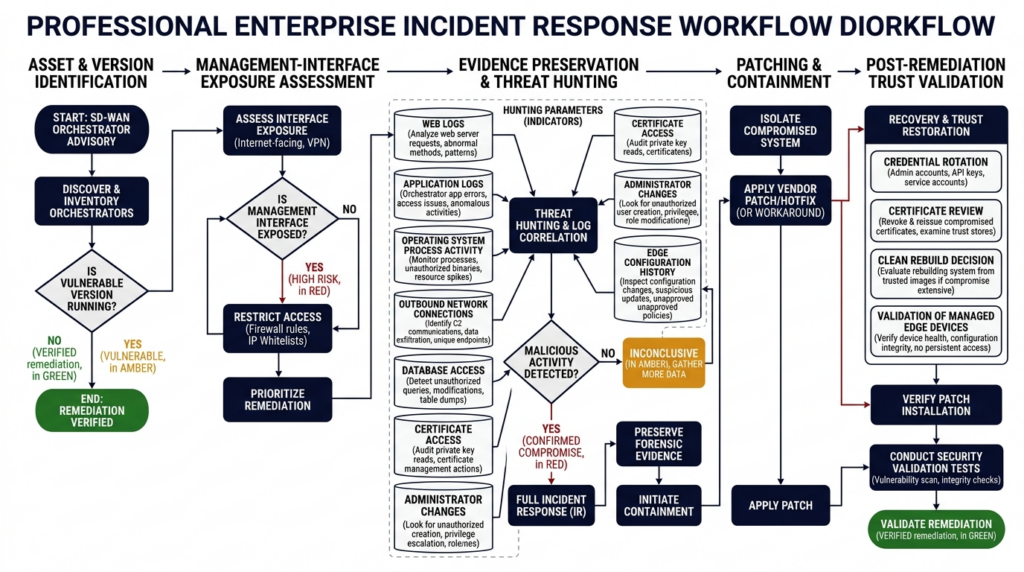
A reliable CVE-2026-16812 assessment should produce evidence across four layers.
Layer One — Product and Version
Confirm:
- The asset is VeloCloud Orchestrator On-Prem.
- The release train is 5.2, 6.1, 6.4, 7.0, or another branch.
- The complete installed version is known.
- The version evidence comes from the appliance, not only the CMDB.
- Active and standby nodes have both been checked.
- Recovery images and snapshots are included.
Layer Two — Reachability
Determine:
- Whether TCP 80 or 443 is reachable from the internet
- Whether a reverse proxy or load balancer publishes the service
- Whether VPN users can reach it
- Whether branch networks can reach it
- Whether contractors or MSPs have a route
- Whether administrator workstations connect directly
- Whether access is restricted to named source networks
- Whether IPv6 creates an exposure not visible in IPv4 reviews
Layer Three — Historical Exploitation Evidence
İncele:
- Web access logs
- Portal, upload and backend application logs
- System logs
- Database activity
- Outbound network connections
- Administrative changes
- File creation and archive activity
- Certificate and key access
- Edge configuration state
- The three published source IPs
Layer Four — Remediation and Retest
Doğrulayın:
- The installed version is fixed.
- The web interface is restricted as intended.
- External logging is operational.
- No stale standby node remains vulnerable.
- Administrative and device state match the approved baseline.
- Credentials and certificates have been rotated where necessary.
- The same checks succeed after the maintenance window.
For organizations managing many appliances, the value of AI-assisted validation is not sending aggressive payloads. It is maintaining the relationship among authorized scope, asset identity, version evidence, reachability, log findings, remediation and retest results. An evidence-oriented platform such as Penligent can support that authorized workflow while keeping potentially destructive actions under human control. Penligent’s separate analysis of the CVE-2026-20127 SD-WAN control-plane trust problem provides additional context for investigating centralized SD-WAN authority rather than treating the controller or orchestrator as an ordinary web server. (Penligent)
Log Sources That Matter
Arista says there is no single definitive indicator of compromise for CVE-2026-16812. Detection requires correlation across web, application, system, database, network and administrative evidence. (Arista Networks)
The VCO deployment guide identifies several application logs:
/var/log/portal/velocloud.log
/var/log/upload/velocloud.log
/var/log/backend/velocloud.log
The portal log covers portal service information, warnings and errors. The upload service handles incoming requests from Edges and Gateways, including activations, heartbeats, flow statistics, link statistics and routing information. The backend service processes scheduled and queued jobs. (Arista Networks)
Arista also documents Syslog forwarding properties for backend, portal and upload services:
log.syslog.backend
log.syslog.portal
log.syslog.upload
Operators can enable forwarding and configure the relevant Syslog host and port through Orchestrator system properties. (Arista Networks)
External logging is particularly important for an actively exploited command injection. If an attacker gains control of the host, local logs may be modified, deleted, rotated or selectively truncated. An independently administered log platform creates a second source of evidence.
Relevant data sources include:
| Data source | Questions it can answer |
|---|---|
| Reverse proxy or load balancer logs | Which external requests reached the service |
| VCO web access logs | Which paths, methods and encodings were used |
| Portal logs | Whether portal functions produced abnormal errors or actions |
| Upload logs | Whether device-facing operations changed unexpectedly |
| Backend logs | Whether scheduled or queued work deviated from normal behavior |
| System journal | Whether services restarted or unusual commands executed |
| Process telemetry | Whether the web application launched shells or utilities |
| Database logs | Whether sensitive tables were queried or exported |
| NetFlow or firewall logs | Whether the VCO initiated unusual outbound connections |
| Administrator audit events | Whether accounts, roles or configurations changed |
| File-integrity monitoring | Whether binaries, scripts, services or archives appeared |
| Edge configuration history | Whether remote devices received unauthorized changes |
| Certificate records | Whether issuance, renewal or revocation activity changed |
Web Request Hunting
Arista advises operators to investigate requests containing unusual URL-like path components, encoded characters, references to local or internal services, or unusually high request rates. (Arista Networks)
Those categories are intentionally broad. Without a public exploit path, a narrowly defined signature risks missing real activity.
A basic local triage command might be:
sudo grep -RIE \
  '(%[0-9A-Fa-f]{2}|localhost|127\.0\.0\.1|0\.0\.0\.0|::1|file:|unix:|/proc/|/etc/)' \
  /var/log/nginx \
  /var/log/portal \
  /var/log/upload \
  /var/log/backend \
  2>/dev/null
This is not a CVE-specific detector. It surfaces encoded characters, loopback references, URI schemes and sensitive local paths for analyst review.
Expect false positives from:
- Normal URL encoding
- Health checks
- Internal API calls
- IPv6 loopback tests
- Monitoring tools
- Support diagnostics
- Certificate operations
- Legitimate file-path errors
- Vulnerability scanners used by the organization
Context is required. A single percent-encoded character is not proof of attack. A stronger pattern would combine unusual encoding with an unauthenticated request, an unexpected route, a backend error, process activity and outbound traffic within the same time window.
A vendor-neutral SIEM query can be expressed as:
FROM vco_web_requests
WHERE
    uri_has_unusual_encoding = true
    OR uri_references_local_service = true
    OR request_rate_exceeds_baseline = true
GROUP BY
    source_ip,
    destination_host,
    uri_path,
    http_method,
    response_status
CORRELATE WITH
    vco_process_events,
    vco_outbound_connections,
    vco_admin_changes
WITHIN 10 minutes
The correlation is more valuable than any one condition.
A Local Log Triage Script
The following script searches text logs for categories named in the Arista advisory. It is deliberately generic and does not contain a VeloCloud exploit signature.
#!/usr/bin/env python3
"""
Defensive local log triage for authorized CVE-2026-16812 investigations.

This script:
- reads existing local log files;
- does not send network requests;
- does not determine whether exploitation succeeded;
- surfaces lines that need analyst review.
"""

from __future__ import annotations

import argparse
import ipaddress
import re
from pathlib import Path
from typing import Iterable


OBSERVED_IPS = {
    "8.19.75.217",
    "206.72.242.124",
    "206.72.242.162",
}

ENCODING = re.compile(r"%[0-9a-fA-F]{2}")
LOCAL_REFERENCE = re.compile(
    r"(localhost|127\.0\.0\.1|0\.0\.0\.0|::1|"
    r"file:|unix:|/proc/|/etc/|/var/run/)",
    re.IGNORECASE,
)
SENSITIVE_ACTION = re.compile(
    r"(database.{0,20}(export|dump)|"
    r"certificate|private.?key|credential|"
    r"archive|tar\b|zip\b|"
    r"configuration.{0,20}(change|update)|"
    r"maintenance.{0,20}(run|execute))",
    re.IGNORECASE,
)
IP_PATTERN = re.compile(
    r"(?<![0-9.])(?:\d{1,3}\.){3}\d{1,3}(?![0-9.])"
)


def valid_ips(line: str) -> set[str]:
    results: set[str] = set()

    for candidate in IP_PATTERN.findall(line):
        try:
            results.add(str(ipaddress.ip_address(candidate)))
        except ValueError:
            continue

    return results


def reasons_for_line(line: str) -> list[str]:
    reasons: list[str] = []

    if OBSERVED_IPS.intersection(valid_ips(line)):
        reasons.append("published-observed-ip")

    if ENCODING.search(line):
        reasons.append("encoded-character")

    if LOCAL_REFERENCE.search(line):
        reasons.append("local-or-internal-reference")

    if SENSITIVE_ACTION.search(line):
        reasons.append("sensitive-action-keyword")

    return reasons


def scan_file(path: Path) -> Iterable[str]:
    with path.open("r", encoding="utf-8", errors="replace") as handle:
        for line_number, line in enumerate(handle, start=1):
            reasons = reasons_for_line(line)

            if reasons:
                yield (
                    f"{path}:{line_number}:"
                    f"{','.join(reasons)}: {line.rstrip()}"
                )


def main() -> int:
    parser = argparse.ArgumentParser()
    parser.add_argument("logs", nargs="+", type=Path)
    args = parser.parse_args()

    for path in args.logs:
        if not path.is_file():
            print(f"SKIP not-a-file: {path}")
            continue

        for result in scan_file(path):
            print(result)

    return 0


if __name__ == "__main__":
    raise SystemExit(main())
Example usage:
python3 hunt_vco_logs.py \
  /var/log/portal/velocloud.log \
  /var/log/upload/velocloud.log \
  /var/log/backend/velocloud.log
The output is a review queue, not a verdict. Analysts should correlate each line with request metadata, process activity, administrative records and the organization’s own maintenance calendar.
Host-Level Detection
Arista advises operators to investigate unexpected command execution, file creation, database exports and archive artifacts on the VCO host. (Arista Networks)
Where endpoint telemetry is available, useful behavioral questions include:
- Did an application service launch
sh,bash,dashor another interpreter? - Did the service launch networking utilities outside a maintenance window?
- Did it create an archive containing configuration or database files?
- Did a process read certificate or key directories unexpectedly?
- Did a new executable appear in a writable directory?
- Did a service definition, startup script or scheduled task change?
- Did the host create an outbound connection immediately after an unusual web request?
- Did a database export coincide with an unauthenticated request?
- Were logs truncated after suspicious activity?
- Did system time, package state or update history change unexpectedly?
Do not build detection around a guessed parent process. The public advisory does not identify the exact vulnerable service or shell path.
A generic process-correlation rule is safer:
SELECT process_event
WHERE
    host_role = "VeloCloud Orchestrator"
    AND parent_process belongs_to management_application
    AND child_process belongs_to command_interpreter_or_system_utility
    AND event_time outside approved_maintenance_window
CORRELATE WITH
    unusual_web_request
    OR unexpected_outbound_connection
    OR sensitive_file_access
WITHIN 5 minutes
Expected administrative activity can produce similar events. VCO software updates, support diagnostics, backups and scheduled maintenance may legitimately execute system utilities. Baselines and change records are essential.
Network Detection
Unexpected outbound HTTP or HTTPS traffic from the VCO host is one of Arista’s named investigation signals. (Arista Networks)
That signal is important because management appliances often require some legitimate outbound access. Arista documentation notes that the Orchestrator may depend on external services and needs established outbound connectivity for upgrades and security updates. (Arista Networks)
A blanket rule stating “VCO should never connect to the internet” may therefore produce noise or break required functions. A better approach is destination and behavior baselining.
İncele:
- New destination IPs or domains
- Direct-to-IP HTTPS that bypasses normal DNS patterns
- Connections to newly registered or low-reputation infrastructure
- Repeated short connections after unusual web requests
- Large outbound transfers
- Connections on unexpected ports
- Requests containing host or environment metadata
- DNS lookups for random-looking subdomains
- Traffic that bypasses the approved proxy
- Connections from the VCO to branch networks it does not normally manage directly
An egress policy should permit only documented services, update destinations, support workflows, monitoring destinations and necessary SD-WAN communications. Every exception should have an owner.
Configuration and Administrative Detection
A command injection on an orchestrator does not have to leave an obvious malware file. An attacker may instead use the appliance’s legitimate management capabilities.
Arista recommends reviewing sensitive configuration changes and privileged maintenance actions that do not correspond to expected administrator workflows. (Arista Networks)
High-value checks include:
- New operator or tenant accounts
- Role changes
- Password resets
- New API credentials
- Changes to authentication settings
- New trusted networks
- Firewall or access-policy changes
- Device activation events
- Profile and template changes
- Edge configuration pushes
- Certificate issuance or renewal
- Certificate revocation changes
- External CA configuration changes
- New Syslog destinations
- Logging disabled or retention reduced
- Support access enabled unexpectedly
- Disaster-recovery role changes
- Standby promotion outside a maintenance window
- Backup or diagnostic-bundle generation
- Database exports
- Unexpected software uploads
Configuration diffs should be compared with change-management records. A technically valid change is not necessarily an authorized change.
Preserving Evidence Before Remediation
Arista tells operators who suspect compromise to preserve VCO web access logs, backend application logs, system logs, database logs and relevant file-system timestamps before remediation where operationally feasible. (Arista Networks)
That instruction creates an important sequencing decision. Patching must happen quickly, but a reboot, upgrade or rebuild may overwrite volatile evidence and rotate logs.
A practical sequence is:
- Restrict external access.
- Record the current time and time-zone configuration.
- Preserve externally stored logs.
- Collect relevant local logs.
- Record active processes and network connections.
- Capture package and version information.
- Obtain an approved diagnostic bundle.
- Snapshot the virtual machine where policy permits.
- Record file-system timestamps for suspicious files.
- Preserve database logs and audit records.
- Export administrator and configuration history.
- Begin the vendor-supported upgrade.
- Continue investigation using preserved copies.
NIST incident-response guidance emphasizes analyzing incident data, determining appropriate containment and recovery actions, and integrating response into broader cybersecurity risk management. Its log-management guidance also stresses reliable collection, transmission, storage and access to security records. (NIST Bilgisayar Güvenliği Kaynak Merkezi)
Evidence collection must still respect operational constraints. A large snapshot, database dump or diagnostic bundle can affect an overloaded appliance. Coordinate with network operations, incident response, legal and Arista TAC.
Immediate Containment
Containment should reduce attack reachability without destroying evidence or cutting off essential SD-WAN operations.
Arista recommends:
- Restricting access to the VCO web interface to trusted administrative networks
- Monitoring for access from the published malicious IPs
- Monitoring unexpected outbound activity
- Reviewing recent administrator activity (Arista Networks)
A stronger emergency containment plan may include:
- Removing public NAT to the management interface
- Restricting TCP 80 and 443 to named administrative source ranges
- Requiring access through a hardened jump host
- Blocking access from general user and branch networks
- Reviewing IPv6 exposure
- Applying equivalent controls at firewalls, security groups, proxies and load balancers
- Restricting outbound traffic to documented destinations
- Increasing log retention
- Enabling packet capture at an upstream control point where appropriate
- Freezing nonessential configuration changes
- Separating suspected compromised nodes from clean recovery infrastructure
Do not rely solely on the three published IP addresses. Source blocking is an additional control, not remediation.
Patching the VCO
Arista’s recommended resolution is to upgrade to a fixed VCO release at the earliest opportunity. Customers on unsupported release trains should contact TAC to discuss upgrade options. (Arista Networks)
The general fixed versions are:
5.2.3.14 or later in the 5.2 train
6.1.3.4 or later in the 6.1 train
6.4.2.4 or later in the 6.4 train
The affected-version section also places the 7.0 boundary at 7.0.0.1, but 7.0 operators should confirm the exact current image with Arista because the initial Resolution section does not separately list that train. (arista.com)
Arista’s Orchestrator guide documents an image-based update process and recommends coordinating upgrades with support. The guide also notes that upgrades can involve schema changes, mandatory reboots, configuration transfer and, for some transitions, no rollback to the previous release. (Arista Networks)
Before upgrading:
- Confirm backup health.
- Record active and standby versions.
- Preserve incident evidence.
- Validate available disk space.
- Confirm Edge and Gateway connectivity.
- Freeze unrelated configuration changes.
- Verify the upgrade image source and integrity.
- Review the supported upgrade path.
- Arrange a recovery plan.
- Confirm support availability.
After upgrading:
dpkg -l | grep vco
Then verify:
- The expected version is installed.
- Portal and management services are healthy.
- Edge and Gateway connections recover.
- DR replication is healthy.
- External Syslog forwarding still works.
- Firewall restrictions remain in place.
- No old virtual machine or snapshot has returned to service.
- The standby node is also fixed.
- The software inventory reflects the new version.
Why Patching Is Not the End of the Incident
A patch prevents future exploitation of the corrected path. It does not undo actions completed before the upgrade.
An attacker who previously reached the host may have:
- Created an account
- Added an SSH key
- Changed a service
- Installed a scheduled task
- Modified an application component
- Exported the database
- Read API credentials
- Copied certificates
- Obtained key material
- Changed Edge configuration
- Created a new trusted network
- Disabled logging
- Established an external access path
Arista’s post-remediation guidance therefore includes credential rotation, review of administrator activity, validation of managed-device state, and restoration or replacement of affected Orchestrator instances from trusted sources. (Arista Networks)
The response decision should distinguish three conditions.
Vulnerable but No Evidence of Exploitation
Actions may include:
- Hemen yama
- Restrict access
- Review the full exposure window
- Confirm external logging
- Retest version and reachability
- Increase monitoring
- Document the evidence supporting the conclusion
Suspicious Activity but Incomplete Evidence
Actions should include:
- Treat the host as potentially compromised
- Preserve evidence
- Contain access
- Engage TAC and incident response
- Rotate high-risk credentials
- Review Edge and Controller state
- Prepare a trusted rebuild
- Expand hunting to connected systems
Confirmed Exploitation
Actions should include:
- Isolate the affected management path
- Preserve forensic evidence
- Rebuild or restore from trusted sources
- Rotate administrative credentials
- Rotate API secrets and tokens
- Review certificate and CA exposure
- Validate every managed Edge
- Reconcile configurations against a trusted baseline
- Investigate adjacent systems
- Reestablish logging and monitoring
- Meet applicable notification obligations
“Patch and monitor” is insufficient when host compromise has been confirmed.
Credential and Certificate Rotation
The scope of rotation should be driven by what the VCO could access during the exposure window.
Potentially relevant secrets include:
- VCO operator credentials
- Tenant administrator credentials
- Local operating-system accounts
- Support accounts
- API tokens
- Automation credentials
- Database credentials
- Backup credentials
- Monitoring credentials
- Syslog authentication material
- Hypervisor or infrastructure credentials stored on the host
- Edge activation secrets
- Certificate-authority credentials
- Device certificates
- TLS private keys
Arista documentation states that certificates are used to authenticate management-plane TLS tunnels and control or data-plane IKEv2 or IPsec tunnels. It also describes the Orchestrator’s role in certificate issuance and renewal workflows. (Arista Networks)
Rotation should follow dependency order. Revoking certificates or replacing keys without understanding device behavior can disconnect branches. Coordinate with network engineering and TAC, and verify every step against the actual deployment architecture.
A useful decision table is:
| Secret type | Rotate when | Doğrulama |
|---|---|---|
| Operator passwords | Host exploitation confirmed or credential store accessed | Test named administrator accounts and remove unknown accounts |
| API tokens | Token files or API configuration may have been read | Revoke old tokens and review recent API activity |
| Database credentials | Database configuration or exports were accessed | Change credentials and verify application connectivity |
| TLS keys | Private-key exposure cannot be excluded | Replace certificates and confirm trust chains |
| Device certificates | Orchestrator PKI data or CA authority may be compromised | Coordinate staged re-enrollment and revocation |
| Support accounts | Unexpected support access or account creation appears | Disable or recreate under approved process |
| Hypervisor credentials | Credentials were stored or used on the VCO host | Rotate and review hypervisor audit logs |
Validating Managed Edge State
Arista explicitly warns that compromise of VCO may allow access to VeloCloud Edge devices. (Arista Networks)
That does not prove that every exploited VCO resulted in Edge compromise. It means Edge validation belongs in the response plan.
For each managed Edge, compare:
- Device identity
- Software version
- Configuration profile
- Firewall policy
- Routing policy
- VPN and tunnel settings
- DNS configuration
- Administrative access
- Certificate state
- Activation history
- Recent restart or upgrade events
- Unexpected configuration pushes
- New external destinations
- Changes outside maintenance windows
Prioritize:
- Internet-facing branches
- Critical infrastructure sites
- Data centers
- Payment or identity environments
- Branches with local administrative access
- Sites carrying regulated data
- Edges that received changes during the suspected compromise window
- Devices with unexplained disconnects or reactivations
The investigation should answer whether the Orchestrator was used only as a compromised host or as an authorized control channel into the wider fabric.
Rebuilding Trust
A management-plane compromise creates a trust problem, not merely a software problem.
After a normal vulnerability patch, the organization trusts that the system is running corrected code.
After confirmed command execution, the organization must answer additional questions:
- Can the operating-system image still be trusted?
- Can installed packages be trusted?
- Can service definitions be trusted?
- Can the database be trusted?
- Can administrator accounts be trusted?
- Can certificates issued during the exposure window be trusted?
- Can stored configuration be trusted?
- Can the standby node be trusted?
- Can backups created during the compromise be trusted?
- Can managed Edge configuration be trusted?
Where those questions cannot be answered with evidence, rebuilding from a trusted source is safer than attempting to remove only visible artifacts.
A trusted recovery process may include:
- Build a clean VCO instance from a vendor-provided image.
- Apply the fixed software before exposure.
- Harden management access.
- Restore only reviewed data.
- Recreate privileged accounts.
- Rotate secrets.
- Validate certificate state.
- Reconcile configuration against approved records.
- Reconnect Edges in controlled stages.
- Monitor closely for recurrence.
The old instance should remain isolated for forensic analysis according to organizational policy.
Hardening the Management Plane
The emergency patch addresses CVE-2026-16812. Long-term controls reduce the impact of the next management-plane vulnerability.
Restrict Web Access
Permit the VCO interface only from:
- Hardened jump hosts
- Named administrator networks
- Approved support paths
- Dedicated out-of-band management networks
Avoid broad private ranges such as an entire corporate RFC 1918 space when only a small administrative subnet is needed.
Separate Administrative Workstations
A management VLAN is not enough if ordinary browsing, email and document handling occur on the same administrator endpoint. Use hardened workstations for network-management access.
Control Egress
Document every legitimate outbound dependency. Deny or alert on connections outside the approved set.
Forward Logs Externally
Enable portal, upload and backend Syslog forwarding. Store logs under separate administrative control with sufficient retention for delayed incident discovery. Arista documents the relevant log.syslog properties for these services. (Arista Networks)
Monitor Configuration Drift
Export or record trusted configuration state and alert on differences not linked to approved changes.
Protect DR Infrastructure
Apply the same network restrictions, patching and monitoring to standby Orchestrators. A forgotten DR node can reintroduce the vulnerability after the primary system is fixed.
Minimize Privileged Integrations
Review API tokens, support access, automation accounts and external CA integration. Every integration expands the consequences of host compromise.
Test Recovery
A backup that has never been restored is not a recovery capability. Test clean VCO restoration, credential rotation and Edge-state reconciliation before an emergency.
Related Control-Plane and Edge Vulnerabilities
CVE-2026-16812 belongs to a broader pattern: vulnerabilities in centralized network and security appliances create impact beyond the vulnerable host because those systems possess authority over other infrastructure.
| CVE | Ürün | Zayıflık | Attack condition | Why it is relevant |
|---|---|---|---|---|
| CVE-2026-16812 | Arista VeloCloud Orchestrator On-Prem | İşletim sistemi komut enjeksiyonu | Unauthenticated network access to VCO web interface | Compromise may affect the Orchestrator, managed data and Edge devices |
| CVE-2026-20127 | Cisco Catalyst SD-WAN control components | Peering authentication bypass | Unauthenticated crafted requests | Attacker may gain a high-privileged internal account and manipulate fabric configuration through NETCONF |
| CVE-2024-3400 | Palo Alto Networks PAN-OS GlobalProtect | File creation leading to OS command injection | Unauthenticated access to affected GlobalProtect configurations | Shows how command injection in an edge security appliance can require patching plus full compromise investigation |
CVE-2026-20127 and SD-WAN Fabric Authority
CVE-2026-20127 affects Cisco Catalyst SD-WAN Controller, Manager and Validator components. Cisco says an unauthenticated remote attacker can bypass peering authentication and obtain administrative privileges. A successful attacker may access NETCONF and manipulate configuration for the SD-WAN fabric. Cisco has also acknowledged limited exploitation. (Cisco)
The root cause differs from CVE-2026-16812. Cisco’s issue is a peering-authentication failure, while the Arista VCO issue is classified as OS command injection involving exposed internal functionality.
The operational lesson is shared: compromise of centralized SD-WAN authority cannot be scoped only to one virtual machine. Defenders must validate the state of the managed fabric.
CVE-2024-3400 and Edge Appliance Recovery
CVE-2024-3400 affected specific PAN-OS versions with GlobalProtect enabled. Palo Alto Networks described it as an unauthenticated command-injection vulnerability that could allow root-level arbitrary code execution on the firewall. The vendor confirmed active attacks and recommended immediate upgrades, forensic review, and stronger recovery procedures for potentially compromised devices. (Palo Alto Networks PSA)
CVE-2024-3400 should not be used to infer the missing technical details of CVE-2026-16812. The affected code, product architecture and execution context are different.
Its relevance is incident handling. Both cases demonstrate why patching an actively exploited network appliance does not, by itself, establish that the device is trustworthy.
Common Response Mistakes
Treating CVSS as the Entire Decision
The score is 10.0, but active exploitation, unauthenticated reachability and management-plane authority are more important than the number alone.
Assuming Authentication Is Required
Arista explicitly says tenant and operator credentials are not required. (Arista Networks)
Checking Only Internet Exposure
A compromised VPN user, branch, partner, administrator workstation or MSP network may provide the required web-interface reachability.
Confusing Hosted and On-Prem Deployments
The public advisory focuses on VCO On-Prem. Arista says Hosted and Dedicated environments were patched before disclosure. Inventory must identify deployment type, not just product name. (Arista Networks)
Blocking Only the Published IPs
The three IP addresses are useful historical indicators. They cannot represent every scanner, relay or later campaign.
Restarting Before Collecting Evidence
A reboot or upgrade can remove volatile state, rotate logs and change timestamps. Preserve evidence first where operationally feasible.
Running an Untrusted PoC
A public script claiming to check command injection may execute real commands, install malware, change appliance state or leak credentials. No production VCO should receive an exploit payload merely to prove that an already affected version is vulnerable.
Declaring Safety After a Failed Remote Probe
A WAF, proxy, ACL or route may block one test source while another source remains able to reach the service. Local version evidence is stronger than a negative remote result.
Ignoring the Pre-Patch Window
A fixed version prevents new exploitation of the corrected path. It does not show whether the old version was exploited.
Treating Unsupported Releases as Unaffected
Arista says end-of-support versions have not been assessed. Unknown is not safe. (Arista Networks)
Overstating the 7.0 Resolution
The affected-version table uses 7.0.0.1 as the boundary, but the initial Resolution section does not explicitly list the 7.0 train. Confirm the current vendor guidance before making a production change.
Response Priority Matrix
| Condition | Öncelik | Minimum action |
|---|---|---|
| Affected version publicly reachable | Emergency | Restrict access, preserve evidence, patch and investigate |
| Affected version reachable from VPN or branch networks | Emergency | Contain internal reachability, patch and hunt |
| Affected version on isolated admin network | Kritik | Validate isolation, preserve logs and patch immediately |
| Fixed version upgraded after July 27 | Critical review | Investigate the earlier exposure period |
| Hosted VCO | Confirmed lower direct exposure to this CVE | Verify vendor-managed patch status and local access assumptions |
| Unknown version | Critical until resolved | Obtain local package or UI evidence |
| Unsupported release | Kritik | Isolate and coordinate migration or TAC guidance |
| Published IOC match | Incident response | Preserve evidence and correlate across host and network data |
| Confirmed command execution | Incident response emergency | Rebuild trust, rotate secrets and validate managed Edges |
Frequently Asked Questions
Does CVE-2026-16812 require a VeloCloud account?
- No VCO tenant or operator credentials are required.
- The attacker must be able to reach the VCO web interface over the network.
- Restricting the interface to trusted administrative networks reduces exposure but does not replace patching.
- Any reachable affected on-premises VCO should be treated as an emergency. (Arista Networks)
Which VeloCloud Orchestrator versions are affected?
- VCO 5.2.x before 5.2.3.14
- VCO 6.1.x before 6.1.3.4
- VCO 6.4.x before 6.4.2.4
- VCO 7.0.x before 7.0.0.1
- End-of-support versions have not been assessed.
- Confirm the installed version locally with package or authenticated UI evidence. (arista.com)
Is Hosted VeloCloud Orchestrator affected?
- The affected product identified by Arista is VeloCloud Orchestrator On-Prem.
- Arista says Hosted and Dedicated VCO environments were patched before public disclosure.
- The advisory’s unaffected list includes VeloCloud Orchestrator Hosted.
- Customers should still confirm service status and review their own access and integration risks. (Arista Networks)
How can defenders validate exposure without exploiting the vulnerability?
- Confirm the deployment type and installed version locally.
- Test only whether the management interface is reachable from approved network locations.
- Review firewall, NAT, proxy, load balancer and VPN rules.
- Inspect logs for the patterns described by Arista.
- Patch to the fixed release and repeat the version and reachability checks.
- Do not send command-injection, delay or callback payloads to production systems.
Is patching enough after CVE-2026-16812?
- Patching closes the corrected vulnerability path.
- It does not remove accounts, keys, files or configuration changes created before the patch.
- Review the complete exposure window.
- Preserve and correlate web, application, system, database and network logs.
- Rotate credentials and certificates when exposure cannot be excluded.
- Rebuild from a trusted image if host compromise is confirmed or system integrity cannot be established.
Which logs should be checked first?
- VCO web access logs
/var/log/portal/velocloud.log/var/log/upload/velocloud.log/var/log/backend/velocloud.log- System and service logs
- Database and export activity
- Firewall, proxy and outbound flow logs
- Administrator and configuration audit events
- Edge configuration and activation history (Arista Networks)
What are the published indicators of compromise?
- Arista published
8.19.75.217,206.72.242.124ve206.72.242.162as IP addresses observed conducting attacks. - Search historical logs and block the addresses where appropriate.
- Investigate unusual encoded URLs, internal-service references and high request rates.
- Hunt for unexpected outbound connections, command execution, file creation, database exports and configuration changes.
- Absence of the three IP addresses does not prove the environment was not targeted. (Arista Networks)
Should a compromised VCO be rebuilt?
- Rebuilding is appropriate when command execution is confirmed or host integrity cannot be established.
- Preserve evidence before replacement.
- Restore only reviewed data from a trusted source.
- Recreate privileged accounts and rotate exposed secrets.
- Validate certificate authority and device-certificate state.
- Compare every managed Edge against an approved configuration baseline.
- Coordinate the recovery with Arista TAC and the organization’s incident-response team.
Closing Assessment
CVE-2026-16812 deserves emergency treatment because four risk factors converge: unauthenticated network access, OS command injection, active exploitation, and management-plane authority over distributed SD-WAN infrastructure.
The defensive sequence should be equally clear: identify every on-premises VCO, restrict web-interface reachability, preserve evidence, install the fixed release, investigate the historical exposure window, rotate affected trust material, and validate the state of managed Edge devices.
A patched Orchestrator is no longer exposed to the corrected command-injection path. A trusted Orchestrator is one whose host, accounts, data, certificates, configuration and managed infrastructure have also been shown to remain under legitimate control.

 Turkish
  English
  German
  French
  Spanish
  Portuguese
  Japanese
  Korean
  Hindi
Hindi  Arabic
  Hebrew