
CVE-2026-48907 is a critical remote code execution vulnerability affecting the Joomla Content Editor, commonly known as JCE, that turns what should be an administrative editor-profile function into an unauthenticated path toward arbitrary PHP execution.
This is not merely a theoretical privilege-boundary weakness or a vulnerability requiring an existing Joomla administrator account. The official CVE record describes a condition in which unauthenticated users can create new JCE editor profiles, ultimately enabling PHP code to be uploaded and executed. The Joomla CNA assigned the flaw a CVSS v4.0 base score of 10.0 Kritik, with network accessibility, low attack complexity, no required privileges, no user interaction, and high confidentiality, integrity, and availability impact.
The vulnerability affects JCE versions 1.0.0 through 2.9.99.4 according to the official CVE record. JCE 2.9.99.5, released on June 3, 2026, introduced the primary fix, while subsequent releases added additional security hardening.
The risk became substantially more urgent after CISA added CVE-2026-48907 to its Known Exploited Vulnerabilities catalog on June 16, 2026, indicating evidence of active exploitation. CISA’s enrichment data classifies exploitation as active, the vulnerability as automatable, and the technical impact as total.
For Joomla administrators, hosting providers, managed service providers, and security teams, that combination changes the operational response completely.
CVE-2026-48907 should be treated as a potential server-compromise event rather than simply another extension update.
CVE-2026-48907 at a Glance
| Saha | Detaylar |
|---|---|
| CVE | CVE-2026-48907 |
| Ürün | Joomla Content Editor, JCE |
| Güvenlik açığı türü | Improper Access Control |
| CWE | CWE-284 |
| Birincil etki | Unauthenticated PHP upload and execution |
| Saldırı vektörü | Network |
| Privileges required | Hiçbiri |
| User interaction | Hiçbiri |
| Attack complexity | Düşük |
| CVSS v4.0 | 10.0 Kritik |
| Etkilenen sürümler | JCE 1.0.0 through 2.9.99.4 |
| Primary fixed version | JCE 2.9.99.5 |
| Active exploitation | Evet |
| CISA KEV | Added June 16, 2026 |
These characteristics come directly from the Joomla-assigned CVE record and subsequent CISA enrichment.
The most important line in that table is not the CVSS score.
It is Privileges Required: None.
A vulnerability affecting a CMS extension becomes dramatically more dangerous when an attacker does not first need to compromise a Joomla user account, steal an administrator session, conduct phishing, or defeat an authentication mechanism.
The vulnerable component itself provides the path from the Internet to server-side code execution.
What Is JCE and Why Does CVE-2026-48907 Matter?
JCE is an editor extension for Joomla that provides richer content-editing and file-management functionality than a basic text editor. Like many CMS extensions, it operates within the security context of the underlying Joomla installation and interacts with functionality such as editor profiles, file browsers, image managers, upload permissions, and filesystem locations.
That makes access control particularly important.
An editor extension should normally distinguish between anonymous visitors, authenticated content authors, administrators, and other user groups. File-related capabilities should likewise depend on explicitly granted privileges.
CVE-2026-48907 breaks that trust boundary.
The official CVE description states that the vulnerability allows the creation of new editor profiles for unauthenticated users, eventually resulting in PHP code upload and execution.
JCE’s own June 3 security release described the underlying problem as allowing unauthenticated users to upload editor profiles, which could subsequently be exploited to upload arbitrary files to the server. The vendor classified the update as a critical security release and advised all users to update.
That profile-management stage is the critical concept behind understanding the vulnerability.
Instead of thinking about CVE-2026-48907 simply as:
Unauthenticated user → PHP upload
it is more accurate to understand the trust-boundary failure as:
Unauthenticated request → unauthorized editor profile → dangerous upload capabilities → executable file placement → PHP execution
The distinction matters because the vulnerability is fundamentally an authorization failure that enables creation of a more powerful execution primitive.
The Root Cause: Improper Access Control
CVE-2026-48907 is classified under CWE-284: Improper Access Control.
Access control vulnerabilities occur when an application fails to enforce whether a user or request should be permitted to perform an operation.
In the case of JCE, the operation exposed through the vulnerable path involves editor-profile functionality.
Profiles are security-sensitive because they can control what capabilities an editor receives. Depending on configuration, those capabilities may include filesystem access, upload functionality, permitted file extensions, image management, file browsing, and related operations.
Allowing an anonymous attacker to influence those settings therefore has consequences that extend far beyond modifying an editor toolbar.
The attacker’s goal is to construct or import a profile with capabilities that would never legitimately be assigned to an unauthenticated visitor.
Once that security boundary fails, other JCE functionality can become an exploitation primitive.
The flaw demonstrates an important principle in web application security:
An authorization vulnerability does not have to directly execute commands to become an RCE vulnerability.
If the authorization failure lets an attacker change configuration governing another dangerous capability, the combined attack chain may be equivalent to direct code execution.
That is precisely why CVE-2026-48907 receives maximum severity.
How the CVE-2026-48907 Attack Chain Works
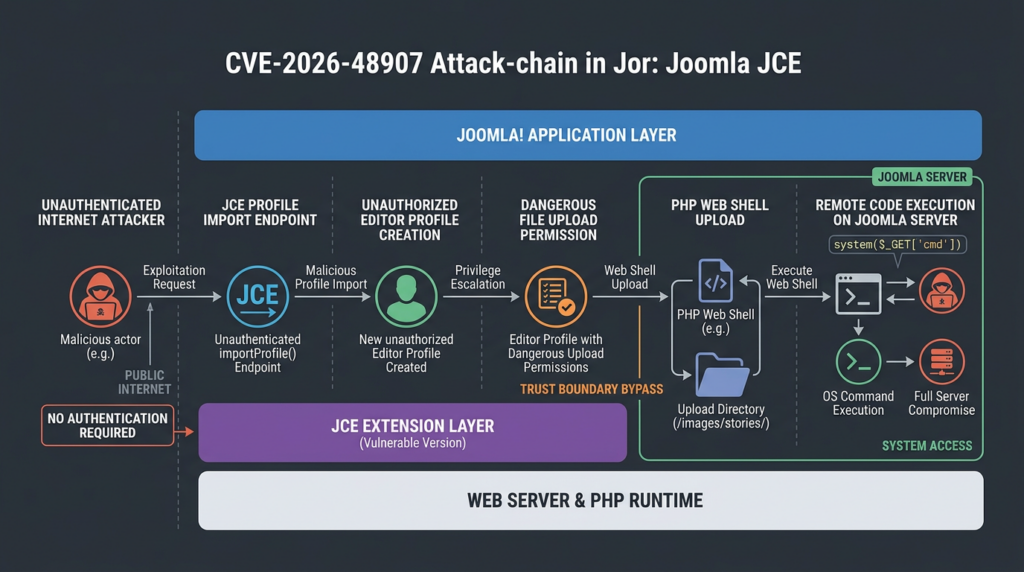
The vendor has publicly described enough of the exploitation path to understand the vulnerability without reproducing weaponized exploit instructions.
JCE explains that attacks involve getting an editor profile onto the site that permits executable file uploads and then using that profile to upload such a file.
A simplified defensive attack model looks like this:
Internet attacker
      |
      v
Unauthenticated HTTP request
      |
      v
JCE profile import functionality
      |
      v
Unauthorized editor profile created
      |
      v
Profile permits dangerous file types
      |
      v
Attacker gains upload capability
      |
      v
PHP file placed in web-accessible location
      |
      v
Web server executes PHP
      |
      v
Remote Code Execution
The dangerous transition occurs when configuration controlled through the imported profile changes what files JCE permits an attacker to place on the server.
A normal media uploader might be expected to accept images or documents. A maliciously configured profile that permits PHP or another server-executable type changes the security properties entirely.
The result is not simply arbitrary file upload.
It becomes arbitrary executable file upload.
And when the web server processes the uploaded PHP file, the attacker crosses the final boundary into server-side code execution.
Why PHP Upload Means Joomla Server Takeover
PHP applications such as Joomla execute within the permissions granted to the web server and PHP runtime.
Therefore, successful arbitrary PHP execution can give an attacker access to resources available to that runtime.
Depending on hosting configuration and filesystem permissions, the resulting exposure may include Joomla files, extension code, configuration files, credentials accessible by the application, website content, databases reachable by the application, session information, writable web directories, and other resources owned by or accessible to the web-server account.
The exact blast radius depends on server isolation and operating-system permissions. It would therefore be inaccurate to claim that every successful CVE-2026-48907 exploitation automatically produces operating-system root access.
But root access is not necessary for the vulnerability to represent full compromise of the Joomla application.
An attacker capable of executing arbitrary PHP inside a Joomla deployment may already possess enough privileges to modify the application, implant persistence, alter content, steal sensitive information accessible to Joomla, install web shells, or use the compromised server as a foothold for additional attacks.
That is why the distinction between “Joomla extension compromise” and “website takeover” quickly disappears after arbitrary code execution.
CVSS 10.0 Explained
The Joomla CNA assigned CVE-2026-48907 the following important CVSS v4 characteristics:
Attack Vector: Network
Attack Complexity: Low
Attack Requirements: None
Privileges Required: None
User Interaction: None

Vulnerable System Confidentiality Impact: High
Vulnerable System Integrity Impact: High
Vulnerable System Availability Impact: High
The resulting base score is 10.0 Kritik.
These metrics explain why CVE-2026-48907 deserves emergency treatment.
An attacker can potentially reach the vulnerable functionality over the network without possessing an account.
No victim needs to click a link.
No administrator needs to open a document.
No prior compromise is required.
No race condition or unusually complicated environmental prerequisite is documented in the official scoring.
The vulnerability is therefore particularly suitable for automated Internet-scale exploitation.
CISA’s vulnerability enrichment reinforces this assessment by labeling CVE-2026-48907 automatable and its technical impact total.
CVE-2026-48907 Is Being Exploited in the Wild
This is the factor that should determine remediation priority.
CISA added CVE-2026-48907 to the Known Exploited Vulnerabilities catalog on June 16, 2026. CISA’s enrichment record reports active exploitation.
JCE independently warned customers that the vulnerability was being actively exploited, that working exploit code was public, and that attacks were automated.
The Hacker News subsequently reported CISA’s KEV addition and described observed exploitation involving rogue editor profiles followed by the placement of a web shell.
SecurityWeek likewise reported exploitation of the JCE issue resulting in arbitrary file uploads and PHP execution.
These observations remove one of the most common excuses for delaying emergency patching:
“We haven’t seen anyone exploit it yet.”
For CVE-2026-48907, exploitation is no longer hypothetical.
Why Disabling Joomla Registration Does Not Protect You
A Joomla administrator might assume that a site without public user registration has very little unauthenticated attack surface.
That assumption is dangerous here.
The JCE maintainer explicitly warned that a website without public registration is not safe from CVE-2026-48907 because exploitation occurs through unauthenticated functionality and automated attacks are already occurring.
This distinction is important.
Authentication policy protects actions that are actually behind authentication.
It cannot compensate for an authorization flaw that mistakenly makes a privileged operation accessible without a valid authenticated identity.
Therefore, configurations such as:
Public registration: disabled
Administrator URL: protected
Strong administrator passwords: enabled
MFA: enabled
are useful security measures, but they do not remove CVE-2026-48907 if the vulnerable JCE code remains reachable.
MFA cannot protect an endpoint that never asks the attacker to authenticate.
Affected Versions of CVE-2026-48907
According to the CVE record, the affected JCE range is:
1.0.0 through 2.9.99.4
The vulnerability was fixed in:
2.9.99.5
JCE subsequently released 2.9.99.6 with additional hardening, followed by further security improvements in later versions.
The distinction matters operationally.
Minimum vulnerability fix
JCE 2.9.99.5 addresses the underlying CVE-2026-48907 vulnerability.
Recommended production strategy
Administrators should not intentionally remain on the minimum patched version simply because it fixes this one CVE.
The vendor continued hardening the upload and profile-management paths after 2.9.99.5. Subsequent JCE releases added defensive changes around the vulnerable functionality.
By July 29, 2026, JCE Pro 2.9.99.10 had also been released as a security and maintenance update addressing a separate privileged file-renaming issue.
The correct operational rule is therefore:
Upgrade to the latest JCE release that is compatible with your supported Joomla and PHP environment, rather than stopping permanently at 2.9.99.5.
What If a Legacy Joomla Site Cannot Upgrade?
Legacy CMS environments are particularly difficult because administrators sometimes keep old PHP or Joomla versions in production for application-compatibility reasons.
JCE has published a backported security patch for some older JCE 2.7.x, 2.8.x, and 2.9.x installations that cannot immediately run the current release. However, the vendor explicitly describes this approach as a stopgap rather than a substitute for migration to a supported platform.
The vendor also warns that the patch only closes the specific vulnerability and does not provide all of the additional hardening present in newer releases.
This leads to an important vulnerability-management principle.
A security patch may fix:
CVE-2026-48907
while the underlying environment still contains:
Unsupported Joomla
+
Unsupported PHP
+
Legacy extensions
+
Other unpatched vulnerabilities
That system should not automatically be considered secure.
Where business constraints force temporary use of the backport, organizations should simultaneously create a migration plan.
Detecting Attempts to Exploit CVE-2026-48907
Patching is only the first half of the response.
Because CVE-2026-48907 has been actively exploited, administrators must determine whether exploitation occurred önce the patch was applied.
JCE’s security guidance specifically recommends examining web-server access logs for unauthenticated requests involving the profile import functionality. The vendor identifies the relevant task as:
index.php?option=com_jce&task=profiles.import
On a Linux server where logs are available locally, defenders can perform a basic hunt such as:
grep -R "com_jce.*profiles.import" /var/log/nginx/ 2>/dev/null
or:
grep -R "com_jce.*profiles.import" /var/log/apache2/ 2>/dev/null
These examples are intended for defensive log analysis.
The important information is not merely whether the string exists.
Investigators should examine:
Timestamp
Source IP
HTTP method
Response status
User-Agent
Request frequency
Requests immediately before and after the import
Subsequent requests to newly created PHP files
A suspicious sequence may be considerably more valuable than any single HTTP request.
Örneğin:
profile import request
        ↓
upload-related request
        ↓
new PHP file appears
        ↓
HTTP request executes that PHP file
        ↓
additional administrative or filesystem activity
This behavioral correlation is far stronger than simply flagging all traffic containing com_jce.
Hunt for Rogue JCE Editor Profiles
The JCE vendor specifically recommends inspecting:
Components
→ JCE Editor
→ Editor Profiles
Administrators should look for profiles they did not create. JCE notes that malicious profiles may have meaningless automatically generated names and may be positioned toward the top of the profile list.
A suspicious profile becomes especially significant when it permits executable file extensions.
JCE recommends checking the Permitted File Extensions settings for file-related plugins such as Image Manager or File Browser.
The central question is:
Does any editor profile permit PHP or another server-executable script format when no legitimate workflow requires it?
If the answer is yes, the profile deserves immediate investigation.
Do not automatically delete evidence before collecting it.
The vendor recommends retaining copies of suspicious profiles and files before cleanup because they may be needed to reconstruct the compromise timeline.
Hunt for Suspicious PHP Files
JCE also advises administrators to inspect locations such as:
images/
media/
tmp/
for PHP files or filenames containing PHP-related extensions that do not belong there.
A simple defensive filesystem review could start with:
find images media tmp -type f \
  \( -iname "*.php" \
     -o -iname "*.php.*" \
     -o -iname "*php*" \) \
  -print
This command does not determine whether a file is malicious.
It identifies files that deserve investigation.
Security teams should additionally review recently modified files:
find images media tmp -type f -mtime -30 -print
The relevant time window should be adjusted to match when the vulnerable JCE version was exposed.
File metadata should then be correlated with web-server logs.
A PHP file created at 03:17 followed by an HTTP request to that file at 03:18 is considerably more suspicious than an isolated historical file with a known legitimate purpose.
Look Beyond Obvious .php Files
Attackers do not necessarily use predictable filenames.
The vendor specifically warns that suspicious names may include PHP within compound extensions such as:
example.php.xml
Defenders should therefore avoid relying entirely on:
find . -name "*.php"
A more comprehensive review should consider file contents, MIME inconsistencies, recently modified scripts, files located where executable code normally does not belong, and server configuration determining which extensions PHP will actually execute.
Detection should focus on behavior and context rather than filenames alone.
Patching Does Not Remove an Existing Web Shell
This is arguably the most important operational lesson from CVE-2026-48907.
JCE explicitly warns that updating closes the vulnerable entry point but does not clean a site that was already compromised.
Consider the sequence:
June 10
Attacker exploits CVE-2026-48907

June 10
Attacker installs persistent PHP web shell

June 11
Attacker creates another administrator account

June 12
Administrator upgrades JCE
The vulnerable endpoint may now be secure.
But the attacker’s web shell still exists.
The malicious account still exists.
Potentially stolen credentials are still stolen.
Any additional persistence established by the attacker still exists.
That is why emergency vulnerability response must distinguish between:
İyileştirme
and:
Incident response
Installing the patch performs the former.
It does not necessarily complete the latter.
Recommended Incident Response After Suspected Exploitation
If evidence suggests that CVE-2026-48907 was exploited, assume the Joomla application has been compromised until investigation demonstrates otherwise.
Preserve suspicious files and profiles before modifying the system.
Then close the entry point by upgrading JCE.
Afterward, conduct a broader compromise assessment covering Joomla administrator accounts, hosting credentials, FTP or SFTP credentials, database credentials, application secrets, recently changed files, scheduled tasks where applicable, unauthorized extensions, unexpected outbound connections, and other persistence mechanisms.
JCE itself recommends changing administrator, database, hosting, and FTP credentials following compromise and running a full server-side malware scan.
Credential rotation matters because arbitrary code execution may allow attackers to read secrets that remain valid even after malicious files are removed.
A clean filesystem does not make a stolen database password secret again.
Restoring From Backup Requires Care
Restoring a backup can be useful, but restoration should be based on the compromise timeline rather than convenience.
JCE recommends examining access logs to determine the earliest malicious profile-import request and restoring from a backup preceding the intrusion when appropriate.
The restoration process should avoid recreating the original exposure.
An unsafe sequence would be:
Restore vulnerable backup
→ Put site online
→ Plan to patch later
A safer process is:
Identify clean backup
→ Restore in isolated environment
→ Patch JCE
→ Update other vulnerable components
→ Rotate secrets
→ Validate filesystem
→ Test application
→ Return to production
Otherwise automated exploitation may simply compromise the restored system again.
Why Web Application Firewalls Are Not the Primary Fix
A WAF may provide useful telemetry or temporary protection, but it should not replace the JCE patch.
CVE-2026-48907 is an application authorization vulnerability.
Blocking a known exploit pattern may stop some current payloads, while slightly modified requests may reach the same vulnerable business logic.
The permanent security boundary needs to exist inside the application itself.
Therefore, the remediation hierarchy should remain:
1. Patch or remove JCE
2. Investigate prior compromise
3. Reduce unnecessary attack surface
4. Apply WAF controls as defense in depth
5. Continuously monitor
not:
Install WAF rule
→ Ignore vulnerable extension
WAF telemetry can nevertheless be valuable when hunting for requests targeting JCE profile management or unusual upload behavior.
Restrict PHP Execution in Upload Directories
One powerful defense-in-depth technique is preventing PHP execution from directories intended only for uploaded media.
If the application legitimately stores images under a directory such as:
/images/
there is rarely a valid reason for arbitrary user-uploaded PHP to execute from that same directory.
The exact configuration depends on Apache, Nginx, PHP-FPM, container architecture, hosting provider configuration, and Joomla deployment design.
The security objective is simple:
User-writable directory
≠
Executable application directory
Separating upload storage from executable application code can break the final stage of many unrestricted-file-upload attack chains.
It should not be considered a substitute for fixing CVE-2026-48907, but it can significantly reduce the impact of similar vulnerabilities.
Apply Least Privilege to Joomla Filesystem Permissions
Remote code execution inherits whatever access the PHP process already possesses.
A poorly isolated Joomla installation may therefore transform application-level RCE into a much larger infrastructure compromise.
Consider two environments.
Environment A
PHP can modify all application files
PHP can access unrelated virtual hosts
Database user has excessive privileges
Application secrets are widely readable
Shared hosting accounts reuse credentials
Environment B
PHP permissions limited to required paths
Separate applications run under isolated identities
Database privileges are application-specific
Secrets are narrowly accessible
Uploads stored separately
Administrative interfaces are restricted
The same initial vulnerability produces very different blast radii.
CVE-2026-48907 is therefore also a useful test of whether the Joomla environment follows least-privilege principles.
Extension Takeover Is the Real Security Story
The phrase “Joomla JCE vulnerability” can make CVE-2026-48907 sound like a localized editor bug.
That framing understates the impact.
An extension exists inside the trust boundary of the CMS.
If an attacker gains code execution through the extension, the security distinction between compromising “JCE” and compromising “Joomla” becomes largely irrelevant.
The attacker is executing code inside the application environment.
From that position, the extension becomes a bridge to the CMS and potentially to the surrounding infrastructure.
That is why extension security should be treated as part of application security rather than as a separate maintenance concern.
Joomla Core Can Be Patched While the Website Remains Vulnerable
CMS security programs often place disproportionate emphasis on updating the CMS core.
Core patching is necessary but insufficient.
The application actually exposed to the Internet is better represented as:
Joomla Core
+
Templates
+
Extensions
+
Editors
+
Page Builders
+
Authentication Plugins
+
Upload Components
+
Hosting Configuration
+
PHP Runtime
An attacker only needs one exploitable boundary.
CVE-2026-48907 demonstrates how a flaw in a third-party editor extension can provide a path all the way to arbitrary PHP execution despite the Joomla core itself not being the vulnerable component.
Research into Joomla extensions has long highlighted the security significance of third-party components because extension vulnerabilities operate inside the same CMS security environment as core functionality.
Safe Validation of CVE-2026-48907
Security teams should validate remediation without reproducing the public weaponized exploit against production systems.
A safe validation workflow should answer four questions:
1. Is JCE installed?
2. Is the installed version vulnerable?
3. Is the vulnerable profile-import path still exposed?
4. Is there evidence the system was exploited before patching?
The first stage is inventory.
Identify every Joomla installation and determine whether JCE is present.
The second stage is version validation.
Any deployment running JCE 2.9.99.4 or earlier falls inside the officially affected range.
The third stage confirms remediation state without uploading executable content.
The fourth stage searches historical logs, profiles, and files for compromise indicators.
This approach produces actionable evidence while avoiding unnecessary execution of an RCE exploit.
Detection Is More Important Than Reproduction After KEV Inclusion
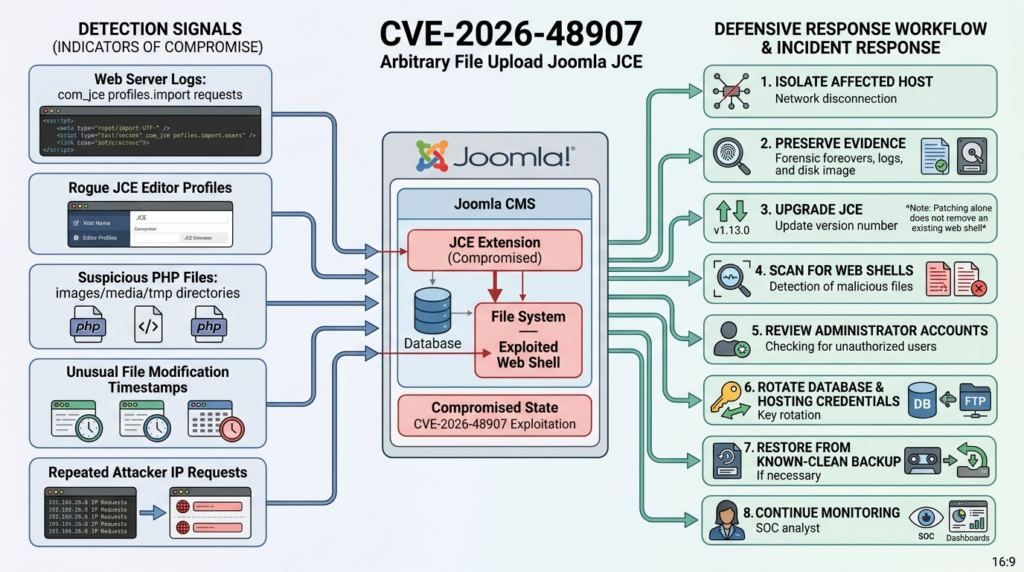
When security researchers first encounter a vulnerability, reproducing the underlying bug can be useful for understanding exploitability.
Once a vulnerability enters CISA KEV and exploitation is known to be active, the operational question changes.
The priority becomes:
Are we exposed?
Were we attacked?
Did exploitation succeed?
What did the attacker change?
rather than:
Can we make the exploit work ourselves?
That distinction matters for enterprise vulnerability management.
A scanner reporting:
CVE-2026-48907 detected
is useful.
A security workflow that can also determine:
Affected asset
Installed version
Internet exposure
Historical exploit requests
Suspicious profile creation
Suspicious executable upload
Potential persistence
Patch state
Evidence collected
is far more useful.
Recommended Detection Checklist
For each Joomla installation using JCE, defenders should verify:
| Kontrol et | Neden Önemli? |
|---|---|
| JCE version | Determines whether the installation falls within the affected range |
| JCE editor profiles | Detects unauthorized or attacker-created profiles |
| Permitted upload extensions | Identifies dangerous script-upload permissions |
| Web access logs | Reveals requests to JCE profile import functionality |
| PHP files in upload directories | Detects likely payload placement |
| Recently modified PHP files | Finds possible persistence |
| Joomla administrator accounts | Detects unauthorized account creation |
| Database credentials | May require rotation after RCE |
| Hosting/FTP credentials | May have been exposed |
| Server malware scan | Helps discover secondary payloads |
| Outbound connections | May reveal command-and-control activity |
| Backup timeline | Helps determine clean restoration point |
No individual indicator proves exploitation.
The strength comes from correlation.
A Practical Defensive Log Workflow
Begin with the profile-import endpoint identified by the vendor:
grep -R "profiles.import" /var/log/nginx/ /var/log/apache2/ 2>/dev/null
Extract timestamps from suspicious requests.
Then inspect requests from the same source around those timestamps.
Örneğin:
grep "SUSPICIOUS_IP" /var/log/nginx/access.log
Next, examine files modified during the same window:
find /path/to/joomla \
  -type f \
  -newermt "2026-06-01" \
  -print
Adjust the timestamp to the environment under investigation.
The objective is to reconstruct activity chronologically:
request
→ configuration change
→ upload
→ execution
→ persistence
That timeline can help distinguish unsuccessful scanning from actual compromise.
Why Vulnerability Scanning Alone Can Miss the Real Problem
Traditional vulnerability management commonly focuses on the state of software now.
Suppose a scanner checks a Joomla server today and discovers:
JCE 2.9.99.10
It may correctly conclude:
CVE-2026-48907 not currently vulnerable
That conclusion does not answer:
Was JCE 2.9.99.4 exposed three weeks ago?
or:
Was the server compromised before the upgrade?
This temporal problem is extremely important for actively exploited vulnerabilities.
Security teams need historical context.
Patching changes the current exposure state.
It does not rewrite the server’s past.
CVE-2026-48907 and Web Shell Persistence
Public reporting associated with CVE-2026-48907 describes exploitation in which attackers use the unauthorized profile capability to facilitate executable uploads and deploy web shells.
A web shell is particularly dangerous because it separates initial access from continuing control.
Initially:
Attacker needs CVE-2026-48907
After persistence:
Attacker only needs the web shell
The original vulnerability can then be patched without removing attacker access.
This is why teams responding to CVE-2026-48907 should think in terms of both:
İlk Erişim
and:
Kalıcılık
Incident response should locate and remove the latter rather than merely closing the former.
Credential Theft Risk
Remote PHP execution may expose application secrets readable by Joomla.
This means defenders should consider credentials compromised when evidence confirms arbitrary-code execution, particularly when those credentials were accessible to the web process.
Potentially relevant secrets can include database credentials, API keys, SMTP credentials, integration tokens, hosting credentials stored on the server, or other application configuration values.
The exact secrets available depend entirely on the deployment.
Therefore, responders should identify what the compromised PHP runtime could read rather than rotating only the Joomla administrator password.
Database Risk
Joomla must communicate with its database using credentials available to the application.
If an attacker obtains those credentials through server-side code execution, potential consequences depend on the privileges granted to the Joomla database account.
A tightly configured account may be restricted to the application’s database.
An overprivileged account could expose significantly more data or administrative capability.
CVE-2026-48907 therefore reinforces another fundamental hardening rule:
Application database users should receive only the permissions required by the application.
Remote code execution should never automatically translate into unrestricted database administration.
Shared Hosting Can Increase the Blast Radius
Joomla remains common in shared and managed hosting environments.
Where multiple sites share the same operating-system identity, reusable credentials, writable directories, or insufficiently isolated runtime environments, compromise of one Joomla application can potentially create additional risk.
Modern hosting architectures should isolate sites wherever possible.
At minimum, organizations managing multiple applications should avoid:
Shared credentials
Shared database administrator accounts
Shared writable application directories
Shared secrets
Overly permissive filesystem ownership
The goal is to ensure:
Compromise of Site A
does not automatically imply:
Compromise of Sites B, C, and D
What Security Teams Should Do Now
Organizations operating JCE should first create an inventory of affected Joomla sites.
Internet-facing systems deserve immediate priority because CVE-2026-48907 is network exploitable and requires no authentication.
Any JCE installation at 2.9.99.4 or earlier should be considered vulnerable.
Upgrade to a current supported release.
Then review historical logs and JCE profiles.
Search images, media, temporary directories, and other upload locations for suspicious executable content.
If compromise is detected, rotate secrets and perform full incident response rather than treating the event as complete once JCE has been updated.
Why CVE-2026-48907 Deserves Priority Over Many Higher-Volume Findings
Organizations commonly have thousands of vulnerability findings and cannot remediate everything simultaneously.
CVE-2026-48907 contains nearly every characteristic that should push a vulnerability toward the top of the queue:
Internet reachable
+
No authentication
+
Low complexity
+
Remote code execution
+
Public exploit availability
+
Automated attacks
+
Confirmed active exploitation
+
CISA KEV
+
Potential persistent web shell
The combination matters more than the CVSS score alone.
A theoretical CVSS 10 vulnerability behind multiple network controls may represent lower immediate risk than a widely reachable exploit being actively automated against public websites.
For CVE-2026-48907, both severity and real-world exploitation point in the same direction.
Broader Lesson: CMS Extension Security Is Application Security
The Joomla ecosystem illustrates an architectural reality shared by WordPress, Drupal, Magento, and other extensible platforms.
Extensions run inside valuable trust boundaries.
A vulnerable image manager can become an upload primitive.
A vulnerable authentication extension can become an account-takeover primitive.
A vulnerable page builder can become a code-execution primitive.
A vulnerable editor can become exactly what happened with CVE-2026-48907: a path from anonymous Internet traffic to server-side execution.
Organizations should therefore inventory extensions with the same seriousness they apply to core software.
An effective asset model should include:
CMS version
Extension name
Extension version
Maintainer
Update status
Internet exposure
Authentication requirement
File-upload capability
Known vulnerabilities
End-of-life status
Without extension visibility, CMS vulnerability management remains incomplete.
Why Removing Unused Extensions Matters
Every extension expands the application’s reachable code and configuration.
If JCE is installed but no longer required, removing it can provide stronger protection than simply leaving an unnecessary component enabled indefinitely.
The JCE vendor explicitly advises users unable to update or apply the provided legacy patch to uninstall JCE.
This principle generalizes well beyond this CVE:
Unused functionality
=
Unnecessary attack surface
A component cannot become tomorrow’s unauthenticated RCE if it is not present.
Continuous Validation After Remediation
Security teams should not consider CVE-2026-48907 complete after one successful patching campaign.
The affected software may exist across development systems, staging environments, forgotten subdomains, legacy microsites, customer portals, disaster-recovery systems, or unmanaged hosting accounts.
Continuous asset discovery can therefore be as important as the remediation itself.
Organizations should periodically answer:
Do we have any new Joomla assets?
Is JCE installed anywhere unexpectedly?
Has an old backup been restored?
Did someone deploy a vulnerable development image?
Are legacy instances still reachable?
The last question is particularly important after emergency patching.
It is easy to update the production site while leaving a forgotten staging copy exposed to the Internet.
Attackers do not care whether the vulnerable system is labeled “production.”
They care whether it is reachable.
Frequently Asked Questions About CVE-2026-48907
What is CVE-2026-48907?
CVE-2026-48907 is an improper access control vulnerability in the Joomla Content Editor extension that allows unauthenticated users to create editor profiles, leading to PHP upload and execution.
Is CVE-2026-48907 an RCE vulnerability?
Yes.
The official CVE description states that exploitation can ultimately result in PHP code upload and execution. Its CVSS v4.0 score is 10.0 Critical.
Does exploitation require authentication?
No.
The official CVSS vector specifies PR:N, meaning no privileges are required, and the vulnerability specifically involves creation of profiles for unauthenticated users.
Does an administrator need to click anything?
No.
The CVSS assessment specifies UI:N, meaning user interaction is not required.
Which JCE versions are vulnerable?
The official CVE record lists JCE versions 1.0.0 through 2.9.99.4 as affected.
Which version fixes CVE-2026-48907?
JCE 2.9.99.5 introduced the primary fix on June 3, 2026. Subsequent versions added further hardening.
Should I upgrade only to 2.9.99.5?
2.9.99.5 is the minimum version containing the CVE fix, but production environments should generally run the latest compatible supported version because subsequent releases include additional security hardening and maintenance fixes.
Is CVE-2026-48907 being exploited?
Yes.
CISA added it to the Known Exploited Vulnerabilities catalog on June 16, 2026, and CISA’s enrichment data lists exploitation as active.
Is disabling Joomla registration enough?
No.
JCE specifically warned that sites without public registration remain exposed because attacks do not require normal user registration and automated exploitation has been observed.
What should I search for in logs?
JCE recommends checking for unauthenticated requests associated with:
index.php?option=com_jce&task=profiles.import
What files should I inspect?
JCE recommends examining upload-oriented directories such as images, media, and tmp for unexpected PHP files or filenames containing PHP-related extensions.
Does patching remove malware?
No.
The vendor explicitly warns that updating closes the vulnerable entry point but does not remove payloads already installed by an attacker.
Final Assessment
CVE-2026-48907 represents one of the most dangerous classes of CMS vulnerabilities: a remotely reachable, unauthenticated access-control failure that can be transformed into arbitrary PHP execution.
The vulnerability affects JCE releases through 2.9.99.4 and was fixed beginning with 2.9.99.5. Its official CVSS v4.0 rating is 10.0 Critical. CISA added it to the Known Exploited Vulnerabilities catalog on June 16, 2026 after evidence of exploitation emerged.
The vulnerability’s attack chain is especially significant because it demonstrates how configuration-level authorization failures can become full execution primitives:
Unauthenticated access
→ rogue editor profile
→ dangerous upload permissions
→ executable PHP upload
→ remote code execution
For defenders, the correct response is therefore larger than “update the plugin.”
Patch JCE immediately.
Then determine how long the vulnerable version was exposed.
Review JCE profiles.
Search web-server logs for profile-import activity.
Inspect upload directories for executable content.
Investigate recently modified files.
Rotate credentials if compromise is confirmed.
Perform server-side malware detection.
And most importantly, remember that successful patching does not prove the server was never compromised.
For an actively exploited RCE such as CVE-2026-48907, vulnerability management and incident response have to meet in the same workflow.

 Turkish
  English
  German
  French
  Spanish
  Portuguese
  Japanese
  Korean
  Hindi
Hindi  Arabic
  Hebrew