
CVE-2026-50656 is a high-severity elevation-of-privilege vulnerability in the Microsoft Malware Protection Engine, the scanning and remediation engine used by Microsoft Defender. Publicly known as RoguePlanet, the vulnerability is particularly interesting because it turns one of Windows’ most privileged defensive components into part of an attacker’s privilege-escalation path.
Microsoft assigns CVE-2026-50656 a CVSS 3.1 score of 7.8 High, with a local attack vector, low privileges required, no user interaction, and potentially high confidentiality, integrity, and availability impact. The official CVE record classifies the vulnerability as CWE-59, Improper Link Resolution Before File Access, and currently identifies Microsoft Malware Protection Engine versions starting at 1.1.0.0 and earlier than 1.1.26060.3008 etkilenmiş olarak. (OpenCVE)
The original RoguePlanet proof of concept was publicly released by security researcher Nightmare Eclipse. The researcher described it as a race-condition vulnerability and demonstrated that successful exploitation could produce a shell running as NT AUTHORITY\SYSTEM. Tests reported by the researcher covered Windows 10 and Windows 11, although reliability varied depending on the machine and timing conditions. (GitHub)
Microsoft subsequently released Malware Protection Engine 1.1.26060.3008 in July 2026 to address CVE-2026-50656. (Qualys ThreatPROTECT)
The story did not end there.
In August, another public exploit named ShieldBreak demonstrated a different path to SYSTEM privileges on patched Windows installations. ShieldBreak was initially described by its researcher as a full bypass of the RoguePlanet patch, but Microsoft ultimately assigned the newer issue a separate identifier, CVE-2026-69414. That distinction is important: CVE-2026-50656 should still be considered fixed by the documented Defender engine update, while ShieldBreak represents a related but separately tracked weakness in Defender’s privileged processing architecture. (Malwarebytes)
For defenders, the larger lesson is more significant than either CVE individually: endpoint security engines operate with extraordinary privileges. When an attacker can manipulate the files, namespaces, callbacks, or remediation operations consumed by those engines, security software itself can become an elevation primitive.
What Is CVE-2026-50656?
CVE-2026-50656 is an elevation-of-privilege vulnerability affecting the Microsoft Malware Protection Engine.
The component powers malware inspection and remediation functions associated with Microsoft Defender. Microsoft describes the issue as an elevation-of-privilege vulnerability publicly referred to as RoguePlanet. Its CVE record maps the weakness to:
CWE-59: Improper Link Resolution Before File Access
The relevant Microsoft CVSS vector is:
CVSS:3.1/AV:L/AC:L/PR:L/UI:N/S:U/C:H/I:H/A:HThe major characteristics are:
| Öznitelik | CVE-2026-50656 |
|---|---|
| CVE | CVE-2026-50656 |
| Vulnerability name | RoguePlanet |
| Vendor | Microsoft |
| Ürün | Microsoft Malware Protection Engine |
| Güvenlik açığı türü | Ayrıcalığın Yükseltilmesi |
| CWE | CWE-59 |
| Microsoft CVSS | 7.8 High |
| Saldırı vektörü | Local |
| Privileges required | Düşük |
| User interaction | Hiçbiri |
| Potential result | SYSTEM privileges |
| Public PoC | Evet |
| Fixed engine | 1.1.26060.3008 |
| Original disclosure | June 2026 |
Microsoft’s currently published affected-version range is:
>= 1.1.0.0
<  1.1.26060.3008
Therefore, organizations should not determine exposure solely from whether Windows Update says that the operating system is current. The Defender Malware Protection Engine version itself matters. (OpenCVE)
Why CVE-2026-50656 Is Unusual
Most defenders intuitively think about antivirus software as a barrier between malware and the operating system.
RoguePlanet reverses that relationship.
Microsoft Defender needs significant privileges because malware can exist almost anywhere on a Windows machine. Defender must be able to inspect, quarantine, delete, move, rewrite, or otherwise manipulate files that ordinary users cannot touch.
That means its scanning and remediation processes operate with powerful security privileges.
This creates an important security invariant:
A privileged security process must never allow an untrusted user to control where its privileged file operation ultimately lands.
CVE-2026-50656 breaks that assumption.
Instead of directly obtaining SYSTEM privileges by exploiting the Windows kernel, the attacker attempts to influence Defender into carrying out a privileged operation on the attacker’s behalf.
Conceptually, the security boundary looks like this:
Low-privileged user
        |
        v
Attacker-controlled filesystem state
        |
        v
Defender scans/remediates object
        |
        v
Filesystem target changes during operation
        |
        v
Privileged Defender operation follows redirected path
        |
        v
Protected SYSTEM location affected
        |
        v
Privilege escalation
        |
        v
NT AUTHORITY\SYSTEM
The public RoguePlanet repository describes the exploit as a race condition and explicitly states that a successful run produces a SYSTEM shell. (GitHub)
Understanding the CWE-59 Link-Following Problem
Microsoft classifies CVE-2026-50656 as CWE-59, or improper link resolution before file access.
Windows supports several mechanisms capable of making a filesystem path refer to something other than what a process may initially expect.
These include concepts such as:
- symbolic links;
- junctions;
- reparse points;
- mount points;
- virtual filesystems;
- NT Object Manager paths.
These mechanisms are legitimate and heavily used throughout Windows.
They become dangerous when a privileged process performs something conceptually similar to:
1. Validate file X
2. Decide file X is safe to modify
3. Open or modify file X
If an attacker can change what X resolves to between step two and step three, the privileged process may perform its operation on a different object.
This is closely related to a time-of-check to time-of-use, or TOCTOU, race.
The security-sensitive sequence becomes:
Defender checks path
      |
      |      Attacker changes path resolution
      |                |
      v                v
Defender accesses target
      |
      v
Target is no longer what Defender checked
A security product running under SYSTEM makes such a mistake considerably more dangerous than a normal desktop application.
The RoguePlanet Race Condition
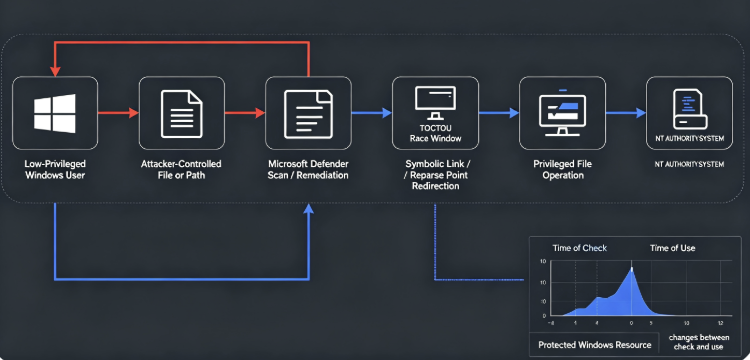
The researcher behind RoguePlanet explicitly described CVE-2026-50656 as a race condition.
This matters because race-condition exploits depend on timing.
There may be an extremely small window between a security check and the following filesystem operation. The attacker attempts to alter the relevant state inside that window.
The RoguePlanet researcher reported achieving very high reliability on some machines while experiencing significantly lower reliability on others. (GitHub)
That observation also explains an interesting disagreement in the vulnerability scoring.
Microsoft scores CVE-2026-50656 at 7.8, using Attack Complexity Low.
NVD has separately calculated a 7.0 High score using Attack Complexity High:
Microsoft:
AV:L/AC:L/PR:L/UI:N/S:U/C:H/I:H/A:H
7.8 HIGH

NVD:
AV:L/AC:H/PR:L/UI:N/S:U/C:H/I:H/A:H
7.0 HIGH
NVD’s reasoning reflects the timing-dependent race condition, while Microsoft’s scoring considers exploitation sufficiently practical to assign AC:L. (OpenCVE)
Whichever scoring interpretation an organization prefers, the operational conclusion remains similar: a public privilege-escalation technique exists and the eventual impact can be total compromise of the affected Windows endpoint.
CVE-2026-50656 Is Not a Remote Unauthenticated RCE
One of the most important points when discussing CVE-2026-50656 is what it does not provide.
The official CVSS vector specifies:
AV:LThat means the vulnerability is yerel.
An attacker generally needs an existing ability to execute code in a low-privileged Windows context before RoguePlanet becomes useful.
So an attacker cannot simply scan the Internet for vulnerable Defender engines and remotely obtain SYSTEM privileges through CVE-2026-50656 alone.
A realistic attack chain is more likely to look like:
Phishing / malicious download / browser exploit / stolen account
                         |
                         v
              Low-privileged execution
                         |
                         v
                 CVE-2026-50656
                         |
                         v
                 SYSTEM privileges
                         |
                         v
         Credential theft / persistence
                         |
                         v
               Lateral movement
This makes RoguePlanet a post-compromise privilege-escalation vulnerability.
But that does not make it unimportant.
Modern attackers frequently begin with restricted execution. Local privilege-escalation vulnerabilities are used specifically to turn that restricted foothold into administrative control.
Why SYSTEM Privileges Matter
NT AUTHORITY\SYSTEM is one of the most powerful security contexts available on Windows.
If an attacker reaches SYSTEM, they can potentially perform actions unavailable to ordinary users, including manipulating protected system resources, accessing sensitive machine-level data, establishing high-privilege persistence, interfering with defensive controls, and using the endpoint as a stepping stone for further compromise.
That is why CVE-2026-50656’s confidentiality, integrity, and availability impact values are all rated High.
Microsoft’s CVSS vector contains:
C:H
I:H
A:H
Successful exploitation therefore crosses an extremely meaningful privilege boundary even though the initial attack vector is local. (OpenCVE)
CVE-2026-50656 Public PoC Changes the Risk Calculation
RoguePlanet was not merely described theoretically.
Public exploit code appeared online.
The original repository includes source code and a compiled demonstration and states that successful exploitation launches a SYSTEM shell. (GitHub)
CISA’s CVE enrichment data accordingly labels exploitation status as:
Exploitation: poc
Automatable: no
Technical Impact: total(OpenCVE)
This distinction matters.
A vulnerability with theoretical exploitation may require an attacker to reverse engineer the vulnerable component and build an exploit independently.
A public PoC substantially reduces that research barrier.
However, public PoC availability does değil automatically mean widespread criminal exploitation has been confirmed.
Security teams should distinguish among:
Vulnerability exists
        ↓
Technical details public
        ↓
PoC exploit public
        ↓
Exploit weaponized
        ↓
Observed exploitation in real attacks
Those are different evidence levels.
Microsoft’s earlier assessment characterized exploitation as more likely, while public reporting at the time noted that Microsoft had not confirmed exploitation in its own telemetry. (Net Güvenliğine Yardım Edin)
For risk management, the availability of a public privilege-escalation exploit is already enough reason to prioritize remediation.
Which Versions Are Vulnerable to CVE-2026-50656?
The current CVE record identifies Microsoft Malware Protection Engine versions:
1.1.0.0 <= version < 1.1.26060.3008as affected.
Microsoft Malware Protection Engine 1.1.26060.3008 is the fixed version for the original CVE-2026-50656 vulnerability. (OpenCVE)
That means the simplest technical exposure check is not:
“Did we install Patch Tuesday?”
It is:
“What Microsoft Malware Protection Engine version is actually running?”
This matters particularly in enterprise environments where operating system patches, Defender platform updates, engine updates, and security-intelligence updates can follow different deployment channels.
How to Check for CVE-2026-50656
Defenders can query Defender status using PowerShell:
Get-MpComputerStatus |
Select-Object AMEngineVersion,
              AMProductVersion,
              AntivirusEnabled,
              RealTimeProtectionEnabled
Look specifically at:
AMEngineVersionFor the original CVE-2026-50656 issue:
AMEngineVersion < 1.1.26060.3008should be treated as vulnerable.
A system running:
1.1.26060.3008or a newer Defender engine has the documented Microsoft correction for RoguePlanet.
Because Defender receives frequent engine releases, many currently maintained systems should already be running versions substantially newer than this baseline.
Organizations should still verify rather than assume.
Updating Microsoft Defender
Administrators can inspect Defender update state and use Microsoft’s normal endpoint-management mechanisms to distribute current Defender updates.
On individual Windows systems, Defender updates can normally be initiated through Windows Security or Windows Update.
PowerShell environments can also use supported Defender management commands such as:
Update-MpSignatureAfter updating, rerun:
Get-MpComputerStatus |
Select AMEngineVersion
and confirm that the engine is at least:
1.1.26060.3008The key point is that installing a Windows cumulative update should not substitute for validating the security component that was actually vulnerable.
Windows 10 and Windows 11 Exposure
The original RoguePlanet researcher reported testing the public PoC successfully against Windows 10 and Windows 11 systems with June 2026 updates installed. (GitHub)
Because the vulnerable component is the Malware Protection Engine rather than a single Windows 11 user-interface feature, CVE-2026-50656 should be treated primarily as a Defender engine vulnerability, not merely as a Windows-version vulnerability.
This is another reason defenders should inventory:
Engine versionrather than trying to infer exposure from:
Operating system buildalone.
What About Windows Server?
The RoguePlanet researcher reported an important nuance involving Windows Server.
The public RoguePlanet PoC depended on an operation that standard users could perform on the tested desktop versions but not in the same way on Windows Server. The researcher therefore stated that the released PoC did not directly work on Windows Server, while arguing that the underlying issue could still affect server environments if the exploit were redesigned. (GitHub)
This distinction is important in vulnerability research:
PoC compatibility is not necessarily identical to vulnerability scope.
An exploit can fail because one component of its delivery chain is unavailable while the underlying vulnerable behavior remains present.
Organizations therefore should follow Microsoft’s affected-product data rather than treating failure of one public PoC as proof that a platform is safe.
Microsoft’s CVE-2026-50656 Patch
Microsoft ultimately fixed the documented RoguePlanet vulnerability through Microsoft Malware Protection Engine:
1.1.26060.3008
Qualys reported the correction as released on July 8, 2026, and other security reporting confirmed that the updated engine addressed CVE-2026-50656. (Qualys ThreatPROTECT)
The current CVE record now clearly represents the boundary:
Affected:
< 1.1.26060.3008

Fixed:
>= 1.1.26060.3008(OpenCVE)
For vulnerability-management systems, this is therefore the most reliable condition for determining remediation of CVE-2026-50656 itself.
Then Came ShieldBreak
CVE-2026-50656 has an unusually important sequel.
In August 2026, the same researcher released another exploit named ShieldBreak, describing it as a full bypass of Microsoft’s RoguePlanet correction.
The ShieldBreak repository claims successful exploitation on Windows 11 25H2, Canary builds, and Windows Server 2025 and reports a 100% success rate in the researcher’s testing. (GitHub)
Independent security researchers and security companies subsequently analyzed the technique. Public analyses describe ShieldBreak as combining mechanisms including Cloud Files API behavior, object namespace manipulation, file-content switching during Defender processing, and privileged Windows Error Reporting behavior. (Cyderes)
At first glance, this can create confusion:
If ShieldBreak bypasses the RoguePlanet patch, is CVE-2026-50656 still vulnerable?
The precise answer is more nuanced.
ShieldBreak Is Now CVE-2026-69414
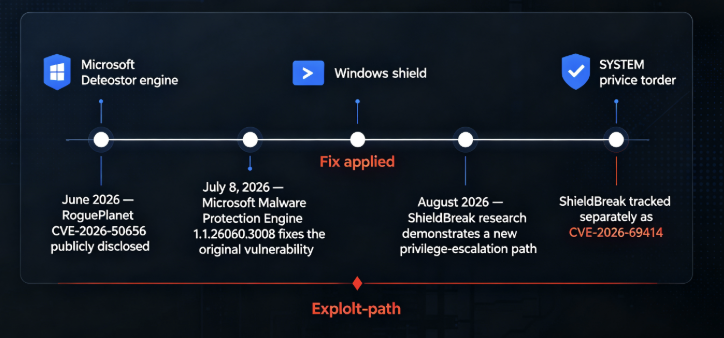
Microsoft subsequently assigned ShieldBreak its own vulnerability identifier:
CVE-2026-69414
Microsoft describes CVE-2026-69414 as another Microsoft Malware Protection Engine elevation-of-privilege vulnerability associated with ShieldBreak. (Malwarebytes)
Therefore, security teams should not simply change the remediation state of CVE-2026-50656 back to “unpatched.”
A better model is:
CVE-2026-50656
RoguePlanet
        |
        | Microsoft fix
        v
Engine 1.1.26060.3008
        |
        v
Original CVE remediated


Related Defender attack surface
        |
        v
ShieldBreak
        |
        v
CVE-2026-69414
        |
        v
Separate vulnerability tracking
ShieldBreak does, however, demonstrate that fixing one exploitation primitive does not necessarily eliminate every way of abusing the broader privileged Defender remediation pipeline.
That is the much more interesting security-engineering lesson.
RoguePlanet vs ShieldBreak
| Characteristic | RoguePlanet | ShieldBreak |
|---|---|---|
| CVE | CVE-2026-50656 | CVE-2026-69414 |
| Hedef | Microsoft Malware Protection Engine | Microsoft Malware Protection Engine |
| Sonuç | SYSTEM privilege escalation | SYSTEM privilege escalation |
| Public PoC | Evet | Evet |
| Relationship | Original vulnerability | Follow-on related vulnerability |
| Original fix | Engine 1.1.26060.3008 | Separately tracked |
| Public name | RoguePlanet | ShieldBreak |
The distinction also helps prevent misleading headlines.
Saying:
“CVE-2026-50656 remains completely unpatched”
would ignore Microsoft’s documented affected-version boundary.
Saying:
“The July Defender fix completely removed this attack surface”
would ignore the later ShieldBreak research.
The technically accurate conclusion is that Microsoft fixed the original RoguePlanet vulnerability, while later research demonstrated another Defender privilege-escalation path that Microsoft tracked separately as CVE-2026-69414. (OpenCVE)
Why Antivirus Engines Are Attractive Privilege-Escalation Targets
RoguePlanet illustrates a broader security principle.
Security tools often operate in unusually privileged positions.
An antivirus engine may:
Read almost any file
Delete protected files
Quarantine malicious files
Inspect process memory
Interact with kernel components
Modify security state
Communicate with cloud analysis systems
Operate as SYSTEM
Every privileged feature adds potential attack surface.
The difficult engineering challenge is that antivirus engines also process some of the most hostile inputs on a computer.
They are intentionally exposed to:
malformed files
malware
archives
executables
scripts
documents
filesystem tricks
untrusted metadata
attacker-controlled paths
A normal application may avoid hostile files.
An antivirus engine’s entire purpose is to open them.
That produces an unusual trust relationship:
Maximum attacker control over input
              +
Maximum operating-system privileges
              =
Extremely sensitive attack surface
CVE-2026-50656 demonstrates why security engines require the same aggressive vulnerability research normally associated with browsers, kernels, virtualization platforms, and document parsers.
Enterprise Attack Scenario
Consider an enterprise Windows workstation where users do not have local administrator rights.
The security team may consider this an important containment layer.
An attacker compromises a user’s account through phishing and receives:
DOMAIN\employeebut not local administrator access.
Without privilege escalation, the attacker may face significant restrictions.
With a vulnerability such as CVE-2026-50656, the attack path potentially becomes:
Initial foothold
      ↓
Standard Windows user
      ↓
Trigger vulnerable Defender behavior
      ↓
Filesystem race / link manipulation
      ↓
SYSTEM-level privileged action
      ↓
NT AUTHORITY\SYSTEM
      ↓
Credential access
      ↓
Security-control tampering
      ↓
Persistence
      ↓
Lateral movement
This is why local EoP vulnerabilities are disproportionately important during real intrusions.
They convert an initial compromise into a substantially more powerful one.
Detection Strategy for CVE-2026-50656
The first defensive priority should be version-based vulnerability detection, not exploit-signature matching.
Check every endpoint for:
AMEngineVersionand flag engines below:
1.1.26060.3008This is much more reliable than trying to detect a specific RoguePlanet binary.
Public exploit code can be recompiled, modified, renamed, or incorporated into another payload.
Defenders should therefore separate:
Güvenlik açığı tespitidan:
Exploit detectionThe former answers:
“Can this device be exploited?”
The latter answers:
“Is someone attempting to exploit it?”
Both matter.
Behavioral Detection Is More Valuable Than Filename Detection
Security teams should avoid relying only on indicators such as:
RoguePlanet.exeA filename can be changed trivially.
Better detection asks whether unexpected behavior is occurring around privileged Defender operations.
Potential hunting areas include unusual combinations of:
- Defender scanning or remediation;
- reparse-point or symbolic-link activity;
- unusual filesystem redirection;
- suspicious virtual filesystem activity;
- modifications involving protected Windows directories;
- unexpected Windows Error Reporting behavior;
- suspicious processes appearing after Defender operations;
- privilege transitions from an ordinary user to SYSTEM;
- SYSTEM processes launching command interpreters.
A detection query focused only on:
FileName == "RoguePlanet.exe"has very little resilience.
A detection based on the exploit’s behavioral chain is more difficult for an attacker to eliminate without redesigning the technique itself.
Monitor Suspicious SYSTEM Shell Creation
For example, defenders should investigate unusual SYSTEM-context execution of:
cmd.exe
powershell.exe
pwsh.exe
rundll32.exe
regsvr32.exe
especially when it occurs immediately after unusual Defender, filesystem, or Windows Error Reporting activity.
The exact telemetry available depends on the EDR platform.
A conceptual hunting sequence might look like:
Standard-user process
        ↓
Unusual filesystem manipulation
        ↓
Defender operation
        ↓
SYSTEM process
        ↓
Command interpreter
That chain is significantly more informative than an individual IOC.
Do Not Disable Defender as a CVE-2026-50656 Mitigation
A security team might intuitively respond:
“If Defender is the vulnerable component, why not disable Defender?”
That is generally the wrong tradeoff.
Removing malware protection to mitigate a local privilege-escalation weakness eliminates an important security boundary against many other attacks.
For the original RoguePlanet issue, the appropriate remediation is to update the Malware Protection Engine.
For related unpatched vulnerabilities, enterprises should use compensating controls such as application control, least privilege, behavioral monitoring, endpoint isolation, and EDR detection rather than broadly removing endpoint protection.
Recommended Enterprise Response
Organizations managing Windows fleets should treat CVE-2026-50656 as a straightforward patch-verification problem now that the original Microsoft correction is available.
First, inventory Microsoft Malware Protection Engine versions across all endpoints.
Second, identify anything below:
1.1.26060.3008Third, force those devices through the normal Defender update process.
Fourth, verify the engine after remediation rather than relying solely on update deployment status.
Fifth, maintain separate tracking for CVE-2026-69414 ShieldBreak rather than treating it as identical to CVE-2026-50656.
Finally, hunt for privilege-escalation behavior independently of known PoC hashes or filenames.
CVE-2026-50656 and CISA Prioritization
CISA’s vulnerability-enrichment information for CVE-2026-50656 records:
Exploitation: PoC
Automatable: No
Technical Impact: Total(OpenCVE)
That combination is useful for security teams.
It means the exploit is publicly demonstrated, mass automated exploitation is not considered straightforward in the SSVC enrichment, but successful exploitation can have severe consequences.
Public EPSS-derived data also showed CVE-2026-50656 reaching an estimated exploitation probability above 11% and approximately the 95th percentile by September 1, 2026, though EPSS should be interpreted as a prioritization signal rather than evidence that exploitation has actually occurred. (Vulnerability Lookup)
For an enterprise with thousands of Windows endpoints, that is enough to justify active remediation rather than passive monitoring.
CVE-2026-50656 FAQ
What is CVE-2026-50656?
CVE-2026-50656, also known as RoguePlanet, is a Microsoft Defender Malware Protection Engine elevation-of-privilege vulnerability involving improper link resolution and a race condition.
How severe is CVE-2026-50656?
Microsoft assigns it CVSS 7.8 High.
NVD separately calculates 7.0 High, primarily because NVD considers the race condition to require high attack complexity. (OpenCVE)
What does successful exploitation provide?
The public RoguePlanet research demonstrated elevation from a low-privileged user context to NT AUTHORITY\SYSTEM. (GitHub)
Is CVE-2026-50656 remotely exploitable?
Not directly.
Its official attack vector is local:
AV:LAn attacker normally needs an existing low-privileged foothold on the Windows machine.
Does CVE-2026-50656 require administrator privileges?
No.
Microsoft’s CVSS vector specifies:
PR:Lmeaning low privileges are required.
Does the victim need to click anything during exploitation?
The official vector states:
UI:Nmeaning no additional user interaction is required once the attacker is in a position to attempt exploitation.
Is there a public CVE-2026-50656 exploit?
Yes.
The original RoguePlanet research repository publicly demonstrated the technique and reported SYSTEM-shell execution. (GitHub)
Is CVE-2026-50656 patched?
Yes.
Microsoft Malware Protection Engine 1.1.26060.3008 addresses the original CVE-2026-50656 vulnerability. (Qualys ThreatPROTECT)
How do I check whether my Windows device is vulnerable?
Run:
Get-MpComputerStatus | Select AMEngineVersionIf the engine is older than:
1.1.26060.3008it falls inside Microsoft’s documented affected-version range.
Does ShieldBreak mean CVE-2026-50656 is still unpatched?
Not exactly.
ShieldBreak was initially presented by the researcher as a bypass of the RoguePlanet fix, but Microsoft subsequently assigned ShieldBreak its own identifier, CVE-2026-69414. (GitHub)
Security teams should patch CVE-2026-50656 and separately track CVE-2026-69414.
Why CVE-2026-50656 Matters Beyond One Defender Bug
The most important lesson from CVE-2026-50656 is not simply that Microsoft Defender contained another security flaw.
It demonstrates an architectural security problem that applies to almost every endpoint security product.
Antivirus and EDR engines sit in an unusually dangerous position:
Highly privileged
+
Constantly exposed to attacker-controlled input
+
Allowed to manipulate security-sensitive objects
A vulnerability does not necessarily need to corrupt kernel memory to become catastrophic.
Sometimes the attacker only needs to convince an already privileged component to perform a legitimate operation against the wrong resource.
That is precisely why filesystem race conditions, symbolic-link attacks, junction manipulation, object namespace confusion, callback races, and TOCTOU vulnerabilities remain relevant on modern operating systems.
The privilege already exists.
The attacker merely has to redirect it.
Final Assessment
CVE-2026-50656 RoguePlanet should be treated as an important Microsoft Defender local privilege-escalation vulnerability with a publicly available exploitation technique and SYSTEM-level impact.
The original issue affected Microsoft Malware Protection Engine versions earlier than 1.1.26060.3008, and organizations should verify that endpoints are running that engine version or newer rather than assuming that normal Windows patch compliance guarantees remediation. Microsoft rates the vulnerability 7.8 High and classifies it as CWE-59 improper link resolution. (OpenCVE)
The later ShieldBreak research makes the case more strategically significant. Microsoft ultimately assigned that technique a separate identifier, CVE-2026-69414, but its emergence demonstrates that Defender’s privileged file-processing and remediation architecture remains a valuable target for vulnerability researchers and attackers alike. (Malwarebytes)
For defenders, the right response is therefore broader than searching for RoguePlanet.exe.
Patch the known vulnerable engine. Verify the engine version across the fleet. Track ShieldBreak independently. Hunt behavior rather than filenames. Restrict initial code execution wherever possible. And treat endpoint-security engines themselves as high-value attack surfaces requiring continuous validation.
For red teams and authorized security researchers, CVE-2026-50656 is also a useful reminder that effective privilege-escalation testing should examine not only Windows kernel vulnerabilities, but the trusted SYSTEM-level software installed to protect the machine.
Authoritative and technical references: Microsoft’s CVE-2026-50656 Security Update Guide remains the primary vendor record. Microsoft CVE-2026-50656 advisory The NVD record provides the independent CVSS assessment and vulnerability metadata. NVD CVE-2026-50656 record The original researcher’s RoguePlanet repository documents the public research and test conditions. RoguePlanet research repository


 Turkish
  English
  German
  French
  Spanish
  Portuguese
  Japanese
  Korean
  Hindi
Hindi  Arabic
  Hebrew