
HackerAI vs Penligent is a useful comparison only after identifying which “hacker AI” you mean. Here, HackerAI refers to the product at hackerai.co and the hackerai-tech/hackerai repository. The phrase is also used generically for AI security tools; this article does not attribute every tool using those words to the same company.
The buying question is straightforward: do you want to assemble and operate a chat-driven testing environment, or evaluate a product workflow against your assessment and reporting requirements? Both routes deserve a practical trial. Public documentation can explain their architecture, but it cannot tell you which will uncover more valid issues in your environment. This vendor-authored comparison reviews official sources as of October 17, 2026, without claiming comparative test results.

What the documented architectures tell you
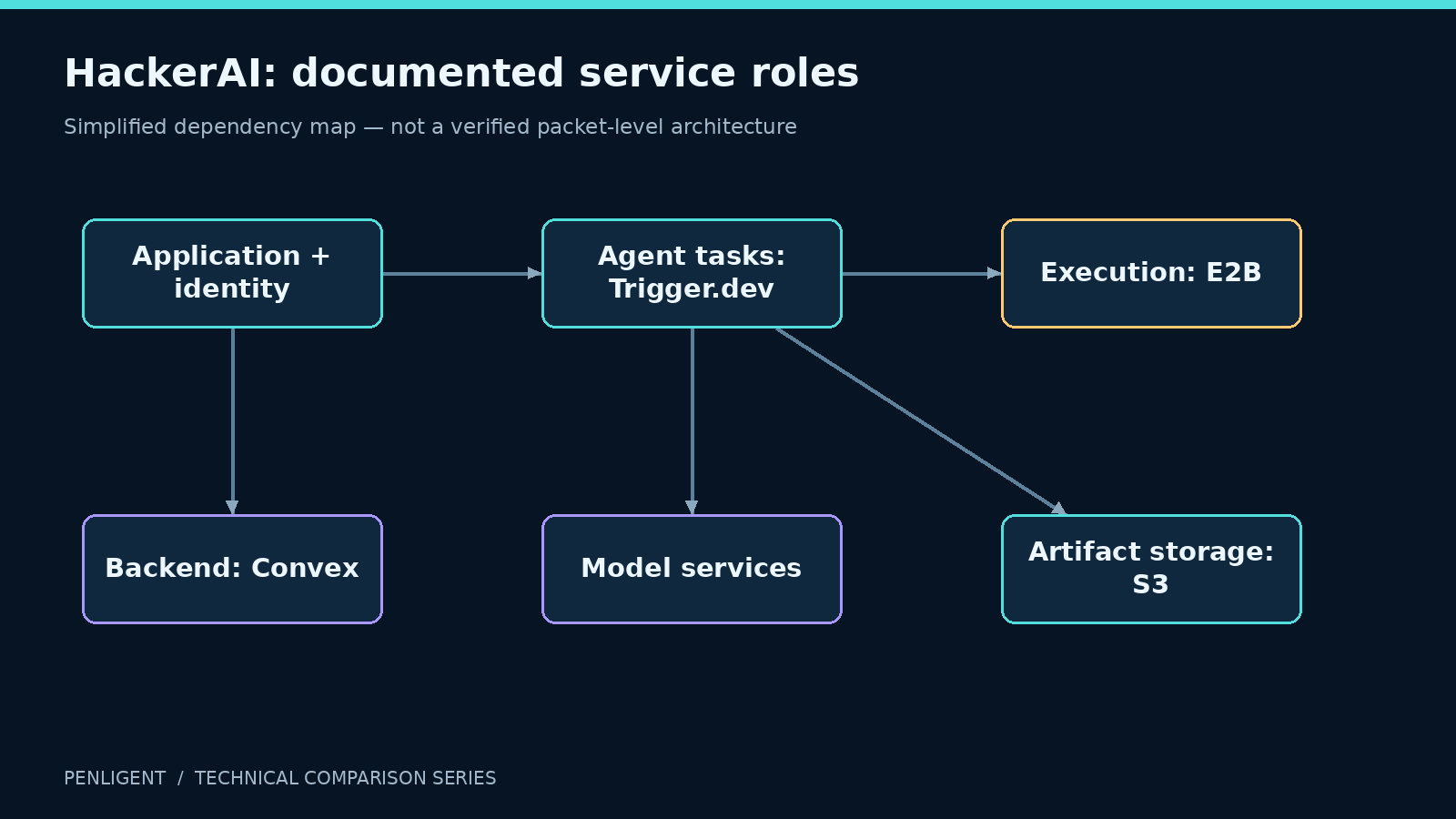
Bu official HackerAI repository describes an AI penetration testing assistant. Its setup uses E2B for Agent-mode execution, Convex for the backend, and Trigger.dev for durable agent tasks, alongside model and supporting services. Hosting the application yourself should therefore not be equated with eliminating external execution or processing dependencies.
Penligent’s current product and plan descriptions describe verification, remediation guidance, and PDF/Markdown reporting. Team and Enterprise add different organization and deployment features. The relevant comparison is the configuration you would operate, including its external services and contractual controls.
| Question | HackerAI starting point | Penligent starting point |
|---|---|---|
| What should procurement inspect? | Repository setup and service dependencies | Chosen plan and deployment agreement |
| Who owns operations? | Identify an owner for each deployed component | Agree the customer/vendor responsibility split |
| Where can assessment data go? | Map execution, model, storage, and backend paths | Obtain the deployment-specific data flow |
| What counts as a result? | Require reproducible evidence in the pilot | Apply the same evidence review |
| How is a fix accepted? | Demonstrate a comparable retest | Demonstrate a comparable retest |
The last four rows are evaluation requirements, not claims that either product lacks the capability. A README is not a full service agreement, and the absence of a public feature description does not prove the feature is unavailable. Resolve a mandatory requirement through a demo or written answer rather than filling the gap with a red cross.
Map the assessment data before connecting accounts
A penetration test can generate sensitive material even when it begins with a public URL. Session cookies, request bodies, internal hostnames, screenshots, and accidentally returned secrets can appear in tool output. Before a pilot, decide which data classes are permitted and where they may be processed. Use dedicated accounts with synthetic records whenever the objective permits.
Draw the path of a single authenticated request. Start with the place credentials are entered, follow the execution environment that uses them, then track the response through model context, logging, storage, and report generation. Include retries and background tasks. An organization may approve one model endpoint while overlooking an execution service that sees the same response body.
For either product, request answers about retention periods, deletion, access permissions, and account offboarding. If a private model is required, verify the actual connection and behavior during a run. A field accepting a model endpoint is not, by itself, proof that all other services are local or that no diagnostic content leaves the environment.
Use an authenticated task to expose workflow differences
A public landing page rarely reveals the hard parts of an engagement. A better pilot uses an authorized staging application with two roles and a defined business rule. For example, create a normal user and a workspace administrator, then ask the tool to assess a restricted export function. Specify which records may be accessed and which actions are outside scope.
Watch how the workflow handles a session that expires halfway through the assessment. Does it distinguish “not vulnerable” from “could not authenticate”? Can the operator update the context without losing the evidence already collected? Does the final report explain the gap? These observations often tell a team more than a long list of vulnerability categories.
Give both workflows the same initial information. If a human supplies a crucial endpoint or writes a missing test, record that assistance. Operator intervention is not inherently a failure; unexplained assistance makes the comparison unreliable. A team seeking a collaborative tool may value efficient human steering, while another may prioritize unattended operation during a narrow release window.
A finding must survive handoff
Before the trial starts, ask an engineer who did not operate the tool to review the expected deliverable. The engineer should be able to locate the affected function, understand the violated rule, reproduce the behavior safely, and judge whether the proposed change addresses it. This is a more useful standard than whether the report sounds technically sophisticated.
For a suspected authorization issue, preserve account role, object ownership, relevant request/response evidence, and the expected access policy. Redact credentials without removing the information needed to reproduce the result. If the issue is a hypothesis rather than a validated impact, label it that way. Do not award the same score to a plausible narrative and a demonstrated boundary violation.
Retest one repaired case and one case that was not changed. The repaired case checks whether the workflow can confirm closure; the unchanged case helps reveal a broken login or test setup. If both suddenly disappear, investigate the environment before crediting the product with successful remediation verification.
Calculate cost per accepted result
A subscription price and a model bill measure different parts of the workflow. Build a pilot cost record that includes execution resources, model usage, storage, deployment maintenance, operator review, and report cleanup. Count aborted runs and duplicate investigations. Otherwise a cheap run that takes hours to interpret can look better than a more expensive run that produces an immediately usable result.
Avoid dividing spend by raw finding count. That metric rewards noisy output. Use findings accepted after review, with false positives and inconclusive cases recorded separately. If the trial contains seeded issues, also record which were missed. A low false-positive rate with no meaningful coverage is not an adequate assessment.
HackerAI’s execution path has several independently operated parts
The dependency list in the HackerAI setup instructions matters because the browser-facing application is only one participant in an Agent-mode run. A request must reach the background runtime, obtain the appropriate model response, execute tools, and preserve the result. When a run stops advancing, the visible chat interface may still be healthy. A support plan must identify which component is responsible for the stalled step.
Consider a hypothetical staging assessment that starts successfully and then loses its execution environment. The user may still be able to type, while a background task is retrying or waiting. A useful investigation needs a run identifier that can be followed across the application, task runtime, execution service, and stored artifacts. Ask the team operating the deployment to demonstrate that correlation with a harmless interrupted job.
The same dependency map is useful when evaluating Penligent’s offered deployment. Request the actual responsibility split rather than assuming a managed service has no dependencies or a self-deployed application has no vendor responsibility. The comparison should identify who sees the failure, who can recover it, and how an incomplete assessment is reported to the person waiting for results.
An organization with an established platform team may find a distributed stack entirely reasonable. A small security team may prefer fewer operational handoffs. That difference concerns staffing and ownership, not whether one architecture is inherently capable of finding a particular vulnerability. Keep the operational judgment separate from the technical result of the assessment.
Authentication has two distinct trust boundaries
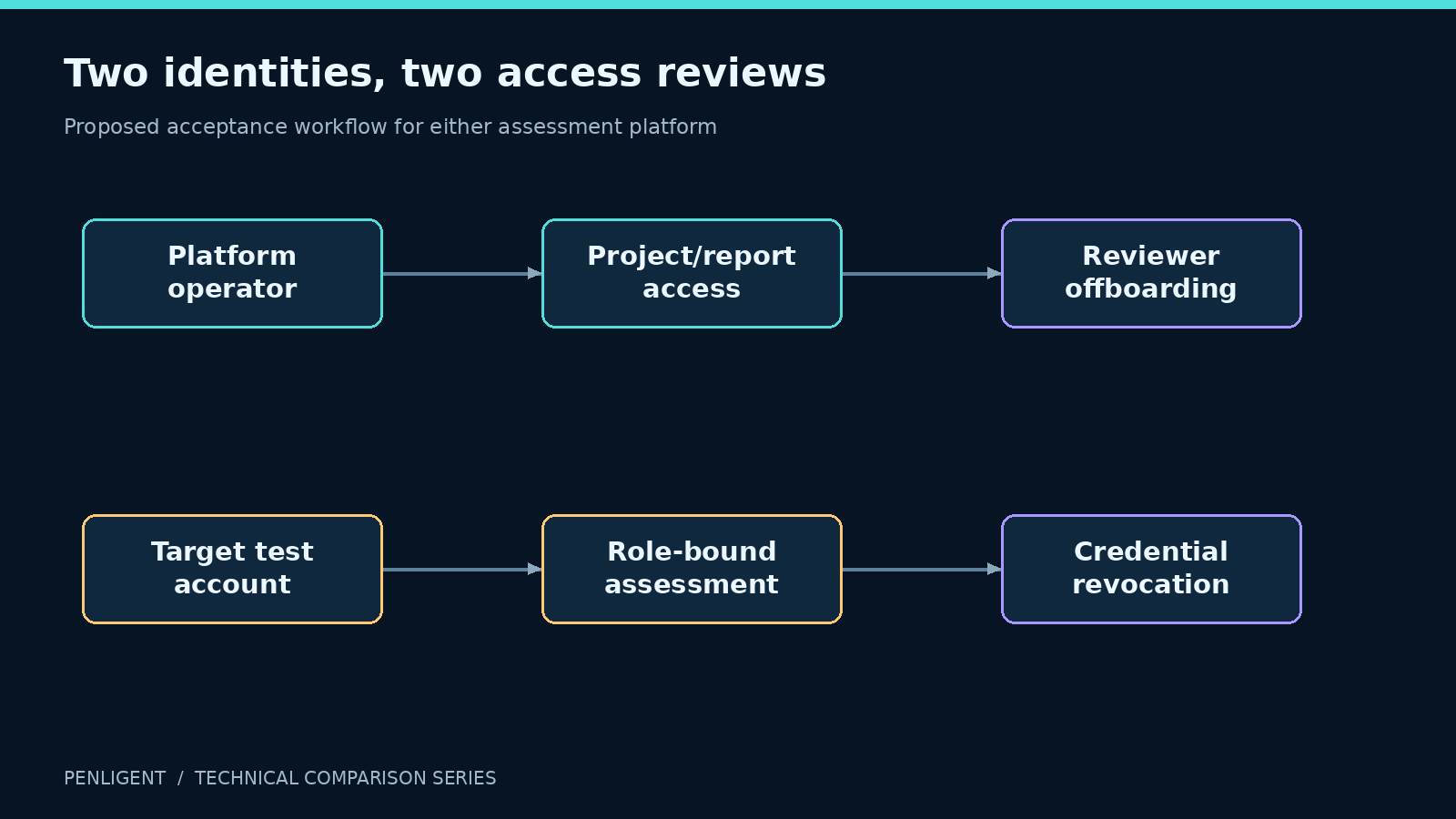
The account used to sign in to the testing platform is different from the account the agent uses against the application under assessment. The first controls access to projects and reports. The second determines what the assessment can reach. Confusing them can lead to an impressive platform login demonstration that says little about authenticated target coverage.
Create a small identity map for the pilot. Name the platform operator, the target account, the target role, and the synthetic tenant. Then define which person may view the resulting evidence. A report can contain data obtained by a low-privilege test account while still being sensitive to other platform users. Review both boundaries when onboarding collaborators.
Include account revocation in the exercise. Remove the target account after a run and verify that later attempts do not silently fall back to a more privileged identity. Separately, remove a platform collaborator and check their access to reports and stored artifacts through the supported interface. These are proposed acceptance tests for the configuration under evaluation, not assertions that either product implements a specific revocation mechanism.
For interactive authentication, document the approved way to complete an MFA challenge or renew a session. Human involvement may be unavoidable and acceptable. What matters is whether the interruption is visible, the resumed run uses the intended identity, and the report records which areas remained inaccessible. A workflow should not turn a temporary authentication problem into an assurance statement about the protected application.
Distinguish a durable task from a repeatable security test
A background runtime can keep work alive across a transient interruption, but continuing a task is not the same as repeating it safely. Some application actions create state: an invitation is sent, an export is queued, or a record changes ownership. If the task resumes after the request succeeded but before the response was recorded, repeating the action may change the test conditions.
Use a synthetic operation with an observable identifier to evaluate this behavior. Record whether the first request took effect and how the workflow handles uncertainty before retrying. The correct result may be “manual review required.” That is preferable to inventing a clean outcome when the execution system cannot determine whether the original operation completed.
Agree on retry boundaries before the assessment. Network reads, state-changing actions, and expensive background jobs need different treatment. An agent can have a sensible retry policy while the target application remains non-idempotent. The operator needs enough visibility to stop a repeated action and explain the resulting state in the evidence record.
In the comparison, count recovery work separately from vulnerability review. Otherwise a tool with persistent background execution may receive credit for an apparently complete run even when the reviewer spends substantial time reconstructing what happened during retries. Measure successful recovery as a preserved, understandable assessment state, not simply a task that eventually stops showing “running.”
A dependency ledger makes the data-flow review concrete
Ask for a ledger of the services used by the tested configuration. It should identify the purpose of each service, the data it receives, the credential used to access it, and the person responsible for removal. Keep optional services in the ledger only when they are enabled; listing every possible integration can make the real data path harder to understand.
The following record is an illustrative procurement artifact, not a configuration file accepted by HackerAI or Penligent. It contains no live credentials and does not describe a confirmed vendor retention policy. Its purpose is to turn an ambiguous “where does the data go?” discussion into a set of answerable questions.
assessment_dependency_record:
  deployment: staging-pilot
  data_classification: synthetic-only
  services:
    - role: model_processing
      approved_endpoint: pending_review
      data_received: prompts_and_selected_tool_output
      retention_evidence: requested
    - role: tool_execution
      approved_endpoint: pending_review
      data_received: target_requests_and_responses
      cleanup_evidence: requested
  access_review:
    target_identity: dedicated_low_privilege_test_account
    artifact_readers: named_pilot_reviewers
  closeout:
    revoke_test_credentials: required
    verify_artifact_deletion: required
Complete the ledger using the deployment’s actual documentation and written answers. Do not replace “pending review” with assumptions drawn from a marketing page. A service’s general retention policy may also differ from the contracted configuration, so keep the evidence tied to the account and deployment being procured.
Separate developer setup from an assessment-ready deployment
A development server proves that the application can start in a developer environment. An assessment-ready deployment needs additional decisions about secrets, updates, access, recovery, and report retention. Make that transition explicit in the project plan. It is particularly easy to overlook when a quick-start guide makes the initial setup straightforward.
Before using real assessment material, exercise a clean rebuild from the recorded configuration. Check that the application and background worker use the intended service accounts and that the operator can locate the resulting artifacts. If a developer’s personal credentials are the only reason the environment works, record that as a deployment dependency and resolve it before expanding the pilot.
Now rehearse a routine update with no active assessment. Preserve a rollback point and check access to a synthetic completed project afterward. This tests an operational capability rather than vulnerability detection. The same requirement can be applied to a managed proposal through a discussion of maintenance windows, version changes, and access to earlier results.
Finally, perform closeout. Revoke the target account, remove temporary secrets, and verify what remains in reports, logs, execution environments, and storage. Closeout is part of the assessment workflow because the testing system itself may accumulate sensitive material. Prefer an explicit record of retained evidence over an unsupported promise that everything disappears automatically.
Use a scorecard that reflects the team doing the work
For a platform engineering team, integration flexibility and the ability to inspect the stack may deserve substantial weight. For an application security team with limited operations capacity, reliable handoff and support may matter more. Write those priorities before the demo so the scorecard cannot be adjusted to favor the most polished presentation.
Give each requirement an evidence type. Architecture questions need a reviewed diagram or configuration; detection questions need a reproduced result; access questions need a role-based demonstration; contractual requirements need written commitments. A screenshot or statement should not receive the same weight for every question. This keeps procurement from confusing a compelling interface with a demonstrated operating control.
Keep mandatory requirements separate from preferences. A candidate that cannot meet a required data boundary is ineligible for that deployment even if it performs well on a synthetic test. A candidate that meets every control but produces poor evidence also has a problem. The decision requires both an acceptable operating model and an assessment result worth reviewing.
Define what support must recover
A support request should contain enough context to investigate a failed run without routinely transferring raw target secrets. Agree on a diagnostic package for the pilot: run identifier, approximate failure time, affected component, sanitized error, and the scope of missing work. Keep the sensitive reproduction artifacts under the approved access process. This makes a support demonstration relevant to the actual assessment workflow.
Then define the desired recovery result. Restarting a task is insufficient if the report loses earlier evidence or repeats a state-changing action. The operator needs to know whether the run resumed from a consistent point, started again under a new identity, or requires a manual decision. Ask for that state to be visible rather than inferred from a status badge.
For a self-operated stack, assign an internal owner to prepare and interpret this package. For a managed proposal, ask which parts the vendor can access and which require customer approval. These arrangements affect response time and effort, but they should not be translated into unsupported service-level guarantees.
Include one unresolved case in the closeout discussion. A credible support process can explain the limit and preserve the evidence even when it cannot recover automatically. That outcome gives the team a usable operating procedure; an unexplained “try again” leaves the next assessment dependent on improvisation.
Which route should you trial first?
Start with HackerAI if you specifically want to inspect and operate its documented application stack and have an owner for the dependencies. Begin with Penligent if its offered assessment workflow and reporting fit the work you need to deliver. In both cases, make deployment, data handling, and evidence quality part of the same trial.
The decision should end with something an engineering team can use: a reproducible finding, a clear remediation task, and a retest that reaches the relevant function. A persuasive chat transcript is useful during investigation, but it should not be the only record left when the assessment is over.

 Turkish
  English
  German
  French
  Spanish
  Portuguese
  Japanese
  Korean
  Hindi
Hindi  Arabic
  Hebrew