
CVE-2025-61882 is one of the most consequential Oracle E-Business Suite vulnerabilities disclosed in 2025, not simply because its CVSS score is 9.8, but because the vulnerability sits at the intersection of three characteristics defenders should treat as an emergency: unauthenticated network exploitation, remote code execution, and confirmed exploitation against real enterprise environments.
Oracle disclosed the vulnerability on October 4, 2025. According to Oracle’s security alert, CVE-2025-61882 affects Oracle E-Business Suite versions 12.2.3 through 12.2.14, specifically Oracle Concurrent Processing and its BI Publisher Integration component. An attacker with HTTP network access does not require credentials or user interaction, and successful exploitation can result in takeover of Oracle Concurrent Processing. Oracle rates the issue CVSS 3.1 9.8, with high confidentiality, integrity, and availability impact. (Oracle)
The vulnerability became considerably more serious when incident-response investigations connected Oracle EBS exploitation with a large-scale extortion operation using the CL0P brand. Google Threat Intelligence Group and Mandiant reported that attackers may have been exploiting CVE-2025-61882 as a zero-day as early as August 9, 2025, weeks before Oracle’s emergency patch became available. Suspicious Oracle EBS activity identified by investigators went back even further, to July 2025. (Google Cloud)
This means CVE-2025-61882 should not be approached as an ordinary vulnerability-management problem.
For organizations that operated internet-accessible Oracle EBS infrastructure during the exploitation window, the correct question is no longer merely:
“Have we installed the patch?”
It is also:
“Was the environment compromised before we installed it?”
That distinction defines the real security problem surrounding CVE-2025-61882.
CVE-2025-61882 at a Glance
| Öznitelik | CVE-2025-61882 |
|---|---|
| Ürün | Oracle E-Business Suite |
| Oracle component | Oracle Concurrent Processing |
| Subcomponent | BI Publisher Integration |
| Etkilenen sürümler | Oracle EBS 12.2.3–12.2.14 |
| Saldırı vektörü | Network |
| Protocol | HTTP |
| Authentication required | Hayır |
| User interaction | Hayır |
| CVSS 3.1 | 9,8 Kritik |
| Potential impact | Remote code execution / takeover of Oracle Concurrent Processing |
| Exploited in the wild | Evet |
| CL0P connection | Extortion activity using the CL0P brand was associated with compromised Oracle EBS environments |
| CISA KEV | Added October 6, 2025 |
| Emergency Oracle patch | October 4, 2025 |
| Important prerequisite | October 2023 Critical Patch Update |
Oracle’s risk matrix gives CVE-2025-61882 the vector CVSS:3.1/AV:N/AC:L/PR:N/UI:N/S:U/C:H/I:H/A:H, meaning exploitation is remotely reachable, requires no privileges or interaction, and can produce high impact across confidentiality, integrity, and availability. (Oracle)
CISA subsequently added the flaw to its Known Exploited Vulnerabilities catalog on October 6, 2025, reflecting evidence that exploitation had moved beyond theoretical proof-of-concept activity. Rapid7 also noted its addition to KEV shortly after Oracle’s emergency disclosure. (Rapid7)
Why Oracle E-Business Suite Makes This Vulnerability So Important
Oracle E-Business Suite is not typically another isolated web application sitting at the edge of an enterprise.
EBS deployments frequently participate in critical business workflows involving finance, procurement, supply chains, human resources, enterprise reporting, orders, payments, and other operational data. A compromise of the EBS application tier can therefore expose information whose business value is significantly greater than that of an ordinary website.
That is particularly attractive to an extortion-focused attacker.
An attacker does not necessarily need to deploy ransomware across hundreds of endpoints if an internet-facing enterprise application already provides access to valuable centralized data.
Google Threat Intelligence highlighted essentially this economic model in its analysis of the campaign. Public-facing enterprise applications that contain sensitive data can allow a threat actor to perform high-value data theft while minimizing lateral movement, thereby reducing the attacker’s operational footprint. (Google Cloud)
That model closely resembles previous CL0P-associated campaigns against managed file-transfer infrastructure.
The strategy can be summarized as:
find a high-value internet-facing enterprise platform → exploit at scale → steal data quietly → wait → begin extortion
The delay between initial compromise and the extortion message is particularly important from a defensive perspective. By the time executives receive the demand, the actual initial-access event may already be weeks old.
CVE-2025-61882 and CL0P: What Is Actually Confirmed?
There is an important terminology problem in reporting around this incident.
Many headlines describe CVE-2025-61882 as a “CL0P ransomware attack.”
That description can be misleading.
Google Threat Intelligence began tracking a high-volume extortion campaign on September 29, 2025 in which a threat actor claiming affiliation with the CL0P extortion brand contacted executives at numerous organizations and alleged that data had been stolen from Oracle EBS systems. The emails used addresses that had appeared on CL0P’s data-leak site, and the actor provided legitimate victim file listings in multiple cases. (Google Cloud)
But this does değil mean investigators observed traditional ransomware encryption on every affected Oracle EBS server.
The campaign was primarily characterized as data theft followed by extortion.
Google also stopped short of formally attributing every element of the intrusion activity to a single tracked actor. It identified overlaps with historical FIN11-associated activity, including malware and infrastructure similarities, but explicitly noted that the CL0P data-leak brand has not always been used exclusively by FIN11. (Google Cloud)
CrowdStrike used a different actor taxonomy. It assessed with moderate confidence that GRACEFUL SPIDER, its designation associated with CL0P operations, was likely involved, while also warning that multiple threat actors could have been exploiting Oracle EBS. (CrowdStrike.com)
Therefore the defensible description is:
CVE-2025-61882 was exploited in an Oracle EBS data-theft campaign associated with CL0P-branded extortion activity, while the precise attribution and boundaries between observed exploit chains remained more complicated than a single actor using a single vulnerability.
That distinction matters.
The CVE-2025-61882 Timeline
Understanding the timeline is essential because patching did not become possible until attackers had apparently already been operating for weeks.
July 10, 2025: Early Suspicious Oracle EBS Activity
Mandiant identified suspicious HTTP activity originating from 200.107.207.26 on July 10, before Oracle’s July 2025 security updates were released.
Investigators could not conclusively prove that this specific event represented successful CVE-2025-61882 exploitation. They lacked several pieces of forensic evidence that would have been expected from the subsequently leaked exploit. (Google Cloud)
This is important because the July activity should not be retrospectively presented as confirmed CVE-2025-61882 exploitation.
July 2025: UiServlet Activity
Mandiant later observed activity involving:
/OA_HTML/configurator/UiServlet
The artifacts overlapped with elements of a later leaked exploit chain, although Google stated that it did not have sufficient evidence to prove that the leaked exploit itself was used in the July incidents. (Google Cloud)
August 9, 2025: Confirmed Exploitation Window Emerges
Google and CrowdStrike both identified August 9 as the earliest known date associated with successful exploitation in their investigations, while cautioning that ongoing forensic work could move that date. (Google Cloud)
This is why the vulnerability is widely described as a zero-day.
Attackers appear to have been exploiting Oracle EBS before Oracle released the October emergency fix.
August 2025: SyncServlet Exploit Chain
Mandiant observed another important exploitation path beginning with a POST request to:
/OA_HTML/SyncServlet
The attacker subsequently manipulated Oracle XML Publisher functionality to create malicious templates inside the EBS database and trigger them through the Template Preview feature. (Google Cloud)
This chain became one of the clearest examples of how attackers turned an EBS web-layer weakness into server-side code execution.
September 29, 2025: Extortion Emails Begin
The attacker began sending large numbers of emails to executives, claiming that sensitive Oracle EBS data had been stolen.
Google reported that the messages originated from hundreds, potentially thousands, of previously compromised third-party email accounts. Some victims were given genuine file listings apparently derived from their environments. (Google Cloud)
This gap between exploitation and extortion is significant.
The attacker could steal data quietly first and reveal the compromise only when monetization began.
October 3, 2025: Exploit Material Becomes Public
An Oracle EBS exploit bundle appeared through a Telegram channel associated with the “SCATTERED LAPSUS$ HUNTERS” naming ecosystem.
Oracle subsequently included hashes associated with that leaked archive in its indicators of compromise. (Oracle)
Once exploit knowledge becomes public, the defensive problem changes again: organizations are no longer defending solely against the original zero-day actor.
They must assume that other attackers can reverse engineer or independently recreate the technique.
October 4, 2025: Oracle Releases Emergency CVE-2025-61882 Patch
Oracle released its security alert and advised customers to patch immediately.
The company also warned that the October 2023 Critical Patch Update is a prerequisite for applying the CVE-2025-61882 security update. (Oracle)
October 6, 2025: CISA Adds CVE-2025-61882 to KEV
CISA added the Oracle vulnerability to its Known Exploited Vulnerabilities catalog. (Rapid7)
October 11, 2025: Oracle Releases Another EBS Security Patch
Oracle subsequently addressed CVE-2025-61884, another remotely exploitable Oracle EBS vulnerability.
Google later assessed that EBS systems updated through Oracle’s October 11 patch were likely no longer susceptible to the exploitation chains known to investigators at that time. (Google Cloud)
This later development is one reason defenders should avoid treating CVE-2025-61882 as the entire Oracle EBS exploitation story.
Is CVE-2025-61882 One Vulnerability or an Exploit Chain?
This is where many technical explanations become inaccurate.
Oracle’s official description associates CVE-2025-61882 with Oracle Concurrent Processing → BI Publisher Integration. (Oracle)
Meanwhile, researchers analyzing a leaked Oracle EBS exploit found a sophisticated series of primitives involving:
SSRF → CRLF injection → internal HTTP request manipulation → authentication-filter bypass → XSLT abuse → command execution
watchTowr reverse engineered the public exploit and described at least five weaknesses being chained to achieve unauthenticated RCE. (watchTowr Labs)
It is tempting to declare:
CVE-2025-61882 = exactly these five bugs.
But Google explicitly warned against drawing that conclusion too confidently.
Mandiant had observed multiple Oracle EBS exploit chains, and Google said that it was unclear which individual weaknesses or chains corresponded precisely to CVE-2025-61882. (Google Cloud)
That caveat should be preserved.
The publicly analyzed exploit is extremely useful for understanding the vulnerable attack surface, but defenders should not assume that detecting one UiServlet pattern means they have detected every exploitation method associated with the campaign.
Understanding the UiServlet Exploit Chain
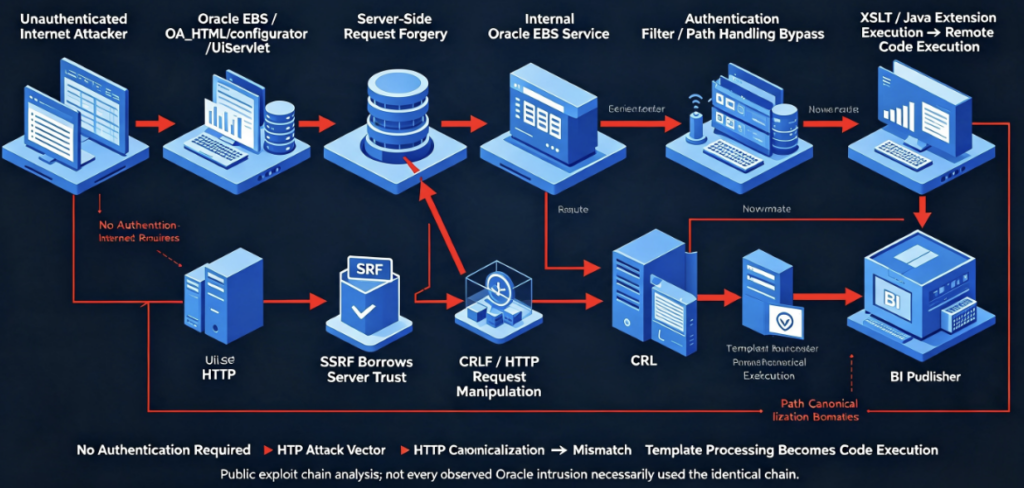
The leaked exploit analyzed by watchTowr is technically important because it demonstrates how multiple individually constrained vulnerabilities can be composed into pre-authentication RCE.
At a conceptual level, the chain looks like this:
Internet attacker
      |
      v
Oracle EBS UiServlet
      |
      v
Server-Side Request Forgery
      |
      v
CRLF / HTTP request manipulation
      |
      v
Reach internal EBS HTTP service
      |
      v
Authentication filter bypass
      |
      v
XSLT processing functionality
      |
      v
Server-side code execution
This is an excellent example of why vulnerability severity cannot always be determined by looking at isolated primitives.
An SSRF may appear constrained.
A path normalization weakness may appear constrained.
An unsafe XSLT feature may appear constrained.
When chained together, those weaknesses can produce unauthenticated RCE.
Stage 1: UiServlet as an SSRF Primitive
The publicly analyzed chain begins with:
/OA_HTML/configurator/UiServlet
watchTowr found that attacker-controlled XML input could influence a return_url subsequently used by the application when making a server-side HTTP request.
That creates an SSRF primitive: instead of the attacker directly accessing an internal resource, the Oracle EBS server accesses the target on the attacker’s behalf. (watchTowr Labs)
SSRF becomes especially dangerous when the server can communicate with application interfaces that are inaccessible from the public Internet.
Stage 2: CRLF Expands Control Over the Request
The chain then exploits carriage-return/line-feed handling to manipulate the structure of the server-generated HTTP request.
This gives the attacker considerably more control than a conventional “server fetches URL” SSRF.
Instead of merely choosing a destination, the attacker can influence HTTP framing sufficiently to construct requests required by subsequent stages of the chain. (watchTowr Labs)
The general security lesson is important:
SSRF impact depends not only on where the server can connect, but also on how much control the attacker has over the resulting protocol message.
Stage 3: Pivoting Toward Internal EBS Services
watchTowr’s analysis showed that the SSRF could reach an internal Oracle EBS HTTP service that would not normally be available to an unauthenticated Internet client. (watchTowr Labs)
This transforms an externally exposed web vulnerability into an internal application-access primitive.
Network segmentation alone therefore does not necessarily save the application.
If the public-facing server is authorized to communicate with the internal component, SSRF effectively borrows that trust relationship.
Stage 4: Authentication-Filter Bypass
The publicly analyzed chain then used path-processing behavior to reach functionality that should otherwise have been protected by the EBS authentication layer.
This stage illustrates another recurring web-security failure:
authorization decisions and request routing must agree on what path is being accessed.
If a security filter canonicalizes a path differently from the downstream application, attackers may be able to reach protected resources through alternate path representations.
watchTowr demonstrated such an authentication-filter bypass as part of the Oracle EBS chain. (watchTowr Labs)
Stage 5: XSLT Turns Application Access Into RCE
The final dangerous boundary involved XML/XSL processing.
The attack could cause Oracle EBS to evaluate an attacker-controlled XSL transformation in an environment capable of interacting with Java functionality.
Once an XSLT engine is configured with powerful Java extension capabilities, an “XML template” is no longer merely passive presentation data.
It can become executable logic.
Rapid7’s analysis of the leaked material similarly found an attacker-hosted XSL template that ultimately interacted with Java functionality to launch operating-system processes on the EBS host. (Rapid7)
The security boundary is therefore:
Untrusted template
      ↓
XSLT processor
      ↓
Java extension capability
      ↓
Runtime functionality
      ↓
Operating-system process
That is the point at which a web application weakness becomes full remote code execution.
The SyncServlet Chain Observed in Real Attacks
Mandiant’s August observations provide another extremely important view of the campaign.
The activity began with:
POST /OA_HTML/SyncServlet
The attacker then used Oracle’s XDO Template Manager functionality to introduce a malicious template into the EBS database. (Google Cloud)
The template was not necessarily written as an obvious .jsp web shell on disk.
Instead, malicious XSL/XML content was stored in Oracle application tables.
That distinction has major implications for threat hunting.
Traditional file-integrity monitoring may completely miss the initial payload.
Malicious XDO Templates
Mandiant found suspicious templates in:
XDO_TEMPLATES_B
with corresponding payload-related information in:
XDO_LOBS
Observed malicious template codes commonly began with:
TMP
or:
DEF
and were later triggered using Oracle’s Template Preview functionality. (Google Cloud)
A defensive review can therefore start with recent template creation:
SELECT
    TEMPLATE_CODE,
    TEMPLATE_TYPE,
    CREATION_DATE
FROM XDO_TEMPLATES_B
ORDER BY CREATION_DATE DESC;
Defenders can then prioritize unexpected recent templates, particularly suspicious TMP* ve DEF* values, and correlate them with web requests, database audit logs, application logs and endpoint telemetry.
This should not be treated as a vulnerability scanner.
Bu bir compromise-hunting query.
Template Preview as the Execution Trigger
Mandiant identified requests to Oracle’s Template Preview page as a high-value exploitation indicator.
The relevant path involved:
/oracle/apps/xdo/oa/template/webui/TemplatePreviewPG
with suspicious template codes using the TMP veya DEF prefixes. (Google Cloud)
The conceptual sequence was:
Unauthenticated request
        ↓
EBS application weakness
        ↓
Create malicious XDO template
        ↓
Template stored in database
        ↓
Request Template Preview
        ↓
XSL/XML evaluation
        ↓
Java payload execution
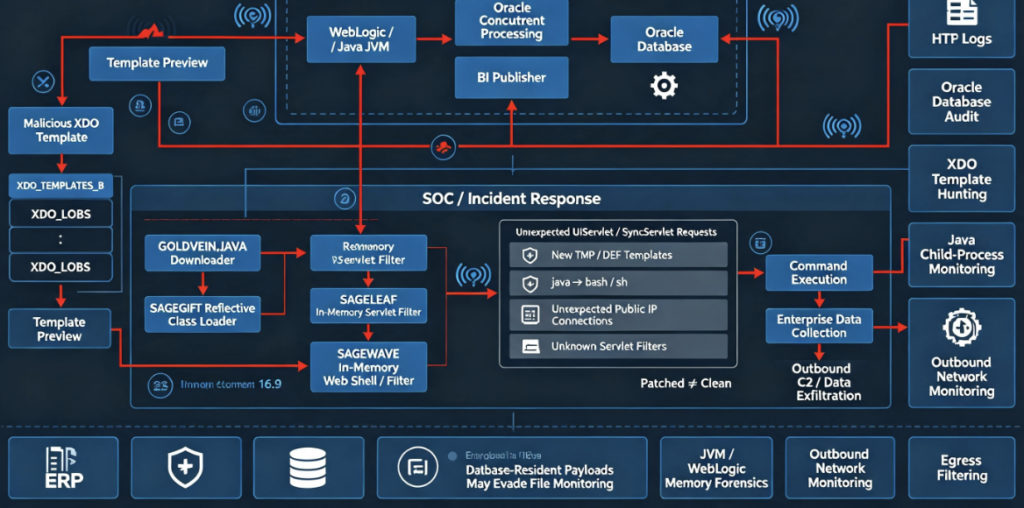
This architecture explains why defenders need visibility across multiple layers.
A WAF sees HTTP.
The Oracle database sees templates.
EDR sees Java processes.
Network monitoring sees C2.
No single telemetry source necessarily shows the complete intrusion.
From RCE to Java-Based Post-Exploitation
The Oracle EBS campaign was not limited to demonstrating kimami.
Mandiant discovered a multi-stage Java post-exploitation framework.
Several components are especially important.
GOLDVEIN.JAVA
Mandiant identified GOLDVEIN.JAVA, a downloader executed within the Java environment.
Its role was to communicate with attacker-controlled infrastructure and retrieve additional payloads. Investigators noted similarities to GOLDVEIN tooling previously associated with exploitation of Cleo products by suspected FIN11-related activity. (Google Cloud)
The important defensive characteristic is not merely the malware family name.
It is the process and network relationship:
Oracle EBS Java process
        ↓
unexpected outbound network connection
        ↓
attacker-controlled infrastructure
        ↓
second-stage payload
An Oracle EBS Java process making arbitrary outbound Internet connections should therefore be treated much more carefully than ordinary web-server traffic.
SAGEGIFT
Google identified SAGEGIFT as a Java reflective class loader designed for Oracle WebLogic environments.
Instead of simply dropping a conventional executable to disk, it could load additional Java code dynamically. (Google Cloud)
This matters because many traditional endpoint detections still depend heavily on executable file creation.
Reflective Java loading reduces that visibility.
SAGELEAF
SAGEGIFT was used to load SAGELEAF, an in-memory Java component capable of installing additional WebLogic servlet-filter functionality. (Google Cloud)
Servlet filters are particularly valuable for persistence because they operate inside the web application’s request-processing pipeline.
A malicious filter can inspect requests and activate only when a secret path, header, or value is present.
To normal users, the application can continue behaving normally.
SAGEWAVE
SAGELEAF could subsequently install SAGEWAVE, another malicious servlet filter.
Mandiant observed variants that required specific request characteristics before processing encrypted attacker content. (Google Cloud)
This is closer to an in-memory web shell than to traditional commodity malware.
Instead of connecting to a standalone binary, the attacker communicates with functionality embedded inside the already trusted Java application process.
The effective architecture becomes:
Internet request
      ↓
Oracle WebLogic / EBS Java process
      ↓
malicious servlet filter
      ↓
encrypted attacker payload
      ↓
dynamically loaded Java classes
      ↓
post-exploitation capability
That architecture significantly complicates incident response.
Why Memory Forensics Matters for CVE-2025-61882
Mandiant specifically recommends memory analysis because much of the observed implant framework executes inside Java processes rather than relying entirely on conventional on-disk malware. (Google Cloud)
This changes the forensic priority order.
A conventional investigation might focus on:
new executable files
startup scripts
cron entries
modified binaries
new services
Those checks remain useful.
But an Oracle EBS investigation should additionally examine:
WebLogic JVM memory
loaded Java classes
servlet filters
unexpected class loaders
Java child processes
Java network sockets
database-resident XSL templates
If investigators only search the filesystem, an in-memory Java implant may remain invisible.
Post-Exploitation Reconnaissance
After successful exploitation, Mandiant observed commands being run in the context of the Oracle EBS applmgr account.
The actor collected information about host networking, mounted storage, running processes and adjacent systems. Mandiant also observed interactive shell activity spawned by Java processes. (Google Cloud)
From a detection perspective, the exact reconnaissance command is less important than the parent-child relationship.
An especially strong behavioral pattern is:
java
  └── shell
       └── host/network discovery
For an Oracle EBS server, that can be far more meaningful than looking for one specific malicious filename.
A generic hunting rule might conceptually look for:
ParentProcess = java
AND
ChildProcess IN [bash, sh, cmd.exe, powershell.exe]
AND
JavaProcess belongs to Oracle EBS / WebLogic
This will generate legitimate exceptions in some environments, so organizations should baseline their own administrative behavior.
But it provides a useful behavioral anchor.
Why Outbound Filtering Is One of the Strongest Compensating Controls
Enterprise application servers frequently receive extensive inbound security attention while being allowed relatively broad outbound Internet access.
CVE-2025-61882 demonstrates why that is dangerous.
Observed post-exploitation payloads depended on outbound communication to attacker infrastructure for second-stage payload retrieval or command-and-control. Google therefore recommended restricting nonessential outbound Internet connectivity from Oracle EBS servers. (Google Cloud)
Consider two architectures.
Weak Egress Model
Oracle EBS
    |
    +----> anywhere on Internet:443
Once RCE occurs, the attacker can potentially establish outbound C2 over a commonly permitted destination port.
Restrictive Egress Model
Oracle EBS
    |
    +----> approved Oracle/update endpoints
    +----> corporate proxy
    +----> explicitly required business integrations
    X----> arbitrary Internet destinations
The second architecture does not eliminate the RCE vulnerability.
But it can break important post-exploitation stages and create higher-quality alerts.
That is defense in depth in practical terms.
Detecting CVE-2025-61882 Exploitation
Detection should combine HTTP, database, endpoint and network evidence rather than rely solely on a static IP blocklist.
Monitor the Key Oracle EBS Paths
Defenders should investigate unusual requests involving:
/OA_HTML/configurator/UiServlet

/OA_HTML/SyncServlet
Mandiant observed these endpoints in separate exploitation activity during the 2025 campaign. (Google Cloud)
Requests involving Template Preview should receive particular scrutiny when paired with newly created or unusual template identifiers.
Hunt Oracle XDO Templates
Review recent rows in:
XDO_TEMPLATES_B
XDO_LOBS
and investigate unexpected templates created around suspected exploitation windows. Google specifically highlighted suspicious codes beginning with TMP veya DEF. (Google Cloud)
A more targeted defensive query could resemble:
SELECT
    TEMPLATE_CODE,
    TEMPLATE_TYPE,
    CREATION_DATE
FROM XDO_TEMPLATES_B
WHERE TEMPLATE_CODE LIKE 'TMP%'
   OR TEMPLATE_CODE LIKE 'DEF%'
ORDER BY CREATION_DATE DESC;
Do not treat the prefixes alone as proof of compromise.
Correlate creation time and application activity with HTTP, database and endpoint telemetry.
Hunt Java-to-Shell Execution
Investigate cases where the Oracle EBS Java process unexpectedly spawns:
bash
sh
cmd.exe
powershell.exe
CrowdStrike and Mandiant both highlighted anomalous command execution originating from the Java application context as useful behavioral evidence. (Google Cloud)
Hunt Java-to-Internet Connections
Look for Oracle EBS or WebLogic Java processes establishing outbound connections to previously unseen public IP addresses.
Historical indicators are valuable for retrospective investigation, but defenders should not design detection solely around published IP addresses.
Attacker infrastructure changes.
Behavior persists.
The higher-value analytic is:
Oracle EBS JVM
      +
unexpected public destination
      +
unusual timing
      +
shell execution or template activity
rather than:
destination IP equals one known IOC
Investigate Suspicious Servlet Filters
Because SAGELEAF and SAGEWAVE operated through Java servlet-filter mechanisms, responders should examine unexpected dynamically registered filters, unusual WebLogic runtime objects and suspicious classes present in memory. (Google Cloud)
This is especially important when a system shows credible exploitation evidence but disk triage finds no traditional web shell.
Oracle’s Published Indicators of Compromise
Oracle’s emergency advisory included several indicators derived from observed activity, while explicitly warning that the IOCs were not limited exclusively to CVE-2025-61882. (Oracle)
Among the infrastructure indicators Oracle published were:
200.107.207[.]26
185.181.60[.]11
Oracle also published SHA-256 hashes associated with the leaked Oracle EBS exploit archive and accompanying scripts. (Oracle)
Mandiant’s broader campaign analysis additionally documented infrastructure associated with UiServlet/SyncServlet activity and Java C2 communications. (Google Cloud)
These IOCs are useful for:
- historical log searches,
- retrospective proxy analysis,
- firewall review,
- SIEM correlation,
- incident scoping.
They should not be treated as a permanent detection strategy.
Blocking yesterday’s attacker IP does not fix CVE-2025-61882.
Why WAF Rules Alone Are Not Enough
CrowdStrike recommended placing appropriate web application firewall controls in front of Oracle EBS, particularly while organizations investigate exposure. (CrowdStrike.com)
A WAF can provide valuable temporary risk reduction.
For example, defenders may identify unexpectedly exposed Oracle paths, malformed requests, SSRF patterns or abnormal request rates.
But a WAF is not a replacement for patching.
The public exploit chain itself demonstrates why.
Attackers were chaining subtle application behaviors across multiple layers. Signature-based rules developed against one known PoC may not stop a modified exploit or a separate exploit chain targeting the same vulnerable architecture.
The correct hierarchy is:
Vendor patch
     ↓
Exposure reduction
     ↓
WAF / reverse-proxy controls
     ↓
Egress restrictions
     ↓
Behavioral monitoring
     ↓
Threat hunting
not:
WAF signature
     ↓
problem solved
Patching CVE-2025-61882
Oracle’s guidance is straightforward: affected customers should apply the Security Alert updates as soon as possible.
Affected supported releases are:
Oracle E-Business Suite 12.2.3 through 12.2.14.
Oracle also states that the October 2023 Critical Patch Update must already be installed before applying the CVE-2025-61882 update. (Oracle)
This prerequisite deserves special operational attention.
An organization cannot assume that downloading the emergency patch alone is sufficient if its EBS environment is significantly behind Oracle’s patch baseline.
Older unsupported releases present an additional problem. Oracle states that releases outside Premier or Extended Support were not tested for the vulnerability, while warning that earlier affected release families may also be vulnerable and recommending migration to supported versions. (Oracle)
Do Not Stop at CVE-2025-61882
Oracle released another EBS security alert on October 11 addressing CVE-2025-61884, also remotely exploitable without authentication. (Oracle)
Google subsequently stated that Oracle EBS environments patched through the October 11 update were likely protected against the known exploit chains being investigated at that point. (Google Cloud)
This creates an important operational rule:
Do not validate Oracle EBS security by checking only whether the CVE-2025-61882 patch exists. Validate the entire Oracle-recommended patch state applicable to the deployment.
This is especially important because incident responders observed multiple exploit chains.
Why “Patched” Does Not Mean “Clean”
Imagine an Oracle EBS server was exploited on August 15.
The attacker installed an in-memory persistence mechanism, extracted data and disconnected.
The organization installs Oracle’s emergency patch on October 5.
The vulnerability is now fixed.
But the August compromise still happened.
The stolen data is still stolen.
And if persistence remains, the attacker may still retain access.
This is why retrospective compromise assessment is essential.
Rapid7 specifically warned that organizations should conduct threat hunting because exploitation may have occurred before the public emergency update became available. (Rapid7)
A reasonable response workflow is therefore:
1. Identify EBS versions and exposure
2. Apply Oracle's current security updates
3. Restrict unnecessary external access
4. Review historical HTTP logs
5. Hunt XDO database templates
6. Review Java child processes
7. Review historical outbound connections
8. Inspect WebLogic/JVM memory when warranted
9. Search for persistence
10. Determine whether sensitive data was accessed
11. Rotate exposed credentials/secrets
12. Rebuild affected systems where trust cannot be restored
Patching belongs near the beginning of this process.
It is not the end.
Internet Exposure Should Be Treated as a Major Risk Multiplier
CVE-2025-61882 requires HTTP network access.
Therefore organizations should determine exactly which Oracle EBS components are externally reachable and whether they genuinely need to be Internet-facing.
The key architectural question is:
Can an unauthenticated Internet client reach the vulnerable application surface at all?
Where external EBS access is necessary, organizations can reduce risk with reverse proxies, strong access gateways, source restrictions or appropriately designed authenticated access layers.
Where direct exposure is unnecessary, it should be removed.
CrowdStrike recommended considering temporary removal of Internet access from exposed EBS services during response and remediation. (CrowdStrike.com)
CVE-2025-61882 Is Also a Lesson in Exploit Chaining
From an application-security perspective, the case is notable because it demonstrates how attackers think differently from traditional vulnerability scanners.
A conventional scanner might separately report:
SSRF
CRLF injection
path handling issue
authorization bypass
unsafe XSLT behavior
Each could receive its own ticket.
An attacker asks a different question:
“Can output from vulnerability A become input to vulnerability B?”
That is how apparently constrained vulnerabilities become RCE.
The leaked Oracle EBS exploit reconstructed by watchTowr demonstrates precisely this kind of composition. (watchTowr Labs)
This has broader implications for modern penetration testing.
Finding isolated weaknesses is useful.
Anlamak attack paths is more important.
Why BI Publisher and Template Processing Deserve Security Attention
The BI Publisher dimension of CVE-2025-61882 also illustrates a recurring enterprise-software security problem: transformation engines often sit dangerously close to executable functionality.
Formats such as:
XSLT
XML
templates
reports
documents
server-side expressions
may look like “data.”
But their parsers may expose:
Java extensions
reflection
script engines
filesystem access
network access
dynamic class loading
Once attacker-controlled content reaches such an engine, the parser itself becomes a security boundary.
This pattern appears far beyond Oracle.
Whenever an enterprise product performs server-side document or template transformation, security engineers should ask:
Can untrusted content cross from declarative data into executable application functionality?
CVE-2025-61882 demonstrates why that question matters.
CL0P’s Broader Zero-Day Extortion Model
The Oracle EBS campaign also fits a broader pattern associated with CL0P-branded operations.
Google noted historical campaigns involving vulnerabilities in products including Accellion FTA, GoAnywhere MFT, MOVEit and Cleo software. In several cases, attackers exploited Internet-facing enterprise systems at scale, stole data and later initiated extortion. (Google Cloud)
The Oracle campaign therefore looks less like opportunistic ransomware spreading inside a network and more like industrialized exploitation of centralized data systems.
The economics are compelling for attackers.
Suppose compromise of one application produces access to high-value business records.
Then:
1 vulnerable enterprise application
       ↓
large centralized dataset
       ↓
minimal lateral movement
       ↓
lower operational complexity
       ↓
high-value extortion opportunity
From the defender’s perspective, this makes public-facing enterprise applications disproportionately important assets.
Frequently Asked Questions About CVE-2025-61882
What is CVE-2025-61882?
CVE-2025-61882 is a critical vulnerability affecting Oracle E-Business Suite’s Oracle Concurrent Processing product and BI Publisher Integration component. It can be exploited remotely over HTTP without authentication and can result in takeover of Oracle Concurrent Processing. (Oracle)
What is the CVSS score?
Oracle assigns CVE-2025-61882 a CVSS 3.1 score of 9.8 Critical. (Oracle)
Which Oracle EBS versions are affected?
Oracle lists E-Business Suite 12.2.3 through 12.2.14 as affected supported versions. (Oracle)
Does exploitation require authentication?
No. Oracle classifies the vulnerability as remotely exploitable without authentication. (Oracle)
Can CVE-2025-61882 lead to remote code execution?
Yes. Oracle explicitly states that successful exploitation may result in remote code execution, while its risk matrix describes successful attacks as capable of taking over Oracle Concurrent Processing. (Oracle)
Was CVE-2025-61882 exploited as a zero-day?
Google Threat Intelligence and CrowdStrike reported evidence indicating exploitation beginning around August 9, 2025, before Oracle’s October 4 emergency patch. (Google Cloud)
Did CL0P exploit CVE-2025-61882?
Intrusions into Oracle EBS environments were associated with an extortion campaign using the CL0P brand. Google identified substantial CL0P and FIN11-related overlaps but did not formally attribute every observed intrusion to one actor, while CrowdStrike assessed GRACEFUL SPIDER involvement with moderate confidence. (Google Cloud)
Therefore “CL0P-linked” or “CL0P-branded exploitation campaign” is more precise than asserting that every CVE-2025-61882 incident was definitively executed by one CL0P operator.
Was ransomware deployed?
The major campaign described by Google centered on data theft and extortion, not necessarily file encryption. (Google Cloud)
This distinction is important despite the CL0P brand’s history with ransomware operations.
Is public exploit code available?
Exploit material was leaked publicly in early October 2025 and subsequently analyzed by researchers including watchTowr and Rapid7. Oracle published hashes associated with the leaked files as IOCs. (Oracle)
Is CVE-2025-61882 in CISA KEV?
Yes. It was added to CISA’s Known Exploited Vulnerabilities catalog on October 6, 2025. (Rapid7)
Is installing the CVE-2025-61882 patch enough?
It closes the addressed vulnerability, but organizations that operated exposed EBS systems during the pre-patch exploitation period should also perform compromise assessment and threat hunting. Oracle’s later CVE-2025-61884 update should also be considered as part of the complete Oracle EBS security baseline. (Oracle)
Defensive Priorities for Security Teams
For defenders responsible for Oracle E-Business Suite, CVE-2025-61882 belongs in the highest remediation tier.
The priority is not based on CVSS alone.
It combines:
pre-authentication exposure + remote code execution + public exploit knowledge + confirmed exploitation + high-value enterprise data + extortion activity
Organizations should first verify whether Oracle EBS versions 12.2.3 through 12.2.14 exist anywhere in the environment and determine whether the vulnerable HTTP surface was externally accessible. Oracle’s applicable emergency updates and subsequent security patches should then be installed according to the vendor’s instructions, including required prerequisites. (Oracle)
Teams should simultaneously perform retrospective hunting rather than waiting for obvious ransomware symptoms.
Review Oracle application traffic around UiServlet, SyncServlet and Template Preview activity. Examine recently created XDO templates. Correlate unusual Oracle Java processes with shell execution. Review outbound connectivity from the application tier. Where evidence justifies it, perform memory analysis of WebLogic JVMs for unexpected classes or servlet filters. These recommendations align closely with Google/Mandiant’s incident-response guidance. (Google Cloud)
Most importantly, treat the EBS database as part of the attack surface.
The observed attackers demonstrated that malicious application logic could be persisted through Oracle’s own template infrastructure rather than through an obvious executable written to disk.
That changes what “compromise evidence” looks like.
Final Assessment
CVE-2025-61882 deserves attention not merely because it is another CVSS 9.8 Oracle vulnerability.
It represents a much broader security problem.
A powerful enterprise application exposed to the network contained an unauthenticated path toward code execution. Attackers appear to have discovered and exploited Oracle EBS environments before defenders had an emergency patch. The resulting intrusions were tied to a large-scale data-theft and extortion campaign using the CL0P brand. Investigators then discovered sophisticated Java-based post-exploitation tooling designed to operate inside the Oracle/WebLogic runtime itself. (Google Cloud)
The publicly analyzed exploit also demonstrates the importance of attack-path thinking. SSRF, request manipulation, authentication bypass and unsafe template execution may look like separate technical issues when examined individually. Combined, they can cross the boundary from unauthenticated HTTP access to operating-system-level execution. (watchTowr Labs)
For organizations running Oracle E-Business Suite, the response should therefore be broader than “patch CVE-2025-61882.”
The appropriate objective is:
patch the complete Oracle EBS security baseline, reduce Internet exposure, constrain outbound connectivity, search the database for malicious templates, inspect Java/WebLogic behavior, reconstruct historical access during the zero-day window, and determine whether sensitive enterprise data left the environment before remediation.
That is the central lesson of the CVE-2025-61882 and CL0P exploitation campaign.
In a mass-exploitation event, vulnerability remediation answers only one question:
Can the attacker exploit us now?
Incident response must answer the more difficult one:
Did they already exploit us before we knew we were vulnerable? (Google Cloud)


 Turkish
  English
  German
  French
  Spanish
  Portuguese
  Japanese
  Korean
  Hindi
Hindi  Arabic
  Hebrew