
CVE-2026-106173 is a critical FortiSIEM vulnerability that can permit unauthenticated code or command execution. Bu Singapore Cyber Security Agency’s October 22 alert identifies FortiSIEM 7.5.0 as affected, recommends upgrading to 7.5.1 or later, and states that a proof-of-concept exploit is publicly available. Prioritize identifying affected appliances and verifying the installed update; a login page is not evidence that a pre-authentication flaw is blocked.
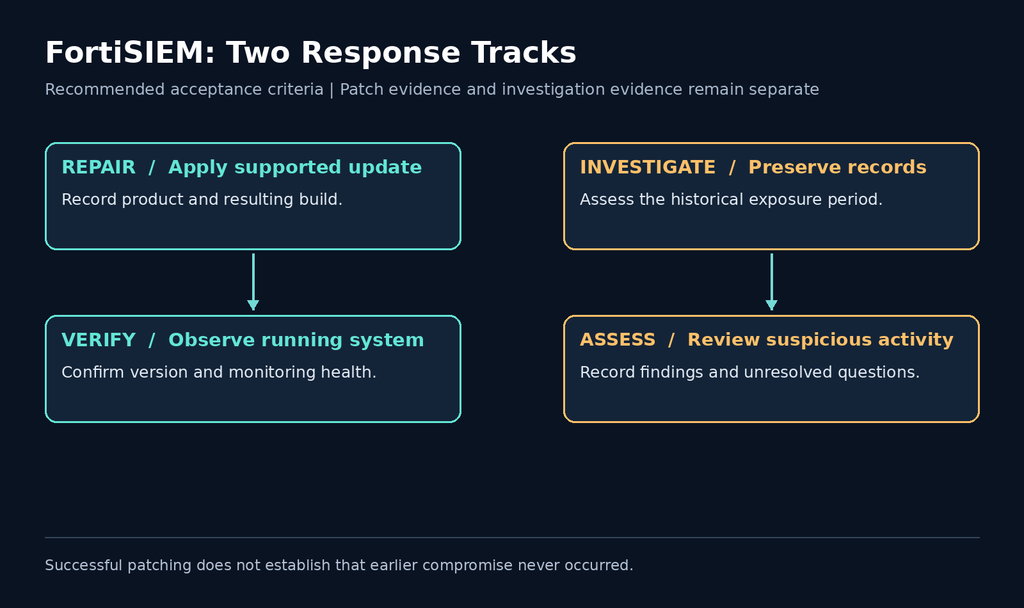
For a security monitoring system, keep two response tracks separate: repair the vulnerable deployment and investigate any evidence of earlier unauthorized activity. A successful patch record supports the first track. It does not establish that the appliance was never compromised or that previously exposed credentials remain trustworthy.
This assessment was checked on October 26, 2026. The operational matrices below are recommended response and acceptance criteria, not a vendor detection signature or results from testing a FortiSIEM appliance. The included Python example is an offline inventory model, with synthetic records only.
Read the affected-version statements precisely
Public advisories use different levels of detail. CSA names 7.5.0 explicitly. The October 23 CERT-In note summarizes affected software as versions prior to 7.5.1. Do not turn that broader summary into a confirmed branch-by-branch matrix. For an older installation, obtain Fortinet’s applicable product guidance and supported upgrade path instead of declaring it unaffected because its exact version is absent from CSA’s short alert.
The vendor advisory referenced by both agencies is FG-IR-26-180. Our research retrieval received an access-denied response from that page, so this article attributes confirmed public facts to the government notices and does not claim to have inspected the vendor’s full technical analysis. Review the live vendor notice during change planning, especially for older branches or deployment-specific procedures.
| Reported installation | What the cited evidence establishes | Operational decision |
|---|---|---|
| FortiSIEM 7.5.0 | Explicitly affected in CSA’s notice | Prioritize the documented update and review access exposure |
| FortiSIEM 7.5.1 | The update target named by CSA | Confirm rollout and the version actually serving each affected role |
| Older or unknown release | CERT-In gives a broader summary; this is not a complete branch matrix | Verify vendor scope and upgrade compatibility; retain the uncertainty |
| A later release | CSA recommends 7.5.1 or later | Match the installed product to current vendor guidance rather than infer full security from version ordering |
What is known about the trust boundary
CERT-In describes improper restriction of a pathname to an intended directory, with specially crafted packets leading to unauthorized execution. That establishes a path-handling weakness at a security boundary. It does not disclose, in the cited note, a verified endpoint, parameter, file destination, process privilege, or complete sequence from input to execution.
A directory boundary and an execution outcome are different stages of a vulnerability description. Do not fill the gap with an assumed upload route, an assumed web shell, or a payload borrowed from an older FortiSIEM CVE. Likewise, a generic reverse-proxy rule cannot be called an effective mitigation without knowing whether it covers the relevant service and input path.
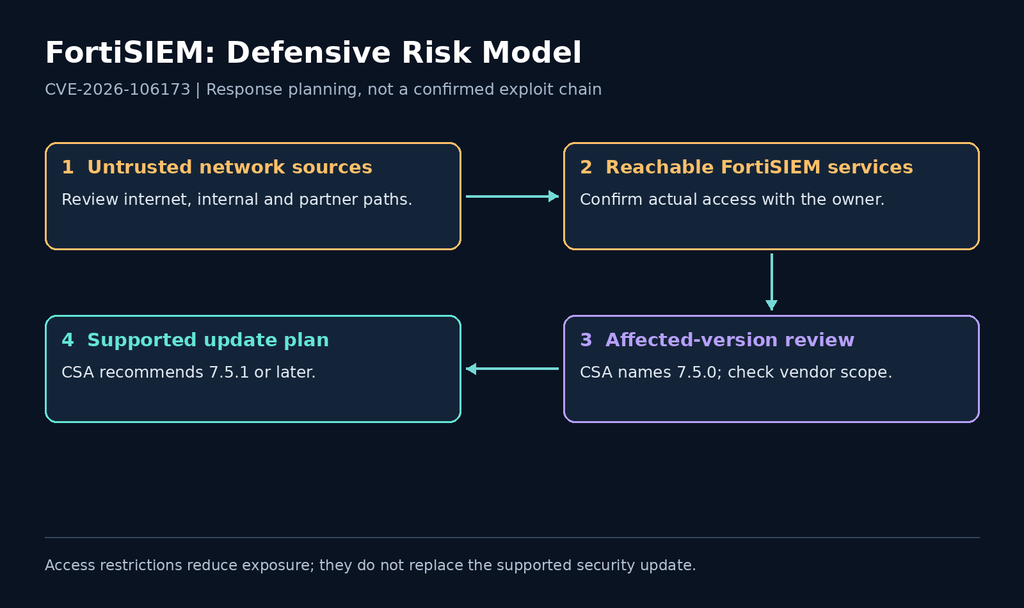
For response planning, the useful question is which untrusted network sources can reach the affected appliance and its services. Review the actual access configuration with the system owner. Restricting an unnecessary path can reduce exposure while a change is prepared, but it does not replace the update. An administrator’s ordinary authentication test exercises a different boundary from the one described in a pre-authentication advisory.
Build the work queue from asset evidence
Start with the deployment inventory and the team that operates it. Record the product, node or appliance identity, reported version, collection time, network reachability, owner, and update record. Keep unknown reachability explicit. An asset that was absent from one external discovery view is not necessarily unreachable from internal networks, partner connections, or an earlier configuration.
Distinguish a current observation from a historical one. A screenshot collected before maintenance cannot prove the new runtime is active. A present-day firewall rule cannot establish which sources could connect last week. These are evidence-handling recommendations: they make the repair and investigation tracks easier to reconcile without assigning certainty to missing data.
The following Python 3 example converts fictional inventory assertions into work-queue labels. It does not connect to a host, inspect a package, parse a complete Fortinet version scheme, or determine exploitability. Exact equality deliberately limits the model: an unfamiliar version goes to vendor-scope review instead of being automatically labeled safe.
def triage(version, reachable, rollout_record):
    # These inputs are inventory assertions, not observations from a scan.
    if version == '7.5.0':
        return 'URGENT' if reachable is True else 'PATCH_AND_VERIFY_ACCESS'
    if version == '7.5.1':
        return 'VERIFY_RUNTIME' if rollout_record else 'VERIFY_ROLLOUT'
    return 'VERIFY_VENDOR_SCOPE'

cases = [
    ('7.5.0', True, False, 'URGENT'),
    ('7.5.0', False, False, 'PATCH_AND_VERIFY_ACCESS'),
    ('7.5.0', None, True, 'PATCH_AND_VERIFY_ACCESS'),
    ('7.5.1', True, False, 'VERIFY_ROLLOUT'),
    ('7.5.1', False, True, 'VERIFY_RUNTIME'),
    ('7.4.9', False, True, 'VERIFY_VENDOR_SCOPE'),
    ('7.6.0', True, True, 'VERIFY_VENDOR_SCOPE'),
    (None, None, False, 'VERIFY_VENDOR_SCOPE'),
]
for version, reachable, record, expected in cases:
    actual = triage(version, reachable, record)
    assert actual == expected, (version, actual, expected)
    print(version, actual)
print('8/8 offline inventory cases passed')
We ran all eight synthetic cases on October 26, 2026; each returned the expected label. The 7.4.9 fixture is an arbitrary older-version string used to test uncertainty handling, not a claim that a specific release exists or is vulnerable. A recorded rollout still leads to runtime verification. The model has no “secure” verdict because its inputs cannot establish one.
Verify the rollout without running a public exploit
Use the supported update and maintenance procedure for the exact deployment. Before changing a monitoring platform, agree the backup and recovery procedure, the maintenance window, and how the team will recognize gaps in event collection. Avoid inventing an appliance command from a generic Linux tutorial; a working shell command does not establish that a product upgrade is supported.
| Closure question | Evidence to retain | Insufficient shortcut |
|---|---|---|
| Was the intended update applied? | Product-specific update record and resulting build identity | Automatic updates are enabled |
| Is the repaired deployment running? | Post-maintenance observation for each relevant instance | A newer package downloaded to a management machine |
| Did monitoring resume correctly? | Approved normal event or workflow check with an observed result | The login page loads |
| What remains exposed? | Current, owner-reviewed reachability and access controls | No result from one discovery tool |
| Was earlier access assessed? | Reviewed exposure period, retained evidence, and unresolved questions | The patch installation succeeded |
A public PoC can increase urgency without becoming a required production acceptance test. Do not run unreviewed exploit code against the monitoring platform merely to produce a green check. If further validation is justified, obtain explicit scope, use an isolated owned environment, and define the minimum observation needed. The eight offline cases above provide no evidence that a FortiSIEM exploit succeeds or fails.
Keep compromise assessment separate from patch status
Preserve relevant records under the organization’s incident procedure when suspicious activity is present. Review unexpected account or configuration changes, unexplained files or processes, and unusual outbound behavior in their operational context. These are broad investigative questions, not product-specific indicators, validated detections, or proof that any observed anomaly is caused by this CVE.
If access to credentials, service integrations, or downstream systems is suspected, expand the investigation according to the evidence and the owner’s response plan. Coordinate credential changes with affected services rather than rotating everything blindly and disrupting recovery. Conversely, an absence of retained alerts does not establish an absence of access when logging, coverage, or retention is incomplete.
Penligent’s documented workflow can support authorized investigation of application-facing surfaces and reviewable findings. It should not be treated as a dedicated CVE-2026-106173 detector or a replacement for Fortinet’s appliance update and incident procedures. Keep any adjacent testing separately scoped so response activity does not inadvertently extend into connected customer environments.
Questions operators need to resolve
Does public PoC availability mean exploitation is confirmed?
No. CSA explicitly reports public PoC availability. That alone does not establish an observed campaign, victim count, or compromise of your appliance. Use it to prioritize repair while keeping exploitation claims tied to actual evidence.
Can a non-public appliance wait?
Restricted access changes the exposure assessment, but it does not repair the flaw. Verify which sources can reach the relevant services, including approved internal paths, and schedule the supported update. Record uncertainty rather than treating “not internet-facing” as a complete risk assessment.
Is an older release outside the scope?
Do not infer that from a short alert naming 7.5.0. CERT-In’s summary is broader. Check the vendor’s exact branch guidance and upgrade requirements, particularly where a deployment has fallen outside supported maintenance.
Close the repair task when the intended update is running and required monitoring still works. Close an investigation only when its separate evidence supports that conclusion. Keeping those decisions distinct gives the next operator a reliable account of what changed and what remains unknown.

 Turkish
 English
 German
 French
 Spanish
 Portuguese
 Japanese
 Korean
 Hindi
 Arabic
 Hebrew