
CVE-2026-35273 is not a routine ERP patching item. Oracle describes it as a vulnerability in Oracle PeopleSoft Enterprise PeopleTools, specifically the Updates Environment Management component, affecting supported PeopleTools versions 8.61 and 8.62. The official Oracle Security Alert says the issue is remotely exploitable without authentication and may result in remote code execution. The NVD entry lists a CVSS 3.1 base score of 9.8 with network attack vector, low attack complexity, no privileges required, no user interaction, and high confidentiality, integrity, and availability impact.
That combination matters. PeopleSoft environments often sit behind payroll, HR, finance, procurement, student administration, and other high-value workflows. PeopleTools is the technical platform that supports those applications. A pre-authentication flaw in a PeopleTools component is therefore closer to a platform exposure than a single business-form bug.
The practical question is not whether CVE-2026-35273 sounds severe. It is whether your organization can prove, with evidence, which PeopleSoft systems exist, which PeopleTools versions they run, whether any affected HTTP endpoints were reachable, whether Oracle’s mitigation or patch was applied everywhere, and whether suspicious activity occurred before remediation.
Confirmed Facts
The public record is specific in some areas and thin in others. That is normal for an actively handled enterprise vulnerability. The safest way to work CVE-2026-35273 is to separate confirmed facts from assumptions.
| Area | Confirmed information | Neden önemli |
|---|---|---|
| Ürün | Oracle PeopleSoft Enterprise PeopleTools | The issue sits in the PeopleTools platform used by PeopleSoft applications, not merely in one business workflow. |
| Bileşen | Updates Environment Management | Update and environment management functions are security-sensitive because they can interact with configuration and lifecycle operations. |
| Affected supported versions | PeopleTools 8.61 and 8.62 | These are the versions Oracle names in the advisory and NVD record. |
| Attack access | Network access via HTTP | Internet-facing, VPN-facing, partner-facing, and internal HTTP exposure must be evaluated. |
| Kimlik Doğrulama | No authentication required | Identity controls after login do not compensate for a pre-authentication flaw. |
| Etki | PeopleTools takeover according to NVD, remote code execution according to Oracle | Treat affected reachable systems as high-priority assets requiring patching and review. |
| CVSS | 9.8 critical, CVSS:3.1/AV:N/AC:L/PR:N/UI:N/S:U/C:H/I:H/A:H | The score reflects low barrier to exploitation and high impact across confidentiality, integrity, and availability. |
| Zayıflık | CWE-306, Missing Authentication for Critical Function | The failure class is an authentication boundary problem around a critical function. |
| CISA status | Listed in CISA’s Known Exploited Vulnerabilities catalog according to NVD | CISA KEV listing changes urgency, especially for organizations that follow federal vulnerability prioritization models. |
| Oracle release date | Oracle Security Alert revision 1 was released on June 10, 2026 | Use this as a reference point when building patch and investigation timelines. |
Oracle also states that patches and mitigations under the Security Alert program are provided only for product versions under Premier Support or Extended Support. The same advisory warns that unsupported releases are not tested for the presence of the vulnerability, but earlier versions of affected releases are likely affected and should be upgraded to supported versions. That language is important for legacy PeopleSoft estates: absence from the affected-version list is not proof that an old unsupported deployment is safe.
The public sources do not provide a safe, vendor-confirmed exploit recipe. They do not describe the vulnerable endpoint in enough detail for defenders to build a reliable exploit detector from a single path string. They do not prove that every PeopleSoft product module is exploitable in the same way. They also do not remove the need for local investigation. A patched system may still have been reachable before the patch, and a vulnerable system that was not internet-facing may still have been reachable from a compromised internal network.
Why PeopleSoft Architecture Raises the Stakes
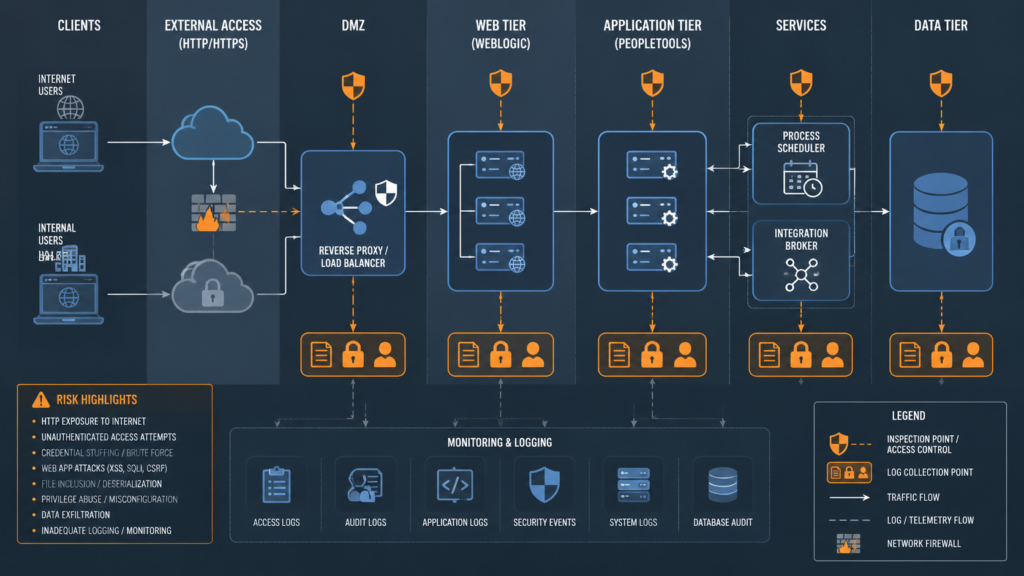
Oracle’s PeopleTools documentation describes PeopleSoft Internet Architecture as a multi-tier environment involving a relational database, application servers, Process Scheduler servers, web servers, and browsers. In the basic flow, the browser sends requests to the web server, the web server transmits requests to the application server, and the application server generates SQL for the database. Oracle’s PeopleSoft Architecture Fundamentals also notes additional technologies such as Integration Broker, Interaction Hub, Feeds Framework, Search Framework, and Performance Monitor.
That architecture creates several defensive consequences for CVE-2026-35273.
First, the HTTP entry point is only the beginning of the security story. A suspicious request may appear in WebLogic or reverse proxy logs, while the business impact may unfold in application server logs, database activity, process execution, scheduled jobs, or configuration changes.
Second, PeopleSoft environments are frequently duplicated. Production may be patched quickly, while disaster recovery, reporting, training, test, upgrade rehearsal, or vendor support environments lag behind. Some of those environments contain sanitized data. Others contain production clones, persistent credentials, trusted network routes, or old integrations. Attackers do not need the “main” instance if a forgotten instance gives them a bridge.
Third, PeopleTools is shared infrastructure. Many organizations think in terms of HCM, Campus Solutions, Financials, or Supply Chain. CVE-2026-35273 should be tracked one layer lower: PeopleTools version, web domain, application server domain, managed server, load-balanced backend, and update management exposure.
| PeopleSoft layer | Örnekler | Relevance to CVE-2026-35273 | Evidence to collect |
|---|---|---|---|
| Edge and routing | DNS, CDN, WAF, reverse proxy, load balancer | Determines who can reach HTTP or HTTPS endpoints | DNS records, virtual host configs, WAF logs, load balancer pools |
| Web tier | Oracle WebLogic, PIA managed servers | Likely first place to observe HTTP requests | HTTP access logs, WebLogic logs, deployment inventory |
| PeopleTools platform | PeopleTools 8.61, 8.62, update tooling | Officially affected layer | Version evidence, patch records, Oracle support patch documentation |
| Application server tier | PSAPPSRV and related services | May show downstream effects of malicious requests | PeopleSoft server process logs, SRID correlation, service request patterns |
| Process Scheduler | Batch jobs, reports, output | Could reveal post-compromise execution or tampering | Scheduler logs, new jobs, modified recurrence definitions |
| Veritabanı | HR, finance, campus, metadata | Holds high-value application data and PeopleTools metadata | Database audit logs, unusual queries, privileged account activity |
| Entegrasyon katmanı | Integration Broker, APIs, connectors | May expose or move sensitive data after compromise | Service operation logs, outbound calls, failed authentication events |
The goal is to avoid a common failure mode: patching the obvious URL and calling the incident closed. CVE-2026-35273 sits in an environment where web traffic, platform services, business data, and administrative workflows are tightly connected. The investigation must follow that connection.
The Vulnerability Class, Missing Authentication Before the Gate
NVD maps CVE-2026-35273 to CWE-306, Missing Authentication for Critical Function. That is a precise and useful classification. CWE-306 does not mean “a user has too many permissions.” It means a function that should require authentication can be reached without a valid authenticated identity.
That distinction changes the control model.
For normal authorization flaws, defenders ask whether the user had the wrong role, whether object-level checks failed, or whether a session was reused. For a pre-authentication critical-function flaw, defenders first ask whether the vulnerable function was reachable at all. Strong SSO, MFA, password rotation, and RBAC still matter for the overall PeopleSoft environment, but they may not stop a request that reaches vulnerable code before identity enforcement.
The CVSS vector reinforces this reading:
| CVSS element | Value for CVE-2026-35273 | Defender interpretation |
|---|---|---|
| Saldırı Vektörü | Network | Remote reachability is central. Asset exposure matters as much as software version. |
| Attack Complexity | Düşük | Do not assume exploitation requires rare timing, special local state, or insider knowledge. |
| Gerekli Ayrıcalıklar | Hiçbiri | Login controls do not provide a complete defense. |
| Kullanıcı Etkileşimi | Hiçbiri | Phishing or user clicks are not required for the base vulnerability. |
| Kapsam | Unchanged | The scored impact remains within the vulnerable security authority. |
| Gizlilik | Yüksek | Sensitive application or platform data may be at risk. |
| Bütünlük | Yüksek | Configuration, data, or application behavior may be altered. |
| Availability | Yüksek | Service disruption is plausible. |
The important operational lesson is simple: a reachable, affected PeopleTools instance should be handled like a critical internet-exposed management-plane vulnerability, even if the normal PeopleSoft login page is protected by SSO.
What To Patch And What To Treat As Unknown
Oracle’s advisory names PeopleSoft Enterprise PeopleTools 8.61 and 8.62. For those versions, the action is to follow Oracle’s patch availability documentation and mitigation instructions through Oracle’s support channels. If your organization runs one of those versions, there is no useful debate about whether the advisory applies. It does.
Unsupported versions require a different kind of discipline. Oracle’s advisory says unsupported releases are not tested for the presence of vulnerabilities addressed by the Security Alert and recommends upgrading to supported versions. That does not prove every older PeopleTools version is vulnerable to CVE-2026-35273 in the same way. It also does not prove they are safe. For risk management, unsupported PeopleTools instances should be treated as unknown until upgraded, isolated, or decommissioned.
A useful triage model looks like this:
| Asset state | Risk posture | Acil eylem |
|---|---|---|
| PeopleTools 8.61 or 8.62, internet-facing | Kritik | Patch or mitigate immediately, preserve logs, perform exposure review and incident triage. |
| PeopleTools 8.61 or 8.62, VPN-facing | Critical to high | Patch, check VPN user population and third-party access, review logs for suspicious internal sources. |
| PeopleTools 8.61 or 8.62, internal only | Yüksek | Patch, verify segmentation, inspect logs for compromised internal hosts or scanning. |
| Unsupported PeopleTools, reachable over HTTP | High unknown | Upgrade to supported version or isolate while risk is evaluated. |
| Non-production clone with production data | Yüksek | Patch and investigate like production if reachable or trusted. |
| Decommissioned but still resolvable host | High operational hygiene risk | Remove routes, DNS, credentials, and load balancer entries, then verify from outside and inside. |
| Patched production, unpatched DR | Yüksek | Patch DR and confirm failover does not reintroduce vulnerable nodes. |
The phrase “internal only” deserves skepticism. Many PeopleSoft environments are reachable from broad corporate networks, vendor VPNs, jump hosts, remote administration networks, shared VDI, or campus networks. From an attacker’s point of view, internal reachability after one foothold is still reachability.
First 24 Hours, An Evidence-Driven Response
For CVE-2026-35273, the first response should produce evidence, not just status updates. The following sequence works well for security teams and PeopleSoft administrators.
- Freeze the asset picture.
Export DNS records, load balancer pools, WAF routes, reverse proxy virtual hosts, CMDB entries, and PeopleSoft environment inventories. Capture both production and non-production. - Identify PeopleTools versions.
Confirm whether each environment runs PeopleTools 8.61, 8.62, an upgraded version, or an unsupported release. Keep screenshots or command output where your change process requires them. - Identify HTTP exposure.
For every environment, determine whether HTTP or HTTPS endpoints are reachable from the internet, VPN, partner networks, corporate LAN, admin networks, and cloud VPCs. - Apply Oracle’s patch or mitigation.
Use Oracle’s Security Alert and the linked patch availability documentation. Track each managed server and backend node, not just the public virtual hostname. - Preserve logs before rotation.
Collect WebLogic HTTP access logs, WebLogic server logs, PeopleSoft PIA logs, application server logs, Process Scheduler logs, reverse proxy logs, WAF events, EDR telemetry, database audit logs, and outbound network logs. - Review activity before and after patching.
Build a timeline from at least the period before Oracle’s June 10, 2026 advisory through the time every environment was patched or isolated. If you have legal, regulatory, or threat intelligence reasons to extend the window, do so. - Retest safely.
Confirm affected endpoints are no longer vulnerable using vendor-approved validation, controlled internal checks, and configuration review. Avoid running public exploit code against production.
A simple inventory file helps keep the work honest:
environment,hostname,public_url,network_zone,peopletools_version,weblogic_domain,managed_server,patched,patch_time_utc,logs_preserved,owner
prod-hcm,hcm.example.edu,https://hcm.example.edu,public,8.62,PIA,PIA1,no,,no,peopletools-admin
prod-fin,fin.example.edu,https://fin.example.edu,vpn,8.61,PIA,PIA1,no,,no,erp-platform
dr-hcm,hcm-dr.example.edu,https://hcm-dr.example.edu,internal,8.62,PIA_DR,PIA1,no,,no,infrastructure
test-hcm,hcm-test.example.edu,https://hcm-test.example.edu,internal,8.60,PIA_TEST,PIA1,unknown,,partial,qa
Then use plain tooling to find likely priorities:
awk -F, 'NR==1 || $5 ~ /8\.61|8\.62/ { print }' peoplesoft-inventory.csv

awk -F, 'NR>1 && ($5=="8.61" || $5=="8.62") && $8!="yes" {
  print "PATCH NEEDED:", $1, $2, $3, $4, $5
}' peoplesoft-inventory.csv
These commands do not prove exploitability. They force the team to stop talking in generalities and start working from a visible list.
Safe Exposure Checks Without Exploit Payloads
Security teams often need fast external confirmation of what is reachable. That can be done without touching exploit paths.
Start with DNS and HTTP metadata:
while read -r host; do
  echo "== $host =="
  dig +short "$host"
  curl -k -sS -I --max-time 8 "https://$host/" | sed -n '1,12p'
done < peoplesoft-hosts.txt
Record status codes, redirects, headers, TLS certificates, and whether the service presents a PeopleSoft login flow. Do not assume a generic 302 or branded login page proves safety. For CVE-2026-35273, the question is not “can a normal user log in?” It is “can unauthenticated HTTP traffic reach an affected PeopleTools component?”
For larger estates, use non-invasive HTTP probing:
nmap -Pn -p 80,443 --open --script http-title,http-headers -iL peoplesoft-hosts.txt -oA peoplesoft-http-surveyUse the result to reconcile the CMDB. If nmap finds a live endpoint the CMDB does not know about, the CMDB is wrong. If the CMDB says a host is decommissioned but DNS and HTTP still respond, treat it as an active security asset until proven otherwise.
For cloud and hybrid deployments, make sure the scan origin matches the question. An internet scan finds public exposure. It will not find partner VPN, private VPC peering, campus network, or admin subnet exposure. Run controlled checks from each relevant network zone and label the results.
Logging You Need Before You Need It
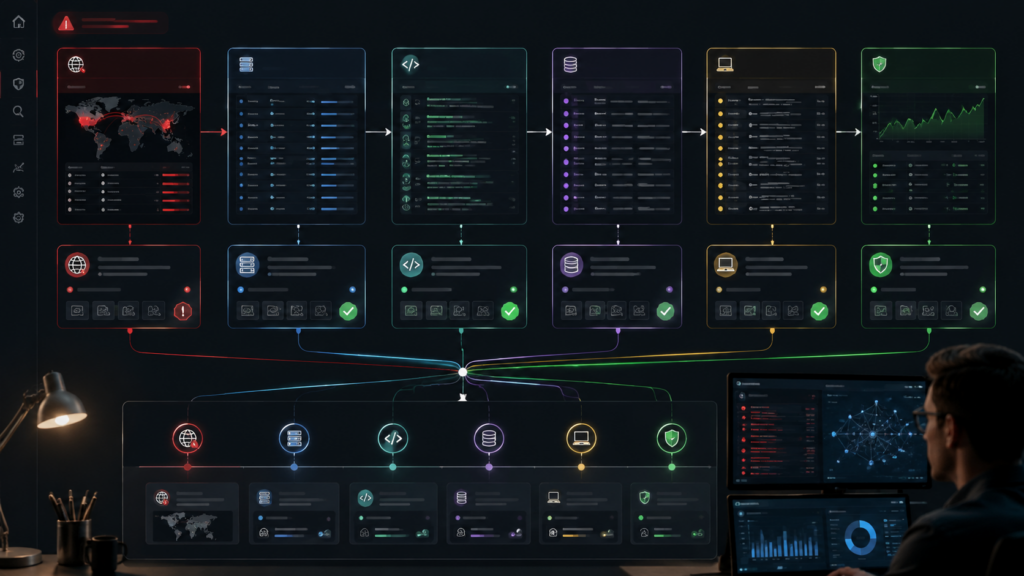
Oracle’s PeopleTools documentation includes two details defenders should use immediately.
First, Oracle documents how to enable the WebLogic HTTP access log for PIA. The Enabling HTTP Access Log page describes using the WebLogic Remote Console, selecting the PIA or customer server, going to Logging and HTTP, enabling the HTTP access log file, saving, committing changes, and restarting WebLogic.
Second, Oracle’s Working with PeopleSoft Server Process Logs documentation explains that PeopleSoft server process logs include fields such as server process, OS process ID, service request number, timestamp, SRID, TOP Instance ID, Operator ID, log level, and message. It also notes that PIA and application server domain logs include correlation fields that can help correlate activity across multiple domains.
Those correlation fields are valuable during CVE-2026-35273 triage. Web access logs may show the suspicious request. PeopleSoft logs may show whether that request produced application-layer effects. Database logs may show whether sensitive data access followed. EDR may show whether a process or file changed.
A minimal log collection plan should include:
| Log source | What it can show | Common gap |
|---|---|---|
| Reverse proxy or load balancer | Source IP, host header, path, status, request size, upstream target | May hide backend server identity unless upstream logging is enabled. |
| WAF | Blocked requests, suspicious patterns, threat labels | WAF labels can be noisy and may not understand the specific vulnerability. |
| WebLogic HTTP access log | Requests that reached PIA managed servers | Often disabled, rotated too quickly, or not centralized. |
| WebLogic server logs | Server errors, deployment events, restarts | May not include enough HTTP detail. |
| PeopleSoft PIA logs | PIA behavior and correlation context | Requires consistent retention and timestamp handling. |
| Application server logs | PSAPPSRV and related service behavior | Needs correlation using SRID, timestamps, and service request numbers. |
| Process Scheduler logs | Unexpected jobs, report generation, batch execution | Non-production schedulers are often overlooked. |
| Database audit logs | Sensitive reads, metadata changes, privileged activity | Auditing may be limited for performance or legacy reasons. |
| OS and EDR telemetry | New processes, file writes, web shells, suspicious outbound connections | Coverage may be missing on older ERP hosts. |
If HTTP access logging is disabled, enable it now. If logs are local only, centralize them. If timestamps differ across tiers, fix time synchronization. A critical vulnerability is a bad time to discover that every layer speaks a different clock.
Log Review Patterns That Matter
Without a vendor-published exploit signature, detection must be behavior-led. That means looking for traffic and system behavior inconsistent with normal PeopleSoft use.
Start with web-tier outliers:
# Top source IPs by request count
awk '{print $1}' PIA_access.log | sort | uniq -c | sort -nr | head -30

# Status code distribution
awk '{print $9}' PIA_access.log | sort | uniq -c | sort -nr

# Requests that returned server errors
awk '$9 ~ /^5/ {print}' PIA_access.log > http-5xx-review.log

# Large POST requests, depending on your log format
awk '$6 ~ /POST/ && $10 > 50000 {print}' PIA_access.log > large-posts.log
Those commands assume a common access-log shape. Adjust field numbers to your actual WebLogic format. The point is not to magically detect CVE-2026-35273. The point is to find requests that deserve human review and correlation.
Next, examine time windows around spikes:
# Replace the timestamp pattern with your log format
grep '2026-06-10' PIA_access.log | awk '{print $4, $1, $6, $7, $9, $10}' | head

# Example: extract a rough time window for review
grep '10/Jun/2026:13:' PIA_access.log > june10-1300-access.log
Then pivot into PeopleSoft logs. If you have SRID or operator correlation, preserve it:
# Show warnings or severe messages in PeopleSoft server process logs
grep -Ei '\(0\)|error|fail|exception|unauthorized|denied|security|authentication' PSAPPSRV*.LOG > psappsrv-security-review.log

# Find entries with placeholder operator IDs, useful when reviewing pre-auth activity
awk '$0 ~ /\[2026-/ && $0 ~ / - / { print }' PSAPPSRV*.LOG | head -100
Be careful with simple string searches. “Authentication” may appear in harmless logs. A 500 response may be caused by normal application errors. A single unfamiliar User-Agent may be a monitoring tool. CVE-2026-35273 triage should use converging evidence: suspicious HTTP request, unusual timing, backend error, new process, unexpected file change, database anomaly, or external data transfer.
| Sinyal | Confidence by itself | Neden önemli | Next step |
|---|---|---|---|
| Affected version exposed over public HTTPS | High risk, not proof of compromise | Confirms vulnerability exposure if unpatched | Patch, preserve logs, review access history. |
| Spike in unauthenticated POST requests | Orta | Could indicate probing or exploitation attempts | Correlate with status codes, backend logs, source IP reputation. |
| Many 404 and 500 responses from one source | Orta | Common during path discovery and failed exploit attempts | Review request paths and timing across hosts. |
| Web error followed by app server exception | Orta ila yüksek | Suggests request reached deeper application logic | Correlate exact timestamp and SRID if available. |
| New files under web-accessible directories | Yüksek | Possible post-exploitation artifact | Preserve evidence, isolate host, run forensic review. |
| New scheduled processes or modified recurrence | Yüksek | Could indicate persistence or data staging | Review owner, timestamp, parameters, and output. |
| Database reads outside normal batch windows | Orta ila yüksek | Could indicate data access after compromise | Map account, source host, query type, and business data touched. |
| Outbound traffic to unusual external hosts | Orta ila yüksek | Could indicate exfiltration or tooling download | Correlate with process tree and firewall logs. |
Patching Is Necessary, But Not Sufficient
For a critical pre-authentication PeopleTools flaw, patching closes the known vulnerability path. It does not answer whether the system was touched before the patch.
A complete remediation record should include:
| Kontrol | Evidence to keep | Failure mode if skipped |
|---|---|---|
| Patch applied | Oracle patch ID, change ticket, timestamp, affected nodes | Teams patch one visible node and miss load-balanced peers. |
| Web tier restarted | WebLogic restart logs, managed server status | Old code or stale deployment remains active. |
| Version confirmed | PeopleTools version evidence after patch | Change ticket says patched, but runtime still shows old level. |
| All environments included | Production, DR, test, training, reporting | Attackers find a trusted clone. |
| Logs preserved | Raw logs copied to immutable storage | Investigation loses pre-patch evidence due to rotation. |
| Exposure reduced | Firewall, WAF, reverse proxy, VPN, route review | Vulnerable management paths remain broadly reachable. |
| Retest completed | Safe validation notes, screenshots, scan output | No proof remediation worked. |
| Credentials reviewed | Service accounts, integration users, admin users | Compromise persists through reused credentials. |
Do not rely on a WAF as the primary fix. WAF rules can reduce opportunistic traffic, block obvious probes, and buy time during a change window. They cannot reliably compensate for an unknown pre-authentication flaw in a complex enterprise platform, especially when exact exploit conditions are not publicly documented. The vendor patch or mitigation remains the center of gravity.
A temporary reverse proxy restriction may still be useful:
# Example only. Test carefully and adapt to your environment.
# Restrict administrative or lifecycle-management paths to approved networks.
location / {
    proxy_pass https://peoplesoft_backend;
    proxy_set_header Host $host;
    proxy_set_header X-Forwarded-For $proxy_add_x_forwarded_for;
}

# Placeholder pattern for sensitive management paths.
# Do not assume this covers CVE-2026-35273.
location ~* ^/(admin|management|update|tools)/ {
    allow 10.10.0.0/16;
    allow 192.0.2.50;
    deny all;
    proxy_pass https://peoplesoft_backend;
}
This configuration is not a CVE-specific mitigation. It illustrates a broader principle: management and lifecycle functions should not share the same reachability profile as ordinary end-user workflows. In many PeopleSoft estates, segmentation and path governance are overdue regardless of this specific CVE.
The Attack Path Defenders Should Model
A defender does not need an exploit payload to model risk. CVE-2026-35273 has enough confirmed characteristics to build a practical attack path.
| Sahne | Attacker objective | Defensive question | Kanıtlar |
|---|---|---|---|
| Keşif | Find PeopleSoft hosts | Which PeopleSoft URLs are externally or internally discoverable? | DNS, certificates, HTTP titles, CMDB, scan results |
| Reachability | Confirm HTTP access to affected PeopleTools | Which affected versions were reachable without authentication? | HTTP probes, WAF logs, load balancer logs |
| Exploitation attempt | Trigger vulnerable pre-auth function | Do logs show suspicious unauthenticated requests before patching? | WebLogic access logs, PIA logs, 4xx/5xx patterns |
| Execution or takeover | Gain control of PeopleTools behavior | Are there new files, processes, jobs, or config changes? | EDR, OS audit, WebLogic logs, PeopleSoft process logs |
| Data access | Reach HR, finance, campus, or metadata | Did database access patterns change? | DB audit logs, app logs, service account activity |
| Kalıcılık | Maintain access after patching | Were accounts, scheduled jobs, integrations, or web artifacts altered? | Identity logs, scheduler review, file integrity |
| Sızma | Move data out | Was there unusual outbound transfer? | Proxy, firewall, DNS, cloud storage, DLP logs |
The most common mistake is stopping at stage three. A failed exploit attempt matters, but a successful platform compromise may leave evidence later in the chain. Conversely, a noisy scan does not prove compromise. Keep the chain intact and test each link.
Related CVEs That Teach The Same Lesson
CVE-2026-35273 belongs to a family of enterprise incidents where administrative, platform, or management-plane functions become reachable to unauthenticated attackers. Three older CVEs are useful comparisons.
| CVE | Ürün | Access pattern | Birincil etki | Why it is relevant |
|---|---|---|---|---|
| CVE-2020-14882 | Oracle WebLogic Server Console | Unauthenticated network access via HTTP | WebLogic takeover, CVSS 9.8 | Like CVE-2026-35273, it shows why HTTP-exposed Oracle middleware management surfaces are high-risk. |
| CVE-2023-21839 | Oracle WebLogic Server Core | Unauthenticated network access via T3 and IIOP | Unauthorized access to critical data, CVSS 7.5 | It highlights that non-HTTP middleware protocols can be just as important as web login pages. |
| CVE-2021-22986 | F5 BIG-IP and BIG-IQ iControl REST | Unauthenticated access to iControl REST | Remote command execution, CVSS 9.8 | It shows the recurring danger of internet-exposed management APIs on infrastructure appliances. |
NVD describes CVE-2020-14882 as an Oracle WebLogic Server Console vulnerability that allows an unauthenticated attacker with network access via HTTP to compromise WebLogic Server, with successful attacks resulting in takeover. That is directly relevant because many PeopleSoft deployments rely on WebLogic as the web tier. The lesson is not that CVE-2026-35273 is the same bug. It is that Oracle enterprise middleware exposed over HTTP has a history of urgent pre-authentication risk when management surfaces are reachable.
NVD describes CVE-2023-21839 as an Oracle WebLogic Server Core vulnerability reachable through T3 and IIOP, allowing unauthenticated attackers to access critical data. It is relevant because defenders often focus only on HTTPS. PeopleSoft environments can involve multiple protocols, tiers, and trust relationships. A web patch does not replace network review of middleware protocols and administrative listeners.
NVD describes CVE-2021-22986 as an unauthenticated remote command execution vulnerability in F5 BIG-IP and BIG-IQ iControl REST. It is not an Oracle issue, but it is a strong management-plane analogy. Exposed control interfaces are repeatedly exploited because they sit close to sensitive configuration and traffic flows. The remediation pattern is familiar: patch, restrict management access, verify exposure from outside, review logs, and assume public exploit interest will follow public advisories.
These comparisons support a broader rule: when a remotely reachable management or platform function fails before authentication, the priority is not based only on the application’s business owner. It is based on what that platform can reach.
Hardening Beyond The Patch
Once Oracle’s fix or mitigation is in place, reduce the chance that the next PeopleSoft or middleware flaw becomes an emergency.
Start with reachability. PeopleSoft login pages may need to be available to employees, students, vendors, or remote staff. Lifecycle management functions do not need the same exposure. Where possible, place administrative, update, and environment management functions behind admin networks, privileged access workstations, VPN policies with device posture, and source restrictions.
Separate production from non-production. Do not let test or upgrade rehearsal environments reuse production service accounts, production database links, or broad network trust. If non-production requires realistic data, sanitize it and protect it as sensitive.
Review WebLogic and PeopleSoft logging defaults. Enable HTTP access logs where appropriate. Send logs to centralized storage. Preserve enough history to investigate vulnerabilities announced after exploitation may have begun. Oracle’s logging documentation is useful, but the operational decision is yours: if logs rotate every two days and your patch window is one week, you are accepting blindness.
Harden service accounts. PeopleSoft environments often have long-lived integration users, batch users, database accounts, and administrative identities. After a possible platform compromise, rotate credentials that could have been exposed, especially if logs suggest suspicious access.
Protect outbound paths. Many ERP environments can reach internal databases and file shares but should not freely initiate outbound internet connections. Egress controls, DNS logging, and proxy authentication make post-compromise data movement easier to detect.
Use file integrity monitoring on web and application servers. A successful RCE or takeover path may write files, modify scripts, change deployment artifacts, or drop tools. File integrity does not prevent the vulnerability, but it raises the chance of finding persistence.
Document patch exceptions. If a business owner delays patching because of a payroll run, admissions deadline, financial close, or upgrade freeze, record the compensating controls and expiration date. “We cannot patch” is not a state. It is a risk decision with a timer.
Verification At Scale
Large PeopleSoft estates need a repeatable validation loop. A useful loop has six parts:
- Discover every route to PeopleSoft.
- Classify each environment by version and business function.
- Confirm affected PeopleTools versions and patch status.
- Validate reachability from relevant network zones.
- Review logs for suspicious activity during the exposure window.
- Retest and preserve evidence after remediation.
That loop can be partly automated, but it should stay evidence-based. Security teams using agentic or AI-assisted testing need strict scope control, safe probes, and human review for critical enterprise systems. For authorized teams that already use AI-assisted validation, tools such as Penligent can fit into the asset-mapping and evidence workflow when the goal is to confirm reachable surfaces, organize reproducible findings, and support retesting rather than spray exploit payloads across production systems. The relevant value is not “AI magic.” It is disciplined coverage, traceable steps, and repeatable verification across many targets.
Penligent'ın AI Pentest page describes black-box attack surface mapping, agent-verified findings, headless browser validation, remediation guidance, and retesting. In a CVE-2026-35273 response, those capabilities are most useful around authorized discovery, validation records, and post-fix confirmation. They do not replace Oracle’s patch, PeopleSoft administrator judgment, or incident response work.
A simple verification checklist can be stored with the change ticket:
cve: CVE-2026-35273
product: Oracle PeopleSoft Enterprise PeopleTools
affected_versions:
  - "8.61"
  - "8.62"
environment: prod-hcm
owner: peoplesoft-platform
public_url: https://hcm.example.edu
network_exposure:
  internet: true
  vpn: true
  internal_lan: true
  admin_network: true
patch:
  applied: true
  applied_at_utc: "2026-06-12T03:30:00Z"
  oracle_reference: "Oracle Security Alert CVE-2026-35273"
validation:
  peopletools_version_confirmed: true
  all_managed_servers_checked: true
  load_balancer_pool_checked: true
  dr_environment_checked: true
  non_prod_checked: false
logs:
  weblogic_http_access_log_preserved: true
  pia_logs_preserved: true
  app_server_logs_preserved: true
  database_audit_reviewed: false
risk_acceptance:
  required: true
  reason: "Non-production clone pending patch during change window"
  expires: "2026-06-17"
The YAML format is not special. The discipline is. Every field should be answerable without hunting through chat threads and memory.
Common Mistakes During CVE-2026-35273 Response
The first mistake is treating the public URL as the asset. A PeopleSoft service may have multiple hostnames, load-balanced nodes, WebLogic managed servers, backend domains, DR endpoints, and non-production clones. Patch coverage must follow the infrastructure, not the homepage.
The second mistake is trusting version labels from old documentation. Confirm runtime versions. Ask PeopleSoft administrators for current evidence. If the CMDB says 8.60 but the server says 8.62, the server wins.
The third mistake is ignoring unsupported versions. Oracle’s advisory names supported affected versions, but it also warns that unsupported releases are not tested and that earlier versions of affected releases are likely affected. A legacy instance should not be waved through because it is absent from a short affected-version list.
The fourth mistake is believing SSO solves a pre-authentication issue. SSO protects normal login workflows. CVE-2026-35273 is explicitly described as remotely exploitable without authentication. If vulnerable code is reachable before the SSO boundary, the SSO control is not enough.
The fifth mistake is overfitting to one log source. Web access logs, app server logs, database logs, scheduler logs, and EDR telemetry answer different questions. You need a timeline across layers.
The sixth mistake is running untrusted exploit code in production. For a critical ERP platform, validation should be vendor-guided, controlled, and scoped. Use safe exposure checks, patch confirmation, configuration review, and approved testing paths.
The seventh mistake is failing to review post-patch persistence. If exploitation occurred before patching, the patch may close the door while leaving something inside. Review accounts, jobs, files, scheduled tasks, integrations, and outbound access.
Guidance For Red Teams, Pentesters, And Bug Bounty Hunters
CVE-2026-35273 will attract attention because it combines PeopleSoft, unauthenticated access, HTTP reachability, and critical impact. That does not make random testing acceptable.
For red teams and pentesters, the right approach is written authorization, defined target lists, approved timing, and safe validation. If the client asks for CVE-2026-35273 coverage, confirm whether exploit attempts are allowed. Many organizations will prefer version and exposure validation, configuration review, log review, and controlled proof that the affected component is no longer reachable or vulnerable after patching.
For bug bounty hunters, do not test PeopleSoft instances unless the program explicitly includes them and permits this class of testing. A critical ERP RCE can cross legal and operational lines quickly. Safe reports can still be valuable: exposed PeopleSoft hostnames, visible affected-version evidence, public access to administrative surfaces, missing security headers, or outdated WebLogic indicators may be reportable if the program scope allows it.
For internal security engineers, insist on reproducibility. A finding that says “maybe vulnerable” is not enough for emergency change approval. A finding that includes host, network vantage point, observed version, reachability, patch status, and evidence path can move.
Incident Review When Exposure Preceded Patching
If an affected PeopleTools 8.61 or 8.62 system was reachable before remediation, conduct at least a focused incident review. The depth depends on exposure, logging quality, business criticality, and observed anomalies.
Start with a timeline:
2026-06-10  Oracle Security Alert released
2026-06-10  External exposure confirmed for hcm.example.edu
2026-06-11  WebLogic HTTP logs preserved from PIA1 and PIA2
2026-06-11  PeopleTools patch applied to PIA1
2026-06-11  Load balancer still sending traffic to unpatched PIA2
2026-06-12  PIA2 patched and restarted
2026-06-12  Suspicious 500 spike identified from 198.51.100.24 on June 9
2026-06-12  App server logs reviewed for matching timestamp
2026-06-13  Database audit review started
2026-06-13  Service account rotation approved
Then build evidence around each suspicious event:
| Question | Evidence source | Decision |
|---|---|---|
| Did the request reach the affected server? | Load balancer logs, WebLogic access logs | If yes, continue correlation. |
| Did the request trigger server-side errors? | WebLogic logs, PIA logs | If yes, review backend impact. |
| Did application server behavior change? | PSAPPSRV logs, SRID correlation | If yes, investigate service context. |
| Did new files or processes appear? | EDR, OS audit, file integrity | If yes, escalate to host forensics. |
| Did database access change? | DB audit, PeopleSoft user activity | If yes, scope data exposure. |
| Did outbound transfer occur? | Proxy, firewall, DNS | If yes, assess exfiltration. |
| Did credentials change or get used oddly? | IAM, SSO, PeopleSoft security logs | If yes, rotate and investigate identity impact. |
If logs are missing, say so in the incident record. Missing evidence is not proof of safety. It is residual risk.
Frequently Asked Questions
What is CVE-2026-35273?
- CVE-2026-35273 is a critical vulnerability in Oracle PeopleSoft Enterprise PeopleTools.
- Oracle identifies the affected component as Updates Environment Management.
- Supported affected versions are PeopleTools 8.61 and 8.62.
- Oracle says it is remotely exploitable without authentication and may result in remote code execution.
- NVD assigns a CVSS 3.1 score of 9.8 and maps the weakness to CWE-306, Missing Authentication for Critical Function.
Which PeopleSoft versions are affected?
- Oracle names PeopleSoft Enterprise PeopleTools 8.61 and 8.62 as affected supported versions.
- Unsupported older versions are not guaranteed safe. Oracle says unsupported releases are not tested for the vulnerability and recommends upgrading to supported versions.
- Business application names such as HCM, Financials, or Campus Solutions are not enough for triage. Confirm the underlying PeopleTools version and environment exposure.
Is CVE-2026-35273 exploitable without login?
- Yes, according to Oracle and NVD, exploitation does not require authentication.
- The attack vector is network-based over HTTP.
- Normal PeopleSoft login controls, MFA, SSO, and user roles do not fully address a flaw reachable before authentication.
- Network segmentation and exposure reduction matter, but they do not replace Oracle’s patch or mitigation.
Does patching end the investigation?
- No, patching is the required first step, not the whole response.
- If the system was reachable before patching, preserve and review logs.
- Look for suspicious web requests, backend errors, new files, unexpected jobs, unusual database access, and outbound traffic.
- Rotate credentials if there is evidence that platform-level access may have exposed secrets or service accounts.
What logs should defenders check first?
- Start with reverse proxy, load balancer, WAF, and WebLogic HTTP access logs to identify suspicious HTTP traffic.
- Review WebLogic server logs and PeopleSoft PIA logs for backend errors or unusual behavior.
- Use PeopleSoft application server logs to correlate activity through fields such as timestamp, SRID, TOP Instance ID, and Operator ID where available.
- Check Process Scheduler, database audit, OS, EDR, DNS, proxy, and firewall logs for post-exploitation signs.
Can a WAF mitigate CVE-2026-35273?
- A WAF may reduce noise or block obvious probes, but it should not be treated as the primary fix.
- Public sources do not provide a reliable universal exploit signature for defenders to encode as a complete WAF rule.
- Use WAF and reverse proxy controls as temporary risk reduction while applying Oracle’s patch or mitigation.
- Restrict management and lifecycle-management functions to trusted administrative networks wherever possible.
How should a pentester validate CVE-2026-35273 safely?
- Get explicit written authorization and confirm whether exploit attempts are allowed.
- Prefer safe validation: version evidence, reachability checks, patch confirmation, route review, and log-based verification.
- Do not run untrusted public exploit code against production ERP systems.
- Provide evidence that helps remediation: host, version, network vantage point, HTTP exposure, patch status, and retest results.
Why is this different from a normal ERP vulnerability?
- CVE-2026-35273 affects PeopleTools, the technical platform beneath PeopleSoft applications.
- It is described as unauthenticated and remotely exploitable, which places it before normal application login controls.
- PeopleSoft systems often store or process sensitive HR, financial, campus, supplier, and identity-related data.
- The response must include platform patching, exposure review, log correlation, and post-patch verification.
CVE-2026-35273 deserves urgent handling because it combines a critical PeopleTools component, HTTP reachability, no authentication requirement, and high impact. The strongest response is not panic and not blind scanning. It is disciplined evidence work: find every PeopleSoft environment, confirm PeopleTools versions, apply Oracle’s fix, reduce unnecessary reachability, preserve logs, review the exposure window, and retest every patched path.
The organizations that handle this well will be the ones that can prove what was exposed, what was fixed, what was checked, and what risk remains.

 Turkish
  English
  German
  French
  Spanish
  Portuguese
  Japanese
  Korean
  Hindi
Hindi  Arabic
  Hebrew