
On October 14, 2026, the curl project released version 8.23.0 to address a high-severity memory corruption vulnerability in its HTTP/2 upload handling. Tracked as CVE-2026-92392, the flaw can cause a use-after-free condition when a server resets an HTTP/2 stream during an upload.
The vulnerability is particularly significant because researchers demonstrated that the memory corruption could be converted into remote code execution under carefully controlled conditions. However, that outcome requires a specific sequence of network events, memory allocations, software versions, and environmental assumptions. A vulnerable curl installation is not automatically an easily exploitable remote shell.
The official curl security advisory for CVE-2026-92392 classifies the issue as High severity and identifies curl versions 8.12.0 through 8.22.0 as affected, subject to specific maintained-branch exceptions. The project recommends upgrading to 8.23.0, applying the corresponding security patch, or avoiding HTTP/2 until remediation is possible.
For security engineers, this vulnerability deserves attention for three reasons. It affects both the curl command-line utility and applications using libcurl. Its trigger involves server-controlled HTTP/2 behavior rather than a conventional malicious file. And its discovery demonstrates how a subtle error in asynchronous connection cleanup can create a path from an application crash to control-flow compromise.
What Is CVE-2026-92392?
CVE-2026-92392 is a use-after-free vulnerability in curl’s HTTP/2 upload implementation.
A use-after-free occurs when software continues accessing memory after the object that previously owned that memory has been released. If the same memory is subsequently allocated for another purpose, the stale pointer may refer to data or structures that no longer have the expected contents.
The immediate result can be incorrect behavior, memory corruption, or a crash. In certain circumstances, an attacker who can influence the memory reused at that location may be able to redirect execution.
This vulnerability involves an internal curl transfer object known as struct Curl_easy.
During a specially sequenced HTTP/2 upload, the remote server can cause curl to terminate a transfer while internal state associated with that transfer remains reachable through another part of the connection-management machinery.
When cleanup proceeds, curl can encounter a pointer referencing an object that has already been freed.
The crucial security concern is that the contents of the freed memory may subsequently be influenced by data received from the server. In a sufficiently controlled environment, this can turn an ordinary memory lifetime bug into an exploitable control-flow violation.
Bu original report and the subsequent technical explanation by curl maintainer Daniel Stenberg establish that remote code execution was demonstrated, while also emphasizing the substantial limitations of the exploit conditions.
CVE-2026-92392 at a Glance
| Öznitelik | Detaylar |
|---|---|
| CVE | CVE-2026-92392 |
| Ürün | curl and libcurl |
| Güvenlik açığı türü | Use-after-free |
| CWE | CWE-416 |
| Upstream severity | Yüksek |
| Etkilenen sürümler | curl 8.12.0 through 8.22.0, with specific patched-branch exceptions |
| Yukarı akış sürümü düzeltildi | 8.23.0 |
| Affected functionality | HTTP/2 uploads and related transfer cleanup |
| Triggering input | Server-controlled HTTP/2 stream reset during an upload |
| Potential impact | Crash, memory corruption, and conditional remote code execution |
| Exploit prerequisites | Specific application, protocol, allocator, and memory layout conditions |
| Temporary mitigation | Avoid HTTP/2 for affected upload workflows |
| Disclosure date | October 14, 2026 |
The distinction between potential impact and practical exploitability is central to evaluating the risk correctly.
Which curl Versions Are Vulnerable?
The vulnerable behavior was introduced in the upstream curl 8.12.0 release series.
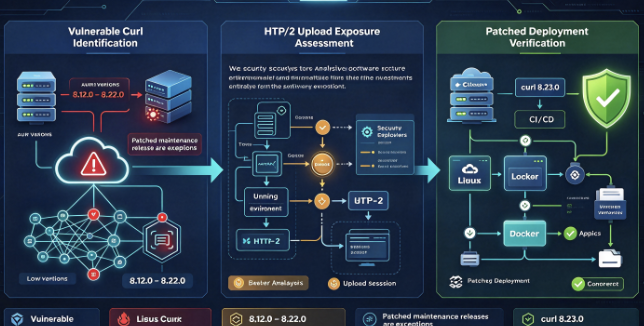
The curl project’s advisory identifies upstream versions 8.12.0 through 8.22.0 as affected and 8.23.0 as fixed.
It also lists patched releases in selected maintained branches: 8.14.3, 8.16.2, and 8.20.2.
These exceptions matter because package version comparisons are rarely as simple as checking whether a version number is numerically below the newest upstream release.
Affected and fixed versions
| Version or package | Durum |
|---|---|
| Upstream curl before 8.12.0 | Not affected by this specific introduced bug |
| Upstream curl 8.12.0–8.22.0 without the fix | Etkilenen |
| curl 8.14.3 in its maintained branch | Fixed |
| curl 8.16.2 in its maintained branch | Fixed |
| curl 8.20.2 in its maintained branch | Fixed |
| Upstream curl 8.23.0 or later | Fixed |
| Distribution packages carrying an explicit backport | Check vendor-specific advisory |
Kaynak: curl’s official affected-version and remediation statement.
Security teams should also distinguish upstream version numbers from Linux distribution package revisions. Debian, Red Hat, Ubuntu, and other distributions may apply patches without replacing the bundled upstream version with 8.23.0.
For example, the Debian security tracker identifies Debian 13’s fixed package revision as 8.14.1-2+deb13u7, while Debian 12 is listed as unaffected because the vulnerable code was not present. The presence of 8.14.1 in a patched distribution package therefore does not automatically imply exposure.
The correct approach is to verify both the installed software and the vendor’s security fix status.
Why HTTP/2 Makes This Vulnerability Possible
HTTP/2 allows multiple logical streams to share one underlying connection.
This provides important performance benefits, including connection reuse and multiplexed transfers. However, it also means a single connection can contain multiple transfers with independent lifecycles.
A transfer may start, pause, receive a response, encounter a stream reset, or terminate while other work remains active on the same connection.
Software implementing this behavior must track the state of both individual transfers and their shared connection resources.
In libcurl, applications typically use easy handles to represent individual transfers. The multi interface manages one or more easy handles and coordinates their progress.
These structures are related, but they do not necessarily have identical lifetimes.
An easy handle might be removed or freed while a multi handle continues to exist. Shared connection state may also outlive a particular HTTP/2 stream.
That architecture is efficient when internal ownership and cleanup rules are correct. It becomes fragile when one subsystem still holds a reference after another subsystem releases the referenced object.
CVE-2026-92392 is a concrete example of that lifetime-management problem.
Understanding the HTTP/2 RST_STREAM Trigger
HTTP/2 includes a RST_STREAM frame that allows an endpoint to terminate an individual stream without necessarily closing the entire connection.
That behavior is legitimate and necessary for normal protocol operation.
The vulnerability concerns how curl handles certain reset conditions during an upload.
The official advisory identifies stream resets using the HTTP_1_1_REQUIRED ve REFUSED_STREAM reasons as relevant to the affected path.
In the reported scenario, curl is uploading data when the remote server manipulates flow control, returns response data, and resets the stream.
The server’s behavior causes curl to finish the transfer through an unusual cleanup path. The underlying connection and other internal state may still be alive.
A reference to the completed transfer can remain even though the object associated with that transfer has been released.
The problem therefore is not that a server can send RST_STREAM. Sending a reset is a supported protocol action.
The problem is that the reset causes client-side state transitions that are not managed safely under the vulnerable implementation.
That is an important distinction for developers and security engineers: malicious behavior can exploit entirely valid protocol features when the application receiving those features has unsafe state handling.
How the Use-After-Free Develops
The vulnerability becomes easier to understand by following the lifecycle of the affected transfer.
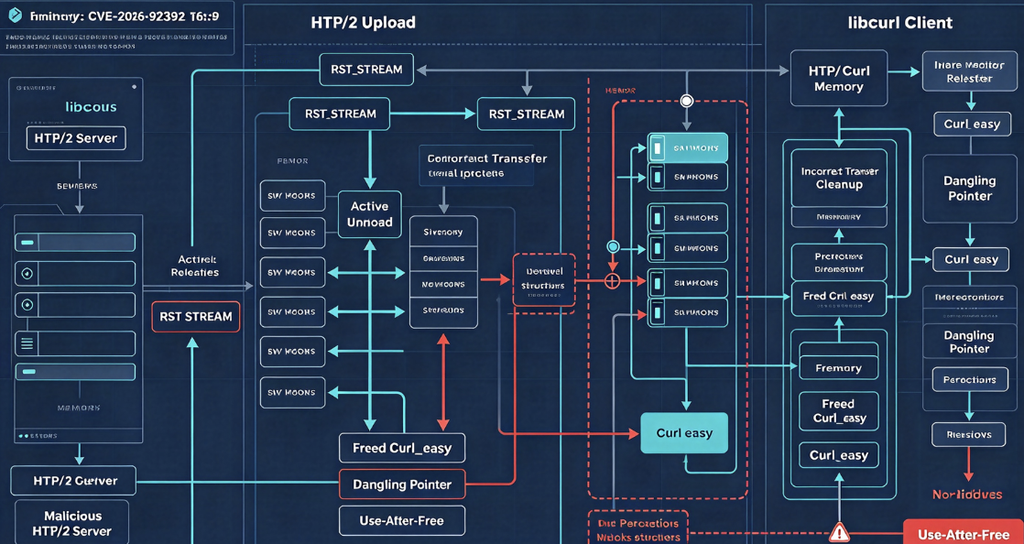
A client begins an HTTP/2 upload to a server. The application has allocated an easy handle representing that transfer and is using a multi handle to manage its progress.
The server then sends a sequence of responses and flow-control changes that causes the upload to stop through a particular error path.
curl correctly recognizes that the transfer has ended, but an internal reference to the easy handle remains in a place where later connection cleanup can encounter it.
The application proceeds to release the easy handle.
At this point, the pointer retained by the connection-management logic is dangling: it refers to memory whose original object is no longer valid.
Later, when the multi handle is cleaned up, libcurl follows a path that can use that stale reference.
The memory previously occupied by the easy handle may already have been reused for another allocation.
If attacker-influenced data occupies that location, the internal structure may contain values different from those expected by the cleanup routine.
This creates the potential for memory corruption and unsafe control flow.
The important engineering lesson is that the crash does not require an exotic parsing bug in the HTTP/2 data itself. The fundamental defect is an inconsistency between object ownership, transfer termination, and connection cleanup.
In his technical explanation, Daniel Stenberg describes the interaction between the freed easy handle and later multi-handle cleanup. His analysis also explains how the proof of concept used leaked client information and carefully arranged allocations to move from a dangling pointer to executable control.
How a Use-After-Free Can Become Remote Code Execution
Not every use-after-free is exploitable as code execution.
Many result only in a crash. Others may expose data or create memory corruption without giving an attacker reliable control over program behavior.
Turning a use-after-free into remote code execution requires additional capabilities.
The attacker must influence how memory is reused after the original object has been freed. They must place useful data into a memory region that the application later interprets as part of an internal structure.
They must also overcome uncertainty introduced by address-space randomization, allocator behavior, application versions, and other environmental details.
In the CVE-2026-92392 research, the successful demonstration involved a carefully calibrated environment.
The curl advisory explicitly identifies the need for knowledge of the relevant object layout, architecture, memory allocator, TLS behavior, and connection scheduling.
It also describes the constraints created by a small available command area.
These details establish that the demonstrated remote code execution is real but highly condition-dependent.
The security impact is therefore serious without justifying the claim that arbitrary remote websites can reliably compromise every vulnerable curl client.
What Makes Exploitation Difficult?
The exploitability limitations are not minor details. They are essential to risk assessment.
The first requirement is that the vulnerable client must initiate an affected upload to a server whose responses are controlled by an attacker.
A malicious server can influence protocol events in that connection, but it cannot automatically force every application using libcurl to make such an upload.
The second requirement is a compatible client environment. Different curl versions, linked libraries, allocators, architectures, and application behaviors can change the relevant memory layout.
The third requirement is appropriate timing. HTTP/2 multiplexing, transfer scheduling, and cleanup behavior determine when the stale reference is encountered and what memory may occupy the freed region.
The fourth requirement is sufficient control over the resulting memory state. The attacker must achieve more than making the application dereference stale memory.
The fifth requirement is overcoming exploit constraints caused by the small payload space and the need for accurate addresses or offsets.
Together, these conditions explain why the curl project assigned a High severity rating while describing successful remote code execution as unlikely under ordinary real-world conditions.
The most probable result of a failed exploitation attempt may be an application crash rather than reliable arbitrary code execution.
This does not make the bug harmless. It means defenders should prioritize based on exposure and application behavior rather than relying on an exaggerated universal exploit narrative.
The Difference Between a Malicious Server and a Malicious HTTP Request
CVE-2026-92392 is particularly interesting because the attacker-controlled component may be the server, not the client.
Many organizations think of curl as a tool used to send requests to remote systems, and therefore assume the primary security concern is whether the request sent by curl is malicious.
This vulnerability reverses that perspective.
The client initiates a transfer that may be legitimate from its own point of view. The server then sends carefully chosen HTTP/2 control messages that exploit the client’s implementation.
The relevant trust boundary is between untrusted network responses and memory management inside the client process.
This matters for automated systems that upload files to external endpoints.
A CI pipeline, artifact uploader, integration service, or background application may use libcurl to transfer data to a destination it expects to be trustworthy.
If the endpoint is controlled by an attacker, compromised, or substituted through another failure, a vulnerable client may become exposed to malicious protocol behavior.
The precise attackability of any such workflow still depends on the narrow trigger requirements documented by curl.
Why libcurl Expands the Potential Exposure
The curl command-line utility is widely recognized, but many applications use libcurl without exposing that dependency to users.
libcurl provides networking capabilities to programs that may never display the word “curl” in their interfaces.
As a result, organizations should not restrict their vulnerability assessment to machines where an administrator frequently runs the kıvrıl command manually.
A service might link to libcurl dynamically. Another application might bundle a private copy of the library. A container may ship a runtime dependency inherited from its base image.
An application might also use curl only for a small part of its functionality, such as transferring artifacts, downloading metadata, or uploading diagnostic files.
The risk question is whether the affected HTTP/2 upload behavior can actually be reached.
An application that never performs uploads over HTTP/2 may not have a practical exposure through the documented trigger, even if it contains a vulnerable library version.
Conversely, an application that performs automated uploads to externally controlled destinations may deserve higher priority.
Dependency inventory is therefore necessary but not sufficient. It must be combined with understanding of application behavior.
How to Check Your curl Version
The simplest initial check is:
curl --versionThis command displays the curl version and usually includes information about supported protocols, features, and linked libraries.
It helps establish whether the installed command-line tool is within the upstream affected range.
However, it is not a complete vulnerability determination.
The version of the command-line executable may differ from the libcurl version loaded by another application. An operating system package may contain a backported patch. A container may have a separate copy of libcurl from the host.
For Debian-based systems, inspect the installed package revision:
dpkg-query -W curl libcurl4 2>/dev/nullFor RPM-based distributions, query the relevant packages:
rpm -q curl libcurlFor an application that dynamically links to libcurl, a useful starting point is inspecting its dependencies:
ldd /path/to/application | grep -i curlThis only identifies dynamically visible dependencies. It does not reliably detect statically linked or embedded copies.
In containers, version checks should run inside the application image or running container, not merely on the host.
Örneğin:
docker exec CONTAINER_NAME curl --versionIf the container has no curl executable, inspect the installed packages or software bill of materials instead.
For Kubernetes, investigate the images used by affected workloads, then assess whether those images contain vulnerable libcurl versions and whether the applications perform relevant uploads.
How to Check the Effective libcurl Library
Determining the actual library used by a program can be more complex than reading one package version.
An application may dynamically link to an operating system libcurl package. It may bundle a private library. It may link libcurl statically or use a library loaded through another component.
Consequently, organizations should consider three separate questions.
What libcurl version was the application built against?
What libcurl implementation is it actually using at runtime?
Has that implementation received the relevant security patch?
For dynamically linked applications, platform dependency tools may help identify the resolved library.
For statically linked applications, the application vendor or build manifest may be the only reliable way to establish patch status.
Software composition analysis and SBOM information can assist with this investigation, but a package name alone should not be treated as proof of runtime exposure.
Version checks also need to account for vendor patches. A distribution-maintained library may carry the fix while retaining an older upstream version number.
This is why authoritative package advisories are more reliable than naive comparisons against 8.23.0.
CVE-2026-92392 and Debian Security Updates
Debian provides a useful example of the difference between upstream and downstream versioning.
According to the Debian Security Tracker for CVE-2026-92392, Debian 13 received a fixed package revision through its security update channel.
Debian 12 is listed as not affected because its source package does not contain the vulnerable change.
This means an administrator should not conclude that every curl version below 8.23.0 is affected.
The relevant question is whether the running build includes the vulnerable code and lacks the corrective patch.
For managed Linux systems, the preferred remediation is normally to install the security update supplied by the distribution and verify the installed package revision.
Replacing system libraries manually can create dependency and maintenance problems, particularly when operating system packages expect a specific ABI or patch series.
For custom builds, administrators should either upgrade to a fixed upstream release or apply the official patch and rebuild through their normal controlled release process.
How curl 8.23.0 Fixes the Vulnerability
The curl project links the correction directly from its security advisory.
The relevant source change is available in the official repository: multi: adjust the cleanup order in multi_done.
The fix addresses the lifetime and cleanup ordering problem underlying the use-after-free condition.
This approach matters because a protocol-level workaround alone does not correct unsafe ownership of internal objects.
If developers merely blocked one particular reset reason, another unusual termination sequence might eventually expose a related lifetime issue.
The stronger engineering solution is to ensure that objects and references are cleaned up in an order that prevents stale references from being used after the underlying object has been freed.
The broader lesson applies to asynchronous networking libraries generally. Transfer completion, connection teardown, error handling, and resource cleanup must agree on who owns each object and when it may safely be released.
A fix for one vulnerability should ideally be accompanied by regression tests and memory-safety testing designed to exercise unusual state transitions.
Temporary Mitigation: Avoid HTTP/2 Where Appropriate
The curl project’s official advisory lists avoiding HTTP/2 as a temporary mitigation.
For a command-line workflow, curl supports the --http1.1 option, which requests HTTP/1.1 rather than HTTP/2.
For example, an approved upload workflow can be configured to use HTTP/1.1 while a vulnerable implementation is being patched.
The exact command depends on the application’s authentication, upload method, and destination.
For applications using libcurl directly, the corresponding API setting is:
curl_easy_setopt(
    curl_handle,
    CURLOPT_HTTP_VERSION,
    CURL_HTTP_VERSION_1_1
);
The official libcurl documentation for CURLOPT_HTTP_VERSION explains how the protocol preference is applied.
However, the documentation also cautions that connection reuse can affect the version actually used for a transfer.
Therefore, a temporary mitigation should be tested in the actual application, and connections should be configured or recycled in a way that ensures the affected HTTP/2 path is not still being used.
For long-running services, simply setting a new option without considering existing pooled connections may not provide the expected immediate protection.
Disabling HTTP/2 may also affect performance and interoperability. It should be treated as a controlled temporary measure rather than a substitute for patching.
Can HTTPS or Certificate Validation Prevent This Attack?
HTTPS does not automatically eliminate this vulnerability.
TLS protects the connection from unauthorized interception and helps authenticate the remote endpoint. It does not prevent a malicious or compromised endpoint from sending protocol messages that exploit a vulnerability in the client.
In fact, the curl maintainer’s discussion specifically notes that the attacker-controlled server in the demonstrated scenario needed to maintain a valid certificate relationship for the connection.
This illustrates an important distinction between transport security and implementation security.
A valid TLS connection means the client has established an authenticated encrypted channel according to its trust configuration.
It does not prove that the remote application’s behavior is benign.
Security teams should therefore continue enforcing certificate validation and trusted endpoint controls, but they should not treat those controls as the primary fix for CVE-2026-92392.
The primary fix is correcting the vulnerable library.
Detection and Investigation Strategies
Detecting exploitation of this vulnerability is difficult because the initial trigger can resemble legitimate HTTP/2 error handling.
Servers can reset streams for benign reasons. Clients can terminate uploads due to normal network failures. Applications may also crash for unrelated reasons.
A useful investigation therefore correlates several kinds of evidence.
Start with applications using affected libcurl versions that perform HTTP/2 uploads.
Look for unusual failures or crashes associated with uploads to endpoints outside the organization’s approved destination list.
Where HTTP/2 diagnostics are available, investigate abnormal stream-reset sequences involving the relevant error reasons.
Host telemetry can also help identify whether a client process crashed, restarted unexpectedly, or showed unusual behavior immediately after an HTTP/2 transfer failure.
Memory-safety instrumentation provides stronger evidence in a controlled test environment.
AddressSanitizer, for example, can detect attempts to access freed memory when a vulnerable code path is exercised under instrumentation. Its output can help developers distinguish a genuine use-after-free from an ordinary network error.
An AddressSanitizer report from a local reproduction is not the same as evidence of active exploitation in production. Likewise, repeated upload failures alone are not proof that an attacker is attempting this CVE.
The goal is to combine version data, application behavior, network evidence, and process telemetry to prioritize investigations.
A Defensive Triage Example
Consider an internal service that periodically uploads diagnostic artifacts to an external support endpoint.
The service uses libcurl and negotiates HTTP/2.
A security team learns that its bundled library falls within the upstream affected range.
The first step is to determine whether the build is actually unpatched. If the distribution or application vendor already backported the fix, the initial version number may be misleading.
If the build is vulnerable, the team should determine whether the upload workflow can reach attacker-controlled destinations, whether it uses HTTP/2 in practice, and whether uploads share connections or run concurrently.
Next, the team should apply the vendor update or temporarily enforce HTTP/1.1 while preparing the patch.
If recent logs show unexplained crashes during HTTP/2 uploads, the team can preserve diagnostic evidence and investigate the relevant transfer state.
This workflow is preferable to attempting to reproduce remote code execution against production infrastructure.
It answers the operational question—whether the system is exposed and how to reduce risk—without creating additional danger.
Why the Proof of Concept Should Not Be Treated as a Universal Exploit
The public research is notable because it demonstrated a path to remote code execution.
That achievement is technically significant, particularly for a mature and widely deployed library.
However, a proof of concept developed for a controlled environment does not automatically transfer to all operating systems, architectures, allocator versions, and application configurations.
The documented attack depends on highly specific knowledge of memory layouts and library behavior.
Small changes in the environment can alter allocation sizes and addresses sufficiently to break a carefully calibrated exploit.
Modern applications also vary in their connection reuse, transfer scheduling, TLS backends, and cleanup behavior.
As a result, reliable exploitation across a broad population of heterogeneous curl installations is substantially more difficult than demonstrating the flaw in a reproducible laboratory environment.
Security teams should avoid two opposite errors.
One is dismissing the vulnerability because exploitation is difficult.
The other is describing it as an immediately weaponizable internet-wide RCE affecting every machine with curl installed.
A proportionate response acknowledges the severity, applies the available patch, and evaluates exposure according to the documented prerequisites.
What This Vulnerability Means for Software Supply Chain Security
One of the broader implications of CVE-2026-92392 is the difficulty of identifying vulnerable functionality across software dependencies.
curl and libcurl occupy different roles in an application ecosystem.
A system administrator may know exactly which command-line utilities are installed on a server, but an application team may not realize that a dependency uses libcurl internally.
This creates a visibility gap.
A vulnerability management program that tracks only obvious executable names can miss libraries embedded within service images or software packages.
The correct approach is to combine runtime inventories, package manifests, SBOM data, and application ownership information.
The result should not simply be a list of systems containing libcurl.
It should identify which builds are unpatched and which applications expose the affected code path through actual HTTP/2 upload behavior.
This provides a much more actionable basis for remediation.
How AI-Assisted Vulnerability Discovery Fits Into This Case
CVE-2026-92392 is also notable for its discovery process.
The curl advisory credits Luna with Claude, Anthropic for the report, and Daniel Stenberg’s explanation connects the discovery to Anthropic’s OSS Scanner.
CVE-2026-92392
+1
The larger significance is not that an AI model independently replaced security engineering.
The case demonstrates how automated code analysis, reasoning about complex control flow, and reproducible testing can contribute to vulnerability discovery.
A use-after-free involving HTTP/2 stream handling, transfer ownership, and asynchronous cleanup is not a simple string-matching problem.
Understanding it requires following object lifetimes through multiple execution paths.
This is a domain where code analysis tools can help identify suspicious relationships between allocation, ownership, release, and later use.
But a useful finding still requires verification.
The difference between a plausible static-analysis warning and a confirmed exploitable vulnerability is evidence: a reproducible trigger, an explanation of the memory corruption, and an assessment of how far the impact can be extended.
That distinction is increasingly important as AI-assisted vulnerability reports become more common.
For security researchers interested in practical verification workflows, Penligent’s discussion of AI pentesting and evidence-based security testing provides related context. The most important lesson from this curl case is that an AI-assisted discovery becomes valuable when the claim can be reproduced, explained, and translated into a corrective engineering change.
Recommended Remediation Priorities
| Öncelik | Önerilen eylem | Reason |
|---|---|---|
| Hemen | Upgrade unpatched curl/libcurl deployments to an appropriate fixed release | Eliminates the known vulnerable implementation |
| Hemen | Apply vendor-maintained security updates | Preserves compatibility while receiving backported fixes |
| Yüksek | Identify applications using libcurl for HTTP/2 uploads | Locates realistic exposure |
| Yüksek | Review externally controlled upload destinations | Helps assess whether an attacker-controlled server is reachable |
| Yüksek | Use HTTP/1.1 temporarily where patching is delayed | Avoids the affected HTTP/2 path |
| Yüksek | Review crash telemetry associated with upload failures | Supports investigation of possible memory corruption |
| Devam ediyor | Improve SBOM and dependency inventory coverage | Finds bundled and less-visible libcurl copies |
| Devam ediyor | Include memory-safety tools in regression testing | Helps detect similar lifecycle errors |
The specific order may differ by organization, particularly when critical applications cannot be upgraded immediately.
A supported vendor package containing the fix is preferable to an untested manually compiled replacement.
Frequently Asked Questions About CVE-2026-92392
Does CVE-2026-92392 affect curl or libcurl?
It affects both the curl command-line utility and applications that use vulnerable libcurl code paths.
The practical exposure depends on whether the application performs affected HTTP/2 uploads and whether the installed build includes the relevant fix.
Is CVE-2026-92392 a remote code execution vulnerability?
The underlying defect is a use-after-free. Researchers demonstrated that it can be converted into remote code execution under specific controlled conditions. The curl project emphasizes that those conditions are difficult to satisfy reliably.
What is the fixed curl version?
Upstream curl 8.23.0 fixes the issue. The official advisory also identifies selected patched releases in maintained branches, and operating system vendors may provide backported fixes under their own package revision numbers.
Does every curl version below 8.23.0 need to be replaced?
No. The vulnerable behavior was introduced in upstream curl 8.12.0. Earlier versions are not affected by this particular bug, and some maintained or distribution-specific builds contain the correction without using the 8.23.0 version number.
Those earlier builds may still contain other vulnerabilities, so a broader software maintenance policy remains important.
Can a malicious website exploit the vulnerability when curl downloads a normal page?
The documented trigger involves an HTTP/2 upload and specific server-controlled reset behavior. Merely downloading a normal web page is not sufficient to satisfy the reported attack scenario.
Does forcing HTTP/1.1 mitigate the issue?
Avoiding HTTP/2 is listed as a mitigation by the curl project. In applications using connection pooling or reuse, administrators should verify that existing connections do not undermine the intended protocol restriction.
Is there confirmed widespread exploitation?
The public sources establish a reproducible vulnerability and demonstrated remote code execution under specific conditions. They do not establish widespread active exploitation in real-world environments as of the October 14 disclosure.
Should organizations treat this as Critical?
The curl project rates the issue High. Its authors explain that reliable code execution requires highly specialized environmental conditions. Organizations can assign higher internal priority to particularly exposed or sensitive workflows, but should distinguish their contextual risk rating from the upstream project’s published severity.
Sonuç
CVE-2026-92392 shows how difficult memory lifetime management becomes in asynchronous networking software.
The initial trigger is a legitimate HTTP/2 mechanism: a server resets a stream during an upload. The security failure occurs when the resulting transfer cleanup leaves behind a reference to memory that has already been freed.
Under carefully controlled conditions, researchers demonstrated that the stale reference could be exploited beyond a crash and converted into remote code execution.
The attack remains difficult to reproduce reliably across different client environments, which is why the curl project classifies the issue as High rather than treating the proof of concept as evidence of universal exploitation.
For defenders, the response is clear. Identify affected curl and libcurl builds, install curl 8.23.0 or the appropriate vendor security update, evaluate which applications perform HTTP/2 uploads, and use HTTP/1.1 as a temporary mitigation where necessary.
The broader engineering lesson is equally important: secure protocol handling requires correct ownership and cleanup of objects across every error path, not only during successful transfers.
As networking libraries become more complex and increasingly subject to AI-assisted security research, reproducible findings of this kind are valuable precisely because they connect a subtle implementation error to a concrete fix.

 Turkish
  English
  German
  French
  Spanish
  Portuguese
  Japanese
  Korean
  Hindi
Hindi  Arabic
  Hebrew