
CVEDetails is one of the fastest ways to turn a CVE identifier into a useful starting point. A security analyst can search a vulnerability, review affected products, inspect CVSS scores, check EPSS data, identify Known Exploited Vulnerabilities, and follow references to advisories or code changes without opening a dozen unrelated tabs.
That convenience is valuable. It is also where mistakes begin.
A CVEDetails page is not a final risk decision. It is an aggregation of records, enrichment, scores, product mappings, references, and threat signals created by different organizations for different purposes. CVEDetails itself states that it uses data from the National Vulnerability Database API and is not endorsed or certified by NVD. Its interface also exposes data such as CVSS, EPSS, KEV status, CWE categories, affected products, advisories, exploits, and code references. Those fields can accelerate analysis, but they do not all carry the same authority or answer the same question. (CVE Details)
The practical question is therefore not whether CVEDetails is trustworthy in the abstract. The better question is:
Which parts of a CVEDetails record can be used for discovery, which parts require verification, and what additional evidence is needed before a security team patches, mitigates, accepts, or closes the finding?
The answer begins with a simple rule:
Treat vulnerability databases as maps, not verdicts.
A map can show where to look. It cannot tell you whether the road is open, whether your destination still exists, or whether the route is safe under current conditions. In the same way, a CVE record can identify a vulnerability and describe its general characteristics, but it cannot automatically establish that a particular production asset is affected, reachable, exploitable, business-critical, or successfully remediated.
What CVEDetails Is Good At
CVEDetails is most useful during the first stage of vulnerability analysis. It helps an analyst create a working fact set before moving into asset-specific verification.
A useful first pass can answer questions such as:
- What CVE identifier is associated with the issue?
- Which vendor and product names appear in public records?
- Which versions are listed as affected?
- Which weakness category is assigned?
- What CVSS scores and vectors have different sources published?
- Does FIRST publish an EPSS score for the vulnerability?
- Has CISA added the vulnerability to the KEV Catalog?
- Which vendor advisories, patches, commits, or research references are linked?
- Has the record changed since it was first published?
- Are there indications that proof-of-concept code or exploitation evidence exists?
Those are discovery questions. They help an analyst decide where to investigate next.
CVEDetails is less suitable for answering questions such as:
- Is this exact binary on this exact server vulnerable?
- Has a Linux distributor backported the fix without changing the upstream version?
- Can an attacker reach the vulnerable code path in our configuration?
- Does authentication, network segmentation, egress filtering, or feature disabling prevent exploitation?
- Is a vulnerable library actually loaded at runtime?
- Does the application invoke the affected function?
- Does the official vendor consider our build affected?
- Has the patch been deployed successfully across every relevant asset?
- Did remediation break the exploit path, or merely suppress a scanner finding?
Those questions require local evidence, vendor-specific information, and often controlled validation.
The distinction matters because a vulnerability program can appear efficient while producing the wrong outcomes. A team may close thousands of high-scoring findings based on package names while missing one actively exploited flaw on an internet-facing identity system. Another team may spend weeks emergency-patching CVSS 9.8 findings that are not applicable while leaving a lower-scoring authentication bypass exposed.
CVEDetails becomes more useful when its output is treated as the beginning of a structured investigation rather than the end of one.
Where CVE Data Actually Comes From
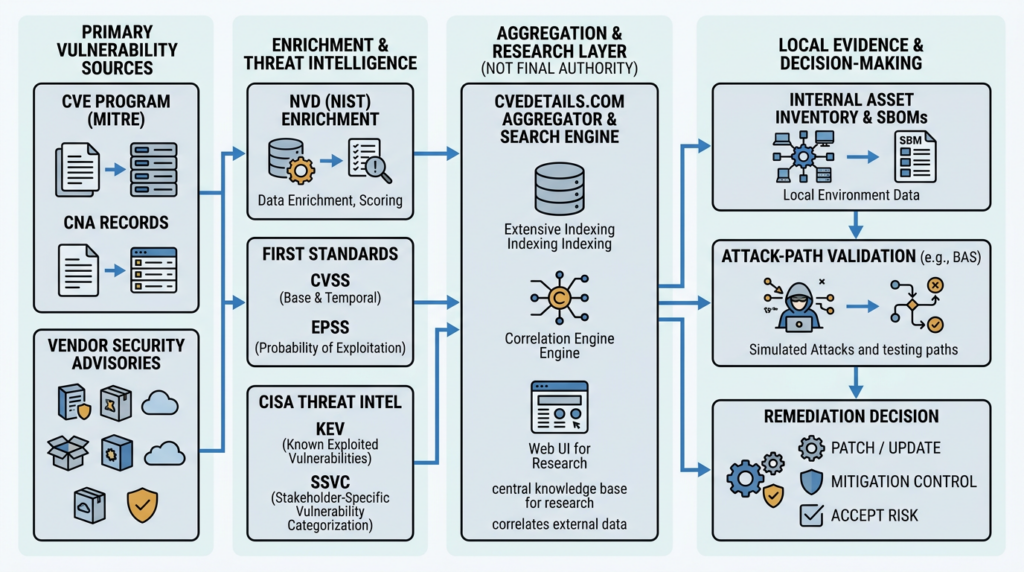
A CVEDetails page can combine information from several layers of the vulnerability ecosystem. Understanding those layers makes it easier to judge which source should resolve a disagreement.
The CVE Program exists to identify, define, and catalog publicly disclosed cybersecurity vulnerabilities. CVE Numbering Authorities create and publish CVE Records, while Authorized Data Publishers can add enrichment to records after publication. The CVE identifier gives different organizations a common reference, but the existence of a CVE does not imply that every downstream database has finished analyzing it. (CVE)
The National Vulnerability Database consumes CVE data and adds analysis such as CVSS metrics, CWE classifications, reference tags, and CPE-based applicability information. NVD also exposes APIs that aggregators, vulnerability products, researchers, and internal security systems can use to retrieve records and change history. (NVD)
CISA contributes operationally useful data through resources such as the Known Exploited Vulnerabilities Catalog and Vulnrichment. FIRST maintains the CVSS standard and publishes EPSS scores. Vendors publish security advisories that often provide the most precise information about affected versions, configurations, mitigations, and fixed releases.
CVEDetails brings many of these data points into a searchable interface.
The resulting ecosystem looks less like a single database and more like a chain of custody:
| Veri katmanı | Primary purpose | What it can establish | What it usually cannot establish |
|---|---|---|---|
| CVE Program and CNA record | Identify and describe a vulnerability | CVE identity, core description, assigner data, references | Local exposure, business impact, remediation success |
| Vendor advisory | Define product-specific impact and remediation | Affected releases, fixed versions, prerequisites, workarounds | Whether every internal asset has been found |
| NVD zenginleştirme | Normalize and enrich CVE data | CVSS, CWE, CPE mappings, tagged references | Exact applicability to every packaging or deployment model |
| FIRST CVSS | Standardize severity characteristics | Technical severity under a stated vector | Exploitation probability or organizational risk |
| FIRST EPSS | Estimate near-term exploitation probability | Relative and probabilistic threat signal | Asset criticality, reachability, compensating controls |
| CISA KEV | Identify vulnerabilities with reliable exploitation evidence | Known exploitation status and remediation guidance | Every exploited vulnerability in every environment |
| CISA SSVC | Support decision-oriented prioritization | Action categories based on multiple factors | Automatic asset discovery or technical validation |
| CVEDetails | Aggregate and present vulnerability information | Fast research, cross-source comparison, reference discovery | Final authority on local risk |
| Internal evidence | Describe the organization’s real environment | Installed version, exposure, reachability, ownership, controls | Global prevalence outside the organization |
This hierarchy prevents a common analytical failure: asking one data source to answer a question it was never designed to answer.
CVSS should not be asked to predict exploitation. EPSS should not be asked to estimate business impact. CPE matching should not be asked to prove runtime reachability. KEV should not be asked to list every vulnerability that may be attacked tomorrow. CVEDetails should not be asked to replace all of them.
Why CVE Details Can Be Missing or Incomplete
An empty field is not the same as a negative finding.
A CVE may be published before NVD has added a CVSS score, CWE classification, or CPE applicability statement. A vendor may disclose a vulnerability while continuing to investigate additional affected versions. An EPSS score may not yet have been refreshed in a downstream interface. A CISA KEV entry may be added after evidence of exploitation becomes available. References may change after researchers publish new analysis or a vendor updates its advisory.
NIST acknowledged on April 15, 2026 that the NVD enrichment backlog, which began in early 2024, had not been cleared because incoming CVE volume continued to grow. NIST moved older backlogged records to a “Not Scheduled” status while continuing to prioritize KEV vulnerabilities. That means a valid CVE may exist even when NVD enrichment is delayed or absent. (NIST)
This has several consequences for teams reading CVE details:
- Missing NVD CVSS does not mean low severity. It may mean that enrichment has not been completed.
- Missing CPE data does not mean no products are affected. The applicability statement may be incomplete or pending.
- Missing KEV status does not prove no exploitation. It only means the vulnerability is not currently represented in that evidence-based catalog.
- An old description may not reflect the latest vendor investigation. The affected range or prerequisites may have changed.
- A score shown by an aggregator may have a different update time from the source record.
- Older CVEs may contain less structured data than newer records. NVD notes that earlier records can have less detail, particularly for older historical entries. (NVD)
When a field is missing, the correct workflow is not to assume a favorable answer. The correct workflow is to mark the field as unresolved and continue to the most relevant primary source.
“Unknown” is a valid analytical state. It is safer than converting missing data into false certainty.
How to Read a CVEDetails Record Field by Field
A CVEDetails page contains several types of information. Each should trigger a different verification step.
CVE identifier
The CVE ID is the stable key used to correlate records across databases, scanners, advisories, ticketing systems, threat intelligence, SBOM tools, and internal asset inventories.
The identifier does not tell you:
- whether the vulnerability is severe;
- whether exploitation is known;
- whether your organization is affected;
- whether a patch exists;
- whether an exploit is public;
- whether the issue is still under analysis.
It is an identifier, not a conclusion.
Before correlating records, confirm that the CVE has not been rejected or disputed and that the referenced vulnerability matches the issue being investigated. A rejected CVE may remain visible for historical traceability, but it should not be treated as an active vulnerability without examining the record state.
Açıklama
The description should be read as a compressed summary of the reported weakness. It is useful for identifying:
- the affected component;
- the vulnerability class;
- the attacker’s required position;
- the likely impact;
- any obvious prerequisites.
Descriptions are intentionally concise. They frequently omit configuration details, deployment assumptions, attack-chain requirements, and remediation caveats.
A description such as “remote code execution vulnerability” does not establish that exploitation is unauthenticated, network-reachable, reliable, or possible under default settings. Conversely, a description labeled “information disclosure” may understate the practical impact if the exposed information includes authentication material or enables a larger chain.
The vendor advisory should resolve product-specific questions whenever one exists.
Published and updated dates
Publication date answers when the record became public. Updated date indicates that some part of the record changed.
Neither date tells you exactly what changed.
A meaningful update might include:
- an expanded affected-version range;
- a changed CVSS vector;
- a new CPE entry;
- a patch reference;
- an added exploitation warning;
- a corrected description;
- an additional affected product;
- a rejection or dispute state.
For high-risk vulnerabilities, teams should retrieve change history rather than merely noting that an update occurred. An update can invalidate a previous closure decision.
Assigner
The assigner identifies the CNA responsible for the CVE Record. This matters because the assigner may have direct product knowledge, coordinate with the vendor, or publish a more specific advisory.
A vendor CNA may be able to describe exact affected releases. A third-party coordinator may initially publish a broader record and refine it later. Neither pattern automatically makes the record wrong, but it affects where an analyst should look for the most detailed product guidance.
Vendor, product, and affected versions
This is one of the most operationally important sections and one of the easiest to misuse.
Affected-version data can be complicated by:
- package renaming;
- forks;
- vendor-maintained branches;
- embedded libraries;
- static linking;
- container layers;
- appliance firmware;
- cloud services with hidden components;
- Linux distribution backports;
- release suffixes;
- downstream patches;
- feature flags;
- architecture-specific builds.
A string comparison is therefore not enough.
Suppose a record says versions before 4.2.5 are affected. An internal scanner finds version 4.2.1. That appears to be a match, but several possibilities remain:
- the vendor backported the fix to 4.2.1-18;
- the detected file belongs to an unused development package;
- the vulnerable code was removed by the distributor;
- the application bundles a different library than the operating system package;
- the version string came from an HTTP banner rather than the executable;
- the vulnerable feature is disabled;
- the scanner detected a stale file that is not loaded;
- a running process has not restarted after patching.
The product and version fields provide a hypothesis. Local package metadata, process inspection, vendor advisories, build provenance, and controlled testing determine whether the hypothesis is true.
CWE
The Common Weakness Enumeration category describes the underlying weakness pattern, such as improper input validation, out-of-bounds write, path traversal, or missing authentication.
CWE is useful because it helps defenders move beyond a single CVE. A team can use the weakness class to:
- search for similar defects;
- select secure coding controls;
- create static-analysis rules;
- define code-review checks;
- build detection hypotheses;
- identify recurring product risk;
- group remediation lessons.
A CWE assignment should not be treated as a complete exploit explanation. Many CVEs have broad or provisional weakness classifications, and one real exploit chain may involve multiple weakness types.
CVSS score
The base score gives a standardized representation of technical severity under a particular vector.
Always record four things together:
- CVSS version
- Score
- Vektör
- Scoring source
A score without the vector hides the assumptions that produced it. A vector without its source hides who made those assumptions. A score without its version may be incomparable with another score produced under a different CVSS specification.
EPSS score and percentile
EPSS publishes a probability between zero and one representing the estimated likelihood of exploitation activity being observed in the next thirty days. FIRST also publishes a percentile showing how the score ranks against other CVEs. The model is refreshed daily. (FIRST)
A probability of 0.40 and a percentile of 0.98 do not mean the same thing.
- The score says the estimated probability is 40 percent.
- The percentile says the vulnerability scores as high as or higher than roughly 98 percent of the scored population.
Confusing percentile with probability can dramatically inflate perceived likelihood.
CISA KEV status
A KEV entry means CISA has added the vulnerability based on reliable evidence of exploitation and the other catalog inclusion requirements. CISA describes the KEV Catalog as an authoritative source of vulnerabilities known to have been exploited in the wild. (CISA)
KEV is therefore a strong escalation signal. It is not merely another severity score.
The right question is not “How high is the CVSS?” but “Is this known-exploited vulnerability present and reachable in our environment?”
Referanslar
References often contain the most important evidence on the page.
High-value references include:
- vendor security advisories;
- release notes;
- official patches;
- source-code commits;
- CISA alerts;
- government advisories;
- maintainer discussions;
- coordinated-disclosure reports;
- reputable research;
- package-distributor notices.
References should be ranked by authority and directness. A vendor advisory generally carries more weight for fixed versions than a reposted news article. A source commit may reveal what code changed, but the release notes determine which supported build contains the fix. A public exploit repository may show that research code exists, but it does not prove successful exploitation in the wild.
Exploit and code links
The presence of exploit-related code changes the threat assessment, but the label “exploit” needs scrutiny.
A linked repository may contain:
- a safe detector;
- a crash reproducer;
- a toy demonstration;
- a weaponized exploit;
- nonfunctional code;
- copied code with no provenance;
- a scanner template;
- a write-up without implementation;
- malware using the CVE;
- code unrelated to the claimed vulnerability.
Security teams should not execute unknown exploit code against production systems. Repository age, maintainer identity, commit history, issue reports, build behavior, network indicators, and sandbox analysis all matter.
Public code is evidence that attacker effort may be reduced. It is not automatic proof that the code works, that it applies to your product build, or that exploitation is safe to reproduce.
A Verification Map for Common CVEDetails Fields
The following table turns each field into a practical verification action.
| CVEDetails field | Useful first conclusion | Primary verification source | Yaygın başarısızlık |
|---|---|---|---|
| CVE KIMLIĞI | A public record exists | CVE Record | Treating the identifier as proof of local exposure |
| Açıklama | General weakness and impact | Vendor advisory and CNA record | Assuming omitted prerequisites do not exist |
| Published date | Initial public timing | CVE Record | Confusing publication with exploit availability |
| Updated date | Record changed | NVD change history, CVE history, vendor advisory | Ignoring what changed |
| Affected product | Candidate product family | Vendor advisory | Accepting loose name matching |
| Affected version | Candidate vulnerable range | Vendor bulletin and package advisory | Ignoring backports and release suffixes |
| CVSS score | Standardized severity view | Score source and vector | Treating severity as risk |
| EPSS | Near-term exploitation probability estimate | FIRST EPSS API | Confusing percentile and probability |
| KEV | Reliable exploitation evidence exists | CISA KEV Catalog | Assuming non-KEV means unexploited |
| CWE | Weakness category | CVE Record and vendor analysis | Treating a category as an exploit chain |
| CPE | Normalized applicability expression | NVD CPE and vendor data | Assuming exact inventory matching |
| Referanslar | Paths to deeper evidence | Original linked sources | Trusting reposts over primary sources |
| Exploit links | Possible public technical material | Repository and independent analysis | Running untrusted code or assuming reliability |
| Fix references | Candidate remediation | Vendor release notes and package advisory | Assuming deployment equals successful remediation |
CVSS Measures Severity, Not Organizational Risk
NVD explicitly warns that CVSS provides a qualitative measure of severity and is not a measure of risk. That distinction is foundational. (NVD)
Severity describes technical characteristics of a vulnerability under stated assumptions. Risk depends on a broader relationship:
Risk depends on threat, exposure, exploitability, impact, asset value, controls, uncertainty, and time.
A CVSS base score does not know whether:
- the affected product is installed;
- the vulnerable feature is enabled;
- the asset is internet-facing;
- an attacker has a route to the service;
- authentication is required in your deployment;
- sensitive data is present;
- the system supports a critical business process;
- a web application firewall blocks the relevant traffic;
- egress controls interrupt the exploit chain;
- the vulnerable function is reachable;
- exploitation is already occurring;
- a patch is available;
- the patch has operational side effects;
- the asset is scheduled for retirement;
- the issue has been accepted under a documented exception.
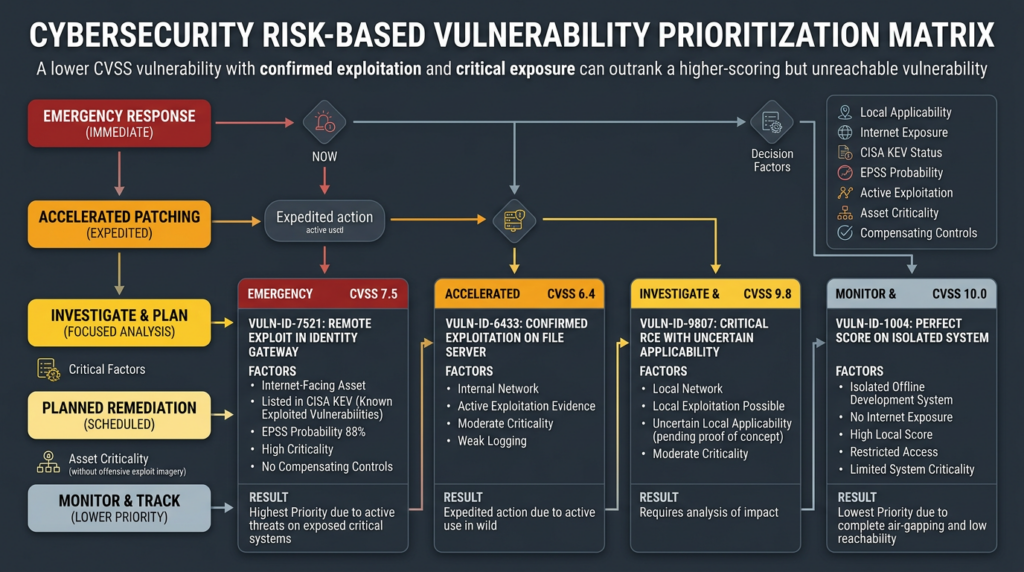
That is why a CVSS 10.0 vulnerability can be a lower immediate priority than a CVSS 7.5 vulnerability.
Consider two hypothetical findings:
Finding A
- CVSS 10.0
- Vulnerable development tool
- Present only on an offline build host
- Feature disabled
- No untrusted input path
- Replacement scheduled
- Compensating controls verified
Finding B
- CVSS 7.5
- Internet-facing authentication service
- Added to CISA KEV
- Exploitation observed
- No effective mitigation
- Privileged access at risk
- Patch available
A queue sorted only by CVSS places Finding A first. A defensible risk process places Finding B first.
The lesson is not that CVSS is unhelpful. CVSS is useful when used for its intended purpose. It creates a common language for technical characteristics and allows analysts to inspect the assumptions behind a score.
The mistake is converting that technical severity into an automatic business decision.
Read the CVSS Vector, Not Just the Number
A CVSS vector explains how the score was produced.
For CVSS v3.1, important base metrics include:
- Saldırı Vektörü
- Attack Complexity
- Gerekli Ayrıcalıklar
- Kullanıcı Etkileşimi
- Kapsam
- Confidentiality Impact
- Integrity Impact
- Availability Impact
Consider this illustrative vector:
CVSS:3.1/AV:N/AC:L/PR:N/UI:R/S:U/C:H/I:H/A:H
It describes a vulnerability that is network-accessible, has low attack complexity, requires no privileges, requires user interaction, does not change security scope, and can have high confidentiality, integrity, and availability impact.
Now compare it with:
CVSS:3.1/AV:N/AC:L/PR:N/UI:N/S:U/C:H/I:H/A:H
The only visible change is UI:R için UI:N. That difference can materially change the base score because one analysis assumes a user must take an action while the other assumes no user participation is required.
A security team should ask:
- What action counts as user interaction?
- Does an administrator need to import a file?
- Must a victim visit an attacker-controlled page?
- Is a background service automatically processing the input?
- Does the vendor’s deployment model make that interaction routine?
- Is the affected user highly privileged?
- Can an attacker reliably induce the action?
A single letter in a vector can represent a major disagreement about the attack path.
CVSS v4.0 expands the framework by separating Base, Threat, Environmental, and Supplemental metric groups. FIRST’s consumer guidance recommends using Threat and Environmental information to move beyond generalized base assumptions and toward local decision-making. The base score remains useful, but the broader model is designed to carry more context when that context is available. (FIRST)
Even under CVSS v4.0, no universal score can know the full business context of every organization. Local analysis remains necessary.
Why One CVE Can Have Several CVSS Scores
Different organizations can score the same vulnerability differently without either score being fabricated.
Differences can arise from:
- incomplete information at initial publication;
- different interpretations of user interaction;
- disagreement about attack complexity;
- disagreement about whether exploitation crosses a security boundary;
- different assumptions about default configuration;
- different conclusions about confidentiality, integrity, or availability impact;
- later discovery of additional attack paths;
- changes between CVSS versions;
- correction of an earlier vector;
- CNA, ADP, vendor, and NVD analyses performed at different times.
A CVEDetails page may therefore show more than one score.
Do not resolve the disagreement by selecting the highest number “to be safe.” That approach appears conservative but can make a program less safe by flooding the emergency queue with unverified assumptions.
Do not automatically select the lowest number either.
Instead:
- Record every source, version, score, vector, and publication time.
- Compare the vectors metric by metric.
- Identify the exact source of disagreement.
- Read the vendor advisory and technical analysis.
- map each disputed assumption to the local environment.
- Document the organization’s conclusion.
- Revisit the conclusion if the record changes.
The output should look like this:
CVE: CVE-YYYY-NNNNN
Source A: CVSS 3.1, 9.8
Vector A: ...
Source B: CVSS 3.1, 8.8
Vector B: ...
Difference: User Interaction
Vendor prerequisite: ...
Local observation: ...
Decision: ...
Evidence captured: ...
Reassessment date: ...
This method preserves uncertainty instead of hiding it behind one number.
Case Study — CVE-2023-38545 and Score Divergence
CVE-2023-38545 is a useful example because its public record shows different CVSS assessments. NVD displayed a CVSS v3.1 score of 9.8, while CISA-ADP provided 8.8. One material difference involved the User Interaction metric. The NVD page also noted that its enrichment could require amendment as the record evolved. (NVD)
The official curl advisory provides the context that the scores alone cannot express. The vulnerability was a SOCKS5 heap buffer overflow affecting libcurl versions 7.69.0 through 8.3.0 and fixed in 8.4.0. Triggering the issue required a specific combination involving SOCKS5 hostname resolution, a sufficiently long hostname, a particular buffer condition, and a slow SOCKS5 handshake. The advisory also distinguished common libcurl use from the curl command-line tool’s typical behavior. (Curl)
A score-only process might produce one of two poor outcomes.
The first team sees 9.8, declares every detected curl package an emergency, and launches disruptive patching without confirming whether the vulnerable library path is used.
The second team sees complex prerequisites, assumes the vulnerability is irrelevant, and closes the issue without checking whether an internal application uses the affected SOCKS5 configuration.
A better analysis asks:
- Is libcurl within the affected range present?
- Is it part of a running application?
- Does the application use a SOCKS5 proxy?
- Is remote hostname resolution enabled?
- Can an attacker control or influence the hostname?
- Does the application’s buffer behavior meet the trigger conditions?
- Is the fixed version available from the package vendor?
- Has the process restarted with the fixed library?
- Can the vulnerable path be tested safely in an isolated environment?
The CVE details are necessary, but the application architecture determines the real priority.
CVSS, EPSS, KEV, and SSVC Answer Different Questions
Security teams often place these signals in one dashboard and then treat them as competing scores. They are not competitors. They describe different dimensions.
| Sinyal | Primary question | Data type | Update pattern | Strong use | Dangerous misuse |
|---|---|---|---|---|---|
| CVSS | How technically severe is the vulnerability under this vector? | Standardized severity metrics | Changes when analysis changes | Compare technical characteristics | Treat as exploitation probability |
| EPSS | How likely is exploitation activity to be observed in the next thirty days? | Predictive probability and percentile | Daily | Prioritize among many published CVEs | Treat as proof of local exploitability |
| KEV | Is there reliable evidence of exploitation? | Evidence-based catalog membership | Event-driven | Escalate applicable vulnerabilities | Assume non-members are safe |
| SSVC | What action should an organization take given several factors? | Decision tree | Re-evaluated as inputs change | Translate context into action | Use without reliable local inputs |
| CPE | Which normalized product configurations may be affected? | Applicability expression | Updated through enrichment | Candidate inventory correlation | Treat as exact asset identity |
| Local validation | Is our asset affected and reachable? | Observed evidence | Environment-driven | Make the actual decision | Skip because a database score exists |
CISA’s SSVC resources use a decision-tree approach to help organizations prioritize vulnerability response based on factors beyond a severity number. The precise decision model depends on the stakeholder and deployment, but the broader lesson is clear: action should follow evidence and context, not a one-dimensional ranking. (CISA)
How to Use EPSS Without Misreading It
EPSS estimates the probability that exploitation activity will be observed in the next thirty days. It is refreshed daily and includes both a probability and a percentile. FIRST emphasizes that EPSS is most useful as a prioritization input when direct evidence of exploitation is not already available. Direct evidence should supersede a probabilistic estimate. EPSS also does not account for local environment, compensating controls, or business impact. (FIRST)
That leads to five practical rules.
Use the probability and percentile together
A high percentile can coexist with a probability that appears modest. This can happen because the overall distribution is highly skewed.
Store both values:
{
  "cve": "CVE-YYYY-NNNNN",
  "epss_probability": 0.0814,
  "epss_percentile": 0.9342,
  "retrieved_at": "2026-07-20T18:00:00Z"
}
The probability supports an absolute interpretation. The percentile supports relative queue ranking.
Preserve the retrieval date
EPSS changes. A ticket that says only “EPSS 0.62” loses important context.
The record should say:
EPSS probability: 0.62
EPSS percentile: 0.98
Observed on: 2026-07-20
Source: FIRST EPSS API
Historical snapshots help explain why a vulnerability was accelerated or deferred at a particular time.
Do not let low EPSS override direct evidence
Suppose incident responders observe exploit attempts against a vulnerable service, but the current EPSS probability is low.
The exploit evidence is stronger.
A model can lag a new campaign, lack a useful feature, or estimate global activity that does not match a targeted threat. Direct telemetry from the organization’s own perimeter should take priority.
Do not let high EPSS replace applicability testing
A high EPSS score means exploitation is more likely across the broader ecosystem. It does not establish that the vulnerable component exists in your environment.
Before opening an emergency change, confirm:
- product identity;
- version or build;
- vulnerable feature;
- attack-path reachability;
- asset ownership;
- business role;
- available remediation.
Use EPSS to allocate validation effort
EPSS is especially valuable when thousands of unresolved findings compete for analyst time.
Örneğin:
- High EPSS plus internet exposure should receive rapid applicability validation.
- High EPSS plus unknown ownership should trigger asset-identification escalation.
- High EPSS plus confirmed non-applicability should be documented and closed with evidence.
- Low EPSS plus KEV status should still be escalated.
- Low EPSS plus a critical internal trust boundary may justify prioritized review.
- Low EPSS plus no exposure and strong controls may enter planned remediation.
The score informs where to investigate. It does not replace the investigation.
How to Use CISA KEV
CISA’s Known Exploited Vulnerabilities Catalog is built around exploitation evidence rather than theoretical severity. A vulnerability must have a CVE ID, reliable evidence of exploitation, and clear remediation guidance to meet the catalog’s established criteria. (CISA)
For an applicable vulnerability, KEV membership should materially change the response.
A practical KEV workflow is:
- Identify every internal asset mapped to the CVE.
- Verify the product and version against the vendor advisory.
- Determine whether the vulnerable function is exposed.
- Review internet-facing and privileged-trust assets first.
- Search telemetry for exploit indicators.
- Apply the vendor remediation or approved mitigation.
- Confirm that services restarted and new binaries loaded.
- Retest the vulnerable path where safe.
- preserve evidence.
- Monitor for newly discovered affected assets.
KEV membership does not remove the need for applicability analysis. An organization may have a package name that resembles the affected product but contains a backported fix. Conversely, a vulnerable component may be embedded in an appliance and absent from ordinary software inventory.
CISA’s federal remediation directives must also be interpreted accurately. On June 10, 2026, CISA revoked BOD 22-01 and replaced the broader federal vulnerability-remediation framework with BOD 26-04. The binding requirements apply to U.S. Federal Civilian Executive Branch agencies. Private organizations can use KEV and the associated remediation expectations as strong operational inputs, but should not represent the federal directive as a legal requirement that automatically applies to every company. (CISA)
Absence from KEV is not a clean bill of health
A vulnerability may be absent because:
- no reliable exploitation evidence has been confirmed;
- exploitation is new or narrowly targeted;
- available evidence does not meet the inclusion threshold;
- exploitation has not been publicly attributed;
- the issue affects a limited ecosystem;
- the vulnerability has not yet been reviewed for inclusion.
Therefore:
KEV = yes
is strong evidence requiring escalation.
But:
KEV = no
means only that the CVE is not currently listed. It does not prove that no one has exploited it.
Product Matching Is Often Harder Than Vulnerability Scoring
The most consequential error in vulnerability management is frequently not a bad score. It is a bad asset match.
A vulnerability record may correctly describe an affected product while the organization incorrectly maps that record to its assets. This produces both false positives and false negatives.
CPE is useful but imperfect
NVD uses Common Platform Enumeration and match strings to express product applicability. A match string may correspond to one or many CPE names and may encode version ranges. NVD enrichment uses these expressions to associate CVEs with potentially affected configurations. (NVD)
The model is valuable for automation, but real software identity is messy.
Inventory sources may report:
Apache HTTP Server
httpd
apache2
Red Hat Enterprise Linux httpd
Vendor Appliance Web Service
Embedded Management Server
Those names may refer to related code but do not automatically map cleanly to the same affected configuration.
CPE matching should produce candidate matches with confidence levels, not unquestioned truth.
Backported patches break naive version comparison
Enterprise Linux distributors frequently backport security fixes from newer upstream releases into older package versions. Red Hat documents this practice explicitly: a package can retain an older upstream version while including security corrections from a later codebase. (Red Hat Customer Portal)
Suppose upstream fixes a vulnerability in version 2.4.60. A distribution may ship a package named:
2.4.57-8.el9_5.2
A scanner that examines only 2.4.57 may report the system as vulnerable. The distribution advisory may show that the relevant patch is included in the release suffix.
The correct evidence includes:
- package epoch;
- upstream version;
- release number;
- distribution;
- repository;
- architecture;
- changelog;
- security advisory;
- running process mapping.
A finding should not be closed merely because the system administrator says “the patch was backported.” The claim needs a package advisory or changelog that connects the installed build to the security fix.
Embedded components create hidden exposure
A vulnerable library may appear:
- inside a Java archive;
- within a shaded dependency;
- in a container layer;
- inside firmware;
- statically linked into a Go or C binary;
- bundled with an endpoint agent;
- copied into an application directory;
- included in a serverless deployment package;
- packaged in an appliance;
- embedded in a desktop application.
Operating-system package inventory may miss these copies.
That is why software composition analysis, SBOMs, file hashing, runtime observation, container scanning, and vendor attestations can all matter.
Component presence is not code-path reachability
An SBOM can show that a component exists. It does not automatically prove that:
- the vulnerable class is included;
- the affected function is invoked;
- attacker-controlled input reaches the function;
- runtime configuration enables the feature;
- required privileges are available;
- a mitigation blocks the chain.
Presence increases confidence in applicability. Reachability determines whether the vulnerable behavior can be exercised.
VEX can reduce ambiguity but is not self-validating
Vulnerability Exploitability eXchange allows a supplier or other producer to communicate whether a product is affected, not affected, fixed, or under investigation. VEX is designed to complement component-transparency data rather than merely repeat that a vulnerable component name appears in an SBOM. (NTIA)
A VEX statement should be evaluated for:
- issuer identity;
- product identity;
- version scope;
- status;
- justification;
- issue date;
- last update;
- signature or integrity protection;
- relationship to the deployed artifact;
- whether local modifications invalidate the statement.
An old “not affected” statement for a different product build is not sufficient evidence.
An Asset Applicability Checklist
Before converting CVE details into a remediation order, answer the following questions.
Kimlik
- What exact product, package, component, library, or firmware is involved?
- Who produced the deployed artifact?
- Is the vendor name in the CVE record the same as the supplier in the inventory?
- Is the asset a fork, appliance, managed service, or downstream package?
Versiyon
- What version is installed?
- What build, release, commit, or image digest is running?
- Has a distributor backported the fix?
- Did the process restart after the update?
- Does the version shown by the scanner come from a reliable source?
Presence
- Is the component actually on the asset?
- Is it included only in a dormant image layer?
- Is it statically linked into a running binary?
- Is it a development dependency or production dependency?
- Is it loaded at runtime?
Reachability
- Can untrusted input reach the vulnerable function?
- Is the relevant port or interface exposed?
- Is authentication required?
- Can an attacker satisfy the required privileges?
- Does user interaction occur in the real workflow?
- Are feature flags or configuration prerequisites enabled?
- Does network egress form part of the exploit chain?
Etki
- What privileges does the affected process hold?
- What data can it access?
- Does it cross a trust boundary?
- Can compromise affect identity, payment, production, safety, or regulated data?
- Can the asset serve as a pivot?
Kontroller
- Is the vulnerable feature disabled?
- Is segmentation enforced?
- Is exploit traffic blocked?
- Are application allowlists active?
- Is egress restricted?
- Are high-risk actions isolated?
- Have the controls been tested against the actual path?
İyileştirme
- Is a fixed version available?
- Is the fix supported by the vendor?
- Is a mitigation temporary or complete?
- Does deployment require a restart?
- Can the patch introduce compatibility risk?
- What validation proves that the issue is gone?
Any unanswered item should remain visible as an evidence gap.
A Defensible Vulnerability Prioritization Model
Many teams try to combine CVSS, EPSS, KEV, exposure, and asset value into one mathematical score.
A numerical model can help sort large queues, but it creates danger when arbitrary weights are presented as scientific precision. A score of 87.4 is not automatically more truthful than a clearly explained decision category.
A more defensible model uses evidence gates.
Emergency
Use this category when evidence indicates immediate action, such as:
- KEV membership with confirmed local applicability;
- active exploitation observed in organizational telemetry;
- an exposed critical asset with a reliable exploit path;
- compromise affecting identity, privileged administration, or critical operations;
- a vendor emergency directive for an affected deployment.
Required actions should include containment, remediation, threat hunting, and post-fix validation.
Accelerated
Use this category when risk is high but direct compromise has not been established:
- high EPSS with confirmed internet exposure;
- credible public exploitation code and a reachable path;
- unauthenticated vulnerability on a sensitive service;
- high-impact vulnerability with few prerequisites;
- exploitable flaw in a widely deployed trust boundary.
The team should validate applicability quickly and schedule remediation through an expedited change process.
Planned
Use this category when the vulnerability is applicable but current evidence supports routine remediation:
- limited exposure;
- authentication required;
- effective compensating controls;
- lower-value asset;
- no exploitation evidence;
- manageable technical impact;
- supported patch available.
“Planned” must still include an owner and deadline.
Investigate
Use this when the main problem is uncertainty:
- product match is ambiguous;
- version evidence conflicts;
- vendor advisory is incomplete;
- scanner evidence is weak;
- CPE mapping may be wrong;
- embedded dependencies are suspected;
- the asset owner is unknown.
Investigation is not a low-priority closure state. It is a request for targeted evidence.
Monitör
Use this when current evidence supports non-applicability, but the conclusion may change:
- component not currently deployed;
- vulnerable feature demonstrably absent;
- vendor VEX says not affected;
- patch is already installed;
- asset retired;
- exploit path blocked by a verified architectural condition.
Monitoring should include triggers such as a vendor update, new KEV status, changed EPSS, configuration drift, or redeployment.
The resulting matrix is easier to audit than a hidden weighted score:
| Exploitation evidence | Local applicability | Maruz kalma | Asset impact | Decision |
|---|---|---|---|---|
| Confirmed exploitation | Confirmed | Any | Material | Emergency |
| KEV | Confirmed | Reachable | Material | Emergency |
| Credible exploit activity | Confirmed | Internet-facing | Yüksek | Emergency or Accelerated |
| High EPSS | Confirmed | Internet-facing | Moderate or high | Accelerated |
| Public PoC | Confirmed | Internal only | Yüksek | Accelerated after path validation |
| No direct evidence | Confirmed | Sınırlı | Orta düzeyde | Planned |
| Any signal | Uncertain | Bilinmiyor | Bilinmiyor | Investigate |
| High CVSS only | Not applicable with evidence | Hiçbiri | Hiçbiri | Monitör |
| Low CVSS | Confirmed exploitation | Reachable | Material | Emergency |
The table deliberately allows a lower CVSS vulnerability to outrank a higher CVSS vulnerability. That is not a defect. It is the purpose of context-aware prioritization.
A Nine-Step Workflow From CVE Details to Remediation
Step One — Create a normalized record
Start with the CVE ID and capture source-specific facts without prematurely merging disagreements.
A normalized record might contain:
{
  "cve_id": "CVE-YYYY-NNNNN",
  "cve_state": "PUBLISHED",
  "description_source": "CNA",
  "published": "YYYY-MM-DD",
  "last_modified": "YYYY-MM-DD",
  "cvss": [
    {
      "source": "source-a",
      "version": "3.1",
      "score": 9.8,
      "vector": "CVSS:3.1/..."
    },
    {
      "source": "source-b",
      "version": "3.1",
      "score": 8.8,
      "vector": "CVSS:3.1/..."
    }
  ],
  "epss": {
    "probability": null,
    "percentile": null,
    "observed_at": null
  },
  "kev": {
    "listed": false,
    "checked_at": null
  },
  "vendor_advisory": null,
  "affected_range": [],
  "fixed_versions": [],
  "references": []
}
Do not overwrite one score with another. Preserve provenance.
Step Two — Confirm the product identity
Resolve the relationship between:
- CVE vendor name;
- CVE product name;
- CPE data;
- CMDB record;
- package manager;
- SBOM component;
- container image;
- cloud service;
- appliance model;
- internal application.
Record aliases rather than forcing all systems to use one name.
product_identity:
  canonical_name: "Example Server"
  aliases:
    - "example-server"
    - "vendor appliance web service"
  supplier: "Example Vendor"
  deployment_type: "container"
  image_digest: "sha256:example"
Step Three — Verify the build
Collect evidence from the deployed asset.
Örnekler şunları içerir:
# Local package inspection
rpm -q --qf '%{NAME} %{EPOCHNUM}:%{VERSION}-%{RELEASE} %{ARCH}\n' example-package

dpkg-query -W -f='${Package} ${Version} ${Architecture}\n' example-package

# Local container image inspection
docker image inspect example/image:tag \
  --format '{{json .RepoDigests}}'

# Local Java archive inventory
find /opt/example-app -type f -name '*.jar' -print
These commands inspect systems under the team’s administration. They do not establish vulnerability on their own, but they provide stronger identity evidence than a network banner.
Step Four — Read the vendor advisory
Extract:
- affected versions;
- fixed versions;
- vulnerable configurations;
- unaffected configurations;
- temporary mitigations;
- restart requirements;
- support status;
- known limitations;
- related CVEs.
If the vendor advisory conflicts with a generic database, document the conflict. The vendor is usually the primary source for its own package state, but local forks or downstream changes may still require separate analysis.
Step Five — Test attack-path reachability
Translate the vulnerability into a sequence of conditions.
Örneğin:
Attacker-controlled input
        ↓
Exposed protocol or application endpoint
        ↓
Parser or vulnerable function
        ↓
Required runtime feature
        ↓
Process privilege and accessible resources
        ↓
Security impact
Mark each edge as:
- confirmed;
- absent;
- blocked;
- unknown;
- conditionally reachable.
This creates an explainable model.
attack_path:
  attacker_input: confirmed
  network_reachability: confirmed
  authentication_required: false
  vulnerable_function_loaded: unknown
  feature_enabled: confirmed
  egress_required: true
  egress_allowed: false
  conclusion: "Path currently blocked by tested egress control, but component remains vulnerable"
The example also shows why “mitigated” and “fixed” are not synonyms. Egress filtering may interrupt one exploit chain while the vulnerable code remains installed.
Step Six — Add threat evidence
Collect:
- KEV status;
- EPSS score and percentile;
- vendor exploitation statement;
- observed scanning;
- public exploit maturity;
- incident-response telemetry;
- relevant malware reports;
- industry targeting;
- internal detections.
Rank direct evidence above prediction.
Internal exploit attempt observed
    > vendor confirms active exploitation
    > CISA KEV membership
    > credible campaign reporting
    > reliable public exploit
    > EPSS probability
    > CVSS severity alone
This ordering is contextual rather than universal, but it prevents a probabilistic model from overriding observed facts.
Step Seven — Add business context
Technical impact becomes organizational risk only when connected to an asset.
Yakalayın:
- asset owner;
- service owner;
- business process;
- data classification;
- user population;
- privilege level;
- recovery requirements;
- external obligations;
- dependency relationships;
- maintenance constraints.
A vulnerability affecting a low-privilege kiosk and the same vulnerability affecting a domain-management server should not automatically receive the same response.
Step Eight — Choose and execute the response
Possible responses include:
- patch;
- upgrade;
- disable the feature;
- remove the component;
- isolate the service;
- restrict network access;
- rotate credentials;
- apply a vendor workaround;
- add detection;
- accept risk temporarily;
- retire the asset.
Every temporary mitigation should have:
- an owner;
- an expiration date;
- a validation method;
- a rollback or replacement plan;
- a monitoring trigger.
Step Nine — Verify remediation
A closed scanner finding is not proof of remediation.
Verification can include:
- package-version confirmation;
- file hash comparison;
- process restart confirmation;
- container redeployment confirmation;
- configuration inspection;
- safe regression test;
- attack-path retest;
- log review;
- scanner rerun;
- exploit-specific detection check;
- validation of every replica and region.
Store before-and-after evidence.
remediation:
  action: "upgrade"
  target_version: "fixed-build"
  deployed_at: "2026-07-20T14:32:00Z"
  process_restarted: true
  running_build_verified: true
  attack_path_retested: true
  result: "not reproducible"
  verifier: "security-engineering"
  evidence_location: "ticket-attachment-reference"
Querying Authoritative Data Safely
The following commands retrieve public vulnerability information for a known CVE. They do not scan or interact with a target system.
Retrieve a record from the NVD API
CVE_ID="CVE-2023-38545"

curl --fail --silent --show-error \
  "https://services.nvd.nist.gov/rest/json/cves/2.0?cveId=${CVE_ID}" \
  -o "${CVE_ID}-nvd.json"
NVD recommends its 2.0 APIs for retrieving current data and provides a separate change-history interface for understanding record changes. (NVD)
Inspect the core record:
jq '
  .vulnerabilities[0].cve
  | {
      id,
      sourceIdentifier,
      published,
      lastModified,
      vulnStatus,
      descriptions,
      weaknesses,
      references
    }
' "${CVE_ID}-nvd.json"
Extract CVSS v3.1 entries without discarding their sources:
jq '
  .vulnerabilities[0].cve.metrics.cvssMetricV31[]?
  | {
      source,
      type,
      baseScore: .cvssData.baseScore,
      baseSeverity: .cvssData.baseSeverity,
      vectorString: .cvssData.vectorString,
      exploitabilityScore,
      impactScore
    }
' "${CVE_ID}-nvd.json"
Bu []? form allows the command to return no entries without failing when enrichment is absent. An empty result should be recorded as missing data, not converted into a zero score.
Query EPSS
FIRST documents a public API for retrieving EPSS data by CVE. (FIRST)
curl --fail --silent --show-error \
  "https://api.first.org/data/v1/epss?cve=${CVE_ID}" \
  -o "${CVE_ID}-epss.json"

jq '
  .data[0]
  | {
      cve,
      epss_probability: .epss,
      percentile,
      date
    }
' "${CVE_ID}-epss.json"
Keep in mind that API values may be encoded as strings. Convert them explicitly before mathematical comparison.
jq '
  .data[0]
  | {
      cve,
      epss_probability: (.epss | tonumber),
      percentile: (.percentile | tonumber),
      date
    }
' "${CVE_ID}-epss.json"
Preserve retrieval metadata
Create a simple evidence manifest:
retrieved_at="$(date -u +%Y-%m-%dT%H:%M:%SZ)"

jq -n \
  --arg cve "$CVE_ID" \
  --arg retrieved_at "$retrieved_at" \
  --arg nvd_file "${CVE_ID}-nvd.json" \
  --arg epss_file "${CVE_ID}-epss.json" \
  '{
    cve: $cve,
    retrieved_at: $retrieved_at,
    sources: {
      nvd: $nvd_file,
      epss: $epss_file
    }
  }' > "${CVE_ID}-manifest.json"
For a stronger audit trail, calculate hashes:
shasum -a 256 \
  "${CVE_ID}-nvd.json" \
  "${CVE_ID}-epss.json" \
  "${CVE_ID}-manifest.json"
The hashes do not prove the upstream data was correct. They prove which local evidence files were used for the decision.
Compare scoring sources
jq -r '
  .vulnerabilities[0].cve.metrics
  | to_entries[]
  | .key as $metric_version
  | .value[]
  | [
      $metric_version,
      .source,
      .type,
      (.cvssData.baseScore | tostring),
      .cvssData.vectorString
    ]
  | @tsv
' "${CVE_ID}-nvd.json"
Possible output:
cvssMetricV31    nvd@nist.gov    Primary      9.8    CVSS:3.1/...
cvssMetricV31    adp@example     Secondary    8.8    CVSS:3.1/...
That output should trigger vector analysis, not automatic selection of one score.
A Safe PoC for Evidence-Based Triage
The following proof of concept demonstrates how multiple vulnerability signals can produce a defensible priority decision.
It is deliberately non-exploitative.
It:
- uses fictional CVEs;
- uses fictional assets;
- reads only local JSON;
- does not scan a network;
- does not send packets;
- does not execute payloads;
- does not test a real vulnerability;
- does not attempt authentication bypass, code execution, or privilege escalation.
Its purpose is to help defenders understand why CVSS alone is insufficient.
Create findings.json:
[
  {
    "cve": "CVE-2099-10001",
    "asset": "offline-build-helper",
    "applicable": true,
    "applicability_confidence": "high",
    "cvss": 10.0,
    "epss": 0.03,
    "kev": false,
    "active_exploitation_observed": false,
    "internet_exposed": false,
    "attack_path_reachable": false,
    "asset_criticality": "low",
    "effective_compensating_control": true,
    "fix_available": true
  },
  {
    "cve": "CVE-2099-10002",
    "asset": "identity-gateway",
    "applicable": true,
    "applicability_confidence": "high",
    "cvss": 7.5,
    "epss": 0.42,
    "kev": true,
    "active_exploitation_observed": false,
    "internet_exposed": true,
    "attack_path_reachable": true,
    "asset_criticality": "critical",
    "effective_compensating_control": false,
    "fix_available": true
  },
  {
    "cve": "CVE-2099-10003",
    "asset": "customer-api",
    "applicable": null,
    "applicability_confidence": "low",
    "cvss": 9.8,
    "epss": 0.78,
    "kev": false,
    "active_exploitation_observed": false,
    "internet_exposed": true,
    "attack_path_reachable": null,
    "asset_criticality": "high",
    "effective_compensating_control": false,
    "fix_available": true
  },
  {
    "cve": "CVE-2099-10004",
    "asset": "internal-reporting",
    "applicable": true,
    "applicability_confidence": "high",
    "cvss": 6.4,
    "epss": 0.01,
    "kev": false,
    "active_exploitation_observed": true,
    "internet_exposed": false,
    "attack_path_reachable": true,
    "asset_criticality": "high",
    "effective_compensating_control": false,
    "fix_available": false
  }
]
Create triage.py:
#!/usr/bin/env python3

from __future__ import annotations

import json
import sys
from dataclasses import dataclass
from enum import IntEnum
from pathlib import Path
from typing import Any


class Priority(IntEnum):
    MONITOR = 1
    PLANNED = 2
    INVESTIGATE = 3
    ACCELERATED = 4
    EMERGENCY = 5


@dataclass(frozen=True)
class Decision:
    priority: Priority
    reasons: list[str]
    evidence_gaps: list[str]


def require_bool_or_none(value: Any, field: str) -> bool | None:
    if value is None or isinstance(value, bool):
        return value
    raise ValueError(f"{field} must be true, false, or null")


def evaluate(finding: dict[str, Any]) -> Decision:
    reasons: list[str] = []
    gaps: list[str] = []

    applicable = require_bool_or_none(
        finding.get("applicable"), "applicable"
    )
    reachable = require_bool_or_none(
        finding.get("attack_path_reachable"),
        "attack_path_reachable",
    )

    kev = bool(finding.get("kev", False))
    observed = bool(
        finding.get("active_exploitation_observed", False)
    )
    exposed = bool(finding.get("internet_exposed", False))
    control = bool(
        finding.get("effective_compensating_control", False)
    )
    fix_available = bool(finding.get("fix_available", False))

    cvss = float(finding.get("cvss", 0.0))
    epss = float(finding.get("epss", 0.0))
    criticality = str(
        finding.get("asset_criticality", "unknown")
    ).lower()

    if applicable is None:
        gaps.append("Local applicability has not been established.")

    if reachable is None:
        gaps.append("Attack-path reachability is unknown.")

    if criticality == "unknown":
        gaps.append("Asset criticality is unknown.")

    if observed and applicable is not False:
        reasons.append(
            "Direct exploitation evidence outranks predictive scores."
        )
        if reachable is True:
            reasons.append("The vulnerable path is reachable.")
        if criticality in {"high", "critical"}:
            reasons.append(
                f"The asset has {criticality} business criticality."
            )
        return Decision(Priority.EMERGENCY, reasons, gaps)

    if kev and applicable is True and reachable is True:
        reasons.append(
            "The vulnerability is known exploited and locally applicable."
        )
        reasons.append("The vulnerable path is reachable.")
        if exposed:
            reasons.append("The asset is internet-facing.")
        if criticality in {"high", "critical"}:
            reasons.append(
                f"The asset has {criticality} business criticality."
            )
        return Decision(Priority.EMERGENCY, reasons, gaps)

    if applicable is None or reachable is None:
        reasons.append(
            "Important local evidence is missing, so the finding "
            "cannot be safely accepted or closed."
        )
        if exposed:
            reasons.append(
                "Internet exposure increases the urgency of validation."
            )
        if epss >= 0.50:
            reasons.append(
                "EPSS is elevated and supports accelerated investigation."
            )
        return Decision(Priority.INVESTIGATE, reasons, gaps)

    if applicable is False:
        reasons.append(
            "Current evidence indicates the vulnerability is not "
            "applicable to this asset."
        )
        return Decision(Priority.MONITOR, reasons, gaps)

    if (
        applicable
        and reachable
        and exposed
        and (
            epss >= 0.50
            or cvss >= 9.0
            or criticality == "critical"
        )
    ):
        reasons.append(
            "The vulnerability is applicable and reachable."
        )
        reasons.append("The asset is internet-facing.")
        if epss >= 0.50:
            reasons.append("EPSS indicates elevated near-term threat.")
        if cvss >= 9.0:
            reasons.append("Technical severity is high.")
        if criticality == "critical":
            reasons.append("The asset is business-critical.")
        return Decision(Priority.ACCELERATED, reasons, gaps)

    if applicable and not reachable and control:
        reasons.append(
            "The component is present, but the tested attack path is "
            "blocked by a compensating control."
        )
        reasons.append(
            "The control should be monitored because the vulnerable "
            "component remains installed."
        )
        return Decision(Priority.PLANNED, reasons, gaps)

    if applicable:
        reasons.append("The vulnerability is locally applicable.")
        if fix_available:
            reasons.append("A fix is available.")
        else:
            reasons.append(
                "No fix is available, so mitigation and monitoring "
                "are required."
            )
        return Decision(Priority.PLANNED, reasons, gaps)

    return Decision(
        Priority.INVESTIGATE,
        ["The available evidence does not support a final decision."],
        gaps,
    )


def main() -> int:
    input_path = Path(
        sys.argv[1] if len(sys.argv) > 1 else "findings.json"
    )

    try:
        findings = json.loads(input_path.read_text())
    except FileNotFoundError:
        print(f"Input file not found: {input_path}", file=sys.stderr)
        return 1
    except json.JSONDecodeError as exc:
        print(f"Invalid JSON: {exc}", file=sys.stderr)
        return 1

    if not isinstance(findings, list):
        print("Input must be a JSON array.", file=sys.stderr)
        return 1

    decisions: list[dict[str, Any]] = []

    for finding in findings:
        try:
            decision = evaluate(finding)
        except (TypeError, ValueError) as exc:
            print(
                f"Invalid finding {finding.get('cve', 'unknown')}: {exc}",
                file=sys.stderr,
            )
            return 1

        decisions.append(
            {
                "cve": finding.get("cve"),
                "asset": finding.get("asset"),
                "cvss": finding.get("cvss"),
                "priority": decision.priority.name,
                "reasons": decision.reasons,
                "evidence_gaps": decision.evidence_gaps,
            }
        )

    decisions.sort(
        key=lambda item: Priority[item["priority"]],
        reverse=True,
    )

    print(json.dumps(decisions, indent=2))
    return 0


if __name__ == "__main__":
    raise SystemExit(main())
Run it locally:
python3 triage.py findings.json
The expected ordering places the actively exploited fictional vulnerability first, followed by the known-exploited and reachable identity vulnerability. The high-CVSS but uncertain API finding enters investigation. The CVSS 10.0 issue on the offline system does not automatically take first place because the tested attack path is blocked.
The PoC illustrates four defensive principles:
- Direct exploitation evidence outranks predictive data.
- KEV plus confirmed applicability and reachability can outweigh a higher CVSS score.
- Unknown applicability should create an investigation task, not a false-positive closure.
- A compensating control can change urgency without changing the fact that vulnerable code remains installed.
This code is intentionally simple. A production implementation would need authenticated data pipelines, schema validation, source provenance, time-based reassessment, asset ownership, exception governance, audit logging, and human approval.
It should still avoid presenting its result as objective mathematical truth. The value lies in the explanation attached to each decision.
Case Study — Log4Shell and the Limits of Database-Only Triage
CVE-2021-44228 demonstrates what happens when severity, exploitability, supply-chain visibility, and operational complexity converge.
Apache documented that Log4j’s JNDI behavior and message lookups created a path to serious impact, including remote code execution under affected conditions. Apache’s subsequent security guidance also showed that the initial 2.15.0 remediation was incomplete in certain non-default configurations, leading to additional fixes and related CVEs. (Apache Logging Services)
A CVEDetails record can quickly show:
- high CVSS assessments;
- KEV status;
- EPSS information;
- affected products;
- related references;
- subsequent vulnerability relationships.
The CVEDetails page for CVE-2021-44228 presents CISA KEV information, EPSS data, and multiple CVSS sources, illustrating the value of a consolidated research view. (CVE Details)
But a database search alone could not answer the hardest operational questions:
- Which applications embedded Log4j?
- Which copies were direct dependencies?
- Which were transitive dependencies?
- Which vendors bundled the library inside appliances?
- Which shaded JAR files hid the package identity?
- Which containers contained vulnerable layers?
- Which applications loaded the affected class?
- Which configurations exposed the vulnerable behavior?
- Which temporary mitigations remained active?
- Which systems received an incomplete initial fix?
- Which services had not restarted?
- Which assets had been missed by inventory?
Organizations with usable SBOM information could locate Log4j components more quickly, but even component visibility still required version, configuration, reachability, and remediation validation. NTIA later highlighted Log4j as an example of how SBOM data helped organizations locate affected components. (NTIA)
The operational lesson is not simply “maintain an SBOM.” It is:
Maintain enough software identity, dependency, runtime, and ownership evidence to convert a public vulnerability record into an accurate list of affected systems.
CVEDetails can identify what to investigate. It cannot generate that internal evidence automatically.
Case Study — Backports and False Positives
Consider a generic Linux package identified by a scanner as an old upstream version.
The scanner reports:
Installed upstream version: 1.8.4
Fixed upstream version: 1.8.9
Status: vulnerable
The actual package is:
1.8.4-22.el9_4.7
The distribution’s security advisory states that the vulnerability fix was backported into release 22.el9_4.7.
A correct conclusion requires the analyst to separate:
- upstream version;
- downstream release;
- distributor patch;
- installed package;
- running binary.
A weak closure says:
False positive because the vendor backported the patch.
A defensible closure says:
The asset runs package 1.8.4-22.el9_4.7 from the supported vendor
repository. Vendor advisory RHSA-EXAMPLE maps CVE-YYYY-NNNNN to the
fixed package release 1.8.4-22.el9_4.7. Package-manager output and the
running process map confirm that this build is loaded. The service was
restarted after installation. The scanner matched only the upstream
version and did not evaluate the vendor release suffix.
The second closure is auditable. It can be challenged and rechecked.
The first is an assertion.
The Most Common Ways Teams Misuse CVE Details
| Arıza modu | Why it happens | Operational consequence | Better practice |
|---|---|---|---|
| Sorting exclusively by CVSS | The number is easy to compare | Known-exploited lower-score flaws remain exposed | Combine exploitation, applicability, exposure, and impact |
| Selecting the highest score source | It feels conservative | Emergency queue becomes noisy | Compare vectors and assumptions |
| Ignoring the vector | Dashboards show only the score | Analysts miss prerequisites | Store version, score, vector, and source together |
| Treating CVSS 9.8 as 98 percent likelihood | Severity and probability are confused | Threat is overstated | Use EPSS for probability and direct evidence for fact |
| Treating EPSS percentile as probability | Both values appear together | Likelihood is misreported | Label and store each value explicitly |
| Treating low EPSS as safe | Prediction is mistaken for certainty | Targeted or new exploitation may be missed | Prioritize direct evidence and local exposure |
| Treating non-KEV as unexploited | Catalog absence is overinterpreted | Emerging attacks are ignored | Use KEV as a strong positive signal, not a complete negative signal |
| Accepting CPE as exact inventory proof | Structured matching appears authoritative | False positives and false negatives | Validate product identity and packaging |
| Ignoring backports | Upstream versions are easier to compare | Patched systems remain in the queue | Check distributor advisories and release fields |
| Closing uncertain matches | Teams are rewarded for queue reduction | Unknown risk disappears from reporting | Use an Investigate state |
| Running public PoCs in production | Reproduction is confused with validation | Outage, compromise, or legal exposure | Use isolated labs and safe checks |
| Closing after patch deployment | Change completion is mistaken for risk removal | Old processes or replicas remain vulnerable | Verify running versions and retest |
| Failing to save timestamps | Dynamic data appears static | Historical decisions cannot be explained | Preserve retrieval dates and source snapshots |
| Trusting a scanner’s silence | Detection coverage is assumed complete | Embedded components remain hidden | Combine inventory, SBOM, runtime, and targeted inspection |
Scanner Evidence Should Be Treated as a Claim
A vulnerability scanner usually produces a claim supported by one or more observations.
Common observation types include:
- service banner;
- package version;
- file version;
- authenticated registry query;
- HTTP response behavior;
- protocol negotiation;
- local file hash;
- package database;
- configuration value;
- safe request-response pattern;
- vendor appliance version;
- cloud API result.
These observations have different confidence levels.
A remote banner can be inaccurate or intentionally changed. An authenticated package query is stronger for package identity but may miss bundled libraries. A file hash can identify a component but not prove it is loaded. A safe behavioral check can demonstrate reachability but may not identify every affected replica.
A high-quality finding should separate observation from inference:
observation:
  type: "authenticated_package_query"
  result: "example-package 3.1.4-2"
  collected_at: "2026-07-20T16:10:00Z"

inference:
  claim: "Version may fall within affected upstream range"
  confidence: "medium"

verification_needed:
  - "Check vendor backport advisory"
  - "Confirm running process uses this package"
  - "Confirm vulnerable feature is enabled"
This structure makes disagreement productive. An application owner can challenge the inference without denying the observation.
Public PoC Availability Is a Threat Signal, Not a Testing Instruction
A public proof of concept can reduce the expertise and time required to test a vulnerability. It may also help defenders understand packet structure, required conditions, crash signatures, or affected code paths.
However, public exploit code creates several risks:
- it may contain malicious dependencies;
- it may execute additional commands;
- it may alter target state;
- it may cause denial of service;
- it may not respect version checks;
- it may produce false positives;
- it may exfiltrate environment data;
- it may violate authorization boundaries;
- it may be unreliable against patched systems;
- it may be copied from an untrusted source.
A safe review process should include:
- Read the code before execution.
- Inspect dependencies and install scripts.
- compare behavior with the vendor advisory.
- Run only in an isolated lab.
- Use synthetic data.
- block unnecessary outbound network access.
- record hashes and provenance.
- avoid real credentials.
- avoid production targets.
- prefer non-destructive detection logic.
For many vulnerabilities, the best production validation is not exploit execution. It may be a combination of package evidence, configuration inspection, code-path analysis, and a safe protocol check.
Data Freshness Is Part of Vulnerability Risk
Vulnerability data is time-sensitive.
A decision made on Monday may be invalid by Friday because:
- a vendor expanded the affected range;
- CISA added the CVE to KEV;
- EPSS increased;
- exploit code became available;
- a workaround was bypassed;
- a patch was recalled;
- a new related CVE was assigned;
- a previously internal service became internet-facing;
- an asset owner changed configuration;
- a container was redeployed from an old image.
Every vulnerability record should include freshness metadata:
source_freshness:
  cve_record_checked: "2026-07-20"
  vendor_advisory_checked: "2026-07-20"
  nvd_checked: "2026-07-20"
  kev_checked: "2026-07-20"
  epss_checked: "2026-07-20"
  asset_inventory_checked: "2026-07-20"
  exposure_checked: "2026-07-20"
The reassessment cadence should depend on the decision.
An emergency vulnerability may require continuous operational tracking. An unresolved internet-facing finding may require daily re-evaluation. A documented non-applicable component may be rechecked when the vendor record, application build, or deployment changes.
Closing a ticket should not erase its reassessment triggers.
Building a Source Hierarchy
A source hierarchy reduces confusion when several pages disagree.
A practical default is:
- Current vendor advisory for product impact and remediation
- CVE Record from the responsible CNA
- Maintainer release notes and source changes
- Supported package-distributor advisory
- CISA exploitation and prioritization information
- NVD zenginleştirme
- FIRST CVSS and EPSS data
- Trusted security research
- CVEDetails and other aggregation interfaces
- Unverified reposts, social media, and anonymous exploit claims
This is not an absolute ranking for every question.
Örneğin:
- CISA KEV may be more authoritative than a vendor advisory about whether reliable exploitation evidence exists.
- The vendor is usually more authoritative about which supported release contains its fix.
- A Linux distributor is more authoritative about its backported package than the upstream project’s version table.
- Internal telemetry is more authoritative about attacks against the organization’s own systems.
- Source code may reveal a technical condition omitted from a brief advisory.
Authority is question-specific.
The analyst should ask:
Which source is closest to the fact I am trying to establish?
Do Not Collapse Conflicting Data Too Early
Aggregation systems often normalize multiple sources into one field. This helps search and reporting but can hide disagreement.
Suppose three sources provide:
Vendor: affected through 5.4.3
CNA: affected before 5.4.4
Distribution: fixed in 5.4.2-19
A single normalized field such as:
affected < 5.4.4
loses the distribution-specific exception.
A better internal model preserves claims:
{
  "claims": [
    {
      "source": "vendor",
      "type": "affected_range",
      "value": "<=5.4.3"
    },
    {
      "source": "cna",
      "type": "affected_range",
      "value": "<5.4.4"
    },
    {
      "source": "distribution",
      "type": "fixed_package",
      "value": "5.4.2-19"
    }
  ]
}
Resolution happens after product identity is known.
The same principle applies to scores:
{
  "cvss_claims": [
    {
      "source": "nvd",
      "version": "3.1",
      "score": 9.8,
      "vector": "..."
    },
    {
      "source": "cisa-adp",
      "version": "3.1",
      "score": 8.8,
      "vector": "..."
    }
  ]
}
Preserving disagreement is not data duplication. It is evidence integrity.
Automated and AI-Assisted Validation
Automation can improve vulnerability management when it connects databases to real evidence.
A useful pipeline can correlate:
- CVE Records;
- NVD enrichment;
- CVEDetails research;
- EPSS;
- KEV;
- vendor advisories;
- SBOM components;
- VEX statements;
- CMDB assets;
- endpoint inventory;
- container registries;
- cloud resources;
- external attack-surface data;
- configuration evidence;
- ticket status;
- remediation validation.
AI can assist with tasks such as:
- comparing conflicting advisories;
- extracting affected and fixed versions;
- identifying prerequisites;
- summarizing CVSS vector differences;
- generating a safe validation plan;
- mapping CVEs to internal assets;
- organizing evidence;
- identifying missing information;
- drafting remediation notes;
- preparing retest steps.
The agent should remain downstream of authoritative evidence and upstream of human approval. It should not convert a CVEDetails score into an unreviewed production action.
A useful lifecycle is the separation of discovery, prioritization, remediation, verification, and reporting described in Penligent’s vulnerability management workflow. Within an authorized environment, tools such as Penligent can help structure evidence collection and retesting, but the underlying CVE details still need to be checked against primary advisories and the actual asset. (Penligent)
The safest AI-assisted workflow should require:
- explicit authorization scope;
- read-only discovery by default;
- human approval for intrusive tests;
- command and tool logging;
- captured outputs;
- source provenance;
- time stamps;
- asset identifiers;
- confidence statements;
- separate facts and inferences;
- rollback plans;
- post-remediation verification.
An AI-generated statement such as “the server is vulnerable” is weak unless accompanied by evidence showing:
Asset:
Observed product:
Observed version:
Source of observation:
Official affected range:
Configuration prerequisites:
Reachability evidence:
Threat evidence:
Validation method:
Result:
Limitations:
Automation should make decisions more explainable, not merely faster.
Vulnerability Management Metrics That Matter
A program optimized only for the number of closed findings can reward unsafe behavior. Analysts may close uncertain matches, accept weak evidence, or suppress findings to improve dashboard performance.
Better operational metrics include the following.
Time to applicability decision
Measure how long it takes to determine whether a finding actually applies.
This exposes inventory and ownership problems that mean-time-to-patch can hide.
Percentage of findings with verified ownership
A vulnerability without an owner is unlikely to be remediated reliably.
Track unresolved ownership separately from technical remediation status.
Kanıt bütünlüğü
A complete record should include:
- source;
- asset;
- product identity;
- version evidence;
- applicability conclusion;
- exposure;
- threat signal;
- action;
- verifier;
- timestamp.
KEV exposure
Track confirmed applicable KEV findings, not merely the number of KEV CVEs found by scanners.
Break them down by:
- internet-facing;
- internal;
- fixed;
- mitigated;
- accepted;
- overdue;
- under investigation.
Post-remediation validation rate
Measure how many remediated findings received independent validation.
A patch ticket closed without confirming the running version should not count as fully verified.
Reopened findings
A high reopening rate may indicate:
- incomplete fixes;
- asset rediscovery;
- image rollback;
- stale templates;
- missed replicas;
- poor exception handling;
- incorrect closures.
Unknown-state age
Track how long findings remain in states such as:
- ownership unknown;
- applicability unknown;
- version unknown;
- vendor guidance unavailable;
- reachability unknown.
Unknowns should not disappear into a generic backlog.
Risk-acceptance expiration
Every accepted vulnerability should have:
- documented rationale;
- accountable owner;
- compensating controls;
- review date;
- expiration date;
- trigger conditions.
Permanent exceptions should be rare and explicit.
Designing Vulnerability SLAs
A remediation SLA should not be generated from CVSS alone.
A more defensible policy uses factors such as:
- confirmed exploitation;
- KEV membership;
- internet exposure;
- authentication requirements;
- exploit maturity;
- asset criticality;
- data sensitivity;
- blast radius;
- available mitigation;
- patch availability;
- regulatory obligation;
- operational constraints.
For example, an organization might define policy logic such as:
Confirmed active exploitation
    → immediate incident and remediation process

KEV plus confirmed applicability
    → emergency remediation path

Internet-facing, reachable, and high impact
    → accelerated remediation path

Applicable with effective controls
    → planned remediation with control monitoring

Applicability unknown
    → investigation deadline, not remediation closure

Documented non-applicability
    → close with evidence and reassessment triggers
The exact timing should reflect the organization’s legal obligations, change capacity, architecture, and risk tolerance. The policy should avoid pretending that one universal number fits every environment.
What a Strong Vulnerability Ticket Looks Like
A high-quality ticket can be understood by an analyst who did not perform the original investigation.
cve: "CVE-YYYY-NNNNN"

public_data:
  cna_record_checked: "2026-07-20"
  vendor_advisory_checked: "2026-07-20"
  nvd_checked: "2026-07-20"
  kev_listed: true
  kev_checked: "2026-07-20"
  epss_probability: 0.64
  epss_percentile: 0.98
  epss_date: "2026-07-20"

asset:
  hostname: "example-production-service"
  owner: "identity-platform"
  environment: "production"
  exposure: "internet-facing"
  criticality: "critical"

identity_evidence:
  product: "Example Gateway"
  version: "4.7.2"
  build: "4.7.2-103"
  collection_method: "authenticated local query"
  collected_at: "2026-07-20T09:45:00Z"

applicability:
  vendor_affected_range: "<4.7.5"
  component_present: true
  vulnerable_feature_enabled: true
  attack_path_reachable: true
  confidence: "high"

decision:
  priority: "emergency"
  reasons:
    - "Listed in CISA KEV"
    - "Confirmed affected build"
    - "Internet-facing attack path"
    - "Critical identity function"

remediation:
  required_version: "4.7.5"
  owner: "identity-platform"
  change_reference: "CHG-EXAMPLE"

verification:
  running_version_confirmed: true
  service_restart_confirmed: true
  safe_retest_completed: true
  exploit_indicators_reviewed: true
  verified_at: "2026-07-20T15:20:00Z"
This ticket is far more valuable than:
Critical CVE. CVSS 9.8. Please patch.
The difference is not verbosity. It is evidence.
SSS
Is CVEDetails an authoritative source for CVE information?
- CVEDetails is a useful aggregation and research interface, not the sole authoritative source for every field.
- It explicitly states that it uses NVD API data and is not endorsed or certified by NVD.
- Verify the CVE identity through the CVE Record.
- Verify affected and fixed versions through the vendor or supported package distributor.
- Verify CVSS through the named scoring source and vector.
- Verify EPSS through FIRST and KEV status through CISA.
- Use local evidence to determine whether an internal asset is actually affected.
Why does one CVE have several CVSS scores?
- Different sources may interpret attack complexity, user interaction, scope, privileges, or impact differently.
- Scores may have been produced at different stages of the disclosure.
- One source may use CVSS v3.1 while another uses CVSS v4.0.
- Later research can change assumptions about the attack path.
- Compare the vectors metric by metric rather than selecting the highest or lowest number automatically.
- Document which assumptions match the organization’s actual deployment.
Should every CVSS 9 or 10 vulnerability be patched first?
- No. CVSS describes technical severity, not complete organizational risk.
- Confirm that the vulnerable product and version are present.
- Check whether the vulnerable feature is enabled and reachable.
- Add KEV, EPSS, exploit evidence, asset criticality, and exposure.
- A lower-scoring known-exploited vulnerability on an internet-facing identity system may require faster action.
- High-severity findings that are not applicable should be closed only with supporting evidence.
Is a vulnerability safe to defer when its EPSS score is low?
- A low EPSS score is not proof that exploitation will not occur.
- EPSS is a probabilistic estimate for observed exploitation activity over the next thirty days.
- Direct exploit attempts, vendor warnings, KEV status, or internal telemetry should override a low model score.
- Targeted attacks may not resemble broad ecosystem activity.
- Use low EPSS as one prioritization input after checking applicability, exposure, and impact.
What does it mean when a CVE is missing from CISA KEV?
- It means the CVE is not currently listed in the catalog.
- It does not prove that exploitation is impossible or has never occurred.
- Evidence may be new, private, narrowly targeted, or below CISA’s inclusion threshold.
- Continue reviewing vendor advisories, threat intelligence, exploit availability, EPSS, and internal telemetry.
- Treat KEV membership as a strong positive escalation signal, not catalog absence as a negative guarantee.
How can a team verify whether an affected version is really installed?
- Use authenticated package, binary, image, firmware, or application inventory.
- Record the full build and release identifier, not only the upstream version.
- Check for vendor or Linux-distribution backports.
- Inspect embedded and transitive dependencies.
- Confirm that the running process loaded the updated component.
- Compare the result with the official vendor advisory.
- Verify that the relevant feature and attack path are present before declaring exploitability.
What evidence should be stored before closing a vulnerability ticket?
- The exact asset and owner
- Product, package, version, build, or image digest
- Method and time of collection
- Vendor advisory and affected-version comparison
- Applicability and reachability conclusion
- CVSS source and vector
- EPSS retrieval date and KEV check
- Remediation or mitigation action
- Restart or redeployment confirmation
- Post-remediation validation result
- Remaining limitations and reassessment triggers
Final Assessment
CVEDetails is valuable because it reduces the cost of initial vulnerability research. It can bring CVE descriptions, affected-product data, CVSS assessments, EPSS values, KEV status, CWE categories, references, and related technical material into one working view.
Its value declines when the convenience of that view is mistaken for certainty.
No vulnerability database can see every internal dependency, confirm every backported patch, understand every trust boundary, inspect every compensating control, or measure the business impact of a compromised asset. No universal score can replace those observations.
A mature security team uses CVE details to build an evidence chain:
Public record
    → authoritative advisory
    → product and version identity
    → local component presence
    → attack-path reachability
    → exploitation evidence
    → business impact
    → remediation
    → independent verification
The goal is not to find the perfect vulnerability score. The goal is to make a defensible decision, act at the right speed, and preserve enough evidence to prove why the decision was correct.


 Turkish
  English
  German
  French
  Spanish
  Portuguese
  Japanese
  Korean
  Hindi
Hindi  Arabic
  Hebrew