
On October 13, 2026, a newly reported Rust compiler bug raised an uncomfortable question for one of the world’s most prominent memory-safe programming languages: what happens when the borrow checker accepts code that Rust’s own lifetime rules should reject?
The issue, tracked as rust-lang/rust #164250, demonstrates that certain generic lifetime requirements can be bypassed through covariant field assignment. Under the right conditions, the compiler accepts entirely safe Rust code that can subsequently access memory outside its valid lifetime, producing undefined behavior without a single explicit güvensiz block.
The discovery is particularly notable because variations of the behavior appear to have existed since Rust’s early stable releases. Contributors investigating the report demonstrated related reproductions dating back to Rust 1.4 and Rust 1.18. The problem is therefore being discussed as an 11-year-old Rust borrow checker bug, although the precise affected-version range has not yet been formally established.
For developers who adopted Rust specifically to avoid memory corruption, the finding deserves attention. It does not mean Rust has suddenly become as susceptible to memory errors as C or C++, nor does it establish that attackers are exploiting the defect in production. It does, however, reveal a genuine gap between the language’s intended safety guarantees and the behavior of its compiler.
A proposed fix is already under review. As of October 14, 2026, the original issue remains open, carries Rust’s I-unsound ve P-high labels, and has a linked repair proposal in pull request #164277. This article examines the underlying failure, how it can lead to memory unsafety, which versions may be affected, and what developers should monitor as the investigation continues.
What Happened to the Rust Borrow Checker?
The reported vulnerability concerns the interaction between generic type requirements, lifetime inference, field assignment, and destructor behavior. Rust normally uses these mechanisms to ensure that references remain valid for as long as they can be accessed. In this case, the compiler can accept an internally inconsistent type whose lifetime obligations have not been correctly enforced.
The original report was submitted by GitHub user jsnell on October 13, 2026, under the title struct’s lifetime requirements can be bypassed via covariant field assignment. The demonstration uses a generic structure constrained to contain values satisfying the 'static bound. Despite that restriction, the compiler accepts an assignment that places a reference to a locally scoped value inside the structure.
The consequences become visible when the structure’s Drop implementation stores that reference somewhere that can outlive the original value. Once the referenced object goes out of scope, subsequent access may read invalid memory. In the reporter’s demonstration, the resulting program printed data from a replacement allocation rather than the original string, while an AddressSanitizer-instrumented execution reported stack-use-after-scope.
That result matters because ordinary safe Rust should not permit the lifetime relationship required to produce this situation. A developer should not need to audit every safe reference assignment for the possibility that the compiler has forgotten a type-level lifetime constraint.
The Rust Types Team has acknowledged the issue and assigned it high priority. In a note added to the official issue discussion, a maintainer explained that a newly introduced bug of comparable severity would have been considered critical. The fact that this behavior has apparently remained undiscovered for approximately 11 years suggests that accidental exposure in ordinary applications may be uncommon. The team also observed that the demonstrated path to memory unsafety appears to require an intentionally constructed Drop implementation.
That distinction is essential. The defect is a real failure of compiler soundness, but the evidence currently supports a narrower risk assessment than a blanket claim that all Rust applications are vulnerable to remote code execution.
Rust Borrow Checker Bug Status and Security Impact
The following table summarizes the information established from the upstream investigation as of October 14, 2026.
| Öznitelik | Current information |
|---|---|
| Issue | Rust compiler issue #164250 |
| Disclosure date | October 13, 2026 |
| Affected component | Rust borrow checker and lifetime/type validation |
| Defect category | Type-system unsoundness |
| Tetikleyici | Covariant field assignment with insufficiently enforced lifetime bounds |
| Memory safety consequence | Possible dangling references and use-after-scope |
Requires explicit güvensiz | Hayır |
| Rust priority | P-high |
| Confirmed versions | Original report: at least 1.85.0 and contemporary nightly; related reproductions reported as far back as 1.4 |
| CVE identifier | Not identified in the upstream issue at publication time |
| Düzeltme | PR #164277, open and awaiting review |
| Exploitation in the wild | No confirmed exploitation identified in the reviewed upstream reports |
Bu P-high label is an internal Rust project prioritization classification, not a CVSS score. It should not be interpreted as a formally assigned vulnerability severity rating, and there is no justification for describing this issue as a CVSS 9.8 or 10.0 vulnerability without a published assessment.
The most important confirmed technical finding is that a Rust compiler can accept code violating its intended lifetime rules. The actual security consequences depend on what the program subsequently does with the invalid reference.
Why Rust’s Memory Safety Guarantee Matters
Rust’s approach to memory safety is fundamentally different from that of traditional systems languages. Rather than relying primarily on programmer discipline, runtime garbage collection, or dynamic checks, Rust places ownership and borrowing rules at the center of its type system.
Every value has an owner, references are subject to borrowing restrictions, and the compiler tracks when references can remain valid. When those relationships cannot be proven safe, the compiler is expected to reject the program before it executes.
Consider a simple example:
fn main() {
    let reference: &String;

    {
        let message = String::from("hello");
        reference = &message;
    }

    println!("{}", reference);
}
The inner scope ends before reference is used. Consequently, message has already been destroyed by the time the program attempts to print it.
Rust normally rejects this code because the borrowed value does not live long enough. In many other systems languages, an equivalent mistake might compile successfully and later produce a crash, corrupted data, or seemingly correct output depending on how the memory has been reused.
The borrow checker is therefore not merely a convenience feature. It is part of the foundation on which Rust’s memory safety model depends.
This model also explains the significance of the 'static lifetime. When a reference has the type &'static T, Rust treats the reference as valid for the entire remaining execution of the program. A string literal can often satisfy such a requirement because its underlying bytes are embedded in the program, whereas a reference to an ordinary local String cannot be freely promoted to 'static.
The critical distinction is that T: 'static means the type contains no non-static borrowed data. It does not mean the value itself must remain allocated forever. An owned String, for instance, satisfies T: 'static even when the actual string value is created and destroyed inside a short-lived scope.
These lifetime relationships are enforced through type checking, subtyping, borrow checking, and related compiler analyses. The Rust Reference documentation on subtyping and variance explains why references with different lifetimes can sometimes be treated as compatible while other conversions must remain prohibited.
The newly disclosed bug exploits an inconsistency in how those requirements are validated. It is not a new exception deliberately introduced into Rust’s ownership model.
A Minimal Rust Borrow Checker Bug Reproduction
One of the clearest demonstrations appeared in the official GitHub discussion shortly after the issue was reported.
The following example illustrates the problematic pattern:
#![forbid(unsafe_code)]

struct Holder<T: 'static>(Option<T>);

impl<T: 'static> Drop for Holder<T> {
    fn drop(&mut self) {}
}

fn main() {
    let local = String::from("hello Rust");

    let mut holder = Holder(None);

    holder.0 = Some(&local);
}
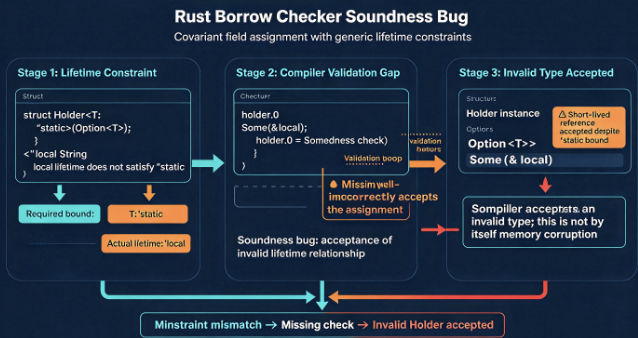
At first glance, this program looks unremarkable. It creates a local string, initializes a generic container with Hiçbiri, then assigns a reference to the string into the container’s optional field.
The problem lies in the constraint on Holder<T>. The type parameter T must satisfy 'static, but the assigned reference points to a local value that does not live for the entire program.
An implementation that correctly enforces the required lifetime relationship should reject this combination.
Instead, affected compiler versions accept the program. Through the interaction of type inference and field assignment, the compiler permits a container whose inferred type does not satisfy the constraint imposed by its own declaration.
This small example does not itself demonstrate a memory corruption event because its destructor performs no operation on the stored reference. Its importance is that it reveals the invalid type relationship before any deliberately dangerous behavior has been introduced.
The distinction between accepting an invalid type and actually triggering undefined behavior is important for analyzing the security implications. A compiler soundness defect can remain invisible for years if ordinary programs never combine the invalid state with an operation that exposes the underlying contradiction.
Developers can inspect the original minimal example and the surrounding technical discussion in rust-lang/rust #164250.
How Covariant Field Assignment Breaks Lifetime Requirements
Understanding the root cause requires examining three concepts that are frequently encountered in advanced Rust programming: variance, generic type well-formedness, and type inference.
Variance determines how relationships between types are preserved when those types appear inside larger structures.
For example, a reference with a longer lifetime can safely be used where a shorter-lived reference is expected. If a function only needs a reference for a few instructions, providing one that remains valid for the rest of the program does not create a problem.
The reverse is not generally safe. A reference to a local variable cannot become a genuine 'static reference merely because the program would find that conversion convenient.
Rust’s type system supports these distinctions through subtyping and variance. The official Rustonomicon chapter on subtyping and variance describes how covariant, contravariant, and invariant positions affect valid lifetime relationships.
In the reported bug, covariance interacts with assignment to a field inside a generic structure. The structure is initially created with an unspecified type parameter, and the subsequent assignment helps determine the concrete type to be used.
The critical failure is that the resulting inferred type can violate the original type parameter’s lifetime requirement without being rejected.
For the simplified container:
struct Holder<T: 'static>(Option<T>);the T: 'static restriction is supposed to hold whenever Holder<T> is treated as a valid type.
But when a local reference is assigned into holder.0, the compiler can effectively end up treating a type involving &'local String as a valid instantiation of Holder<T>, despite the unsatisfied 'static requirement.
The issue is not that covariance itself is unsafe. Covariance is an intentional and necessary feature of the Rust type system. The problem is that the compiler has failed to enforce all of the conditions that must accompany its use.
A well-formed type must satisfy the constraints on its generic parameters. These conditions are normally checked before the compiler relies on them when verifying other operations.
Once an invalid type is admitted, later stages may use assumptions that are only justified for well-formed types. The destructor can be checked under a valid-looking 'static bound, even though the actual stored reference was obtained from a shorter-lived value.
This creates a gap between what the compiler has proven and what the generated program actually contains.
The direction of the proposed fix is revealing. PR #164277, titled require MIR local types to be well-formed, introduces additional checking of type well-formedness obligations during borrow checking. That reinforces the interpretation that missing constraint validation, rather than a deliberate change in lifetime semantics, is central to the reported failure.
The precise final scope of the defect may evolve during review, particularly because contributors also demonstrated related type-unification behavior outside the original field-assignment pattern.
From a Lifetime Bug to Use-After-Scope
A compiler accepting an invalid lifetime relationship is already a significant correctness problem. The security implications become clearer when an application uses that relationship to retain a reference beyond its valid lifetime.
Rust’s Drop trait allows a type to execute custom code when an instance is destroyed. This mechanism is widely used for releasing resources, closing files, unlocking synchronization primitives, and performing cleanup operations.
In a correctly enforced lifetime model, the destructor should not be able to convert a reference to a short-lived local value into one that can safely be accessed after the value is destroyed.
The reported compiler bug makes that assumption unreliable in the affected pattern.
The following demonstration is adapted from the official report. It shows how the missing lifetime constraint can allow a reference to escape its valid scope:
#![forbid(unsafe_code)]

use std::any::Any;
use std::sync::Mutex;

static RETAINED: Mutex<Vec<Box<dyn Any + Send>>> =
    Mutex::new(Vec::new());

struct Holder<T: Send + 'static>(Option<T>);

impl<T: Send + 'static> Drop for Holder<T> {
    fn drop(&mut self) {
        if let Some(value) = self.0.take() {
            RETAINED.lock().unwrap().push(Box::new(value));
        }
    }
}

fn main() {
    {
        let local = String::from(
            "This is a locally owned string"
        );

        let mut holder = Holder(None);
        holder.0 = Some(&local);
    }

    let retained = RETAINED.lock().unwrap();

    let reference = retained[0]
        .downcast_ref::<&'static String>()
        .unwrap();

    println!("{}", reference);
}
This is a demonstration of undefined behavior, not code intended for production use. Its purpose is to expose the underlying lifetime violation.
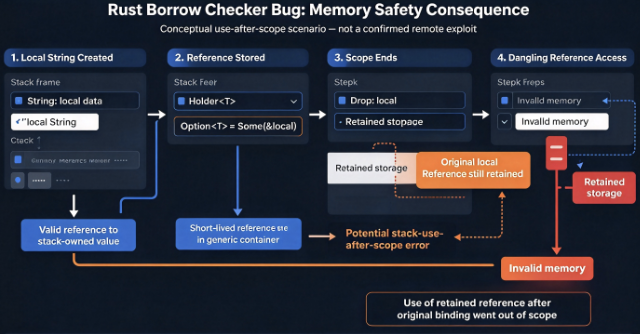
The program creates a local String and stores a reference inside Holder. During destruction, the custom Drop implementation moves the stored value into a global collection that expects its contents to satisfy 'static.
The reference is therefore retained after the original local string has been destroyed.
When the program later retrieves the reference from the global collection and attempts to print it, it can access memory belonging to an object whose lifetime has ended.
The entire example prohibits explicit unsafe code through #![forbid(unsafe_code)]. This makes the demonstration especially significant: the problematic behavior does not depend on an unsafe block written by the application developer.
In the original proof of concept, the reporter observed that the program could print replacement data placed in memory previously occupied by the original object. AddressSanitizer also identified a stack-use-after-scope violation.
That finding is stronger evidence than a program merely crashing. A crash alone might be caused by many unrelated programming mistakes. A memory sanitizer identifying invalid access after an object’s lifetime has ended directly supports the conclusion that the compiler accepted an unsound lifetime relationship.
The precise runtime symptom is not guaranteed to be identical across systems, optimization levels, and compiler versions. Undefined behavior can result in corrupted output, a sanitizer error, a process crash, or apparently normal execution.
An apparently successful run is therefore not evidence that the program is safe.
Why the Drop Implementation Matters
The role of Drop deserves particular attention because it helps explain both the technical severity of the bug and why Rust maintainers have not treated it as evidence of widespread exploitation.
A destructor receives access to an instance that is about to be destroyed. Its implementation may read fields, transfer owned resources, or interact with external state, subject to the language’s usual safety restrictions.
Rust has dedicated rules for destructor safety because destruction happens at the boundary of an object’s lifetime. If a generic destructor could freely access values that were already invalid, ordinary resource cleanup would become a source of memory unsafety.
Bu Rustonomicon’s discussion of drop checking explains why generic types and destructor behavior require careful lifetime validation.
In the current case, the custom destructor becomes the mechanism through which an invalid reference escapes. The generic constraint tells the compiler that the retained value can safely be treated as 'static, while the original assignment has supplied something that does not meet that requirement.
Without the missed constraint, the compiler would prevent the inconsistent state from being created.
This also explains why the Rust Types Team considers accidental exploitation unlikely. Most applications do not deliberately construct a generic destructor that moves apparently static references into globally retained type-erased storage.
However, low likelihood is not the same as impossibility. A security analysis must consider that library abstractions can be complex, and combinations of generic types, custom destructors, and lifetime inference may be difficult for application developers to audit manually.
The currently demonstrated behavior warrants fixing even if no widely used library is known to trigger it.
Is This a Rust Compiler Bug or a Fundamental Type System Flaw?
The distinction matters because it determines whether the solution requires changing Rust’s language model or correcting the compiler’s implementation.
A fundamental type system design flaw would mean that the language’s intended rules permit a program that should not be considered safe. Repairing that kind of problem may require changing the language specification, restricting existing features, or introducing compatibility-breaking semantic changes.
A compiler implementation bug is different. In that case, the intended rules already prohibit the unsafe behavior, but the implementation fails to enforce them correctly.
The evidence surrounding issue #164250 points toward a failure of compiler constraint checking. The relevant generic lifetime bound is present, and the compiler is expected to preserve it. The proposed repair focuses on verifying type well-formedness in MIR, Rust’s Mid-level Intermediate Representation.
This distinction also appeared in the Hacker News discussion, where developers debated whether the discovery undermines Rust’s safety claims or illustrates an implementation defect that can be repaired without abandoning the ownership model.
The more useful engineering conclusion is that sound language rules and a sound implementation are related but separate requirements.
A programming language can have a rigorous safety model and still contain implementation defects. Conversely, finding a compiler bug does not demonstrate that the underlying safety model is ineffective.
Rust has eliminated broad categories of common memory errors by imposing ownership and borrowing requirements. The existence of a rare soundness hole does not erase those protections, but it does show that the implementation must be continuously tested against the guarantees it is supposed to provide.
How Old Is the Rust Borrow Checker Vulnerability?
The description of the issue as an 11-year-old bug reflects evidence that related reproductions have been accepted by Rust compilers dating back to the language’s early stable releases.
Rust 1.0 was released on May 15, 2015, as documented in the official Rust 1.0 announcement.
During the October 13, 2026 investigation, one contributor reported that a simplified version of the lifetime issue compiled successfully as far back as Rust 1.18. Another contributor demonstrated a related variant that could produce a segmentation fault or print freed memory on Rust 1.4. The original reporter independently confirmed the behavior on stable versions at least as old as 1.85.0 and on a contemporary nightly compiler.
These observations strongly suggest that the underlying problem predates recent Rust compiler changes.
They do not yet constitute a complete release-by-release analysis. In particular, the precise minimum affected version for every known reproduction and whether all variants share an identical root cause remain questions for the upstream investigation.
The age of the bug nevertheless carries an important lesson. A security defect can survive many years of development, testing, compiler improvements, and widespread production use if its triggering conditions are sufficiently unusual.
It also illustrates why regression testing and compiler fuzzing remain valuable even for mature languages with strong static guarantees.
Which Rust Versions Are Affected?
As of October 14, 2026, no authoritative fixed-version boundary has been published for this issue.
The report establishes that the problem affects more than a single experimental nightly build. Its existence in stable Rust versions means that simply avoiding nightly features is not a complete mitigation.
It would also be misleading to claim that every Rust release from 1.4 onward is affected by every demonstrated variant. The community’s historical reproductions provide evidence of long-standing behavior, but a comprehensive affected-version matrix requires additional testing.
For developers, the distinction between the compiler version and the application’s runtime environment is especially important.
Rust performs borrow checking during compilation. The defect is therefore associated with how source code is accepted and translated, rather than with a dynamically loaded runtime component that can always be replaced independently.
Applications compiled with a compiler that accepts the invalid pattern may contain code capable of triggering undefined behavior. Updating the Rust toolchain does not automatically rewrite binaries that have already been distributed.
After a verified correction becomes available, projects that may contain the relevant pattern should be rebuilt and retested using a fixed toolchain.
That does not mean every existing Rust binary must immediately be treated as compromised. The practical urgency depends on whether a project contains the triggering construction and whether the invalid reference can actually be used after its lifetime ends.
The official Rust issue tracker remains the best source for confirmed affected versions and eventual release information.
Does the Rust Borrow Checker Bug Allow Remote Code Execution?
A memory safety violation can sometimes become the foundation of a remote code execution vulnerability, but the existence of undefined behavior does not automatically establish an exploitable RCE path.
The demonstrated Rust defect can create dangling references and invalid memory accesses. Those conditions are potentially serious because undefined behavior removes the assumptions that normally allow developers to reason reliably about execution.
However, turning a compiler soundness bug into a practical security exploit generally requires more than proving that the compiler accepts invalid code.
An attacker would need an application or component that contains a relevant vulnerable construction, a way to reach that behavior, and an execution environment in which the resulting memory corruption can be shaped into a useful security consequence.
The published proof of concept intentionally creates the problematic lifetime relationship and retains the reference. It does not show a remote attacker sending ordinary network input to an arbitrary Rust service and gaining code execution.
Nor does the upstream report identify a widely deployed Rust application that has been compromised through this mechanism.
There is also an important distinction between malicious source code and exploitation of a deployed application. A dependency author who can already introduce arbitrary application code may have numerous ways to create dangerous behavior. The more significant question is whether a compiler defect can unexpectedly invalidate the safety assumptions of otherwise well-designed application or library code.
Until such an application-level exploitation chain is demonstrated, describing issue #164250 as an actively exploited Rust RCE would overstate the available evidence.
A more accurate classification is a confirmed compiler soundness defect with demonstrated memory safety consequences and an application-dependent exploitation potential.
How to Detect and Verify the Rust Borrow Checker Bug
The most direct way to verify the issue is to reproduce the reported program in a controlled environment and observe whether the compiler accepts it.
A simple toolchain inventory can begin with:
rustc --version
cargo --version
rustup show
These commands identify the installed compiler and active toolchain. They do not determine whether an application contains the vulnerable code pattern, but they provide the version context necessary for subsequent testing.
For a minimal reproduction, place the earlier Holder<T> example in a file and compile it:
rustc --edition 2021 borrowck_repro.rsThe relevant observation is whether the compiler accepts a generic type construction that should violate the 'static requirement.
A successful compilation of the minimal program is evidence of the incorrect acceptance behavior, not proof that the program has performed an invalid memory access.
To investigate the runtime consequence, developers can use the memory-access proof of concept from the original issue alongside instrumentation.
AddressSanitizer
AddressSanitizer is designed to detect memory errors such as use-after-free, out-of-bounds accesses, and use-after-scope.
Rust documents sanitizer integration in the Unstable Book. Sanitizer support uses nightly compiler options, and the required target and standard-library build configuration depend on the testing environment.
For a supported Linux target, a Cargo project can be instrumented using a command such as:
RUSTFLAGS="-Zsanitizer=address" \
cargo +nightly test -Zbuild-std \
  --target x86_64-unknown-linux-gnu
Developers should ensure the required nightly toolchain, target, and rust-src component are installed before running such tests.
In the original issue, AddressSanitizer identified the reported invalid stack access. That provides a concrete confirmation of memory unsafety in the demonstrated execution.
Sanitizer results must still be interpreted carefully. A detector can only observe behavior reached during execution, and an invalid program may behave differently across compiler options or environments.
Miri
Miri provides another way to investigate undefined behavior in Rust programs. It interprets Rust code and can identify classes of memory errors that may otherwise remain difficult to observe.
The official Miri documentation describes running tests and applications through the interpreter.
For a project compatible with Miri, a typical workflow is:
rustup +nightly component add miri

cargo +nightly miri test
Miri is especially useful when evaluating small, controlled reproductions and library code containing complex reference relationships.
However, it is not a complete soundness verifier. Passing Miri does not prove that every possible program execution is free of undefined behavior, nor does it establish that the compiler correctly enforces every type-system requirement.
A robust investigation combines compiler-version testing, minimal reproductions, sanitizer instrumentation, and inspection of the relevant lifetime relationships.
Most importantly, developers should avoid treating a successful compilation as sufficient evidence that the problematic generic construction is valid.
How to Assess Exposure in Real Rust Applications
The practical challenge for engineering teams is that this defect does not currently come with a simple vulnerability fingerprint that can be matched against a package name or version in every application.
Unlike a vulnerability confined to a particular external library, a compiler soundness issue concerns the behavior of the language implementation itself.
A dependency inventory is still useful, but it cannot establish the absence of this defect solely by checking published package advisories.
The most relevant initial review targets are advanced generic abstractions that combine lifetime bounds, type inference, optional or replaceable fields, and custom destructor implementations.
A codebase containing Drop implementations that transfer references or other borrowed values into longer-lived storage deserves closer inspection. This is not because every such destructor is unsafe, but because it is closer to the construction demonstrated by the upstream proof of concept.
Particular care is warranted where values are stored behind type-erased interfaces such as dyn Any, or where generic constraints are being relied upon to establish that a retained value can safely outlive its original context.
For example, an application that deliberately stores values satisfying T: 'static in a shared registry normally relies on Rust’s type system to ensure that these values do not contain invalid short-lived references. The reported defect demonstrates a path by which that type-level expectation can be violated.
At the same time, developers should not respond by assuming that ordinary generic containers, every use of Option<T>, or all implementations of Drop are inherently vulnerable.
A useful review focuses on the interaction between these features and on whether references can escape the scope of their owners.
Security-sensitive libraries may also benefit from temporary regression tests that exercise relevant lifetime constraints across toolchain versions. Once the upstream fix is merged, these tests can establish that the same invalid constructions are rejected by the corrected compiler.
Rust Borrow Checker Bug Fix Status and Latest Updates
Last verified: October 14, 2026
Work on a correction began rapidly after the original issue was reported.
On October 13, 2026, contributor Li-Zheng-Rong opened pull request #164277, titled require MIR local types to be well-formed. The proposal aims to ensure that certain types encountered during MIR borrow checking satisfy the well-formedness obligations required by their definitions.
This is an important part of the compiler’s safety model. A generic type cannot be considered valid simply because its structural components can be inferred or unified. The constraints declared on that type must remain satisfied throughout the relevant type-checking process.
The proposed patch introduces additional proof obligations using Rust compiler machinery associated with WellFormed predicates.
During review, a contributor also raised the question of whether comparable checks would be necessary for casts and user type ascriptions. This shows that the review is examining the completeness of the correction rather than merely making the original proof of concept fail.
By October 14, the PR had been assigned to a member of the Rust Types Team and remained open with a waiting-for-review status.
The existence of this PR should not be confused with the release of an official fix. A proposed patch can be revised, replaced, or extended before maintainers merge it, and a merged compiler change must still reach an appropriate toolchain release before it can serve as a broadly available mitigation.
The current progression is:
| Date | Development | Durum |
|---|---|---|
| October 13, 2026 | Compiler unsoundness reported as issue #164250 | Confirmed |
| October 13, 2026 | Additional reproductions and historical version evidence discussed | Confirmed |
| October 13, 2026 | Fix proposal #164277 opened | Confirmed |
| October 14, 2026 | Proposal under Rust compiler/type-system review | In progress |
| Future update | Fix merged into Rust compiler | Not confirmed |
| Future update | Fixed toolchain version identified | Not confirmed |
| Future update | Official impact and regression guidance published | Not confirmed |
This section should be revisited when the upstream issue or repair proposal changes.
What Developers Should Do Before an Official Fix
For most Rust application teams, the appropriate response is targeted investigation rather than an emergency rewrite.
The first priority is to understand whether the codebase contains structures resembling the reported lifetime-bypass pattern. A project that does not use the relevant combination of generic lifetime constraints, inferred field assignments, and destructor behavior is not automatically exposed simply because it was compiled using an affected Rust toolchain.
Teams maintaining security-critical libraries should pay particular attention to type-level guarantees that depend on 'static or other outlives requirements. If such guarantees are used to justify retaining references beyond their original scope, the relevant constructions deserve closer testing.
It may be possible to avoid a particular triggering pattern by making lifetime relationships explicit or restructuring the code so that a short-lived reference cannot enter the generic container. For example, explicitly declaring a required &'static String type should cause an ordinary short-lived reference assignment to be rejected:
struct Holder<T: 'static>(Option<T>);

impl<T: 'static> Drop for Holder<T> {
    fn drop(&mut self) {}
}

fn main() {
    let local = String::from("hello");

    let mut holder: Holder<&'static String> =
        Holder(None);

    holder.0 = Some(&local);
}
In this version, the assignment attempts to place a non-static reference into a field with an explicit static-reference type. The compiler should reject that operation.
This is an illustration of making a lifetime obligation visible, not a general-purpose fix for the underlying compiler defect. Adding explicit annotations cannot be assumed to eliminate every possible unsound construction, especially given the related type-unification examples under investigation.
Until an official fix is released, maintaining appropriate test coverage and avoiding known triggering constructions are more defensible measures than relying on an unreviewed patch.
When maintainers eventually publish a corrected Rust toolchain, projects that rely on affected generic abstractions should rebuild, run their normal test suites, and include memory-safety tests where practical.
Any compiler change that strengthens type checking may also reject source code that compiled previously. Such failures should be investigated rather than bypassed automatically, because previously accepted code may have depended on an invalid lifetime relationship.
Is the New Polonius Borrow Checker Related?
The discovery arrives during a period of significant work on Rust’s borrow-checking architecture.
In August 2026, the Rust project announced that the next iteration of the borrow checker, known as Polonius Alpha, was being enabled on nightly builds for testing before stabilization.
Bu official Rust announcement describes Polonius Alpha as an evolution of the existing non-lexical lifetimes borrow checker, with more precise flow-sensitive handling of lifetime outlives relationships. The goal is to accept valid programs that the current analysis rejects unnecessarily, while preserving Rust’s safety guarantees.
It would be tempting to connect every recent borrow checker bug directly to the Polonius rollout, but the evidence does not support that conclusion for issue #164250.
The reported problem reproduces on stable Rust releases predating the 2026 nightly rollout. Its historical behavior means it cannot simply be described as a newly introduced Polonius Alpha regression.
Other Rust issues involving Polonius have been reported separately, and those should not be conflated with this specific defect.
Nevertheless, the broader architectural work is relevant. Changes to lifetime analysis and type checking create opportunities to strengthen compiler invariants, introduce better regression testing, and identify previously overlooked assumptions.
The challenge is ensuring that more permissive analyses accept additional valid programs without accidentally accepting invalid ones.
Rust Project Zero and the Future of Compiler Soundness
The current bug is part of a broader class of problems that the Rust project has already identified as important.
Rust’s Project Zero roadmap sets out the goal of eliminating known type-system soundness bugs so that safe Rust can reliably avoid undefined behavior.
The roadmap recognizes that some existing soundness defects are relatively obscure and unlikely to affect normal applications. However, it also argues that leaving them unresolved undermines the language’s core safety guarantees and creates a potential foundation for future exploitation.
This is not a response invented after the October 2026 discovery. Project Zero was already part of Rust’s planned compiler-safety work.
Several related initiatives seek to improve the underlying foundations of type checking. These include the next-generation trait solver, improvements to region constraints, and efforts to make well-formedness and implied-bound reasoning more consistent.
The new trait solver is particularly relevant because it changes how the compiler determines whether types satisfy trait requirements and other constraints. Rust’s August 21, 2026 announcement describes the implementation as a substantial replacement of existing compiler infrastructure, intended in part to unblock fixes for known soundness issues.
The significance of these efforts extends beyond any single bug. Compiler soundness depends on thousands of interactions between language features, and local checks are not sufficient if one stage of the compiler assumes properties that another stage has failed to establish.
A sustainable solution therefore requires both fixing individual defects and strengthening the architecture that prevents similar mistakes.
Why This Bug Matters for Compiler Security Research
The Rust borrow checker finding also highlights an increasingly interesting area of vulnerability research: attacking the assumptions made by compilers rather than looking exclusively for mistakes in application code.
Traditional application security testing often focuses on input validation, memory corruption in native libraries, authentication bypasses, and unsafe API usage. Those areas remain important, but a compiler soundness issue can invalidate properties that downstream applications expect the language implementation to guarantee.
A useful research question is whether a compiler accepts a program that violates a type invariant and whether that violation can be converted into observable undefined behavior.
The investigation of issue #164250 offers an unusually clear example. Researchers begin with an invalid lifetime relationship, minimize the source code needed to make the compiler accept it, then construct a destructor that exposes the consequences.
The resulting memory error can be checked through sanitizers or other dynamic instrumentation.
This suggests several complementary research techniques. Compiler fuzzing can generate unusual combinations of generic types, lifetimes, and assignments. Differential testing can compare acceptance across compiler versions or configurations. Program reduction can transform large failing examples into minimal reproductions that reveal the underlying constraint violation.
Static inspection and execution-based tools can then help determine whether an accepted program is merely surprising or actually violates a required memory-safety invariant.
AI-assisted code generation may become useful in this workflow, particularly for exploring unusual type combinations and suggesting candidate reductions. However, generated test cases still require compilation, verification, and analysis before they can be treated as genuine compiler vulnerabilities.
The present issue should not be attributed to an AI vulnerability-discovery system without evidence establishing such an origin.
More importantly, the success of these methods should be judged by the number of independently verified, meaningful findings rather than the volume of generated bug reports.
For compiler maintainers, security researchers, and teams developing low-level software, the wider lesson is that memory safety assurance requires continued evaluation of the compiler itself.
Does This Mean Rust Is No Longer Memory-Safe?
The discovery does not justify abandoning Rust’s memory safety model, but it does demonstrate why guarantees must be understood in the context of real implementations.
Rust is designed so that safe code cannot cause undefined behavior when the compiler and the abstractions it depends on uphold their required invariants. The newly reported defect shows that the compiler can fail to enforce one of those invariants.
That is a meaningful limitation, not merely a theoretical objection.
At the same time, the existence of one obscure failure does not make ownership checking equivalent to manual memory management. Rust continues to prevent common classes of dangling references, double-free errors, invalid mutable aliasing, and related problems through compile-time restrictions.
The practical comparison is not between a perfect language and an imperfect one. It is between systems with different default protections, different failure modes, and different mechanisms for finding and correcting defects.
In C and C++, developers generally carry much more responsibility for maintaining memory validity manually. Rust automates substantial portions of that responsibility, reducing the set of mistakes that ordinary safe application code can express.
A compiler soundness vulnerability exposes a weakness in this automated enforcement. Correcting it strengthens the value of the language’s existing protections.
The Rust project’s response is therefore as important as the original discovery. Public reproductions, explicit prioritization, review of the compiler’s invariant checking, and regression tests are all necessary parts of maintaining confidence in a safety-oriented language.
Frequently Asked Questions About the Rust Borrow Checker Bug
What is the Rust borrow checker bug discovered in October 2026?
It is a compiler soundness issue tracked as rust-lang/rust #164250. The compiler can accept certain generic lifetime relationships that violate required type constraints, allowing short-lived references to be treated as if they satisfy longer-lived requirements. A specially constructed destructor can expose the defect by retaining a reference after its valid lifetime has ended.
Can safe Rust code cause undefined behavior because of this bug?
Yes. The published reproductions demonstrate that code without explicit güvensiz operations can be accepted by affected compilers and subsequently trigger undefined behavior. This is precisely why the issue is classified as an unsoundness defect rather than an ordinary application logic error.
How long has the Rust borrow checker bug existed?
Investigators reported related reproductions working on Rust versions as old as 1.4, released in 2015. This supports the description of an approximately 11-year-old problem. The complete historical scope and earliest affected version for every variant have not yet been formally established.
Is the Rust borrow checker vulnerability being exploited in the wild?
There is no confirmed real-world exploitation in the upstream material reviewed as of October 14, 2026. The public evidence establishes compiler acceptance of invalid lifetime relationships and memory unsafety in deliberate proofs of concept, not a documented attack campaign against deployed Rust applications.
Is there a CVE for Rust issue #164250?
The original upstream issue does not identify a CVE at the time of this article’s publication. The issue number 164250 is a GitHub tracking identifier, not a CVE. Any later assignment should be verified through an authoritative vulnerability record before being added to the article.
Has the Rust borrow checker bug been fixed?
Not in a confirmed official release as of October 14, 2026. The proposed correction in PR #164277 remains under review. Developers should verify the PR’s eventual merge status and corresponding fixed Rust release rather than assuming the existence of a pull request means a patch is already available.
Should developers stop using Rust?
The available evidence does not support that conclusion. Rust continues to offer meaningful memory-safety protections, and the demonstrated flaw appears to require unusually specific circumstances. Developers should follow the upstream investigation, avoid identified triggering patterns, and adopt a verified compiler fix when one becomes available.
Can Rust’s Miri tool detect this vulnerability?
Miri can detect many forms of undefined behavior, including invalid memory accesses, in programs it executes. It can therefore help investigate reproductions of this issue. However, it cannot prove that arbitrary Rust code is completely sound, and the absence of a reported error does not establish that the compiler has enforced every required lifetime invariant.
Will upgrading Rust automatically fix applications compiled with vulnerable versions?
A future verified compiler fix should prevent relevant invalid source patterns from compiling, but upgrading the toolchain does not retroactively change distributed binaries. Applications suspected of containing affected constructions need to be reviewed, rebuilt, and tested using a corrected compiler.
Sonuç
The Rust borrow checker bug disclosed in October 2026 is significant precisely because it challenges an assumption that developers normally do not need to question: when Rust accepts safe code, its lifetime rules should prevent dangling references from being used.
Issue #164250 demonstrates that this assumption can fail under a particular combination of generic type constraints, covariance, field assignment, and destructor behavior. The resulting program can cause undefined behavior without explicit unsafe code, exposing a real compiler soundness defect that appears to have existed since Rust’s early releases.
At the same time, the currently available evidence does not establish widespread exploitation, a confirmed remote code execution campaign, or a general failure of Rust’s ownership model. The problem is serious because it violates the intended guarantees of the language, not because every Rust application is suddenly known to be exploitable.
The proposed well-formedness checks in PR #164277 provide a concrete direction for remediation, while Rust’s broader Project Zero initiative offers a longer-term approach to eliminating known soundness defects.
For developers, the immediate priority is to understand the triggering pattern, review unusually complex lifetime-dependent abstractions where appropriate, and follow the upstream fix through review and release.
For the wider security community, the incident is a reminder that compiler correctness is part of the software supply chain’s security foundation. Strong language-level protections can eliminate large categories of mistakes, but those protections remain dependent on a compiler that enforces its own rules correctly.
The most important next development will be a reviewed, merged, and released correction that closes the reported lifetime-validation gap without introducing new unsoundness or unexpected compatibility problems.
Until that happens, the Rust issue tracker ve associated fix proposal should remain the authoritative sources for the latest technical status.


 Turkish
  English
  German
  French
  Spanish
  Portuguese
  Japanese
  Korean
  Hindi
Hindi  Arabic
  Hebrew