
CVE-2026-114713 is an UnrealIRCd command-injection vulnerability at the boundary between client-supplied message metadata and trusted server traffic. The published CVE description identifies the labeled-response module in UnrealIRCd 6.0.0 before 6.2.7.1 and a network with at least two linked servers. A normal user’s correlation label can cross into server-command authority. That description does not establish arbitrary operating-system shell execution.
The practical response is a network-wide correction with runtime evidence. One updated hub, one successful maintenance command, or one version banner cannot establish the state of every linked node. Administrators also need a separate investigation into whether privileged IRC actions occurred during the exposure window. The deployment task and the incident task answer different questions, even when the same people own both.
The maintainer’s November 7 security announcement reports exploitation and offers a hot-patch or an upgrade. This assessment uses primary sources checked November 14, 2026. It supplies a proposed operational method and an in-memory educational example; it does not report testing a live IRC network.
Severity, exploitation and response priority
The CVE record and its CISA enrichment show a CVSS 3.1 score of 8.6, classified High, and a November 13 addition to CISA’s Known Exploited Vulnerabilities catalog. The project describes the issue as critical. Preserve both attributions rather than silently replacing one classification with the other. The record’s integrity-focused score is also not a complete description of every operational consequence for a particular network.
CISA’s enrichment establishes the catalog-addition fact used for priority here. Remediation requirements belong in a separate applicability decision: the network owner should consult the current government entry and determine which guidance applies to the organization. Keep that decision tied to the current source rather than copying an unverified deadline into a maintenance plan. The source snapshot, the local deployment state and any formal obligation each deserve their own dated record.
Known exploitation changes scheduling. It does not prove that a given channel, server, or user was affected. Start urgent remediation while gathering local evidence, and avoid sending an incident notice that claims confirmed compromise solely because a public catalog lists the CVE. Conversely, a quiet local alert console should not turn the exploitation signal into a low-priority maintenance ticket.
Separate four fields in the response record: vendor severity, standardized score, public exploitation evidence, and local incident assessment. This prevents a reviewer from treating “High” as a reason to defer action or “critical” as proof of a particular damage scenario. Each field has an authority and a distinct purpose.
For a community network, malicious administrative actions can undermine confidence even if no host compromise is established. For a business-operated network, consider dependencies such as support channels, automation and operational coordination. Describe those dependencies as locally assessed business impact. Do not attribute a customer outage, stolen data, or an operating-system intrusion to this CVE without evidence.
Give the coordinator a node-level queue with owners and deadlines. Independently operated servers will produce evidence at different times and through different methods; the coordinator’s job is to reconcile those observations and expose the missing ones. An operator-channel announcement can start the response, while the queue establishes who has actually answered. Conflicting module results and unavailable owners should remain visible until a qualified operator resolves them.
Why a response label can become an authority problem
The IRCv3 labeled-response specification uses a client-chosen opaque identifier to correlate replies with a request and limits the value to 64 bytes. Its legitimate purpose is association: a client can recognize which response belongs to which action. That purpose gives the identifier no right to change who issued a command or which privileges apply.
Serialization is the security boundary. A parsed string can be harmless while held as data and dangerous when placed into another protocol context. The receiving component interprets a sequence according to its own framing rules. A sender that copies a value without preserving its data-only meaning can accidentally create syntax where the application intended metadata.
The IRCv3 message-tag specification defines escaping for tag values and distinguishes client-only tags from tags carrying verified meaning. That distinction illustrates why a value’s origin and authority must survive every transformation. Parsing a value once does not make it trusted for every later use.
For this CVE, the confirmed mechanism is the unescaped label described in the record. A useful defensive model is a sequence of client input, reply construction, transport across a trusted link and interpretation by a peer. The model explains what must remain invariant. It is not a claim that every message follows the same internal route, and it does not supply the bytes required to exploit a real server.
A linked peer may legitimately accept commands from another server that it would reject from a normal client. If untrusted metadata becomes part of that trusted command stream, the receiving peer can apply the wrong authority. The security property is therefore larger than “reject unusual characters.” The system must preserve the separation between the principal that supplied a value and the principal authorized to perform an operation.
Transport encryption does not repair that semantic error. A protected server link can faithfully carry incorrectly constructed application data. Likewise, a firewall rule can reduce reachability while leaving the vulnerable transformation unchanged. Those controls can support a response, but their existence is not evidence that the labeled-response implementation has been corrected.
This also explains why command-injection terminology needs context. IRC command authority and operating-system command execution are different claims. An assessment should name the interpreter and the authority crossed. If an investigation later finds an independent host compromise, document the additional evidence and the relationship rather than expanding the CVE description retrospectively.
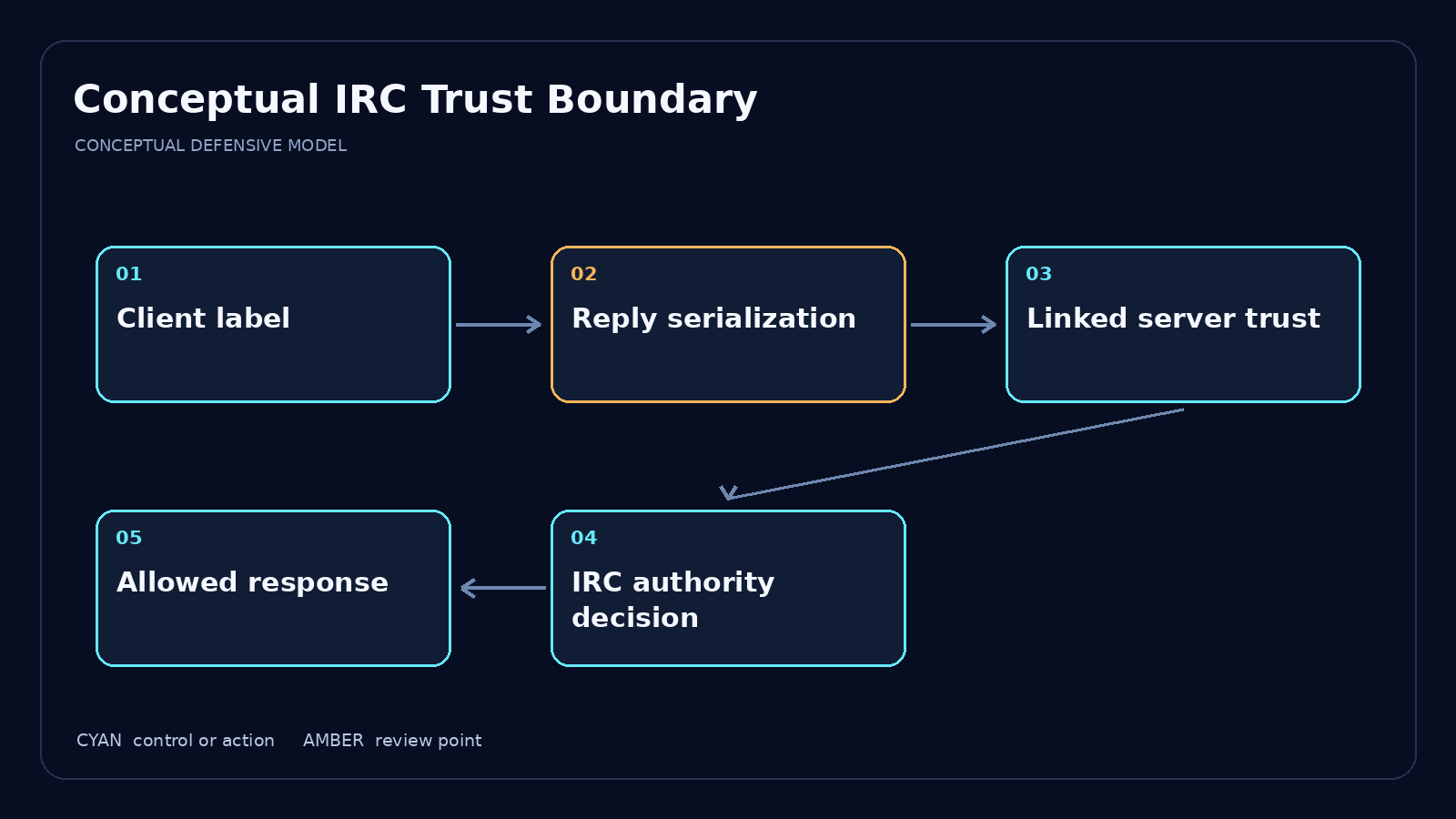
The node and trust inventory
Begin with a node register containing the server identity, operator, deployed release, active module state, linked peers, exposure and maintenance contact. Distinguish authoritative observations from names copied out of an old diagram. A disconnected backup, a private hub and an experimental node can still matter if they may join the production network.
Record the observation method and time for each node. A release recorded at the beginning of a maintenance window may no longer describe the process running at the end. A screenshot from another host is not transferable evidence, even when the hosts were built from the same image. Use stable asset identifiers so that renamed servers do not disappear from the accounting.
Map trust relationships separately from client entry points. A public leaf can be the place where an ordinary user connects, while a hub participates in server-authority decisions. The owner of a hub may not control the leaf’s maintenance. The response needs both an ingress view and a link view to avoid declaring the network complete after correcting only its most visible address.
| Inventory item | Evidence to retain | Decision it supports |
|---|---|---|
| Active server | Owner, identity and observed release | Applicable correction route |
| Runtime module | Dated active status | Whether corrected code is loaded |
| Linked peers | Confirmed adjacency and responsible owner | Network coverage |
| Standby node | Join policy and maintenance state | Safe future reconnection |
| Unknown or unreachable node | Last evidence and next contact | An explicit unresolved exception |
| End-of-life installation | Product branch and migration owner | Supported replacement planning |
An unknown node should have a status, not an optimistic default. “Owner not yet reached” and “verified corrected” cannot share the same color on a dashboard. Record what prevents verification and who can resolve it. If an operator cannot provide reliable evidence, consider the operational consequences of restricting that node’s participation through the network’s approved change process.
Include administrative tooling in the register without assuming that it is vulnerable. Bots, services and monitoring clients may depend on response behavior or operator commands. Their owners should help define ordinary workflow tests after remediation. The goal is to identify dependencies that must continue to function, not to create speculative findings against every component attached to IRC.
Treat credentials and network configuration as sensitive operational data. A shared response worksheet needs enough information to identify owners and evidence, but it does not need passwords, complete user lists or private channel transcripts. Keep the detailed topology and raw logs in an approved location and publish only the minimum conclusions required by the audience.
Selecting a supported correction route
The project advisory identifies 6.2.7.1 as a corrected release and supplies bundle-20261107 for the supported six-series hot-patch route. Windows administrators are directed to the upgrade route. The announcement also describes a temporary filter whose protection depends on every linked server being at least 6.0.4; that measure does not address the other issues in the release.
Use those vendor choices as inputs to a local change decision. Do not select hot-patching only because it sounds convenient. Establish whether the source tree, toolchain, configuration and running installation correspond to the supported procedure. A full upgrade may be the clearer route when that relationship cannot be established confidently.
The temporary control should have a named owner, activation evidence and an expiry condition. A workaround that remains in a chat message without a recorded deployment state is difficult to review. Give it a concrete exit: the supported correction is active on every in-scope node and the normal-function checks have passed. Until then, describe the remaining exposure accurately.
For an upgrade, prepare the supported package, verify its provenance and plan the restart with the operator. Preserve configuration and required operational data through the owner’s normal backup process. Restoration planning must not become permission to deploy an arbitrary older build that reintroduces the exposure.
For hot-patching, identify who can interpret the output and inspect runtime status. The success of a build or copy operation is not the final acceptance condition. If the operator sees an error they do not understand, the next step is diagnosis or a supported upgrade, not repeatedly issuing commands until a reassuring line appears.
Avoid combining this emergency correction with unrelated configuration cleanup. A large change set makes failures harder to attribute and can consume the maintenance window before the security objective is reached. Record nonessential improvements separately. Make only the additional changes necessary to complete the correction safely and verify service.
A small pilot can expose deployment problems, but it does not justify leaving the remaining network in an indefinite intermediate state. Set the next batch, the expected evidence and a deadline appropriate to the active exploitation signal. A pilot is a learning step inside the response, not the completed response.
Prove that the corrected module is active
For a six-series installation within the advisory’s stated scope, the maintainer provides a local check:
./unrealircd module-statusInspect the labeled-response entry in that local output on an owned server. The CVE record identifies the corrected release, while the project announcement describes the hot-patch-specific status. Retain the relevant line, server identity and observation time rather than publishing the complete process output.
The advisory’s hot-patch marker is labeled-response 5.0-hot-patch-bundle-20261107. A fixed-release status of 6.2.7.1 is a different valid route. Plain 5.0 is not evidence of that hot-patch. For older supported circumstances where the local status method is unavailable or produces no output, follow the maintainer’s documented IRCOp verification method instead of interpreting absence as success.
The evidence should distinguish disk state, activation and process identity. A package manager can report a new file while a service uses another installation path. A compilation can succeed without the expected rehash. A technician can inspect a development tree while the production daemon runs elsewhere. These are ordinary deployment ambiguities that must be resolved before closure.
Keep the acceptance record brief but reproducible: which host, which running service, which correction route, which active status and which observer. If a reviewer cannot tell whether the observation belongs to the affected instance, the evidence is incomplete. Repeating the same unbound version string in several systems does not improve it.
A subsequent restart is an important persistence check when a hot-patch was used. The specific supported maintenance procedure determines how the correction survives service lifecycle changes. Record the expected post-restart state before a planned restart, then confirm it afterward. Do not assume a transient active result automatically describes a future process.
For distributed ownership, request the supported remote operator result together with the observed node identity and time. That gives the coordinator a reviewable handoff while leaving host authority with its responsible administrator. Public banner collection can help identify an inventory gap, but it cannot replace this runtime evidence. The acceptance method should use the authority and context operators already hold rather than expand into unrelated internet probing.
If evidence conflicts, keep the node unresolved. Examples include a corrected banner with an old module entry, a success transcript from a different host, or a later restart with no corresponding verification. Ask the owner to reconcile the discrepancy. A dashboard should show the uncertainty rather than choosing the more favorable signal.
Diagnose hot-patch failures without hiding them
The UnrealIRCd hot-patching FAQ describes missing source, mismatched source and running versions, compilation problems and failed rehashing. It specifically warns that an “already applied” message after an earlier compilation failure does not establish active correction. That warning is a useful operational distinction between modified source and corrected execution.
Capture the first meaningful error before retrying. A later command may produce a different message because an earlier stage partially completed. Without the original failure, a second operator can mistake the new output for proof that the entire operation succeeded. Preserve the sequence, then use the supported recovery path.
When the source tree is missing, do not download a random tree with a matching name and assume it is suitable for the running installation. Establish the exact supported relationship or choose the upgrade route. Source provenance and version alignment are part of maintenance correctness, especially when code is compiled and loaded into a live daemon.
A toolchain change deserves the same care. A distribution upgrade can alter compiler defaults and make a formerly working build process fail. Follow the project’s documented troubleshooting for the observed condition. Do not remove warnings indiscriminately, disable signature verification or apply unrelated build flags copied from a forum thread without understanding their applicability.
Configuration errors can prevent activation even when the corrected module was built. Fix the actual configuration problem through the normal review process and verify the resulting active state. The fact that a configuration problem predates the patch does not make the unactivated correction acceptable. It simply explains why the deployment task remains open.
Give troubleshooting a bounded decision point. If the operator cannot establish the active state within the approved window, move to an explicitly supported alternative or keep the node restricted according to the network’s operational policy. Unbounded trial and error on a live service can create more uncertainty than a planned restart.
Document the chosen recovery path, including why a hot-patch attempt was abandoned. That information matters to the next maintenance team. Without it, a future operator may repeat the same failing procedure or mistake a partially patched source tree for a supported baseline. The record should preserve operational knowledge without copying private configuration into public incident communications.
Coordinate a rolling change across independent operators
A linked network is often a shared operational system without a single deployment controller. Define a response lead, a node owner for every server and a communication channel that remains available if IRC itself becomes unreliable. The coordination plan should be usable during a netsplit, a service restart or a suspected operator-account compromise.
Before the first change, agree on the smallest acceptable service capacity and which nodes may be taken out of rotation together. This is a local availability decision, not a reason to leave a known exposure indefinitely. Owners need a common understanding of how to preserve essential operations while making verifiable progress.
Use a batch record with start time, responsible operator, expected correction and required checks. A batch ends when its nodes have a result, not when someone posts “done.” Results can include corrected, failed, unreachable and deliberately isolated. Keeping those states separate makes the remaining risk visible and prevents repeated work.
Test the communication handoff itself. The person who can approve a restart may differ from the person who can access the host or interpret module output. Establish those roles in advance. A plan that depends on a single unavailable volunteer can stall even when the technical steps are straightforward.
Plan for nodes reconnecting from an older state. A standby server, restored image or briefly offline peer can reintroduce an unverified component after the main maintenance window. Require a correction check before reconnecting such nodes to the trusted network. This is a proposed admission rule, not a claim about a default UnrealIRCd feature.
A correction queue should also include exceptions with operational consequences. If a node cannot be maintained because its platform is obsolete, record its migration owner and interim participation policy. Do not treat an owner’s promise to upgrade later as equivalent to current runtime evidence. An exception explains an unresolved condition; it does not make the condition safe.
At the end of each batch, reconcile the node register against the intended topology. A count of completed tasks is useful only if its denominator remains stable and complete. If an additional server is discovered, add it openly and reassess coverage. Accurate accounting is more valuable than preserving a previously reported completion percentage.
Use a toy model to separate data from authority
An educational example should make the security property visible without reproducing an IRC exploit. The following program has no sockets, server links, operating-system commands or production protocol parser. It models only a message containing a principal and a correlation label. The proposed boundary rejects inappropriate metadata while preserving the independently supplied principal.
The program uses a deliberately narrow label policy for its fictional application. That policy is not the IRCv3 grammar and must not be copied into an IRC implementation as a patch. Its purpose is to demonstrate that metadata validation and authority selection are separate decisions. A label accepted as data still cannot promote a client into a privileged principal.
from dataclasses import dataclass
import json

@dataclass(frozen=True)
class ToyReply:
    principal: str
    label: str
    result: str

def make_reply(principal, label):
    if principal not in {"client", "operator"}:
        raise ValueError("unknown principal")
    if not isinstance(label, str):
        raise ValueError("label must be text")
    if not 1 <= len(label) <= 24:
        raise ValueError("toy label length")
    if not all(ch.isascii() and
               (ch.isalnum() or ch in "-_") for ch in label):
        raise ValueError("toy label characters")
    return ToyReply(principal, label, "ready")

def serialize(reply):
    return json.dumps(reply.__dict__, sort_keys=True)

ordinary = make_reply("client", "request-7")
decoded = json.loads(serialize(ordinary))
assert decoded["principal"] == "client"
assert decoded["label"] == "request-7"

privileged_word = make_reply("client", "operator")
assert privileged_word.principal == "client"

for bad in ["", "x" * 25, "two words", "line\nbreak", "nonascii-é"]:
    try:
        make_reply("client", bad)
    except ValueError:
        pass
    else:
        raise AssertionError("invalid toy label accepted")

print("Toy metadata and authority checks passed.")
The second assertion is the important one. A client can choose a label that happens to spell “operator,” but the principal remains client. The label is not an authorization source. This is the same general design question a reviewer should ask at every application boundary: which input establishes authority, and can an unrelated field overwrite it?
The rejected examples exercise the fictional boundary without constructing a real injected command. They test empty values, size, character policy and framing-like input. A successful run says only that this toy code obeys its stated rules. It does not establish that UnrealIRCd is fixed, that the complete IRCv3 specification has been implemented or that any deployed module is safe.
If adapting the exercise for internal training, ask one person to define the property and another to review the result. The reviewer should inspect the principal after serialization rather than relying on the absence of an exception. A program can accept and emit a message successfully while silently changing its meaning. Observable output matters more than a reassuring completion message.
Keep production acceptance separate. The real deployment still requires vendor correction and active module evidence. An in-memory model is useful for explaining the boundary to developers, operators and incident responders. It is not a replacement for the maintainer’s supported maintenance process or a reason to run an untrusted exploit against a community network.
Design regression cases for the serialization boundary
A protocol maintainer needs a regression corpus that tests meaning across transformations, rather than a single string that stops reproducing an issue. Start by naming the input representation, the internal representation and the emitted representation. The same identifier should remain associated with the same request while remaining separate from command identity and authority.
For accepted values, compare the decoded output with the intended input value and verify that no unrelated message field changed. For rejected values, check the actual rejection behavior and whether any partial response was emitted. A test that merely catches an exception can miss output written before the exception. The expected result should cover the whole boundary, including error handling.
The message-tag specification is the authority for the actual wire encoding. A project’s tests should use its supported parser and serializer instead of a simplified approximation copied from a blog. The toy above deliberately avoids that implementation question. Its narrow policy makes one property easy to see, but production interoperability requires the real protocol rules.
Consider canonicalization explicitly. An application may validate one representation, decode it and later serialize it again. Reviewers should ask whether the validation applies to the representation that will actually reach the next parser. A value that passes an early check can still require context-specific handling at emission. Passing a parser is not the same as being safe in every output context.
Include boundary lengths as measured by the protocol, not only by a convenient programming-language string length. Multibyte text can make character counts and byte counts diverge. The labeled-response specification defines a byte limit, so maintainers should test the relevant encoded boundary rather than assuming a character-count assertion is equivalent.
A useful corpus also tests ordinary correlations concurrently. Two clients can issue unrelated requests, and one client can have multiple outstanding operations. Verify that a response remains associated with the appropriate request and recipient. A security correction that rejects dangerous syntax but misroutes legitimate results would still fail an important application requirement.
Test error and timeout behavior without manufacturing a production attack. In an isolated development environment, use approved fixtures to represent missing responses, partial completion and rejected metadata. Confirm that the system does not promote uncertain correlation data into trusted control information while recovering. Preserve the distinction between an incomplete response and an authenticated administrative instruction.
Finally, put the test beside the boundary it protects and explain the invariant in the test name or comments. A future refactor may replace a serializer, introduce a new message path or change module interactions. A regression case is more durable when another maintainer understands why it exists. The target is preservation of data meaning and principal identity, not memorization of one historical exploit.
Make partition and rejoin behavior part of acceptance
A linked network can change while maintenance is underway. A peer may disconnect, a route may change or an operator may restart a node after its initial verification. The acceptance plan needs a way to reconcile those changes with the coverage record. Otherwise, the record can be accurate at one moment and misleading at the moment service is declared restored.
Treat a partition as an observation about connectivity, not proof that every node on either side is corrected. Record which nodes were reachable from the checking operator and which were independently verified by another owner. A missing remote result can reflect topology or permission rather than absence of a module. Keep the reason for the missing result explicit.
When a peer returns, repeat the checks relevant to its changed state. If its process restarted, verify the active correction. If its configuration was restored, review the supported configuration and ordinary role behavior. If nothing except the link changed, reconcile the node identity and evidence age. The required check should follow the event that could invalidate the previous conclusion.
Use a small, harmless reconnection fixture selected by the owner. Establish that intended clients and services can resume their approved workflows and that ordinary role boundaries remain intact. Do not use a real moderation event against another user as a test. The point is to observe normal recovery without adding a second operational incident.
State synchronization deserves its own review after a suspected authority misuse. A corrected node may reconnect to peers carrying administrative state that still requires investigation. Software correction and state reconciliation can therefore progress on different schedules. Assign ownership to the state decision instead of assuming that reconnecting a corrected process makes every inherited condition trustworthy.
Keep admission decisions under human operational authority. A monitoring tool can report a stale or missing result, but it should not be assumed to have permission to sever a production link. Define in advance who may restrict participation, under which conditions and how the action will be communicated. This allows a fast response without inventing authority during a crisis.
A scheduled drill can test this process without exposing a vulnerable service. Use a supported isolated test network, create fictional stale-evidence and unavailable-owner conditions, and ask the team to produce the final register. Evaluate whether the team preserves uncertainty, identifies the correct owner and requests only the evidence needed to close each condition.
The drill’s success criterion is a consistent decision trail. It is not the number of commands issued or the speed of declaring all nodes green. A team that can explain why one node remains pending has better operational control than one that closes the entire network on the strength of a single successful restart.
Test normal operation with explicit expected outcomes
A corrected module should be accepted through ordinary workflows selected by the network owner. Define the client types, operator roles, services and bots in scope. Choose test accounts and channels that will not expose private conversations or disrupt real users. A useful acceptance plan is small enough to execute consistently on each batch.
For a normal client, verify the supported connection and authentication flow, an ordinary permitted action and the expected response behavior. Record which client and server were used. Do not infer that a test on one leaf covered a different node or every capability combination. The test establishes only the observed path and the expected result.
For an operator, check a harmless authorized administrative workflow approved for the test environment. Pair it with an ordinary user’s inability to perform the same privileged operation through the normal interface. The intent is to verify the role boundary, not to reproduce the vulnerability. Avoid destructive commands, real-user moderation changes and attempts to inject server traffic.
For services and bots, identify what they need to keep working after the correction. An automation owner may care about response correlation, reconnection or error handling. Use a synthetic event and a clear expected output. A bot’s mere presence in a channel does not establish that its workflows survived the change.
| Test | Proposed expected result | What it cannot prove |
|---|---|---|
| Ordinary client workflow | Approved action completes normally | Complete protocol coverage |
| Operator workflow in a controlled setting | Authorized role retains the intended capability | No historical abuse |
| Ordinary user through normal interface | Privileged action remains unavailable | Resistance to every exploit technique |
| Bot or service fixture | Expected harmless response and recovery | Safety of all integrations |
| Planned lifecycle change | Corrected runtime state remains active | Integrity of unrelated host components |
Document failures in terms of behavior. “Bot test failed” is not enough for a second operator to act. State the synthetic input, expected result, observed result, affected node and relevant time. Keep tokens, private channel names and user messages out of general-purpose tickets unless they are essential and stored under the appropriate access controls.
A regression does not automatically mean the security correction should be undone. First determine whether the failure is related to the change, whether a supported configuration adjustment exists and whether service can continue safely through another node. If rollback is necessary, treat the return to an exposed state as a new risk decision with an owner and a containment plan.
Make the stop condition explicit. Unexpected privilege, private data, uncontrolled load or a result outside the approved test scope should stop the exercise and trigger review. A maintenance acceptance test should not expand into exploratory offensive testing because one result looks interesting. Separate authorization is needed for any broader assessment.
An incident timeline with explicit evidence limits
Start incident review with a dated exposure interval for each node. The beginning may be uncertain because the original installation or module history is incomplete. The end is the verified activation time of a correction or an effective containment measure, not the time a technician began maintenance. Preserve uncertainty rather than inventing precise boundaries.
Collect relevant server, operator, service and infrastructure records through the owners’ supported procedures. The available data varies by deployment. Do not assume that a particular event name, packet field or log file exists everywhere. Record the actual data source, retention window and known gaps before drawing conclusions from it.
A useful timeline separates observations from interpretations. An unexpected moderation action is an observation if supported by a record. “The CVE caused this action” is an interpretation requiring additional evidence. Keep the original event reference and the reasoning together so that another reviewer can challenge the conclusion without losing the underlying data.
Normalize time carefully. Different operators can supply local timestamps, UTC timestamps or logs without a timezone. Record the original value and the normalization rule. A mistaken timezone conversion can make a benign maintenance action appear to precede the change that authorized it, or make a suspicious event fall outside an incorrectly defined exposure window.
Look for corroboration across independent sources. A server record, a services log and an operator’s approved change ticket can help distinguish legitimate administration from unexplained action. Repeated copies of the same event in several dashboards are not independent confirmation. Identify the original event producer when evaluating confidence.
Do not make the investigation depend on a single public indicator. The confirmed mechanism concerns authority in a protocol, and attackers may vary how they act after crossing that boundary. A lack of a specific string can be useful within a documented search, but it does not establish that no misuse occurred. State the scope and limitations of every search.
Keep three conclusion levels available: evidence consistent with misuse, no misuse observed in the reviewed data, and insufficient evidence to assess. Those outcomes support different next steps. A network with poor retention may need additional monitoring and conservative state review even when no historical conclusion can be reached.
Maintain evidence integrity without overcollecting. Preserve relevant records and checksums using the organization’s normal incident process. Do not copy every private conversation into a shared response folder in the hope that it might later be useful. The investigation needs the information required to answer defined questions, with access controlled accordingly.
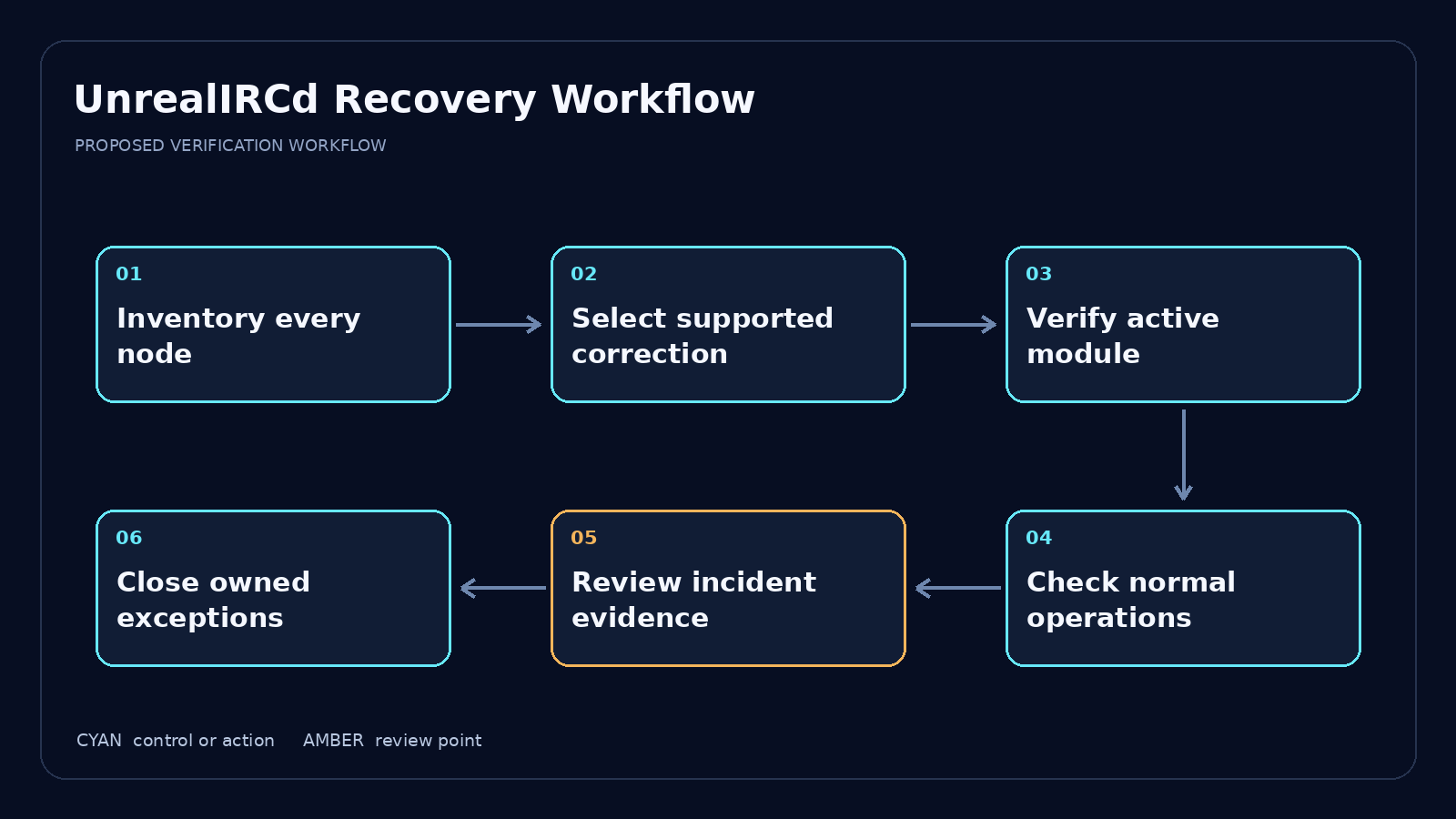
Review administrative state after suspected authority abuse
If evidence suggests unauthorized IRC authority was exercised, a successful patch does not reverse the resulting state. Review the categories of change that matter to the network: bans, operator-related settings, service access and other administrative effects actually supported by the local configuration. The scope should follow evidence and product capabilities rather than a speculative catalog of attacker actions.
Compare current state with an approved baseline where one exists. A previous export can be helpful, but it is not automatically trustworthy. Establish who produced it, when it was captured and whether legitimate changes occurred afterward. Blind restoration can erase authorized moderation decisions or reintroduce obsolete configuration.
Where a baseline is missing, use an owner review. Each responsible operator should assess the changes within their authority and identify records they can explain. Unexplained state remains a task with a named owner. A mass reset may be operationally tempting, but it can create disruption and destroy context needed for investigation.
Credentials need an evidence-based scope. A protocol command-injection finding does not automatically demonstrate that host secrets were stolen. If the investigation finds account compromise, unexplained credential changes or another access path, address those findings directly. Avoid both extremes: rotating everything without a plan and assuming that no identity work is necessary because the software was patched.
Coordinate with service operators before restoring state that they manage. A services database, local server configuration and network-wide policy can represent different sources of truth. Changing one in isolation can cause another component to recreate the undesired state. Identify the authority that should own each setting and restore through that path.
Communicate uncertain findings carefully. “We corrected the vulnerable module and are reviewing unexplained administrative changes” is more defensible than announcing that all users were compromised or that nothing happened. A precise statement helps users decide what action they need to take without forcing the response team to defend unsupported certainty.
After restoration, record the normal-state checks that were repeated. An investigator may restore a configuration that differs from the one tested during deployment. Repeating only the affected acceptance tests can establish that the final state still meets the intended role and service requirements. Keep restoration evidence linked to the incident rather than burying it in unrelated maintenance notes.
If an independent host intrusion is discovered, expand the response under the appropriate authorization and expertise. Preserve the distinction between the IRC finding and the host finding. Shared timing may support a hypothesis, but it is not enough to collapse two security boundaries into a single undocumented exploit chain.
Treat end-of-life installations as a migration problem
The maintainer’s announcement separately discusses UnrealIRCd 5 and other end-of-life branches. Those statements should be read as vendor guidance for those branches, while the six-series range in the CVE description remains explicit. Do not interpret a broad machine-readable lower bound as a complete tested history of every release.
A temporary module restriction can be an emergency measure when the maintainer documents it, but an unsupported branch remains a wider maintenance problem. Assign a migration owner and identify the operational constraints: configuration conversion, service compatibility, authentication dependencies and the administrators available to support the new environment.
Build the replacement in an isolated environment using supported materials. Import only the configuration and data required for the migration, then review their meaning under the new release. A file accepted by a parser can still carry outdated permissions or assumptions. Successful startup is only the beginning of migration acceptance.
Select a small set of representative workflows before cutover. Include ordinary users, operator permissions, bots and any important services. Define what success looks like and which result would stop the migration. The test plan should reflect how the network is used rather than a long list of features nobody depends on.
Identify the rollback boundary in advance. A supported replacement that fails a normal workflow may require repair or a revised cutover, but returning an unsupported exposed server to the linked network cannot be treated as a neutral undo. Record the risk and the interim participation decision if the original environment must remain available temporarily.
Update monitoring and ownership records during migration. New paths, service identities or host names can make old operational checks irrelevant. A corrected server that nobody monitors or knows how to maintain is a weak long-term outcome. Confirm that the people responsible for the next update can identify the installation and obtain its active state.
Do not let legacy complexity disappear into a general “patched” total. Report migration separately from correction of already supported nodes. A network can make substantial progress while still carrying an unresolved unsupported component. Honest reporting lets the owner direct resources toward the remaining constraint.
Work through a fictional mixed-state network
Consider a fictional four-node network used solely to illustrate the response method. North is a public leaf, South is another public leaf, Core is a private hub and Reserve is normally disconnected. Each has a different operator. The names are placeholders, not discovered assets or a report of a real incident.
North completes the supported upgrade and provides an active corrected module status. Its normal client and operator fixtures pass. That establishes a useful node-level result. It does not establish the state of South, Core or Reserve, and it says nothing about administrative actions that may have occurred before North’s correction.
South reports that a hot-patch command says the patch was already applied. The original transcript shows a compilation failure, and the active module remains uncorrected. South is therefore unresolved. The operator chooses a supported upgrade instead of treating the repeated command output as success. The network’s progress report should reflect that distinction immediately.
Core has active hot-patch evidence but no recorded post-restart expectation. Its owner schedules a controlled lifecycle check and establishes which supported installation will start. The current active result can be recorded with its limits while the lifecycle task remains open. The owner should not silently convert a temporary observation into a permanent guarantee.
Reserve is not linked during the window. Its owner cannot participate until later. The coordinator records a reconnect restriction under the network’s approved process and assigns a verification task before Reserve can return. Being offline reduces current participation, but it does not justify deleting the asset from the inventory.
The incident reviewer finds an unexplained moderation change on North during the exposure interval. The deployment record remains corrected; the incident record remains under review. Those conclusions are compatible. Combining them into a single green or red badge would obscure the decisions that different owners need to make.
This example shows why “three of four nodes patched” can still be too coarse. North has correction and an open state review; South needs correction; Core needs a lifecycle check; Reserve needs admission control and later verification. The response improves when each unresolved condition becomes a specific action rather than an argument about one aggregate percentage.
Package evidence so another operator can use it
A closure package should identify its scope, snapshot time, source advisories and responsible reviewers. Include the node register, active correction evidence, selected normal-workflow results, exceptions and the incident-review conclusion. Store the raw supporting records separately under appropriate access controls and link them by stable references.
Use a consistent evidence identifier for each observation. The identifier should let a reviewer locate the original result without embedding private host details in every summary. A short, dated module-status excerpt is usually more useful than an unstructured screenshot dump. Explain what each observation proves and what it leaves unresolved.
Keep evidence collection proportional. Do not request a full filesystem archive merely to establish a module version, and do not ask community operators to publish private network configuration as proof of cooperation. If a deeper investigation requires sensitive records, define that scope and an approved transfer method separately.
A software-assisted review can help organize authorized tasks and findings, but the acceptance standard must remain independent of the tool. Before using any assessment product, confirm its supported target types and methods. This article does not claim that Penligent natively tests this IRC flaw or certifies an UnrealIRCd deployment.
Make the difference between a task result and a risk decision visible. An operator can report a failed upgrade accurately. A network owner can then decide how to restrict participation or provide support. A report that hides failures behind a general completion statement deprives the owner of the information needed to act.
Record review triggers rather than promising permanent safety. A restored image, new linked node, module change, service restart or vendor revision can invalidate an earlier observation. The closure package should explain when the relevant checks need to run again and who is responsible for that decision.
At final review, ask whether another qualified operator could reproduce the acceptance conclusion from the package. If the answer depends on an undocumented chat message, a missing screenshot or the memory of one volunteer, repair that gap. Reproducibility is an operational quality, not simply a desirable report format.
A useful evidence review also checks ordering. The correction must be observed after the operation intended to activate it, and the functional result must describe the final configuration. If a node is restored after verification, the earlier record becomes historical evidence until the restored instance is checked. This rule prevents a perfectly authentic observation from being used to support the wrong deployment state.
Use the same discipline when several people contribute records. Preserve who observed a result and which node they observed, even if a coordinator prepares the summary. The coordinator’s report can reconcile evidence; it cannot convert an undated statement into a current runtime observation. Resolve missing context with the responsible operator before calling the node complete.
Close the network response with four separate conclusions
The first conclusion concerns coverage: every in-scope node has a current identity and owner, and unknown or excluded nodes are accounted for. Coverage is a statement about what was assessed. It must remain distinguishable from whether the assessed nodes passed.
The second concerns correction: the supported fix or explicitly documented interim measure is active where required. Identify which route was used and the evidence for activation. An interim measure should remain labeled interim even if it allows normal service to continue.
The third concerns operation: the selected client, operator and service fixtures passed in the final deployed state. Describe their limits. These checks provide confidence in the workflows exercised, not exhaustive proof of protocol correctness.
The fourth concerns incident review: state what was investigated, what was found and what remains unknown. A corrected network can still require recovery work. An investigation with no observed misuse can still have evidence gaps. Neither outcome should be overwritten by the maintenance dashboard.
These conclusions create a clear handoff to routine operations. The owner can maintain the correction baseline, enforce reconnect checks, retain incident follow-ups and schedule the next supported update. The result is a network that has a reviewable current state instead of a collection of maintenance claims.
Frequently asked questions
What does CVE-2026-114713 allow?
- The published record describes client label data becoming server-to-server command authority on a linked UnrealIRCd network.
- Name the IRC authority boundary when describing impact. Do not translate it into operating-system shell execution without separate evidence.
Which release should administrators check?
- The record identifies UnrealIRCd 6.0.0 before 6.2.7.1. Use the project’s current guidance to select a supported correction.
- End-of-life branches require their own vendor guidance and a migration decision rather than an assumed six-series hot-patch procedure.
Is one corrected server enough?
- A node-level result establishes the observed state of that node.
- Inventory and verify every in-scope participant, including standby systems that may reconnect. Keep unresolved owners and missing evidence explicit.
Does a hot-patch completion message prove activation?
- Inspect active runtime evidence and reconcile any earlier error.
- Modified source, a completed build and loaded corrected code are different states. A later restart also deserves a documented expectation.
Can a normal workflow test replace the patch?
- No. It verifies selected behavior after the supported correction.
- A harmless test that passes does not establish resistance to the CVE or justify running a production exploit.
Does known exploitation mean this network was breached?
- It supports urgent response at the vulnerability level.
- A local incident conclusion needs local evidence, a defined time interval and an account of retention gaps.
What should the final response record contain?
- Node coverage, active correction, normal-operation results and incident conclusions, each with evidence references and accountable owners.
- Preserve exceptions and reconnect conditions so that an offline or restored node cannot silently invalidate the completed work.
The durable outcome is an explicitly maintained boundary: client metadata stays data, trusted server authority stays tied to its source, and every participating node has a correction state that an operator can verify. Keep that evidence current as the network changes.
The following official Penligent video presents the general product workflow. It is separate from the source research and does not demonstrate or certify the specific findings discussed above.
 English
 German
 French
 Spanish
 Portuguese
 Japanese
 Korean
 Hindi
 Arabic
 Turkish
 Hebrew