
Apple announced more granular app-control and disk-access choices in macOS 27.3 beta 2 on November 16, 2026. For developers of desktop AI agents and automation tools, the useful task is to test workflows that have access to only the required apps and folders. This is a beta-platform change, not evidence that every production Mac has already received a new permission model. Read Apple’s announcement before changing onboarding guidance.
Separate app control from file access
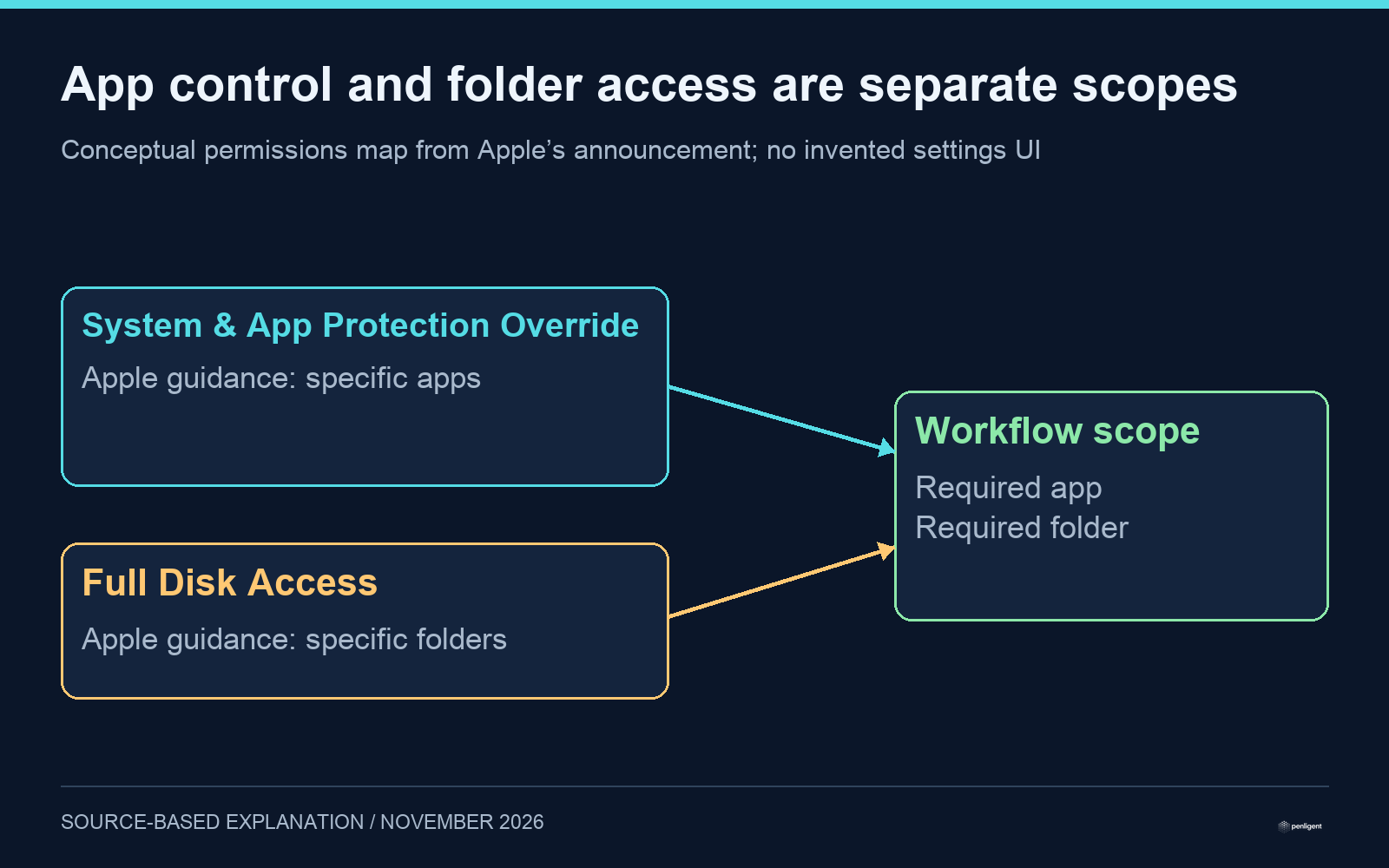
Apple is splitting Device Control and Data Access into System & App Protection Override and Accessibility. The announcement describes guidance toward granting access to specific apps for System & App Protection Override and specific folders for Full Disk Access. It also describes selecting the requesting app from a list, greater visibility into broad grants, an option to ask each time access is needed, and an indicator when one app controls another using System & App Protection Override.
These are different authority dimensions. An agent that edits a document may need one folder, while a workflow that interacts with another application may need an app-specific control grant. Do not present a single broad permission as a substitute for understanding the workflow. Apple asks developers to handle access limited to a set of folders or apps gracefully.
Existing grants and new requests need separate cohorts
Apple says permissions previously granted by users remain in effect, and users see the updates when approving new permission requests. A successful run on a developer’s existing Mac therefore does not validate onboarding for a new installation. Test a clean-permission cohort and an existing-grant cohort independently.
The announcement also discusses entitlements for disk-backup apps and assistive technologies, says known apps currently retain their experience, and says additional entitlement details will be available later. It does not provide a complete entitlement policy for AI agents. Avoid promising eligibility or a specific exception before Apple publishes the applicable details.
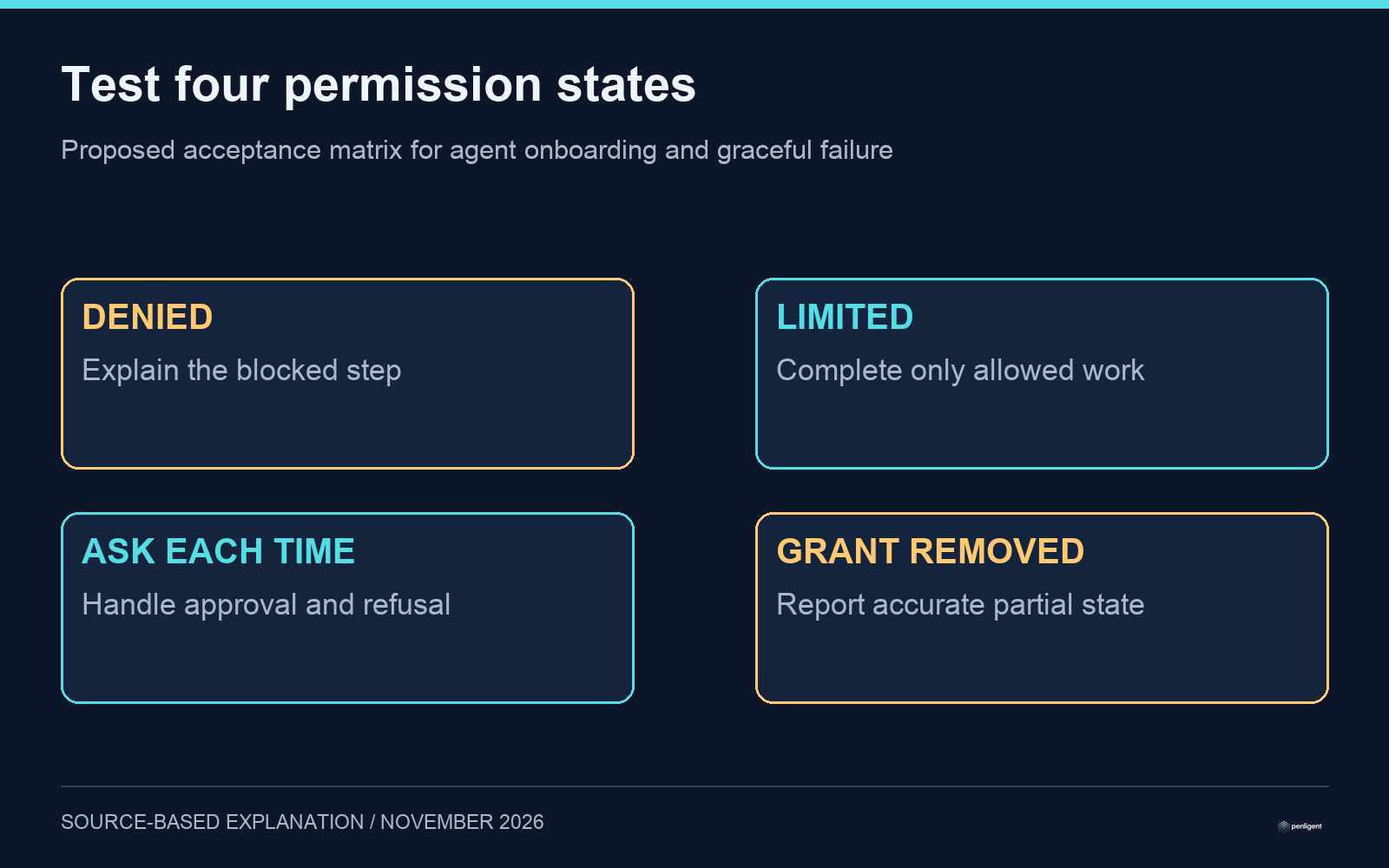
A four-state test matrix for an agent workflow
The following matrix is our proposed acceptance method. Use synthetic documents and owned test applications in the beta environment; it is not a report that we tested a particular agent.
| Permission state | Test | Expected product behavior |
|---|---|---|
| Access denied | Request a task requiring an unavailable folder or app | Explain the blocked step and offer a bounded recovery; do not claim completion |
| One app or folder allowed | Complete an in-scope task, then request an out-of-scope resource | Finish the allowed work and report the separate access limit |
| Ask every time | Exercise the workflow with approval and refusal | Handle both outcomes without silently repeating the request |
| Grant removed during a workflow | Change access through supported test controls, then continue a safe task | Stop the affected operation and preserve an accurate partial-result state |
The expected behaviors in the last column are design recommendations, not a guarantee about Apple’s prompt timing, API error codes or revocation semantics. Measure those details in the supported beta environment and record them. The announcement alone is insufficient to invent an exact dialog sequence or an API contract.
Define completion before asking for broader access
For a workflow such as “summarize the approved project folder,” define the required folder and the output location before the run. If the folder is readable but the destination is unavailable, the agent should identify that specific limit. It should not say the summary was saved simply because it produced text internally.
For cross-application automation, separate observation, editing and submission in the acceptance record. A control permission does not determine whether a user authorized a particular business action. Likewise, a workflow that can read a chosen folder should not silently expand to unrelated folders because the initial task encountered a missing file.
Make rollout evidence reproducible
Record the macOS beta build, application build and signing identity, initial grant state, requested scope, user response and observed result. Repeat after a relevant application or operating-system update. Keep the distinction between an existing broad grant and a new scoped request visible in support diagnostics; otherwise two users can appear to run the same workflow while exercising very different authority.
The immediate deliverable is a tested, narrower onboarding and failure-handling path. Broader access should be a deliberate user decision tied to a real workflow need. Beta behavior and future entitlement details remain subject to Apple’s subsequent documentation.
Method: Apple’s November 16 developer announcement reviewed November 18, 2026. AI assisted drafting and agent editorial validation. The acceptance matrix is analysis, not an Apple-certified test suite or first-hand beta result. The following Penligent 3.0 video is a general product demonstration.
 English
 German
 French
 Spanish
 Portuguese
 Japanese
 Korean
 Hindi
 Arabic
 Turkish
 Hebrew