
CVE-2026-63129 affects both write tools and a reader-tier path in MSSQL MCP packages. The maintainer advisory says caller-controlled identifiers and predicates were inserted into T-SQL without sufficient validation. A confirmation step does not prevent execution when row-count and preview queries are built and run before confirmation. The list_databases state filter is also affected, including in the reader package and under READONLY=true.
Upgrade the package that your server actually consumes
| npm package under @connorbritain/ | Affected versions | First patched version |
|---|---|---|
| mssql-mcp-core | ≤ 0.5.0 | 0.6.0 |
| mssql-mcp-reader | ≤ 0.4.2 | 0.5.0 |
| mssql-mcp-writer | ≤ 0.4.2 | 0.5.0 |
| mssql-mcp-server | ≤ 0.5.2 | 0.6.0 |
Inspect the resolved dependency tree, lockfile and deployed artifact. Updating a top-level manifest without rebuilding can leave an old core library in a running MCP server. The consumer versions above depend on the corrected core. Record the package scope and complete version rather than matching only the unscoped name.
Three controls protect different boundaries
| Control | Intended job | Why it was insufficient here |
|---|---|---|
| READONLY mode or reader tier | Limit exposed tool operations | The reader list_databases stateFilter was itself interpolated. |
| Preview and explicit confirmation | Let an operator review a proposed change | The preliminary query already evaluated untrusted SQL fragments. |
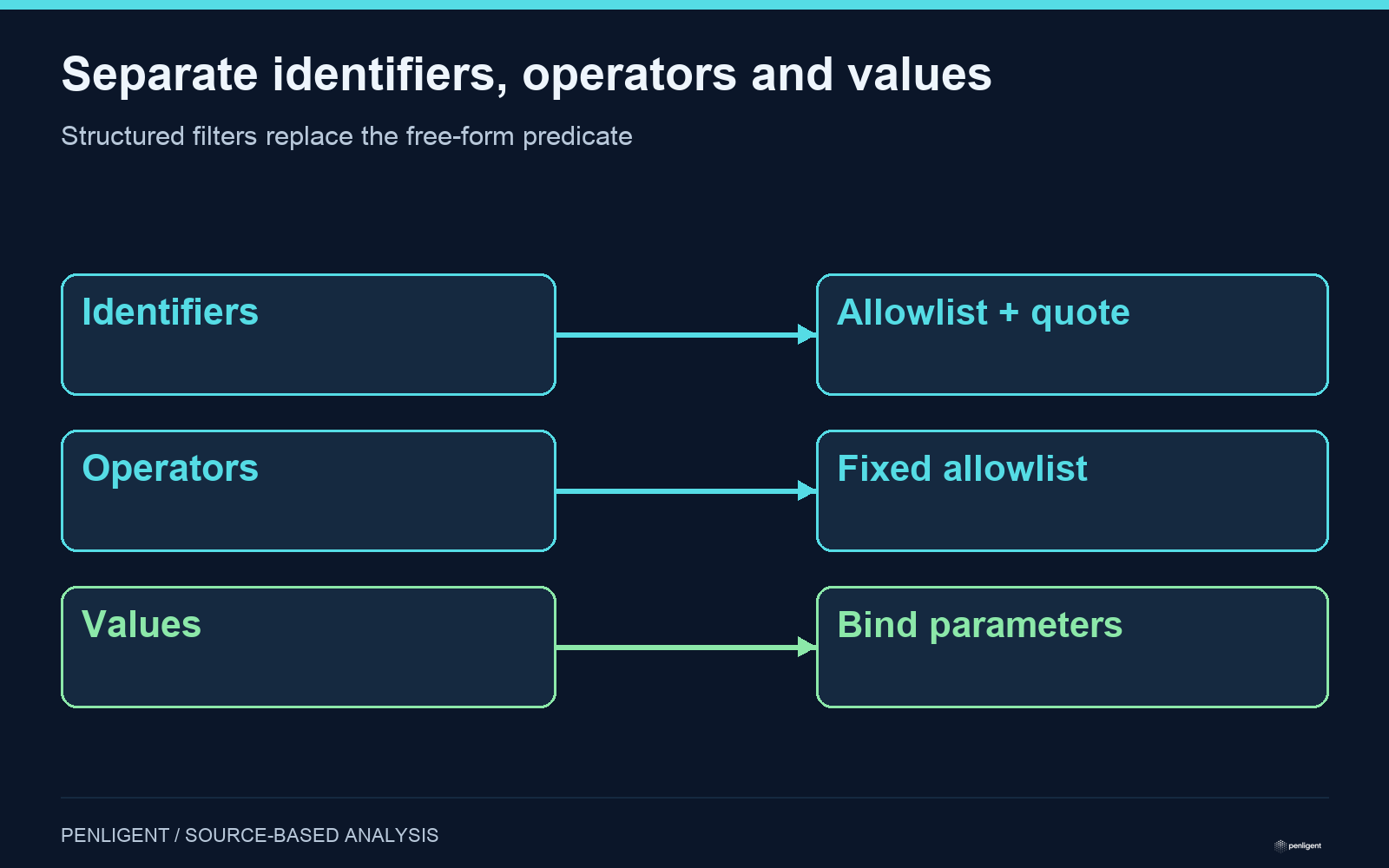
| Bound data values | Separate values from SQL syntax | Table, column and other identifiers plus free-form predicates remained unsafe. |
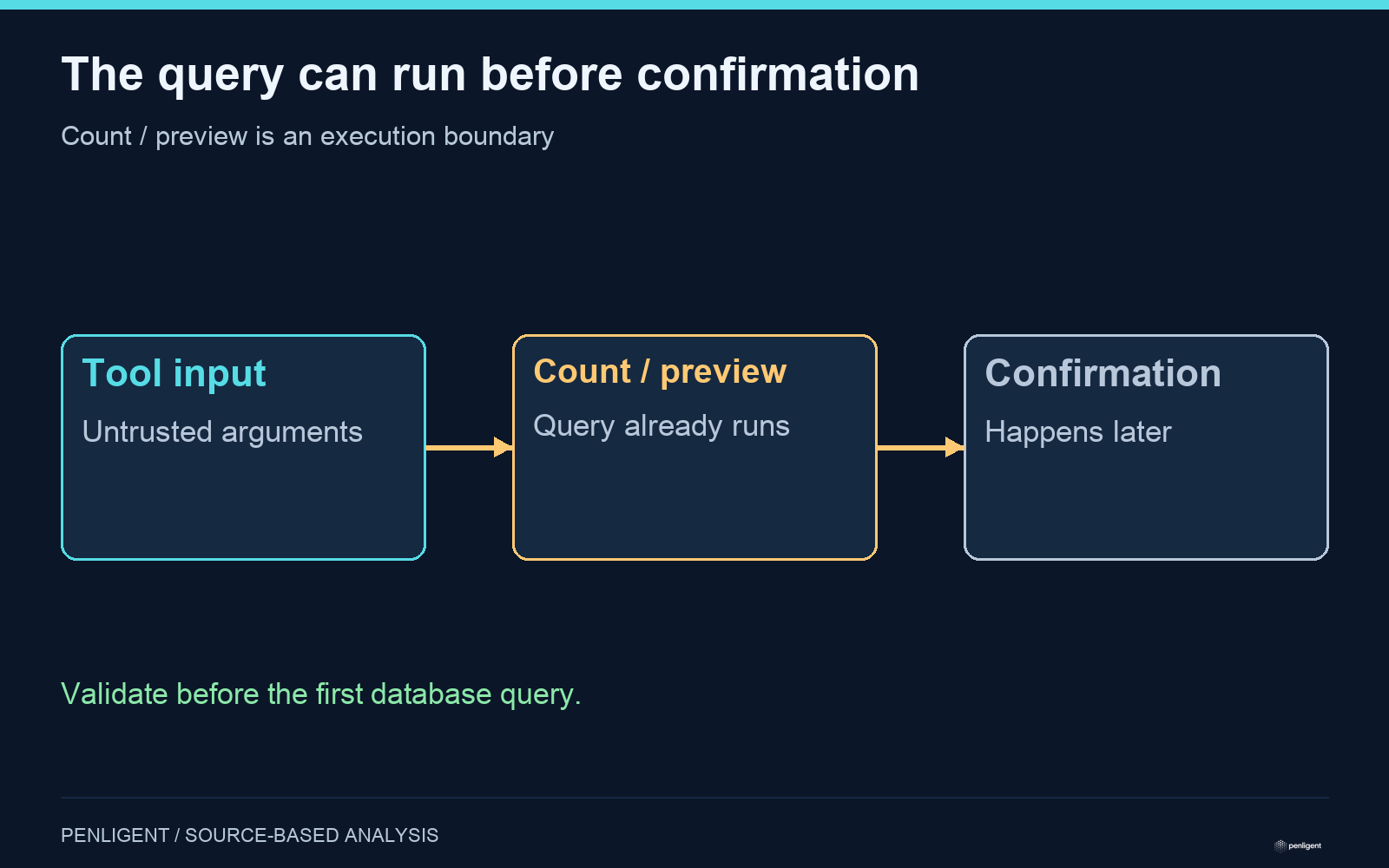
The advisory describes actors who can supply tool arguments, including a compromised MCP client or an agent influenced by indirect prompt injection. That is an input-authority condition, not evidence that every database connected to an LLM was exploited. Impact follows the SQL login’s privileges; operating-system command execution requires additional privileged configuration. Do not turn that conditional outcome into a universal RCE claim.
The fix changes the tool contract
The maintainer removes the free-form whereClause string and introduces structured filters with column, operator and value fields. It validates identifiers against an allowlist, quotes them with a shared helper, binds values and validates the database state filter before use. These are separate protections for identifiers, operators and values. They cannot be replaced by a single prompt telling an agent to avoid SQL syntax.
The source change is also an integration change. Review clients, saved workflows and schemas that supplied the old predicate string. A package upgrade that silently breaks a legitimate update path is not a complete operational rollout. Adapt clients to the documented structured contract and ensure unsupported inputs fail clearly rather than being transformed into raw SQL elsewhere.
A safe acceptance plan for the rebuilt server
| Owned staging case | Expected property | Record |
|---|---|---|
| Normal reader query with an allowed state | The documented read operation succeeds | Returned synthetic database metadata and resolved core version. |
| Unsupported state or malformed identifier | Validation rejects before issuing a database query | Validation result and trusted application query instrumentation. |
| Normal structured update awaiting confirmation | Preview uses only validated structure and bound values | Synthetic fixture, preview record and confirmation state. |
| Obsolete free-form predicate contract | The client migrates or fails explicitly | Client version and supported schema, without a hidden raw-SQL fallback. |
These are proposed defensive checks. Use a dedicated database, a least-privilege test login and synthetic records; no stacked statements or production data are needed. Instrumenting whether a query was sent makes rejection evidence stronger than an empty result alone. An empty result may simply reflect a nonexistent table or a different login.
Contain database authority separately from the package fix
The advisory calls upgrading the only complete fix. Restrict allowed MCP clients and use a least-privilege SQL identity as defense in depth. If an affected server processed untrusted tool arguments, review database and tool-call evidence within the retained window without reproducing the injection. A repaired query builder does not reverse earlier changes or invalidate exposed database credentials.
When using Penligent in an authorized agent-security assessment, include the reader path and the pre-confirmation phase in scope. Checking only the final write operation leaves the relevant boundary untested.
The following Penligent 3.0 video is a general product workflow demonstration. It is not evidence of exploitation or proof that this vulnerability was remediated.
Methodology, November 19, 2026: AI-assisted drafting with agent verification against the linked primary records and source changes. The deployment decisions and proposed acceptance checks are analysis. No exploit was executed and no first-hand incident response is claimed.
 English
 German
 French
 Spanish
 Portuguese
 Japanese
 Korean
 Hindi
 Arabic
 Turkish
 Hebrew