
VMSA-2026-0011 requires separate decisions for vCenter and ESX. A vCenter appliance already on 8.0 U3m can satisfy its part of the advisory while the hosts it manages still need patches. For ESX 9.0, available fixes for the critical I/O filter issues must also be distinguished from two other CVEs whose fixes remain pending. Use the product, release branch, and CVE together when closing a remediation ticket.
Broadcom published the advisory on November 24, 2026. CVE-2026-123903 affects authentication in the vCenter VMware Directory Service; CVE-2026-123910 and CVE-2026-123911 affect memory safety in the ESX I/O filter service. All three have a CVSSv3 score of 9.8. The official advisory describes network access as the prerequisite for these issues. This assessment reflects the response matrices checked on November 25, 2026.
Start with two separate asset records
Create one record for each vCenter appliance and another for every ESX host. Record the installed release, build, owner, and relevant CVEs before assigning a target. A cluster name or a completed management-appliance change is insufficient evidence for the hosts beneath it. The distinction matters most when a recent emergency update makes an environment appear fully covered.
CVE-2026-123903 is distinct from CVE-2026-123890. However, Broadcom confirms that the vCenter 8.0 U3m update used for the earlier advisory already contains the new vCenter fixes. The official FAQ, questions 7–8 says vCenter 9.1.x needs 9.1.2, while 9.0.x must be compared with its current matrix entry. Do not use the earlier incident’s exploitation status as evidence about these new identifiers.
Match the patch to the product and branch
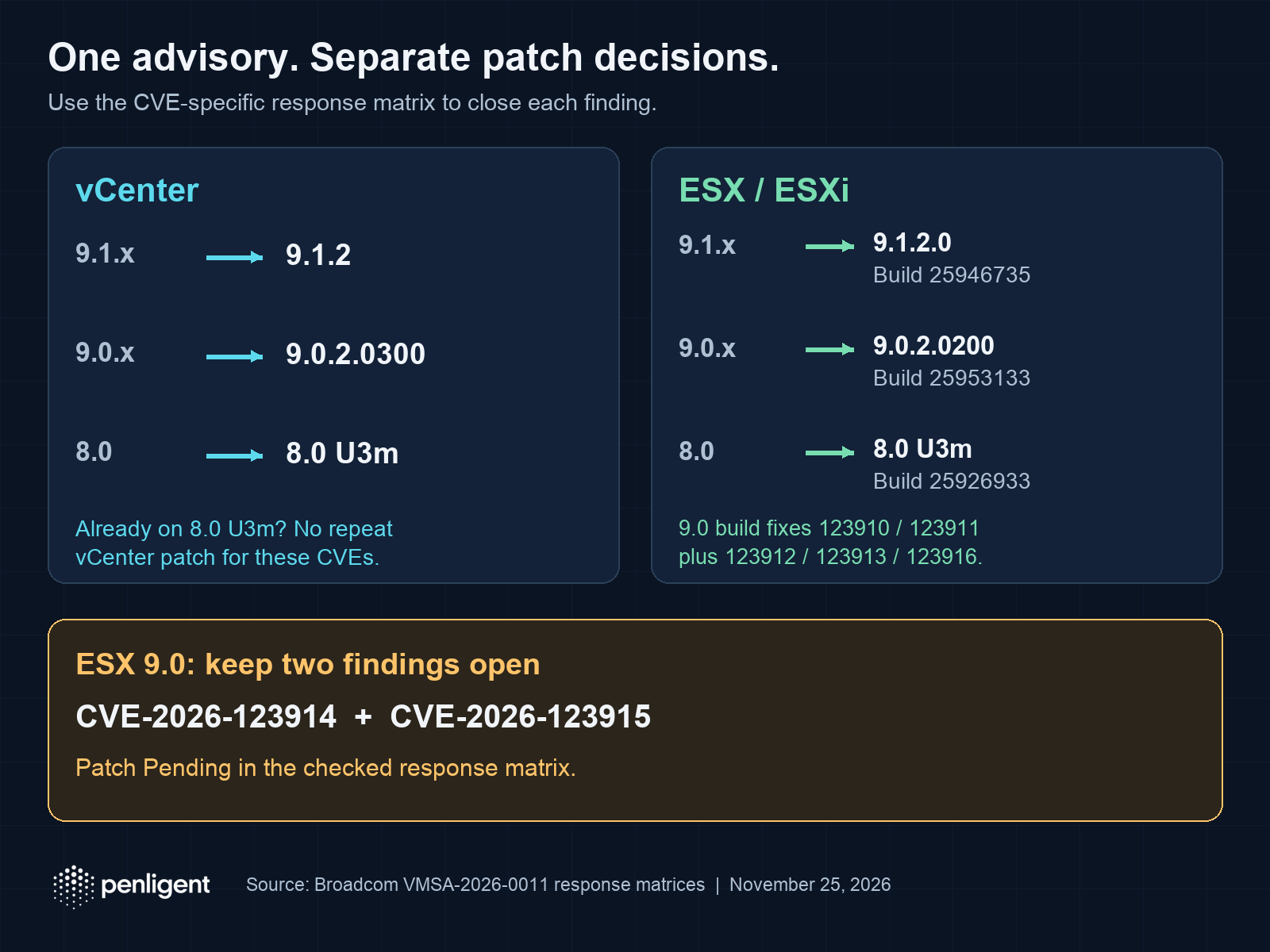
The table translates the CVE-specific response matrices into closure decisions. The vCenter targets cover CVE-2026-123903 through CVE-2026-123909; the ESX targets below identify the critical I/O filter fixes and the important 9.0 exception.
| Product and branch | Advisory target | Decision |
|---|---|---|
| vCenter 9.1.x | 9.1.2 | Compare the appliance release; an earlier 9.1 update is insufficient. |
| vCenter 9.0.x | 9.0.2.0300 | Use the vCenter release, not the similarly named ESX patch. |
| vCenter 8.0 | 8.0 U3m | Already installed? Keep evidence; no repeat vCenter update is needed for these CVEs. |
| ESX 9.1.x | ESXi-9.1.2.0-25946735 | Covers the seven ESX CVEs in this advisory. |
| ESX 9.0.x: 123910/123911 | ESXi-9.0.2.0200-25953133 | Also covers 123912, 123913, and 123916. |
| ESX 9.0.x: 123914/123915 | Patch Pending | Keep these two findings open; the available patch does not close them. |
| ESXi 8.0 | ESXi80U3m-25926933 | Covers the seven ESX CVEs; KB463535 is a limited interim option. |
| vCenter or ESX 7.0 | Contact Broadcom Support | Customers with an extended support contract can request patches. |
For VCF 5.x, Broadcom lists 5.2.5 and directs administrators to its asynchronous patching process for the relevant vCenter and ESX updates. Treat the platform label as a routing instruction: retain component-level evidence rather than assuming one completed platform task proves every product is fixed.
The ESX 9.0 pending rows do not cancel the available fix
The response matrix separates the ESX 9.0 issues into two groups. The critical I/O filter CVEs have an explicit fixed build. CVE-2026-123914 and CVE-2026-123915 retain a pending status. That supports two parallel decisions: deploy the available update for the covered findings and maintain a separately owned follow-up for the remaining pair.
Broadcom’s FAQ describes the ESX express patch broadly. For individual closure, use the more specific CVE row in the advisory. A useful evidence record pairs each CVE with the installed build and the matrix status checked that day. Avoid a single “VMSA complete” checkbox: it can hide an unresolved row or delay a useful critical fix while another issue awaits a patch.
Use the ESXi 8.x workaround within its stated boundary
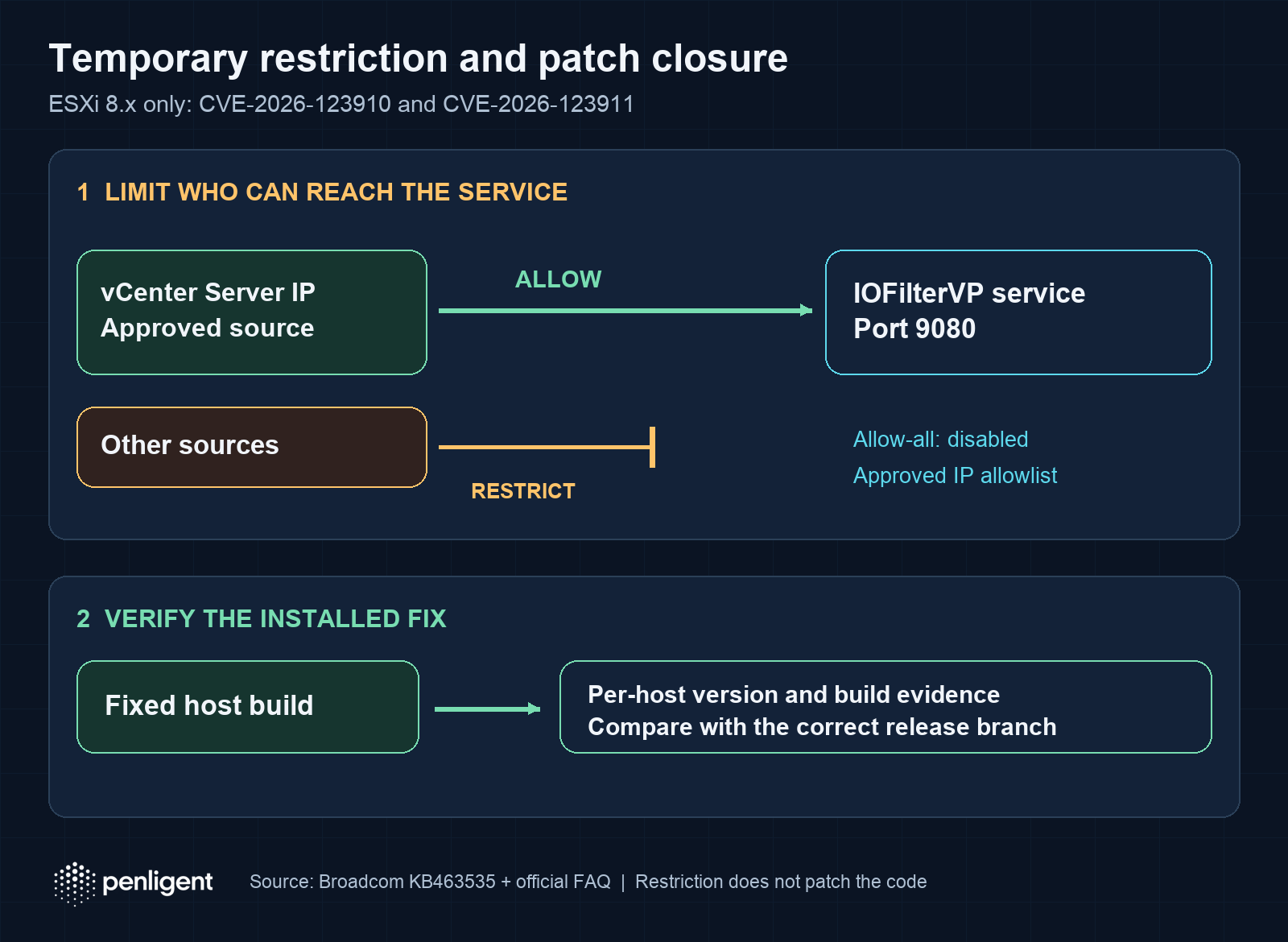
Broadcom KB463535 applies only to ESXi 8.x. It identifies the IOFilterVP service on port 9080 and instructs administrators to disable the firewall ruleset’s allow-all setting, then allow the vCenter Server IP. This is an interim access restriction for CVE-2026-123910 and CVE-2026-123911. It is not a vCenter workaround or a general solution for every CVE in the advisory.
Before changing production firewall policy, confirm the correct management address and the dependencies of the affected cluster. The official FAQ, question 25 warns that restricting this service can affect cluster, workload, and storage availability. Document the approved change, check required operations afterward, and keep the patch task open.
For an authorized ESXi 8.x host, this read-only command from the KB displays the configured IP allowlist:
esxcli network firewall ruleset allowedip list -r iofiltervpAn allowlist alone is incomplete evidence: also verify that allow-all is disabled. Record the actual rule state and approved addresses. Do not infer that a reachable port proves exploitability, or that a blocked port proves the vulnerable code has been removed.
Close findings with version evidence and operational checks
Broadcom documents a read-only PowerCLI host inventory command in question 32:
Get-VMHost | Select-Object Name, Version, BuildRun it in an already authorized, authenticated management session, then compare every returned host with its branch-specific target. Preserve the before-and-after inventories with the change record. Record unqueried or unavailable hosts as unresolved coverage, rather than silently excluding them from the success count. Separately capture each vCenter appliance’s version and build from its Summary view.
The FAQ’s operational guidance, questions 18 and 34–36 says ESX remediation restarts hosts and these updates are not eligible for ESX Live Patch. Plan workload migration or shutdown accordingly. Updating vCenter and ESX does not update VMware Tools inside virtual machines; track that product separately. These checks establish patch coverage and service recovery. They do not establish that an earlier intrusion never occurred.
Keep the attack paths distinct
CVE-2026-123910 and CVE-2026-123911 are network-to-host issues; guest VM access is not required. The separate XHCI issue, CVE-2026-123912, starts with local administrative privileges in a VM. Broadcom distinguishes its impact on Workstation and Fusion from ESX, where exploitation remains inside the VMX sandbox. Describe the particular CVE and prerequisite instead of labeling the entire advisory a VM escape. See the vendor’s attack-path explanation in question 11.
Methodology: This is source-based analysis prepared with AI assistance and checked against Broadcom’s advisory, official FAQ, and workaround KB. Penligent did not run an exploit or independently reproduce these vulnerabilities. The remediation record and closure criteria above are operational recommendations, not vendor certification.
The following official Penligent 3.0 video demonstrates a general product workflow. It does not demonstrate exploitation or remediation of these VMware CVEs.
 English
 German
 French
 Spanish
 Portuguese
 Japanese
 Korean
 Hindi
 Arabic
 Turkish
 Hebrew