
CVE-2026-50691 is a Microsoft 365 Copilot elevation-of-privilege vulnerability caused by improper authorization. Microsoft’s CNA record assigns a CVSS 3.1 score of 9.9, identifies a low-privilege network attacker, and tags the issue as an exclusively hosted service. That service boundary changes the evidence needed for remediation: a desktop client build does not establish that the backend issue is resolved.
Track two workstreams separately. The CVE ticket needs Microsoft’s service-side remediation status. A tenant hygiene review needs owned permissions and evidence that ordinary user access matches policy. The second workstream is useful defensive practice, but it cannot certify the first or reproduce this vulnerability.
What the CNA record actually confirms
The Microsoft Security Response Center entry classifies CVE-2026-50691 as improper authorization in Microsoft 365 Copilot. The CVE record identifies the affected component as an exclusively hosted service, which changes the remediation model: there is no customer-installed Copilot binary whose version can be checked as the primary closure signal.
The record’s CVSS vector includes AV:N/AC:L/PR:L/UI:N: network access, low attack complexity, low privileges, and no user interaction. Its public description stops at elevation of privilege. The source does not disclose a request sequence or name a prompt-injection mechanism. Preserve that distinction when communicating urgency to tenant owners.
For the CVE ticket, save the MSRC advisory status and the time you checked it. The record lists the affected version as - and provides no customer-side fixed version. If your change policy requires explicit resolution evidence, obtain Microsoft’s documented service status or a support response rather than inventing a client KB or treating a clean permissions review as a patch result.
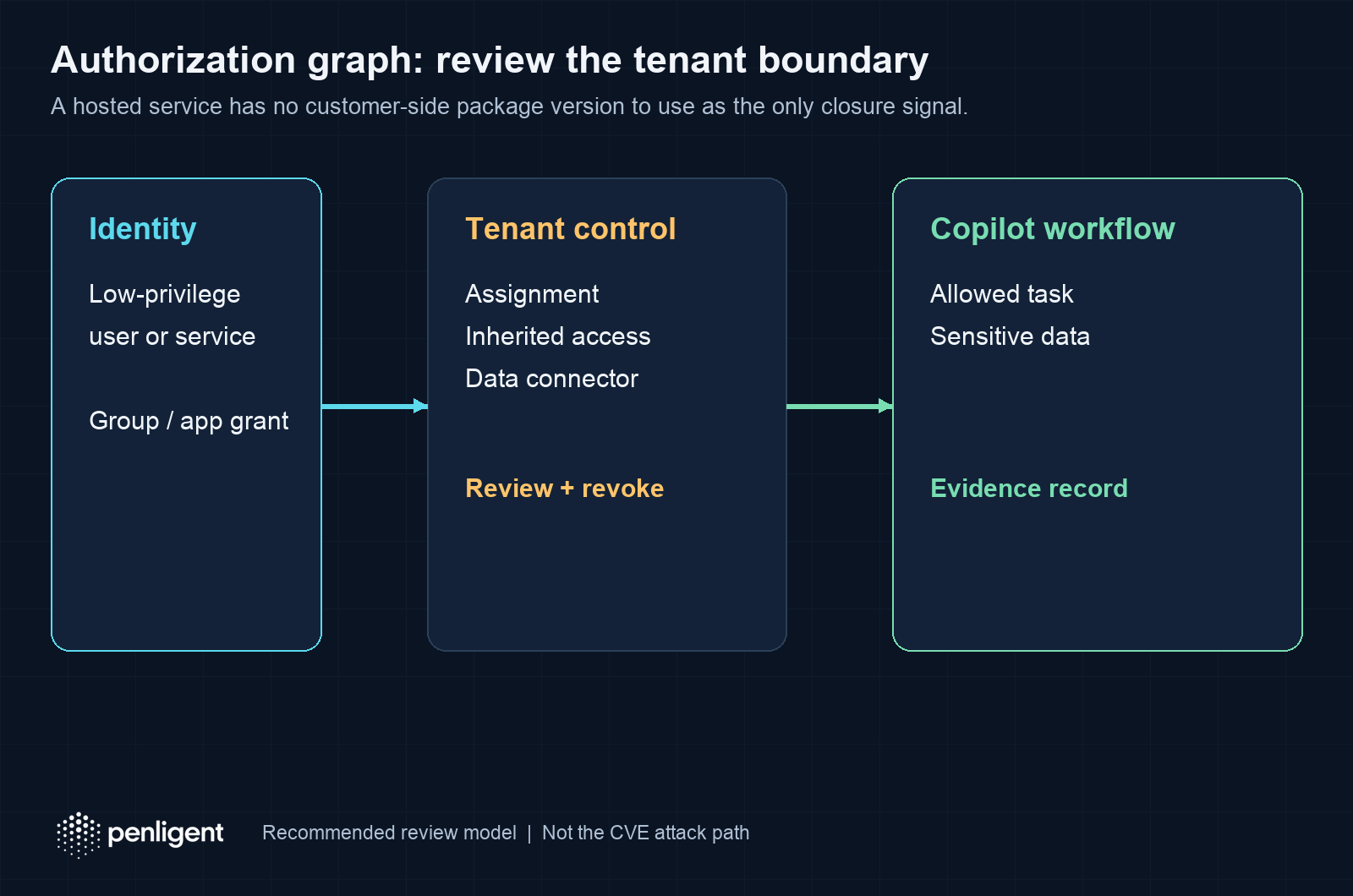
Review tenant permissions as a separate workstream
For the parallel hygiene review, inventory the identities, groups, and application grants relevant to your approved Copilot use. Capture the source of each grant, its owner, its last review date, and whether the grant is still required. Review inherited membership and dormant accounts explicitly. These are recommended tenant controls, not an inferred description of the CVE’s attack path.
- Export the current assignment and group membership evidence from the tenant’s authorized administration tools.
- Remove grants without a current owner or business purpose, then record the change ticket and timestamp.
- Review application and delegated permissions that can retrieve or act on organizational data used by Copilot workflows.
- Preserve relevant audit events before and after the change so the review can distinguish configuration closure from incident evidence.
Use two ticket fields: vendor remediation evidence and tenant permission review evidence. The first records the applicable Microsoft status; the second records your configuration changes and checks. Mark an unavailable result as unresolved. Combining them into a single “tested safe” checkbox would hide what was actually verified.
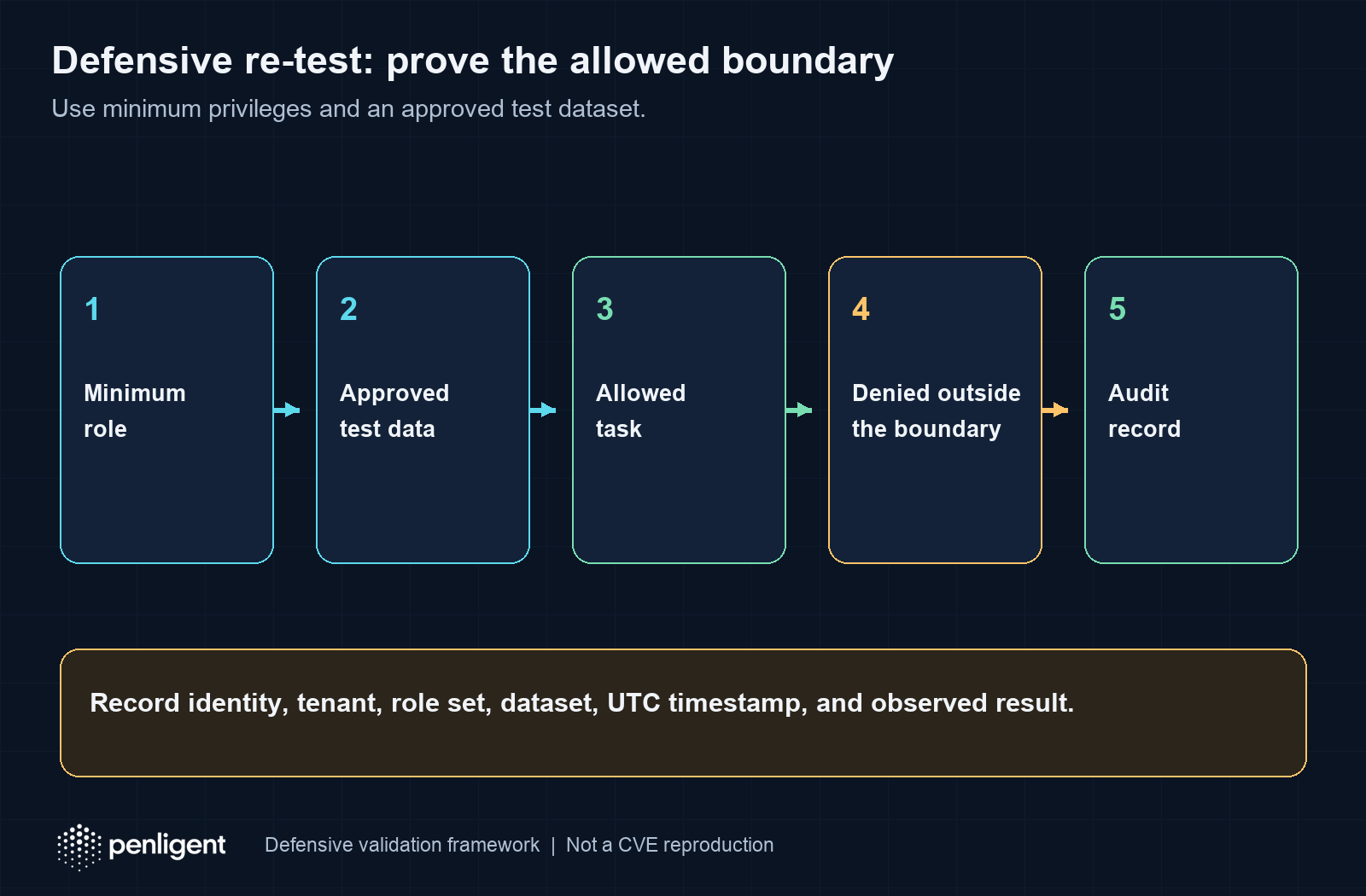
Use a low-privilege re-test with a clear boundary
Create a test account that has the minimum role needed for the intended business workflow and no access to a sensitive test dataset outside that workflow. Confirm that it can perform the approved task, then verify that it cannot retrieve, modify, or administer data outside the granted boundary. Record the identity, tenant, role set, test dataset, UTC timestamp, and observed result.
A failed boundary check needs investigation: verify the expected permissions and test setup before attributing the result to service behavior or a CVE. Escalate unexplained access through Microsoft’s support and security channels and preserve the context permitted by your policies. A successful check establishes only the tested access boundary; it does not prove the vulnerability was fixed.
What this record does not say
Neither the MSRC entry nor the public CVE record reviewed for this article establishes prompt injection, a cross-tenant attack, a named endpoint, a payload, or a confirmed exploitation campaign. Do not add those details to an incident report unless you have separate evidence. The record also does not provide a client KB number or a version string that can serve as a universal patch test.
Methodology: This is source-based analysis prepared with AI assistance and checked against Microsoft’s CNA entry and the public CVE record on November 25, 2026. Penligent did not run an exploit or access a Microsoft customer tenant. The checklist is a defensive authorization review, not a vendor certification.
The following official Penligent 3.0 video demonstrates a general product workflow. It does not demonstrate exploitation or remediation of CVE-2026-50691.
 English
 German
 French
 Spanish
 Portuguese
 Japanese
 Korean
 Hindi
 Arabic
 Turkish
 Hebrew