
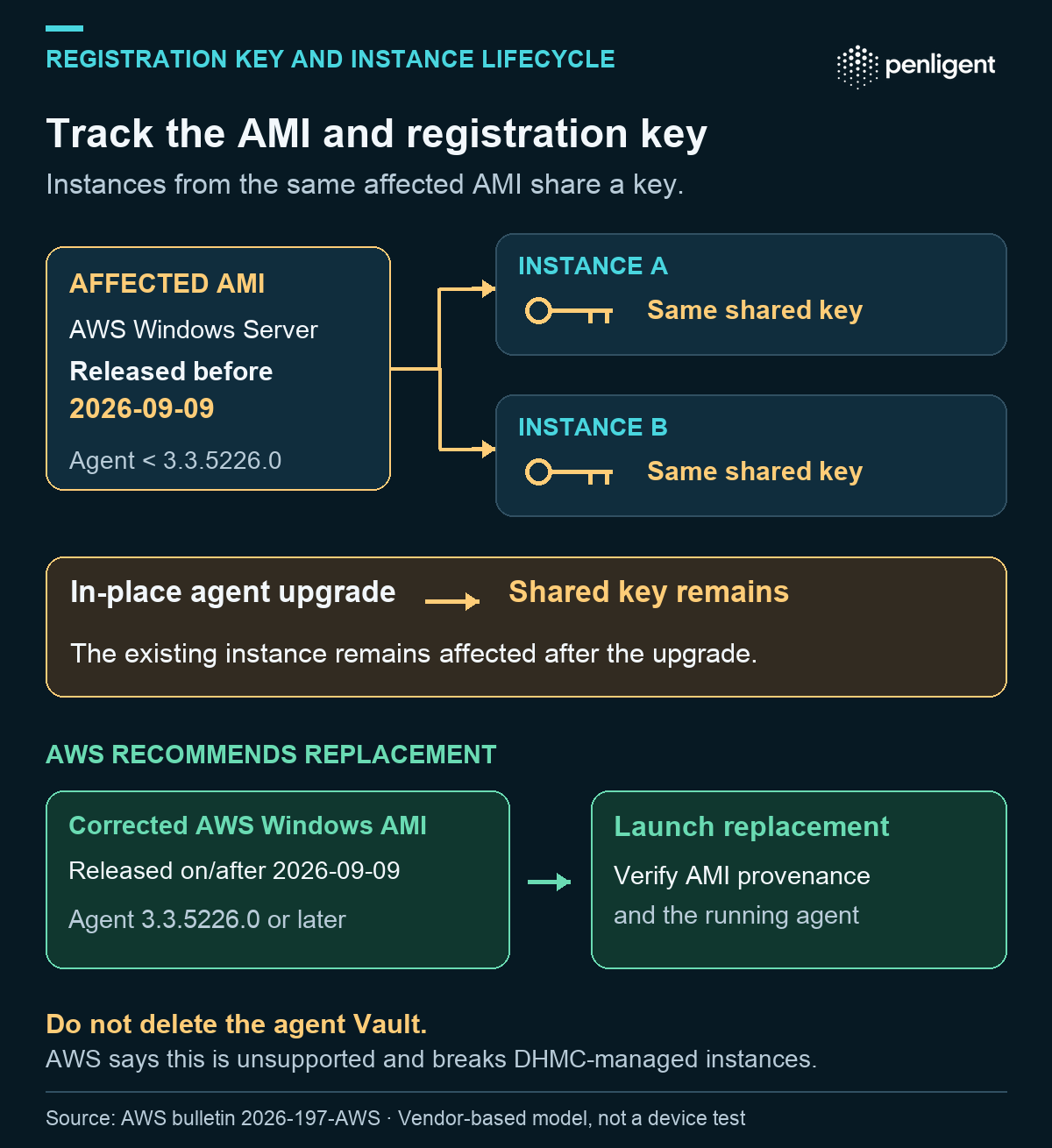
CVE-2026-134069 can remain unresolved after an Amazon SSM Agent upgrade. AWS says Windows instances launched from affected AWS-provided AMIs retain a shared registration key when the agent is updated in place. Its recommended remediation is to replace those instances using AWS Windows Server AMIs released on or after September 9, 2026, which include SSM Agent 3.3.5226.0 or later. A current package version alone cannot establish that this replacement happened.
The AWS bulletin published November 23, 2026 describes a local credential exposure involving Default Host Management Configuration, or DHMC. The practical assessment needs three kinds of evidence: the instance’s source image, its Systems Manager credential configuration, and its replacement history.
Understand the credential exposure
The affected combination is SSM Agent below 3.3.5226.0 on AWS Windows Server AMIs released before September 9, 2026. Under the conditions described by AWS, instances launched from the same image share an SSM registration key. A local user without administrative privileges on a DHMC-managed instance might obtain that instance’s DHMC role credentials.
The official agent advisory rates the issue High, with a CVSS v3.1 score of 7.3, and explicitly requires local access. It describes the default role as allowing limited Systems Manager actions. An assessment should therefore identify the role actually selected and its permissions before describing the possible cloud impact. The advisory does not establish unauthenticated remote access or automatic possession of administrator credentials.
Classify instances using history and current configuration
The following decision table is derived from the vendor conditions. It is an assessment framework, not a report of testing an AWS account.
| Evidence available | Assessment | Next step |
|---|---|---|
| Affected source AMI; DHMC-managed instance; local non-administrative access possible | The documented exposure conditions are present | Prioritize replacement and restrict that local access while waiting. |
| Affected source AMI; agent upgraded in place | The update does not establish remediation | Retain the finding until the recommended replacement is verified. |
| Affected source AMI; DHMC use not established | The documented credential path is not yet established | Check the effective management configuration and its history; do not discard the image finding. |
| Replacement launched from an AWS Windows Server AMI released on or after September 9, 2026; required agent version verified | Meets the vendor’s replacement criteria | Validate management and workload operation, and account for the old instance. |
| Unknown source image or a custom image with incomplete ancestry | Applicability unresolved | Recover build and launch records before accepting a version-only result. |
Recover image provenance before comparing dates
Record the account, Region, instance ID and source AMI ID together. The EC2 AMI documentation explains that AMI IDs are Region-specific and provides ways to identify Amazon-owned Windows images. Use the image’s publisher and release information alongside deployment records; an instance launch date is a different event from the release of its source image.
For example, a November launch from an affected August image does not become a September-or-later image deployment. Likewise, an agent inventory collected after an automatic update shows the software now installed, without proving that the instance’s registration state was replaced. These are consequences of the vendor’s affected-image and persistent-key conditions, rather than additional vulnerabilities.
For a custom image, keep the finding unresolved until its build lineage and handling of agent registration state are understood. A recent internal image timestamp is insufficient evidence by itself. The bulletin does not supply a universal rule for every image-copy, backup or restore workflow; use the builder’s records and AWS support where the ancestry cannot be established. Do not label every custom Windows image vulnerable solely because it is custom.
Check whether the instance actually uses DHMC
AWS documents DHMC as an account-and-Region setting with a selected IAM role. Its permissions can be customized, so record the selected role and relevant policies rather than assuming every deployment has the default permissions. Review each applicable account and Region.
There is an important precedence rule: SSM Agent attempts to use instance-profile permissions before DHMC permissions. AWS states that an instance profile allowing ssm:UpdateInstanceInformation causes the instance to use that profile instead of DHMC permissions. An enabled account setting is therefore useful inventory evidence, but it does not by itself prove the credential path used by a particular instance.
Retain the current setting, instance-profile permissions and management records together. If the configuration changed, distinguish today’s state from the earlier exposure window. Do not remove an instance profile or change role permissions merely to make the assessment easier; those changes can affect management and other instances sharing the selected role.
Plan replacement without breaking management
For affected instances, follow the replacement recommendation in 2026-197-AWS. Select an appropriate AWS Windows Server AMI released on or after September 9, 2026, then migrate and validate the workload through the organization’s normal change process. Check application compatibility, identity, network dependencies, monitoring and Systems Manager access before moving production traffic.
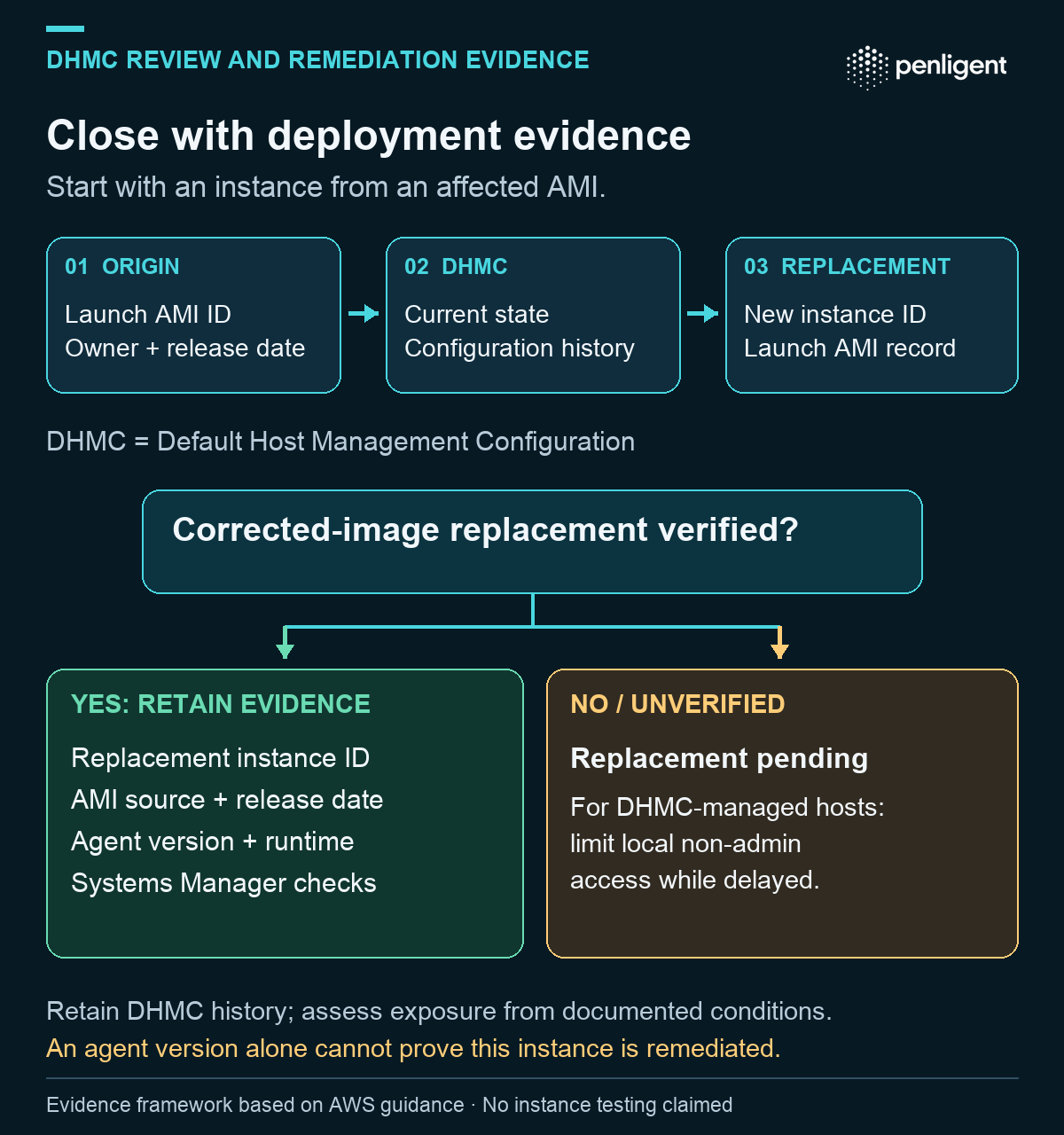
Keep a mapping from each old instance to its replacement, including the replacement’s AMI ID, image release information, active agent version and acceptance results. The operational objective is a verifiable new deployment from the corrected image. Restoring old agent registration material would undermine that evidence, so review migration scope rather than treating a full-state restore as equivalent to the recommended replacement.
Until replacement is possible, AWS advises limiting local non-administrative access on affected DHMC-managed instances. Record the restriction, its owner and the replacement date as an interim measure. The bulletin specifically rejects deleting the agent’s Vault as a remediation because it breaks DHMC-managed instances. Removing registration files is not an alternative replacement procedure.
DHMC’s documentation also warns that disabling the feature can leave instances unmanaged if no suitable instance profile supplies Systems Manager permissions. A fleet-wide toggle is therefore an operational change requiring its own review. The documented workaround is the narrower local-access restriction; it does not rotate the shared key.
Close the finding with a replacement record
A useful closure record lets another engineer reconstruct why the instance is considered remediated. It should connect the original exposure, the replacement and the active workload, instead of attaching only a successful package-update result.
| Record | Question it answers |
|---|---|
| Original instance and source-image history | Which deployment required action, and why? |
| Replacement instance, Region, AMI provenance and agent version | Was the vendor’s specified replacement path used? |
| Effective management role and successful management checks | Does the replacement operate through the intended permissions? |
| Workload acceptance and old-instance disposition | Is the new deployment serving the workload, and what happened to the affected one? |
| Rollback conditions and remaining exceptions | Could an affected deployment return, and who owns that risk? |
None of these checks requires extracting the registration key or obtaining role credentials through the vulnerability. If rollback returns the workload to an affected instance, reopen the remediation record and restore the interim restriction. A successful availability rollback does not preserve the security outcome of the replacement.
Review earlier exposure separately
Replacement addresses the deployment condition; it does not establish whether credentials were previously accessed. Where the old instance had untrusted local users, preserve relevant host access and available role-activity records under the incident-response process. The documentation reviewed here does not provide a validated detection signature or a universal event pattern for this CVE.
The CVE record includes a CISA assessment dated November 24, 2026 that recorded no exploitation at that time. That assessment does not prove an individual account is uncompromised. This article makes no claim of observed exploitation or an incident investigation.
For an authorized assessment using Penligent, apply the same evidence standard: source-image history, effective permissions and verified replacement must support the conclusion. This article does not claim automatic validation of this CVE. The following Penligent 3.0 video demonstrates a general product workflow and is not evidence of exploitation or remediation here.
Method: AI assistance was used to organize AWS advisories and documentation into an assessment and replacement workflow. Sources were checked on November 27, 2026. The decision tables are documentation-derived guidance; no AWS account testing or exploitation was performed.
 English
 German
 French
 Spanish
 Portuguese
 Japanese
 Korean
 Hindi
 Arabic
 Turkish
 Hebrew