
In the cybersecurity landscape of 2026, the concept of a “network perimeter” has been entirely replaced by the “identity perimeter.” However, the robustness of this perimeter is only as strong as the validation logic within our administrative tools. On January 13, 2026, a critical vulnerability was disclosed—CVE-2026-20965—that fundamentally challenges the trust model of hybrid cloud management.
This vulnerability in the Windows Admin Center (WAC) Azure Extension allows an attacker to pivot from a single compromised local server to full administrative control over an entire Azure tenant. This guide provides a deep-dive analysis for security engineers, exploit researchers, and cloud architects into the mechanics of token mixing and the systemic failure of Proof-of-Possession (PoP) validation.
Understanding the WAC and Azure SSO Trust Model
Windows Admin Center (WAC) serves as the centralized management plane for Windows ecosystems, increasingly used to manage Azure Virtual Machines and Azure Arc-enabled servers directly from the Azure Portal. To provide a seamless experience, Microsoft utilizes a sophisticated Single Sign-On (SSO) flow involving Microsoft Entra ID (formerly Azure AD).
This flow relies on the interplay of two specific tokens:
- The WAC.CheckAccess Token: A standard Bearer token used to authenticate the user’s session to the WAC gateway.
- The PoP (Proof-of-Possession) Token: An enhanced token designed to prevent replay attacks. It contains a cryptographic binding to the specific request and the intended resource.
Under a secure implementation, the WAC backend must ensure that both tokens belong to the same identity. CVE-2026-20965 exists precisely because this binding was not enforced.
Technical Root Cause: The Token Mixing Primitive
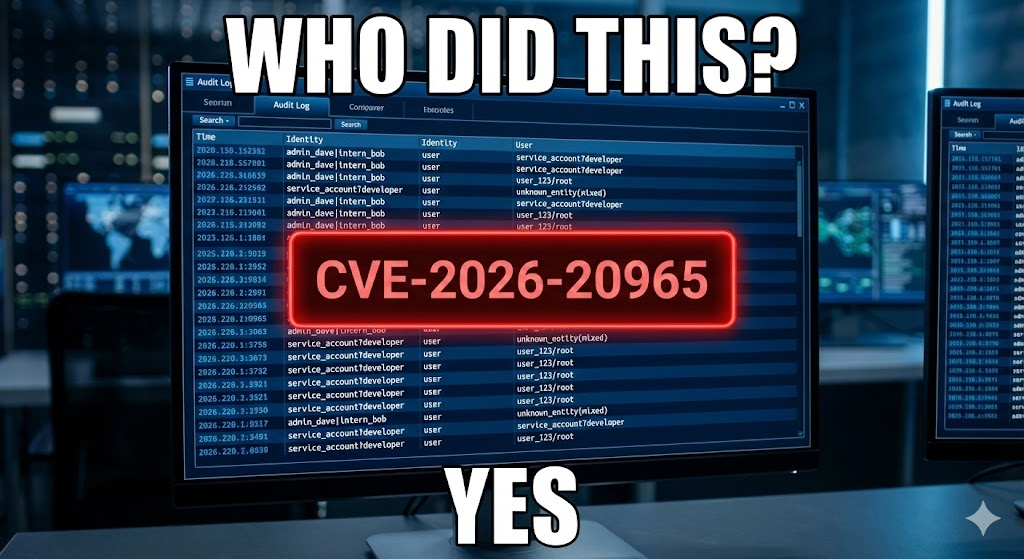
The essence of CVE-2026-20965 is “Token Mixing.” Research led by Cymulate Labs in late 2025 revealed that the WAC server does not validate that the User Principal Name (UPN) in the WAC.CheckAccess token matches the UPN in the PoP token.
1. UPN Mismatch Exploitation
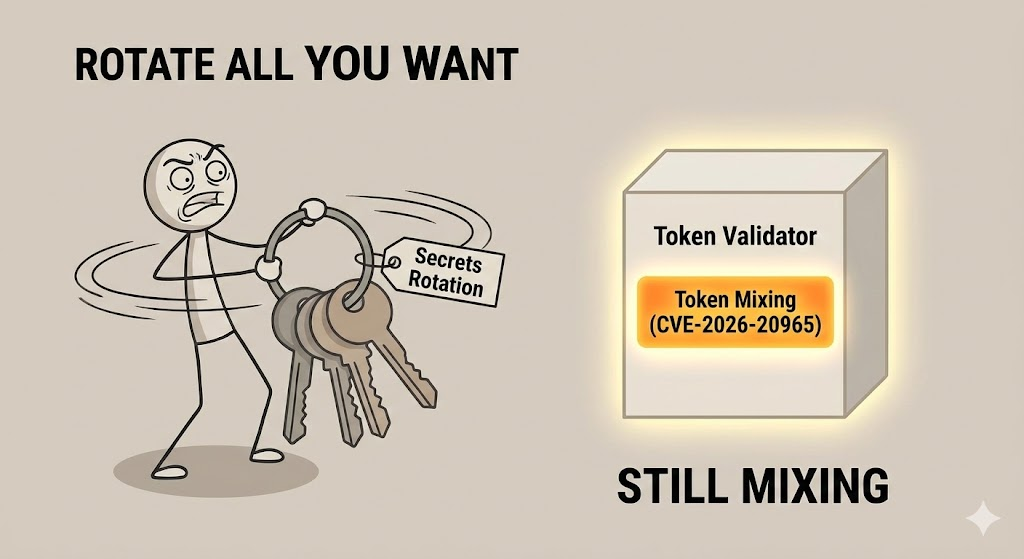
Because WAC treats these two tokens as independent validation checks, an attacker can use a stolen WAC.CheckAccess token from a high-privilege administrator and pair it with a PoP token generated by the attacker’s own low-privilege account. The WAC server sees two “validly signed” tokens and proceeds with the administrative request, effectively granting the attacker the permissions of the stolen session.
2. Nonce and Scoping Failures
Beyond identity mismatch, the vulnerability revealed several other validation gaps:
- Nonce Reuse: The server failed to invalidate nonces after a single use, allowing for replay-style attacks within the token’s validity window.
- Non-Gateway DNS Acceptance: The PoP protocol is supposed to be scoped to the gateway’s URL. However, CVE-2026-20965 allowed the
ufield in the token to point to arbitrary IP addresses or non-gateway domains on port 6516, facilitating direct attacks on internal nodes. - Cross-Tenant Token Acceptance: WAC would mistakenly accept PoP tokens issued from an attacker-controlled external tenant, as long as the cryptographic signature was valid.
Detailed Attack Chain: From Local Admin to Tenant RCE
To appreciate the severity of CVE-2026-20965, we must examine the typical attack lifecycle used to exploit it in a modern enterprise environment.
Step 1: Initial Compromise and Token Exfiltration
The attacker gains local administrator access on a machine managed by WAC. By monitoring memory or intercepting traffic to the WAC service (which often runs with high privileges), the attacker extracts the WAC.CheckAccess token of an administrator who has recently logged in via the Azure Portal.
Step 2: The Rogue Gateway Setup
The attacker stops the legitimate WAC service and runs a rogue listener. When a new administrative session is initiated, the rogue server captures the necessary metadata to facilitate the next stage of the exploit.
Step 3: Forging the Malicious PoP Token
Using their own low-privilege Azure account (or a separate tenant), the attacker generates a PoP token. They manually craft the token’s payload to target a specific Azure VM within the victim’s tenant.
JSON
`// Example of a forged PoP Token Header (Simplified) { “alg”: “RS256”, “typ”: “pop”, “kid”: “attacker_key_id” }
// Example of a malicious PoP Token Payload { “at”: “eyJ0eXAiOiJKV1QiLCJhbGci…”, “u”: “10.0.0.5:6516”, // Direct internal target IP “m”: “POST”, “p”: “/api/nodes/AzureVM01/features/powershell”, “n”: “reused_nonce_value”, “ts”: 1736761200 }`
Step 4: Remote Code Execution (RCE)
The attacker sends a crafted POST request to the WAC API, mixing the stolen high-privilege WAC.CheckAccess token with the forged PoP token. The command is executed via WAC’s PowerShell gateway, allowing the attacker to run arbitrary scripts on any VM connected to the tenant.
Comparative Vulnerability Landscape: January 2026
The release of the fix for CVE-2026-20965 coincided with several other major vulnerabilities in the January 2026 Patch Tuesday cycle. The following table provides a high-level comparison to help security teams prioritize remediation.
| CVE Identifier | Component | Impact | CVSS 4.0 | Key Characteristic |
|---|---|---|---|---|
| CVE-2026-20965 | WAC Azure Extension | Tenant-Wide RCE | 7.5 | Token Mixing / Auth Bypass |
| CVE-2026-20805 | Desktop Window Manager | Info Disclosure | 5.5 | Actively Exploited 0-day |
| CVE-2026-21265 | Windows Secure Boot | Feature Bypass | 6.4 | Compromises Firmware Trust |
| CVE-2026-20944 | Microsoft Office | Remote Code Execution | 7.8 | No user interaction (Preview Pane) |
| CVE-2025-49231 | Azure Connected Machine | Elevation of Privilege | 7.2 | Lateral movement via Arc Agent |
By integrating Penligent (https://penligent.ai/) into your security workflow, you shift from reactive patching to proactive, AI-driven verification of your cloud identity boundaries.
Strategic Remediation and Hardening Guidelines
Protecting against CVE-2026-20965 requires a multi-layered approach that extends beyond the initial software update.
1. Immediate Software Updates
Organizations must update the Windows Admin Center Azure Extension to version 0.70.0.0 or higher. This version implements strict UPN matching and closes the nonce reuse loophole.
2. Strengthening Entra ID Conditional Access
Implement Conditional Access policies that require Phishing-Resistant MFA (such as FIDO2 keys) for all administrative sessions. Furthermore, use Token Protection (Token Binding) where supported to ensure that tokens cannot be easily exfiltrated and used on secondary devices.
3. Network Isolation for Management Ports
Strictly limit access to port 6516 (the WAC management port). Ensure that only authorized administrative workstations or specific Bastion hosts can communicate with this port on managed nodes.
4. Monitoring and Threat Hunting
Security Operation Centers (SOC) should implement hunting queries to detect anomalies in token usage.
- Search for Multiple UPNs: Look for sessions where the
ActorUPN and theSubjectUPN in Entra ID logs do not match. - Monitor Nonce Anomalies: Flag administrative API requests that reuse nonces or originate from IP addresses not associated with the initial gateway login.
Conclusion: The Future of Identity Security
CVE-2026-20965 serves as a stark reminder that as we centralize management for the sake of efficiency, we also centralize risk. The “Token Mixing” attack is a sophisticated technique that exploits the very protocols designed to protect us. To stay ahead of these threats, security teams must move toward automated, AI-driven testing platforms like Penligent that can think like an attacker and validate every link in the identity chain.
Authoritative Reference Links
- Microsoft Security Response Center (MSRC) Advisory for CVE-2026-20965
- Cymulate Research Labs – Technical Write-up on Token Mixing Exploitation
- NIST National Vulnerability Database (NVD) – CVE-2026-20965 Detail
- Rapid7 Analysis of 2026 Azure Authentication Flaws
- Penligent.ai – AI-Powered Automated Penetration Testing Platform

 English
  German
  French
  Spanish
  Portuguese
  Japanese
  Korean
  Hindi
Hindi  Arabic
  Turkish
  Hebrew