
CVE-2017-5689 is dangerous because it sits below the place most defenders look. It is not a vulnerable web app running on Windows or Linux. It is not a missing patch in Apache, OpenSSL, or an endpoint agent. It is an authentication bypass in Intel manageability firmware, affecting Intel Active Management Technology, Intel Standard Manageability, and Intel Small Business Technology in specific firmware generations. Intel’s advisory describes the issue as an escalation of privilege vulnerability that can let an unprivileged attacker gain control of affected manageability features, with affected firmware versions spanning 6.x, 7.x, 8.x, 9.x, 10.x, 11.0, 11.5, and 11.6. (Intel)
That placement matters. Intel AMT is designed for out-of-band administration. It can help administrators reach machines when the operating system is broken, asleep, powered down but connected, or missing a normal management agent. Those same properties make a bug in AMT different from a normal service bug. If an attacker reaches the AMT management interface on a vulnerable and provisioned system, the operating system may not be the control point, the logging point, or the place where the attack becomes visible.
The short version for defenders is blunt: do not treat CVE-2017-5689 as an old trivia bug from 2017. Treat it as a case study in management-plane risk. It is in CISA’s Known Exploited Vulnerabilities catalog, and NVD lists it with a CVSS 3.1 base score of 9.8 critical. NVD also records CISA’s required action for affected federal systems as applying updates per vendor instructions. (NVD)
The facts that matter first
| Item | Practical meaning |
|---|---|
| CVE | CVE-2017-5689 |
| Intel advisory | INTEL-SA-00075 |
| Affected technology | Intel AMT, Intel ISM, Intel SBT, depending on scenario |
| Primary class | Authentication bypass and privilege escalation in manageability firmware |
| Remote attack path | Network attacker reaches provisioned Intel AMT or Intel ISM management interface |
| Local attack path | Local attacker can provision manageability features on affected AMT, ISM, or SBT systems |
| Severity | NVD CVSS 3.1 score 9.8 critical for the network vector |
| KEV status | Listed by CISA as known exploited, according to NVD’s CVE record |
| Core fix | OEM firmware update to a resolved firmware version, or mitigation if firmware is unavailable |
| Common mistake | Assuming OS patching, EDR coverage, or password rotation alone fixes the issue |
Intel’s own advisory separates two access paths. The first is a network path affecting provisioned AMT and ISM systems, rated CVSSv3 9.8 critical. The second is a local path in which an unprivileged local attacker can provision manageability features on AMT, ISM, and SBT systems, rated CVSSv3 8.4 high. Intel also states that consumer PCs with consumer firmware, Intel servers using Intel Server Platform Services, and certain Xeon E3 and E5 workstations using SPS firmware are not affected. (Intel)
That distinction prevents two bad outcomes. One is underreaction: “It’s old, so it cannot matter.” The other is overreaction: “Every Intel machine is vulnerable.” The real answer is narrower and more operational. A system must have the relevant manageability capability and vulnerable firmware, and the risky interface must be reachable or locally provisionable under the conditions described by Intel.
Why Intel AMT changes the threat model
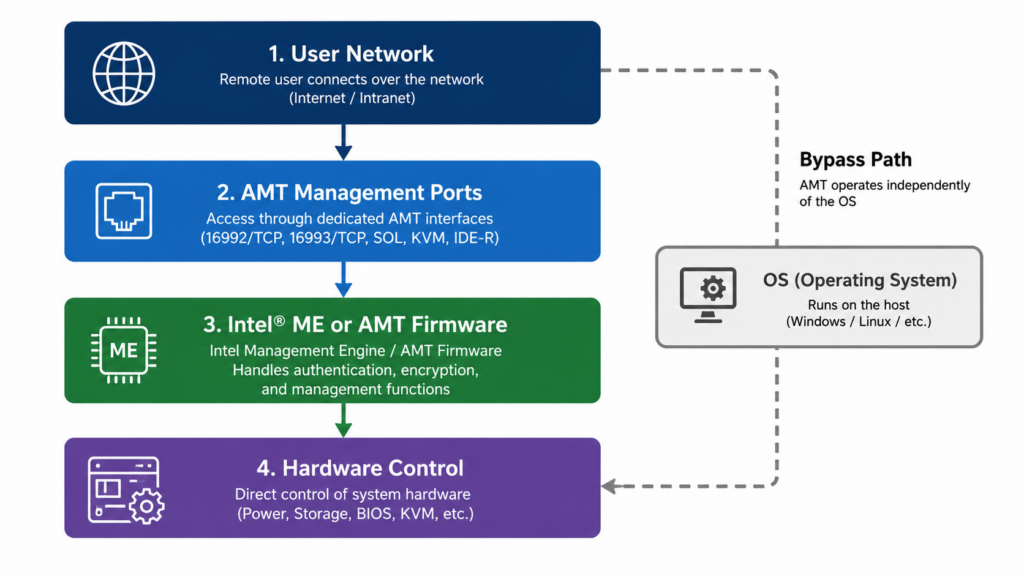
Intel Active Management Technology is meant to solve a real operations problem. Enterprises need to recover machines that are powered off, broken, unmanaged, or unreachable through the normal OS agent. Out-of-band management gives administrators a hardware-backed path to do that.
That design changes security assumptions. A normal remote administration tool lives inside the operating system. It depends on Windows or Linux networking, host firewall policy, local services, endpoint telemetry, and OS-level credentials. AMT does not fit cleanly into that model. Intel’s manageability port documentation states that traffic addressed to certain registered ports can be routed to Intel AMT when enabled, and that messages received on a wired LAN interface go directly to Intel AMT. (Intel)
For a defender, this means three things.
First, asset inventory must include firmware and manageability state, not only operating system version. A fully patched OS does not prove the AMT firmware is fixed.
Second, network exposure matters even when the host looks quiet. A scanner may see ports that are not owned by a normal process visible through netstat or ss inside the OS.
Third, response workflows need an owner. Endpoint security teams may not own BIOS settings, firmware upgrades, AMT provisioning, or OEM support channels. Infrastructure teams may not own vulnerability triage. CVE-2017-5689 lives in the gap between those responsibilities.
This is why the bug was so alarming when disclosed. It touched enterprise manageability, not just software. It affected machines that could sit inside corporate networks for years. It required OEM firmware work, not just a package manager command.
What actually went wrong
The most useful mental model for CVE-2017-5689 is not “someone forgot a password check.” It is “the authentication decision could be fooled.”
Public research and scanner documentation converged on the same practical detection idea: AMT’s web interface used HTTP Digest authentication, and vulnerable systems could accept a malformed or blank digest response. Nmap’s http-vuln-cve2017-5689 script describes its detection method as attempting Digest authentication with a blank response parameter and treating an HTTP 200 response as success. (Nmap)
Tenable’s write-up gives a clear technical account of its rediscovery work. Its researchers provisioned an AMT-capable Dell system, confirmed access to the AMT web interface, observed HTTP Digest authentication, and then tested whether sending only part of the expected response hash would succeed. They reported that authentication succeeded, and that a simple proxy replacement setting the Digest response field to an empty string allowed login to the AMT web interface as admin with any password. (Tenable®)
That last phrase is often misunderstood. It does not mean the password was weak. It means the authentication check could be bypassed. Rotating the AMT admin password is still good hygiene, but it is not the fix for a vulnerable firmware implementation. The fix is firmware remediation or mitigation, plus exposure control.
HTTP Digest, simplified
HTTP Digest authentication normally works like this:
- The client asks for a protected resource.
- The server replies with a challenge, including a realm and nonce.
- The client calculates a response value using the username, password, nonce, method, URI, and other fields.
- The server computes what the response should be.
- The server compares the client’s response with the expected response.
- Access is granted only if the values match.
CVE-2017-5689 broke that trust boundary. The important part is the final comparison and decision. If the server accepts a blank or malformed response, the attacker is not cracking the digest. The attacker is skipping the meaningful proof of knowledge.
For defenders, that makes the bug especially useful to understand. A password policy cannot compensate for a broken verifier. MFA cannot help if the vulnerable management path does not enforce it. EDR cannot reliably stop a path that is handled below the OS. Good network architecture and firmware lifecycle management become the controls that matter.
Affected firmware and resolved versions
Intel states that the issue was observed in manageability firmware versions 6.x, 7.x, 8.x, 9.x, 10.x, 11.0, 11.5, and 11.6 for Intel AMT, Intel SBT, and Intel ISM, and that versions before 6 or after 11.6 are not impacted. Intel’s advisory also lists resolved firmware versions by firmware generation and associated CPU generation, and recommends checking with system OEMs for updated firmware. (Intel)
That OEM dependency is one of the reasons CVE-2017-5689 stayed operationally messy. The vulnerable code sits in firmware distributed through vendors and system models. A fleet might contain Dell, HP, Lenovo, Fujitsu, Panasonic, Toshiba, Intel NUC, and other systems, each with its own firmware update process. CERT/CC’s vulnerability note tracked multiple affected vendors and stated, for example, that some Lenovo ThinkCentre, ThinkPad, ThinkServer, and ThinkStation models were affected, with firmware expected by model; Siemens also stated that several industrial products using Intel technology were affected and that updates or mitigations were being provided. (CERT Coordination Center)
A practical affectedness check should not stop at “Intel CPU present.” It should ask:
| Question | Why it matters |
|---|---|
| Does the system have Intel manageability firmware in an affected range | CPU brand alone is not enough |
| Is AMT, ISM, or SBT present | Not every Intel system exposes the affected capability |
| Is the system provisioned | The network attack path depends on provisioned manageability for AMT and ISM |
| Are AMT ports reachable from attacker-controlled networks | Exposure determines remote exploitability |
| Has OEM firmware been updated | Intel’s fix path depends on resolved firmware |
| Can unsupported systems be unprovisioned or isolated | Some older systems may not receive convenient updates |
Dell’s Avamar advisory is a useful example of precise scoping. Dell repeated the CVE description but concluded that the referenced Avamar Data Store nodes were not vulnerable because, despite Xeon processors with vPro technology, they did not have the ME interface or AMT management firmware required for that product context. (Dell)
That is the level of care defenders need. “VPro present” is a signal, not a verdict. “Port open” is a signal, not a complete exploitability finding. “Firmware affected” is a signal, but exposure and provisioning still determine the immediate attack path.
The ports defenders should know
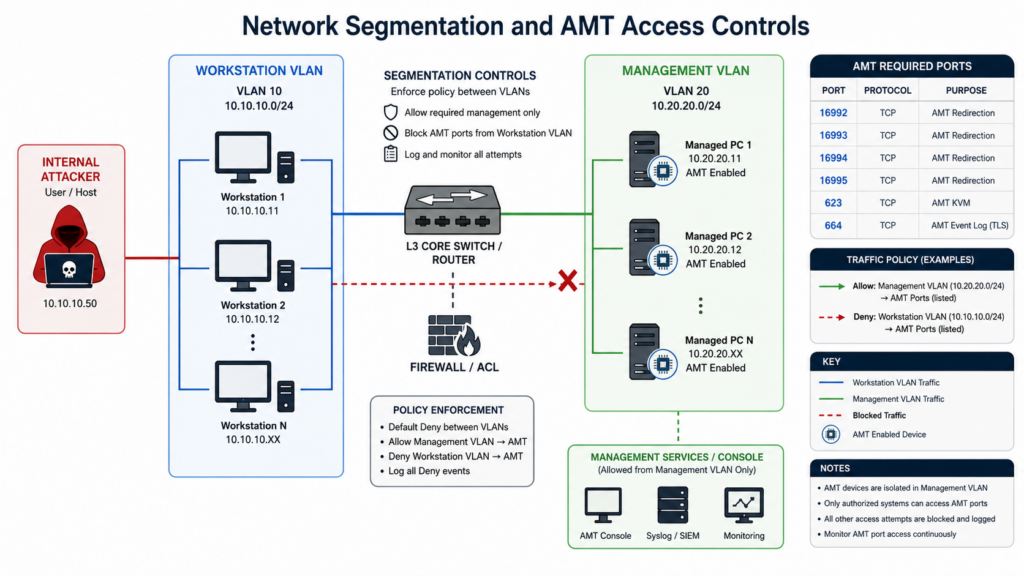
Intel AMT uses a small set of well-known management ports. They deserve special handling in vulnerability management because they may not map to normal OS-owned services.
| Port | Protocol context | AMT use | Defensive priority |
|---|---|---|---|
| 16992 | HTTP | Intel AMT HTTP and WS-Management traffic | High, especially on older systems |
| 16993 | HTTPS | Intel AMT HTTPS and WS-Management over TLS | High |
| 16994 | TCP redirection | Serial-over-LAN, storage redirection, KVM redirection in older contexts | High in management networks |
| 16995 | TLS redirection | TLS-secured redirection traffic | High in management networks |
| 623 | RMCP | ASF remote management and WS-Management related traffic | Medium to high |
| 664 | Secure RMCP | Secure out-of-band web services management | Medium to high |
| 5900 | VNC-style KVM context | Legacy KVM-related usage in some AMT contexts | Investigate if present |
Intel’s current manageability documentation notes a shift away from insecure ports in newer platform generations: starting with Alder Lake platforms using Raptor Lake CPUs and Intel CSME 16.1 firmware, remote connections to insecure AMT ports 16992, 16994, and 623 are no longer supported, and TLS ports must be used; starting with Intel CSME 19 firmware on Arrow Lake, non-TLS connections are not supported at all. (Intel)
That modern behavior should not create false comfort. CVE-2017-5689 is about older affected firmware generations. A 2026 desktop with modern CSME behavior is not the same as a 2014 enterprise workstation sitting in a lab, a branch office, or a forgotten VLAN. Scan and inventory the environment you actually have, not the platform architecture you wish you had.
Why the risk survives inside internal networks
Public internet exposure is bad, but it is not the only risk. AMT is often an internal management feature. Many organizations assume internal-only means safe enough. That assumption fails once an attacker gets a foothold through phishing, VPN compromise, exposed developer infrastructure, stolen credentials, or a vulnerable edge device.
Inside a network, CVE-2017-5689 can be attractive because the target is not a normal application server. It may be a workstation, kiosk, point-of-sale terminal, lab system, engineering machine, or industrial workstation. If AMT is reachable, the attacker may gain a management path that bypasses OS login controls and some endpoint defenses.
The bug also sits in a class of vulnerabilities that age poorly. Application servers get redeployed. Containers get rebuilt. Laptops and embedded workstations may remain in service with the same firmware for years. Asset owners may replace the OS several times without touching BIOS or ME firmware. A vulnerability scanner that only maps OS packages can miss the real problem.
Authorized validation workflow
The safest way to handle CVE-2017-5689 is to separate discovery, affectedness, exploitability, and remediation. Do not jump from an open port to a panic finding. Do not jump from an Intel CPU to a false positive. Follow a chain.
Step 1, define scope
For a production environment, write down:
- The approved CIDR ranges.
- Whether workstations are in scope.
- Whether management VLANs are in scope.
- Whether active AMT authentication testing is allowed.
- Whether testing can be performed during business hours.
- Who owns firmware remediation.
This matters because AMT management testing touches out-of-band control paths. Even safe checks can alarm network monitoring or device owners.
Step 2, find AMT-looking exposure
Start with port discovery. The first pass should be conservative.
nmap -Pn -n \
  -p 16992,16993,16994,16995,623,664 \
  --open \
  10.0.0.0/24
For larger environments, save results in a structured format:
nmap -Pn -n \
  -p 16992,16993,16994,16995,623,664 \
  --open \
  -oA amt-port-sweep \
  10.0.0.0/16
An open port is not proof of CVE-2017-5689. It is a prioritization signal. The next question is whether the service is actually Intel AMT, what version it appears to expose, and whether the system is vulnerable.
Step 3, confirm service identity
A light banner check can help:
curl -sI http://10.0.0.50:16992/ | sed -n '1,12p'
curl -k -sI https://10.0.0.50:16993/ | sed -n '1,12p'
You are looking for signs such as Intel(R) Active Management Technology, but absence of a friendly banner does not prove absence of AMT. Some services may not return enough information to unauthenticated requests.
Step 4, use a purpose-built vulnerability check under authorization
Nmap includes a dedicated NSE script:
nmap -Pn -n \
  -p 16992 \
  --script http-vuln-cve2017-5689 \
  10.0.0.50
Nmap’s documentation says the script detects vulnerable Intel AMT systems by attempting Digest authentication with a blank response parameter and checking whether authentication succeeds with HTTP 200. (Nmap)
For HTTPS AMT endpoints:
nmap -Pn -n \
  -p 16993 \
  --script http-vuln-cve2017-5689 \
  10.0.0.50
Keep this framed as validation, not exploitation for control. The goal is to prove whether the authentication bypass condition exists, then hand the system to the remediation owner.
Step 5, verify locally where possible
Network validation is useful, but local firmware checks give better remediation data. On Linux systems, look for the MEI device:
lspci | grep -iE 'mei|heci|management engine'
ls -l /dev/mei*
Intel published Linux detection and mitigation tooling for INTEL-SA-00075. The GitHub README states that Linux users can run the discovery tool and unprovisioning tool, and it warns that being unable to access /dev/mei0 does not imply the system has no MEI support or is not vulnerable. (GitHub)
A local check may look like:
make clean
make

sudo ./INTEL-SA-00075-Discovery-Tool
sudo ./INTEL-SA-00075-Discovery-Tool -d /dev/mei0
If mitigation rather than full firmware update is required:
sudo ./INTEL-SA-00075-Unprovisioning-Tool
sudo ./INTEL-SA-00075-Unprovisioning-Tool -d /dev/mei0
Do not treat tooling output as the only record. Store firmware version, model, serial number or asset ID, business owner, network segment, and remediation action.
How to classify findings
A mature vulnerability report should not say every AMT-related signal is equal. Use a tiering model.
| Finding state | Example evidence | Risk level | Next action |
|---|---|---|---|
| Confirmed vulnerable and reachable | Nmap NSE confirms blank Digest bypass on AMT port | Critical | Emergency firmware update, isolation, incident review |
| AMT reachable, vulnerable firmware suspected | AMT port open, model and firmware generation match affected range | High | Local Intel tool validation and temporary network restriction |
| AMT present but not externally reachable | Local tool flags affected firmware, ports blocked from user networks | Medium to high | Firmware update or unprovisioning, maintain segmentation |
| AMT capable but not provisioned | Hardware supports AMT but tool shows not provisioned | Medium | Prevent unauthorized provisioning, update firmware where feasible |
| Not affected by product architecture | Vendor confirms no AMT firmware or ME interface in product context | Informational | Record evidence and close |
| Unknown | Asset offline, no owner, incomplete scan data | Triage risk | Inventory cleanup before closure |
This classification does two things. It reduces panic, and it prevents false closure. A vulnerable but non-reachable system is not as urgent as an exposed vulnerable system, but it is not “fixed.” A non-provisioned but affected system may still be locally provisionable under Intel’s local scenario. A system with no AMT firmware in the product context is different from a system that merely failed a scanner check.
Detection signals that actually help
CVE-2017-5689 detection is hard because some activity may not appear in normal host telemetry. You need network visibility, asset context, and firmware inventory.
| Signal | Where to look | Why it matters | Limitation |
|---|---|---|---|
| Connections to 16992 or 16993 | Firewall, NetFlow, Zeek, switch telemetry | AMT web management access | May be legitimate admin traffic |
| Digest authentication anomalies | Proxy, packet capture, IDS where visible | Blank or malformed Digest response patterns may indicate probing | TLS can hide payload unless inspected in an authorized lab |
| Scans across AMT ports | IDS, firewall, NetFlow | Attackers often enumerate management interfaces | Internal vulnerability scanners can look similar |
| RMCP traffic to 623 or 664 | NetFlow, firewall, NDR | Out-of-band management discovery | May be normal in managed environments |
| Management access from non-management VLANs | Firewall policy logs | Indicates segmentation failure | Requires accurate network zone data |
| Unexpected power or KVM actions | AMT console logs, management tooling | High-value evidence of misuse | Logging quality varies by environment |
| Firmware versions in affected range | Endpoint inventory, OEM tools, Intel tool | Determines remediation need | Inventory systems often omit firmware detail |
A simple SIEM-style rule for network visibility might look like this:
title: Intel AMT Management Port Access Outside Management Network
status: experimental
logsource:
  category: firewall
detection:
  selection_ports:
    destination_port:
      - 16992
      - 16993
      - 16994
      - 16995
      - 623
      - 664
  filter_management_sources:
    source_ip|cidr:
      - 10.10.10.0/24
      - 10.10.20.0/24
  condition: selection_ports and not filter_management_sources
fields:
  - source_ip
  - destination_ip
  - destination_port
  - action
  - user
level: high
A Zeek-oriented hunting query might focus on destination ports and service banners:
cat conn.log \
  | zeek-cut ts id.orig_h id.resp_h id.resp_p proto service \
  | awk '$4==16992 || $4==16993 || $4==16994 || $4==16995 || $4==623 || $4==664'
If you collect HTTP logs from lab validation traffic, hunt for AMT server headers:
grep -i "Intel(R) Active Management Technology" http.log
Do not overstate these detections. They are useful for exposure management and suspicious access detection. They do not replace firmware validation.
Remediation that works
The best remediation is to update the affected manageability firmware through the system OEM. Intel’s advisory recommends using its detection tool, checking whether the system has affected firmware, and then checking with the OEM for updated firmware. Intel also notes that resolved firmware versions have a four-digit build number starting with 3, using 8.1.71.3608 as an example. (Intel)
When firmware is available, treat it like a security update with hardware lifecycle implications:
- Identify affected models.
- Map each model to the correct OEM advisory and firmware package.
- Test firmware deployment on a small ring.
- Confirm AMT settings after upgrade.
- Re-run vulnerability validation.
- Record the resolved firmware version in inventory.
When firmware is not available, use compensating controls. Intel’s Linux tooling points users to mitigation and unprovisioning steps when firmware is not available. (GitHub)
| Control | What it solves | What it does not solve |
|---|---|---|
| Firmware update | Fixes the vulnerable implementation | Requires OEM support and deployment success |
| AMT unprovisioning | Removes or reduces the exposed management state | May not be acceptable where AMT is operationally required |
| Disable AMT where possible | Reduces attack surface | BIOS settings vary by vendor and fleet |
| Management network isolation | Prevents broad network reachability | Does not fix firmware |
| Firewall blocks on AMT ports | Reduces reachable attack surface | Can be bypassed by attackers already in allowed segments |
| Password rotation | Reduces credential risk | Does not fix the authentication bypass |
| EDR monitoring | Helps with post-compromise activity | May not see AMT-layer activity |
For network containment on Linux hosts or local firewalls, a rule might look like this:
# Allow AMT management ports only from the approved management subnet.
sudo iptables -A INPUT -p tcp -s 10.10.10.0/24 \
  -m multiport --dports 16992,16993,16994,16995 \
  -j ACCEPT

sudo iptables -A INPUT -p tcp \
  -m multiport --dports 16992,16993,16994,16995 \
  -j DROP
At the network firewall, the same logic is better enforced centrally:
deny tcp any any eq 16992
deny tcp any any eq 16993
deny tcp any any eq 16994
deny tcp any any eq 16995
deny udp any any eq 623
deny tcp any any eq 664

allow tcp MGMT_NET AMT_TARGETS eq 16993
allow tcp MGMT_NET AMT_TARGETS eq 16995
allow udp MGMT_NET AMT_TARGETS eq 664
Use exact syntax for your firewall platform. The important idea is simple: AMT belongs on a management plane, not on flat user networks and not on the public internet.
The false fixes that keep teams exposed
Some controls sound reasonable but do not close CVE-2017-5689.
Changing the AMT password is not enough. The bug bypasses authentication logic. Strong credentials matter only after the firmware is fixed or the vulnerable path is otherwise removed.
Patching Windows or Linux is not enough. The vulnerable component is Intel manageability firmware. OS patching can leave the underlying AMT issue untouched.
Closing only port 16992 is not enough. AMT can use TLS and other management ports. Check 16993, 16994, 16995, 623, and 664 as well.
Assuming “not on the internet” is not enough. Internal attackers, compromised VPN users, malicious insiders, and infected hosts can reach internal management surfaces if segmentation is weak.
Assuming EDR will catch it is not enough. AMT exists to operate out of band. Endpoint telemetry may detect downstream effects, but it is not a reliable control for the management-plane authentication bypass itself.
Assuming “old CVE means low risk” is not enough. CISA KEV status signals known exploitation, and old enterprise hardware often survives longer than vulnerability management dashboards expect.
Why management-plane bugs keep repeating
CVE-2017-5689 belongs to a broader pattern: systems designed to administer other systems become high-impact targets when authentication, exposure, or input handling fails. The details differ, but the operational lesson repeats.
| CVE | Technology area | Why it is relevant | Attack condition | Real risk | Main mitigation |
|---|---|---|---|---|---|
| CVE-2017-5689 | Intel AMT, ISM, SBT firmware | Out-of-band management authentication can fail below the OS | Attacker reaches provisioned AMT or ISM, or can locally provision affected manageability features | Unauthorized control of manageability functions | OEM firmware update, unprovisioning, isolation |
| CVE-2024-3400 | Palo Alto Networks PAN-OS GlobalProtect | Internet-facing remote access and management-adjacent surfaces become critical entry points | Specific vulnerable PAN-OS versions and feature configurations | Unauthenticated command execution as root on affected firewalls | Vendor patches and mitigations |
| CVE-2019-19781 | Citrix ADC and Gateway | Remote access infrastructure becomes a pivot when exposed and unpatched | Unauthenticated access to affected ADC or Gateway versions | Directory traversal leading to code execution in real attacks | Vendor fixes and mitigations |
| CVE-2017-0144 | Microsoft SMBv1, EternalBlue | Infrastructure services can become wormable when broadly reachable | Exposed vulnerable SMBv1 service | Remote code execution and worm propagation | MS17-010 patches, SMBv1 removal, segmentation |
Palo Alto Networks describes CVE-2024-3400 as a command injection vulnerability in the GlobalProtect feature of specific PAN-OS versions and configurations that may let an unauthenticated attacker execute code with root privileges on the firewall. (security.paloaltonetworks.com) CISA described CVE-2019-19781 as an arbitrary code execution vulnerability in Citrix ADC and Citrix Gateway that had been exploited in the wild. (CISA) CISA’s WannaCry alert tied the ransomware’s propagation to the EternalBlue exploit against SMBv1, illustrating how a widely reachable infrastructure service can turn a vulnerability into a major operational event. (CISA)
The shared lesson is not that these bugs are technically identical. They are not. The lesson is that remote access, management, and infrastructure control planes deserve stricter exposure rules than normal application surfaces. When they fail, attackers inherit the privileges those systems were built to provide.
A practical playbook for security teams
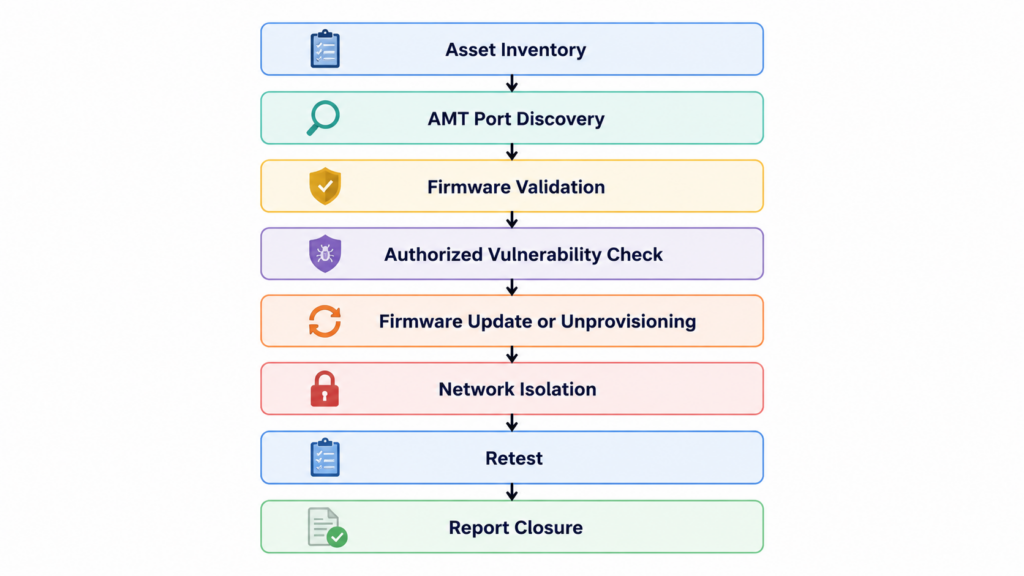
A good CVE-2017-5689 response program does not start with exploit code. It starts with inventory.
Inventory
Collect:
- Device model.
- BIOS version.
- Intel ME or CSME firmware version.
- AMT, ISM, or SBT capability.
- Provisioning state.
- Network segment.
- Owner.
- Business criticality.
- Remote management requirement.
- OEM support status.
The output should be a table, not a Slack thread. Firmware risk is hard enough without losing evidence in chat.
Exposure mapping
Scan for AMT ports across approved networks. Separate results by zone:
for cidr in 10.0.0.0/24 10.1.0.0/24 10.2.0.0/24; do
  nmap -Pn -n \
    -p 16992,16993,16994,16995,623,664 \
    --open \
    -oA "amt-${cidr//\//_}" \
    "$cidr"
done
Convert scan results into a remediation queue:
grep -R "Ports:" amt-*.gnmap \
  | awk '{print $2, $0}' \
  > amt-open-hosts.txt
Validation
For hosts with AMT-like exposure, use Nmap NSE or Intel tooling under authorization. Store the output.
nmap -Pn -n \
  -p 16992,16993 \
  --script http-vuln-cve2017-5689 \
  -oA amt-cve-2017-5689-validation \
  -iL amt-hosts.txt
Remediation
Create remediation tracks:
- Track A: confirmed vulnerable and reachable.
- Track B: affected firmware but not reachable outside management network.
- Track C: AMT capable but not provisioned.
- Track D: unsupported hardware requiring isolation or retirement.
- Track E: not affected, with evidence.
This avoids fighting over every host with the same urgency. The reachable confirmed-vulnerable systems go first. Unsupported systems get a business decision: isolate, replace, or accept documented residual risk.
Retest
After firmware update or unprovisioning, repeat the same validation method. Do not close findings based on a change ticket alone.
A minimal retest record should include:
Asset ID:
Hostname:
IP:
Model:
Old firmware:
New firmware:
AMT state:
AMT ports before:
AMT ports after:
Validation tool:
Validation output path:
Retest date:
Owner:
Residual risk:
This is where AI-assisted pentesting workflows can be useful if they preserve evidence instead of merely generating prose. In an authorized engagement, a tool such as Penligent can help connect asset discovery, CVE validation, command evidence, retest steps, and report generation into a single workflow, as long as the operator controls scope and treats firmware validation as an evidence problem rather than a keyword match. Penligent’s public material emphasizes CVE scanning, verified impact, reproducible evidence, operator-controlled workflows, and one-click reports, which maps naturally to this kind of validation-and-retest loop when used on approved assets. (Penligent)
Penligent’s own AI pentesting workflow article makes a related operational point: CVE validation should not be based only on weak signals such as leaked version strings; the workflow needs traffic, scope, evidence, and a decision about whether validation is justified. That principle applies especially well to CVE-2017-5689, where a vulnerable-looking Intel platform is not enough without firmware, provisioning, and reachability context. (Penligent)
Reporting CVE-2017-5689 without creating noise
A useful finding should read like a technical record, not a scanner dump.
Bad finding:
Host has CVE-2017-5689. Critical. Patch immediately.
Better finding:
The host 10.0.0.50 exposes Intel AMT over TCP 16992 from the workstation VLAN.
Authorized validation using Nmap http-vuln-cve2017-5689 returned VULNERABLE,
indicating the AMT Digest authentication bypass condition associated with
CVE-2017-5689. The system model is Dell ExampleModel 7040, firmware version
8.1.xx.xxxx, which is within Intel's affected firmware range. The asset is
assigned to the engineering lab and is reachable from non-management networks.
A strong finding includes:
- Affected asset and owner.
- Exposure path.
- Validation tool and timestamp.
- Firmware version or affected generation.
- Whether the system is provisioned.
- Whether exploitation was confirmed or inferred.
- Business impact.
- Fix path.
- Temporary containment.
- Retest criteria.
The remediation section should be concrete:
Recommended remediation:
1. Apply the OEM firmware update that resolves INTEL-SA-00075 for this exact model.
2. If AMT is not required, unprovision or disable AMT after firmware update.
3. Restrict AMT ports to the approved management network.
4. Re-run Intel discovery tooling and the Nmap validation script.
5. Close only after the host no longer validates as vulnerable and AMT exposure is limited.
Handling unsupported or unmanaged hardware
The hardest cases are older systems with no clear OEM update path. These devices often sit in labs, manufacturing, healthcare, education, or branch offices. The business may resist replacing them because they run a special tool, license, driver, or connected device.
For those systems, the decision tree should be explicit:
| Condition | Recommended action |
|---|---|
| Firmware update exists | Apply update and retest |
| Firmware update does not exist, AMT not needed | Unprovision or disable AMT, block ports, document result |
| Firmware update does not exist, AMT needed | Restrict to dedicated management network, enforce jump host access, monitor AMT ports |
| System cannot be updated or isolated | Escalate to risk acceptance or replacement |
| Ownership unknown | Treat as unmanaged risk until owner is assigned |
Risk acceptance should not be a casual sentence. It should state:
- Why firmware cannot be updated.
- Why AMT cannot be disabled.
- Which networks can reach AMT.
- What monitoring exists.
- What compensating controls exist.
- When the exception expires.
- Who owns the risk.
Old hardware is not automatically unacceptable. Unowned hardware with exposed management ports is.
What attackers would look for
A defender can think like an attacker without turning the article into an exploitation manual. The attacker’s path is straightforward:
- Find AMT management ports.
- Confirm Intel AMT service behavior.
- Test whether authentication can be bypassed.
- Use management functions to increase control.
- Avoid noisy OS-level actions when possible.
- Pivot to the normal OS only when useful.
The attractive part is not only initial access. It is persistence and control. AMT-like capabilities can include power management, boot redirection, serial-over-LAN, KVM-like workflows, and hardware-level recovery operations depending on configuration and generation. Those are useful for administrators. They are also useful to an attacker who gets unauthorized access.
That is why segmentation and firmware fixes matter more than after-the-fact host cleanup. If an attacker can use the management plane, rebuilding the operating system may not answer the most important question: how did they reach the control plane in the first place?
Why CVE-2017-5689 is not just an Intel story
The deeper issue is security ownership for invisible infrastructure. Enterprises are full of components that are not treated as normal software but still make security decisions:
- Firmware.
- BMCs.
- VPN appliances.
- Load balancers.
- Hypervisors.
- SD-WAN devices.
- Cloud metadata services.
- CI/CD runners.
- Identity connectors.
- Remote monitoring agents.
- Browser management extensions.
- AI agent tool bridges.
When those layers expose management functions, they become part of the attack surface. When they are not in inventory, they become blind spots.
CVE-2017-5689 forced teams to ask uncomfortable questions:
- Do we know which machines support AMT?
- Do we know which ones are provisioned?
- Do we know which firmware versions are running?
- Do we know who can reach AMT ports?
- Do we know whether old devices were unprovisioned before reuse or resale?
- Do we know whether our scanner can see firmware risk?
- Do we know whether endpoint telemetry would catch abuse?
Those questions are still relevant. Replace AMT with BMC, VPN portal, developer console, remote management agent, or AI tool executor, and the structure remains the same.
Safe lab validation
For security researchers and defenders, lab validation is the right place to understand the bug. Use hardware you own, isolate it, and avoid testing third-party IPs. A basic lab might include:
- One AMT-capable system with affected firmware in a controlled network.
- One management workstation.
- A separate VLAN with no production access.
- Packet capture.
- Nmap.
- Intel detection tooling.
- A written test plan.
A safe test plan should avoid destructive management actions. You do not need to power-cycle systems, change boot devices, or alter AMT configuration to prove the authentication bypass. The validation should stop at confirming vulnerable authentication behavior and collecting enough evidence for remediation.
Example lab evidence checklist:
[ ] Asset model recorded
[ ] Firmware version recorded
[ ] AMT provisioning state recorded
[ ] AMT ports captured in Nmap output
[ ] Vulnerability check output saved
[ ] Packet capture saved if policy allows
[ ] No destructive management actions performed
[ ] Firmware update applied
[ ] Post-update validation saved
[ ] AMT exposure restricted or disabled
This discipline matters because public PoCs for CVEs are not inherently trustworthy. A 2022 academic study of GitHub-hosted PoCs for vulnerabilities disclosed from 2017 through 2021 found malicious indicators in 899 out of 47,285 repositories, about 1.9 percent of the studied set. (arXiv)
Use reputable tools, inspect code before running it, and prefer vendor detection utilities or well-maintained scanners for production validation.
Patch prioritization
CVE-2017-5689 should be high priority when any of the following are true:
- AMT ports are reachable from user networks.
- AMT ports are reachable from VPN networks.
- AMT is reachable from the internet.
- The asset has privileged access to sensitive environments.
- The system is in a lab, OT, manufacturing, or medical network where patching is irregular.
- The system is unsupported or lacks ownership.
- The system is shared, reused, or purchased secondhand.
- The firmware version falls within Intel’s affected range.
- Nmap or Intel tooling confirms vulnerability.
It may still require action, but with lower emergency priority, when:
- AMT is present but unprovisioned.
- AMT is blocked from all non-management networks.
- The system has a confirmed resolved firmware version.
- The vendor confirms the product architecture lacks AMT firmware or ME interface.
- The device is scheduled for near-term retirement and is isolated.
Prioritization should be evidence-driven. CVSS tells you the worst-case technical severity. Exposure tells you urgency. Asset criticality tells you business impact.
Procurement and lifecycle lessons
CVE-2017-5689 also belongs in procurement conversations. When buying enterprise hardware, teams should ask vendors:
- How are ME or CSME firmware updates delivered?
- Are AMT settings centrally manageable?
- Can AMT be disabled or unprovisioned at scale?
- How long will firmware updates be provided?
- Are firmware versions exported into inventory tools?
- Can devices be shipped with AMT disabled by default?
- What happens at end of support?
- How are returned, resold, or redeployed devices sanitized?
For device retirement, include AMT state in the wipe process. Reinstalling the OS does not necessarily reset manageability configuration. A decommissioning checklist should include BIOS, firmware, AMT provisioning, certificates, management accounts, and network access.
FAQ
Is CVE-2017-5689 still relevant today?
- Yes, for environments with older Intel business systems, unsupported hardware, lab machines, industrial workstations, or incomplete firmware inventory.
- NVD records CVE-2017-5689 as a critical CVSS 9.8 issue and identifies it as part of CISA’s Known Exploited Vulnerabilities catalog. (NVD)
- The main risk is not that every modern Intel system is affected. The risk is that old, provisioned, reachable AMT systems can remain hidden from normal OS patch workflows.
- The correct action is to inventory, validate, patch or unprovision, isolate, and retest.
Is CVE-2017-5689 a remote code execution vulnerability?
- Intel and NVD describe it primarily as an escalation of privilege issue affecting Intel manageability features, not as a normal application-layer RCE. (Intel)
- Some vendor or third-party descriptions have used stronger language because AMT control can have severe practical impact.
- The precise technical issue is an authentication bypass in manageability firmware.
- The practical risk is unauthorized control of out-of-band management functions, which can be as serious as or worse than many OS-level bugs.
Which ports should I check first?
- Start with TCP 16992 and 16993 for AMT web and WS-Management access.
- Also check 16994, 16995, 623, and 664 because AMT and related manageability functions can use those ports.
- Intel’s manageability documentation lists these ports and explains their AMT management roles. (Intel)
- Do not assume closing 16992 alone is enough.
Does changing the AMT admin password fix CVE-2017-5689?
- No, not by itself.
- The vulnerability is an authentication bypass, so the attacker does not need to know the correct password if the vulnerable path is reachable.
- Password rotation is still useful after firmware remediation, especially if AMT credentials were old, shared, or exposed.
- The real fix is OEM firmware update, or mitigation such as unprovisioning and network isolation when updates are unavailable.
Can EDR detect exploitation of CVE-2017-5689?
- EDR may detect later attacker activity inside the operating system.
- EDR should not be treated as the primary control for AMT-layer exploitation because AMT is out-of-band and below normal OS visibility.
- Network monitoring, firmware inventory, AMT configuration review, and management-plane segmentation are more relevant.
- Use EDR as one layer, not the deciding control.
How do I know whether a system is affected?
- Check whether the system has Intel AMT, ISM, or SBT capability.
- Confirm firmware version against Intel’s affected range and resolved firmware guidance.
- Use Intel’s discovery tooling or OEM guidance where possible.
- Check whether AMT is provisioned and whether its ports are reachable.
- Validate only inside an authorized scope using vendor tools or trusted scanners.
What should I do if the OEM no longer provides firmware?
- Disable or unprovision AMT if the business does not need it.
- Restrict all AMT ports to a dedicated management network if AMT must remain available.
- Remove unsupported systems from sensitive network zones.
- Create a documented exception only with owner, expiration date, compensating controls, and replacement plan.
- Retire systems that cannot be updated, isolated, or monitored to an acceptable level.
Closing judgment
CVE-2017-5689 is a reminder that the most important attack surface is not always the one running inside the operating system. A vulnerable AMT interface can sit below host controls, outside normal patch habits, and inside networks that were never designed to defend against a compromised management plane.
The right response is not panic. It is disciplined validation. Find the systems. Confirm the firmware and provisioning state. Check the ports. Use trusted tools. Apply OEM firmware where available. Unprovision or disable what you do not need. Isolate what you must keep. Retest before closing.
Old firmware bugs become serious when nobody owns them. The best defense against CVE-2017-5689 is ownership: of inventory, management-plane exposure, remediation evidence, and the lifecycle of the hardware itself.


 English
  German
  French
  Spanish
  Portuguese
  Japanese
  Korean
  Hindi
Hindi  Arabic
  Turkish
  Hebrew