
Microsoft’s September 2026 Patch Tuesday includes a Windows vulnerability that deserves significantly more attention than its CVSS 7.8 score might initially suggest.
Tracked as CVE-2026-81963, the flaw affects the Windows Update Stack and allows an attacker who already has low-privileged local access to escalate privileges to SYSTEM, the highest commonly used security context on Windows endpoints.
More importantly, this is not a theoretical vulnerability waiting for attackers to discover it.
Microsoft has confirmed that CVE-2026-81963 was exploited in the wild before the security update became available, making it a genuine Windows zero-day. Tenable independently highlights the vulnerability as one of two actively exploited zero-days fixed in Microsoft’s September 2026 security release. (Tenable®)
CISA subsequently added CVE-2026-81963 to its Known Exploited Vulnerabilities catalog, describing it as a Microsoft Windows link-following vulnerability capable of allowing a local attacker to escalate privileges up to SYSTEM. (Vulners)
For defenders, the combination is significant:
Windows Update Stack + low-complexity local exploitation + SYSTEM privileges + confirmed active exploitation.
The vulnerability does not provide remote initial access by itself. An attacker generally needs to obtain some degree of execution on the target first. But that does not substantially reduce its importance.
Modern attacks frequently operate as chains.
A phishing payload, browser exploit, malicious document, stolen user session, exposed application, infostealer, or remote-access tool may initially execute with ordinary user permissions. CVE-2026-81963 can potentially provide the next step: crossing the privilege boundary from that limited foothold into SYSTEM-level control.
That makes CVE-2026-81963 especially valuable as a post-exploitation privilege-escalation primitive.
What Is CVE-2026-81963?
CVE-2026-81963 is an Elevation of Privilege vulnerability in the Windows Update Stack.
Microsoft describes the underlying weakness as:
Improper link resolution before file access in Windows Update Stack.
The vulnerability has been mapped to CWE-59: Improper Link Resolution Before File Access as well as CWE-284: Improper Access Control. (Vulners)
The CVSS 3.1 vector is:
CVSS:3.1/AV:L/AC:L/PR:L/UI:N/S:U/C:H/I:H/A:HThe resulting base score is 7.8 High. (Tenable®)
Breaking that vector down:
| Metric | Value | Meaning |
|---|---|---|
| Attack Vector | Local | Attacker requires local execution |
| Attack Complexity | Low | No particularly complex exploitation conditions are required |
| Privileges Required | Low | An ordinary low-privileged account may be sufficient |
| User Interaction | None | Victim interaction is not required during exploitation |
| Scope | Unchanged | Exploitation remains within the affected security authority |
| Confidentiality | High | SYSTEM access can expose sensitive data |
| Integrity | High | Attackers may modify protected system resources |
| Availability | High | SYSTEM privileges can disrupt or disable the machine |
| CVSS | 7.8 | High severity |
| Exploited | Yes | Microsoft reports exploitation in the wild |
| CISA KEV | Yes | Added September 8, 2026 |
The most consequential part of this profile is not the numerical score.
It is the transition:
Low-privileged local user
          ↓
CVE-2026-81963
          ↓
SYSTEM
Once an attacker controls a process running as SYSTEM, many security restrictions applied to normal users cease to represent meaningful barriers.
Why CVE-2026-81963 Is a Real Zero-Day
The term “zero-day” is frequently used too loosely in vulnerability reporting. CVE-2026-81963 qualifies in the security-relevant sense because exploitation was occurring before defenders had access to the corresponding September 2026 patch.
Microsoft classified the vulnerability as exploited in the wild when it published the September 8 security updates. Tenable similarly identifies it as a zero-day and notes that Windows Update Stack elevation-of-privilege vulnerabilities have appeared previously, but CVE-2026-81963 is the first such Update Stack EoP vulnerability since 2022 known to have been exploited in the wild as a zero-day. (Tenable®)
The Zero Day Initiative also places CVE-2026-81963 among the vulnerabilities under active attack in its September 2026 review.
However, ZDI makes an important observation: the public record still contains little information about how broadly the vulnerability has been exploited. It also cautions against assuming that the Windows automatic update mechanism itself has been compromised. One plausible scenario is that attackers are chaining this privilege-escalation vulnerability with another execution vector after initially gaining access to a machine. (Zero Day Initiative)
That distinction is essential.
CVE-2026-81963 is not currently documented as a remote unauthenticated compromise of Windows Update.
The vulnerability exists in the Windows Update Stack, but this does not mean attackers can remotely push malicious Windows updates through Microsoft’s infrastructure.
Instead, the publicly available evidence points toward a local privilege-escalation vulnerability involving link-following behavior inside privileged Windows functionality.
How Windows Privilege Escalation Fits Into a Real Attack
A vulnerability such as CVE-2026-81963 makes the most sense when viewed as one stage of a larger intrusion.
Consider an attacker who compromises an employee workstation.
The initial execution may happen as:
CORP\aliceThe attacker now has code execution, but their capabilities remain limited.
They may not be able to:
- dump protected credentials;
- modify security-sensitive registry locations;
- install privileged services;
- tamper with EDR components;
- access another user’s protected files;
- manipulate system-wide configuration;
- obtain machine account secrets;
- install drivers;
- access privileged process memory;
- create certain persistence mechanisms.
For an attacker, privilege escalation therefore becomes one of the highest-priority post-compromise objectives.
MITRE ATT&CK tracks this behavior as T1068 — Exploitation for Privilege Escalation, describing how adversaries exploit vulnerabilities in operating-system or privileged components to move from user-level permissions to higher privileges such as SYSTEM. (MITRE ATT&CK)
CVE-2026-81963 fits directly into that model.
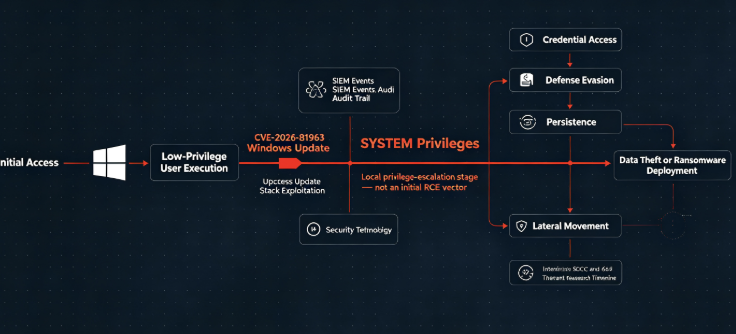
A conceptual attack chain could therefore look like this:
Initial Access
     │
     ▼
Remote Code Execution / Malicious Payload
     │
     ▼
Low-Privilege User Process
     │
     ▼
CVE-2026-81963
Windows Update Stack
     │
     ▼
SYSTEM Privileges
     │
     ├── Credential Access
     ├── Defense Evasion
     ├── Persistence
     ├── Local Discovery
     ├── Lateral Movement
     └── Data Theft / Ransomware Deployment
This diagram is an architectural model, not a claim that Microsoft has observed this exact sequence in the attacks exploiting CVE-2026-81963.
As of September 9, 2026, neither Microsoft nor CISA has publicly attributed exploitation to a specific threat group or published the complete observed exploit chain.
Understanding the Link-Following Vulnerability Behind CVE-2026-81963
The most interesting technical clue in Microsoft’s disclosure is CWE-59: Improper Link Resolution Before File Access.
This vulnerability class appears when a privileged process performs an operation on a filesystem object but does not sufficiently protect itself against that object being redirected somewhere unexpected.
On Windows, several filesystem mechanisms can influence where a path ultimately resolves.
These include concepts such as:
- symbolic links;
- junctions;
- mount points;
- NTFS reparse points;
- object-manager symbolic links;
- other path redirection mechanisms.
The exact primitive used by CVE-2026-81963 has not been publicly documented, so it would be irresponsible to claim that a particular junction or reparse-point sequence reproduces the vulnerability.
But the general security problem is well understood.
Imagine a privileged component intends to modify:
C:\ProgramData\Application\Temp\update.tmpThe component validates that location and concludes that it is safe.
An attacker somehow causes the path to resolve elsewhere before the privileged file operation occurs:
C:\ProgramData\Application\Temp\update.tmp
                      │
                      └────────────► privileged_target
If the privileged process follows the attacker-controlled link without correctly validating the resolved target, the attacker may be able to transform a legitimate privileged operation into an unauthorized modification of another object.
The critical principle is that:
Checked path != final path accessedwhen link resolution can change the meaning of that path.
That becomes dangerous when the operation is performed by a SYSTEM process.
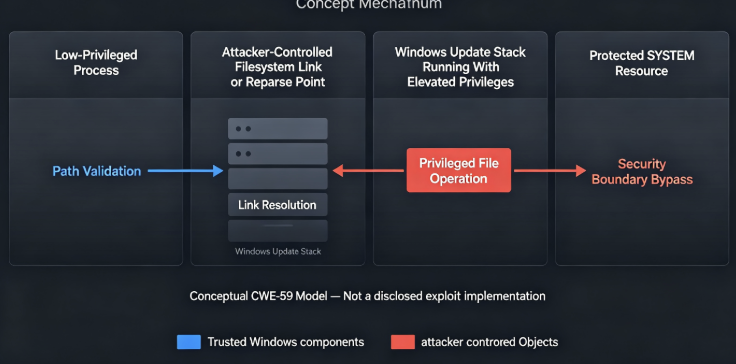
A Simplified Link-Following Example
Consider a hypothetical privileged updater.
Its intended behavior is:
1. Create temporary file
2. Validate temporary directory
3. Write updated data
4. Replace old file
5. Delete temporary data
The updater assumes:
C:\UpdateTemp\payload.tmpstill references the same file after validation.
But if a lower-privileged attacker can manipulate filesystem redirection, the logical sequence may become:
Updater checks:
C:\UpdateTemp\payload.tmp

         ↓

Attacker changes path resolution

         ↓

Updater performs privileged operation

         ↓

Actual target:
C:\Windows\SomeProtectedLocation\...
This class of bug can potentially turn actions such as:
Create
Delete
Rename
Move
Overwrite
Set permissions
into privilege-escalation primitives.
Again, this is an explanation of CWE-59, not a published exploit for CVE-2026-81963.
Microsoft has not disclosed enough implementation detail to establish which privileged file operation or link mechanism is involved in the real exploit.
Why File Operations Can Become Privilege Escalation
At first glance, a filesystem bug may sound less dangerous than memory corruption.
In practice, privileged file manipulation can be extremely powerful.
Suppose an attacker can cause SYSTEM to overwrite a protected resource.
Depending on the affected resource and surrounding security controls, this could potentially lead to:
Privileged file modification
        ↓
Trusted executable or configuration altered
        ↓
Privileged component loads attacker-controlled content
        ↓
Code executes as SYSTEM
Alternatively:
Privileged arbitrary delete
        ↓
Security-sensitive resource removed
        ↓
Attacker recreates replacement under weaker permissions
        ↓
Privileged code consumes replacement
        ↓
Privilege escalation
Or:
Privileged path redirection
        ↓
Unexpected protected destination
        ↓
SYSTEM performs attacker-influenced filesystem operation
The precise chain varies enormously between vulnerabilities.
This is why defenders should not interpret “link following” as merely a filesystem integrity problem. When the component performing the operation runs with elevated privileges, filesystem confusion can become a direct boundary violation.
Why the Windows Update Stack Is an Interesting Target
Windows updating necessarily involves operations that normal applications rarely need.
An operating-system servicing mechanism may need to interact with:
- protected Windows files;
- system components;
- servicing metadata;
- privileged directories;
- pending update state;
- package databases;
- components requiring replacement during reboot;
- security-sensitive operating-system resources.
Those operations require significant privilege.
That creates a fundamental security requirement:
Every boundary between attacker-controlled filesystem state and privileged servicing logic must be carefully validated.
A bug in this area becomes especially attractive because attackers do not necessarily need to invent a new high-privilege process. The operating system already contains trusted components capable of privileged actions.
The attacker instead looks for a way to make that trusted component operate on the wrong object.
The Confused Deputy Problem
A useful way to understand bugs like CVE-2026-81963 is through the concept of a confused deputy.
The low-privileged attacker cannot directly perform an action.
For example:
Attacker
   │
   ├── cannot modify protected resource
   │
   ▼
Permission denied
But a trusted SYSTEM component can.
The attacker therefore manipulates inputs so the privileged component unknowingly performs the sensitive action:
Attacker-controlled filesystem state
             │
             ▼
      SYSTEM component
             │
             ▼
      Privileged action
             │
             ▼
Attacker-controlled security outcome
The privileged process becomes the deputy.
The vulnerability exists because it fails to maintain the intended trust boundary while resolving the attacker-influenced path.
CVE-2026-81963 Does Not Mean Windows Update Servers Were Hacked
Because the vulnerable component is called Windows Update Stack, headlines can easily create the wrong impression.
There is currently no public evidence that CVE-2026-81963 allows an attacker to compromise Microsoft’s update infrastructure, forge Windows Update packages, or remotely push arbitrary patches onto unexposed Windows machines.
The disclosed CVSS vector starts with:
AV:Lmeaning Local Attack Vector.
It also requires:
PR:Lmeaning the attacker already needs low privileges.
The vulnerability is therefore better understood as:
Existing local compromise
        +
CVE-2026-81963
        =
SYSTEM privilege escalation
rather than:
Internet attacker
        ↓
Windows Update
        ↓
Instant remote compromise
This distinction matters both technically and operationally.
Why Local Privilege Escalation Is Still Extremely Dangerous
Security teams sometimes prioritize remote code execution vulnerabilities while delaying local privilege-escalation patches.
That approach can become dangerous when the LPE is already being exploited.
Many real-world compromises begin with limited privileges.
Initial-access techniques often provide exactly that:
Browser sandbox process
User-level malware
Compromised employee account
Office application
Low-privileged service
Remote access session
Application worker process
The attacker then needs a privilege boundary escape.
A reliable Windows LPE can dramatically increase the value of an initial compromise.
Think of the intrusion as a multiplication problem:
Initial Access
×
Privilege Escalation
×
Credential Access
×
Lateral Movement
=
Domain-scale compromise
Removing one step can disrupt the chain.
That is why actively exploited LPE vulnerabilities are strategically important even when their CVSS scores remain below Critical.
Potential Attack Scenario
A realistic conceptual scenario might begin with an employee receiving a malicious attachment.
The initial payload obtains execution as the user:
WIN11-LAPTOP
User: alice
Integrity: Medium
At this stage, the malware encounters restrictions.
It cannot easily access resources belonging to SYSTEM.
The attacker then deploys a privilege-escalation exploit.
Conceptually:
Phishing / exploit / credential abuse
                │
                ▼
       User-level execution
                │
                ▼
       CVE-2026-81963
                │
                ▼
     Windows Update Stack
                │
                ▼
          SYSTEM token
With SYSTEM-level execution, the attack can proceed toward more damaging objectives.
Possible post-escalation actions could include:
SYSTEM
 ├─► dump locally accessible credentials
 ├─► manipulate security controls
 ├─► establish privileged persistence
 ├─► inspect sensitive configuration
 ├─► access protected files
 ├─► deploy additional tooling
 └─► prepare lateral movement
There is currently no public evidence that all or any of these specific post-exploitation actions were used in the observed CVE-2026-81963 campaign.
They illustrate why SYSTEM-level privilege escalation matters.
Active Exploitation Changes the Priority
CVSS is useful, but it is not a complete risk model.
Compare two vulnerabilities:
Vulnerability A
CVSS: 9.8
No known exploitation
Complex operational exposure
Limited reachable assets

Vulnerability B
CVSS: 7.8
Working exploit used by attackers
Hundreds or thousands of Windows endpoints
SYSTEM privilege escalation
It would be difficult to justify patching purely according to the numerical order.
CVE-2026-81963 is Vulnerability B.
Its real-world exploitation status should override a simplistic severity-based patch queue.
CISA reached the same operational conclusion by putting it into the KEV catalog. (Vulners)
CISA KEV Status
CISA added CVE-2026-81963 to the Known Exploited Vulnerabilities catalog on September 8, 2026.
The KEV description states that Microsoft Windows Update Stack contains a link-following vulnerability allowing a local attacker to escalate privileges up to SYSTEM. (Vulners)
That is particularly important because inclusion in KEV is based on evidence of exploitation rather than theoretical exploitability.
For vulnerability-management teams, KEV inclusion should move CVE-2026-81963 toward the top of the remediation queue.
Organizations do not need to be U.S. federal agencies to adopt the same prioritization philosophy.
A reasonable enterprise hierarchy is:
Actively exploited + Internet exposed
              ↓
Actively exploited + post-exploitation value
              ↓
Public working exploits
              ↓
Exploitation likely
              ↓
High severity but theoretical
CVE-2026-81963 belongs near the top of that hierarchy.
Affected Windows Versions
Microsoft’s current advisory data identifies affected Windows 11 and Windows Server 2025 releases.
The relevant September security builds include:
| Platform | Patched Build | September Update |
|---|---|---|
| Windows 11 23H2 | 22631.7582 | KB5122880 |
| Windows 11 24H2 | 26100.9445 | KB5124008 |
| Windows 11 25H2 | 26200.9445 | KB5124008 |
| Windows 11 26H1 | 28000.2954 | KB5124012 |
| Windows Server 2025 | 26100.33438 | KB5122871 |
Microsoft’s September Windows client image documentation confirms Windows 11 23H2 build 22631.7582 with KB5122880, while Microsoft’s Windows Server image documentation lists Server 2025 build 26100.33438 with KB5122871. (Microsoft Support)
For Windows 11 24H2 and 25H2, Microsoft’s September 8 release notes identify KB5124008, producing builds 26100.9445 and 26200.9445 respectively. (Microsoft Support)
Security teams should still use Microsoft’s Security Update Guide and their endpoint-management platform as the authoritative source when determining applicability to a specific fleet.
How to Check Whether a Windows Machine Is Patched
Administrators can first retrieve the current Windows build from PowerShell:
Get-ComputerInfo | Select-Object WindowsProductName, WindowsVersion, OsBuildNumberAnother option is:
[System.Environment]::OSVersion.VersionTo inspect recently installed hotfixes:
Get-HotFix |
    Sort-Object InstalledOn -Descending |
    Select-Object -First 20
Specific KBs can be queried individually:
Get-HotFix -Id KB5124008For Windows 11 23H2:
Get-HotFix -Id KB5122880For Windows 11 26H1:
Get-HotFix -Id KB5124012For Windows Server 2025:
Get-HotFix -Id KB5122871If the command returns the relevant update, that provides one indicator that the cumulative security update has been installed.
Organizations should preferably validate both:
Installed KB
+
OS build
rather than relying on a single inventory field.
Fleet-Wide Verification With PowerShell
Administrators managing multiple Windows endpoints can collect the OS build and latest installed updates using a simple defensive inventory script:
$os = Get-CimInstance Win32_OperatingSystem

$latestHotfixes = Get-HotFix |
    Sort-Object InstalledOn -Descending |
    Select-Object -First 10

Write-Output "Computer: $env:COMPUTERNAME"
Write-Output "OS: $($os.Caption)"
Write-Output "Version: $($os.Version)"
Write-Output "Build: $($os.BuildNumber)"
Write-Output ""
Write-Output "Recent Updates:"

$latestHotfixes |
    Select-Object HotFixID, InstalledOn |
    Format-Table -AutoSize
In enterprise environments, the same information is usually better collected through:
- Microsoft Intune;
- Configuration Manager;
- endpoint management platforms;
- vulnerability scanners;
- EDR inventory;
- PowerShell Remoting;
- asset-management systems.
The key objective is not merely installing the patch but proving coverage.
Patch Verification Matters More Than Patch Deployment
One of the easiest mistakes during an emergency patching event is treating:
Patch deployment initiatedas equivalent to:
System protectedThose are different states.
A useful remediation workflow is:
Identify affected endpoints
        ↓
Deploy September security update
        ↓
Verify installation
        ↓
Verify expected build number
        ↓
Complete restart if required
        ↓
Re-scan
        ↓
Investigate failed or stale systems
Microsoft has specifically noted that some September 2026 security improvements touch components that cannot complete servicing without a restart. For Windows Server 2025 hotpatch environments, September is a baseline update and affected systems need a restart to finish installation. (Microsoft Support)
This matters because a dashboard showing an update as “downloaded” is not enough evidence that the machine has reached the patched security state.
Patch CVE-2026-81963 Before Waiting for a Public PoC
Security teams sometimes wait for public proof-of-concept code before escalating remediation.
That logic is inverted for CVE-2026-81963.
Microsoft already says exploitation has occurred.
A public GitHub repository is not required to prove the threat exists.
In fact:
No public PoCand:
No exploitare completely different statements.
The current situation is closer to:
Exploit exists
        ↓
Attackers have used it
        ↓
Technical details remain largely private
That is arguably more concerning than a noisy public PoC that defenders have already incorporated into detection systems.
Why Public Exploit Details Are Still Limited
As of September 9, 2026, Microsoft has not publicly documented:
- the exact vulnerable Windows Update Stack function;
- the privileged filesystem operation being redirected;
- the exact link type used during exploitation;
- a triggering directory or filename;
- exploit source code;
- indicators specific to the exploit;
- the attacker responsible for exploitation;
- the malware family using it;
- the initial-access method;
- exploitation volume.
ZDI similarly notes that little is publicly known about the breadth of exploitation. (Zero Day Initiative)
This creates an important challenge for threat detection.
Without an exploit-specific behavioral signature, defenders cannot simply search for:
CVE-2026-81963 = Event ID XNo such authoritative mapping has been publicly disclosed.
Detection therefore needs to operate at several layers.
Detection Strategy for CVE-2026-81963
The strongest defensive strategy currently combines:
Patch-state detection
+
Privilege-transition monitoring
+
Filesystem abuse telemetry
+
Process behavior
+
Post-exploitation hunting
Patch-state detection should remain the highest-confidence control.
If an endpoint is known to be vulnerable and the vulnerability is actively exploited, the first question is whether it can be updated immediately.
Behavioral hunting then provides additional defense for potentially compromised machines.
Hunt for Unexpected Privilege Transitions
CVE-2026-81963 ultimately matters because an attacker can move from low privileges to SYSTEM.
Security teams should therefore look for unusual transitions where an ordinary user-controlled execution chain rapidly produces highly privileged activity.
A conceptual detection pattern is:
User process
      ↓
Unexpected system interaction
      ↓
SYSTEM process or child
      ↓
Sensitive action
Useful signals include:
- new SYSTEM-level processes following user execution;
- unexpected service creation;
- unusual scheduled-task creation;
- processes acquiring privileged tokens;
- suspicious child processes spawned by trusted SYSTEM components;
- security tooling suddenly terminated after an elevation event;
- credential-access behavior shortly after local execution.
These signals are not unique to CVE-2026-81963.
That is precisely why they remain useful before exploit-specific indicators become public.
MITRE’s current detection strategy for T1068 Exploitation for Privilege Escalation recommends correlating exploitation of vulnerable operating-system components with unusual process or token behavior. MITRE specifically identifies process creation and privileged-session telemetry as useful inputs. (MITRE ATT&CK)
Monitor Suspicious Filesystem Redirection
Because Microsoft classifies CVE-2026-81963 as improper link resolution, organizations with sufficiently rich telemetry may also consider monitoring abnormal link and reparse-point activity near privileged servicing operations.
Potentially interesting behaviors include:
Untrusted process
        ↓
Creates/manipulates filesystem redirection
        ↓
Privileged Windows component accesses same path
        ↓
Protected resource modified
Important caution:
This is a behavioral hunting hypothesis derived from CWE-59, not a confirmed CVE-2026-81963 exploit signature.
Creating junctions or reparse points is not inherently malicious.
Many legitimate applications use filesystem redirection.
A useful detector therefore needs contextual correlation rather than simply alerting every time a link exists.
High-Signal Correlation Beats Single Events
A better model is:
Low-privilege process
        +
unusual filesystem redirection
        +
Windows servicing activity
        +
unexpected SYSTEM execution
        =
higher-confidence alert
Individual events may be legitimate.
The sequence is what becomes interesting.
This is particularly important for privilege-escalation exploits, where attackers often operate for only a fraction of a second inside the vulnerable component before transitioning into a new SYSTEM process.
Sysmon Can Improve Visibility
Organizations using Sysmon can capture information relevant to post-exploitation hunting.
Useful categories include:
Process creation
File creation
Process access
Driver loading
Registry modification
Network connections
For example, Process Create events can help establish parent-child relationships around a suspected escalation.
Rather than looking exclusively for a known exploit executable name—which attackers can trivially change—analysts should ask:
What low-privileged process ran immediately before the first unexpected SYSTEM activity on the endpoint?
Timeline reconstruction is frequently more reliable than filename-based hunting.
Windows Security Logs
Windows Security telemetry can also contribute.
Relevant event categories may include:
4688 – New process created
4672 – Special privileges assigned to new logon
4697 – Service installed
4698 – Scheduled task created
4720 – User account created
The presence of one of these events does not prove exploitation.
But a chain such as:
Suspicious user process
     ↓
privilege escalation
     ↓
SYSTEM process
     ↓
new service
     ↓
credential dumping
is substantially more actionable.
Example Hunting Logic
A generic SIEM hunting query might focus on unexpected SYSTEM execution following a user-level process.
The implementation depends on the EDR platform, but conceptually:
SELECT *
FROM process_events
WHERE user = "NT AUTHORITY\SYSTEM"
AND parent_process NOT IN known_system_parents
AND timestamp BETWEEN suspected_compromise_time
                  AND suspected_compromise_time + 10 minutes
A second search might examine filesystem manipulation shortly before elevation:
SELECT *
FROM filesystem_events
WHERE action IN (
    "symlink_create",
    "reparse_point_create",
    "junction_create"
)
AND initiating_user NOT IN privileged_accounts
ORDER BY timestamp
These queries are deliberately generic.
No publicly validated CVE-2026-81963 exploit indicator currently justifies narrowing them to a particular path or executable.
Post-Exploitation Detection May Be Easier Than Exploit Detection
There is another practical lesson.
Security teams often spend enormous effort trying to detect the exploit primitive itself.
But if exploitation succeeds, attackers usually do something with the new privileges.
SYSTEM access is rarely the final objective.
That means defenders can hunt for the behavior immediately following privilege escalation.
Examples include:
Credential dumping
LSASS access
SAM / SECURITY hive access
Service installation
EDR tampering
Firewall changes
Persistence creation
Remote administration tool deployment
Shadow copy manipulation
New privileged accounts
Lateral movement
The exploit might be sophisticated.
The attacker’s next steps may be considerably noisier.
CVE-2026-81963 and Credential Theft
SYSTEM privilege is particularly relevant to credential access.
Windows contains credentials and authentication material that ordinary users cannot normally access.
After privilege escalation, an attacker may attempt to inspect:
- LSASS;
- cached credentials;
- registry secrets;
- service-account configuration;
- machine credentials;
- local security databases;
- authentication tokens.
The exact feasibility depends on protections such as Credential Guard, LSASS protection and EDR controls.
But privilege escalation significantly changes the attacker’s position.
This is why an LPE can have consequences far beyond one workstation.
The endpoint may become the bridge toward identity infrastructure.
Why Domain Environments Should Treat CVE-2026-81963 Seriously
Imagine CVE-2026-81963 exists on an administrator workstation.
An attacker initially compromises a standard user session.
After escalation:
Compromised user
        ↓
SYSTEM
        ↓
local credential access
        ↓
privileged authentication material
        ↓
lateral movement
        ↓
server compromise
Again, this is not a documented CVE-2026-81963 campaign.
It illustrates why asset context matters.
The same CVE has different business risk on:
Offline kioskversus:
Domain administrator workstationor:
Windows Server 2025 production serverRisk-based patching should reflect that distinction.
Prioritize High-Value Windows Assets First
If an organization cannot deploy patches everywhere immediately, a practical prioritization order would be:
| Priority | Asset Type | Reason |
|---|---|---|
| P0 | Administrative workstations | Credential and privilege concentration |
| P0 | Security-management systems | Compromise may weaken defenses |
| P0 | Windows Server 2025 systems | High business and infrastructure impact |
| P1 | Developer workstations | Source code, credentials and cloud tokens |
| P1 | Internet-facing Windows workloads | Higher probability of initial compromise |
| P1 | Remote-access endpoints | Common attacker footholds |
| P1 | Systems holding sensitive credentials | High post-exploitation value |
| P2 | Standard user endpoints | Broad attack surface |
| P3 | Isolated low-value machines | Lower immediate blast radius |
CISA KEV status should nevertheless push the goal toward complete remediation rather than permanent risk acceptance.
CVE-2026-81963 and Ransomware
One of the natural questions is whether CVE-2026-81963 is being used by ransomware operators.
At the moment, there is insufficient public evidence to make that claim.
CISA’s available KEV information confirms exploitation but does not establish a ransomware campaign.
ZDI notes that privilege-escalation vulnerabilities of this kind could logically be combined with code execution to spread malware or ransomware, but that should not be confused with evidence that this particular CVE has already been used by a named ransomware group. (Zero Day Initiative)
The correct wording is therefore:
CVE-2026-81963 is actively exploited. Its use by a specific ransomware operation has not been publicly established.
That distinction matters for accurate threat intelligence.
No Public Exploit Does Not Equal Low Risk
Immediately after Patch Tuesday, security researchers often begin reverse-engineering patched binaries.
This changes the vulnerability lifecycle.
Before patch:
Small number of parties understand exploitAfter patch:
Old binary
        +
New binary
        ↓
Binary diffing
        ↓
Security-relevant change identified
        ↓
Vulnerability reconstructed
        ↓
PoC development
Once a patch exists, researchers and attackers can compare vulnerable and fixed binaries.
That can dramatically shorten the path toward independent exploit development.
Therefore, organizations delaying remediation may face increasing risk after disclosure rather than decreasing risk.
Patch Diffing Changes the Economics of Zero-Days
Historically, discovering a vulnerability required finding the bug from scratch.
Patch diffing changes that.
A security update effectively tells researchers:
Something important changed here.An analyst can inspect:
Old Windows component
vs.
Patched Windows component
and identify differences in:
- path validation;
- access checks;
- file handling;
- security descriptors;
- link resolution;
- object validation;
- control flow.
That does not automatically reveal a working exploit.
But it significantly narrows the search space.
CVE-2026-81963 is therefore likely to become easier to study as researchers analyze the September binaries.
Defenders Should Assume Exploit Knowledge Will Spread
The appropriate assumption is not:
No PoC today → safe tomorrowIt is:
Known exploitation today
        +
Patch available
        +
Reverse engineering
        =
increasing exploit availability over time
That makes the first days following disclosure especially important.
September 2026 Patch Tuesday Context
CVE-2026-81963 was released during an unusually large Microsoft Patch Tuesday.
Tenable reports that Microsoft addressed 964 CVEs in September 2026, including 104 Critical and 860 Important vulnerabilities. Elevation-of-privilege issues represented the largest category, accounting for 44.7% of the vulnerabilities discussed in Tenable’s analysis. (Tenable®)
Two vulnerabilities stood out because Microsoft confirmed exploitation in the wild:
CVE-2026-81963
Windows Update Stack Elevation of Privilege

CVE-2026-85880
Windows Advanced Local Procedure Call Elevation of Privilege
Both illustrate the continuing attacker demand for reliable Windows privilege-escalation primitives.
An organization may successfully prevent many direct remote attacks but still become compromised through:
credentials
phishing
browser exploitation
third-party software
supply chain
malicious insiders
stolen sessions
Once code executes locally, privilege escalation becomes the next security boundary.
CVE-2026-81963 vs CVE-2026-85880
The September release is particularly notable because two exploited Windows LPE vulnerabilities appeared simultaneously.
| Property | CVE-2026-81963 | CVE-2026-85880 |
|---|---|---|
| Component | Windows Update Stack | Windows ALPC |
| Vulnerability class | Link following / access control | Privilege escalation |
| Impact | SYSTEM privileges | SYSTEM privileges |
| CVSS | 7.8 | 7.8 |
| Exploited | Yes | Yes |
| Primary role | Post-exploitation escalation | Post-exploitation escalation |
For defenders, discovering one vulnerable machine should therefore trigger broader validation of the full September security baseline rather than treating CVE-2026-81963 as an isolated patch.
Incident Response: What If a Vulnerable Machine Was Already Compromised?
Patching closes the vulnerability.
It does not remove an attacker who already exploited it.
If evidence suggests that a vulnerable endpoint was compromised before the September patch, security teams should consider it an incident-response problem rather than a patch-management problem.
A useful sequence is:
1. Isolate suspicious endpoint
2. Preserve forensic telemetry
3. Establish initial execution timeline
4. Identify privilege transition
5. Search for SYSTEM-level activity
6. Investigate credential access
7. Hunt persistence
8. Inspect lateral movement
9. Rotate exposed credentials where required
10. Patch vulnerable systems
11. Hunt across the broader environment
A machine that was exploited yesterday does not become clean because KB5124008 was installed today.
Hunt Around the First SYSTEM-Level Activity
When exploit-specific telemetry is unavailable, timeline analysis becomes extremely valuable.
Analysts should identify:
First malicious execution
        ↓
First unusual privileged event
        ↓
First confirmed SYSTEM action
Then inspect the minutes surrounding that transition.
Questions include:
- Which process was running as the user immediately beforehand?
- Which SYSTEM processes appeared afterward?
- Was a new service installed?
- Did LSASS access occur?
- Were Windows Defender settings modified?
- Were scheduled tasks created?
- Did new outbound network connections begin?
- Were security logs cleared?
- Did PowerShell execution change after elevation?
- Were new administrative accounts created?
Privilege escalation often becomes visible through what the attacker does next.
Patch Management Is the Primary Mitigation
Because the vulnerability affects an operating-system servicing component, the primary remediation is straightforward:
Install Microsoft’s September 2026 security update for the affected Windows version.
Do not rely on speculative workarounds unless Microsoft explicitly documents them.
For affected releases, the important September updates include:
Windows 11 23H2
KB5122880
Build 22631.7582

Windows 11 24H2
KB5124008
Build 26100.9445

Windows 11 25H2
KB5124008
Build 26200.9445

Windows 11 26H1
KB5124012
Build 28000.2954

Windows Server 2025
KB5122871
Build 26100.33438
These build mappings are reflected in Microsoft’s September servicing documentation and current vulnerability records. (Microsoft Support)
Additional Hardening While Patching Is In Progress
Organizations that cannot immediately patch every endpoint should focus on reducing the chance that attackers obtain the low-privileged execution required to use CVE-2026-81963.
Useful measures include:
- restricting unnecessary executable content;
- maintaining strong EDR coverage;
- enforcing application-control policies where practical;
- reducing local administrator membership;
- protecting privileged workstations;
- limiting interactive access to critical servers;
- applying least privilege;
- hardening PowerShell and script execution;
- isolating compromised systems rapidly;
- monitoring unusual SYSTEM process creation;
- blocking known malicious initial-access vectors.
These controls should complement patching, not replace it.
MITRE’s mitigation guidance for T1068 similarly emphasizes regular software updates alongside exploit protection and execution controls. (MITRE ATT&CK)
Vulnerability Scanners Should Verify the Installed Build
Security scanners normally detect Windows Patch Tuesday exposure using:
OS version
+
installed KB
+
build revision
rather than attempting to actively exploit a production endpoint.
That is appropriate.
For a vulnerability under active exploitation, defenders generally do not need to prove compromise by reproducing the exploit on production machines.
The safer question is:
Is this machine demonstrably patched?If the answer is no, treat it as exposed.
Pentesting CVE-2026-81963 Requires Careful Validation
Authorized penetration testers may eventually want to determine whether CVE-2026-81963 can be reproduced in controlled Windows environments.
The responsible workflow should begin with a disposable lab:
Known vulnerable Windows build
        ↓
Snapshot
        ↓
Telemetry enabled
        ↓
Controlled low-privilege account
        ↓
Behavioral testing
        ↓
Evidence collection
        ↓
Patch
        ↓
Retest
Until reliable technical analysis becomes public, scanners or AI systems should not claim successful CVE-2026-81963 exploitation merely because a Windows version appears vulnerable.
There is an important distinction between:
Version vulnerableand:
Exploit successfully reproducedA technically rigorous assessment should preserve that distinction.
What a Proper CVE Verification Report Should Contain
A security report for CVE-2026-81963 should ideally record:
| Evidence | Purpose |
|---|---|
| Windows edition | Establish platform |
| OS version | Establish affected release |
| OS build | Determine patch state |
| Installed KB | Confirm servicing status |
| User privilege level | Establish precondition |
| Exploitation evidence | Required before claiming successful reproduction |
| Resulting privilege | Confirm security impact |
| Timestamp | Support incident timeline |
| Endpoint identity | Asset correlation |
| Patch result | Verify remediation |
| Retest result | Confirm closure |
A scanner that sees Windows 11 24H2 below build 26100.9445 can reasonably report:
The host appears vulnerable based on patch state.
It should not automatically report:
SYSTEM privilege escalation successfully achieved.
Those are different findings.
Why AI Pentesting Systems Need Evidence-Based CVE Verification
CVE-2026-81963 also highlights a broader problem emerging in automated security testing.
LLMs can easily read:
CVE-2026-81963
Windows Update Stack
CWE-59
SYSTEM privilege escalation
and generate a plausible-looking exploit narrative.
That narrative may be completely wrong.
For newly disclosed zero-days, the public technical record is often incomplete.
An evidence-driven testing system therefore needs to separate:
Threat intelligence
        ↓
Hypothesis
        ↓
Test
        ↓
Observed evidence
        ↓
Independent validation
        ↓
Finding
rather than converting a CVE description directly into an exploitation claim.
For CVE-2026-81963 specifically, any system claiming that it knows the exact vulnerable path, exact reparse-point setup, or exact exploitation sequence should provide verifiable supporting evidence.
As of September 9, that information has not been publicly documented by Microsoft.
Defensive Teams Should Avoid Overfitting Detection Too Early
Early vulnerability reporting often creates a rush to publish detection rules.
That can lead to weak signatures.
For example:
alert if process_name == "exploit.exe"is almost useless.
Attackers rename tools.
Likewise:
alert on every junction creationmay produce enormous false-positive volume.
Better detection engineering focuses on relationships:
low-privilege process
        ↓
unexpected filesystem manipulation
        ↓
privileged Windows servicing activity
        ↓
SYSTEM execution
        ↓
credential or persistence behavior
This survives changes in filenames and exploit packaging.
A Practical Enterprise Response Plan
For organizations responding to CVE-2026-81963 now, the response can be summarized in four phases.
Phase 1: Exposure Discovery
Inventory:
Windows 11 23H2
Windows 11 24H2
Windows 11 25H2
Windows 11 26H1
Windows Server 2025
Then compare against the current September security builds.
Phase 2: Emergency Remediation
Prioritize:
Tier-0 workstations
Security infrastructure
Administrative endpoints
Servers
Developer systems
Remote-access machines
High-value endpoints
Standard workforce endpoints
Deploy the relevant Microsoft cumulative update.
Phase 3: Verification
Confirm:
Expected KB installed
Expected OS build reached
Restart completed where necessary
Endpoint checked back into management
Vulnerability scanner reports remediated
Phase 4: Threat Hunting
For systems that were exposed before remediation, review:
Unexpected SYSTEM processes
Privilege changes
Service creation
Scheduled tasks
EDR tampering
Credential access
Suspicious filesystem redirection
Outbound C2
Lateral movement
This combines vulnerability management with incident detection rather than treating them as separate disciplines.
Why CVE-2026-81963 Matters Beyond One Patch Tuesday
The broader lesson from CVE-2026-81963 is that mature Windows environments remain dependent on numerous highly privileged operating-system services.
Attackers do not necessarily need to defeat every security boundary directly.
They can search for situations where:
Low-privileged user
        ↓
controls input
        ↓
privileged component
        ↓
performs security-sensitive action
Link-following bugs are one example of this architecture-level problem.
Race conditions, object-manager confusion, service misconfiguration, token handling, driver vulnerabilities and IPC flaws can produce similar privilege-boundary failures.
That is why reliable local privilege escalations remain strategically valuable to offensive operators.
CVSS 7.8 Does Not Mean Medium Operational Risk
One of the most important lessons from CVE-2026-81963 concerns vulnerability prioritization.
Its CVSS score is 7.8.
Its real-world context is:
Microsoft Windows
+
SYSTEM privilege escalation
+
Low attack complexity
+
No user interaction
+
Confirmed active exploitation
+
CISA KEV
Operationally, that combination can justify a much higher response priority than the number 7.8 suggests.
Security teams should increasingly think in terms of:
Risk =
Severity
× Exploitability
× Threat activity
× Asset exposure
× Business impact
rather than:
Risk = CVSSCVE-2026-81963 is a strong example of why.
Frequently Asked Questions About CVE-2026-81963
Is CVE-2026-81963 actively exploited?
Yes. Microsoft reports that CVE-2026-81963 has been exploited in the wild, and CISA added it to the Known Exploited Vulnerabilities catalog on September 8, 2026. (Tenable®)
Is CVE-2026-81963 a zero-day?
Yes. The vulnerability was already being exploited when Microsoft released its September 8, 2026 security update.
What component is vulnerable?
The vulnerability affects the Windows Update Stack.
What type of vulnerability is CVE-2026-81963?
It is a local elevation-of-privilege vulnerability involving improper link resolution before file access, mapped to CWE-59 and CWE-284. (Vulners)
What is the CVSS score?
Microsoft assigns CVE-2026-81963 a CVSS 3.1 score of 7.8 High. (Tenable®)
Does exploitation require user interaction?
No. The CVSS vector specifies UI:N.
Does an attacker need privileges first?
Yes. The vulnerability requires low privileges and has a Local attack vector.
Can CVE-2026-81963 give an attacker SYSTEM privileges?
Yes. CISA states that exploitation can allow a local attacker to escalate privileges up to SYSTEM. (Vulners)
Is this a remote code execution vulnerability?
No. CVE-2026-81963 itself is a local privilege-escalation vulnerability. Attackers may potentially chain it with an initial-access or code-execution vulnerability, but CVE-2026-81963 should not itself be described as unauthenticated remote code execution.
Does this mean Microsoft Windows Update servers were compromised?
No evidence currently supports that interpretation. The vulnerability concerns privilege escalation in the local Windows Update Stack.
Is a public PoC available?
As of September 9, 2026, the major authoritative disclosures do not provide a complete public exploitation chain. That does not mean an exploit does not exist—Microsoft has already confirmed real-world exploitation.
Is CVE-2026-81963 being used by ransomware?
Public evidence currently does not establish use by a specific ransomware operation. CISA confirms active exploitation, but ransomware attribution remains unconfirmed.
What patch fixes CVE-2026-81963?
Depending on the Windows version, September 2026 updates include KB5122880, KB5124008, KB5124012, and KB5122871. Organizations should confirm the applicable update through Microsoft’s Security Update Guide and servicing documentation. (Microsoft Support)
Final Assessment
CVE-2026-81963 should be treated as an emergency Windows privilege-escalation vulnerability despite its CVSS 7.8 rating.
Three facts dominate the risk calculation.
First, exploitation has already occurred in the wild.
Second, exploitation can move an attacker from low privileges to SYSTEM.
Third, the vulnerable component exists inside Windows itself, making affected endpoint populations potentially broad.
The currently known attack model is:
Initial compromise
        ↓
Low-privileged execution
        ↓
CVE-2026-81963
        ↓
Windows Update Stack privilege boundary bypass
        ↓
SYSTEM
        ↓
Post-exploitation
What is still unknown is equally important.
Microsoft has not publicly disclosed the exact vulnerable code path, complete exploit sequence, observed threat actor, initial-access mechanism or exploit-specific indicators.
Security teams should therefore resist the temptation to fill those gaps with speculation.
The defensive response does not require speculation.
It requires:
Identify
   ↓
Patch
   ↓
Restart where required
   ↓
Verify
   ↓
Re-scan
   ↓
Hunt previously exposed endpoints
CVE-2026-81963 demonstrates a broader truth about modern vulnerability management: active exploitation often matters more than headline severity.
A CVSS 7.8 local privilege-escalation vulnerability may look less urgent than a Critical remote code execution bug on a spreadsheet. Once attackers are already weaponizing it to reach SYSTEM, however, that arithmetic changes completely.
For organizations running affected Windows 11 or Windows Server 2025 systems, the September 2026 security updates should be deployed and verified as a priority. (Tenable®)


 English
  German
  French
  Spanish
  Portuguese
  Japanese
  Korean
  Hindi
Hindi  Arabic
  Turkish
  Hebrew